HBSE Class 9 Sample Paper 2027 Social Science Marking Scheme
Finished viewing? Save it for later —
Download HBSE Class 9 Sample Paper 2027 Social Science Marking Scheme (PDF · 7 pages)About HBSE Class 9 Sample Paper 2027 Social Science Marking Scheme
HBSE Class 9 Sample Paper 2027 Social Science Marking Scheme is available here for free download. Published by Haryana Board for Class 9, this answer key can be viewed online or downloaded as a PDF (7 pages). Candidates preparing for Class 9 can use HBSE Class 9 Sample Paper 2027 Social Science Marking Scheme to understand the exam pattern, the type of questions asked, and the overall difficulty level.
Frequently Asked Questions
How can I download HBSE Class 9 Sample Paper 2027 Social Science Marking Scheme?
Open this page and click the Download button to save HBSE Class 9 Sample Paper 2027 Social Science Marking Scheme as a PDF. It is completely free on AglaSem Docs.
Is HBSE Class 9 Sample Paper 2027 Social Science Marking Scheme free to download?
Yes. HBSE Class 9 Sample Paper 2027 Social Science Marking Scheme can be viewed online and downloaded as a PDF free of cost on AglaSem Docs.
How many pages does HBSE Class 9 Sample Paper 2027 Social Science Marking Scheme have?
HBSE Class 9 Sample Paper 2027 Social Science Marking Scheme contains 7 pages, which you can read online or download together as a single PDF.
Where can I find more Class 9 study material?
You can find more Class 9 question papers, sample papers, syllabus, and answer keys on AglaSem Docs.
HBSE Class 9 Sample Paper 2027 Social Science Marking Scheme – Text
Read the full text of this answer key below — useful to quickly search, copy and reference the content online without downloading the PDF.
📄 View text version (8 pages)
Page 1
HBSE Class 9 Sample
Paper 2027 Social
Science Marking
Scheme
EXAM YEAR TYPE SUBJECT
Haryana Class 9 2027 Answer Key Social Science
Notes · Sample Papers · Previous Year Papers · Mock Tests
Page 2
.co s e m
s em l a
a ag
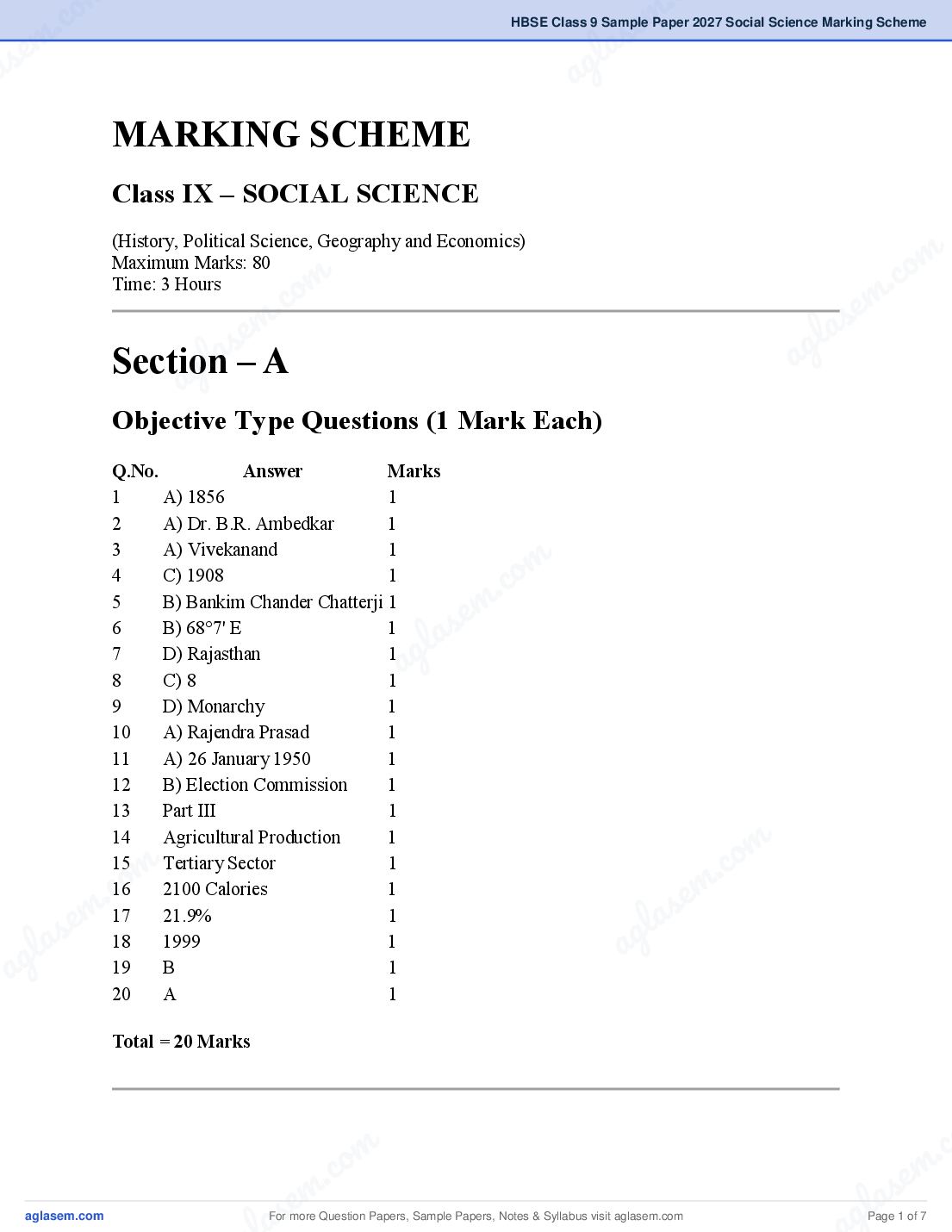
MARKING SCHEME
Class IX – SOCIAL SCIENCE
(History, Political Science, Geography and Economics)
m
Maximum Marks: 80
Time: 3 Hours
om . co
. c em
e m l as
as ag
Section
g l –A
a
Objective Type Questions (1 Mark Each)
Q.No. Answer Marks
1 A) 1856 1
2 A) Dr. B.R. Ambedkar 1
3 A) Vivekanand 1
m
4
5
C) 1908 1
B) Bankim Chander Chatterji 1 m .co
s e
6 B) 68°7' E 1
l a
7
8
D) Rajasthan
C) 8
1
1
ag
9 D) Monarchy 1
10 A) Rajendra Prasad 1
11 A) 26 January 1950 1
12 B) Election Commission 1
13 Part III 1
14 Agricultural Production 1
m
15
m Tertiary Sector 1
.co
m .co
16 2100 Calories 1
s e m
s e 17 21.9% 1
g la
g la 18 1999 1 a
a 19
20
B
A
1
1
Total = 20 Marks
c. o s e m
s em
Page 1 of 7
Page 3
Very Short Answer Questions (2 Marks Each)
Q21. What was Kuka Movement?
Religious and social reform movement started by Guru Ram Singh – 1 mark
Opposed British rule and social evils – 1 mark
Q22. What was the Kamagatamaru Incident?
Ship carrying Indian passengers to Canada in 1914 – 1 mark
Passengers were not allowed to enter Canada and forced to return – 1 mark
Q23. What is meant by Multipurpose Projects?
Projects built on rivers for many purposes – 1 mark
Such as irrigation, electricity, flood control etc. – 1 mark
Q24. What is meant by Western Disturbance?
Weather system originating near Mediterranean region – 1 mark
Causes winter rainfall in North India – 1 mark
Q25. Write any two arguments in favour of democracy.
Any two points:
Improves quality of decision making
Provides equality
Enhances dignity of citizens
Allows peaceful change of government
(1 mark each)
Q26. Write the Fundamental Rights mentioned in the Indian Constitution.
Any four rights = ½ mark each
Right to Equality
Right to Freedom
Right against Exploitation
Right to Freedom of Religion
For more Question Papers, Sample Papers, Notes & Syllabus visit Page 2 of 7
Page 4
.co s e m
s em l a
a ag
Cultural and Educational Rights
Right to Constitutional Remedies
Q27. Define Birth Rate and Death Rate.
Birth Rate:
m
co
Birth rate refers to the number of live births per 1000 persons in a year in a particular
area.
. c om em .
Death Rate:
e m l as
l as
Death rate refers to the number of deaths per 1000 persons in a year in a particular
ag
g
area.
a
Q28. What is disguised unemployment?
Situation where more people are employed than required – 1 mark
Removal of some workers does not affect production – 1 mark
Total = 16 Marks
m
m .co
Section – C s e
g l a
a
Source/Case Based Questions (3 Marks Each)
Q29.
29.1 Muslim League – 1 mark
29.2 Direct Action Day was observed on 16 August 1946 to demand Pakistan – 1 mark
29.3 By opposing Congress movements/plans and creating communal pressure – 1 mark
m
Q30.
om
c.30.1 m.co
m Number of persons living per square kilometre – 1 mark s e
s e 30.2 Fertile soil, flat land, adequate rainfall, industries etc. – 1 mark gla
g la 30.3 Desert climate, scarcity of water, sandy soil – 1 mark a
a Q31.
31.1 Referendum means direct voting by people on an issue – 1 mark
31.2 Military takeover of government by army – 1 mark
31.3 President got power to dissolve assemblies – 1 mark
c. o s e m
s em
Page 3 of 7
Page 5
32.1 Primary sector – 1 mark
32.2 Traditional irrigation replaced by electric tube wells – 1 mark
32.3 Growing more than one crop on same land in a year – 1 mark
Total = 12 Marks
Section – D
Short Answer Type Questions (3 Marks Each)
Q33. Repressive policies of Lord Lytton
Any three points (1 mark each)
Vernacular Press Act
Arms Act
High taxation/famine mismanagement
Extravagance during Delhi Durbar
Q34. Difference between desert and mountain forests
Any three correct differences (1 mark each)
Desert Forests Mountain Forests
Found in dry regions Found in hilly areas
Thorny vegetation Coniferous trees
High rainfall/cool
Low rainfall
climate
Q35. Features of democratic election
Any three points (1 mark each)
Universal adult franchise
Free and fair elections
Secret ballot
Regular elections
For more Question Papers, Sample Papers, Notes & Syllabus visit Page 4 of 7
Page 6
.co s e m
s em l a
a ag
Q36. Public Distribution System in India
Government system of distributing essential goods – 1 mark
Goods supplied at subsidized rates – 1 mark
Distributed through fair price shops/ration shops – 1 mark
Total = 12 Marks
o m
m . c
. co and spread of the Non-Cooperation Movement.
Q37. Explain the origin
s e m
Introduction: se
m l a
g
la Movement was started by Mahatma Gandhi in 1920 against British rule.
a It
g
The Non-Cooperation
a
became the first mass movement of the Indian freedom struggle.
Origin/Causes:
1. The British government passed the repressive Rowlatt Act.
2. The Jallianwala Bagh massacre angered Indians.
3. The Khilafat issue united Hindus and Muslims against the British.
Spread of the Movement:
1. People boycotted foreign goods and British institutions.
m
2. Students left government schools and colleges.
m .co
3. Lawyers gave up practice in courts.
s e
4. Bonfires of foreign clothes were organized.
l a
Withdrawal:
ag
The movement was withdrawn after the Chauri Chaura incident in 1922.
Importance:
• Political awareness increased among common people.
• National movement became stronger.
Q37 (OR). Discuss the role of the Dandi March in the Indian struggle for
independence.
m
m .co
.co m
Introduction:
m The Dandi March was started by Mahatma Gandhi on 12 March 1930 from Sabarmati Ashram to s e
s e g la
la
Dandi.
g Role in Freedom Struggle: a
a 1. It was launched against the British Salt Law.
2. Gandhi and his followers walked about 240 miles.
3. Gandhi broke the salt law by making salt at Dandi.
4. The movement spread throughout India.
5. Thousands of people participated in Civil Disobedience Movement.
c. o s e m
s em
Page 5 of 7
Page 7
Importance:
• It united Indians against British rule.
• It attracted worldwide attention.
• It weakened the authority of the British government.
Q38. Compare the Northern Plains and the Peninsular Plateau.
Northern Plains:
1. Formed by alluvial deposits of rivers.
2. Flat and fertile land.
3. Suitable for agriculture.
4. Densely populated.
5. Rivers are perennial.
Peninsular Plateau:
1. Made of old hard rocks.
2. Uneven and rocky surface.
3. Rich in minerals.
4. Less densely populated.
5. Rivers are seasonal.
Conclusion:
Northern Plains are important for agriculture while the Peninsular Plateau is important for
mineral resources and industries.
Q38 (OR). Describe the Indian Desert and its main features.
Introduction:
The Indian Desert lies towards the western margins of India and is also called the Thar Desert.
Main Features:
1. It receives very low rainfall.
2. The climate is hot and dry.
3. Sand dunes are common.
4. Vegetation is sparse and thorny.
5. Streams appear only during rainy season.
6. Population density is low.
Importance:
• Camel is an important means of transport.
• Irrigation has improved agriculture in some regions.
For more Question Papers, Sample Papers, Notes & Syllabus visit Page 6 of 7
Page 8
.co s e m
s em l a
a ag
Conclusion:
The Indian Desert has a unique geographical environment and plays an important role in
western India.
Q39. Describe the powers and functions of the Prime Minister of India.
m
Introduction:
om . co
. c em
The Prime Minister is the real executive head of India and leader of the Council of Ministers.
e m l as
l as
Powers and Functions:
ag
ag
1. Forms the Council of Ministers.
2. Distributes portfolios among ministers.
3. Presides over cabinet meetings.
4. Advises the President.
5. Coordinates work of ministries.
6. Represents India internationally.
Importance:
The Prime Minister ensures smooth functioning of the government.
m
m .co
s e
Q39 (OR). Describe the powers and functions of the President of India.
g l a
Introduction:
a
The President is the constitutional head of India.
Powers and Functions:
1. Appoints the Prime Minister and other ministers.
2. Summons and dissolves Parliament.
3. Gives assent to bills.
4. Supreme Commander of Armed Forces.
5. Can declare emergency. m
m
6. Appoints governors, judges and ambassadors. .co
m .co
Importance:
s e m
s e The President safeguards the Constitution and ensures constitutional functioning.
g la
g la a
a
c. o s e m
s em
Page 7 of 7
Document Details
| Board / Org | Haryana Board |
| Exam | Class 9 |
| Type | Answer Key |
| Pages | 7 |
| Updated | 03 Nov 2026 |