Goa Board Class 12 Sample Paper 2026 Co-operation
Finished viewing? Save it for later —
Download Goa Board Class 12 Sample Paper 2026 Co-operation (PDF · 16 pages)About Goa Board Class 12 Sample Paper 2026 Co-operation
Goa Board Class 12 Sample Paper 2026 Co-operation is available here for free download. Published by Goa Board for Class 12, this sample paper can be viewed online or downloaded as a PDF (16 pages). Candidates preparing for Class 12 can use Goa Board Class 12 Sample Paper 2026 Co-operation to understand the exam pattern, the type of questions asked, and the overall difficulty level.
Frequently Asked Questions
How can I download Goa Board Class 12 Sample Paper 2026 Co-operation?
Open this page and click the Download button to save Goa Board Class 12 Sample Paper 2026 Co-operation as a PDF. It is completely free on AglaSem Docs.
Is Goa Board Class 12 Sample Paper 2026 Co-operation free to download?
Yes. Goa Board Class 12 Sample Paper 2026 Co-operation can be viewed online and downloaded as a PDF free of cost on AglaSem Docs.
How many pages does Goa Board Class 12 Sample Paper 2026 Co-operation have?
Goa Board Class 12 Sample Paper 2026 Co-operation contains 16 pages, which you can read online or download together as a single PDF.
Where can I find more Class 12 study material?
You can find more Class 12 question papers, sample papers, syllabus, and answer keys on AglaSem Docs.
Goa Board Class 12 Sample Paper 2026 Co-operation – Text
Read the full text of this sample paper below — useful to quickly search, copy and reference the content online without downloading the PDF.
📄 View text version (16 pages)
Page 1
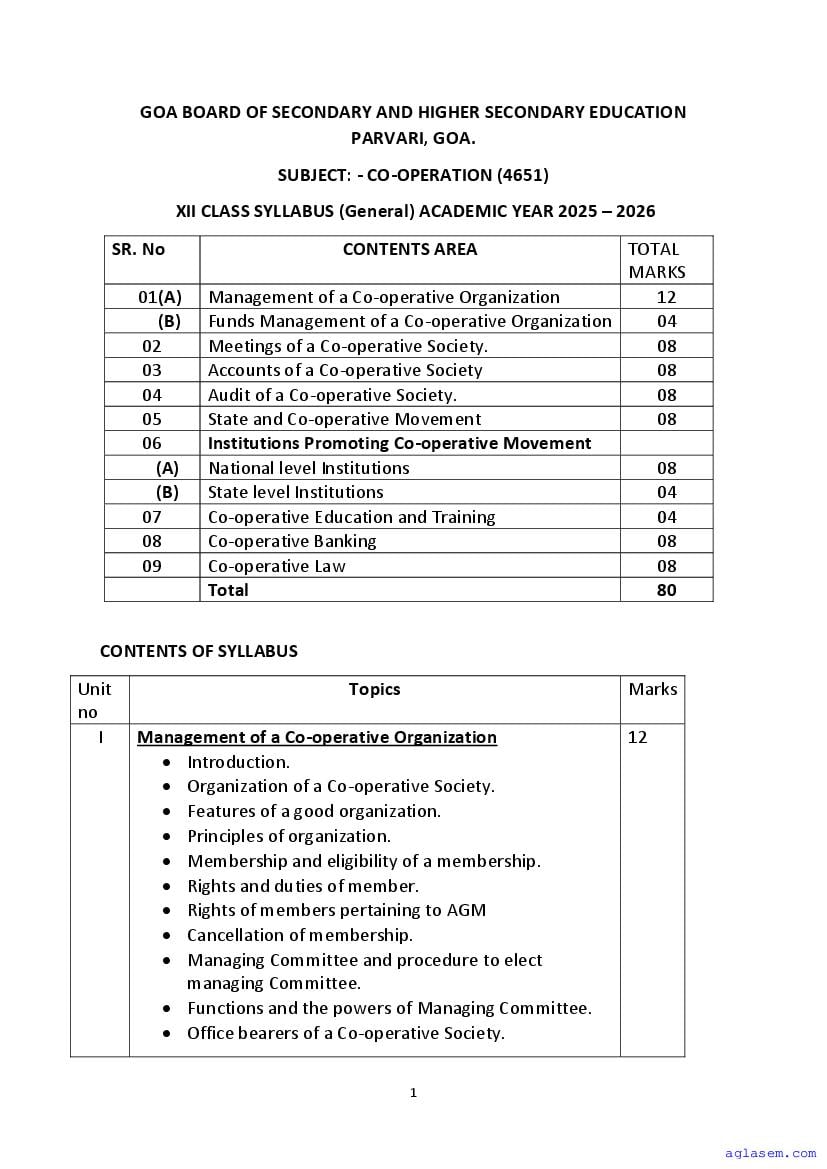
PARVARI, GOA.
SUBJECT: - CO-OPERATION (4651)
XII CLASS SYLLABUS (General) ACADEMIC YEAR 2025 – 2026
SR. No CONTENTS AREA TOTAL
MARKS
01(A) Management of a Co-operative Organization 12
(B) Funds Management of a Co-operative Organization 04
02 Meetings of a Co-operative Society. 08
03 Accounts of a Co-operative Society 08
04 Audit of a Co-operative Society. 08
05 State and Co-operative Movement 08
06 Institutions Promoting Co-operative Movement
(A) National level Institutions 08
(B) State level Institutions 04
07 Co-operative Education and Training 04
08 Co-operative Banking 08
09 Co-operative Law 08
Total 80
CONTENTS OF SYLLABUS
Unit Topics Marks
no
I Management of a Co-operative Organization 12
• Introduction.
• Organization of a Co-operative Society.
• Features of a good organization.
• Principles of organization.
• Membership and eligibility of a membership.
• Rights and duties of member.
• Rights of members pertaining to AGM
• Cancellation of membership.
• Managing Committee and procedure to elect
managing Committee.
• Functions and the powers of Managing Committee.
• Office bearers of a Co-operative Society.
1
Page 2
• Secretary appointment, duties towards office,
Managing Committee, members and the Registrar.
• Treasurer appointment and role.
FUNDS MANAGEMENT OF A CO-OPERATIVE SOCIETY
• Need for finance. 04
• The factors determining the capital requirements of a
Co-operative Society.
• Sources of finance.
II MEETINGS OF A CO-OPERATIVE SOCIETY 08
• Introduction.
• Need and purpose of meeting.
• Essentials of a valid meeting.
• Procedure of convening and conducting of a meeting.
• Types of Meetings
• General Body Meetings of the Members.
• First General Meeting meaning and business
transacted.
• Annual General Meeting meaning and business
transacted.
• Special General Meeting.
• Managing Committee Meeting meaning and
business transacted.
• Meeting of Committees of Managing committee or
Board.
• Powers and duties of the chairperson related to
meeting.
• Duties of Secretary towards conduct of Annual
General Meeting.
III ACCOUNTS OF A CO-OPERATIVE SOCIETY 08
• Introduction.
• Need and Importance of Accounts.
• Books of Accounts of a Co-operative Society.
• Statutory books.
• Non – Statutory Books.
Study of important statutory books.
2
Page 3
• Register of Shares.
• Registrar of Debentures.
• Minute’s book.
• Stock Register.
• Property Register.
• Finalization of Accounts of a Co-operative Society.
• Contents of final accounts.
• Statutory requirements for publication of final
accounts.
• Guidelines for Appropriation of profit earned by a Co-
operative Society.
IV AUDIT OF A CO-OPERATIVE SOCIETY 08
• Introduction to audit.
• Objects of audit.
• Advantages of audit.
Types of Audits.
• Annual Audit.
• Interim Audit.
• Continuous Audit.
• Internal Audit.
• Qualification of an auditor.
• Rights and duties of Auditors.
• Preparation of the Audit.
• Audit Programme and its contents.
• Audit note Book and its contents.
• Audit Memorandum and its contents.
• Audit classification.
• Rectification of errors or defects in Accounts.
• Weakness of audit System.
V STATE AND CO-OPERATIVE MOVEMENT 08
• Introduction.
• Constitutional status of Co-operatives.
• Recommendations made by Ministers of Conference
in 1969.
• Government’s contribution at time of distress.
• Special concessions and exemptions from certain
taxes.
3
Page 4
knowledge to students not to be evaluated for exam)
Functions of Co-operative department.
• Statutory functions
• Developmental functions.
• Powers of the Registrar of Co-operative Societies.
• Reports and returns to be submitted to the Registrar.
VI INSTITUTIONS PROMOTING CO-OPERATIVE MOVEMENT
(A) NATIONAL LEVEL INSTITUTIONS 08
Reserve Bank of India.
• Introduction.
• Functions.
a) Establishment of Agricultural Credit Department.
b) Establishment of Standing Advisory Committee on
Agricultural Credit.
c) Simplification of Procedure of Granting Credit.
d) Establishment of State Co-operative Banks.
e) Creation of Special Funds for Financing Agriculture.
f) Provision of finance
g) Cheap Remittance Facilities.
h) Advisory Functions.
i) Training of Co-operative Personnel.
j) Establishment of an Agricultural Credit Board.
National Bank for Agriculture and Rural Development.
• Introduction
• Functions of NABARD.
State Bank of India.
• Introduction.
• Functions.
a) Assistance to the Marketing and Processing Societies.
b) Assistance to Agricultural and Rural Development
Banks.
c) Assistance to Consumers Co-operative Societies.
d) Assistance to State and Central Co-operative Banks.
e) Remittance facilities.
National Co-operative Development Co-operation.
• Introduction
• Role played by NCDC
4
Page 5
The Goa State Co-operative Bank.
• Introduction.
• Management Structure.
• Objectives and functions of the Apex Bank.
The Goa Co-operative Marketing and supply Federation.
• Introduction and functions.
The Goa State Co-operative Housing finance and Federation
Limited.
• Introduction and functions.
VII CO-OPERATIVE EDUCATION AND TRAINING 04
• Introduction and need.
Institutions imparting Co-operative Education and
Training.
Vaikunth Mehta National Institute of Co-operative
Management.
• Introduction and functions.
Khadi and Village Industries Commission.
• Introduction
• Functions.
• New Initiative of KVIC.
State Co-operative union: - Goa Rajya Sahakari Sangha
Maryadit.
• Introduction and functions.
Training Activities Conducted through Dayanand Bandodkar
Co-operative Training Centre, Panjim.
VIII CO-OPERATIVE BANKING 08
• Need and Nature.
• Special features of Co-operative Banking.
• Role of Co-operative Banks in supply Credit to
Agricultural Sector.
Importance of Agricultural Economy.
• Financial need of Agricultural Sector.
• The sources of credit to agricultural sector.
• Individual level and institutional resources.
• Participation of Co-operative Banks in supply of credit
to other sectors.
5
Page 6
commercial Banks and Agricultural Credit Societies
and non-agricultural Credit Societies.
• Defects in working of Co-operative Banks.
• Suggestions for betterment of Co-operative Banks.
IX CO-OPERATIVE LAWS 08
• Introduction
• Co-operative Societies Act 1904 need and provisions
• Co-operative societies Act 1912 provisions
• Multi-State Co-operative Societies Act 1984
introduction and provisions.
Maharashtra Co-operative Societies Act 1960
• introduction and provisions.
The Goa State Co-operative Societies Act 2001 and the
Rules 2003.
• Introduction and provisions.
TOTAL MARKS 80
INTERNAL ASSIGNMENT/ PROJECT: - 20 MARKS
CRITERIA FOR ASSESMENT OF ASSIGNMENT/ PROJECT
1 Introduction of topic 2 marks
2 Presentation of PPT/ handwritten 3 marks
3 Contents covered 8 marks
4 Summary/conclusion 2 marks
5 Viva 5 marks
Total 20 marks
NOTE :
The evaluation of the student is based on the information presented on any
ONE of the below mentioned topics . Also a teacher is permitted to ask
students to collect furthermore relevant information on below mentioned
topics.
6
Page 7
Bank.
Guidelines/ Criteria.
a) Collect information on different sources of finance.
b) Find out how funds collected from different sources are utilized.
c) Future prospects of society/Banks for community development.
2. Visit to co-operative society and collect information on the role of the
office bearers.
Guidelines/ criteria
a) Find the names of the office bearers of the society.
b) Appointment and tenure of the office bearers.
c) Role and the responsibility of office bearers.
3. Types of loans sanctioned for the development of the agricultural
sector
Guidelines/ criteria
a) Different types of loans provided to farmers.
b) Procedure followed for sanctioning loans.
c) Any special schemes for farmers to develop agricultural sector.
d) Interest rates on loans.
4. Case study on empowerment of women through Self- help Groups
Guidelines/Criteria
a) Provide brief overview of the importance women empowerment.
b) Role, responsibilities and activities conducted by the self-help group.
c) Government schemes for supporting women empowerment.
5. Collect information on bye-laws of a co-operative society and its
amendment.
Guidelines/criteria
a) Objectives of bye-laws of the society.
b) Preparation of bye-laws.
c) Procedure for amendment of bye-laws.
d) Information on contents of bye-laws.
6. Interview with the Registrar/ Assistant Registrar of the Co-operatives
Societies and write report on his role.
Guidelines/criteria
a) Registration process of a co-operative society.
b) Role in organizing training programmes.
c) Co-operative week observed in Goa.
7
Page 8
society.
Guidelines/ criteria: -
a) Importance of maintaining books of accounts in a co-operative
society.
b) Information on types of statutory and non-statutory books.
c) Consequences of not maintaining statutory books.
d) Collect the specimen copies of vouchers, financial statements of
society etc.
8. Case study of any co-operative society on its audit
Guidelines/criteria
a) Information on objectives and types of audit of a co-operative
society.
b) Role of auditor in a co-operative society.
c) Advantages of auditing.
d) Collect specimen copy of audit report and interpret on its financial
status.
9. Collect information on National level institution promoting co-
operative movement in India
Guidelines/ criteria
a) Information on any national level institution such a RBI, SBI, NCDC
promoting co-operative movement.
b) Schemes implemented.
c) Initiatives and measures, taken by the ministry of co-operation to
promote co-operative movement.
10.Visit to any State level institution promoting Co-operative Movement.
Guidelines/ criteria
a) Information on state level institutions promoting co-operative
movement in Goa.
b) Schemes implemented.
c) Initiatives and measures taken by the ministry of Co-operation to
promote the co-operative sector.
d) Co-operative week observed in Goa.
11.Interview with any member of a co-operative society.
Guidelines/criteria.
a) Brief background of a co-operative society in which he has taken
membership.
8
Page 9
fees and annual subscription.
c) Rights and duties, election in the society, schemes to members,
reasons for cancellation of membership.
d) Social commitments of the said society.
(Pls note: A Teacher is also permitted to choose any other similar topics )
WEIGHTAGE TO LEARNING OUTCOMES
NO LEARNING OUTCOMES MARKS PERCENTAGE OF MARKS
1 Knowledge 24 30%
2 Understanding 30 37.5%
3 Application 18 22.5%
4 Analysis 04 05%
5 Evaluation 04 05%
6 Creation -- --
Total 80 100%
Weightage to forms of questions
Sr. No Form of questions Marks for No of Total Expected
each question questions marks time (Mts)
1 MCQs 01 20 20 20
2 SA -I 02 08 16 40
3 SA – II 03 08 24 70
4 LA 04 05 20 50
Total 41 80 180
Weightage to difficulty level of questions
Sr. No Estimated difficulty Marks Percentage
level of questions
01 Easy 24 30%
02 Average 36 45%
03 Difficult 20 25%
Total 80 100%
Pls note : Questions may vary in difficulty level. Such assessment in each question will be
made by the paper setter.
9
Page 10
1. Co-operation paper for mid- term examination will of 20 marks.
2. Duration of examination will be of 60 minutes.
3. It is at the teacher’s discretion regarding the number of topics to be
included for mid term examination and the weightage to contents area.
FIRST TERM EXAMINATION FOR 2025 -26
1. Co-operation paper for first term examination will of 80 marks.
2. Duration of examination will be of 3 hours.
3. It is at the teacher’s discretion regarding the number of topics to be
included for first term examination and the weightage to contents area.
GOA BOARD OF SECONDARY & HIGHER SECONDARY EDUCATION, ALTO, BETIM, GOA.
BLUE PRINT HSSC EXAMINATION 2025 – 2026
SUBJECT:CO-OPERATION (4651)
MAXIMUM MARKS: 80 DURATION 3HRS.
Objectives knowledge understanding Application Analysis Evaluation Tot
al
Content area VSA SA SA LA VSA SA SA LA VSA SA SA LA V S S LA V S S LA
I II I II I II S A A S A A
A I II A I II
Mgt. of co-op 3(1) 1(3) 2(1) 4(1) 12
org. (6)
Funds Mgt. of 1(1) 3(1) 04
co-op. society (2)
Meetings of 2(1) 3(1) 1(3) 08
society (5)
Accounts of 1(2) 2(1) 2(2) 08
society (5)
Audit of Co- 1(2) 2(1) 4(1)* 08
op society (4)
State & co- 1(1) 3(1) 4(1) 08
op. mov. (3)
National lev. 1(1) 3(1) 4(1) 08
Institutions (3)
State lev, 1(1) 3(1) 04
institutions (2)
Co-op Edu. & 1(1) 3(1)* 04
training (2)
Co-op. 1(1) 2(1) 1(2) 3(1) 08
Banking (5)
Co-op. Law 1(2) 2(1) 4(1)* 08
(4)
Total 12 06 06 -- 08 08 06 08 02 12 04 04 04 80
(12) (3) (3) (8) (4) (2) (2) (1) (4) (1) (1) (1) (41)
10
Page 11
❖ Figures inside the bracket indicates numbers of questions.
❖ (*) indicates internal choice in the questions.
❖ The above blueprint is a sample and may differ keeping in mind contents, marks and internal choice topics same
by the paper setter.
MODEL QUESTION PAPER GOA BOARD 2025 -26
SUBJECT: CO-OPERATION (H 4651)
CLASS XII
Total No of questions: 41 Maximum marks 80
Duration 3 hours
---------------------------------------------------------------------------------------------------------
INSTRUCTIONS:
• All questions are compulsory.
• Question Nos 1 to 20 are MCQ’s of 01 mark each.
• Question Nos 21 to 28 are of 02 marks each.
• Question Nos 29 to 36 are of 03 marks each.
• Question Nos 37 to 41 are of 04 marks each.
• Internal choice is to be exercised in question No 35,38 and 41.
1. The principle of an organization that suggest the centralization and
decentralization of power and authority to be maintained in an
organization is _________________
• Balance
• Continuity
• Efficiency
• Responsibility
2. The office bearer who helps the managing committee to conduct the
functions of the society smoothly is ________________
• Auditor
• Nominee
• Promoter
• Secretary
11
Page 12
member on payment of fees within a period of ________________
• Four months
• Three months
• Two months
• One month
4. Which of the following source of finance determines solvency and credit
of the co-operative society?
• Issue of shares
• Issue of debentures
• Internal finance
• Grants and subsidies
5. The manner of placing a motion before a meeting in a co-operative
society is prescribed by the ________________
• Agreement
• Amendment
• Bye-laws
• Constitution
6. The collective will of the body of the meeting of a co-operative society in
a co-operative society is known as _____________
• Agenda
• Notice
• Quorum
• Resolution
7. Which of the following the following meeting considers the provisional
committee to look after management of the society?
• Board meeting
• Annual general meeting
• First general meeting
• Special general meeting
8. A member of a co-operative society can inspect the details of the
nominee of member from ________________
• Debenture register
• Member register
• Stock register
• Property register
12
Page 13
loss account in a co-operative society is _______________
• Balance sheet
• Trial balance
• Income and expenditure statement
• Receipt and payment statement
10.In a co-operative society the accounting system is made efficient
through _________
• Manipulation
• Taxation
• Classification
• Auditing
11.Which of the following audit is compulsory for all the co-operative
organization?
• Statutory audit
• Internal audit
• Interim audit
• Continuous audit
12.The officer appointed by the state government to mange the affairs of
the co-operative societies is ______________
• Member
• Nominee
• Registrar
• Treasurer
13.The State Bank of India was established in the year ___________
• 1935
• 1955
• 1963
• 1982
14.The Goa Rajya Sahakari Sangha Maryadit was established in the year
__________
• 1991
• 1981
• 2001
• 2012
13
Page 14
education and management training is _____________
• VAMNICOM
• RBI
• NCDC
• KVIC
16.The organizational structure of co-operative banks in India is
___________
• Five tier
• Four tier
• Three tier
• Zero tier
17.Which of the following activity farmer requires long term finance?
• Purchasing cattle’s
• Purchasing fertilizer
• Purchasing seeds
• Purchasing agricultural land
18.The main purpose of co-operative banks is to cater to the financial needs
of __________
• Mining sector
• Industrial sector
• Construction sector
• Agricultural sector
19.The co-operative society formed with the object to serve the interest of
members of more than one state is _____________
• District societies
• Multi-state societies
• Primary societies
• Employees societies
20.As per provision of Co-operative societies act 1904, all profits earned
should be transferred to _____________
• Welfare fund
• Promoters fund
• Reserve fund
• Education fund
14
Page 15
co-operative society.
22.Point out any four items of business that can be transacted at managing
committee meeting of a co-operative society.
23.State any four needs for accounts in a co-operative society.
24.Distinguish between statutory books and non-statutory books.
25.Mr. Amar Naik is appointed as the Auditor of Namrata Housing co-
operative Society. Determine any four points he should plan before
preparing audit of the said society.
26.Distinguish between co-operative banks and commercial banks. (any two
points)
27.Summarize any four institutional sources of credit to agricultural sector.
28.Interpret any four features of the Maharashtra Co-operative Societies
Act 1960.
29.State any six functions of treasurer of a co-operative society.
30.“Every organization big or small requires finance”. With reference to this
statement, outline any six needs of finance for a co-operative society.
31.List out any six items of business transacted at Annual General Meeting
of a co-operative society.
32.Identify any six factors that are responsible for distress in a co-operative
society according to Dr. E.M. Hough.
33.“NABARD is an apex financial institution at the national level act as
refinancing institute for co-operative”. With reference to this statement
identify any six functions of NABARD.
34.“The Goa Co-operative Marketing and Supply Federation Limited is an
apex federation for primary consumer and marketing societies in the
state of Goa”. In the view of this statement identify any six objects of
The Goa Co-operative Marketing and supply Federation.
35.State any six points to highlight the need for Co-operative Education and
training for development of Co-operative Movement.
OR
State any six activities conducted through Dayanand Bandodkar Co-
operative Training Centre, Panaji.
36.“The Co-operative Banks Need to improve their banking activities”. In
the view this statement develop any six suggestions to improve working
of co-operative banks.
15
Page 16
a co-operative society.
38.Identify any eight points to be considered by a co-operative society
while preparing for the audit of the society.
OR
Identify any eight contents of Audit Memorandum prepared by an
Auditor after auditing the books of accounts of a society.
39.“The Registrar of Co-operative Societies is considered as the controlling
authority for the co-operatives in the state”. With reference to this
statement examine any eight powers of the Registrar of Co-operative
Societies.
40.“The Reserve Bank of India has initiated numbers of measures for the
development of Co-operatives in India”. In the view of this statement
evaluate any four measures initiated by RBI for development co-
operatives in India.
41.List out any eight provisions of The Co-operative Societies Act 1912.
OR
List out any eight provisions of The Goa State Co-operative Societies Act
2001 Rule 2003 in respect of registration.
------------------------------------********************------------------------------------
16
Document Details
| Board / Org | Goa Board |
| Exam | Class 12 |
| Type | Sample Paper |
| Pages | 16 |
| Updated | 24 Sep 2026 |