NIOS Class 10 Syllabus 2023 Home Science
Finished viewing? Save it for later —
Download NIOS Class 10 Syllabus 2023 Home Science (PDF · 7 pages)About NIOS Class 10 Syllabus 2023 Home Science
NIOS Class 10 Syllabus 2023 Home Science is available here for free download. Published by NIOS for NIOS Class 10, this syllabus can be viewed online or downloaded as a PDF (7 pages). Candidates preparing for NIOS Class 10 can use NIOS Class 10 Syllabus 2023 Home Science to understand the exam pattern, the type of questions asked, and the overall difficulty level.
Frequently Asked Questions
How can I download NIOS Class 10 Syllabus 2023 Home Science?
Open this page and click the Download button to save NIOS Class 10 Syllabus 2023 Home Science as a PDF. It is completely free on AglaSem Docs.
Is NIOS Class 10 Syllabus 2023 Home Science free to download?
Yes. NIOS Class 10 Syllabus 2023 Home Science can be viewed online and downloaded as a PDF free of cost on AglaSem Docs.
How many pages does NIOS Class 10 Syllabus 2023 Home Science have?
NIOS Class 10 Syllabus 2023 Home Science contains 7 pages, which you can read online or download together as a single PDF.
Where can I find more NIOS Class 10 study material?
You can find more NIOS Class 10 question papers, sample papers, syllabus, and answer keys on AglaSem Docs.
NIOS Class 10 Syllabus 2023 Home Science – Text
Read the full text of this syllabus below — useful to quickly search, copy and reference the content online without downloading the PDF.
📄 View text version (7 pages)
Page 1
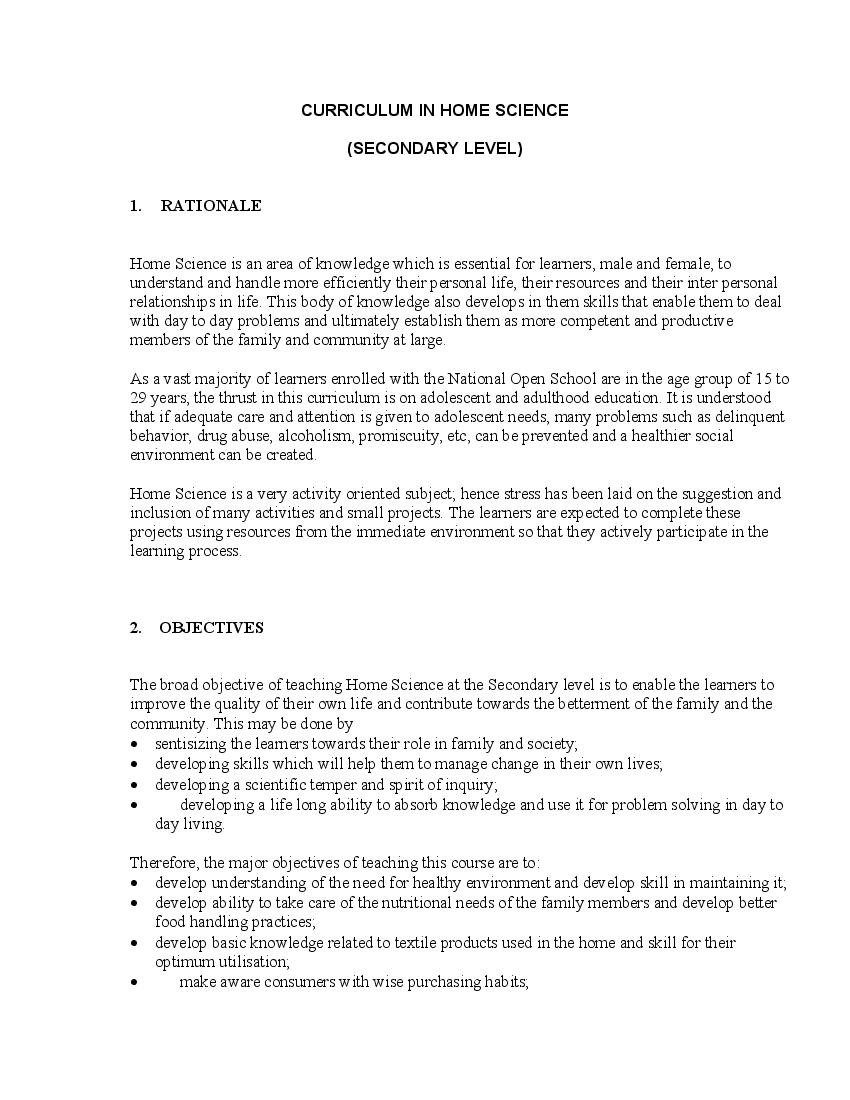
(SECONDARY LEVEL)
1. RATIONALE
Home Science is an area of knowledge which is essential for learners, male and female, to
understand and handle more efficiently their personal life, their resources and their inter personal
relationships in life. This body of knowledge also develops in them skills that enable them to deal
with day to day problems and ultimately establish them as more competent and productive
members of the family and community at large.
As a vast majority of learners enrolled with the National Open School are in the age group of 15 to
29 years, the thrust in this curriculum is on adolescent and adulthood education. It is understood
that if adequate care and attention is given to adolescent needs, many problems such as delinquent
behavior, drug abuse, alcoholism, promiscuity, etc, can be prevented and a healthier social
environment can be created.
Home Science is a very activity oriented subject; hence stress has been laid on the suggestion and
inclusion of many activities and small projects. The learners are expected to complete these
projects using resources from the immediate environment so that they actively participate in the
learning process.
2. OBJECTIVES
The broad objective of teaching Home Science at the Secondary level is to enable the learners to
improve the quality of their own life and contribute towards the betterment of the family and the
community. This may be done by
• sentisizing the learners towards their role in family and society;
• developing skills which will help them to manage change in their own lives;
• developing a scientific temper and spirit of inquiry;
• developing a life long ability to absorb knowledge and use it for problem solving in day to
day living.
Therefore, the major objectives of teaching this course are to:
• develop understanding of the need for healthy environment and develop skill in maintaining it;
• develop ability to take care of the nutritional needs of the family members and develop better
food handling practices;
• develop basic knowledge related to textile products used in the home and skill for their
optimum utilisation;
• make aware consumers with wise purchasing habits;
Page 2
• foster understanding of human developmental process and use it to strengthen interpersonal
relationships.
3. COURSE CONTENTS
The curriculum is developed around two broad content areas, consisting of the following two
modules:
Module 1 Home Science in Everyday Life
Module 2 My Family and I
4. COURSE DESCRIPTION
MODULE 1 HOME SCIENCE IN EVERYDAY LIFE MARKS 46
APPROACH
The topics being covered in this module are related to the basics of Home Science in our everyday
life. It is intended to be the foundational structure, the understanding of which will be reflected in
the following module where the learners are expected to apply the knowledge of processes and
procedures. The topics range from the basics of food and nutrition, housing, health concepts and
diseases, knowledge of fibres and process of fabric construction, to human development from
infancy to adulthood.
4.1.1 WHAT IS HOME SCIENCE
• importance of Home Science
• scope of Home Science
4.1.2 THE FOOD THAT WE EAT
- FOOD AND IT’S NUTRIENTS
• functions of food
• nutrients – sources and functions
• deficiency diseases
- FOOD GROUPS
• classification of food, utility of classifying
• balanced diet
• factors affecting planning balanced diets
• balanced meal for the family
- METHODS OF COOKING FOOD
• reasons and methods of cooking food- by moist heat, dry heat, frying, solar cooking
• conservation and enhancement of nutrients
Page 3
• methods of preserving food at home
• hygienic handling of food in a clean kitchen
4.1.3 FIBRES AND FABRICS
- FIBRE TO FABRIC
• classification of fibers – properties, identification
• yarn formation
• fabric construction
• basic weaves
• knitting
- FINISHES
• basic finishes
• finishing with color and design
- CARE AND MAINTENANCE OF FABRICS
• meaning and importance of laundry
• general principles of laundering- sorting, mending, stain removal, soaking,
washing, drying, finishing, storing
4.1.4 HOME MAINTENANCE
- HOUSING
• importance and functions
• lighting, ventilation in the home
• sanitation
• care and maintenance of the home
• space organisation and aesthetics in the home
- HOUSEHOLD EQUIPMENT
• selection, care and use of various equipment in the home
• conservation of fuel, electricity and water at home
4.1.5 HEALTH AND ENVIRONMENT
- HEALTH
• definition
• signs of good health
• factors affecting health
• personal hygiene
Page 4
• first aid
• care of the sick at home
- COMMUNICABLE DISEASES
• types- communicable, non communicable
• causes
• prevention ( immunization)
- COMMON CHILDHOOD DISEASES
• diseases preventable through immunization
• recurrent ailments and diseases
- ENVIRONMENT
• pollution – sources, effects, prevention
• waste disposal- waste water, garbage and animal waste
• eco-friendly practices
4.2 MY FAMILY AND I MARKS 39
APPROACH
This module is designed to help the learner understand the process of human development
beginning from conception to adolescence, with the objective of making them more understanding
and sensitive parents when they have a family of their own. The topics also lay stress on caring for
and understanding of the varied needs of family members. An attempt has been made to cater to
the all round development of the young learners, especially to deal with the peer pressures and
parental conflicts, understand clothing and dietary needs, improve social interaction.
Keeping in view the fact that learners are young, stress has been laid on incorporating values and
strengthening interpersonal relationships, which will lead to a more peaceful and conducive social
environment.
4.2.1 MY FAMILY
- MY FAMILY
• family as a social unit
• changing structure of the family
• relationships within the family
• advantages of having fewer children
- PREGNANCY
• conception
Page 5
• prenatal and antenatal care
- CONCEPT OF DEVELOPMENT
• concepts and principles of development
• heredity and environment
- DEVELOPMENT DURING CHILDHOOD
• developments during infancy and childhood- physical, motor, socio- emotional,
cognitive and language
- DEVELOPMENT DURING ADOLESCENCE
• body changes during adolescence
• social and emotional development during adolescence
• cognitive and language development during adolescence
- CARING FOR THE FAMILY
• caring for the members of the family, specially during
- pregnancy
- infancy
- childhood
- adolescence
- old age
4.2.2 RESOURCES OF THE FAMILY
- FAMILY RESOURCES
• meaning and importance
• types of resources
• optimal use of resources
• process of management- planning, organising and evaluating
- MANAGING TIME AND ENERGY
• advantages of making a time plan
• methods of saving time and energy
- MANAGING INCOME
• income and expenditure
• developing a spending plan
• generating additional income
- SAVING AND INVESTMENT
• need to save money
• investing money safely
- CLOTHING AND LINEN FOR THE FAMILY
Page 6
• selection of ready made vs tailor made clothes
• importance of grooming
4.2.3 RIGHTS AND RESPONSIBILITIES
- BECOMING AN AWARE CONSUMER
• importance of consumer education
• problems faced by consumers
• consumer aids
• consumer rights and responsibilities
- PURCHASE OF HOUSEHOLD ITEMS
• wise purchasing practices – food, consumer durables, medicines, garments and
textiles
- SAFETY IN THE HOME
• common accidents, causes, prevention
• storage of drugs and chemicals
• safety in electrical wiring
- VALUES IN LIFE
• rights and responsibilities of an individual
• respect for elders
• dignity of labor
• tolerance
• empathy for the disadvantaged
• gender sensitivity
5. SCHEME OF STUDIES
Theory 85 marks
Practical Examination 15 marks
Page 7
Module 1 HOME SCIENCE IN EVERYDAY LIFE
Unit 1 What is Home Science 2
Unit 2 The Food That We Eat 12
Unit 3 Fibres and Fabrics 10
Unit 4 Home Maintenance 10
Unit 5 Health and Environment 12
Module 2 MY FAMILY AND I
Unit1 My family 15
Unit2 Family Resources 12
Unit3 Rights and Responsibilities 12
TOTAL 85
6. SCHEME OF EVALUATION
THEORY 85 MARKS
PRACTICAL EXAMINATION 15 MARKS
Division of marks in the Practical Examination Record Book - 3 marks
Practical Examination – 8 marks
Viva based on Practical –4 marks
Document Details
| Board / Org | NIOS |
| Exam | NIOS Class 10 |
| Type | Syllabus |
| Pages | 7 |
| Updated | 22 Jul 2026 |