NIOS Class 10 Syllabus 2023 Indian Culture and Heritage
Finished viewing? Save it for later —
Download NIOS Class 10 Syllabus 2023 Indian Culture and Heritage (PDF · 11 pages)About NIOS Class 10 Syllabus 2023 Indian Culture and Heritage
NIOS Class 10 Syllabus 2023 Indian Culture and Heritage is available here for free download. Published by NIOS for National Institute of Open Schooling Class 10, this syllabus can be viewed online or downloaded as a PDF (11 pages). Candidates preparing for National Institute of Open Schooling Class 10 can use NIOS Class 10 Syllabus 2023 Indian Culture and Heritage to understand the exam pattern, the type of questions asked, and the overall difficulty level.
Frequently Asked Questions
How can I download NIOS Class 10 Syllabus 2023 Indian Culture and Heritage?
Open this page and click the Download button to save NIOS Class 10 Syllabus 2023 Indian Culture and Heritage as a PDF. It is completely free on AglaSem Docs.
Is NIOS Class 10 Syllabus 2023 Indian Culture and Heritage free to download?
Yes. NIOS Class 10 Syllabus 2023 Indian Culture and Heritage can be viewed online and downloaded as a PDF free of cost on AglaSem Docs.
How many pages does NIOS Class 10 Syllabus 2023 Indian Culture and Heritage have?
NIOS Class 10 Syllabus 2023 Indian Culture and Heritage contains 11 pages, which you can read online or download together as a single PDF.
Where can I find more National Institute of Open Schooling Class 10 study material?
You can find more National Institute of Open Schooling Class 10 question papers, sample papers, syllabus, and answer keys on AglaSem Docs.
NIOS Class 10 Syllabus 2023 Indian Culture and Heritage – Text
Read the full text of this syllabus below — useful to quickly search, copy and reference the content online without downloading the PDF.
📄 View text version (11 pages)
Page 1
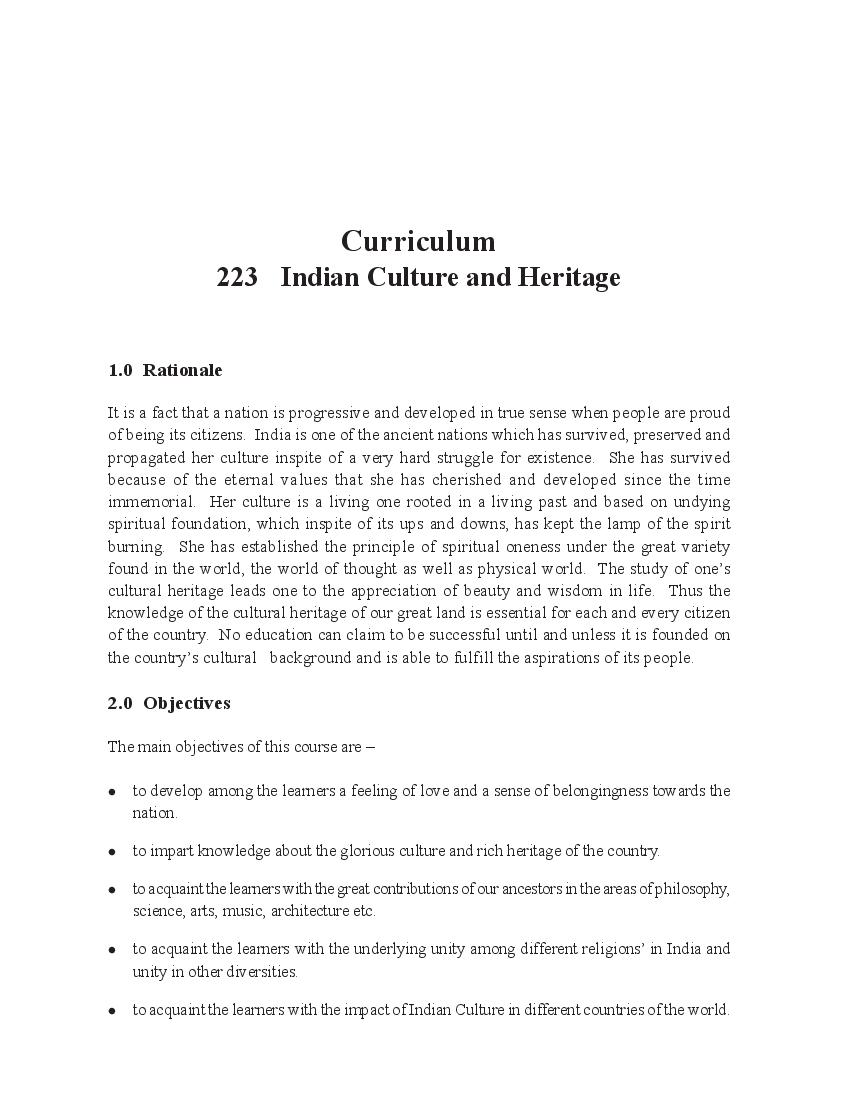
223 Indian Culture and Heritage
1.0 Rationale
It is a fact that a nation is progressive and developed in true sense when people are proud
of being its citizens. India is one of the ancient nations which has survived, preserved and
propagated her culture inspite of a very hard struggle for existence. She has survived
because of the eternal values that she has cherished and developed since the time
immemorial. Her culture is a living one rooted in a living past and based on undying
spiritual foundation, which inspite of its ups and downs, has kept the lamp of the spirit
burning. She has established the principle of spiritual oneness under the great variety
found in the world, the world of thought as well as physical world. The study of one’s
cultural heritage leads one to the appreciation of beauty and wisdom in life. Thus the
knowledge of the cultural heritage of our great land is essential for each and every citizen
of the country. No education can claim to be successful until and unless it is founded on
the country’s cultural background and is able to fulfill the aspirations of its people.
2.0 Objectives
The main objectives of this course are –
z to develop among the learners a feeling of love and a sense of belongingness towards the
nation.
z to impart knowledge about the glorious culture and rich heritage of the country.
z to acquaint the learners with the great contributions of our ancestors in the areas of philosophy,
science, arts, music, architecture etc.
z to acquaint the learners with the underlying unity among different religions’ in India and
unity in other diversities.
z to acquaint the learners with the impact of Indian Culture in different countries of the world.
Page 2
2. Indian Culture through the Ages 14
3. Languages and Literature 10
4. Indian Philosophical Thought 10
5. Fine Arts 10
6. Science and Technology 12
7. Education 10
8. Social Structure 12
9. Spread of Indian Culture Abroad 12
Total 100
Description of Course
Module 1 : Culture : Definition and Characteristics
Marks : 10
Study Hours : 20
This module is designed to develop an understanding of the concept and meaning of culture.
The salient features of Indian culture which make it distinct will also be discussed.
Unit 1 : Culture : Meaning and Components
z Definition of Culture
z Concept of Culture (Sanskriti) in India;
z Characteristics of Culture – Culture is Universal, Dynamic Nature of Culture,
Culture is Acquired and Learned, Culture includes both material and non-material
components
z Emergence of Culture – Evolution of Culture, Savagery, Barbarism, Pastoral,
Agricultural, Industrialization
z Meaning of Civilization – Variation in Civilization, Culture and Civilization,
Culture and Heritage
Unit 2 : Salient Features of Indian Culture
z Indian Concept of Culture
Page 3
Scientific Outlook, Theory of Karma, Love for Nature, Reverence for Women, Value
Based Society
z Towards Synthesis of Cultures
Module 2 : Indian Culture through the Ages
Marks : 14
Study Hours : 35
This module aims at developing an understanding of the historical development of Indian Culture.
The evolution of Indian Culture through the Ages will be highlighted . This module will also
help the learners to know about religious impact and the reformative movements.
Unit 3 : Indian Culture through the Ages : Ancient India – I
z Lifeline of Indian Culture
z Time Scale
z Evolution of Human Body
z Dynamism of Indian Culture
z Historical Perspective : Roots of Indian Culture in Sindhu-Saraswati Civilization
and Vedic Culture
Unit 4 : Indian Culture Through the Ages : Ancient India – II
z Popular Religious Reforms
z Vedic Revival in South India
z The Age of Empires
z The Rajputs
z Pallavas and Cholas
Unit 5 : Indian Culture Through the Ages : Medieval India – I
z Arrival of Muslims
z Rise of Sufism – Four Silsilahs,
z Political Aspect
z Cultural Development in India
z Influence on Religion and Society
Unit 6 : Indian Culture Through the Ages : Medieval India – II
z Development of Folk Arts – Painting, Music
z Indo-Mughal Culture
Page 4
z New Faiths – Sikh, Parsi
z Southern India
Unit 7 : Indian Culture Through the Ages : Modern India
z Rise of the West and its Impact on India
z India by the end of the 18th Century
z Social Conditions
z Social and Religious Reformers – Raja Ram Mohan Roy, Swami Dayanand,
Jyotiba Govindraro Phule, Narayan Guru, Pandita Rama Bai
z Press and the growth of Modern Indian Languages and Literature – Since
Independence, India Today
z Conclusion
Module 3 : Languages and Literature
Marks : 10
Study Hours : 25
This module is intended to acquaint the learners with Indian languages and literature. Our
Vedas are the oldest literature, which deal with all the dimensions of human life. The Upanishads
present the philosophical knowledge contained in Vedas. Most of the ancient literature of
India is in Sanskrit. A large number of languages is used in India now a days. All this will be
discussed in this module.
Unit 8 : Indian Languages and Literature – I
z Indian Languages
z The Vedas – Rig Veda, Yajur Veda, Sam Veda, Atharva Veda
z The Upnishads
z Epics : Ramayan and MahaIndia – The Bhagvat Gita,
z Puranas
z Buddhist and Jain Literature in Pali, Prakrit and Sanskrit
z Sanskrit Literature
Unit 9 : Indian Languages and Literature – II
z Northern Indian Languages and Literature – Urdu and Persian, Hindi Literature,
Bengali, Assamese and Oriya Literature, Punjabi and Rajasthani, Gujarati
Language, Sindhi, Marathi, Kashmiri Literature
Module 4 : Indian Philosophical Thought
Marks : 10
Page 5
This module is designed with the aim to explain the Indian philosophic thoughts. This module
will also help the learners to understand the continuity and change in Indian Thought and Practice.
Unity 10 : Concept and Meaning of Philosophy
z Metaphysics (Theory of Reality) – Cosmology, Nature of Human Being, Problem
of Freedom, Concept of God
z Epistemology – Agnosticism, Skepticism, Affirmation of Knowledge,
Experimentalism
z Logic
z Ethics
z Aesthetics
Unity 11 : Different Schools of Philosophy – I
z Systems of Indian Darshan – Samkhya System, Main Characteristics, Prakrit,
Nature of Purusha
z Philosophy of Yoga – Main Characteristics, The Eight-fold Yoga
z Nyaya Philosophy - Main Characteristics
z Vaisheshika Philosophy – Main Characteristics
z Mimansa Philosophy – Main Characteristics, Validity of Knowledge, Mimansa
Metaphysics, Mimamsa Philosophy of Religion
z Vedanta Philosophy – Main Characteristics, Advaita Metaphysics, The Doctrine of
Maya
Unity 12 : Different School of Philosophy – II
z Charvaka School – Main Characteristics – Cosmology, Carvaka Ethics
z Jain Philosophy – Main characteristics
z Philosophy of Buddha – Main Characteristics
Unity 13 : Unity and Continuity in Indian Thought
z Unity in Diversity – Main Common Characteristics
Module 5 : Fine Arts
Marks : 10
Study Hours : 25
Page 6
repositories of all arts. Thus Indian Art is spiritual in its outlook, idealistic in expression and
sublime in interpretation. This module intends to make the learners aware of spiritual
objectives behind ancient Indian Art. An attempt will also be made to acquaint the learners
with folk art and crafts (Rural and Tribal) along with the impact of Mughal and Roman art.
Unit 14 : Indian Art – Visual Arts – Painting and Sculpture
z Concept of Art
z Painting
z Sculpture
z Evolution of Art - Mauryan Era, Ajanta, Mughal Era, British Company School,
Modern Indian Art, Folk Art, Mithila Painting, Kalamkari Painting, Warli
Painting, Kalighat Painting, Pahadi Painting
z Role of Art in Indian Culture
Unit 15 : Indian Art – Performing Arts – Music, Dance and Drama
z Concept of Performing Arts
z A Brief History of Music (Sangeet), Dance (Nritya), Drama (Natak)
z Present Scenario of the three Art forms
z Some Important Dramas and their Writers - Well Known Dancers, Important
Musicians who have contributed in the field of music
z Art forms and the Development of Human Personality
Unit 16 : Indian Architecture
z Architecture – Origins
z Indian Perspective
z Evolution of Indian Architecture – Pre-Historic Indus Valley Period, Development
in the Rig Vedic Period, Early Historic Period, Architecture in Mughal Era
z Colonial Architecture and The Modern Period
z Greatness of Indian Architecture
z Limitations of Indian Architecture
Module 6 : Science & Technology
Marks : 12
Study Hours : 30
Page 7
the contribution of Indians to the filed of Science and Technology which is no less significant
than their contribution of spiritual wisdom. Through this module our learners will know our
ancestors who made immense contribution in the field of science and technology. The reference
of great scientists will be made at proper places.
Unit 17 : Science and Technology
z Vedas as the supreme source of knowledge
z Achievements in Metallurgy – Iron Pillar at Mehraulli, Copper Statue of Buddha
z Aeronautical and Marine Times
z Mathematics
z Astronomy
z Astrology
z Physics
z Chemistry
z Natural Sciences and Ayur-Ved
z Concept of ecological Balance rooted in Traditions
Unit 18 : Science and Scientists of Ancient India – I
z Mathematics - India’s Numeral System – Baudhayan, Aryabhatta, Brahmgupta,
Bhaskaracharaya
z Physics – Kanad, Varahmihir
z Chemistry - Nagarjuna
z Astronomy
Unit 19 : Sciences and Scientists of Ancient India – II
z Biology
z Surgery
z Sushrut
z Astrology - Phalit Jyotish
z Ayurved – Noteworthy Features of Ayurved, Charak
z Yog – Patanjali
Unit 20 : Science and Scientists of Medieval India
z Sciences in Medieval Period – Mathematics, Biology, Chemistry, Astronomy,
Medicine, Agriculture
Page 8
z Srinivas Ramanujan
z Chandershekhar V. Raman
z Jagdish Chander Bose
z Homi Jehangir Bhabha
z Dr. Vikram Sarabhai
z Dr. A.P.J. Abdul Kalam
Module 7 : Education
Marks : 12
Study Hours : 30
The ancient system of education in India not only imparted education to earn livelihood but
also to develop all round personality of the students. Ancient universities such as Takshila and
Nalanda had attained phenomenal growth and fame in the world. This module is designed to
introduce the learners with ancient educational system and present problems and developments
in the field of education.
Unit 22 : Education System in Ancient India
z General Concept of Education
z Aims and Objectives of Education
z Concept of four Rinas
z Other methods to Preserve Cultural Tradition
z Gurukul System
z Teacher Student Relationship (Guru-Shisya Parampara)
z Subjects of Study
z Concepts of Biksha and Guru Dakshina
z Education of Girls
Unit 23 : Famous Centres of Learning in Ancient India
z
z Takshila – Nalanda, Valabhi, Vikramasila, Kashi, Nadia, Mithila
z Method of Teaching in the Vedic Schools
Unit 24 : Contemporary Education System (Brief Historical Perspective and its
Problems)
z Important Features of the Ancient Education System
Page 9
System
z Education in Mughal Period – Salient features of Muslim Education
z Education under the British Rule – Domination by Christian Missionaries, Objective
of English Education, Setting of Education Departments, Higher Education
z Sri Aurobindo’s National system of Education
z School Education in the Post Independence India
z Problems of Contemporary Education
z Some Notable Developments in the Field of Education
z Diversified Fields of Education
Module 8 : Social Structure
Marks : 12
Study Hours : 30
A study of culture of any society has to include all aspects of the social life. To know the Indian
culture, it is important to know the social structure of contemporary society. This module
intends to make the learners aware of social structure of India starting from individual and
reaching to the entire world of beings.
Unit 25 : Indian Social Structure ‘Varna’ and ‘Jati’ Systems
z Social Structure of Indian Society
z Varna System – Brahmin, Kshatriya, Vaishya, Shudra
z Emergence of Caste (Jati) System
Unit 26 : Indian Value System ‘Purusharth’ and ‘Ashram’ System
z Concept of ‘Purusharth’ – Dharm, Arth, Kaam, Moksh
z Social Significance of Purusharth
z Concept of Rin (Debts)
z Social Institution of ‘Ashram’ – Brahmacharya, Grihasth, Vanprasth and Sanyas
z Social significance of the Ashram system
z Sanskars
Unit 27 : Concept of Family and Place of Woman in the Indian Society
z Concept of Family – Characteristics of Family, Functions of Family
z Family in Indian Perspective – Importance of Marriage,
z Family System in India – Characteristics of Joint Family
z Status and Role of Women in the Indian Society
Page 10
z Dowry Problem
z Drug Abuse and Drug Dependence
z Child Abuse – Problem of the Girl Child and Women
z Problem of the Aged
z Problem of Poverty and Unemployment
z Overview
Module 9 : Spread of Indian Culture Abroad
Marks : 12
Study Hours : 30
While others conquered the other countries through wars, Indians made their way in foreign
lands through the heart of the people living there. Right from the beginning Indian culture
attracted the students and aspirants of other countries who took with them the spirit of Indian
culture to their lands. This module will explain to the learners how the Indian culture spread
far beyond the geographical boundaries of India through trade, learning, indentured labour or
religious ambassadors.
Unit 29 : Spread of Indian Culture Abroad : Modes
z Spread of Indian Culture Through Traders
z Through Teachers, Emissaries and Missionaries
z Through Indentured Labour and Other Modes – Indentured Labour, Romas
z Non-Resident Indians
Unit 30 : Indian Culture in Central and East Asia
z Afghanistan
z Central Asia
z China
z Korea
z Japan
z Nepal
z Mongolia, Siberia and Buryatia
z Tibet
z Bhutan
Unit 31 : Indian Culture in South East Asia
Page 11
z Burma
z Thailand
z Laos
z Cambodia
z Vietnam (Champa)
z Malaysia
z Indonesia
Unit 32 : Spread of Indian Culture Abroad – West Asia
z Participation of Navy in trade
z India’s contact with Africa
z India’s contact with Rome
z Early Indians Expansion
z Emperor Asoka’s contribution to the world outside
z Spread through Scholars
z Spread of Medical Knowledge Abroad
z Spread through Indented Labourers
Document Details
| Board / Org | NIOS |
| Exam | National Institute of Open Schooling Class 10 |
| Type | Syllabus |
| Pages | 11 |
| Updated | 22 Jul 2026 |