Manipur Board Class 11 Syllabus 2027 Computer Science
Finished viewing? Save it for later —
Download Manipur Board Class 11 Syllabus 2027 Computer Science (PDF · 9 pages)About Manipur Board Class 11 Syllabus 2027 Computer Science
Manipur Board Class 11 Syllabus 2027 Computer Science is available here for free download. Published by Manipur Board for Class 11, this syllabus can be viewed online or downloaded as a PDF (9 pages). Candidates preparing for Class 11 can use Manipur Board Class 11 Syllabus 2027 Computer Science to understand the exam pattern, the type of questions asked, and the overall difficulty level.
Frequently Asked Questions
How can I download Manipur Board Class 11 Syllabus 2027 Computer Science?
Open this page and click the Download button to save Manipur Board Class 11 Syllabus 2027 Computer Science as a PDF. It is completely free on AglaSem Docs.
Is Manipur Board Class 11 Syllabus 2027 Computer Science free to download?
Yes. Manipur Board Class 11 Syllabus 2027 Computer Science can be viewed online and downloaded as a PDF free of cost on AglaSem Docs.
How many pages does Manipur Board Class 11 Syllabus 2027 Computer Science have?
Manipur Board Class 11 Syllabus 2027 Computer Science contains 9 pages, which you can read online or download together as a single PDF.
Where can I find more Class 11 study material?
You can find more Class 11 question papers, sample papers, syllabus, and answer keys on AglaSem Docs.
Manipur Board Class 11 Syllabus 2027 Computer Science – Text
Read the full text of this syllabus below — useful to quickly search, copy and reference the content online without downloading the PDF.
📄 View text version (10 pages)
Page 1
Manipur Board Class 11
Syllabus 2027
Computer Science
EXAM YEAR TYPE SUBJECT
Manipur Class 11 2027 Syllabus Computer Science
Notes · Sample Papers · Previous Year Papers · Mock Tests
Page 2
.co s e m
s em l a
a ag
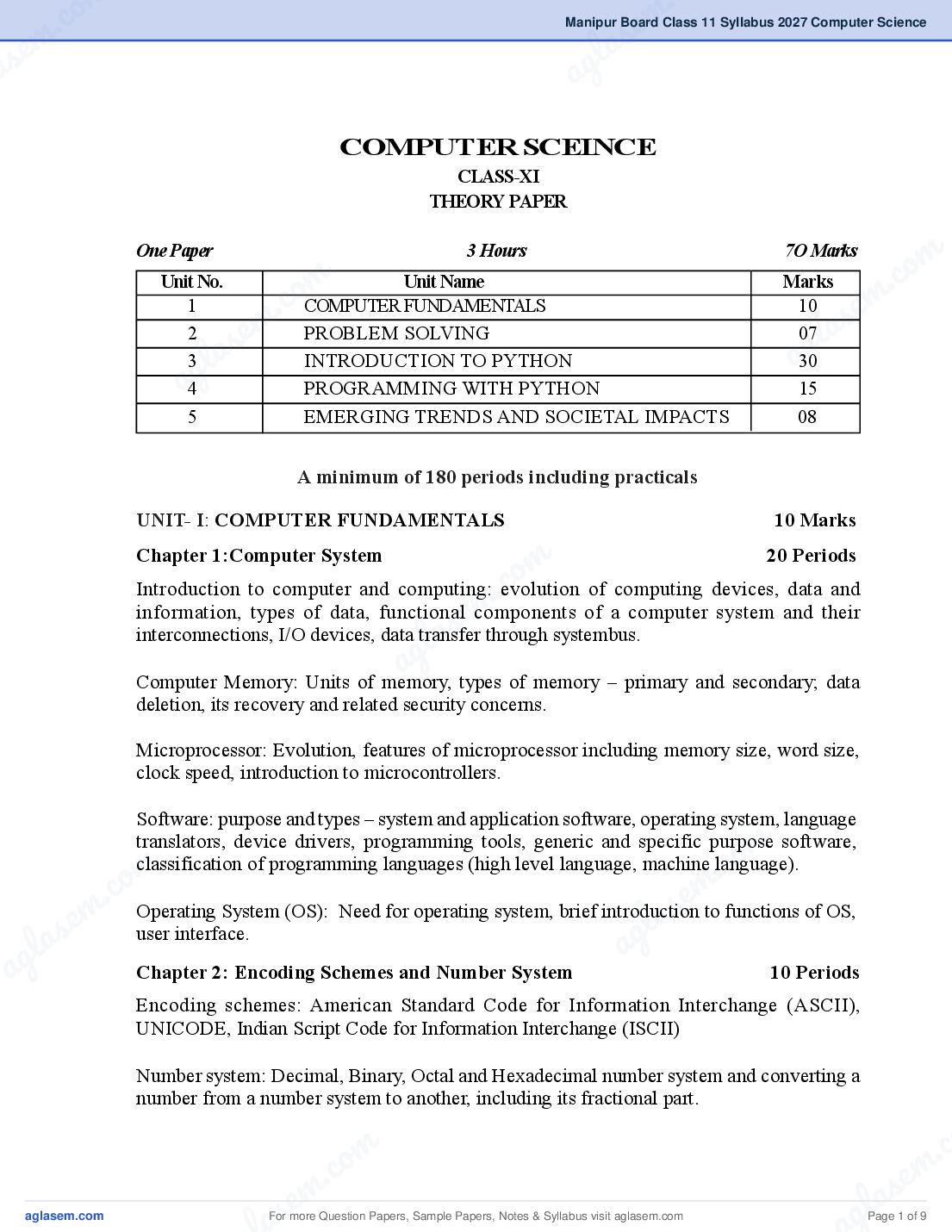
COMPUTER SCEINCE
CLASS-XI
THEORY PAPER
One Paper 3 Hours 7O Marks
m
Unit No.
om Unit Name Marks . co
1 . c COMPUTER FUNDAMENTALS 10 e m
e m l as
2
l as PROBLEM SOLVING
INTRODUCTION TO PYTHON
07
ag
ag
3
4 PROGRAMMING WITH PYTHON
30
15
5 EMERGING TRENDS AND SOCIETAL IMPACTS 08
A minimum of 180 periods including practicals
UNIT- I: COMPUTER FUNDAMENTALS 10 Marks
Chapter 1:Computer System
m 20 Periods
co
Introduction to computer and computing: .evolution of computing devices, data and
m
information, types of data, functionalecomponents of a computer system and their
l as through systembus.
interconnections, I/O devices, data transfer
a g
Computer Memory: Units of memory, types of memory – primary and secondary; data
deletion, its recovery and related security concerns.
Microprocessor: Evolution, features of microprocessor including memory size, word size,
clock speed, introduction to microcontrollers.
Software: purpose and types – system and application software, operating system, language
translators, device drivers, programming tools, generic and specific purpose software, m
mclassification of programming languages (high level language, machine language).
c. oOperating System (OS): Need for operating system, brief introduction m .co
m user interface. s e
e l a to functions of OS,
las ag
ag Chapter 2: Encoding Schemes and Number System 10 Periods
Encoding schemes: American Standard Code for Information Interchange (ASCII),
UNICODE, Indian Script Code for Information Interchange (ISCII)
Number system: Decimal, Binary, Octal and Hexadecimal number system and converting a
number from a number system to another, including its fractional part.
m . c
c. o s e m
s em
For more Question Papers, Sample Papers, Notes & Syllabus visit
gl a
Page 1 of 9
Page 3
Chapter 4:Problem Solving 18 Periods
Introduction to Problem Solving: problem solving cycle - analyzing a problem, designing
algorithm, implementation through coding, testing the solution
Algorithms: what is an algorithm, need of algorithm in problem solving, characteristics of
algorithm, representation of algorithm using flowchart and pseudo-code
Programming: concept of a program, need for writing programs, process of conceptualizing
a solution to a problem and moving from algorithm to programming.
Programming Constructs: Sequence, Selection and Iteration; Simulation (dry run) of program
for better understanding of algorithm; Comparison and Analysis of Algorithms through
simulations.
Decomposition: concept, need for decomposing a problem, examples of problem-solving
using decomposition.
UNIT – III: INTRODUCTION TO PYTHON 30 Marks
Chapter 5: Getting started with Python 35 Periods
Basics of Python programming, working with Python interpreter in interactive mode and
script mode, structure of a program, debugging-errors and exceptions, identifiers, keywords,
constants, variables, types of operators, precedence of operators, data types, mutable and
immutable data types, statements, expressions, evaluation and comments, input and output
statements, data type conversion, debugging
Chapter 6 : Flow of control 15 Periods
Control structures: Sequence, selection (decision) and repetition (iteration) Selection: if, if-
else, and nested if statement, indentation
Repetition: for, while, and nested loops, break,continue;
Chapter 7: Functions 20 Periods
Introduction to functions, need of functions
User defined functions: passing arguments to a function, returning values from functions,
scope of variables,
Standard library: using built-in functions, importing modules-math, random, statistics,
creating and importing user defined module.
For more Question Papers, Sample Papers, Notes & Syllabus visit Page 2 of 9
Page 4
.co s e m
s em l a
a ag
UNIT – IV: PROGRAMMING WITH PYTHON 15 Marks
Chapter 8: Strings 10 Periods
Strings: initializing strings and accessing strings, string operations, built-in functions for
string manipulation, string traversal, string as argument to function m
Chapter 9: Lists om . co
. c - creating, initializing, traversing and manipulating lists, list methodssem
Lists: list operations
12 Periods
s em nested lists, list as argument to a function.
and built-in functions,
g l a
g a Tuples and Dictionary
l10: a
a
Chapter 20 Periods
Tuples: Creating, initializing, accessing elements, tuple assignment, operations on tuples,
tuple methods and built-in functions, nested tuples.
Dictionary: concept of key-value pair, mutability, creating, initializing, traversing, updating
and deleting elements; dictionary methods and built-in functions.
m
.co
UNIT – V: EMERGING TRENDS AND SOCIETAL IMPACTS 15 Marks
Chapter 3: Emerging Trends 10 Periods
e m
l as
Brief understanding of the following emerging trends:
aglearning, Natural Language Processing, Immersive
Artificial Intelligence, Machine
experience, Robotics, Big data and its characteristics, Internet of Things (IoT), Sensors,
Smart cities, Cloud Computing and Cloud Services (SaaS, IaaS, PaaS); Grid Computing,
Blockchain technology
Chapter 11: Societal Impacts 10 Periods
Digital footprint, Etiquettes for Net surfing and for communicating through social medias,
m
m data protection, Intellectual Property Rights (IPR) and their violation, plagiarism and
.co
.co m
copyrights, Free and Open Source Software (FOSS), Cyber crime and cyber laws, hacking,
s e
em
phishing, cyber bullying, Indian IT Act, preventing cyber crime.
s g l a
g la a like effect on eyesight,
Awareness about health concerns related to usage of technology
a physiological issues and ergonomic aspects.
m . c
c. o s e m
s em
For more Question Papers, Sample Papers, Notes & Syllabus visit
gl a
Page 3 of 9
Page 5
SUBJECT : COMPUTER SCIENCE
PAPER : THEORY
CLASS : XI
FULL MARK : 70
TIME : 3 HOURS
WEIGHTAGE TO OBJECTIVES:
Objectives Marks Percentage
Knowledge (K) 10 15
I Understanding (U) 35 50
Application (A) 21 30
Skill (S) 04 05
Total 70 100
WEIGTHAGE OF FORMS OF QUESTIONS:
No. of Time
Form of Questions Marks Percentage
questions (in minutes)
Essay/Long Answer (E/LA) 03 60 15 21
II Short Answer (SA-I) 06 37 18 26
Short Answer (SA-II) 10 40 20 29
Very Short Answer (VSA) 07 21 07 10
MCQ 10 22 10 14
Total 36 180 70 100
WEIGHTAGE OF CONTENTS:
UNIT TOPIC MARKS
1 COMPUTER FUNDAMENTALS 10
2 PROBLEM SOLVING 07
III
3 INTRODUCTION TO PYTHON 30
4 PROGRAMMING IN PYTHON 15
5 EMERGING TRENDS AND SOCIETAL IMPACTS 08
TOTAL 70
IV SCHEME OF SECTION : Nil
SCHEME OF OPTION:
V 1. Internal option will be given in Essay Type Question.
2. Internal option will be given in three questions of SA-I including one case study based question
DIFFICULTY LEVEL:
Difficulty : 35% of the total marks
VI
Average : 50% of the total marks
Easy : 15% of the total marks
Abbreviation: K (Knowledge), U (Understanding), S(Skill), E (Essay Type),
SA(Short Answer Type), VSA (Very Short Answer Type),
MCQ(Multiple Choice Question)
NOTE- (i) Two questions out of 10 (ten) questions of MCQ will be assertion & reason type question.
(ii) Only one question of SA-I will be Case Study based question.
For more Question Papers, Sample Papers, Notes & Syllabus visit Page 4 of 9
Page 6
.co s e m
s em l a
a ag
COMPUTER SCIENCE
CLASS- XI
PRACTICAL
m
om . co
. c e m
e m l as
One Paper
l as 3 Hours 30 Marks
ag
a
UNITg TOPICS MARKS
Programming in Python
One programming problem in Python to be developed and tested in
Computer.
During the examination. Marks are allotted on the basis of
1 following: 10
Logic : 5 Marks m
Documentation/Indentation : 2 Marks
m .co
Output presentation s e : 3 Marks
l a
ag
Notes: The types of problems to be given will be of application type
from the following topics:
Project work
2 As mentioned in general guidelines for project, given at the end of 10
the curriculum)
Practical File
3 05
m
Must have minimum 15 programs from the topics covered in Class
XI course. . com
c. o s e m
em
Viva voce
as 4 Viva will be asked from syllabus covered in Class a
la
XIgand the 05
l
ag project developed by the student
——§§§——
m . c
c. o s e m
s em
For more Question Papers, Sample Papers, Notes & Syllabus visit
gl a
Page 5 of 9
Page 7
CLASS- XI
PRACTICAL
One Paper 3 Hours 30 Marks
Estimated Time (Min)
Program Presentation
Program correctness
Operational Skills
Form of Exercise
Debugging skills
Marks Allotted
Nature of Exercise Booting skills
Sl. No.
1. Short Project Record 0 2 4 2 2 10 60
Algorithm/ Program
2. Major 0 5 2 2 1 10 100
Writing
3. Short Viva-Voce 0 0 1 2 2 5 20**
Sessional Record File of
4. 0 3 2 0 0 5 x
Record Program/Algorithm
N.B. : Only one python program is to be performed by each student.
** No fixed time is allotted for Viva-Voce. It is to be performed during the course of
the examination.
——§§§——
For more Question Papers, Sample Papers, Notes & Syllabus visit Page 6 of 9
Page 8
.co s e m
s em l a
a ag
PRESCRIBED TEXTBOOK:
Computer Science for class XI
Published by : NCERT, New Delhi
m
REFERENCE BOOK :
om . co
c
Saraswati Computer Science for Class XI
. e m
em
By Reeta Sahoo and Gagan Sahoo
l as
l as
Published by New Saraswati House (India) Private Limited, New Delhi – 110002
ag
ag
m
m .co
s e
l a
ag
m
m .co
m .co s e m
s e g la
g la a
a
m . c
c. o s e m
s em
For more Question Papers, Sample Papers, Notes & Syllabus visit
gl a
Page 7 of 9
Page 9
· Searching and sorting
· Binary File operations (Creation, Displaying, Searching and modification)
· Text File operations (Creation, Displaying and modification)
15 SQL commands along with the output based on any table/relation :
5. Viva Voce 05
Viva will be asked from syllabus covered in Class-XII and the project
developed by student.
GUIDELINES FOR PROJECTS (Class XI and XII)
1. Preamble
1.1 The academic course in Computer Science includes one Project in each year.
The Purpose behind this is to consolidate the concepts and practices imparted
during the course and to serve as a record of competence.
1.2 A group of two/three students a steam may be allowed to work on one project.
2. Project content
2.1 Project for Class-XI can be selected from one of the topics given in event
programming.
2.2 Project for Class-XII should ensure the coverage of following areas of
curriculum:
a. Problem Solving
b. Data Structure
c. Programming in Python
d. Data File Handling
Theme of the project can be
· Any subsystem of a System Software or Tool
· Any Scientific or a fairly complex algorithmic situation
· Business oriented problems like Banking, Library in formation system.
Hotel or Hospital management system, Transport query system
· Quizzes/Games;
· Tutor/Computer Aided Learning Systems
2.3 The aim of the project is to highlight the abilities of algorithmic formulation,
modular programming, optimized code preparation, systematic documentation
and other associated aspects of Software Development.
For more Question Papers, Sample Papers, Notes & Syllabus visit Page 8 of 9
Page 10
.co s e m
s em l a
a ag
2.4 The assessment would be through the project demonstration and the Project
Report, which should portray Programming Style, Structured Design, Minimum
Coupling, High Cohesion, Good documentation of the code to ensure readability
and ease of maintenance.
m
o
PRESCRIBED TEXTBOOK m FOR CLASS XII : . co
c
Computer .Science for class XII e m
emby : NCERT, New Delhi l as
s
Published
la ag
ag
REFERENCE BOOKS : FOR CLASSE XII
Saraswati Computer Science for Class XII
By Reeta Sahoo and Gagan Sahoo
Published by New Saraswati House (India) Private Limited, New Delhi - 110002
m
.co
ªªªªªªª
e m
l as
ag
m
m .co
m .co s e m
s e g la
g la a
a
m . c
c. o s e m
s em
For more Question Papers, Sample Papers, Notes & Syllabus visit
gl a
Page 9 of 9
Document Details
| Board / Org | Manipur Board |
| Exam | Class 11 |
| Type | Syllabus |
| Pages | 9 |
| Updated | 04 Nov 2026 |