MP PAT 2025 Syllabus
Finished viewing? Save it for later —
Download MP PAT 2025 Syllabus (PDF · 11 pages)About MP PAT 2025 Syllabus
MP PAT 2025 Syllabus is available here for free download. Published by MPESB for MP PAT, this syllabus can be viewed online or downloaded as a PDF (11 pages). Candidates preparing for MP PAT can use MP PAT 2025 Syllabus to understand the exam pattern, the type of questions asked, and the overall difficulty level.
Frequently Asked Questions
How can I download MP PAT 2025 Syllabus?
Open this page and click the Download button to save MP PAT 2025 Syllabus as a PDF. It is completely free on AglaSem Docs.
Is MP PAT 2025 Syllabus free to download?
Yes. MP PAT 2025 Syllabus can be viewed online and downloaded as a PDF free of cost on AglaSem Docs.
How many pages does MP PAT 2025 Syllabus have?
MP PAT 2025 Syllabus contains 11 pages, which you can read online or download together as a single PDF.
Where can I find more MP PAT study material?
You can find more MP PAT question papers, sample papers, syllabus, and answer keys on AglaSem Docs.
MP PAT 2025 Syllabus – Text
Read the full text of this syllabus below — useful to quickly search, copy and reference the content online without downloading the PDF.
📄 View text version (11 pages)
Page 1
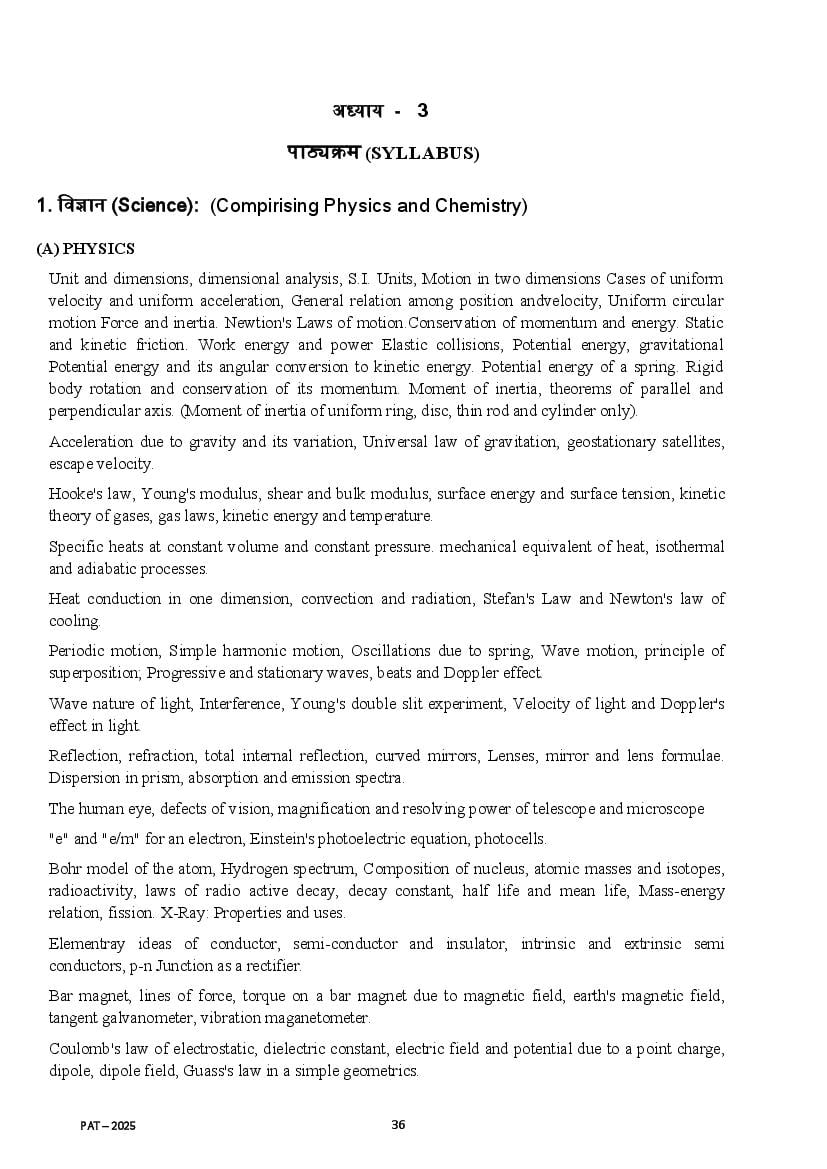
पा म (SYLLABUS)
1. िव ान (Science): (Compirising Physics and Chemistry)
(A) PHYSICS
Unit and dimensions, dimensional analysis, S.I. Units, Motion in two dimensions Cases of uniform
velocity and uniform acceleration, General relation among position andvelocity, Uniform circular
motion Force and inertia. Newtion's Laws of motion.Conservation of momentum and energy. Static
and kinetic friction. Work energy and power Elastic collisions, Potential energy, gravitational
Potential energy and its angular conversion to kinetic energy. Potential energy of a spring. Rigid
body rotation and conservation of its momentum. Moment of inertia, theorems of parallel and
perpendicular axis. (Moment of inertia of uniform ring, disc, thin rod and cylinder only).
Acceleration due to gravity and its variation, Universal law of gravitation, geostationary satellites,
escape velocity.
Hooke's law, Young's modulus, shear and bulk modulus, surface energy and surface tension, kinetic
theory of gases, gas laws, kinetic energy and temperature.
Specific heats at constant volume and constant pressure. mechanical equivalent of heat, isothermal
and adiabatic processes.
Heat conduction in one dimension, convection and radiation, Stefan's Law and Newton's law of
cooling.
Periodic motion, Simple harmonic motion, Oscillations due to spring, Wave motion, principle of
superposition; Progressive and stationary waves, beats and Doppler effect.
Wave nature of light, Interference, Young's double slit experiment, Velocity of light and Doppler's
effect in light.
Reflection, refraction, total internal reflection, curved mirrors, Lenses, mirror and lens formulae.
Dispersion in prism, absorption and emission spectra.
The human eye, defects of vision, magnification and resolving power of telescope and microscope
"e" and "e/m" for an electron, Einstein's photoelectric equation, photocells.
Bohr model of the atom, Hydrogen spectrum, Composition of nucleus, atomic masses and isotopes,
radioactivity, laws of radio active decay, decay constant, half life and mean life, Mass-energy
relation, fission. X-Ray: Properties and uses.
Elementray ideas of conductor, semi-conductor and insulator, intrinsic and extrinsic semi
conductors, p-n Junction as a rectifier.
Bar magnet, lines of force, torque on a bar magnet due to magnetic field, earth's magnetic field,
tangent galvanometer, vibration maganetometer.
Coulomb's law of electrostatic, dielectric constant, electric field and potential due to a point charge,
dipole, dipole field, Guass's law in a simple geometrics.
PAT – 2025 36
Page 2
parallel, energy of a capacitor.
Electric current, Ohm's law, Kirchhoffs laws, resistances in series and parallel temperature
dependence of resistance. Wheatstone bridge, potentiometer.
Measurement of voltages as currents.
Electric power, heating effects of currents, chemical effects and law of electrolysis thermoelectricity.
Biot Savart law. Magnetic fields due to a straight wire circular loop and solenoid.
Force on a moving charge in a magnetic field (Lorentz force), magnetic moment of a current loop,
effect of a uniform magnetic field of a current loop, forces between two currents, moving coil,
galvanometer, ammeter and voltmeter.
Electromagnetic induction induced emf, Faradays law, Lenz's law, self and mutual inductance
alternating currents, impedence and reactance, growth and decay of current in L-R circuit,
elementrary idea if dynamo and transformer.
(B) CHEMISTRY
GENERAL AND PHYSICAL CHEMISTRY
1. Structure of Atom: Constitution of nucleus: Bohr's atom model: quantum numbers Aufbau
principle, electronic configuration of elements (upto-Kr): de-Broglie relation, shapes of orbitals.
2. Chemical Bond: Electrovalent, covalent and coordinate bonds, hybridisation (sp): hydrogen bond:
shapes of molecules (VSEPR theory) : bond polarity, resonance, Elements of VBT a MOT.
3. Solutions: Modes of expressing concentrations of solutions: Types of solutions, Raoults law of
colligative properties, non-ideal solution, abnormal molecular weights.
4. Solid State: Crystal lattices, unit cells, Structure of ionic compunds: close packed structure lonic
radii, imperfections (Point defects): Properties of solides.
5. Nuclear chemistry Radio active radiations: half-life, radioactive decay, group displacement Law
structure and properties of nucleus: Nuclear reaction, disintegration series artificial transmutation:
isotopes and their uses: Radiocarbondating.
6. Chemical Equilibrium: Chemical equilibrium, Law of mass action: Kp and Kc: Le Chatelier
principle and its applications.
7. Ionic Equilibria in solutions, Solubility product, common ion effect, theories of acids and base
hydrolysis of salts: pH : buffers.
8. Thermochemistry and Thermodynamics: Energy changes during a chemical reaction: instrinsic
energy enthalpy, First Law of thermodynamics: Hess's law Heats of reactions: Second law of
thermodynamics: entropy: free energy; spontaneity of a chemical reaction; free energy change and
chemical equlibrium; free energy as energy available for useful work.
9. Chemical Kinetic: Rate of a reaction, factors affecting the rate, rate constant rate expression, order
of reaction, first order rate constant expression and characteristics, Arrhenous equation.
PAT – 2025 37
Page 3
conduction. Faraday's laws; voltaic cell, electrode potentials, electromotive force, Gibb's energy
and cell potentials. Nernest equation, commercial cells, fuel cell, electrochemical theory of
corrosion.
11. Surface chemistry, Colloids and Catalysis; Adsorption, Colloids (types preparation and
properties), Emulsions, Micelles, Catalysis: Types and characteristics.
INOGRANIC CHEMISTRY:
12. Principles of metallurgical operations: Furnaces, ore concentration, extraction, purification metallurgies of
Na, Al, Fe, Cu, Ag, Zn and Pb and their properties.
13. Chemical periodicity: S.p.d. and f-block elements, periodic Table: periodicity : atomic and ionic
radii valency. ionization energy, electron affinity electronegativity, metallic character.
14. Comparative study of elements: Comparative study of the following families of elements: (i)
Alkali metals (ii) Alkaline earth metals (iii) Nitrogen family (iv) Oxygen family (v) halogens (vi)
Noble gases.
15. Transition metals: Electronic configuration of 3d-metal ions, oxidation states, other general
characteristic properties, Potassium permanganate, potassium dichromate.
16. Co-ordination compounds: Simple nomenclature, bounding and stability, classification and bonding in
organometailics.
17. Chemical analysis: Chemistry involved is simple inorganic quilitative analysis:calculations based on acid-
base titrimetry.
ORGANIC CHEMISTRY:
18. Calculation of empirical and molecular formula of organic compounds, Nomenclature of organic
compounds, common functional groups isomerism Structure and shapes of alkanes, alkanes and benzene.
19. Perparation properties and uses of alkynes, alkynes, benzene petroleum, cracking octane number, gasoline
additives.
20. Nomenclature, Physical chemical properties, correlation of physical properties with structure properties
and uses of heloalkanes, halobenzenes, alcohols and phenols: General ideas of some polyhalogen
compounds viz dicholorothanes, dichloroethers, chloroform, carbon tetrachloride D.D.T. benzene
hexachloride.
21. Nomenclature, methods of preparation, Chemical properties correlations of physical properties with
structures and uses of ethers aldehydes, ketones, carboxylic acids and their derivatives, Brief account of the
chemistry of Cyanides isocyanides, amines and nitro compounds.
22. Polymers: Classification: Preparation and uses of common natural and synthetic polymers.
23. Biomolecules: Classification, Structures and biological importance of carbohydrates amino acids, peptides,
proteins and enzymes, nucleic acids and lipids.
2. गिणत (MATHEMATICS)
1. ALGEBRA: Algebra of complex mumbers. Graphical representation of complex numbers
modulus, and argument of complex numbers, conjugated of a complex number, Triangle
inequality, cube roots of unity. Arithmetic, geometric and harmonic progression. Arithmetic,
PAT – 2025 38
Page 4
numbers. Theory, geometric equation, relations between roots and coefficients. uadratic
expressions, quadratic equations in one variable, Permutations and combinations. Bionomial
Theorem (any index) exponential and logarithmic series. determinants upto third order and their
order and their elementary properties matrices types of matrices, adjoint and inverse of matrix,
elementary. Application in solving simultaneous equation upto three variables.
2. TRIGONOMETRY: Trigonometry functions and their graphs, addition and subtraction formulae;
formulae involving multiple and submultiple angles, general solutions of trignometrical equations.
Relations between sides and angles of a triangle. Solutions of triangles, inverse; trigonometrical
functions, height and distance (Simple Problems).
3. CO-ORDINATE GEOMETRY OF TWO DIMENSIONS: Rectangular cartesain coordinates.
Straight line, pair to straight lines, distance of a point from a line, angle between two lines. Circle,
tangents and normals, system of circles. Conic section; Parabola, Ellipse and Hyperbola in
standard forms with elementary properties, tangents and normals.
4. CO-ORDINATE GEOMETRY OF THREE DIMENSIONS: Rectangular co-ordinate system.
Direction cosines and direction ratios, equation of place in standard forms. Perpendicular distance
from a point, equation of a line angle between two lines.
5. VECTOR ALGEBRA: Definition of vector, addition of vector, components in three dimensional
space. Scalar and vector products. Triple products, simple application in geometry and mechanics.
6. DIFFERENTIAL CALCULUS: Function, polynomial, rational trignometric, logarithmic and
exponential,inverse functions. Limit continuity and differentiability of functions, differentiation of
rational, trigonometric and exponential functions. Application of derivative in elementary problems
in mecharics, increasing and decreasing frunctions. Maxima and Minima of function of one
variable. Roll's theorem and mean value theorem.
7. INTEGRAL CALCULUS: Integration as the inverse process of differentation. Integration by
parts. By substitution and by partial fraction. definite integral. Areas under simple curves.
8. DIFFERENTIAL EQUATIONS: Formulation of differential equation, ordered degree. Solution
of differential equations by seperation of variable method. Homogeneous form. Linear differential
equation of first order.
9. STATISTICS : Probability, addition and multiplication laws. Conditional probability. Binomial
distribution. simple problems in correlation and regression.
10. NUMERICAL METHODS: Solution of equation by the methods of bisection, false position and
Newton-Raphson. Numerical integration by trapezoided and Simpson's Rule.
11. LINEAR PROGRAMMING: Definition and formation of linear programming problems.
Solution by graphical method.
3. BIOLOGY (Compirising Botany & Zoology)
(A) वन पित शा (BOTANY)
Structural organization of cell, cell theory. Light and Electron Microscopic view of cell. Structure and
functions of cell organelles : Nucleus Mitochondria, Chloropast Endoplasmic reticulum, Golgi
complex-lysosome, microbodies microfilaments Ribosomes. Centrioles and Plasmids, Eukaryotic
PAT – 2025 39
Page 5
Division, cell cycle significance of mitosis and meiosis.
Mendel's Laws of inheritance, Monohyobrid and dihybrid cross; linkage and crossing over of genetic
material DNA relication, genetic code transcription transcription and gene regulation.
Difference between prokaryote and Eukaryotes : Structure reproduction and economic importance of
viruses Mycoplasma, Bacteriophage, Cynobacteria (Nostoc) and Bacteria.
Five Kingdom classification Binomial Nomenclature : Extrenal morophology and life cycle of
Spirogyra mucor, Funaria Selaginella and pinus.
Elementary knowledge of microsporogenesis megasporogenesis. Fertilisation endosperm and embroyo
development in Angiosperms.
Tissue and tissue systems, meristematic and permanent tissue, Mineral nutrition-essential elements and
their functions: uptake of minerals transport of water and solutes. Transpiration Photosynthesis and
Respiration: Importance, mechanism and factors affecting these processess: Photorespiration.
Enzymes and growth hormones with reference to their classification. Chemical nature, mode of action
importance. Elementary idea of photoperiodism and phytochrome.
Ecosystem - Structures and function, Major ecosystems i.e. lake and Forest; Food chain, Food Web
and Energy flow, Ecological crisis- Role of man in polluting Environment - Air Water and Soil.
Role of plants in human welfare : A general knowledge of plant products of economic value-Drugs,
Fibers, Cereals.
Wheat and Rice, Pulses (gram), Oil seeds (Ground nut), Sugarcane, Coal and Petroleum.
Food preservation-Methods and importance.
Principle of plant breeding and its role in improvement of crops. Biotechnolgy; scope and importance
in Agriculture and industries manufacture of cheese. Yoghurt Alcohol Antibiotics.
(B) ाणीशा (Zoology)
MULTICELLULARITY - STRUCTURE AND FUNCTION OF ANIMAL LIFE:
- Structure and function of Animal tissues Epithelial, Connective Muscular, Skeletal and Nerve.
- Histology of Mammalian organs - Stomach, Intestine, Liver, Kidney, Lung, Testes and Ovary.
- Structure and Physiology of different organ systems of Human body. Skin, Digestive system,
Respiratory System. Criculatory system.
- Skeleton, Joints, Muscles on the basic of movement Receptors.
- Endocrine system with special reference to various Endocrine glands of man and Hormonal
co-ordination.
- Vitamin & minerals (source and disorders due to deficiencies).
PAT – 2025 40
Page 6
- Female reproductive cycles in mammals. Gametogenesis alongwith structure of sperm and ovum.
Types of eggs, Fertilization, cleavage types of cleavage and blastula. development of mammals upto
three germinal layers. Foetal membranestructure and functions.
- Growth, repair and ageing, amniocentesis.
- Chromosomes, Types of chromosome, Human karyotype and chromosomal abnormalities and
syndromes, Hormanal, Chromosomal and Genic Balance theory of sex determination, Sex linkage
and sex linked inheritance in Man. Blood Group and their significance, Blood Bank.
- Tissue culture, Genetic Engineering (Brief idea). Mutation gene mutation.
- Human population natality Mortality, Sex ratio Population explosion, dynamics of humaan life with
respect to food supply, housing health and standard of living impact of population problems and
their control.
TAXONOMY EVOLUTION ECONOMIC ZOOLOGY :
- Classification - Bionomial and trinomial nomenclature, Basic features of classification,
Classification of different animal phyla upto classes with characters and suitable examples.
- Origin of life, Theories of organic evolution-Darwin, Lamarck, Synthetic Evidence of organic
evolution, Human Evolution.
- Economic Zoology/Sericulture, Apiculture, Lac culture, Poultry, Fishery and pearl industry.
- Protozaon disease in relation to man. Insect carying diseases in relation to man.
- Cancer-types of cancer and cancer cell. Communicable diseases (Hepatitis, AIDS) STD, Immune
Response, Vaccines and antisera allergies.
- Smoking, alcoholism and drug addiction, symptoms and control.
- Wild conservation.
- Pesticides - Uses, advantages and hazards.
4. कृ िष के िलए उपयोगी िव ान एवं गिणत त व [ELEMENTS OF SCIENCE AND
MATHEMATICS]
(USE FOR AGRICULTURE) AG.-1
(I) AGRICULTURE PHYSICS:
1. Principle of Archimedes, Floating bodies density and relative density, determination of R.D. by
Hydrometers.
2. Atmospheric pressure. Fortins barometer and its relation to weather condition manometer.
3. Pumps - Force and vacuum pumps, symphon suction pumps.
4. Friction - Laws of Friction, angle of friction, coefficient of friction and its determination,
advantages and disadvantages of friction.
5. Machine - simple machines such as plas, lever, pully. Simple wheel, their construction and
working mechanical advantages, Velocity ratio efficiency of machine.
PAT – 2025 41
Page 7
law of gravitation.
7. Unit of heat, Specific heat, thermal capacity, water equivalent of heat, determination of Specific
heat of solid and liquid, Latent heat, determination of latent heat of ice and steam.
8. Transmission of Heat-Conduction, Convection and Radiation. Conductivity, good and bad
conductor, New-tons law of cooling-simple idea.
9. Light, Rectilinear propagation of light, Shadow and eclipse, pinhole camera, reflection through
Prism, Dispersion of light, dispersive power spectrum, their type, spectometer.
10. Optical instruments, Human eye, its defects, photographic camera, simple and compound
microscope Telescope.
11. Magnetism, Magnetic Field, Intensity of magnatic field, lines of forces; Neutral point, Couple
acting on magnet placed in a uniform magnetic field. Magnetic movement of magnet, tangent
law and its limitation.
12. Electric charge- electric potential, electric field and its intensity due to a point, potential inside a
conductor.
13. Electrical capacity, its unit, its value for a Spherical conductor, principle of condensers capacity
of spherical and parellel plate condenser.
14. Ohm's law, Resistance, grouping of resistance, electomotive froce and potential difference.
Potentiometer its principle, comparision of EMF of two cells by potentiometer.
15. Elementary idea of heating effect of current, Joule's law determination of 'J' by Joules
Calorimeter, elementary, idea of the house wiring electric iron, electric power and energy.
(II) AGRICULTURE CHEMISTRY :
1. Atomic Structure: Bohr's atomic model, Distribution of electrons according to Bohr- Bory
Rules. Radioactivity and atomic disintegration.
2. Chemical Bonds : Characterstics of electrovalent, Covalent and Co-rodinate Bonds.
3. Ionic Theory : Uses of ionisation, Solubility product, Hydrolysis, neutralisation, Ionic product
of water. Determination of pH Buffer Solution, Nutritional importance of Soil pH.
4. Colloids: Lyophilic and Lyophobic, properties of colloids, colloidal solutions, protective
colloids, gold number, Soil colloids clay and humus.
5. Introduction of important minerals present in soil and their chemical composition.
6. Chemical Fertilizers: Manufacture of different fertilizers of N.P.K. and their utilization
Micronutrients.
7. Volumetric analysis: Strength of solution, Normality, determination of equivalent weight
of acid, base and salt.
8. Introduction to Organic Chemistry, Determination of empirical, molecular and structural
formula of simple organic compounds.
9. Classfication and nomenclature of organic compounds, Isomerism.
10. Saturated and unsaturated Hydrocarbons, Mathane, Ethylene, Chemistry of gobar Gas.
PAT – 2025 42
Page 8
12. Oil and fats, extraction, Composition and properties, manufacture of soap, Vanaspati Ghee, use
of oil in paints.
13. Elementary Biochemistry, Carbohydrates, proteins, Lipids, Vitamins and enzymes.
(III) AGRICULTURE MATHEMATICS:
1. Arithmetic Progression: Definition, formula to find the nth term. Formula to find sum of n
terms. Definition of arithmetic mean. Insertion of given number of mean between two given
quantities. Finding of remaining quantity when any three of S, a d, n are given.
2. Geometric Progression: Definition, Formula to find the nth term, sum opf n terms, geometric
mean insertion of geometric means between two given Quantitites. Finding or remaining
quantity when any three of ks, a, n are given.
3. Logarithms and Common Logarithms: Definition of product division of number raised to any
power characteristics of the logarithim of any number greater than unity. Characteristics of the
Logarithm of a decimal fraction.
4. Trigonometrical functions of angles of any size and sign. Trignometrical ratios of an angle (90+)
(190) (80+)
5. Trigonometrical ratio fo the sum and difference of two angles. Geometrical proof for sin (A+B),
Cos (A+-B) product formula for Sin (C+ - sin D), (C+ - CosD)
6. Statistics: Calculation of mean, mode, median and standard deviation, variance and mean
deviation for grouped data using various formula.
(IV) AGRICULTURE, BOTANY, ZOOLOGY:
1. Plant Anatomy : (i) Root-Structure and Functions (ii) Stem-Structure and Functions (iii) Leaf
Structure and Functions.
2. Agril Botany Zoology : Classification of plants, (i) Outline of classification of plants, (ii) Study
of the following families, (a) Compositeae (b) legumininoseae (c) Cucurbitae (d) Solananceae
(e) Mavaceae (f) Cruciferae (g) Gramineae.
3. Plant Breeding and Genetics : (i) Definition of Genetics and plant breeding and role of
Genetics in plant breeding (ii) Cell-its structure and cell division (iii) Principle of
inheritance (iv) Self and cross polinated crops, (v) Methods of breeding field crops.
4. Plant Physiology: (i) Respiration, types function, (ii) Photosynthesis (iii) Transpirations (iv)
Plant growth and development.
5. Animal Kingdom: (i) Classification of animal kingdom, (ii) Useful and harmful insects of
agriculture Silk work, Honey bee, LAC insect, Termites, Grass hopper, grass caterpillar.
Anatomy and physiology, elementary internal anatomy of grass hopper, earthworm and
cockroach with reference to digestive. Respiratory and reproductive system.
PAT – 2025 43
Page 9
5. (A) CROP PRODUCTION AND HORTICULTURE (AG.-2)
1. (i) Introduction and activities of agriculture and crop production, (ii) Importance of crop
production in National Economy (iii) Different Branches of Farming and their importance.
2. Soil and Soil Fertility : (i) Soil and its constitutents (ii) Physical properties of Soil-Soil texture
and Structure porespace, specific gravity, plasticity, cohesion and soil temperature (iii)
Formation of soil-classification of soil in M.P. and their characteristics (iv) Soil corrosion its
kind, their causes and control, measures of soil conservation (v) Soil acidity and alkalinity and
their reclaimation soil-pH.
3. Tillage: (i) Object of tillage, tillage operations, ploughing, levellling, harrowing,
intercultivation (ii) Tillage implements, country plough imporoved ploughs, harrows and
cultivators, threshers, winnowers and seed drills, tractor driven implements.
4. Manures and Fertilizer (i) Essential element for plant growth (ii) Description and uses of
organic manures. F.Y.M. Compost green manures (iii) Differnet Nitrogenous, Phosphate and
potash Fertilizers, properties and uses.
5. Production of crops: (i) Classification of crops according to seasons and economic
classification (ii) Cultivation of Kharif Crops- Jowar, Maize, Groundnut, Cotton, Paddy,
Soybean, Arhar, Urad, Moong (iii) Rabi crops-Wheat, Linseed, Mustard, Sugarcane, Gram,
Barely under following heads 1. Preparation of land 2. sowing operation 3. Seed rate per hectare
4. Manures and fertilizer 5. irrigation 6. Interculture and weeding 7. Imporved varieties 8. Yield
per Hectare 9. Disease: pests and their control.
6. Irrigation land Drainage: (i) object of irrigtion and drainage (ii) sourcs of irrigation and
drainage (iii) Method of irrigation and drainage (iv) Water requirements of crops (v) Duty and
discharge of water, (vi) Common water lifts. Diesel and electric pumps.
7. Weed and weed control.
8. Cropping scheme, importance of principles if: (i) Crop rotation (ii) Principle cropping (iii)
Mixed and inter cropping (vi) Dry farming (v) Cooperative farming.
9. Elementary Surveying-Importance of Surveyng. elementary survey with the help of chains,
instruments used in survey as optical square, cross staff offset rod, dumpy level, recording of
field book.
10. Introduction (i) Importance and scope of Horticulture (ii) Pomology - Location and layout.
(iii) Planting system - training, pruning, inter-cropping, winds breaks, protection from frost
and sun burn (vi) care maintenance and rejuvenation of fruit, orchards.
11. Vegetable Gardening (i) Kitchen gradening (ii) Cultivation of Radish, Carrot, cole crops, Onion
Brinjal, Chilies, Tomato potatoes.
12. Fruit cultivation (i) Vegetative propagation-Budding, inarching and Goottee cutting, Grafting
and layering (ii) Cultivation of Papaya, Banana, Grapes, Mango, Guava and citrus frruits.
13. Ornamental Gardening (i) General Cultivation of Winter and summer season annuals (ii)
Ornamental and flowering plants. Trees shrubs, climbers, hedges and hedges plants. (iii)
PAT – 2025 44
Page 10
Preparation and maintenance of lawns.
14. Fruit and Vegetable preservation- Canning and bolt ling Technique (i) Simple canning and
botting techniques use of suitable containers like aluminised plastic and paper (ii) Washing,
Blandching and peeling of fruit and Vegetables, trading of fruits for canning.
15. Preservation of Fruits and Vegetables (i) General principles and methods of fruit and vegetable
preservation (ii) Processing by heat, preservation by antiseptic drying, preservation by
fermentation dehydration and packing (iii) Preparation of jelly, Lime squash and Tomato sauce.
16. Rural Finance (i) Cultivator's Finance needs for farmers (ii) Source of credit (iii) Organisation
of Rural Cooperative credit and marketing societies.
5.(ब) पशुपालन एवं कु कु ट पालन के त व
5. (B) ELEMENTS OF ANIMAL HUSBANDRY AND POULTRY FARMING (Ag.-3)
(A).1. Introduction :- (i) Importance of Live stock in Indian Economy, (ii) Body parts of cow and buffalo and
description of important systems, respiratory, digestive, reproductive, secretion of milk.
2. Improved Cattle Breeds :- (i) Cow (ii) Buffalo (iii) Goat and (iv) Sheep.
3. Care and management of Cattle :- (i) Animal Hygiene (ii) Cattle housing sheds for bullocks, bull,
milch cattle etc. (iii) Special attention for rearing of calves, pregnant and milch cattle, working bullocks
and bull.
4. Breeding of Cattle :- (i) Breeding Line breeding and cross breeding, Mendel's laws of breeding (ii)
Artificial insemination in cattle with examples.
(B)5. Dairy Farming: (i) General idea regarding dairy farming as a business in village and town conditions
requirement of land, labour, captial; management techniques.
6. Milk Production: - (i) Differnet methods of milking, (ii) Principles of clean milk production,. (iii)
Factors affecting quality and quantity of milk.
7. Composition of milk : (i) Definition of milk (ii) Milk constitutents (iii) Composition of Milk: Factors
affecting composition of milk.
8. Physical properties of milk : (i) Temperature (ii Boiling Freezing point (iii) pH (iv) Density (v)
Specific gravity use of Lactometer (vi) Gerber's method for fat test.
(C)9. Feed and Feeding : (i) Principles of Feeding of dairy cattle (ii) Different types of feeds and fodders and
their nutritive calues - Kharif and Rabi Fodders: Hay and silage crops (iii) Preservation of fodders
making of silage, hay silopits hay silopits. (iv) Computation of balanced ration of cows, buffaloes,
bullocks, bulls goats and sheep.
10. Judging of Cattle : (i) Importance of Judging, (ii) Judging method, Score card method and on the basis
of body parts, (iii) Judging the age of cattle by rings on the horn and by the teeth development.
11. Dairy appliances : (i) Constrution of appliances and their cleanliness (ii) working of cream separator
and tis parts. Butter churner, Butter worker.
12. Milk Products : (i) Preparations of cheese. Cream, Ravri, Dahi, Butter, Ghee, condensed milk. Milk
powder and their composition.
13. Common diseases of Cattle : (i) Symptoms of sick Animals, (ii) Symptoms of different diseases.
Rinderpest Foot and Mouth disease. Blackquater, Haemorrhagic Septicaemia, Anthrax and
piroplasmosis: (iii) their prevention and control measures.
14. Poultry Farming : (i) Introductory, (ii) Scope and limitation of Poultry Farming, (iii) important breeds
of poultry for eggs, meat (iv) Hatching of eggs and uses of incubator.
15. Housing and ration for poultry birds: (i) Poultry sheds, layout model sheds (ii) Ration of poultry
bird-chicken, Growere, layers and Broilers.
PAT – 2025 45
Page 11
Coccidiosis, Fowl, Pox, Fowl cholera, Ecto and endoparasites.
6- कृ िष AGRICULTURE (Arts and Science Group) (Ag.)
1. Introduction (i) Importance and scope of Agriculture in our National Economy and Development. (ii)
Measures to be adopted for increasing the yeild of crops.
2. Meteorology (i) Distribution of crop Zones depending upon the rainfall in M.P. (i.e.) Weather
recording-Rainfall, Temperature, Humidity and atmospheric pressure.
3. Soils (i) Importance of Soil, Soil texture, soil structure, mineral matter, soil organic matter, soil and
organism (ii) Different soil of M.P. and their Characteristics (iii) causes of infertility and ways to
improve them.
4. Tillage (i) Definition of tillage, tillage operations such as ploughing, harrowing interculture etc. (ii)
Tillage implements-Country plough, improved plough, harrows, cultivators, thresheres, winnower and
seed drills.
5. Manures and Fertilizers (i) Major and minor plant nutrients (ii) organic manures F.Y.M. compost,Green
manures, Oil cakes (iii) Inorganic Fertilizers - Nitrogenous, phosphatic and Potash Fertilizers.
6. Weeds and weed Control (i) Defination of weeds, damage caused by weeds (ii) Weed control methods
mechanical Biological and Chemical.
7. Inrrigation and Drainage (i) Need Objects of irrigation and drainage (ii) Sources of irrigation and
drainage.
8. Cropping Schemes: Importance and principles of Crop-rotation, mixed cropping, multi cropping, Dry
farming.
9. Crop Producation (i) Classification of crops(ii) Cultivation of following crops with reference to their
land preparation, manuring, sowing, seed rate, irrigation, interculture, imporved varieties, control of
diseases and pests, yield per hectare, Major crops paddy, Wheat, Jowar, ground nut and cotton Minor
Crops-Arhar, Moong, Soybean, Linseed and Mustard.
10. Introduction (i) meaning and scope of Horticulture (ii) Planting system, pruning, training and
intercropping (iii) Elementary idea regarding ornamental plants, annuals, shrubs, trees hedges.
11. Cultivation of fruit plants (ii) propagation of plants-cutting, budding, layering gootee, grafting and
inarching (iii) Elementary idea regarding ornamental plants, annuals, shrubs, trees hedges.
12. Cultivation of vegetables (i) classification of vegetalbe as per family seasons and uses (ii) cultivation of
Potato, Cauliflower, Radish, Onion, Tomato, Brinjal, bhindi and Chillies.
13. Fruit and vegetable preservation (i) General principles and methods of fruit and vegetable preservation.
14. Animal Husbandry (i) Important breeds of cow and buffaloes (ii) care maintenance and housing of
cattles (iii) Principles of feeding and balanced ration of cattles.
15. Milk and milk testing (i) composition of milk of cows and buffaloes (ii) Testing of milk by lactometer.
16. Milk products and Dairy machines (i) Preparation of Cream, ghee, Butter, Khoya and Dahi (ii)
Construction of working of cream separator.
17. Diseases of Cattles (i) Sings of sick animal (ii) Common diseases of cattle, their prevention and control.
18. Poultry Farming (i) Important Poultry breeds and their characteristics (ii) Warehousing and feeding of
Poultry breeds (iii) Hatching of egg by natural and artificial methods (iv) Grading and marketing of
eggs (v) Common diseases of poultry, their prevention and control.
PAT – 2025 46
Document Details
| Board / Org | MPESB |
| Exam | MP PAT |
| Type | Syllabus |
| Pages | 11 |
| Updated | 24 Sep 2026 |