APTET Question Paper with Answers 10 Jun 2018 Paper 1 (Shift 1)
Finished viewing? Save it for later —
Download APTET Question Paper with Answers 10 Jun 2018 Paper 1 (Shift 1) (PDF · 64 pages)About APTET Question Paper with Answers 10 Jun 2018 Paper 1 (Shift 1)
APTET Question Paper with Answers 10 Jun 2018 Paper 1 (Shift 1) is available here for free download. Published by Andhra Pradesh Exams for Andhra Pradesh Teacher Eligibility Test, this question paper can be viewed online or downloaded as a PDF (64 pages). Candidates preparing for Andhra Pradesh Teacher Eligibility Test can use APTET Question Paper with Answers 10 Jun 2018 Paper 1 (Shift 1) to understand the exam pattern, the type of questions asked, and the overall difficulty level.
Frequently Asked Questions
How can I download APTET Question Paper with Answers 10 Jun 2018 Paper 1 (Shift 1)?
Open this page and click the Download button to save APTET Question Paper with Answers 10 Jun 2018 Paper 1 (Shift 1) as a PDF. It is completely free on AglaSem Docs.
Is APTET Question Paper with Answers 10 Jun 2018 Paper 1 (Shift 1) free to download?
Yes. APTET Question Paper with Answers 10 Jun 2018 Paper 1 (Shift 1) can be viewed online and downloaded as a PDF free of cost on AglaSem Docs.
How many pages does APTET Question Paper with Answers 10 Jun 2018 Paper 1 (Shift 1) have?
APTET Question Paper with Answers 10 Jun 2018 Paper 1 (Shift 1) contains 64 pages, which you can read online or download together as a single PDF.
Where can I find more Andhra Pradesh Teacher Eligibility Test study material?
You can find more Andhra Pradesh Teacher Eligibility Test question papers, sample papers, syllabus, and answer keys on AglaSem Docs.
APTET Question Paper with Answers 10 Jun 2018 Paper 1 (Shift 1) – Text
Read the full text of this question paper below — useful to quickly search, copy and reference the content online without downloading the PDF.
📄 View text version (64 pages)
Page 1
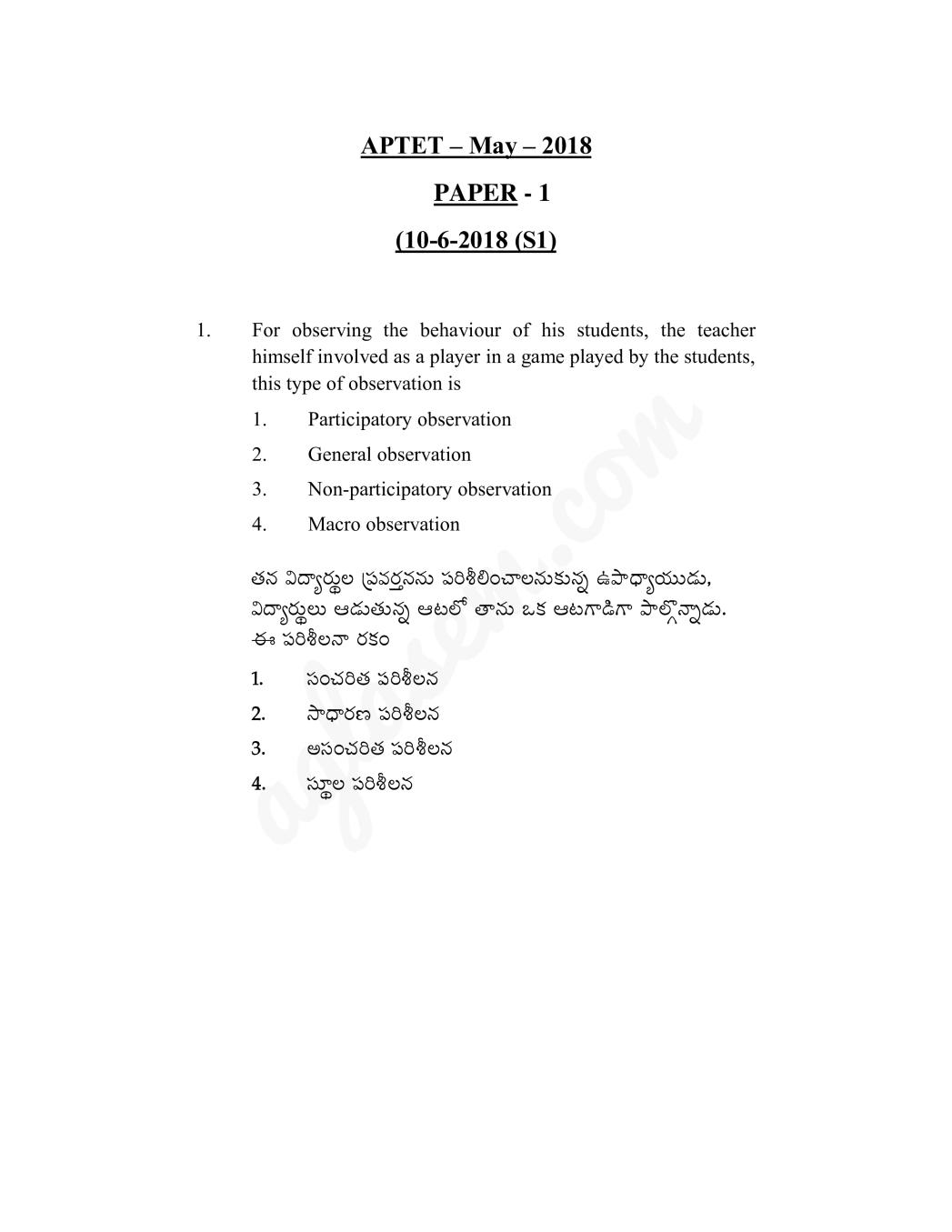
PAPER - 1
(10-6-2018 (S1)
1. For observing the behaviour of his students, the teacher
himself involved as a player in a game played by the students,
this type of observation is
1. Participatory observation
2. General observation
3. Non-participatory observation
4. Macro observation
Page 2
1. Development is a short term process
2. There are no individual differences in development
3. Development is not uniform in all the developmental
stages
4. Development is not predictable
3. The third stage in the order of language development is
1. Bobbling stage
2. Prelingual stage
3. Language comprehension stage
4. Sound imitation stage
1.
2.
3.
4.
Page 3
Freud for dwelling out the repressed unconscious feelings
1. Free association
2. Gestaultism
3. Dream analysis
4. Hypnosis
5. The study that supports the influence of Heredity on
development of an individual
1. Pearson – Darwin’s family
2. Freeman – Miltred Rooth
3. Skodak – Foster children
4. Gordon – Gipsy children
Page 4
activity of a child with his friends
1. Solitary play
2. Parallel play
3. Co-operative play
4. Arrogant play
1.
2.
3.
4.
7. According to instincts and its corresponding emotions the
following is a right pair
1. Parental urge - anger
2. Curiosity - fear
3. Laughter – spirit/activeness
4. Structure - abhorrence
Page 5
Piaget’s Cognitive development
1. Sensory motor stage
2. Pre-operational stage
3. Concrete operational stage
4. Formal operational stage
9. The present performance of an individual that shows the
future achievement is
1. Interest
2. Aptitude
3. Attitude
4. Performance
Page 6
level of Kohlberg’s moral development
1. Pre-moral or Pre-conventional
2. Conventional moral level
3. Self accepted moral or Late conventional level
4. Natural moral level
11. Irrespective of his intention to participate in the essay
competition the child doesn’t participate in it because of his
fear of poor performance and not being able to get a reward.
The defense mechanism related to this is
1. Regression
2. Identification
3. Projection
4. Withdrawal
Page 7
join in that college but she does not like to reside in the
hostel. The conflict is
1. Approach - Approach
2. Approach - Avoidance
3. Avoidance - Avoidance
4. Double approach - Avoidance
13. One of the following is a secondary need
1. Food
2. Recognition
3. Sleep
4. Water
Page 8
outcomes of the following learning theory
1. Insight theory of learning
2. Trial and error theory of learning
3. Classical conditioning theory
4. Operant conditioning theory
15. The type of reinforcement related to acquiring own standards
without expecting anything from others
1. Direct Reinforcement
2. Indirect Reinforcement
3. Self Reinforcement
4. Negative Reinforcement
Page 9
time
1. Rote memory
2. Short term memory
3. Passive memory
4. Active memory
17. Even though we haven’t seen the situation we are seeing now,
we feel it as we have seen that before – this feeling is,
1. Zeigarnik effect
2. Hallo effect
3. Deja vu
4. Gestalt effect
Page 10
1. Repression
2. Disuse
3. Interference
4. Motivation
19. In terms of transfer of learning ‘the effect of mother tongue in
learning correct pronunciation of a foreign language’ can be
termed as,
1. Positive transfer
2. Negative transfer
3. Bilateral transfer
4. Zero transfer
Page 11
Salivation to bell in classical conditioning is
1. Reinforcement
2. Spontaneous Recovery
3. Generalization
4. Extinction
21. One of the following is a reason for mental ill-health in
students
1. Pleasant school atmosphere
2. Over burdened learning programs
3. Flexible examination system
4. Healthy habits of students
Page 12
learning is
1. Retention
2. Reproduction
3. Attention
4. Reinforcement
23. The following is not related to Bruner’s Theory of Instruction
1. Readiness
2. Analysis
3. Content construction
4. Serial order
Page 13
2009 the number of teachers to be placed in the school
1. 5 primary teachers + one science teacher
2. 4 primary teachers + one language teacher
3. 4 primary teachers + one head teacher
4. 5 primary teachers + one head teacher
25. As per NCF-2005, the general aspect which is a physical
inconvenience to children
1. Caring school staff
2. Proximity in availability of school
3. Well equipped Toilets
4. Over burdened school bags
NCF-
Page 14
members enjoy complete freedom and take final decisions by
themselves.
1. Democratic
2. Autocratic
3. Laissez faire
4. Mixed
27. The type of counselling process proposed by Carl Rogers is
1. Directive counselling
2. Non-directive counselling
3. Eclectic counselling
4. Dominant counselling
Page 15
1. Profound mentally retarded
2. Severe mentally retarded
3. Moderate mentally retarded
4. Mild mentally retarded
29. Intellectual resource among the following
1. Scientists
2. Water falls
3. Farm fields
4. Zoo
Page 16
slip-test is
1. 10 marks
2. 20 marks
3. 25 marks
4. 15 marks
Page 17
32.
33. ______
Page 18
35.
36.
37.
Page 19
39.
40.
41.
Page 20
43.
44.
45.
Page 21
47.
48.
49.
Page 22
51.
Page 23
53.
54.
Page 24
56.
57.
Page 25
59.
60.
Page 26
Choose the meaning of the word “cloak” .
1. a short wide pipe.
2. a small brown and grey bird.
3. a strong wind.
4. a type of coat that has no sleeves.
62. Usha’s meticulous systematic training began in earnest.
Choose the synonym of the word, ‘earnest’.
1. calm
2. serious
3. untidy
4. thin
Page 27
which made him tremble.
Choose the antonym of the word, ‘many’.
1. several
2. few
3. any
4. a few
64. Choose the word with wrong spelling.
1. aboriginol
2. spectacle
3. miniature
4. inhabitants
65. Ramesh set up a new business.
Choose the meaning of the phrasal verb ‘set up’ in the
context.
1. bought
2. offered
3. started
4. showed
Page 28
adverb.
1. ly
2. lly
3. ness
4. er
67. If you are thirsty, you can drink buttermilk.
This is;
1. a simple sentence
2. a compound sentence
3. a complex sentence
4. an interrogative sentence
68. Choose the grammatically correct sentence from the
following.
1. One should do his duty.
2. One should do one’s duty.
3. One should do her duty.
4. One should do their duty.
Page 29
Choose the correct form of the verb that fits the blank.
1. say
2. said
3. says
4. have said
70. They never expected to have any more.
Choose the part of speech of the word, ‘never’.
1. a pronoun
2. a conjunction
3. an adverb
4. an adjective
71. He hopes that he will win the first prize.
This sentence has;
1. a noun clause
2. a conditional clause
3. a defining relative clause
4. a non-defining relative clause
Page 30
Choose the correct form of the verb that fits the blank.
1. arriving
2. arrived
3. was arriving
4. had arrived
73. Manjula and Sruthi play ………… guitar well.
Choose the correct article that fits the blank.
1. a
2. an
3. the
4. No article is needed.
74. The teacher explained the problem ………. the students.
Choose the correct preposition that fits the blank.
1. with
2. to
3. by
4. up
Page 31
Choose the comparative degree of this sentence.
1. Tendulkar is as great as Lara.
2. Tendulkar is greater than Lara.
3. Lara is greater than Tendulkar.
4. Lara is as great as Tendulkar.
76. You must take care of your parents.
This sentence indicates;
1. obligation
2. suggestion
3. command
4. request
77. Come out now, Cousin.
Choose the correct question tag of this sentence.
1. do you ?
2. don’t you ?
3. are you ?
4. won’t you ?
Page 32
Choose the correct reported speech of the sentence.
1. Seema said to that she will catch you in a minute.
2. Seema says that she would catch him in a minute.
3. Seema replied that she would catch him in a minute.
4. Seema told that she will catch you in a minute.
79. I built a high wall all around.
Choose the correct passive voice of the sentence.
1. A high wall is built by me all around.
2. A high wall was built all around by me.
3. I was built a high wall all around.
4. All around a high wall has been built by me.
80. Choose the correctly punctuated sentence.
1. “I’m sorry,” the chemist said.
2. “I’m sorry the chemist said”
3. I’m sorry, “the chemist said.”
4. “I’m sorry” the chemist said.
Page 33
1. The details of father.
2. Educational Qualifications.
3. Age and date of birth.
4. Contact details.
82. Choose the list of words in the correct alphabetical order.
1. property, properly, proper, properate
2. proper, properate, property, properly
3. proper, properate, properly, property
4. properate, properly, property, proper
83. Read the passage and choose the correct answer to the
question given after.
Horses have close to 360 degree all-round vision. The only
place they cannot see is directly behind or right in front of
them, which is why it’s dangerous to stand behind a horse.
The horse riders cover their horse’s eyes with blinkers.
The horse riders cover their horse’s eyes with blinkers so that
the horses.
1. can see what is behind.
2. can move faster.
3. can carry heavy loads.
4. can focus only to the road ahead.
Page 34
question given after.
A library inspires the students to develop the habit of reading
books. The reading room provides an atmosphere where
every man wants to read the books.
We can develop our reading habit;
1. by visiting a library frequently.
2. by watching TV serials.
3. by visiting our friends’ houses.
4. by meeting people in various places.
85. Formative evaluation is:
1. a process of conducting test on the whole syllabus.
2. a process of ultimate feedback on performance.
3. a process of ongoing feedback on performance.
4. a process of assessing all-round development.
86. While searching for a particular train in the Railway
timetable, we use the following reading technique.
1. Extensive reading
2. Skimming
3. Scanning
4. Intensive reading
Page 35
supplementary reader as syllabus.
1. Stories
2. Incidents
3. Descriptions
4. Poems
88. The following focuses on natural way of learning a second
language like that of the acquisition of the first language.
1. Direct method
2. Translation method
3. S.O.S. method
4. Bilingual method
89. The form of reliability that is used to judge the consistency of
results across items on the same test is;
1. Test – Retest Reliability
2. Inter-rater Reliability
3. Split Item Reliability
4. Parallel – Forms Reliability
Page 36
1. Norman Invasion
2. Saxon Invasion
3. Anglo-Saxon Invasion
4. West Saxon Invasion
Page 37
1. 10 millions
2. 100 millions
3. 1000 lakhs
4. 10000 lakhs
92. The sum of first three common multiples of 3, 4 and 9 is
1. 108
2. 144
3. 216
4. 252
93. Convert 2 : 3 into percentage
200
1. %
3
200
2. %
300
2
3. %
300
100
4. %
3
Page 38
94. The following fraction is equivalent to
5
3
5
5
1.
3
9
2.
25
9
3.
15
13
4.
15
95. The next number in the pattern 62, 37, 12, ….. is
62, 37, 12 …
1. 25
2. 13
3. 0
4. 13
96. The cost of 20 tons of iron is ` 6,00,000 then the cost of
560 kg of iron is (in rupees)
`
1. 1680000
2. 168000
3. 16800
4. 33600
Page 39
297 km then the diesel required to travel a distance of 550 km
is (in liters)
1. 100
2. 50
3. 25.16
4. 25
98. The interest on ` 12000 for one month at the rate of 10% per
annum is (in Rupees)
`
1. 12100
2. 1200
3. 600
4. 100
Page 40
1. Protractor
2. Compass
3. Divider
4. Set square
1.
2.
3.
4.
100. The angle between two parallel lines is
1. 0o
2. 90o
3. 180o
4. 270o
101. The three angles of a quadrilateral are 55o, 65o and 105o
respectively then the fourth angle is
55o, 65o
105o
1. 85o
2. 105o
3. 115o
4. 135o
Page 41
that angle is
1. 36o
2. 72o
3. 108o
4. 144o
103. The 3D shaped figure which does not have a vertex
1. Cone
2. Sphere
3. Pyramid
4. Prism
1.
2.
3.
4.
Page 42
3 3 3
104. If then the value of x is
13 13 13
2 9 2x 1
3 3 3
‘x’
13 13 13
1. 6
2. 5
3. 5
4. 6
5 4
105. The order of the polynomial 4 x 3 x 3 x 2 is
2
5 4
4 x3 x 3x 2
2
5
1.
2
2. 3
3. 4
4. 2
106. Twice of a number reduced by 10 equals to 32 then the
number is
1. 32
2. 21
3. 11
4. 10
Page 43
dimensions of the rectangle are 14cm 11cm then the radius
of the circle is (in cms)
1. 21
2. 14
3. 10.5
4. 7
108. The cost of fencing a square park of side 250 m. at the rate of
` 20 per meter is (in Rupees)
`
1. 5000
2. 10,000
3. 20,000
4. 50,000
109. 1 kilo liter in milliliters
1. 10,00,000
2. 1,00,000
3. 10,000
4. 1,000
Page 44
allotted for her studies is (in minutes)
PM PM
1. 45
2. 60
3. 75
4. 115
111. The marks obtained by 15 students in a test respectively are
8, 1, 5, 2, 6, 5, 5, 0, 1, 9, 7, 8, 0, 3, 5. The number of students
who got 5 or more than 5 marks are
8, 1, 5, 2, 6, 5, 5, 0,
1, 9, 7, 8, 0, 3, 5
1. 9
2. 8
3. 7
4. 5
Page 45
1.
2.
3.
4.
113. Length of the class of the class intervals 125-150, 150-175,
175-200, ….. is
125-150, 150-175, 175-200, ….
1. 150
2. 175
3. 25
4. 25
114. If Tushar ate 3 parts out of 5 parts of a cake then the
remaining part in fraction form is
3
1.
5
2
2.
5
5
3.
3
5
4.
2
Page 46
1. August Comte
2. Benjamin Pierce
3. Aristotle
4. Eudoxus
1.
2.
3.
4.
116. The Educational Value that was not shown in “Young’s
Classification”
1. Utilitarian value
2. Other functions of mathematics
3. Mathematics as a mode of thought
4. Disciplinary value
1.
2.
3.
4.
Page 47
1. Example to Principle
2. General to Specific
3. Unknown to known
4. Concrete to Abstract
1.
2.
3.
4.
118. This aid is used in teaching of “Geometrical Concepts”
1. Grid paper
2. Bulletin board
3. Geo board
4. Notice board
1.
2.
3.
4.
Page 48
curriculum construction” -
1. Principle of utility
2. Principle of correlation
3. Principle of child centeredness
4. Spiral approach
1.
2.
3.
4.
120. The Academic Standard to be tested through the following
test item
“Show 3 4 = 12 on the number line”
1. Reasoning - Proof
2. Communication
3. Connection
4. Representation - Visualization
3 4 = 12
1.
2.
3.
4.
Page 49
1. Silk
2. Cotton
3. Wool
4. Nylon
122. The nearest atmospheric layer to the earths surface is
1. Stratosphere
2. Thermosphere
3. Troposphere
4. Ionosphere
Page 50
1. Mercury
2. Alcohol
3. Bromine
4. Air
124. The bulb that consumes more electricity among the bulbs
with wattages 25W, 40W, 60W and 100W is
25W, 40W, 60W 100W
1. 100 W
2. 25 W
3. 60 W
4. 40 W
Page 51
1. Static friction
2. Sliding friction
3. Rolling friction
4. Fluid friction
126. The chemical nature of metallic oxide is
1. Acidic
2. Basic
3. Amphoteric
4. Neutral
Page 52
1. Producers
2. Primary consumers
3. Secondary consumers
4. Recyclers
128. “Micro organisms could be killed by boiling”. This was
proved by
1. Lazzaro Spallanzani
2. Ronald Ross
3. Edward Jenner
4. Jonas Salk
Page 53
1. Hinge joints
2. Pivotal joints
3. Fixed joints
4. Ball and socket joints
130. Earthworm breathes through its
1. Lungs like sacs
2. Whole body surface
3. Trachea
4. Net work of respiratory tubes
Page 54
provided a phone number. It is
1. 108
2. 104
3. 1098
4. 100
132. Choose the correct pair
1. Mary Kom - Boxing
2. Methali Raj - Badminton
3. Saina Nehwal - Cricket
4. Koneru Humpy - Kabaddi
Page 55
1. Stones
2. Dogger
3. Harpoon
4. Gun
134. The person responsible for Jallianwala Bagh massacre
1. General Dyer
2. Lord Rippon
3. Lord Curzon
4. Lord Litton
Page 56
1. Aral Sea
2. Caspian Sea
3. Mediterranean Sea
4. Black Sea
136. Paper industries are using this as a substitute to Bamboo
1. Neem
2. Subabul
3. Jatropa
4. Pine
Page 57
1. Chandragupta Vikramaditya
2. Ashoka
3. Bindusara
4. Ajatha Sathru
138. Generally the direction shown at the top of a map
1. North
2. South
3. East
4. West
Page 58
Maratha Kingdom
1. Shivaji
2. Sambhaji
3. Shahaji Bhosle
4. Samardha Ramadasu
140. The largest plateau in India
1. Tibet Plateau
2. Deccan Plateau
3. Malwa Plateau
4. Chota Nagapur Plateau
Page 59
Earth is known as
1. Condensation
2. Precipitation
3. Evaporation
4. Humidity
142. The trees that grow only in very cold climates and have
snowfall
1. Teak
2. Mahagani
3. Eboni
4. Coniferous
Page 60
to fixed deposits is always…
1. More
2. Less
3. Equal
4. Too high
144. ‘Khudkhasth’ means
1. Self cultivated land by Zamindars
2. Tax paid by farmers
3. Tax paid by employees
4. Tax levied by Church
Page 61
1. Net National Productivity
2. Normal Nutrition Productivity
3. Net National Procedure
4. Normal Nutrition Process
NNP
146. Affective domain is related to
1. Body
2. Consciousness
3. Heart
4. Brain
Page 62
1. Rigidity
2. Elasticity
3. Limitedness
4. Unlimitedness
148. The highest percentage of learning takes place through this
sense organ of our body
1. Ear
2. Nose
3. Eye
4. Skin
Page 63
responsible for planning and purposing’. This definition is
given by
1. W.H. Kilpatrick
2. Ballard
3. J.A. Stevenson
4. Parkar
150. Qualitative assessment tool among the following
1. Data analysis
2. Survey
3. Biography
4. Rating scale
Page 64
Paper-I - Telugu Medium - Set-A 10.06.2018 Morning Session
Q. Nos. CDP Q. Nos. Telugu Q. Nos. English Q. Nos. Maths Q. Nos. EVS
1 1 31 2 61 4 91 4 121 4
2 3 32 3 62 2 92 3 122 3
3 4 33 4 63 2 or 4 93 1 123 4
4 2 34 4 64 1 94 3 124 1
5 1 35 3 65 3 95 2 125 1
6 2 36 4 66 1 96 3 126 2
7 3 37 2 67 3 97 1 127 4
8 2 38 2 68 2 98 4 128 1
9 2 39 1 69 1 99 4 129 3
10 1 40 2 70 3 100 1 130 2
11 4 41 3 71 1 101 4 131 2
12 2 42 1 72 2 102 4 132 1
13 2 43 3 73 3 103 2 133 3
14 2 44 2 74 2 104 1 134 1
15 3 45 3 75 2 105 3 135 3
16 4 46 2 76 1 106 2 136 2
17 3 47 4 77 4 107 4 137 1
18 4 48 4 78 3 108 3 138 1
19 2 49 4 79 2 109 1 139 1
20 4 50 2 80 1 110 3 140 2
21 2 51 3 81 1 111 1 141 2
22 3 52 1 82 3 112 3 142 4
23 2 53 2 83 4 113 3 143 2
24 4 54 4 84 1 114 2 144 1
25 4 55 3 85 3 115 3 145 1
26 3 56 4 86 3 116 4 146 3
27 2 57 2 87 4 117 2 147 2
28 4 58 2 88 1 118 3 148 3
29 1 59 1 89 3 119 4 149 4
30 2 60 2 90 1 120 4 150 4
Document Details
| Board / Org | Andhra Pradesh Exams |
| Exam | Andhra Pradesh Teacher Eligibility Test |
| Type | Question Paper |
| Pages | 64 |
| Updated | 09 Jun 2026 |