Class 11 Revision Test 2024-25 Question Paper Chemistry
Finished viewing? Save it for later —
Download Class 11 Revision Test 2024-25 Question Paper Chemistry (PDF · 7 pages)About Class 11 Revision Test 2024-25 Question Paper Chemistry
Class 11 Revision Test 2024-25 Question Paper Chemistry is available here for free download. Published by AglaSem for Class 11, this question paper can be viewed online or downloaded as a PDF (7 pages). Candidates preparing for Class 11 can use Class 11 Revision Test 2024-25 Question Paper Chemistry to understand the exam pattern, the type of questions asked, and the overall difficulty level.
Frequently Asked Questions
How can I download Class 11 Revision Test 2024-25 Question Paper Chemistry?
Open this page and click the Download button to save Class 11 Revision Test 2024-25 Question Paper Chemistry as a PDF. It is completely free on AglaSem Docs.
Is Class 11 Revision Test 2024-25 Question Paper Chemistry free to download?
Yes. Class 11 Revision Test 2024-25 Question Paper Chemistry can be viewed online and downloaded as a PDF free of cost on AglaSem Docs.
How many pages does Class 11 Revision Test 2024-25 Question Paper Chemistry have?
Class 11 Revision Test 2024-25 Question Paper Chemistry contains 7 pages, which you can read online or download together as a single PDF.
Where can I find more Class 11 study material?
You can find more Class 11 question papers, sample papers, syllabus, and answer keys on AglaSem Docs.
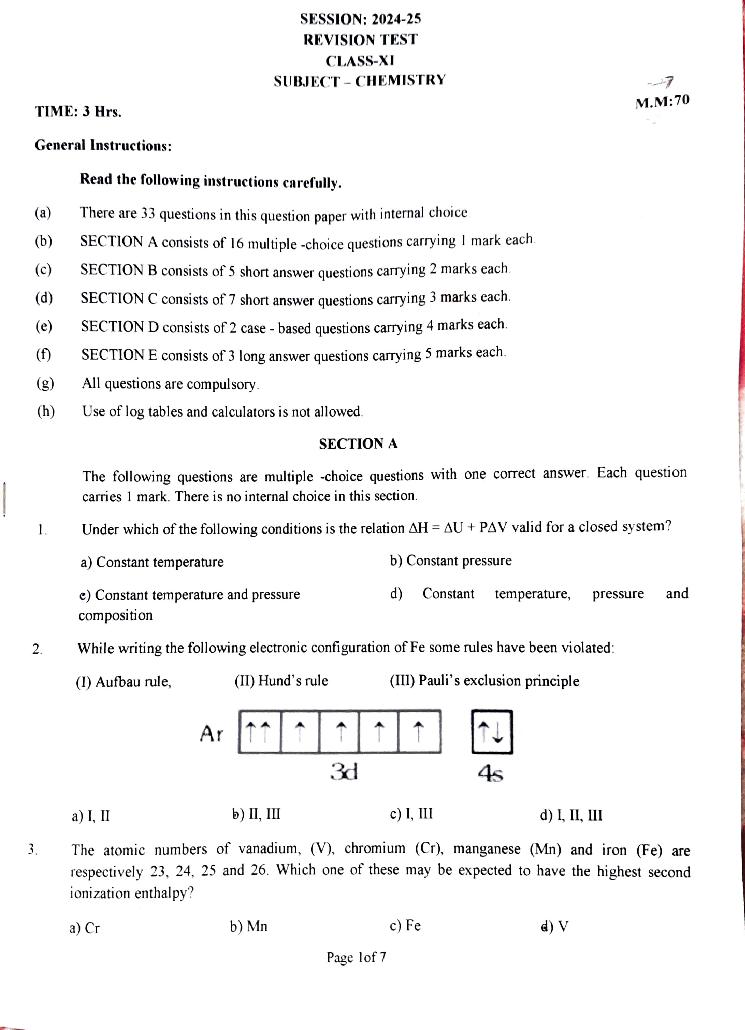
Class 11 Revision Test 2024-25 Question Paper Chemistry – Text
Read the full text of this question paper below — useful to quickly search, copy and reference the content online without downloading the PDF.
📄 View text version (7 pages)
Page 1
REVISION TEST
CLASS-XI
SUBJECT-CHEMISTRY
M.M:70
TIME: 3 Hrs.
Generallnstructions:
Read the following instructions carefully.
(a) There are 33 questions in this question paper with internal choice.
(b) SECTION Aconsists of 16multiple -choice questions carrying I mark each.
(c) SECTION Bconsists of 5 short answer questions carrying 2 marks each.
(d) SECTIONC consists of 7 short answer questions carrying 3 marks each.
(e) SECTION D consists of 2 case - based questions carrying 4 marks each.
() SECTION E consists of 3 1long answer questions carrving 5 marks each.
(g) All questions are compulsory.
(h) Use of log tables and calculators is not allowed.
SECTION A
The following questions are multiple -choice questions with one correct answer. Each question
carries 1 mark. There is no internal choice in this section.
Under which of the following conditions is the relation AH =AU +PAV valid for a closed system?
a)Constant temperature b) Constant pressure
c) Constant temperature and pressure d) Constant temperature, pressure and
composition
2 While writing the following electronic configuration of Fe some rules have been violated:
(1) Aufbau rule, (I) Hund's rule (I) Pauli'sexclusion principle
Ar
3d 46
a) I, II b) II, III c) I, II d) 1, II, I
3 The atomic numbers of vanadium, (V), chromium (Cr), manganese (Mn) and iron (Fe) are
respectively 23, 24, 25 and 26. Which one of these may be expected to have the highest second
ionization enthalpy?
a) Cr b) Mn c) Fe d) V
Page lof 7
Page 2
a) The reactants which undergo oxidation and reduction are called reactant and oxidant respectively
b) InRedox reaction, the oxidation number of oxidant increases while that of reductant decreases
c) HNO2 acts as an oxidising as well as reducing
agent
d) Oxidation is the process in which electrons are lost.
According to Fajan's rule, covalent bond is favoured by
a) Large cation and small anion b) Large cation and large anion
e) Small cation and large anion d) Small cation and small anion
6. Among the following molecules: SO:, SF4, CIFs, BrFs and XeF4, which of the following shapes does
not describe any of the molecules mentioned?
a) Bent b) Trigonal bipyramidal c) See-saw d) T-shape
7
Which of the following is the correct option for free expansion of ideal gas under adiabatic
conditions?
a) q=0, AT<0, w 0 b) q =0, AT=0, w =0
c) q#0, AT= 0, w-=0 d) q =0, AT#0, w=0
Bohr'smodel can explain
a) the solar spectrum b) the spectrum of hydrogen molecule
c) spectrum of any atom or ion containing d) the spectrumof hydrogen atom only
one electron only
IUPAC names of a few esters are given below:
i. Ethyl propanoate ii. Propyl methanoate
iii. Methyl butanoate iv. Ethyl butanoate
The ester(s) which contain(s) ten hydrogen atoms per molecule is/are -
a) ionly b) iv only e)iand ii only d) iand i only
10. For the synthesis of ammonia by the reaction N+3H, 2NH3 in the Haber's process, the attainment
of equilibrium is corectly predicted by the curve:
a) b)
H. H
N
NH,
NH,
time +
time +
Page 2of 7
Page 3
traon
NH, N,
Molar N H
H N
timo tine
Number of o bonds and z bonds in the following structure is
H H
H.
a) 19, 6 b) 20,4 e) 19, 5 d) 20,5
12. Increasing order of electro negativity is -
a) Bi <P<S<CI b) P< Bi <S< CI
c) S < Bi <P<CI d) Cl <S<Bi<P
Given below are two statements labelled as Assertion (A) and Reason (R). Select the most appropriate
answer from the options given below:
(a) Both A and R are true and R is the correct explanation of A
(b) Both Aand R are true but R is not the correct explanation of A.
(c) A is true but R is false.
(d) A is false but R is true.
Assertion (A): Allthe carbon atoms in H2C-C-CH; are sp' hybridised
Reason (R): In this molecule, all the carbon atoms are attached to each other by double bonds.
14. Assertion:Combustion of all organic compounds is an exothermic reaction.
Reason: The enthalpies of allelements in their standard state is zero.
15.. Assertion (A): The equilibrium constant is fixed and characteristic for any given chemical reaction at
a specified temperature.
Reason (R): The composition of the final equilibrium mixture at a particular temperature depends
upon the starting amount of reactants.
16. Assertion (A): Atomic radius of inert gases is largest in the period.
Reason (R): Effective nuclear charge of inert gases is minimum.
Page 3of 7
Page 4
This section contains Squestions with internal choice in one question The followiny
17.
very short answer type and carry 2 marks cach questioS ae
Explain Nucleophile and Electrophile with example
18 Calculate the formal charge on Natom in HNO3molecule.
(2)
OR
Although both CO: and SO; are triatomic molecules the shape of SO2 is bent while that of
Linear. COi(2)n
Using Stock notation,represent the formula ofthe following compounds :
(a) H AuCl4 (b) T(;0
ii)Hydrogen peroxide can act as oxidising agent as wellas reducing agent whereas nitric acid oe
as only oxidant. Give reason.
20. Consider the following reaction: (2
N04(g) 2NO2(g); AH = 58.6 kJ
What willbe the effect of the following changes on the concentration of N;04 at equilibrium
a) Increasing the pressure
b) Increasing the temperature
c) Increasing the volume
d) Adding more NO2(g) to the system without changing the temperature and pressure
21. i) How does acidity of oxides vary on moving along a period in modern periodic table? (1+1)
ii)Write the IUPACname and the symbol of an element with atomic number 104.
SECTION C
This section contains 7 questions with internal choice in one question. The following questions are
short answer type and carry 3 marks each.
22. What volume of 0.250 M HCI(ag) is required to react completely with 22.6g of sodium carbonate
according to the reaction :(3)
NazCOs(s) + 2HCI(aq) ’ 2NaCl (aq) + H;0 + CO:
(At mass of Na =23u, Cl = 35.5u)
OR
of methanol is
22. What is the molality of a solution of methanol in water in which the mole fraction
0.25?
Page 4of7
Page 5
magnetic behaviour (2+1)
Out of MgO and NaCl, which has more lattice energy and why?
24 Balance the given equation in basic medium (3)
Ss(s) +OH(aq) ’ S(aq) +S; 04 (aq)
Show that the difTerence between molar heat capacity at constant pressure and that at constant
volume for one mole of an ideal gas is equal to 8.314 J K'mol'. (2+1)
11) For a reaction both AH and AS are positive. Under what conditions will the reaction occur
spontaneously?
26. )Draw the orbital diagram of ethyl carbocation showing hyperconjugation. (1+1+1)
ii) Supply the curved arrows necessary for the following reactions:
:ö:
H-C-;0: - H H-C +
:ö:-CH:
0-CH; O-H
i) ldentify the electrophilic centre in the following:
a) CH;CH-0 b) CH,CN
27. Write down the electronic configuration of Cu ion and answer the following questions: (1+1+1)
i) What is the number of unpaired electrons in it?
ii) How many electrons in it have n=3 and m=0?
iii) What is the number of electrons in M-subshell?
28 Nitric oxide reacts with Brz and gives nitrosyl bromide as per reaction given below: 2NO(g) + Brz(g)
+ 2NOBr(g)
When 0.087 mol of N0 and 0.0437 mol of Br2 are mixed in a closed container at constant
temperature, 0.0S18 mol of NOBr is obtained at equilibrium. Calculate the equilibrium amount of NO
and Br..
SECTION D
The following questions are case-based questions. Read the case carefully and answer the questions
that follow.
29 We can measure the transfer of heat from one system to another which cause change in temperature.
The magnitude of change in temperature depends upon heat capacity of the substance. The enthalpy
change of reaction remains the same irespective of number of steps is Hess's law. It helps to
calculate enthalpy of formation, combustion and other enthalpy changes. Enthalpy change can also
be calculated by using bond enthalpies. First law gives law of conservation of energy but does not
Page 5of 7
Page 6
give drechon of reaction Sccond law statcs, cntropy of universc is continuously increas1ng due
SpontaneOUs proccssCs taking place in it AH and AS (entropy changc) cannot decide spontancity of
process We need AG (free energy change) which is -ve for spontaneous, tve for non-spontaneOus
AG-0for process in cquilibrium AGis related to cuuilibriumconstant If AG ve, 'K' Is tve and
Vice versa Third law of thermodynamics states the cntropy of perfectly crystall1ne substance is zero
at zero kelvin
a) We can determine AH latlee with the help of cycle Name the cycle. (1+1)
b) How can we calculate enthalpy of solution?
i) AH? of O, CaO, H2 and Hl are +142 2, - 6439, 46, t+25 95 kJ mol Arrange these in
increasing order of stability. ()
OR
ii) For the reaction
2Cl(g) Cla(g), what are the signs of AH and AS. (1)
ii)State second law of thermodynamics. (1)
30.
Equilibrium can be established for both physical and chemical processes and at equilibrium rate of
forward and reverse processes are equal. Equilibrium constant (Ke) is expressed as the concentration
of products divided by reactants, each raised to Stoichiometric Coefficient. K. has fixed value of
constant temperature and at this stage concentration, pressure, etc. become constant. Kp is
equilibr1um constant in terms of partial pressure of gases or vapours. The direction of reaction can be
predicted by reaction quotient Q: and Q, Qe =Ke at equilibrium and Q, =K, Le Chatelier's principle
states 'Equilibrium' will shift in the direction so as to counter balance the effect of change in T, P and
Conc.
i) The equilibrium constant for reaction Na (g) +3H2 (g) = 2NH(g) KËis 49,what is equilibrium
constant K, for NHs(g) 1/2 Na(g)+ 3/2 H2(g)? (2)
ii) How can you show the dynamic nature of equilibrium experimentally? (1)
OR
i) What happens to the equilibrium constant when a catalyst is added? (1)
ii) What is the relation between Ke and K, for the reaction: PCls (g) = PCIs (g) + Ci; (g) (1)
SECTION E
The following questions are long answer type and carry 5 markseach. All questions have an internal
choice.
31. i) Can the absolute value of internal energy be determined? Justify. (1+1+3)
ii) Comment on the spontaneity of areaction at constant temperature and pressure when AH<0 and
AS <0.
iii)Calculate the enthalpy change on freezing of 1.0mol of water at 10.0°C to ice at -10.0°C. AsH®
Page 6of 7
Page 7
75.3 J mol-1 K!
c(H:0(9)) =36.8 J mol' K
OR
(1+1+3)
i)Statethelimitation of first law of thermodynamics.
Give one example in which AH =0but still the reaction is spontaneous.
ii) For oxidation of iron
4Fe(s) + 30:(g) ’ 2Fe2O3 (s)
of this reaction, why
Entropy change 1s -549,4 JK°'mol at 298 K. Inspite of negative entropv change
is the reaction spontaneous?(A,H for this reaction is -1648 kJ mol)
(1+1+3)
i)Under what condition is Kp = Ke ?
ii) What will be the conjugate base of HSOZ?
Hz(g) CHolg). What will be the
ii) Kp = 0.4 atm at 899K for the following reaction: CH4(g) + pressure and allowed to
equilibrium pressure of C2H, when it is placed in a flask at 4.0 atm.
come to equilibrium?
OR
(1+1+3)
i) Classify the following species into Lewis acid and Lewis bases:
OH, F, H, BCI,
equilibrium constant Kç?
ii) When does the reaction quotient Q. become equal to the
K and allowed to attain equilibrium:
ii) 13.8 g of N204 was placed in in a 1 L reaction vessel at 400
9.15 bar. Calculate Kc,
N204(g) 2N02 (g). The total pressure at equilibrium was found to be
Kp and partial pressure at equilibrium.
33. Attempt any five of the following:
does not?
i) Cl; show disproportionation reaction while F2
ii) Give an example of non-metal displacement reaction.
redox reaction. Why?
ii) Decomposition of CaCO; to form CaO and CO2 is not a
iv) Calculate the oxidation number of S in H,SO4.
in the reaction?
v) What is change in oxidation state of the element which gets oxidised
vi) What is the change in oxidation number of Carbon in the following reaction? CHA(g) + 4Clh(g)
’CCl.() +4HClg)
vii) Wite the correct increasing order of electron releasing tendency of the metals Cu, Ag and Zn.
Page 7of 7
Document Details
| Board / Org | AglaSem |
| Exam | Class 11 |
| Type | Question Paper |
| Pages | 7 |
| Updated | 29 Aug 2026 |