NIOS Class 12 Syllabus 2023 Painting
Finished viewing? Save it for later —
Download NIOS Class 12 Syllabus 2023 Painting (PDF · 6 pages)About NIOS Class 12 Syllabus 2023 Painting
NIOS Class 12 Syllabus 2023 Painting is available here for free download. Published by NIOS for National Institute of Open Schooling Class 12, this syllabus can be viewed online or downloaded as a PDF (6 pages). Candidates preparing for National Institute of Open Schooling Class 12 can use NIOS Class 12 Syllabus 2023 Painting to understand the exam pattern, the type of questions asked, and the overall difficulty level.
Frequently Asked Questions
How can I download NIOS Class 12 Syllabus 2023 Painting?
Open this page and click the Download button to save NIOS Class 12 Syllabus 2023 Painting as a PDF. It is completely free on AglaSem Docs.
Is NIOS Class 12 Syllabus 2023 Painting free to download?
Yes. NIOS Class 12 Syllabus 2023 Painting can be viewed online and downloaded as a PDF free of cost on AglaSem Docs.
How many pages does NIOS Class 12 Syllabus 2023 Painting have?
NIOS Class 12 Syllabus 2023 Painting contains 6 pages, which you can read online or download together as a single PDF.
Where can I find more National Institute of Open Schooling Class 12 study material?
You can find more National Institute of Open Schooling Class 12 question papers, sample papers, syllabus, and answer keys on AglaSem Docs.
NIOS Class 12 Syllabus 2023 Painting – Text
Read the full text of this syllabus below — useful to quickly search, copy and reference the content online without downloading the PDF.
📄 View text version (6 pages)
Page 1
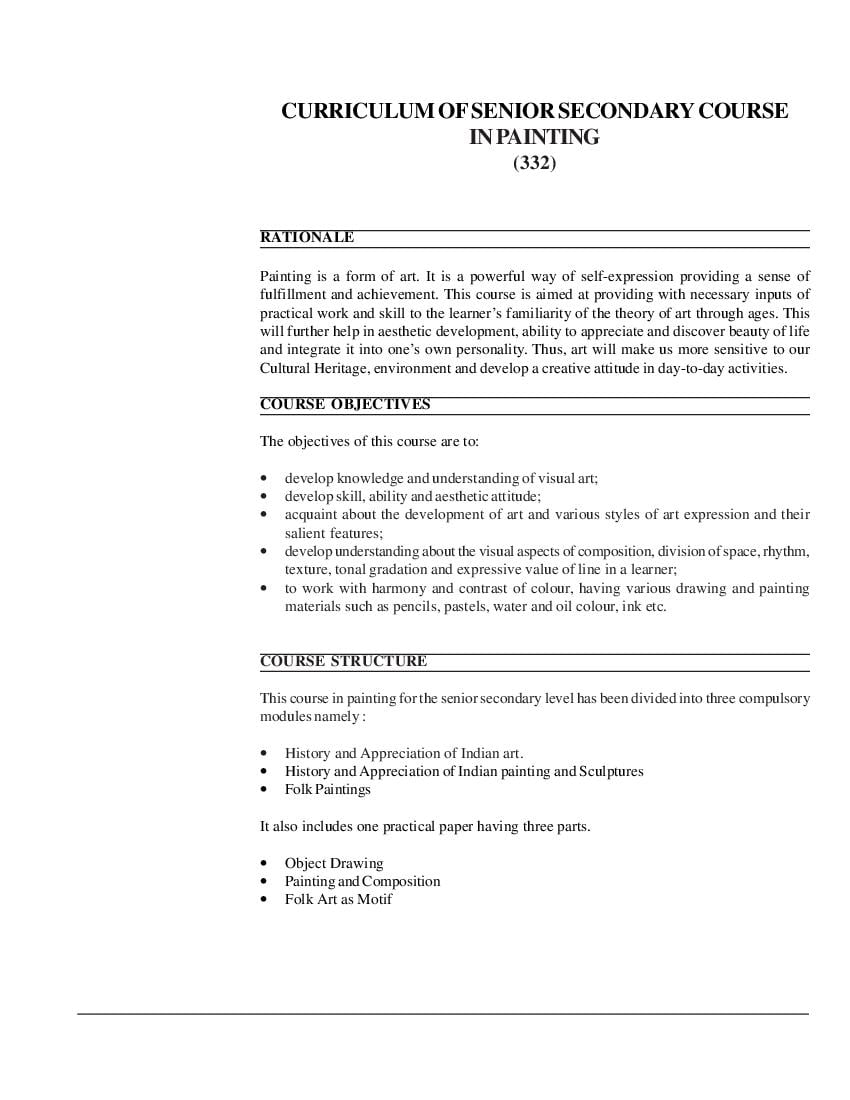
IN PAINTING
(332)
RATIONALE
Painting is a form of art. It is a powerful way of self-expression providing a sense of
fulfillment and achievement. This course is aimed at providing with necessary inputs of
practical work and skill to the learner’s familiarity of the theory of art through ages. This
will further help in aesthetic development, ability to appreciate and discover beauty of life
and integrate it into one’s own personality. Thus, art will make us more sensitive to our
Cultural Heritage, environment and develop a creative attitude in day-to-day activities.
COURSE OBJECTIVES
The objectives of this course are to:
• develop knowledge and understanding of visual art;
• develop skill, ability and aesthetic attitude;
• acquaint about the development of art and various styles of art expression and their
salient features;
• develop understanding about the visual aspects of composition, division of space, rhythm,
texture, tonal gradation and expressive value of line in a learner;
• to work with harmony and contrast of colour, having various drawing and painting
materials such as pencils, pastels, water and oil colour, ink etc.
COURSE STRUCTURE
This course in painting for the senior secondary level has been divided into three compulsory
modules namely :
• History and Appreciation of Indian art.
• History and Appreciation of Indian painting and Sculptures
• Folk Paintings
It also includes one practical paper having three parts.
• Object Drawing
• Painting and Composition
• Folk Art as Motif
Page 2
COURSE DESCRIPTION
Module – 1 : History and Appreciation of Indian art.
(From 2500 B.C. to 16th Century A.D.)
Approach :
The art objects, belonged to Indus Valley Civilization, are the only available earliest evidence
of great tradition of India. The nature form of these art works help us to imagine that
tradition of Indian art must have begun long before 2500 B.C. Changing condition of politics
and religions kept on motivating Indian art through the ages from 4th C. B.C. to 16th C.
A.D., leaving a missing link for approximately 1000 yrs from post Indus Valley civilization to
Mauryan period. Indian Art under the patronage of Hindu, Muslim, Buddhist and Jain rulers,
flourished till 16th C. A.D. to face a new era of art movement after the Mughals became the
rulers of India.
Unit 1.1 Art of Indus Valley Civilization
(Harappan and Mohen-jo-daro 2500 B.C. to 1750 B.C.).
Brief introduction and appreciation supported with drawing, maps, and pictures of the
following art objects:
Objects Collection
• Mother Goddess National Museum, Delhi
• Seal with Bull Design National Museum, Delhi
• Painted Pottery National Museum, Delhi
• Jewellery (necklace) National Museum, Delhi
• Mother Goddess
• Seal with Bull Design
• Painted Pottery
• Jewellery (necklace)
Unit 1.2: Art of Mauryan to Gupta Period
(4th Century B.C. to 6th Century A.D.)
Brief introduction and appreciation supported with drawing and pictures of the following
art objects:
Objects Collection
• Lion Capital Sarnath Museum
• Chauri Bearer (Yakshi) Patna Museum
• Stupa I at Sanchi Sanchi, Madhya Pradesh
• Lord Mahavira – Jain Tirthankara National Museum, U.P.
• Seated Buddha (Gandhara Style) Sarnath Museum, Madhya Pradesh
• Seated Buddha Government Museum, Mathura
Page 3
• Nataraja, (Cosmic dance of lord Shiva
• Dokra Casting (Trible Bronze casting)
• Triumph of Labour
Unit 1.6 : Indo – Islamic Architecture
(From 12th Century A.D. to 17th Century)
Brief introduction and appreciation supported with drawing, and pictures of the following
heritages/monuments.
Pictures Place
• Qutab Minar Delhi
• Taj Mahal Agra
• Gol Gumbaz Bijapur
• Qutab Minar
• Taj Mahal
• Gol Gumbaz
Module – 2 : History and Appreciation of Indian paintings and Sculptures
(From 16th Century A.D. Pioneers to Contemporary Art Movements)
Approach :
The 16th century saw a profound change in the stylistic development of Indian art. Art of
miniature painting became very popular in Rajputana and in the court of the Mughals. It also
influenced the South Indian painters.
The muslim rulers were great admirers of architecture. They enriched Indian art with superb
structures, including one of the wonders of the world, Taj Mahal.
Under the British rule, the character of Indian art underwent a thorough change. Beside
the painters like self-taught artist Raja Ravi Verma, many Indian artists followed the realistic
style of European art. On the other hand, Abanindranath Tagore and his Bengal school
tried to bring back classical Indian style with contemporary themes and Jamini Roy
modernised the folk style of India. Amrita Shergil, with her Parsian art education, was the
most influential painter in contemporary art scene, while Rabindranath Tagore visualised
the most modern aesthetics in his painting. These pioneers inspired the next generation of
Indian artists to discover their identity in the filed of international art.
Unit 2.1: Mughal School
(From Akbar to Bahadur Shah II)
Brief introduction and appreciation of the following Miniature Paintings:
Paintings Artist Collection
• Bird catching at Baran Bhag National Museum, Delhi
Page 4
• Tanjore Painting Unknown National Museum, Delhi
• Nizamuddin Awaliya and Amir Khusrau
• Tanjore Painting
Unit 2.5: Company School
Brief introduction and appreciation of the following Paintings:
Paintings Artist Collection
• A group of Kashmiri Artisans Unknown National Museum, Delhi
• The Bird Unknown National Museum, Delhi
• A group of Kashmiri Artisans
• The Bird
Unit 2.6: Pioneers of Contemporary Art Movements in India
Brief introduction and appreciation of Paintings in the modern era :
Paintings Artist Collection
• Ravana and Jatayu Raja Ravi Varma National Museum, New Delhi
Bengal School
• Radhika Abanindra Nath Tagore National Gallery of Modern Art, New Delhi
• Sri Chaitanaya under
Garud Stambha Nand Lal Bose National Gallery of Modern Art, New Delhi
• Crucifixion Jamini Roy National Gallery of Modern Art, New Delhi
• Ravana and Jatayu
• Radhika
• Sri Chaitanaya under Garud Stambha
• Crucifixion
Unit 2.7: Contemporary Arts of India
Brief introduction and appreciation of Paintings in modern era:
Paintings Name of the Artist Collection
• Women Face Rabindranath Tagore National Gallery of Modern Art, New Delhi
• Adornment of Bride Amrita Shergil National Gallery of Modern Art, New Delhi
• Santhal Family (Sculpture) Ram Kinker Baij National Gallery of Modern Art, New Delhi
• Mother Teresa M.F. Hussain National Gallery of Modern Art, New Delhi
• Thorn Prick N.S. Bendre National Gallery of Modern Art, New Delhi
Page 5
PRACTICAL
Part I : Object Drawing `Study hours : 65 Marks : 20
(1) Object Study
(2) Nature Study
Approach:
Awareness of Fundamentals of Drawing like space, line, tone, volume, perspective, light,
and shade, etc. through simple experimental exercises. Study of two or three simple objects
including natural and geometrical be arranged together and composed on a given format
either vertically or horizontally.
Simple objects based on geometrical shapes could include, for example, jug, tumbler, basket,
plate, bottle, kettle, vase, book, magazine, cup and box etc. of a variety of materials like
terracotta, ceramics, cane, glass, paper, wood, plastic, drapery, leather and metal
etc. Natural forms locally available like fruits, vegetables, flowers, leaves, twigs, etc. are
to be used. Select any two or three on given objects.
Materials to be used: Drawing paper-1/2 imperial size or (15”/11” approximate size);
Various grades of pencils (soft lead); eraser; colours- Oil pastels, water colours and ink;
various grades of flat / round brushes;
Part II : Painting and Composition Study hours : 65 Marks : 20
(3) Fundamentals of Painting
(4) Composition
(5) Sketching from Life and Memory
Approach:
Free hand drawing directly from life of Human Figures, Animals, Trees, Building, Interior
of a Room, Bus stop, Market Place, Vehicles, etc. Paint on a given topics like e.g. Festival,
Fair, Railway station, Man reading a book or newspaper, Playing with your pet, Eating
out, Night scene, Rainy day, wedding, Gram Panchayat, Pollution, Library, Mother &
Child etc. using imagination and everyday sketches.
Starting with Basic Design and various Experiments to understand variety in forms
and overlapping, their simplification, colour wheel, variety in colour, hue, tone and texture,
rhythm and continuity in application, concept of far etc. all brought together meaning
fully in a composition. (Select any one on given topics).
Materials to be used: Drawing paper-1/2 imperial size or (15”/11” approximate
size); Various grades of pencils (soft lead); eraser; colours- Oil pastels, water colour and
ink; various grades of flat / round brushes;
Page 6
SCHEME OF EVALUATION
Mode of Evaluation Duration in hours Marks Parts
Theory 1½ 30 1
Practical (Three Papers) 2½
Part I : Object Drawing 20 1
• Composition and Drawing 8
• Treatment of Media 8
• Overall impression 4
Part II : Painting and Composition 2½ 6 20 1
• Compositional arrangement including
emphasis on the subject expressed 8
• Treatment of media 8 70
• Overall impression 4
Part III : Folk Art as Motif 1 15 1
• Design and Layout 10
• Overall impression 5
Portfolio Submission 15
• Complete work 5
• Quality of work Self paced 5
• Presentation 5
Total 7½ 100 4
Document Details
| Board / Org | NIOS |
| Exam | National Institute of Open Schooling Class 12 |
| Type | Syllabus |
| Pages | 6 |
| Updated | 22 Jul 2026 |