AP TET 2022 Question Paper II Social Studies
Finished viewing? Save it for later —
Download AP TET 2022 Question Paper II Social Studies (PDF · 61 pages)About AP TET 2022 Question Paper II Social Studies
AP TET 2022 Question Paper II Social Studies is available here for free download. Published by Andhra Pradesh Exams for Andhra Pradesh Teacher Eligibility Test, this question paper can be viewed online or downloaded as a PDF (61 pages). Candidates preparing for Andhra Pradesh Teacher Eligibility Test can use AP TET 2022 Question Paper II Social Studies to understand the exam pattern, the type of questions asked, and the overall difficulty level.
Frequently Asked Questions
How can I download AP TET 2022 Question Paper II Social Studies?
Open this page and click the Download button to save AP TET 2022 Question Paper II Social Studies as a PDF. It is completely free on AglaSem Docs.
Is AP TET 2022 Question Paper II Social Studies free to download?
Yes. AP TET 2022 Question Paper II Social Studies can be viewed online and downloaded as a PDF free of cost on AglaSem Docs.
How many pages does AP TET 2022 Question Paper II Social Studies have?
AP TET 2022 Question Paper II Social Studies contains 61 pages, which you can read online or download together as a single PDF.
Where can I find more Andhra Pradesh Teacher Eligibility Test study material?
You can find more Andhra Pradesh Teacher Eligibility Test question papers, sample papers, syllabus, and answer keys on AglaSem Docs.
AP TET 2022 Question Paper II Social Studies – Text
Read the full text of this question paper below — useful to quickly search, copy and reference the content online without downloading the PDF.
📄 View text version (60 pages)
Page 1
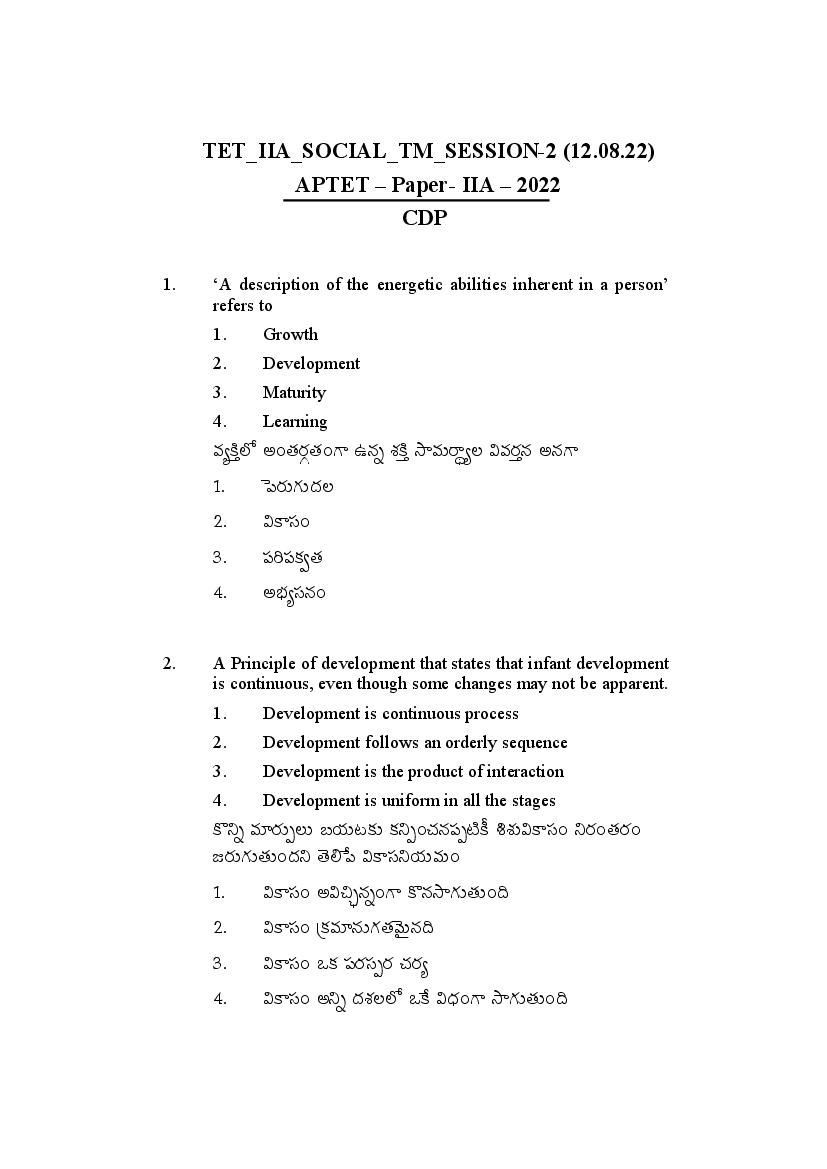
APTET – Paper- IIA – 2022
CDP
1. ‘A description of the energetic abilities inherent in a person’
refers to
1. Growth
2. Development
3. Maturity
4. Learning
e«¿ìïýË n+ÔásÁZÔá+>± q Xø¿ìï kÍeTs«\ $esÁïq nq>±
1. |sÁT>·T<\
2. $¿±d+
3. |]|¿£ÇÔá
4. nuó«dq+
2. A Principle of development that states that infant development
is continuous, even though some changes may not be apparent.
1. Development is continuous process
2. Development follows an orderly sequence
3. Development is the product of interaction
4. Development is uniform in all the stages
¿= eÖsÁTÎ\T jáT³Å£ ¿£Î+#áq|Î{ì¿¡ ¥Xø$¿±d+ sÁ+ÔásÁ+
ÈsÁT>·TÔáT+< Ôî*| $¿±djáTeT+
1. $¿±d+ n$ºÌÛq+>± ¿=qkÍ>·TÔáT+~
2. $¿±d+ ç¿£eÖqT>·ÔáyîT®q~
3. $¿±d+ ÿ¿£ |sÁdÎsÁ #ásÁ«
4. $¿±d+ n <Xø\ýË ÿ¹¿ $<ó+>± kÍ>·TÔáT+~
Page 2
1. Temperature
2. Home Environment
3. Social Environment
4. Mother’s womb
ç¿ì+~ yýË ÈqH+ÔásÁ |]ds+Á ¿±~
1. cþç>·Ôá
2. >·V² yÔesÁDÁ +
3. kÍ+|T¾ ¿£ yÔesÁD+
4. Ôá*¢>·sÁÒÛ+
4. Age of ‘Ambiguity’
1. Early Childhood
2. Later Childhood
3. Adolescence
4. Infancy
d+~>·Æ ejáTdT
1. |PsÁÇ u²\«<Xø
2. Ôásï Á u²\«<Xø
3. ¿eÖsÁ <Xø
4. XèXÕ eø <Xø
Page 3
isolation’ stage is
1. Play age
2. School age
3. Early Adulthood
4. Later Infancy
m]¿ù b]¿£àH ç|¿±sÁ+ »dV¾²Ôá+`@¿±+Ôá+µ nHû kÍ+|T¾ ¿£ ¿ìw¢ ¼
|]d¾Ü
>·\ <Xø
1. ç¿¡& <Xø
2. bÍsÄXÁ æ\ <Xø
3. |PsÁÇ ejîÖÈq <Xø
4. Ôásï Á XèXÕ eø +
6. The author of ‘Mental Test and its Measurements’
1. Galton
2. Mckeen Cattell
3. Clifford Beers
4. John Dewey
»yîT+³ýÙ fÉd¼t n+& {Ùà yîTÈsYyTî +{Ùµ ç>·+<¸ sÁ#sá TTÔá
1. >±\¼H
2. yîT¿ù¿H¡ ¿³ýÙ
3. ¿ì¢|sY¼ ;sYà
4. C²H &Ö«sTT
Page 4
‘Reven’s Standard Progressive Test’
1. Non verbal test
2. Group test
3. Performance test
4. Paper pencil test
ç¿ì+~ yýË »seHà kͼ+&s¦Y çbþçÂ>d¾dµt |jÖî Ð+#á ç|C²ã|¯ ¿£
1. nXæ_Æ¿£ |¯¿£
2. kÍeTÖV¾²¿£ |¯¿£
3. cÍÎ<q |¯¿£
4. ||sY |àýÙ |¯¿£
8. ‘A teacher who likes the students well, the statement refers to
that teacher will be liked by the students’
1. Aptitude
2. Attitude
3. Interest
4. Friendly nature
»@ bÍ<ó«jáTT&îÔ
Õ û Ôáq $<«sÁT\ qT u²>± w¼|& ÔsÃ,
bÍ<ó«jáTT&T $<«sÁT\ +<sÖÁ w|¼ & Ô
sÁTµ y¿£«+
dÖº+#û~
1. dV²È kÍeTsÁ«+
2. yîKÕ ]
3. n_ósÁTº
4. dV² dÇuó²e+
Page 5
is not good’ the situation refers to
1. Displacement
2. Projection
3. Withdrawal
4. Compensation
»|¯¿£ýË Ôá|ξ q $<«], Ôáq bÍ<ó«jáTT uË<óq d]>± ýñ<q &+µ
nHû~
1. $kÍ|q +
2. ç|¿¹ | D +
3. |d+ V²sÁD
4. |]VäsÁ+
10. According to Guilford, the co-ordinated result of 5´5´6 = 150
factors refers to intelligence. In this the number ‘6’ related to
1. Content
2. Operations
3. Products
4. General factors
ÐýÙ|sY¦ ç|¿±sÁ+ 5´5´6 = 150 ¿±sÁ¿±\ d+jáTT¿£ï ç|u²ó eyûT ç|Èã
¿£Ø& »6µ nHû~
1. $wjáÖ\T
2. ç|#\¿±\T
3. ÔáÎÔáT\ï T
4. kÍ<ósÁD ¿±sÁ¿±\T
Page 6
1. Problem solving learning
2. Activity based learning
3. Trail and error learning
4. Learning through imitation
yî¿Õ ±]jáTdt yîÖ&*+>´ nqTq~
1. deTkÍ« |]cÍØsÁ nuó« dq+
2. ¿£Ôá«<ósÁ nuó«dq+
3. jáTÔá<Ãw nuó«dq+
4. nqT¿£sÁD nuó«dq+
12. According to Ebbinghaus the percentage of forgetting of the
learnt material of an individual at the end of the sixth day is
m_Ò+>´V² dt ç|¿±sÁ+, sÁe sÃE ºe]ýË ÿ¿£ e«¿ìï HûsÁTÌÅ£q
$wjÖá \qT eTsÁºbþjûT XæÔá+
1. 50%
2. 25%
3. 75%
4. 100%
Page 7
select for UPSC. This is
1. Intrinsic Motivation
2. Extrinsic Motivation
3. Achievement Motivation
4. Objective motivation
MTsÁT jáTT.|¾.bdt.d¾.¿ì m+|¾¿¿£ ±e\ MT Ôá+ç&>±sÁT sÁs TT+ºq+<TÅ£
MTsÁT ¿£w|¼ & #á<T eÚÔáTHsÁT. ~
1. n+ÔásÁZÔá ç|sÁD
2. V¾²sÁÔ Z á ç|sÁD
3. kÍ<óqá ç|sÁD
4. \¿±«Ôá¿£ ç|sÁD
14. Collaborative learning is a part of
1. Vygotsky’s theory
2. Bruner’s theory
3. Bandura’s theory
4. Kohler’s theory
uó²>·kÍÇeT« nuó« dq+ +<TýË uó²>·+
1. yî>Õ ±{ÙdØÓ d¾<Æ+Ôá+
2. çÖqsY d¾<Æ+Ôá+
3. +&Ös d¾<Æ+Ôá+
4. ¿ÃV²\sY d¾<Æ+Ôá+
Page 8
created by
1. Gesell
2. Skinner
3. Garret
4. Piaget
ºq |¾\¢\ ç|esÁïqqT n<ó«jáTq+ #ûjáT&¿ì »»n¨¹sÇwH &Ã+µµ qT
sÁÖbõ+~+ºq~
1. >Â dýÙ
2. d¾ØqsY
3. ¹>sÁ{Ù
4. |¾jáÖCñ
16. The best method to study a person with a problem is
1. Experimental
2. Observation
3. Case study
4. Problem Solving
deTkÍ«|P]Ôá e«¿ìï mqT¿= y n<ó«jáTH¿ì dÂsÕq |<ÆÜ
1. ç|jÖî >±Ôá¿£
2. |]o\q
3. e«¿ìï n<ó«jáTq
4. deTkÍ« |]cÍØsÁ
Page 9
about a subject or activity is said to be
1. Experience
2. Interest
3. Attitude
4. Motivation
ÿ¿£ $wjTá + ýñ< ÿ¿£ ¿£Ôá«+ >·T]+º ÿ¿£ e«¿ìï¿ì nÜ eTTK«eT|¾+#û
nqTuóÖ Ü ý² n+{²sÁT.
1. nqTuóe +
2. n_ósÁTº
3. yîÕK]
4. ç|sÁD
18. The person who popularized the concept of ‘Emotional
Intelligence”
1. Freeman
2. Bingham
3. Gardener
4. Golman
»<ûÇ>±Ôá¿£ ç|Èãµ nHû uó²eqqT çbÍ#áTsÁ«+ýË¿ì ÔîºÌq y&T
1. ç|eÓ TH
2. _+>´Vä+
3. >±]¦qsY
4. >ÃýÙeTH
Page 10
experimental psychology is
1. On Memory
2. Educational Determinism
3. Animal Intelligence
4. The Mentality of Apes
ç|jîÖ>±Ôá eTHÃ$C²ãq+ýË ÿ¿£ yîT\® TssTT>· >·T]ï+|Ú
bõ+~q ç>·+<¸+
1. H yîTyîTT]
2. m&T«¹¿wqýÙ &³]È+
3. neTýÙ +fÉ*CÉHà
4. ~ yîT+{²*{¡ |t @|tà
20. A state of deviation where the difference between the Normal
Distribution Curve (NDC) and the data curve is greater is
called
1. Standard deviation
2. Kurtosis
3. Mean deviation
4. Skewness
kÍeÖq« d+uó²e«Ôá eç¿£¹sK (NDC)Å£ <Ôï+Xø eç¿£s¹ KÅ£ eT<ó«
yî|Õ ¯ Ôá«+ n~ó¿+£ >± +&û $#á\q d¾Ü
ý² n+{²sÁT.
1. çbÍeÖDì¿£ $#áq\+
2. ţţ<Ôá
3. n+¿£eT<« $#á\q+
4. yîÕweT«+
Page 11
1. Magnetic Disks
2. Hard disks
3. Microphone
4. Speakers
¿ì+~ yýË H|Ú{Ù |]¿£sÁ+
1. eÖÂ>{ì¿ù &dtØà
2. VäsY¦ &dØt
3. yîT®ç¿ÃbþH
4. dÓο£sàY
22. One of the following is not characteristic of learning
1. Learning is a transferable process
2. Learning is a lifelong process
3. Learning is purposeful
4. Learning is a activity for appreciation
¿ì+~ y{ìýË nuó« dq \¿£D
+ ¿±~
1. nuó« dq+ <ý²sTT+#á&û ç|ç¿ìjTá
2. nuó« dq+ J$Ô+Ôá+ È]¹> ç|ç¿ìjáT
3. nuó«dq+ ç|jîÖÈHÔá¿£yîT®q~
4. nuó« dq ç|ç¿ìjTá ç|X+ø d ¿Ãd+ È]|¿£Ôá«+
Page 12
ECCE $d]
ï +#á>±
1. Early Childhood Community Education
2. Early Childhood Community and Education
3. Early Childhood Care Education
4. Early Childhood Care and Education
24. Dry ration means
1. Rice, eggs and chikki
2. Rice, dal and eggs
3. Eggs, dall and chikki
4. Rice, dal and vegetables
ç&îÕ s¹ wH nq>±
1. _jáT«+, >·T&T,¢ º¿ìØ
2. _jáT«+, ||Ú Î, >·T&T¦
3. >·T&T¢, ||ÚÎ, º¿ìØ
4. _jáT«+, ||Ú Î, Å£LsÁ>±jáT\T
25. Rubrics is a
1. Mobile Application
2. Anti virus
3. Scoring tool
4. Virus
sÁÖç_¿ùà nqTq~ ÿ¿£
1. yîÖuÉÕýÙ n|¾¿¹¢ wH
2. jáÖ+{ì yîsÕ dÁ t
3. kþØ]+>´ kÍ<óq+
4. yîsÕ Ádt
Page 13
1. Samuel Kirk
2. Binet
3. Valentin Hauy
4. Termon
»nuó« dq yî¿Õ \£ «+µ nHû |< |jÖî Ð+ºq eÖqd¾¿£ Xæçdyï Ô
û ïá
1. XæeTÖ«ýÙ ¿ìsYØ
2. _Hî{Ù
3. yýÉ+{¡H VA«
4. fÉsÁH
27. Geeta a four years old girl talks to herself about the ways she
can proceed on the task. According to Vygotsky such private
speech is a sign of
1. Psychological disorder
2. Cognitive immaturity
3. Self regulation
4. Ego-centricism
H\T¹>Þøß ejáTdTýË q ^Ôá ÿ¿£ | ¿=qkÍÐ+#á>\· eÖsZ\
>·T]+º ÔáqýË ÔHû eÖ{²¢&T Å£+³T+~. yî>Õ ±{ÙdØÓ ç|¿±sÁ+
e«¿ì>ï Ô
· á ç|d+ >·+ B¿ì d+¿¹ Ôá+
1. eÖqd¾¿£ sÁT>·Ôá
2. n_óC²ã n|]|¿Ç£ Ôá
3. dÓÇjáT eÖsÁZ<sÁô¿£ÔáÇ+
4. >à dç{ìd¾ÈyT
Page 14
1. Assessing a project
2. Assessing during the class
3. Assessing at the end of the term
4. Assessing at the end of the lesson
d+ç>·V² D²Ôá¿£ eT~+|Ú jîTT¿£Ø \¿£D +
1. çbÍCÉÅ£ q¼ T eT~+|Ú #ûjTá &+
2. Ôás>Á Ü · ÈsÁT>·TÔáTq deTjáT+ýË eT~+|Ú#ûjTá &+
3. ¯Ôá deTjáT+ eTTÐ+|ÚýË eT~+|Ú #ûjTá &+.
4. bÍsÄ+Á ºesÁýË n+#áH yûjTá &+
29. Computer based learning is a
1. Teacher centered method
2. Content centered method
3. Assessment centered method
4. Learner centered method
¿£+|P«³sY <ó]Ôá nuó«dq+ nHû~
1. bÍ<ó«jáT ¿¹ +çB¿£Ôá |<Ü Æ
2. $wjÖá ¿¹ +çB¿£Ôá |<Ü Æ
3. eT~+|Ú ¿¹ +çB¿£Ôá |<Ü Æ
4. nuó²«d¾ ¿¹ +çB¿£Ôá |<Ü Æ
Page 15
She is writing the main points on the blackboard. While
teaching the students are listening with attention. It is….
1. Demonstration Method
2. Lecture Method
3. Inductive Method
4. Deductive Method
6e Ôás>Á Ü · ¿ì »eTq VäsÁ+µ nHû dÕHà $wjÖá bÍ<ó«jáTTs\T
uË~ódT Hï sÁT. yîTç|<ó q n+Xæ\qT u²¢¿ù uËsY¦ |Õ sd¾ uË~ódT Hï sÁT.
$<«sÁT\ T çXø<>Æ ± $+³THsÁT. ~
1. ç|<s ôÁ H |<Ü Æ
2. |H«d |<ÜÆ
3. >·eTq |<Ü Æ
4. >·eTq |<Ü Æ
Page 16
31. ¿ì+~ |<« #á~$, ç|XøÅ£ ÈyT >·T]ï+#á+&.
m+Ôá #î*$TjáTTq m>·Ô[ #ûjáTÅ£
dsÁdeT+Ôá q+Ôá $sÁdeT>·TqT
eÖ³ C²ÂsHû eT] rdT¿ÃýñeTT
Ôî*d¾ yîT\T>·TeTjáT« Ôî\T>·T_&¦
Ôî\T>·T_&¦ eTÅ£³+ÔÃ |<«+ sdysÁT.
1. HsÁ¢ ºsÁ+J$
2. ¿£sÁTDl
3. HsÁ¢ yû+¿£fñXøÇsÁseÚ
4. <îÝq
32. ¿ì+~ |<« #á~$, ç|XøÅ£ ÈyT >·T]ï+#á+&.
m+Ôá #î*$TjáTTq m>·Ô[ #ûjáTÅ£
dsÁdeT+Ôá q+Ôá $sÁdeT>·TqT
eÖ³ C²ÂsHû eT] rdT¿ÃýñeTT
Ôî*d¾ yîT\T>·TeTjáT« Ôî\T>·T_&¦
|<«+ B >·T]+º #îTÔÃ+~
1. dV²+ >·T]+º
2. eÖ³rsÁT >·T]+º
3. w+¼ >·T]+º
4. C²ãq+ >·T]+º
Page 17
1855ýË ºqjáTdÖ] u²\y«¿£sD Á + e#ûÌ<¿± e#áq sÁ#qá ¿=~Ý>±
È]ÐH ¥w¼ y«eVä]¿£+ýË +&û~. ÔásÁTyÔá |]d¾Ü eÖ]
ç>±+~¸¿£ e«eVä]¿Ã<«eÖ\T jáT\T<ûs&Á + Ôà Ôî\T>·TýË e#áq
sÁ#qá Å£+³T|&~¦ . <óT ¿£ uó²wÅ£ >·TsÁC²&, Ð&T>·T\T |³T¼
>=eTýÉHÕ sÁT. ÿ¿£ yîÕ|Ú d+|T d+dØsÁ>ï ±, eTs=¿£y|Õî Ú sÁ#sá TTÔá>±
|sÁT yîÖd¾q l M¹sXø*+>·+ |+ÔáT\T>±sÁT Ôî\T>·TýË $$<ó kÍV¾²Ôá«
ç|ç¿ìjTá \qT ÔîºÌ|{²¼sTÁ .
»u²\ y«¿£sÁD+µ sÁº+ºq~
1. >·TsÁC²& nbÍÎseÚ
2. ¿£+<TÅ£L] M¹sXø*+>·+
3. Ð&T>·T seTÖ]ï
4. ºqjáTdÖ]
34. ¿ì+~ >·<« #á~$, ç|Xø Å£ ÈyT >·T]ï+#á+&.
1855ýË ºqjáTdÖ] u²\y«¿£sD Á + e#ûÌ<¿± e#áq sÁ#qá ¿=~Ý>±
È]ÐH ¥w¼ y«eVä]¿£+ýË +&û~. ÔásÁTyÔá |]d¾Ü eÖ]
ç>±+~¸¿£ e«eVä]¿Ã<«eÖ\T jáT\T<ûs&Á + Ôà Ôî\T>·TýË e#áq
sÁ#qá Å£+³T|&~¦ . <óT ¿£ uó²wÅ£ >·TsÁC²&, Ð&T>·T\T |³T¼
>=eTýÉHÕ sÁT. ÿ¿£ yîÕ|Ú d+|T d+dØsÁ>ï ±, eTs=¿£y|Õî Ú sÁ#sá TTÔá>±
|sÁT yîÖd¾q l M¹sXø*+>·+ |+ÔáT\T>±sÁT Ôî\T>·TýË $$<ó kÍV¾²Ôá«
ç|ç¿ìjTá \qT ÔîºÌ|{²¼sTÁ .
»Å£+³T|&¦~µ n+fñ nsÁ+
1. eTT+<T |&~¦
2. yîq¿£&+~
3. eÖsÁTÎ #î+~+~
4. ¿=qkÍÐ+~
Page 18
eT+#á+ ` bõ&T|ÚÅ£ $&T|Ú.
1. qT\¿£ eT+#á+
2. uóÖ$T
3. eTw¾
4. ¿=+&
36. »>·TD+µ |<¿ì $¿£Ü
1. >=q+
2. >·THî+
3. >·TD+
4. >·ÖD+
37. »|ÚsÁ+ç~óµ |<¿ì eÚ«ÔáÎÔáï«sÁ+
1. |ÚsÁ+ýË |Ú{ìq¼ ~
2. |ÚsÁ+ýË Ü]¹>~
3. >·Vä <ó] +#û~
4. |ÚsÁ+ýË |Ú³¼~
38. »¿ìܵ n+fñ
1. ¿=d
2. uóÖ$T
3. ¿£e T
4. ç¿Ã<ó+
Page 19
1. ¹>jáT+
2. e#áq+
3. e#áq ¿£$Ôá
4. |<«+
40. »ÔÞøßbÍ¿£ y] ý²*, Ôá]>=+&eT VäsÁܵ nHû~ ÿ¿£
1. C²rjáT+
2. HqT&
3. dÖÎ]ï
4. H<+
41. q\¢ sÞøßÅ£ ¥*Î MT< ¿£ÔáCãÔá +&*. n Ôî*|¾q ¿£$
1. $XøÇH<¸ dÔ«á HsjáTD
2. #ûeTÅ£LsÁ yî+¿£³¿£$
3. |Ú³¼|] ï HsjáTD#sÁT«\T
4. >·TiÀ+ C²w§y
42. ¿={ìq¼ |¾+&, |Ú¿ìس |ÚsD+ $
1. kÍyîTÔá\T
2. C²rjáÖ\T
3. bõ&T|Ú¿£<\¸ T
4. H<\T
Page 20
1. |¿Øì n|Î\ qsÁdj Tá «
2. HsÁ¢ ºsÁ+J$
3. Xâw|ο£$
4. @qT>·T\¿£ D¿£$
44. »{ìvÙ |+&T>·µ çbÍ+Ôá+ Ð]ÈqT\T ÈsÁT|ÚÅ£+{²sÁT.
1. $XæK, $ÈjáTq>·s+Á
2. lXè\Õ +
3. ÜsÁT|Ü
4. ç|¿±Xø+
45. »Å£ <óµ |<¿ì |s«jáT|<\T
1. uóÖ $T, <ós D
Á ì
2. ¿£*, Å£ ÔáTï
3. º>·TsÁT, |\e¢ +
4. ¿Ã]¿£, ¿±+¿£
46. |PsÁÇ |sÁ dÇs\Å£ |sÁ dÇsÁ+ @¿±<ûXø+ ¿±e&+
1. $ç>·V² y¿£«+
2. d¿s£ Á ¿£+
3. d+~ó
4. deÖd+
Page 21
Á +T yû&<î H . ^Ôá ^d¾q |<+
1. <ûXø+
2. ç<TÔá ç|¿£ Ü¿£+
3. >·eTeTT
4. ¿£Þø
48. |sTÁ \¿Ãd+ bͳT|& qsÁT çÔáTÅ£ m+<TÅ£?
^Ôá ^d¾q |< +<ó+ ýË $uó¿ ïì
1. #áÔáT]Æ
2. d|$ï T
3. |+#á$T
4. ww¾÷
49. meÇ#û È+#áT È>·yTî eÇýË|\qT+&T ©qyîT.®
|<« bÍ<+ eÔï¿ì #î+~q~.
1. eTÔûïuó+
2. #á+|¿e£ Ö\
3. XæsÁÖÝ\+
4. ÔáÎ\eÖ\
50. eTqdTÅ£ Vä<¢ + ¿£*Ð+#û$ eT<ÖÅ£ýï ñ.
^Ôá ^d¾q |<
+<ó+ ýË d+~ó
1. e~Æ
2. desÁBsÁé
3. >·TD
4. jáTD²<ûXø
Page 22
1. ÈjáT+ÔáT«Ôáàe+
2. kÍÇÔá+çÔë<«eT+
3. |¾Ôá ²DeTT
4. nwÕ ¼XøÇs«\T
52. >·d& < y<ûXø d+~óýË |PsÁÇ|<+ $uó¿ ýïì Ë +&*.
1. ÔárjáT
2. ~ÇrjáT
3. ç|<e¸ T
4. #áÔáT]Æ
53. ¿ì+~ |<
+<ó\ýË >·d& <y <ûXø d+~ó¿ì <V²sÁD ¿±~
1. ÔÃ#îE¿£Ø\T
2. Ôá*<¢ + ç&T\T
3. Å£LsÁ>±jáT\T
4. }sÁTeýÉ\¢ T
54. ¿ì+~ |<
+<ó\ýË |eÖq|PsÁÇ|< ¿£sÁ <ósÁjTá
deÖkÍ¿ì <V²sÁD
1. oÔÃw+
2. dsÁdeT<óTsÁ+
3. e<Æ¿£bþÔá+
4. ÔûHî |\TÅ£\T
Page 23
y¿£«+ýË ^Ôá ^d¾q |< +<ó\ýË q deÖd+
1. ne«sTÖuó²e+
2. VQçMV¾²
3. ¿£sÁ<ósÁjáT+
4. ÔáÔáTÎsÁTw+
56. nqT~q d+ÔÃwDeTT\T ÈÔá çXøeTÔ|<T 'K d+XËwDeTTýÙ
|Õ |<« bÍ<\ýË Xøu²Ý\+¿±sÁ+
1. jáTeT¿£+
2. ý²{²qTçbÍd
3. n+Ô«qTçbÍd
4. #ó¿û ±qTçbÍd
57. Ôá\T|Ú d+<TýË Ôÿ£ sÁTÅ£Øq m\T¿£ý² y&T $\$ý²¢&b þjáÖ&T.
y¿£«+ýË n\+¿±sÁ+.
1. sÁÖ|¿+£
2. dÇuó²yÿìï
3. nÜXøjîÖ¿ìï
4. |eT
58. dTàýË #ûÔTá \T jáT³Å£ |³¼Å£ . ~ y¿£«+
1. ç|XæsÁ¿ +£
2. w<ósÁ¿£+
3. XøÌjáÖsÁ¿£+
4. d+uó²eHsÁ¿£+
Page 24
1. XøÌs«sÁ¿ £ y¿£«+
2. kÍeÖq« y¿£«+
3. d+jáTT¿£ï y¿£«+
4. d+¥¢w¼ y¿£«+
60. \+d¾+Ð n+<yTî q® ç|<Xû +ø . n~ #ý² #á\>¢ ± +³T+~.
y¿£«+ýË dsÁÇHeT |<+
1. n~
2. \+d¾+Ð
3. #á\¢>±
4. ç|<Xû ø+
Page 25
61. You lost your Secondary School Certificate. The person to
whom you have to write a complaint letter about this is
1. the sub inspector of police.
2. the postmaster.
3. the headmaster.
4. the commissioner.
62. Bring a glass of water.
The passive voice of this sentence begins with
1. A glass of water
2. Let
3. He
4. Shall I
63. did / eat / what / you / yesterday
Choose the grammatically correct question.
1. What you did eat yesterday?
2. Yesterday what did you eat?
3. What did you eat yesterday?
4. Yesterday what you did eat?
64. I regret to bring to your notice ____
The sentence above indicates
1. seeking permission.
2. greeting.
3. disagreeing.
4. complaining.
Page 26
Choose the article that fits the blank.
1. a
2. an
3. the
4. No article is required.
66. I am taller than you, _________
Choose the correct question tag of the sentence above.
1. amn’t I?
2. won’t I?
3. isn’t I?
4. aren’t I?
67. Choose the suffix that indicates plural.
1. y
2. ly
3. es
4. ty
68. Choose the word you find between these
guide words; sweater – swim.
1. swimming
2. swelling
3. swear
4. sweat
69. Choose the word with wrong spelling.
1. precious
2. assignment
3. beneficial
4. depresion
Page 27
1. full stop
2. comma
3. apostrophe
4. quotation mark
71. Because of war all the resources were scarce and the prices
were not affordable.
Choose the synonym of the word ‘scarce’.
1. adequate
2. limited
3. sufficient
4. excess
72. Mrs. Guo proved an ideal soul-mate but was modest about her
contribution.
Choose the antonym of the word ‘modest’.
1. boastful
2. mean
3. reasonable
4. normal
73. He asked me, ‘Do you know French?’
Choose the reported speech of the sentence.
1. I was asked by him to learn French.
2. He asked me if I knew French.
3. He asked me if I had know French.
4. He told me whether she knew French.
Page 28
Choose the expression that fits the blank.
1. as the heavier than
2. as the heaviest as
3. as heavier as
4. as heavy as
75. To describe things that are always true, we use
1. present continuous.
2. simple future.
3. simple past.
4. present simple.
76. My mother ______ all the doors and windows before
she goes to bed.
Choose the correct form of verb to fill in the blank.
1. shut
2. shuts
3. will have shut
4. is shutting
77. The police made after the stolen car.
The meaning of made after is
1. finished in time.
2. developed successfully.
3. broke into pieces.
4. chased.
Page 29
The above is
1. a simple sentence.
2. a compound sentence.
3. a complex sentence.
4. a compound complex sentence.
79. Don’t try to pull the wool over my eyes. I know what you
really want.
In the sentence above, ‘pull the wool over my eyes’ means
1. try to deceive.
2. wake me up.
3. remind me over.
4. solve the problems.
80. We agreed _______ a time and place to meet.
Choose the best possible word that fits the blank.
1. with
2. on
3. for
4. at
81. He did no work _________, he failed his exams.
Choose the linking phrase that doesn’t fit the blank.
1. with the aim of
2. consequently
3. as a consequence
4. as a result
Page 30
Choose the word that fits the blank.
1. with
2. for
3. of
4. in
83. Karthik go for a walk everyday.
Choose the option that can improve the underlined part.
1. went for a walk
2. go to a walk
3. has gone on
4. goes for a walk
84. I overheard him saying something to me. When I was quit.
Choose the option that can grammatically improve the
underlined part.
1. was about to quit
2. had be been quitting
3. had to about quit
4. almost had quit
85. Choose the sentence that has the adverb of time.
1. Patanjali is an Indian brand.
2. Your house is very near.
3. This house is very old.
4. I have read it before.
Page 31
1. formal verbs.
2. finite verbs.
3. informal verbs.
4. non-finite verbs.
87. Sunny can sing well.
This sentence indicates
1. ability.
2. permission.
3. offer.
4. request.
88. Four years _______ a long time to spend away from your
friends and family.
Choose the verb that fits the blank.
1. is
2. are
3. were
4. have
Page 32
We commonly think that all packaged drinking water is
mineral water. But bottled water is nothing but filtered tap
water. Filtration reduces minerals from tap water. Further the
empty water bottles and packets also cause pollution to our
environment.
This passage talks about
1. the uses of filtration.
2. the process of filtration.
3. the facts about packaged drinking water.
4. the pollution caused by mineral water.
90. Read the following passage.
We commonly think that all packaged drinking water is
mineral water. But bottled water is nothing but filtered tap
water. Filtration reduces minerals from tap water. Further the
empty water bottles and packets also cause pollution to our
environment.
This passage says that
1. we need not prefer to drink packaged water.
2. we use filter water and pack in bottles.
3. filtration improves minerals in water.
4. mineral water pollutes environment.
Page 33
SOCIAL STUDIES
91. “KYOTO PROTOCOL” is related to
1. Education development
2. Industrialisation
3. Improving Trade
4. Reducing Global Warming
»»¿Ã«{Ë çbþ{Ë¿±ýÙµµ Ôà d++<ó+ ¿£*Ðq~
1. $<«_óe~Æ
2. bÍ]çXæ$T¿¡¿£sÁD
3. y«bÍs_óe~Æ
4. uóÖ>ÃÞø+ yû&î¿£Ø& ÔáÐZ+#á&+
92. Kolluru Diamond mine is located in
1. Guntur
2. Krishna
3. Anantapur
4. YSR Kadapa
¿=\Ö¢sTÁ eçC²\ >· q ý²¢
1. >·T+³ÖsÁT
2. ¿£cÍ
3. nq+Ôá|ÚsÁ+
4. YSR ¿£&|
Page 34
1. Pampero
2. Yoma
3. Loo
4. Chinook
w kÍ¿£ |eqeTT ¿±~
1. bÍ+|sÃ
2. jîÖeÖ
3. \Ö
4. ºqÖ¿ù
94. Meteorites burn up in this layer
1. Thermosphere
2. Stratosphere
3. Mesosphere
4. Exosphere
\Ø\T eT+&bþjûT esÁD+
1. <¸s à esÁD+
2. çkͼ{Ë esÁD+
3. MTkþ esÁD+
4. m¿Ãà esÁD+
Page 35
1. 68°7¢ East Longitude
2. 86°7¢ East Longitude
3. 97°25¢ East Longitude
4. 79°25¢ East Longitude
uó²sÁÔá<Xû +ø jîTT¿£Ø º³¼ºesÁ ÔáÖsÁTÎ s¹ U²+Xø+
1. 68°7¢ ÔáÖsÁTÎ s¹ U²+Xø+
2. 86°7¢ ÔáÖsÁTÎ s¹ U²+Xø+
3. 97°25¢ ÔáÖsÁTÎ s ¹ U²+Xø+
4. 79°25¢ ÔáÖsÁTÎ s ¹ U²+Xø+
96. Guyots are found in relief of the ocean
1. Continental shelf
2. Continental slope
3. Deep Sea plain
4. Oceanic deeps
>·jÖî {Ùà\T ¿£q&û deTTç<|Ú Hû\
1. K+&rsÁ|Ú n+#áT
2. K+& rsÁ|Ú y\T
3. eTVä deTTç< yîT<® q+
4. eTVä deTTç< n>±<ó+
Page 36
1. Venus
2. Jupiter
3. Saturn
4. Mars
uóÖ $Tý²¹> ÿ¿£ çuóe TD²¿ì ÿ¿£ sÃE deTjáT+ rdTÅ£Hû ç>·V² +
1. XøçÅ£&T
2. >·TsÁT&T
3. Xø
4. n+>±sÁÅ£ &T
98. The winds that blow from the subtropical high pressure belt
towards the sub polar low pressure belt in the South are
1. North – East Trade winds
2. South – East Trade Winds
3. Polar Easterlies
4. Prevailing Westerlies
<¿D
ì ²sÁ> ÃÞø+ýË | jáTq s¹ U² n~ó¿£ |Ó&q yûTK\ qT+& |<ó e
n\Î|Ó&q yûTK\ yîÕ|Ú M#û |eH\T
1. Xæq« y«bÍsÁ |eH\T
2. ¹>jáT y«bÍsÁ |eH\T
3. <ó e ÔáÖsÁTÎ |eH\T
4. |¥ÌeT |eH\T
Page 37
1. Article 41
2. Article 21
3. Article 19
4. Article 14
J$+#û V²Å£ØqT dÖº+#û n~ó¿s£ D
Á
1. 41e n~ó¿£sÁD
2. 21e n~ó¿£sÁD
3. 19e n~ó¿s£ D Á
4. 14e n~ó¿£sÁD
100. The following does not come under physical capital
1. Tools
2. Machines
3. Raw materials
4. Buildings
uó Ü¿£ |³T¼& ¿±~
1. |]¿£s\T
2. jáT+çÔá|] ¿£s\T
3. eTT&|< s\T
4. uóe H\T
Page 38
1. London
2. Cairo
3. Bangkok
4. Bengaluru
dTesÁu óÖ $T n+Ôás¨rjáT $eÖHçXøjTá + q ç|<Xû +ø
1. \+&H
2. ¿Â sÕ Ã
3. u²«+¿±¿ù
4. uÉ+>·ÞSø sÁT
102. Wrong statement related to effects of the green revolution is
1. Increase in production
2. Increase in ground water
3. Environment imbalance
4. Decrease in soil fertility
V²]Ôá $|e¢ ç|u²ó y¿ì d++~ó+º Ôá|Ú Î y¿±« >·T]ï+#á+&.
1. ÔáÎÜïýË |sÁT>·T<\
2. uóÖ >·sÒÁ ÈÛ \ eT³¼+ |sÁT>·T<\
3. |s«esÁD ndeTÔê\«+
4. Hû\ kÍsÁ+ýË Ôá>T· <Z \
103. Expand BPO
BPO $d]
ï +#á>±
1. Business Purposes Outsourcing
2. Business Processes Outsourcing
3. Business Purposes Orgnisation
4. Below Poverty Outsourcing
Page 39
1. India
2. Pakistan
3. China
4. Bangladesh
ç||+ #á+ýË nÜ|<Ý Èq|HsÁ edTeï Ú\ m>·TeTÜ<sÁT
1. +&jáÖ
2. bÍ¿ìkÍïH
3. #îÕH
4. +>±¢<Xû Ù
105. The minimum calorie intake for a person in urban area
(in kilo calories)
|³D¼ çbÍ+Ôá+ýË e«¿ìï rdT¿Ãe\d¾q ¿£úd VäsÁ+
(¿ìýË ¿±\¯\ýË)
1. 2100
2. 2200
3. 2300
4. 2400
106. Ravi has 4 acres of land. He is a
1. Small farmer
2. Semi medium farmer
3. Medium farmer
4. Large farmer
sÁ$¿ì 4 m¿£s\T uóÖ $T ¿£\<T. nsTTÔû nÔáqT
1. ºq ÂsÕÔáT
2. dq¿±sÁT ÂsÕÔáT
3. eT<ó« ÔásVÁ ä s Ô
Õ Tá
4. |<Ý sÂ Ô Õ Tá
Page 40
Legislative Council of Andhra Pradesh
1
1. Members are elected by MLA’s
3
1
2. Members are elected by Local bodies
6
1
3. Members are elected by Graduates
12
1
4. Members are elected by Teachers
12
+ç<óç |<Xû Ù $<óq |]wÔY duóT «\Å£ d++~ó+º Ôá|Ú Î>± q
y¿±« >·T]ï+#á+&.
1
1. e e+ÔáT duTó «\qT myT.býÙ.m.\T mqTÅ£+{²sÁT
3
1
2. e e+ÔáT duTó «\qT kÍ¿£ d+d\ duTó «\T mqTÅ£+{²sÁT
6
1
3. e e+ÔáT duTó «\qT ç>±&T«jûT³T¢ mqTÅ£+{²sÁT
12
1
4. e e+ÔáT duTó «\qT bÍ<ó«jáTT\T mqTÅ£+{²sÁT
12
108. The Manufacturing units of indelible ink are located at
1. Mysore, Chennai
2. Hyderabad, Patna
3. Kolkata, Mumbai
4. Hyderabad, Mysore
eTq<ûX+ø ýË +&î*TýÙ +¿ù ÔájÖá ¯ ¿¹ +ç<\T
1. yîTd® Ö sY, #îHÕî
2. VÕ²<su²<, bÍ{²
3. ¿ÃýÙ¿£Ô, eTT+uÉÕ
4. VÕ²<su²<, yîTd® Ö sY
Page 41
1. Politics
2. Economics
3. Medicine
4. Peace
+>´ kÍH dÖ¿¡ HÃuÉýÙ VQeTÜ bõ+~q sÁ+>·+
1. sÈ¿¡jTá Xæçd+ï
2. ]¿X£ æçd+ï
3. yîÕ<«Xæçdï+
4. Xæ+Ü
110. Articles and Schedules in the draft Constitution of India
1. 395 Articles, 8 Schedules
2. 315 Articles, 8 Schedules
3. 325 Articles, 7 Schedules
4. 398 Articles, 12 Schedules
uó²sÁÔá eTTkÍsTT< sC²«+>·+ýË q n~ó¿s£ D
Á \T eT]jáTT
w&Ö«Þøß
1. 395 n~ó¿s£ D
Á \T, 8 w&Ö«Þøß
2. 315 n~ó¿£sÁD\T, 8 w&Ö«Þøß
3. 325 n~ó¿£sÁD\T, 7 w&Ö«Þøß
4. 398 n~ó¿s£ D Á \T, 12 w&Ö«Þøß
Page 42
land lords were called as
1. Colons
2. Haciendas
3. Boers
4. Genoese
<¿D ì nyîT]¿± K+&+ýË |<Ý uóÖ kÍÇeTT\ jáT+çÔáDýË >·\ $Xæ\
uóÖ eTT\Å£ >·\ |sÁT
1. ¿Ã\Hà
2. V²d¾jÖî +&dt
3. uËjáTsYà
4. CÉHsTTdt
112. ‘Long-March’ was carried out by
1. Sun-Yat-Sen
2. Chaing-Kai-Shek
3. Nnamdi Azikiwe
4. Mao Zedang
»ý²+>´ eÖsY̵ qT sÁÇV¾²+ºqysÁT
1. dH` jîT{Ù`dH
2. ºjáÖ+>´`¿Õ`w¿ù
3. q$TÝ n¿ìyî
4. eÖyà CÉ&+>´
Page 43
1. UNO - New York
2. WHO - Geneva
3. UNICEF - Paris
4. ILO - Geneva
d]¿± ÈÔáqT >·T]ï+#á+&.
1. UNO - qÖ«jáÖsYØ
2. WHO - CÉúy
3. UNICEF - bÍ]dt
4. ILO - CÉúy
114. The term ‘Gana’ means
1. Assembly
1 th
2. of the crop production
6
3. Grahapathi
4. People of Equal Status
»>·Dµ |<¿ì nsÁ+
1. duó
2. |+&q |+³ýË 1 e e+ÔáT
6
3. >·V²|Ü
4. ÿ¹¿ VA< ¿£*Ðq ç|È\T
Page 44
rode with horses with ease” said by
1. Domingo paes
2. Marcopolo
3. Fernao-Nuniz
4. Duarte Barbosa
»»sÁTç<eT<û$ #ý² <óîsÕ «Á e+ÔáTs\T. eT>·y] (sE) ý²>· eçkÍï\T
<ó] +º >·Tçs\qT dT\uó+ >± kÍǯ #ûdT +ï ~µµ n |s=ØqysÁT
1. &=$T+>Ã |sTTCÙ
2. eÖsÃØbþýË
3. |sà qÖ«CÙ
4. <ê¹sï u²sÃÒkÍ
116. A business enterprise that makes profit primarily through trade
is called
1. Imperialism
2. Capitalism
3. Mercantilism
4. Liberalism
ç|<ó q+>± yDìÈ«+ <Çs ý²uó²\T bõ+<û y«bÍsÁ $<óq+
1. kÍçeÖÈ«y<+
2. |³T¼& <¯ $<óq+
3. esÁ¿ï £ y<+ (yîTsÁØ+³*ÈyT)
4. <sÁy<+
Page 45
depression in 1929
1. Japan
2. Britain
3. USSR
4. USA
1929 ýË rçe ]¿£ eÖ+<« ç|uó²e+ qT+º Ôá|ξ +#áTÅ£q <ûX+ø
1. CbÍH
2. ç_³H
3. jáTT.mdt.bdt.sY.
4. jáTT.mdt.@.
118. The city that was not under the control of the British around
1857 AD was
1. Benaras
2. Calcutta
3. Hyderabad
4. Madras
ç¿¡.Xø. 1857e d+eÔáàs¿ì ç_{ìwt y] jáT+çÔáDýË ýñ çbÍ+Ôá+
1. uÉHsÁdt
2. ¿£\¿£Ôï
3. VÕ²<su²<
4. eTç<dt
Page 46
auction in the system
1. Ryotwari System
2. Zamindari System
3. Mahalwari System
4. Permanent Settlement System
ÈMT+<sÁT\T yû\+bͳ <Çs uóÖ $T ¥dTqï T edÖ\T#ûjTá T
n~ó¿±s bõ+~q s yîqÖ« $<óq+
1. ÂsÕÔǯ |<ÆÜ
2. È$T+<¯ $<óq+
3. eTVäý²Ç¯ |<Ü Æ
4. XæXøÇÔá ¥dTï sÁj Tá |<Ü
Æ
120. The main reason for Vandemataram Movement was
1. Levied tax on Salt
2. Against Jallianwala Bagh massacre
3. Partition of Bengal
4. Against Khilafat movement
e+<ûeÖÔásÁ+ <«eT çbÍsÁ+uó²¿ì ç|<óq ¿±sÁD+
1. |ÚÎ|Õ |qT yûjTá &+
2. È*jáTH yý²u²>´ <TsÁé³qÅ£ e«Ü¹s¿£+>±
3. uÉ+>±ýÙ $uóÈ q¿ì e«Ü¹s¿£+>±
4. Ïý²|ÔY <«eÖ¿ì e«Ü¹s¿£+>±
Page 47
1. Pulakesi-I
2. Pulakesi-II
3. Ravi Keerthi
4. Hari Keerthi
×qyÃ\T Xædq+ (×VAýÙ Xædq+) qT sÁº+ºq ysÁT
1. yîTT<{ì |Ú\¹¿¥
2. s +&e |Ú\¹¿¥
3. sÁ$¿¡]ï
4. V²]¿¡]ï
122. During wars Krishnadevaraya employed troops in his army
from this country
1. Portugal
2. England
3. Germany
4. Italy
¿£w< ûesjáT\T jáTT<Æ deTjáÖýË¢ <ûXdø T \ qT Ôáq dÕq«+ýË
jáT$T+#áTÅ£H&T
1. bþsÁTÌ>·ýÙ
2. +>·¢+&
3. ÈsÁú
4. ³©
Page 48
1. Martin Luther King
2. Khan Abdul Gaffar Khan
3. Nelson Mandela
4. Jacob Zuma
»»<¿D
ì ²ç|¿¾ ± >±+Bóµµ >± |¾\Te&û~
1. eÖ]¼H \Ö<¸sY ¿ì+>´
2. U²H nTÆýÙ >·|sY U²H
3. Hî\àH eT+&ûý²
4. C²¿£uÙEeÖ
124. The land Ceiling Act was more efficiently implemented in the
State of
1. Maharashtra
2. Haryana
3. Karnataka
4. West Bengal
uóÖ >·]w¼ |]$TÜ #á{²¼ deTsÁe+Ôá+>± neT\T|sºÁ q sçw+¼
1. eTVäsçw¼
2. V²s«H
3. ¿£s³¿£
4. |¥ÌeT uÉ+>±ýÙ
Page 49
through this amendment
1. 83rd amendment
2. 84th amendment
3. 85th amendment
4. 86th amendment
$<«qT çbÍ<¸$ T¿£ V²Å£Ø>± bÍsÁy¢ Tî +{Ù sC²«+>· desÁD ç|¿±sÁ+
>·T]ï+º+~.
1. 83e desÁD
2. 84e desÁD
3. 85e desÁD
4. 86e desÁD
126. “Forced Labour” prohibited under this right
1. Right to Equality
2. Right to Freedom
3. Right against Exploitation
4. Right to Freedom of Religion
V²Å£Ø ç|¿±sÁ+ »»\e+Ôá|Ú #¿ì¯µµ w~ó+#á&+~.
1. deÖqÔáÇ|Ú V²Å£Ø
2. kÍÇÔá+çÔá«|Ú V²Å£Ø
3. |Ó&H sÃ~ó+#û V²Å£Ø
4. eTÔá kÍÇÔá+çÔá«|Ú V²Å£Ø
Page 50
1. Women and Children
2. Industrial Workers
3. Disabled Persons
4. Government Employees
©>·ýÙ d¯Çdt n<¸]{¡ ç¿ì+< de\T bõ+<{²¿ì nsÁT½\T ¿± ysÁT
1. eTV¾²Þø\T eT]jáTT |¾\¢\T
2. bÍ]çXæ$T¿£ ¿±]Å£\T
3. n+>·y¿Õî \£ « e«Å£ï\T
4. ç|uTó ÔáÇ <ë>·T\T
128. Shaik Nazar was famous for
1. Burrakatha
2. Harikatha
3. Tholubommalata
4. Kuchipudi
w¿ù HÈsY sÁ+>·+ýË ç|d¾<Æ ¿£Þ²¿±sÁT&T
1. TçsÁ¿<£ ¸
2. V²]¿£<¸
3. ÔÃ\Tu¤eTý²³
4. Å£Lº|P&
Page 51
1. Chola dynasty
2. Rastrakuta dynasty
3. Pallava dynasty
4. Chandela dynasty
<+>·<eû eTVäsE jîTT¿£Ø e+Xø+
1. #ÃÞø e+Xø+
2. sçwż L£ ³ e+Xø+
3. |\e¢ e+Xø+
4. #á+<û\ e+Xø+
130. The headquarter of ICC is located at
1. London
2. Dubai
3. New York
4. Mumbai
×.d¾.d¾. ç|<ó q ¿±s«\jáT+ ¿£Ø& ¿£\<T
1. \+&H
2. <Tu²sTT
3. qÖ«jáÖsYØ
4. eTT+uÉÕ
Page 52
1. Shiva
2. Brahma
3. Vishnu
4. Yama
»»Þ²«sÁT\Tµµ M] uóÅ£ï\T
1. ¥eÚ&T
2. çV²
3. $w§eTÖ]ï
4. jáTeTT&T
132. The building ‘Kaaba’ is the holy place to
1. Christianity
2. Buddhism
3. Islam
4. Hindu
»»¿±u²µµ uóe q+ M] |$çÔá d\ +
1. ç¿dÕ ïeÚ\T
2. u <TÆ\T
3. k͢+
4. V¾²s<ÖeTÔá+
Page 53
1. Bhagyareddy Varma
2. B.R. Ambedkar
3. Narayana Guru
4. E.V. Ramaswami Naicker
»È>·H $TçÔá eT+&*µ çbÍsÁ+_ó+ºq~
1. uó²>·«Âs&¦ esÁ
2. _.sY. n+uñ<ØsY
3. HsjáTD >·TsÁT
4. .$. seTkÍÇ$T HjáT¿£sY
134. This is not in panchavrathas of Jainism
1. Ahimsa
2. Asteya
3. Aparigraha
4. Penance
CÉqÕ T\ |+#áçeÔ\ýË ýñ~
1. nV¾²+d
2. dïjáÖ
3. n|]ç>·V² +
4. Ôá|dTà
Page 54
1. 1865 AD
2. 1875 AD
3. 1885 AD
4. 1895 AD
eTV²<H +>â z]jáT+³ýÙ ¿£Þ²Xæ\ kÍ|+¾ #á&q d+eÔáàsÁ+
1. ç¿¡.Xø. 1865
2. ç¿¡.Xø. 1875
3. ç¿¡.Xø. 1885
4. ç¿¡.Xø. 1895
136. Find out wrong aspect related to the Sikh religion
1. The Sikh Temple is called Gurudwara
2. The Sikh’s holy book is Guru Granth Sahib
3. There were 12 Gurus in Sikh religion
4. The word “Sikh” means disciple
d¾Å£ Ø eTÔ¿ì d++~ó+º d]¿± n+Xø+
1. d¾Å£Ø\ <ûy\jáÖ »>·TsÁT<Çsµ n+{²sÁT
2. d¾Å£ Ø\ |$çÔá ç>·+<¸+ »>·TsÁT ç>·+<¸ kÍV¾²uÙµ
3. d¾Å£ Ø eTÔá+ýË 12 eT+~ >·TsÁTeÚ\T ¿£\sÁT
4. »d¾Å£Øµ |<¿ì nsÁ+ ¥w§«&T
Page 55
1. Veeresalingam Panthulu
2. Raja Rama Mohan Rai
3. Dayananda Saraswathi
4. Bhagyareddy Varma
»>·<« Ü¿£Øqµ n |¾\Te&q d+|T d+dØsÁï
1. M¹sXø*+>·+ |+ÔáT\T
2. sC²seTyîÖV²qsjYT
3. <jáÖq+< dsÁdÇÜ
4. uó²>·«Âs&¦ esÁ
138. Sankaracharya advocated
1. Doctrine of Dvaita
2. Doctrine of Advaita
3. Doctrine of Vishishtadvaita
4. Doctrine of Mahadvaita
Xø+¿£s#sÁT«\T#û ç|ÜbÍ~+#á&q d¾<Æ+Ôá+
1. <îÇÕ Ôá d¾<Æ+Ôá+
2. n<îÕÇÔá d¾<Æ+Ôá+
3. $¥cͼ<îÕÇÔá d¾<Æ+Ôá+
4. eTVä<îÇÕ Ôá d¾<Æ+Ôá+
Page 56
139. “Basic Education” is proposed by
1. Nehru
2. Gandhiji
3. Moulana Abul Kalam Azad
4. Tilak
»»uñd¿¾ ù $<«$<óq+µµqT ç|ÜbÍ~+º+~.
1. HîçVA
2. >±+BóJ
3. eTòý²q nTýÙ ¿£ý²yT nC²<
4. Ü\¿ù
140. Nature of Social Studies
1. Humanistic
2. Technical
3. Scientific
4. Materialistic
kÍ+|T¾ ¿£Xæçd+ï jîTT¿£Ø dÇuó²e+
1. eÖqe d++<óyTî +® ~
2. kÍ+¹¿Ü¿£ |sÁyTî +® ~
3. Xæçdï d++<óy Tî +® ~
4. edTï d++<óy Tî +® ~
Page 57
students of
1. Primary level
2. Secondary level
3. Upper Primary level
4. Higher level
»»_óqÔáÇ+ýË @¿£ÔáÇ+µµ nHû uó²eq @ kÍsTT $<«sÁT\ nuó«dH \¿£« +
1. çbÍ<¸$ T¿£ kÍsTT
2. eÖ<ó« $T¿££ kÍsTT
3. çbÍ<¸$T¿ÃqÔᣠkÍsTT
4. qÔᣠkÍsTT
142. This is related to “Psychomotor Domain”
1. Realizing
2. Analysis
3. Evaluation
4. Simulation
eÖqd¾¿£ #á\HÔá¿£ sÁ+>·+Å£ d++~ó+ºq~
1. ç>·V¾²+#á&+
2. $Xâ¢wD
3. eTÖý²«+¿£q+
4. nqT¿£sÁD
Page 58
1. Stimulus
2. Variables
3. Subject
4. Responses
ç|jîÖ>· dyûX+ø ýË eÖsÁÌ&¿ì M\T>± +&û$
1. BÝ|q
2. #ás\T
3. ç|jîÖE«&T
4. ç|ÜdÎ+<q\T
144. All characters enact through body movements with
background music is
1. Pageant
2. Pantomime
3. Tableau
4. Puppetry
d+^Ôá Hû|<¸«+ýË bÍçÔá\ú Xæ¯sÁ¿£ ¿£<*¿£\Ôà q&|¾+#û H³¿¡¿£sÁD
|<ÆÜ
1. |jáT+{Ù
2. bÍ+{¤yîTy® T
3. ÔuË¢
4. ÔÃ\Tu¤eTý²³
Page 59
1. The learning time of students and teachers is saved
2. Provides an opportunity to utilize leisure time
3. Quick formation of Social Studies knowledge
4. Doubts of students will be cleared
kÍ+|T¾ ¿£Xæçdï ç|jÖî >·Xæ\ ç|jÖî Èq+ ¿±~
1. nuó« dqýË $<«sÁT\, bÍ<ó«jáTT\ deTjáT+ <
neÚÔáT+~.
2. $çXæ+Ü deTjáÖ ç|jÖî Èq¿£s+Á >± |jÖî Ð+#áTÅ£Hû
ne¿±Xæ ¿£*ÎdT+ï ~.
3. kÍ+|T¾ ¿£Xæçdï $wjTá |]C²ãq+ ÔáÇsÁ>± @sÁÎ&TÔáT+~.
4. $<«sÁT\ d+<ûVä \T eÜï neÚÔsTT
146. “Muse” means
1. Temple
2. Goddess of Education
3. Motivation
4. Attitude
»»eTÖ«CÙµµ nq>±
1. \jáT+
2. $<«<ûeÔá
3. ç|sÁD
4. n_ósÁTº
Page 60
educational objectives have been achieved” is stated by
1. Brad Field
2. Tuckman
3. Rolf Taylor
4. Lindman
»»$<«\¿±«\T m+ÔáesÁÅ£ kÍ~ó+#á&+ È]Ð+<à Ôî\TdT¿=Hû $<óqyûT
eTÖý²«+¿£q+µµ n Ôî*|¾q~
1. çu²&|ýÓ Ù¦
2. ³¿ùeTH
3. sýÙÎfñ\sY
4. *+&eÖH
148. The following is useful in assessing individual behaviour and
their problems
1. Observations
2. Checklists
3. Rating Scales
4. Interviews
¿ì+~ yýË e«Å£\ï ç|esÁïq\qT eT~+|Ú #ûjTá &¿ì, deTd«\T
Ôî\TdT¿Ãe&¿ì |jÖî >·|& $û
1. |]o\q\T
2. XË<óq dÖº¿£\T
3. ssÁD eÖ|q\T
4. |]|#áÌ\Û T
Document Details
| Board / Org | Andhra Pradesh Exams |
| Exam | Andhra Pradesh Teacher Eligibility Test |
| Type | Question Paper |
| Pages | 61 |
| Updated | 24 Sep 2026 |