HBSE Class 12 Sample Paper 2027 History Marking Scheme
Finished viewing? Save it for later —
Download HBSE Class 12 Sample Paper 2027 History Marking Scheme (PDF · 16 pages)About HBSE Class 12 Sample Paper 2027 History Marking Scheme
HBSE Class 12 Sample Paper 2027 History Marking Scheme is available here for free download. Published by Haryana Board for Class 12, this answer key can be viewed online or downloaded as a PDF (16 pages). Candidates preparing for Class 12 can use HBSE Class 12 Sample Paper 2027 History Marking Scheme to understand the exam pattern, the type of questions asked, and the overall difficulty level.
Frequently Asked Questions
How can I download HBSE Class 12 Sample Paper 2027 History Marking Scheme?
Open this page and click the Download button to save HBSE Class 12 Sample Paper 2027 History Marking Scheme as a PDF. It is completely free on AglaSem Docs.
Is HBSE Class 12 Sample Paper 2027 History Marking Scheme free to download?
Yes. HBSE Class 12 Sample Paper 2027 History Marking Scheme can be viewed online and downloaded as a PDF free of cost on AglaSem Docs.
How many pages does HBSE Class 12 Sample Paper 2027 History Marking Scheme have?
HBSE Class 12 Sample Paper 2027 History Marking Scheme contains 16 pages, which you can read online or download together as a single PDF.
Where can I find more Class 12 study material?
You can find more Class 12 question papers, sample papers, syllabus, and answer keys on AglaSem Docs.
HBSE Class 12 Sample Paper 2027 History Marking Scheme – Text
Read the full text of this answer key below — useful to quickly search, copy and reference the content online without downloading the PDF.
📄 View text version (17 pages)
Page 1
HBSE Class 12 Sample
Paper 2027 History
Marking Scheme
EXAM YEAR TYPE SUBJECT
Haryana Class 12 2027 Answer Key History
Notes · Sample Papers · Previous Year Papers · Mock Tests
Page 2
m .co
m .co s e m
se g l a
a
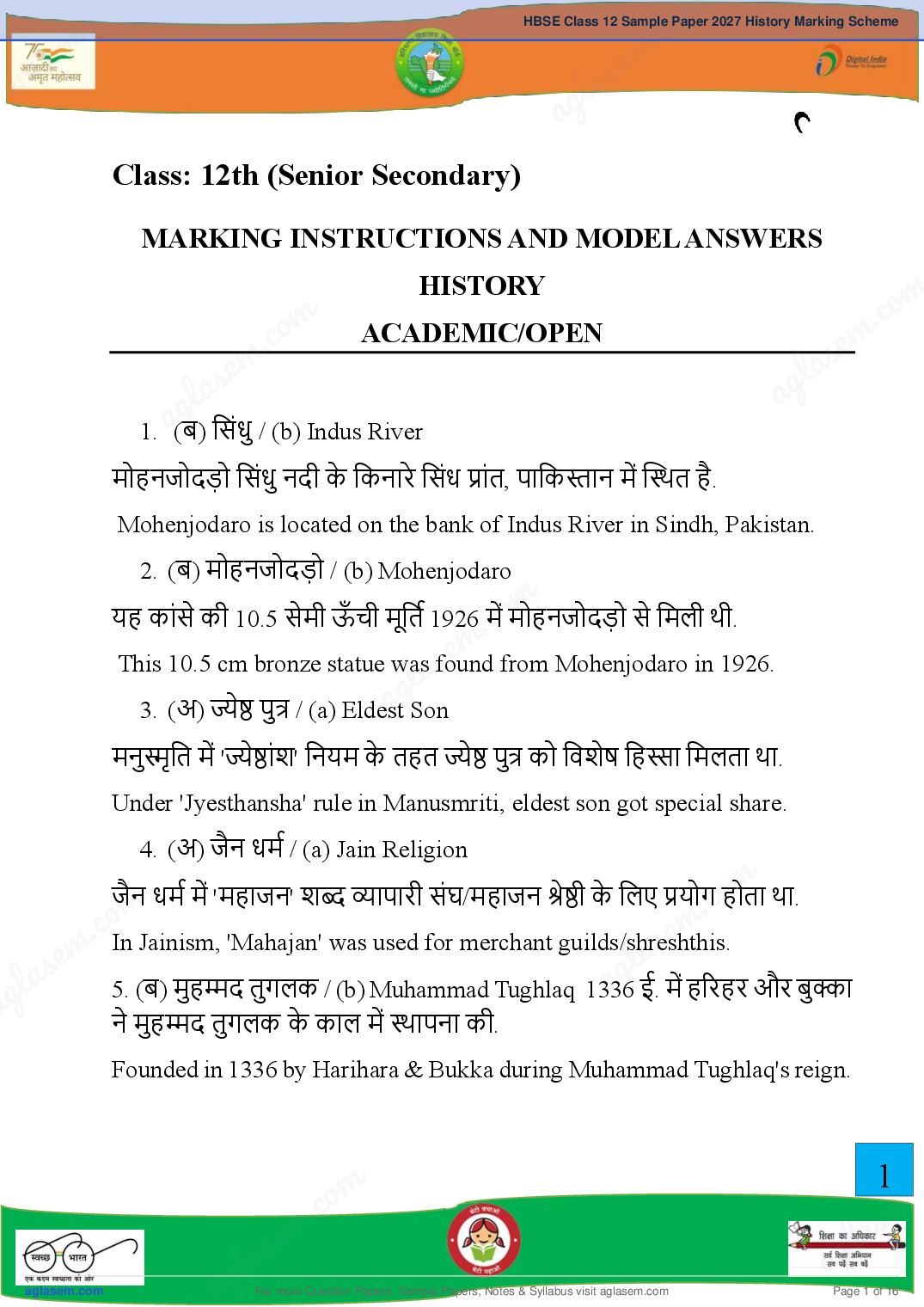
Class: 12th (Senior Secondary)
MARKING INSTRUCTIONS AND MODEL ANSWERS
HISTORY m
m .co
.co ACADEMIC/OPEN
s e m
s em l a
g la ag
1. a(ब) स िंधु / (b) Indus River
मोहनजोदडो स िंधु नदी के सकनारे स िंध प्ािं त, पासक्ቜान में स्थित है .
Mohenjodaro is located on the bank of Indus River in Sindh, Pakistan.
2. (ब) मोहनजोदडो / (b) Mohenjodaro
m
यह क िं े की 10.5 ेमी ऊँची मूसति 1926 .मेंcoमोहनजोदडो े समली थी.
m
se from Mohenjodaro in 1926.
This 10.5 cm bronze statue wasafound
l
ag
3. (अ) ्ቋे् पु्ቔ / (a) Eldest Son
मनु्ቦृसत में '्ቋे् िं श' सनयम के तहत ्ቋे् पु्ቔ को सिशेष सह्स समलत थ .
Under 'Jyesthansha' rule in Manusmriti, eldest son got special share.
4. (अ) जैन धमि / (a) Jain Religion
m
जैm .coहोत थ .
न धमि में 'मह जन' श्ቒ ्ቤ प री िंघ/मह जन ्शे्ी के सलए ्ቚयोग
coIn Jainism, 'Mahajan' was used for merchant guilds/shreshthis.
m
. s e
s em g l a
g la 5. (ब) मुह्मद तुगलक / (b) Muhammad Tughlaq 1336 a ई. में हररहर और बु्ሪ
a ने मुह्मद तुगलक के क ल में स्थ पन की.
Founded in 1336 by Harihara & Bukka during Muhammad Tughlaq's reign.
m 1 .
c. o s e m
s em g l a
l a a
ag For more Question Papers, Sample Papers, Notes & Syllabus visit Page 1 of 16
Page 3
30 सद िंबर 1906 को ढ क में नि ब लीमु्ल ह ख न ्ቛ र .
On 30 Dec 1906 at Dhaka by Nawab Salimullah Khan.
7. ( ) कैसबनेट समशन योजन / (c) Cabinet Mission Plan
कैसबनेट समशन 1946 के ्ቚ़् िोिं के तहत िंसिध न भ बनी.
Formed under Cabinet Mission proposals, 1946.
8. (ब) मु्ऺिम लीग / (b) Muslim League
मु्ऺिम लीग, सहन्दू मह भ और क्युसन्ि प टी ने 1942 के आिं दोलन क सिरोध
सकय .
Muslim League, Hindu Mahasabha & Communist Party opposed it.
9. मुगल ेन में ीम िती/पह डी ्षे्ቔोिं े भती सकए गए ैसनकोिं को 'द्ऺखल-ए-कोह'
कहते थे.
In Mughal army, soldiers recruited from hilly/border areas were called
'Dakhil-i-Koh'.
10. अमृत र, पिंज ब में 13 अ्ቚैल 1919 को जनरल ड यर ्ቛ र . / At Amritsar,
Punjab on 13 April 1919 by General Dyer.
11. प ि पुरी, सबह र में 468 ई.पू. में. / At Pawapuri, Bihar in 468 BCE.
12. कृ्ቚदे ि र य (1509-1529 ई.) / Krishnadeva Raya (1509-1529 AD).
तेलुगु सह्ቓ के िंर्षक, 'आिं ्ष भोज' कहल ए. Patron of Telugu literature,
called 'Andhra Bhoja'.
13. 1822 में उ्ቈर-पसिमी ्ቚ िं त, आगर , अिध, म्ቖ ्ቚ िं त और पिंज ब में.
2
For more Question Papers, Sample Papers, Notes & Syllabus visit Page 2 of 16
Page 4
m .co
m .co s e m
se g l a
a
In 1822 in North-Western Provinces, Agra, Awadh, Central Provinces &
Punjab.
14. लॉडि म उिं टबेटन / Lord Mountbatten.
1947 में भ रत के पहले गिनिर जनरल भी बने. m
m .co
.co
Also first Governor-General
m
of India in 1947.
s e m
s e l a
15. महaभ रत के भी्ብ पिि क अिंग है .
g l ag
a Bhishma Parva of Mahabharata.
Part of
इ में 18 अ्ቖ य, 700 ्शोक हैं .
Has 18 chapters, 700 verses.
16. सहन्दू धमि / Hindu Religion.
m
यह एक ्ቦृसत ्ቇिंथ और धमिश ኚᮌ है .
m .co
s e
It is a Smriti text and Dharmashastra.
g l a
17. आग ख ँ / Aga Khan. a
1 अ्ሴू बर 1906 को सशमल में 35 द्ि समले थे. 35 members met on 1 Oct
1906 at Shimla.
18. कन ि टक में 12िीिं शत ्ቒी में
In Karnataka in 12th century. m
m
c. o िंस्थ पक: ब ि्ቐ . इ्ቖसलिंग की पूज करते हैं. Founder: Basavanna
m .co
s e
s em 19. g l a
la a
ag *A और R दोनोिं ही हैं , और R, A की ही ्ቤ ्ቅ है .
*Both A and R are true, and R is the correct explanation of A.
m 3 .
c. o s e m
s em g l a
l a a
ag For more Question Papers, Sample Papers, Notes & Syllabus visit Page 3 of 16
Page 5
*A और R दोनोिं ही हैं , और R, A की ही ्ቤ ्ቅ है .
*Both A and R are true, and R is the correct explanation of A.
21.
*A और R दोनोिं ही हैं , और R, A की ही ्ቤ ्ቅ है .
*Both A and R are true, and R is the correct explanation of A.
22.
कौसट्ि/च ण्ቄ ्ቛ र रसचत 'अथिश ኚᮌ' मौयि क ल क र जनीसतक ्ቇिंथ है . इ के
15 असधकरण, 180 ्ቚकरण हैं . इ में र ज के कति्ቤ, ्ቚश न, ्य य, कर ्ቤिस्थ ,
ज ू ी तिं्ቔ और यु्ቍनीसत क िणिन है . ' प् िं ग स ्ቍ िं त' में र ्ቋ के 7 अिंग बत ए.
यह बत त है सक र ज को ्ቚज के क्ि ण के सलए श न करन च सहए.
'Arthashastra' written by Kautilya/Chanakya is a political treatise of
Mauryan period. It has 15 books, 180 chapters. It describes king's duties,
administration, justice, tax system, espionage and warfare. 'Saptanga
Theory' mentions 7 organs of state. It says king should rule for welfare of
people.
23.
1. *कृसष*: गेहँ, जौ, कप मु्ቅ फ लें थीिं. क लीबिंग े जुते खेत के ्ी समले.
2. *पशुप लन*: बैल, भैं , भेड-बकरी प लते थे.
3. *सश्ቜ ि ्ቤ प र*: मनके, बतिन, त िं बे के औज र बन ते थे. मे ोपोट समय े
मु्शी ्ቤ प र करते थे.
4. *मछली पकडन *: लोथल ि ु्ሹ गेंडोर े ्ቚम ण समले.
1. *Agriculture*: Wheat, barley, cotton were main crops. Ploughed field
evidence from Kalibangan.
4
For more Question Papers, Sample Papers, Notes & Syllabus visit Page 4 of 16
Page 6
m .co
m .co s e m
se g l a
a
2. *Animal husbandry*: Kept ox, buffalo, sheep-goat.
3. *Craft & Trade*: Made beads, pottery, copper tools. Maritime trade with
Mesopotamia.
4. *Fishing*: Evidence from Lothal & Sutkagendor. m
m .co
24.
m .co s e m
se
मह य न / Mahayana l a
g la ag
a को ई्षर म न . मूसति पूज शुरू.
1. बु्ቍ
2. बोसध ् की क्ቜन .
3. िं्ቍृत भ ष क ्ቚयोग.
हीनयान / Hinayana
m
.
1. बु्ቍ को मह पुरुष म न . मूसति पूज नहीिं c.o
s em
2. अहि त बनन ल्ी.
g la
a
3. प ली भ ष क ्ቚयोग.
महायान
1. Considered Buddha as God. Idol worship started.
2. Concept of Bodhisattva.
m
m
c. o3. Used Sanskrit language. m.co
m Hinayana s e
s e g l a
l a a
ag 1. Considered Buddha as great man. No idol worship.
2. Goal was to become Arhat.
3. Used Pali language.
m 5 .
c. o s e m
s em g l a
l a a
ag For more Question Papers, Sample Papers, Notes & Syllabus visit Page 5 of 16
Page 7
'ल ल-ब ल-प ल' गरम दल के तीन ्ቚमुख र ्ቖरि दी नेत थे.
1. *ल ल*- ल ल ल जपत र य, पिंज ब के री.
2. *ब ल*- ब ल गिंग धर सतलक, '्ऽर ज मेर ज्मस ्ቍ असधक र है' कह .
3. *प ल*- सबसपन चिं्श प ल, बिंग ल के क् िं सतक री. इन्ोिंने ्ऽदे शी आिं दोलन चल य .
'Lal-Bal-Pal' were three prominent extremist nationalist leaders.
1. *Lal*- Lala Lajpat Rai, Punjab Kesari.
2. *Bal*- Bal Gangadhar Tilak, said 'Swaraj is my birthright'.
3. *Pal*- Bipin Chandra Pal, revolutionary from Bengal. They led
Swadeshi Movement.
26.
1. *अिशेष रखने हे तु*: बु्ቍ य बौ्ቍ सभ्षुओिं के अ्ऺस्थ-अिशेष रखने के सलए.
2. *पूज स्थल*: बौ्ቍ अनुय यी पररक्म कर पूज करते थे.
3. *धमि ्ቚच र*: अशोक ने 84,000 ़्ूप बनि कर बौ्ቍ धमि फैल य . िं ची ़्ूप
्ቚस ्ቍ है .
1. *To store relics*: To keep relics of Buddha or Buddhist monks.
2. *Place of worship*: Buddhists worshipped by doing parikrama.
3. *Spread religion*: Ashoka built 84,000 stupas to spread Buddhism.
Sanchi stupa is famous.
27.
18िीिं दी में र जमहल पह सडयोिं के पह सडय लोग मैद नोिं पर हमल करते थे
्ቄोिंसक:
6
For more Question Papers, Sample Papers, Notes & Syllabus visit Page 6 of 16
Page 8
m .co
m .co s e m
se g l a
a
1. *भोजन की कमी*: पह डोिं में खेती कम होती थी. 2. *ब हरी दब ि*: मैद नी
सक न और जमीिंद र जिंगलोिं पर क्ቈ कर रहे थे.
3. *्ቚसतरोध*: अिं्ቇेजोिं की र ज्ऽ नीसत के ्ऺखल फ सिरोध. इ सलए िे बदल लेने
हमले करते थे. m
o m
In 18th century,.cPaharias of Rajmahal hills raided plains because: m .co
m s e
se l a
1. *Food ascarcity*:
g l
Less agriculture in hills.
ag
a
2. *External pressure*: Peasants & zamindars occupied forests.
3. *Resistance*: Against British revenue policy. So they raided for revenge.
28.
1. * ै्य सिजय*: 1509-1529 में बीज पुर, गोलकुिंड को हर य . ओसडश जीत .
2. *्ቚश न*: तेलुगु, क्ቐड सह्ቓ को बढom
ि . 'अमु्ሹम ्िद' सलखी.
. c
3. *सनम ि ण*: हज र र म मिंसदर, सि्ሿल m
e मिंसदर बनि ए. 4. *्ቤ प र*: पुतिग सलयोिं े
s
a युग' कहते हैं.
घोडोिं क ्ቤ प र. उनके क ल को gl'्ऽणि a
1. *Military*: Defeated Bijapur, Golconda in 1509-1529. Conquered
Odisha.
2.*Administration*: Promoted Telugu, Kannada literature. Wrote
'Amuktamalyada'.
3.*Construction*: Built Hazara Rama & Vitthala temples. m
m
c. o4. *Trade*: Horse trade with Portuguese. His period is called
m 'Golden Age'. .co
s e
s em 29. g l a
la a
ag 1. *बडी जोत*: जोतद रोिं के प हज रोिं एकड जमीन होती थी.
2. *जमीिंद र पर सनयिं्ቔण*: जमीिंद र शहर में रहते थे, लग न ि ूली जोतद र करते
थे.
m 7 .
c. o s e m
s em g l a
l a a
ag For more Question Papers, Sample Papers, Notes & Syllabus visit Page 7 of 16
Page 9
4. *र जनीसतक श्ऺ्ሹ*: दखलिंद जी और पिंच यत पर क्ቈ . इ सलए 18िीिं दी
अिंत तक जोतद र जमीिंद र े ्ቋ द त कतिर हो गए.
1. *Large holdings*: Jotedars had thousands of acres.
2. *Control over Zamindars*: Zamindars lived in cities, Jotedars collected
revenue.
3. *Power over peasants*: Made poor peasants bonded through loans.
4.*Political power*: Dominated local panchayats. Thus by late 18th c.,
Jotedars became more powerful than Zamindars.
30.
हड्ቔा ्ቜता का पतन 1900 ई.पू. के आ पा शुरू हुआ. मोहनजोदडो के
उ्ሺनन े इ के कई कारण पता चलते हैं :
1. *ब ढ और जलि यु पररितिन*: मोहनजोदडो में 7 ब र ब ढ आने के ्ቚम ण समले
हैं . स िंधु नदी क म गि बदलन और र्ऽती/घ्ሮर नदी क ूख ज न मु्ቅ क रण
थ . जलि यु शु्ቌ हो गई.
2. *प रर्ऺस्थसतक सिन श*: ल खोिं प्ሪी ईिंटें पक ने के सलए जिंगलोिं की अिंध धुिंध
कट ई हुई. इ े ब ढ बढी और भूसम बिंजर हो गई. कृसष उ् दन सगर .
3. *्ቤ प र क पतन*: 2000 ई.पू. के ब द मे ोपोट समय े मु्शी ्ቤ प र बिंद हो
गय . लोथल जै े बिंदरग ह उजड गए. अथि्ቤिस्थ चरमर गई.
4. *्ቚश सनक कमजोरी*: सिश ल ् ्ቋ पर कें्शीय सनयिं्ቔण कमजोर पड गय .
नगरोिं क रख-रख ि बिंद हो गय .
5. *रोग और मह म री*: मोहनजोदडो े समले किंक लोिं में सहिं और रोग के ल्षण
समले हैं .
8
For more Question Papers, Sample Papers, Notes & Syllabus visit Page 8 of 16
Page 10
m .co
m .co s e m
se g l a
a
6. *आयि आक्मण स ्ቍ िं त*: कुछ सि्ቛ न आयों के आक्मण को क रण म नते हैं ,
पर इ के ठो पुर त ्ऺ्क ्ቚम ण नहीिं समले.
इ प्कार प्ाकृसतक और आसििक कारणोिं े यह महान नगरीय ्ቜता धीरे -धीरे
न्ቖ हो गई. m
co
m started declining around 1900 BCE. Excavationsem
.co
.
The Harappan civilization
a
em reveal several causes:
at Mohenjodaro
s g las
l a
ag & Climate Change*: Evidence of 7 floods found at
1. *Floods
Mohenjodaro. Change in course of Indus River and drying up of
Saraswati/Ghaggar river was a main cause. Climate became arid.
2.*Ecological Destruction*: Massive deforestation for baking millions of
bricks led to floods and barren land. Agricultural production fell.
3. *Decline of Trade*: After 2000 BCE, maritime
m trade with Mesopotamia
.co Economy collapsed.
stopped. Ports like Lothal were abandoned.
m
4. *Administrative Weakness*: a s e control over vast empire weakened.
Central
l
ag
Maintenance of cities stopped.
5. *Disease & Epidemic*: Skeletons from Mohenjodaro show signs of
violence and disease.
6. *Aryan Invasion Theory*: Some scholars cite Aryan invasion, but there
is little archaeological evidence.
o
Thus, natural and economic factors led to gradual decline of this mgreat urban
m c
. cocivilization. m. e
m
e सिक्ቜ 2:- l as
l as ag
ag हड्ቔा ्ቜता की अिि्ቤवथिा कृसि, पशुपालन, सश्ቜ और ्ቤापार पर आधाररत
िी:
m 9 .
c. o s em
s em g l a
l a a
ag For more Question Papers, Sample Papers, Notes & Syllabus visit Page 9 of 16
Page 11
क लीबिंग े जुते हुए खेत क ्ी समल है . ये सि्ष में ब े पहले कप उग ने
ि ले लोग थे, सज े यून नी 'स ्न' कहते थे.
2. *पशुप लन*: बैल, भैं , भेड, बकरी, ुअर, कु्ቈ प लते थे. कूबड ि ल बैल
मुहरोिं पर समल है . घोडे के ्ी कम समलते हैं .
3. *सश्ቜ उ् दन*: मनके, सम्ሾी के बतिन, क िं े-त िं बे के औज र, शिंख की ि़्ुएँ
बन ते थे. चन्हदडो 'सश्ऺ्ቜयोिं क नगर' थ . धोल िीर े ब ट और तर जू समले हैं .
4. *्ቤ प र*: आिं तररक और ब हरी दोनोिं ्ቤ प र होत थ . लोथल और ु्ሹ गेंडोर
बिंदरग ह थे. मे ोपोट समय े त िं ब , सटन मिंग ते थे और मनके, ह थीद िं त भेजते थे.
5. *मछली ि सशक र*: स िंधु नदी े मछली पकडते थे. सहरण, ूअर क सशक र
करते थे.
6. *भोजन*: गेहँ-जौ की रोटी, म िं , मछली, दू ध, फल ख ते थे.
इ प्कार हड्ቔावा ी एक उ्ቐत समसित अिि्ቤवथिा वाले िे जो आ्ቒसनर्िर और
मृ्ቍ िी.
Harappan economy was based on agriculture, animal husbandry, craft and
trade:
1. *Agriculture*: Main occupation. Grew wheat, barley, rice, peas, sesame,
mustard. Evidence of ploughed field found at Kalibangan. They were first
in world to grow cotton, called 'Sindon' by Greeks.
2. *Animal Husbandry*: Kept ox, buffalo, sheep, goat, pig, dog. Humped
bull found on seals. Little evidence of horse.
3. *Craft Production*: Made beads, pottery, bronze-copper tools, shell
objects. Chanhudaro was 'city of craftsmen'. Weights and scales found at
Dholavira.
10
For more Question Papers, Sample Papers, Notes & Syllabus visit Page 10 of 16
Page 12
m .co
m .co s e m
se g l a
a
4. *Trade*: Both internal and external trade existed. Lothal & Sutkagendor
were ports. Imported copper, tin from Mesopotamia and exported beads,
ivory.
5. *Fishing & Hunting*: Caught fish from Indus river. Hunted deer, boar.
m
m
6. *Food*: Ate wheat-barley
co
bread, meat, fish, milk, fruits.
m .co
. e
Thus Harappans
s as
em had an advanced mixed economy which wasglself-
sufficientlaand prosperous. a
a g
31.
िंत कबीर 15वीिं दी के सनगुिण र्स्ि िंत िे. उनके उपदे श 'बीजक', ' ाखी' और
'रमैनी' में िंकसलत हैं :
1. *एके्षरि द*: कबीर ने र म-रहीम को एक म न . 'एको अहिं , स्ቛतीयो न ्ऺ़्' क
्ቚच र सकय . om . c
2. *ज सत-्ቚथ क सिरोध*: 'ज सत न पूeछो m धु की, पूछ लीसजए ्ሺ न' कहकर ज्म
पर आध ररत भेदभ ि क खिंडनgसकयlas .
a
3. *ब ्ቨ आडिं बरोिं क खिंडन*: मूसति-पूज , रोज -नम ज, तीथिय ्ቔ को ्ቤथि बत य .
कह – 'प थर पूजे हरर समले, तो मैं पूजूिं पह र'.
4. *गुरु क मह्*: 'गुरु गोसििंद दोऊ खडे , क के ल गूिं प िं य' – गुरु को ई्षर े बड
मन.
m
5.m* द च र पर बल*: ्ቓ, असहिं
o co . 'ऐ ी ि णी
, िंतोष, दय को अपन ने को .कह
.cबोसलए, मन क आप खोय'. e m
em l as
las g
a कर ्ቚेम और भ ईच रे
6. *सहिं दू-मु्ऺिम एकत *: दोनोिं धमों के क्ሾरपिंथ क सिरोध
ag
क िंदेश सदय .
कबीर के उपदे शोिं ने माज ुधार और धासमिक सह्ቚुता को बढावा सदया.
m 11 .
c. o s e m
e m l a
l as ag
ag For more Question Papers, Sample Papers, Notes & Syllabus visit Page 11 of 16
Page 13
compiled in 'Bijak', 'Sakhi' and 'Ramaini':
1. *Monotheism*: Kabir considered Ram and Rahim as one. Preached
'There is only one God'.
2. *Opposition to Caste*: Said 'Don't ask the caste of a saint, ask his
knowledge', rejecting birth-based discrimination.
3. *Rejection of Rituals*: Called idol worship, fasting, pilgrimage useless.
Said 'If God is found by worshipping stone, I would worship a mountain'.
4. *Importance of Guru*: 'Guru and God both stand, whose feet should I
touch first' – considered Guru greater than God.
5. *Emphasis on Morality*: Preached truth, non-violence, contentment,
compassion. 'Speak such words that ego vanishes'.
6. *Hindu-Muslim Unity*: Opposed fanaticism of both religions and
spread message of love and brotherhood.
Kabir's teachings promoted social reform and religious tolerance.
सिक्ቜ 2:-
8िीिं े 17िीिं दी तक चल भ्ऺ्ሹ आिं दोलन म्ቖक लीन ध समिक ुध र आिं दोलन
थ:
1. *ई्षर की एकत *: भी िंतोिं ने एक ई्षर की भ्ऺ्ሹ पर जोर सदय . गुण और
सनगुिण दोनोिं रूप ्ቚचसलत थे.
2. *ज सत-्ቤिस्थ क सिरोध*: रै द , कबीर, न नक जै े िंतोिं ने ज्म आध ररत
ऊँच-नीच क सिरोध सकय .
3. *गुरु की ्ቚध नत *: भ्ऺ्ሹ म गि में गुरु को असनि यि म न गय . 'सबन गुरु ्ሺ न न
होई'.
12
For more Question Papers, Sample Papers, Notes & Syllabus visit Page 12 of 16
Page 14
m .co
m .co s e m
se g l a
a
4. *स्थ नीय भ ष *: िं्ቍृत के स्थ न पर तसमल, सहिं दी, मर ठी, बिंग ली में उपदे श
सदए. इ े आम जनत जुडी.
5. *कमिक िं ड क सिरोध*: य्ሺ, बसल, ्वत आसद ब हरी आडिं बरोिं को नक र . ्ቚेम
और मपिण को मह् सदय . m
m
co *: ኚᮌी-पुरुष, सहिंदू-मु्ऺिम में भेद नहीिं म न . मीर ब ई, अिंडsलem .co
6. * म सजक .मत
m
जै ी मसहल se िंत हुईिं.
la gla a
g
र्स्ि aआिं दोलन ने र्ारतीय माज को एक ू्ቔ में बािं धा और ािं ्ቍृसतक एकता
बढाई.
Bhakti Movement from 8th to 17th century was a medieval religious reform
movement:
1. *Unity of God*: All saints stressed devotion to one God. Both Saguna
m
and Nirguna forms were popular.
.co
m
e like Raidas, Kabir, Nanak opposed
2. *Opposition to Caste System*:sSaints
birth-based hierarchy. g la
a
3. *Supremacy of Guru*: Guru was considered essential in path of
devotion. 'No knowledge without Guru'.
4. *Local Language*: Preached in Tamil, Hindi, Marathi, Bengali instead
of Sanskrit. Connected common people.
m fasts.
5. *Rejection of Rituals*: Denied external rituals like yajna, sacrifice,
o
co
m
Emphasized love and surrender.
m .c
. s e
s em 6. *Social Equality*: No distinction between man-woman,
g l a Hindu-Muslim.
l a Women saints like Mirabai, Andal emerged. a
ag Bhakti Movement united Indian society and enhanced cultural unity.
m 13 .
c. o s e m
e m l a
l as ag
ag For more Question Papers, Sample Papers, Notes & Syllabus visit Page 13 of 16
Page 15
सिलय पूछ है . 'अथि ' में सिदे सशयोिं के ्ऺखल फ आिं दोलन = ्ऽदे शी/अ हयोग
आिं दोलन हो कत है .
Asks for political causes of 1857 like Doctrine of Lapse, annexation of
Awadh. 'OR' part refers to movements against foreigners = Swadeshi/Non-
Cooperation.
33.
मोहनजोदडो का सवशाल ्በानागार 11.88 × 7.01 मीटर का है और 2.43 मीटर
गहरा है . इ के चारोिं ओर बरामदे और कमरे बने हैं . सव्ቛानोिं का मानना है सक इ का
उपयोग धासमिक अनु्ान के सलए होता िा. हड्ቔा नगरोिं में जल सनका ी की उ्ሹृ्ቖ
्ቤवथिा िी. घरोिं का गिंदा पानी नासलयोिं े ढके हुए मु्ቅ नालोिं में जाता िा.
The Great Bath of Mohenjodaro is 11.88 × 7.01 meters and 2.43 meters
deep. It is surrounded by verandas and rooms. Scholars believe it was used
for religious rituals. Harappan cities had excellent drainage system. Dirty
water from houses went into covered main drains through drains.
(i)11.88 मीटर लिंब और 7.01 मीटर चौड थ
It was 11.88 m long and 7.01 m wide.
(ii) घरोिं क गिंद प नी न सलयोिं े ढके मु्ቅ न लोिं में ज त थ
Dirty water from houses went to covered main drains.
(iii) सि्ቛ नोिं के अनु र इ क उपयोग ध समिक अनु् न और पसि्ቔ ्በ न के सलए
होत थ . च रोिं ओर बने कमरे पुज ररयोिं के सलए थे.
According to scholars, it was used for religious rituals and holy bath.
Rooms around it were for priests.
34.
14
For more Question Papers, Sample Papers, Notes & Syllabus visit Page 14 of 16
Page 16
m .co
m .co s e m
se g l a
a
1857 के सि्शोह में बह दु र श ह जफर को भ रत क ् ट घोसषत सकय गय .
सद्ली पर क्ቈे के ब द ैसनक मेरठ े सद्ली आ गए. र नी ल्िीब ई, न न
हब, त ्ቓ टोपे ने नेतृ् सकय . अिं्ቇेजोिं ने इ े 'स प ही सि्शोह' कह , पर भ रतीय
इसतह क र इ े '्ቚथम ्ऽतिं्ቔत िं्ቇ म' म नते हैं .
o m
o
In 1857 revolt, Bahadur m Shah Zafar was declared Emperor of India. After . c
. c e m
capturing Delhi,
e m soldiers came from Meerut to Delhi. Rani Lakshmibai,
l as
Nana Saheb,
l as g
Tantia Tope led it. British called it 'Sepoy Mutiny', butaIndian
ag call it 'First War of Independence'.
historians
(i) बह दु र श ह जफर को / Bahadur Shah Zafar.
(ii) 'स प ही सि्शोह' / 'Sepoy Mutiny'.
(iii) र नी ल्िीब ई और न न हब / Rani Lakshmibai and Nana Saheb.
m
c. o सि्शोह थ . इ में ैसनक, सक न,
्ቄोिंसक यह अिं्ቇेजोिं के ्ऺखल फ पहल िंगसठत
र ज , जनत भी ने भ ग सलय . उ्ቌे ्ብ emअिं्ቇेजी श न ख्ቒ करन थ .
s
Because it was first organized l a
g revolt against British. Soldiers, peasants,
a
kings, public all participated. Aim was to end British rule.
35.
गािं धी जी 1915 में दसिण अ्ऻीका े र्ारत लौटे . 1917 में चिंपारण ्ቓा्ቇह सकया.
1919 में रौलट ए्ሴ के सवरोध में हडताल हुई. 1920 में अ हयोग आिं दोलन शुरू
सकया. गािंधी जी ने कहा 'असहिं ा मेरा धमि है और ्ቓ मेरा ई्ቫर है '. m
m . c o
. coGandhiji returned from South Africa to India in 1915.
s e mDid Champaran
s em Satyagraha in 1917. In 1919, strike against RowlattgAct
l a happened. Started
g la Non-Cooperation Movement in 1920. Gandhiji saida 'Non-violence is my
a religion and Truth is my God'.
(i) 1915 में
m 15 .
c. o s e m
e m l a
l as ag
ag For more Question Papers, Sample Papers, Notes & Syllabus visit Page 15 of 16
Page 17
(iii) ग िं धी जी क धमि 'असहिं ' और ई्षर ' ्ቓ' थ . िे सहिं के सिरु्ቍ थे और ्ቓ
के म गि पर चलने में सि्ष रखते थे. यही उनके आिं दोलनोिं क आध र थ .
Gandhiji's religion was 'Non-violence' and God was 'Truth'. He was against
violence and believed in path of truth. This was the basis of all his
movements.
Q36. म नसच्ቔ िंबिंधी उ्ቈर/ Map Based Questions
(क) मोहनजोदडो
(ख) िं ची
(ग) अमर िती
(घ) सद्ली
(ङ) न गपुर
16
For more Question Papers, Sample Papers, Notes & Syllabus visit Page 16 of 16
Document Details
| Board / Org | Haryana Board |
| Exam | Class 12 |
| Type | Answer Key |
| Pages | 16 |
| Updated | 03 Nov 2026 |