NIOS Class 12 Syllabus 2023 Sociology
Finished viewing? Save it for later —
Download NIOS Class 12 Syllabus 2023 Sociology (PDF · 5 pages)About NIOS Class 12 Syllabus 2023 Sociology
NIOS Class 12 Syllabus 2023 Sociology is available here for free download. Published by NIOS for National Institute of Open Schooling Class 12, this syllabus can be viewed online or downloaded as a PDF (5 pages). Candidates preparing for National Institute of Open Schooling Class 12 can use NIOS Class 12 Syllabus 2023 Sociology to understand the exam pattern, the type of questions asked, and the overall difficulty level.
Frequently Asked Questions
How can I download NIOS Class 12 Syllabus 2023 Sociology?
Open this page and click the Download button to save NIOS Class 12 Syllabus 2023 Sociology as a PDF. It is completely free on AglaSem Docs.
Is NIOS Class 12 Syllabus 2023 Sociology free to download?
Yes. NIOS Class 12 Syllabus 2023 Sociology can be viewed online and downloaded as a PDF free of cost on AglaSem Docs.
How many pages does NIOS Class 12 Syllabus 2023 Sociology have?
NIOS Class 12 Syllabus 2023 Sociology contains 5 pages, which you can read online or download together as a single PDF.
Where can I find more National Institute of Open Schooling Class 12 study material?
You can find more National Institute of Open Schooling Class 12 question papers, sample papers, syllabus, and answer keys on AglaSem Docs.
NIOS Class 12 Syllabus 2023 Sociology – Text
Read the full text of this syllabus below — useful to quickly search, copy and reference the content online without downloading the PDF.
📄 View text version (5 pages)
Page 1
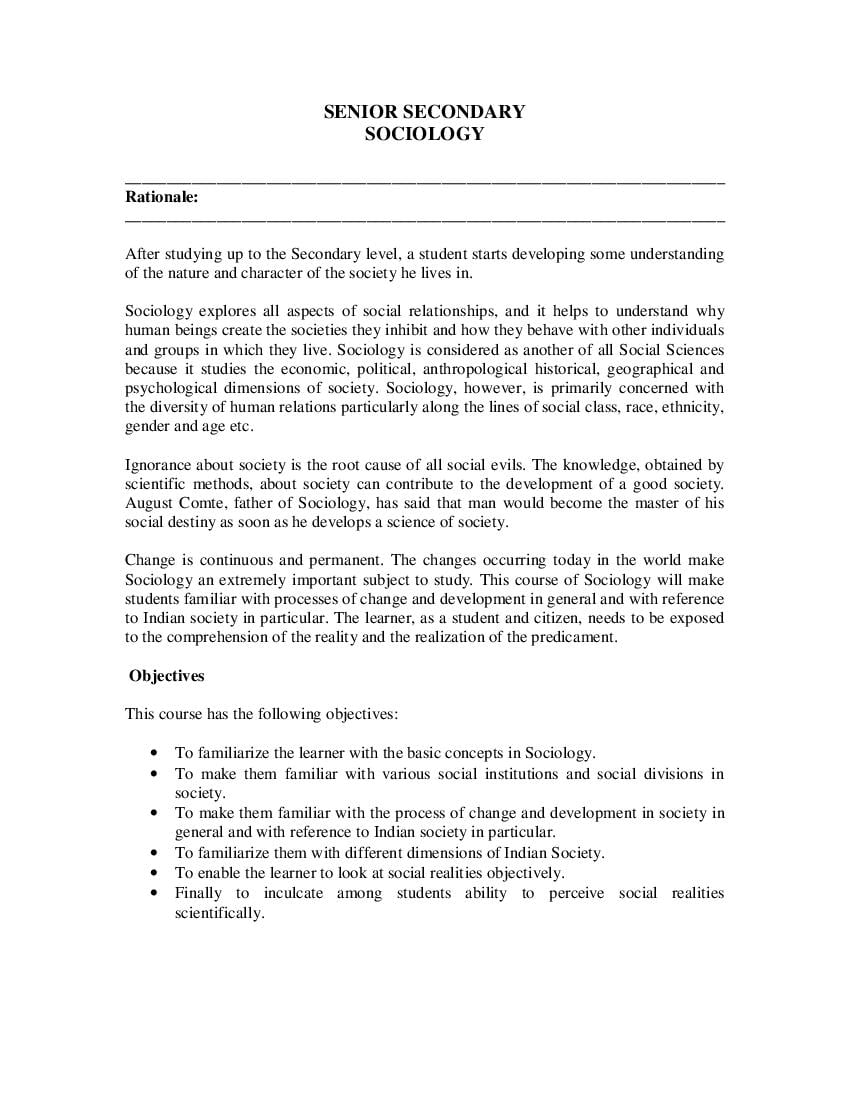
SOCIOLOGY
________________________________________________________________________
Rationale:
________________________________________________________________________
After studying up to the Secondary level, a student starts developing some understanding
of the nature and character of the society he lives in.
Sociology explores all aspects of social relationships, and it helps to understand why
human beings create the societies they inhibit and how they behave with other individuals
and groups in which they live. Sociology is considered as another of all Social Sciences
because it studies the economic, political, anthropological historical, geographical and
psychological dimensions of society. Sociology, however, is primarily concerned with
the diversity of human relations particularly along the lines of social class, race, ethnicity,
gender and age etc.
Ignorance about society is the root cause of all social evils. The knowledge, obtained by
scientific methods, about society can contribute to the development of a good society.
August Comte, father of Sociology, has said that man would become the master of his
social destiny as soon as he develops a science of society.
Change is continuous and permanent. The changes occurring today in the world make
Sociology an extremely important subject to study. This course of Sociology will make
students familiar with processes of change and development in general and with reference
to Indian society in particular. The learner, as a student and citizen, needs to be exposed
to the comprehension of the reality and the realization of the predicament.
Objectives
This course has the following objectives:
• To familiarize the learner with the basic concepts in Sociology.
• To make them familiar with various social institutions and social divisions in
society.
• To make them familiar with the process of change and development in society in
general and with reference to Indian society in particular.
• To familiarize them with different dimensions of Indian Society.
• To enable the learner to look at social realities objectively.
• Finally to inculcate among students ability to perceive social realities
scientifically.
Page 2
________________________________________________________________________
Module Marks Study hours
________________________________________________________________________
1. Sociology: Basic concepts 30 70
2. Social Institutions and Social 12 35
stratification
3. Social Change Socialization and 13 35
Social Control
4. Indian Society 30 60
5. Optional (Any One) 15 40
Status of Women
Or
Culture
________________________________________________________________________
Total 100 240
________________________________________________________________________
Module I
Title : Sociology: Basic concepts
Time: 70 hours Marks : 30
Approach: This module is meant to introduce Sociology to the learner. It acquaints the
learner with the definition of Sociology, its development and growth, relationship with
other Social Sciences. It further exposes the learner to certain techniques used in
Sociological research. This module also explains important basic sociological concepts.
Contents:
1.1 An Introduction to Sociology
1.2 Emergence and Development of Sociology
1.3 Sociology: Its Relationships with other Social Sciences
1.4 Methods and Techniques of Research in Sociology
1.5 Society, Community, Association and Institution
1.6 Social Groups
1.7 Social Structure and Social System
1.8 Norms and values
1.9 Status and Role
1.10 Cooperation, Competition and Conflict
1.11 Acculturation, Assimilation & Integration
Page 3
Title : Social Institution and Social Stratification
Time: 35 hours Marks: 12
Approach: This module has been designed to acquaint the learner about major social
institutions found in a society and also to acquaint him with the system of social divisions
based on hierarchy, differentiations and inequality.
Contents
2.1 Marriage
2.2 Family
2.3 Kinship
2.4 Economy, Polity and Religion
2.5 Social Stratification: Hierarchy, Differentiation and Inequality
Module III
Title : Social change, Socialization and Social Control
Time 35 hours Marks: 13
Approach: This module acquaints the learner with the processes of social change in
society, and how an individual becomes an accepted member of a society through
socialization. It also explains how social control is maintained in a society and the
relationship between society and environment.
Content:
3.1 Factors of Social change
3.2 Processes of Social Change
3.3 Socialization
3.4 Social control
3.5 Social Deviance
3.6 Society and Environment
Page 4
Title: Indian Society
Time: 60 hours Marks: 30
Approach: This module acquaints the learner with certain Indian Social thinkers and
various dimensions of Indian society. It sensitizes the learner with major social problems
of India in general and of certain weaker sections in particular.
Content:
4.1 Indian Social Thinkers
4.2 Unity and Diversity
4.3 National Integration: Concept and Challenge
4.4 Indian Society: Tribal, Rural and Urban
4.5 Caste System in India
4.6 Major Religious communities in India
4.7 Major Social Problems of India
4.8 Problem of Scheduled Castes and Scheduled Tribes
4.9 Problems of other Deprived Sections
Module V
Optional Module
Time: 40 Marks: 15
Approach: These modules have been designed for enrichment of knowledge in a specific
area of interest of the learner, either about status of women or culture. Learners can select
one out of the two modules for study and examination.
(a) Status of Women:
Approach: This module has been designed to acquaint the learner with the status of
women from historic to present times. It also explains gender discrimination and
problems of women and their quest for equality and empowerment.
5.1 Society and Environment
5.2 Historical and cultural perspectives
5.3 Gender Discrimination
5.4 Problems of women
5.5 Quest for Equality and Women’s Empowerment.
OR
Page 5
Approach : The module has been designed to acquaint the learner with the concept of
culture and its characteristics. This also enriches the knowledge about different aspects of
culture in general and with particular reference to Indian cultural heritage. It also briefly
tells us about the influence of media on culture.
5.1 Culture: Concept and Characteristics
5.2 Indian Cultural Heritage
5.3 Cultural Pluralism
5.4 Media and culture
Document Details
| Board / Org | NIOS |
| Exam | National Institute of Open Schooling Class 12 |
| Type | Syllabus |
| Pages | 5 |
| Updated | 22 Jul 2026 |