ICSE Class 10 Question Paper 2019 for English Paper 2
Finished viewing? Save it for later —
Download ICSE Class 10 Question Paper 2019 for English Paper 2 (PDF · 13 pages)About ICSE Class 10 Question Paper 2019 for English Paper 2
ICSE Class 10 Question Paper 2019 for English Paper 2 is available here for free download. Published by CISCE for Class 10, this question paper can be viewed online or downloaded as a PDF (13 pages). Candidates preparing for Class 10 can use ICSE Class 10 Question Paper 2019 for English Paper 2 to understand the exam pattern, the type of questions asked, and the overall difficulty level.
Frequently Asked Questions
How can I download ICSE Class 10 Question Paper 2019 for English Paper 2?
Open this page and click the Download button to save ICSE Class 10 Question Paper 2019 for English Paper 2 as a PDF. It is completely free on AglaSem Docs.
Is ICSE Class 10 Question Paper 2019 for English Paper 2 free to download?
Yes. ICSE Class 10 Question Paper 2019 for English Paper 2 can be viewed online and downloaded as a PDF free of cost on AglaSem Docs.
How many pages does ICSE Class 10 Question Paper 2019 for English Paper 2 have?
ICSE Class 10 Question Paper 2019 for English Paper 2 contains 13 pages, which you can read online or download together as a single PDF.
Where can I find more Class 10 study material?
You can find more Class 10 question papers, sample papers, syllabus, and answer keys on AglaSem Docs.
ICSE Class 10 Question Paper 2019 for English Paper 2 – Text
Read the full text of this question paper below — useful to quickly search, copy and reference the content online without downloading the PDF.
📄 View text version (13 pages)
Page 1
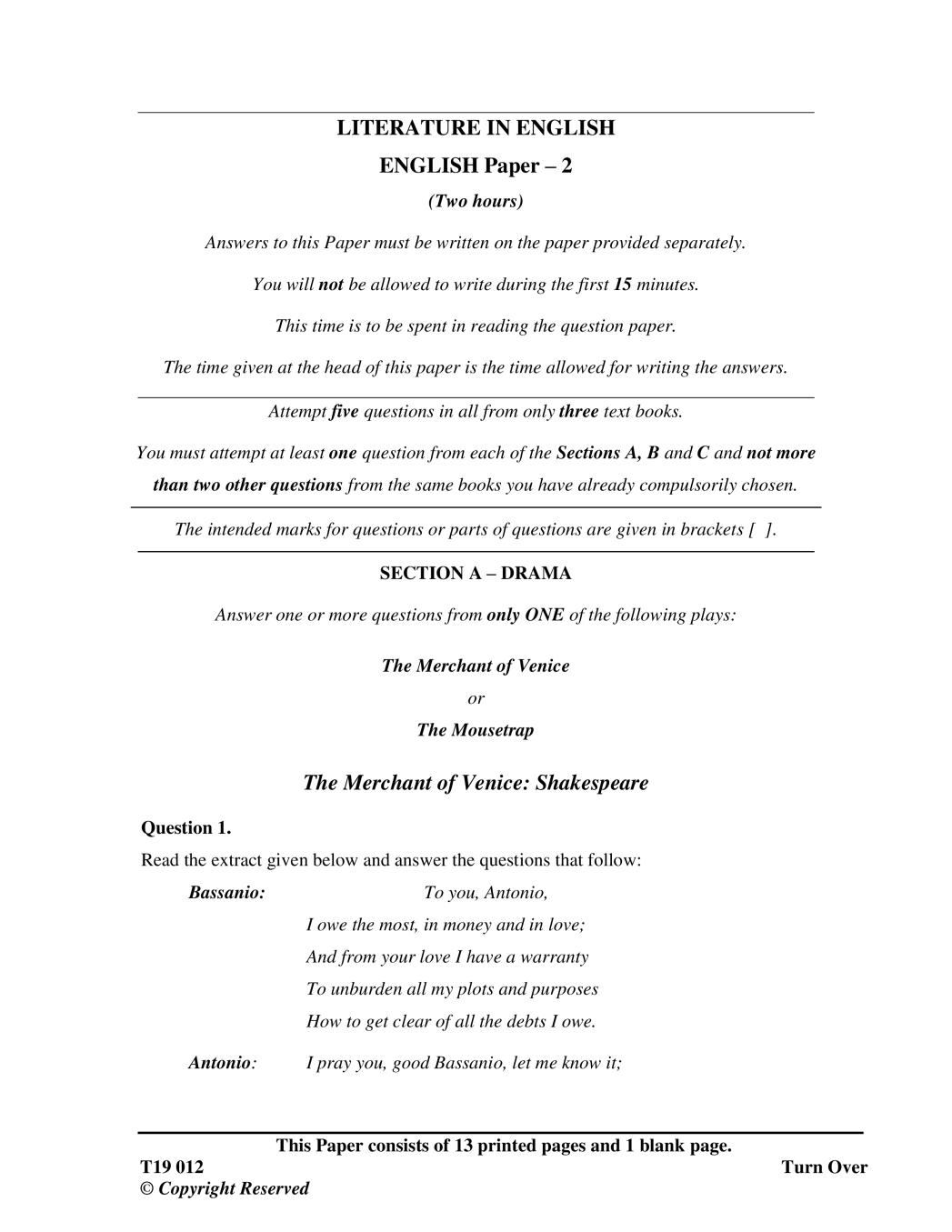
ENGLISH Paper – 2
(Two hours)
Answers to this Paper must be written on the paper provided separately.
You will not be allowed to write during the first 15 minutes.
This time is to be spent in reading the question paper.
The time given at the head of this paper is the time allowed for writing the answers.
Attempt five questions in all from only three text books.
You must attempt at least one question from each of the Sections A, B and C and not more
than two other questions from the same books you have already compulsorily chosen.
The intended marks for questions or parts of questions are given in brackets [ ].
SECTION A – DRAMA
Answer one or more questions from only ONE of the following plays:
The Merchant of Venice
or
The Mousetrap
The Merchant of Venice: Shakespeare
Question 1.
Bassanio: To you, Antonio,
I owe the most, in money and in love;
And from your love I have a warranty
To unburden all my plots and purposes
How to get clear of all the debts I owe.
Antonio: I pray you, good Bassanio, let me know it;
This Paper consists of 13 printed pages and 1 blank page.
T19 012 Turn Over
© Copyright Reserved
Page 2
State any two reasons that Antonio’s friends, who were present, gave to explain
his mood.
(ii) What promise did Antonio make to Bassanio immediately after this [3]
conversation?
(iii) What did Bassanio say to Antonio about ‘a lady richly left’ in Belmont? [3]
(iv) Why was Antonio unable to lend Bassanio the money that he needed? [3]
How did he propose to help his friend?
(v) What does the above extract reveal of the relationship between Antonio and [4]
Bassanio?
Mention one way in which this relationship was put to the test later in the play.
Question 2.
Bassanio: A gentle scroll. – Fair lady, by your leave; [Kissing her]
I come by note, to give and to receive.
Like one of two contending in a prize,
That thinks he hath done well in people’s eyes
Hearing applause and universal shout
Giddy in spirit, still gazing, in a doubt
Whether those peals of praise be his or no;
(i) Where did Bassanio find the ‘gentle scroll’? [3]
What ‘prize’ had Bassanio just won?
(ii) Explain why Bassanio said he felt ‘Giddy in spirit, still gazing, in a doubt’. [3]
(iii) Shortly after this exchange, Portia gave Bassanio a ring as a token of her [3]
affection. What did the gift symbolise?
(iv) What assurance did Bassanio give her when he accepted the ring? [3]
(v) What did Portia urge Bassanio to do when she learnt that his friend Antonio [4]
was in trouble?
What aspect of her character is revealed through her words?
T19 012 2
Page 3
Duke: You hear the learn’d Bellario, what he writes:
And here, I take it, is the doctor come.
[Enter Portia, dressed like a Doctor of Laws]
Give me your hand. Come you from old Bellario?
Portia: I did, my lord.
Duke: You are welcome: take your place.
Are you acquainted with the difference
That holds this present question in the court?
(i) Where is this scene set? Why was Portia there? [3]
(ii) What reason had Bellario given for his absence? Whom had he sent in his [3]
stead?
(iii) Bellario’s letter stated that he had taken some measures to prepare the ‘young [3]
and learned doctor’ to deal with the case. What were they?
(iv) What was the ‘difference’ between Shylock the Jew and Antonio the merchant [3]
that the Duke was unable to resolve?
(v) How does Portia succeed in saving Antonio? [4]
What does this reveal of her character?
The Mousetrap: Agatha Christie
Question 4.
Giles: I beg your pardon. Did you say something?
Trotter: Yes, Mr. Ralston, I said ‘Is there an extension?’ (He crosses to
Centre.)
Giles: Yes, up in our bedroom.
T19 012 3 Turn Over
Page 4
(Giles exits to the stairs, carrying the glove and bus ticket and
looking dazed. Trotter continues to trace the wire to the
window. He pulls back the curtain and opens the window,
trying to follow the wire. He crosses to the arch up Right, goes
out and returns with a torch. He moves to the window, jumps
out and bends down, looking, then disappears out of sight. It is
practically dark. Mrs. Boyle enters from the library up Left,
shivers and notices the open window.)
Mrs. Boyle: (Moving to the window) Who has left this window open?
(i) Why did Giles fail to hear what Trotter had said earlier? [3]
Why did Giles look ‘dazed’?
(ii) What was Trotter attempting to do? Why? [3]
(iii) Why did Mrs. Boyle close the window? [3]
What did the voice on the radio say about the ‘mechanics of fear’?
(iv) How did the murderer mask the sounds of the killing? [3]
Who entered the room immediately after the murder?
What did this person see?
(v) Who was the victim? Why was the victim murdered? [4]
What was the ‘signature tune’ that the murderer whistled?
What is the significance of this tune in the context of the play?
Question 5.
Trotter: (Leaning on the refectory table) Those simple actions took you
rather a long time, didn’t they, Mr Ralston?
Giles: I don’t think so. (He moves away to the stairs)
Trotter: I should say you definitely – took your time over them.
Giles: I was thinking about something.
T19 012 4
Page 5
you were.
(i) What ‘simple actions’ of Giles was Trotter referring to? [3]
Where had Giles been? Who had sent him there?
(ii) How did Christopher Wren account for his whereabouts at the time of the [3]
murder?
(iii) Where was Paravicini at that time? What was he doing? [3]
(iv) Whom did Giles accuse of having committed the murder? [3]
On what did he base this accusation?
(v) Mollie shared her suspicions regarding the identity of the murderer with [4]
Trotter, later in this scene.
Whom did she suspect of being the murderer?
What reasons did she give for her suspicion?
Question 6.
Trotter: Yes. You’ve been extraordinarily foolish, you know. You’ve run a
very good chance of being killed by holding out on me. As a result,
you’ve been in serious danger more than once.
Mollie: I don’t know what you mean.
Trotter: (moving slowly above the sofa table to the Right of the sofa; still
quite natural and friendly) Come now, Mrs. Ralston. We policemen
aren’t quite so dumb as you think. All along I’ve realized that you
had first-hand knowledge of the Longridge Farm affair. You know
Mrs. Boyle was the magistrate concerned. In fact, you knew all
about it. Why didn’t you speak up and say so?
Mollie: (Very much affected) I don’t understand. I wanted to forget-forget.
(She sits at the Left end of the sofa.)
T19 012 5 Turn Over
Page 6
(ii) Trotter revealed to Mollie some facts that he had uncovered about her past. [3]
What were they?
(iii) What did Mollie want to forget? [3]
How was she linked with the ‘Longridge Farm affair’?
(iv) How did Trotter manage to pass himself off as a policeman? [3]
How had he reached Monkswell Manor?
(v) What did Trotter reveal to Mollie about his true identify? [4]
How was Mollie saved at the end of the play?
SECTION B – POETRY
Answer one or more questions from this Section.
A Collection of Poems
Question 7.
“Now tell us what it was all about”.
Young Peterkin, he cries.
And little Wilhelmine looks up
With wonder –waiting eyes,
“Now tell us all about the war,
And what they fought each other for”.
— After Blenheim, Robert Southey
(i) Who are Peterkin and Wilhelmine? [3]
How does the poet describe the scene at the beginning of the poem?
(ii) What did Young Peterkin find and where? Describe it. [3]
(iii) Who is referred to as “each other”? What did they fight for? [3]
(iv) To whom are the words in the extract addressed? [3]
How was this person’s family affected by the war?
T19 012 6
Page 7
with great and famous victories?
What message does the poet want to convey to the readers?
Question 8.
There’s nobody on the house-tops now---
Just a palsied few at the windows set;
For the best of the sight is, all allow,
At the Shambles’ Gate---- or, better yet,
By the very scaffold’s foot, I trow.
— The Patriot, Robert Browning
(i) Who is the speaker? Where is he being taken? Why? [3]
(ii) Describe the scene when he had walked down the same street a year ago. [3]
(iii) Where does the speaker think all the people had gathered that day? [3]
Why does he think so?
(iv) Describe the speaker’s physical condition. [3]
(v) What is the central message of the poem? [4]
Does the poem end on a note of hope or despair?
Give one reason for your answer.
Question 9.
All round the field spectators were gathered
Cheering on all the young women and men
Then the final event of the day was approaching
The last race about to begin.
— Nine Gold Medals, David Roth
T19 012 7 Turn Over
Page 8
What had brought them together?
How had they prepared themselves for the event?
(ii) What was the last event of the day? [3]
How many athletes were participating in this event?
What signal were they waiting for?
(iii) What happened to the youngest athlete half way through the race? [3]
How did he respond?
(iv) What ‘strange’ turn did the story take at this point? [3]
(v) Why does the poet say that the banner – ‘Special Olympics’ could not have [4]
been nearer the mark?
What human quality does the poem celebrate?
SECTION C – PROSE
Answer one or more questions from only ONE of the following books that you have studied:
A Collection of Short Stories
or
Animal Farm
or
The Call of the Wild
A Collection of Short Stories
Question 10.
It had no eyes, ears, nose or mouth. It was just a round smooth head
– with a school cap on top of it! And that’s where the story should
end. But for Mr. Oliver it did not end here.
The torch fell from his trembling hand. He turned and scrambled
down the path, running blindly through the trees and calling for
T19 012 8
Page 9
a lantern swinging in the middle of the path.
(i) Who was Mr. Oliver? Where did he encounter ‘It’? [3]
(ii) Where did Mr. Oliver work? [3]
Why did Life magazine describe this place as the ‘Eton of the East’?
(iii) Why had Mr. Oliver approached ‘It’ in the first place? [3]
What had he mistaken it for?
(iv) What is a lantern? Who was holding the lantern? [3]
Why did Mr. Oliver feel relieved at the sight of the lantern?
(v) Briefly describe the meeting between the lantern-bearer and Mr. Oliver. [4]
State one reason why ‘A Face in the Dark’ could be considered a horror story.
Question 11.
An angry athlete is an athlete who will make mistakes, as any coach
will tell you. I was no exception. On the first of my three qualifying
jumps, I leaped from several inches beyond the take-off board for a
foul.
(i) When and where is this story set? [3]
What reason does the narrator Jesse Owens give for the heightened
nationalistic feelings at this time?
(ii) In which event had Owens been confident of winning a gold medal? Why? [3]
(iii) What had made Owens angry enough to make mistakes? [3]
(iv) Name Owens’ rival who approached him at this point. [3]
What advice did this athlete give Owens?
(v) How did the two athletes perform in the finals? [4]
What does Jesse Owens consider his ‘Greatest Olympic Prize’? Why?
T19 012 9 Turn Over
Page 10
Answer the following questions with reference to Ray Douglas Bradbury’s short
story, ‘All Summer in a Day’:
(i) Name the planet on which this story is set. [4]
Describe everyday life on this planet.
(ii) Why was there so much excitement in the school room that morning? [4]
What set Margot apart from the other children?
(iii) Describe how the planet was transformed when the sun came out and shone [8]
briefly over it.
Why was Margot not able to witness this phenomenon?
What emotion do you suppose the other children experienced when Margot
emerged at the end of the story?
Animal Farm: George Orwell
Question 13.
One Sunday morning, when the animals assembled to receive their
orders, Napoleon announced that he had decided upon a new policy.
“From now onwards Animal Farm would engage in trade with the
neighbouring farms: not, of course, for any commercial purpose, but
simply in order to obtain certain materials which were urgently
necessary.”
(i) Why did the animals need ‘certain materials’? [3]
What arrangements had Napoleon made to engage in trade with the
neighbouring farms?
(ii) Why did Napoleon’s announcement make the animals uneasy? [3]
(iii) What did Squealer say to the animals to ease their doubts and fears? [3]
T19 012 10
Page 11
Why had he entered into this agreement with Napoleon?
(v) There was a change in the attitude of the humans towards Animal Farm. [4]
Comment on this change. What were the signs and symptoms of this change?
Question 14.
One Sunday morning Squealer announced that the hens, who just
come in to lay again, must surrender their eggs.
(i) Why were the hens required to surrender their eggs? [3]
(ii) How did the hens react on receiving this information? [3]
(iii) The three young black Minorca pullets led the other hens in ‘something [3]
resembling a rebellion’. How exactly did they do this?
(iv) What steps did Napoleon take to put down this ‘rebellion’? [3]
(v) How long did the rebellion last? Describe the consequences of the rebellion. [4]
What do you learn of Napoleon’s character from the way in which he dealt
with the rebellion?
Question 15.
With reference to George Orwell’s ‘The Animal Farm’, answer the following
questions:
(i) Who wrote the poem ‘Comrade Napoleon’? [4]
How did Napoleon show his approval of the poem?
(ii) What precautions were taken to ensure Napoleon’s safety? [4]
(iii) What single commandment replaced the seven commandments on Animal [8]
Farm?
Mention some of the changes that the animals noticed in the behaviour of the
pigs after the new commandment had been put up.
T19 012 11 Turn Over
Page 12
Question 16.
The breaking down of discipline likewise affected the dogs in their
relations with one another. They quarrelled and bickered more than
ever among themselves, till at times the camp was a howling
bedlam: Dave and Sol-leks alone were unaltered, though they were
made irritable by the unending squabbling.
(i) What led to the break-down of discipline in the dog team? [3]
How did it affect the relationship among the dogs?
(ii) What other acts of indiscipline did Buck’s encouragement lead to? [3]
(iii) What started the dogs off on a chase after supper one night at the mouth of the [3]
river Tahkeena?
(iv) Who led the dogs in the chase? [3]
What primitive urge did Buck experience during the chase?
(v) How did Spitz use the chase to try and outwit Buck? [4]
What does this reveal of Spitz’s nature?
Question 17.
With the dogs falling, Mercedes weeping and riding, Hal swearing
innocuously, and Charles’s eyes wistfully watering, they staggered
into John Thornton’s camp at the mouth of White River. When they
halted, the dogs dropped down as though they had all been struck
dead.
(i) Who were Mercedes, Hal and Charles? How were they related to each other? [3]
(ii) What was John Thornton doing when they arrived at his camp? [3]
Describe his responses to Hal’s questions. Give one reason for his manner.
T19 012 12
Page 13
What reason did he give for his warning?
How did Hal respond to Thornton’s advice?
(iv) How did Hal manage to get his dogs back on their feet? [3]
Why did Buck not respond to Hal’s blows?
(v) Describe how Thornton saved Buck’s life. [4]
Question 18.
Answer the following questions with reference to Jack London’s, ‘The Call of the
Wild’.
(i) How was Thornton talked into a wager that involved Buck, during a [4]
conversation in the Eldorado Saloon?
(ii) How did Thornton feel after he had committed Buck to the wager? [4]
(iii) Give a brief description of how Buck managed to win the wager for [8]
Thornton.
T19 012 13
Document Details
| Board / Org | CISCE |
| Exam | Class 10 |
| Type | Question Paper |
| Pages | 13 |
| Updated | 22 Jul 2026 |