KSET 2020 Question Paper Earth Science
Finished viewing? Save it for later —
Download KSET 2020 Question Paper Earth Science (PDF · 16 pages)About KSET 2020 Question Paper Earth Science
KSET 2020 Question Paper Earth Science is available here for free download. Published by Karnataka Exams for Karnataka State Eligibility Test, this question paper can be viewed online or downloaded as a PDF (16 pages). Candidates preparing for Karnataka State Eligibility Test can use KSET 2020 Question Paper Earth Science to understand the exam pattern, the type of questions asked, and the overall difficulty level.
Frequently Asked Questions
How can I download KSET 2020 Question Paper Earth Science?
Open this page and click the Download button to save KSET 2020 Question Paper Earth Science as a PDF. It is completely free on AglaSem Docs.
Is KSET 2020 Question Paper Earth Science free to download?
Yes. KSET 2020 Question Paper Earth Science can be viewed online and downloaded as a PDF free of cost on AglaSem Docs.
How many pages does KSET 2020 Question Paper Earth Science have?
KSET 2020 Question Paper Earth Science contains 16 pages, which you can read online or download together as a single PDF.
Where can I find more Karnataka State Eligibility Test study material?
You can find more Karnataka State Eligibility Test question papers, sample papers, syllabus, and answer keys on AglaSem Docs.
KSET 2020 Question Paper Earth Science – Text
Read the full text of this question paper below — useful to quickly search, copy and reference the content online without downloading the PDF.
📄 View text version (16 pages)
Page 1
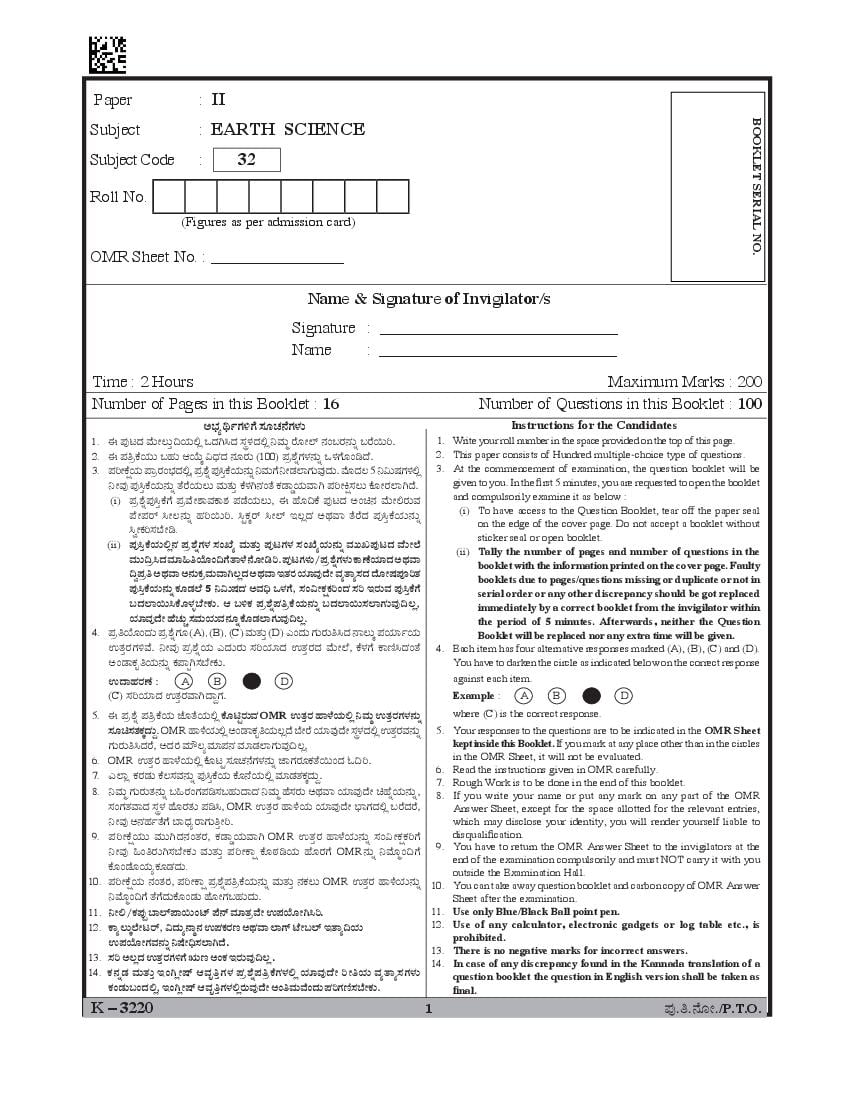
Booklet SERIAL No.
Subject : Earth Science
Subject Code : 32
Roll No.
(Figures as per admission card)
OMR Sheet No. : ____________________
Name & Signature of Invigilator/s
Signature : _________________________________
Name : _________________________________
Time : 2 Hours Maximum Marks : 200
Number of Pages in this Booklet : 16 Number of Questions in this Booklet : 100
A»Ü¦ìWÜÚWæ ÓÜãaÜ®æWÜÙÜá Instructions for the Candidates
1. D ±Üâo¨Ü ÊæáàÆᤩ¿áÈÉ J¨ÜXst ÓܧÙܨÜÈÉ ¯ÊÜá¾ ÃæãàÇ… ®ÜíŸÃÜ®Üá° ŸÃæÀáÄ. 1. Write your roll number in the space provided on the top of this page.
2. D ±Ü£ÅPæ¿áá ŸÖÜá BÁáR Ë«Ü¨Ü ®ÜãÃÜá (100) ±ÜÅÍæ°WÜÙÜ®Üá° JÙÜWæãíw¨æ. 2. This paper consists of Hundred multiple-choice type of questions.
3. ±ÜÄàPæÒ¿á ±ÝÅÃÜí»Ü¨È
Ü É, ±ÜÅÍæ° ±ÜâÔ¤P¿
æ á®Üá° ¯ÊÜáWæ ¯àvÜÇÝWÜáÊÜâ¨Üá. Êæã¨ÜÆ 5 ¯ËáÐÜWÜÙÜÈÉ 3. At the commencement of examination, the question booklet will be
¯àÊÜâ ±ÜâÔ¤Pæ¿á®Üá° ñæÃæ¿áÆá ÊÜáñÜᤠPæÙÜX®Üíñæ PÜvÝx¿áÊÝX ±ÜÄàQÒÓÜÆá PæãàÃÜÇÝX¨æ. given to you. In the first 5 minutes, you are requested to open the booklet
(i) ±ÜÅÍæ°±ÜâÔ¤PæWæ ±ÜÅÊæàÍÝÊÜPÝÍÜ ±Üvæ¿áÆá, D Öæã©Pæ ±Üâo¨Ü Aíb®Ü ÊæáàÈÃÜáÊÜ and compulsorily examine it as below :
±æà±ÜÃ… ÔàÆ®Üá° ÖÜÄÀáÄ. ÔrPÜRÃ… ÔàÇ… CÆÉ¨Ü A¥ÜÊÝ ñæÃæ¨Ü ±ÜâÔ¤Pæ¿á®Üá° (i) To have access to the Question Booklet, tear off the paper seal
on the edge of the cover page. Do not accept a booklet without
ÔÌàPÜÄÓܸæàw.
sticker seal or open booklet.
(ii) ±ÜâÔ¤Pæ¿áÈÉ®Ü ±ÜÅÍæ°WÜÙÜ ÓÜíTæ ÊÜáñÜᤠ±ÜâoWÜÙÜ ÓÜíTæ¿á®Üá° ÊÜááS±Üâo¨Ü ÊæáàÇæ
(ii) Tally the number of pages and number of questions in the
ÊÜáá©Åst ÊÜÞ×£Áãí©Wæ ñÝÙæ ®æãàwÄ. ±ÜâoWÜÙÜá/±ÜÅÍæ°WÜÙÜá PÝOæ¿Þ¨Ü A¥ÜÊÝ
booklet with the information printed on the cover page. Faulty
©Ì±ÜÅ£ A¥ÜÊÝ A®ÜáPÜÅÊÜáÊÝXÆÉ¨Ü A¥ÜÊÝ CñÜÃÜ ¿ÞÊÜâ¨æà ÊÜÂñÝÂÓÜ¨Ü ¨æãàÐܱÜäÄñÜ booklets due to pages/questions missing or duplicate or not in
±ÜâÔ¤Pæ¿á®Üá° PÜãvÜÇæ 5 ¯ËáÐÜ¨Ü AÊܘ JÙÜWæ, ÓÜíËàPÜÒPÜÄí¨Ü ÓÜÄ CÃÜáÊÜ ±ÜâÔ¤PæWæ serial order or any other discrepancy should be got replaced
Ÿ¨ÜÇÝÀáÔPæãÙÜÛ¸æàPÜá. B ŸÚPÜ ±ÜÅÍ氱ܣÅPæ¿á®Üá° Ÿ¨ÜÇÝÀáÓÜÇÝWÜáÊÜâ©ÆÉ, immediately by a correct booklet from the invigilator within
¿ÞÊÜâ¨æà ÖæaÜác ÓÜÊÜá¿áÊÜ®Üã° PæãvÜÇÝWÜáÊÜâ©ÆÉ. the period of 5 minutes. Afterwards, neither the Question
4. ±ÜÅ£Áãí¨Üá ±ÜÅÍæ°WÜã (A), (B), (C) ÊÜáñÜᤠ(D) Gí¨Üá WÜáÃÜá£Ô¨Ü ®ÝÆáR ±Ü¿Þì¿á Booklet will be replaced nor any extra time will be given.
EñܤÃÜWÜÚÊæ. ¯àÊÜâ ±ÜÅÍæ°¿á G¨ÜáÃÜá ÓÜÄ¿Þ¨Ü EñܤÃÜ¨Ü ÊæáàÇæ, PæÙÜWæ PÝ~Ô¨Üíñæ 4. Each item has four alternative responses marked (A), (B), (C) and (D).
AívÝPÜꣿá®Üá° PܱݳXÓܸæàPÜá. You have to darken the circle as indicated below on the correct response
E¨ÝÖÜÃÜOæ : A B C D against each item.
(C) ÓÜÄ¿Þ¨Ü EñܤÃÜÊÝX¨ÝªWÜ. Example : A B C D
5. D ±ÜÅÍæ° ±Ü£ÅPæ¿á hæãñæ¿áÈÉ PæãqrÃÜáÊÜ OMR EñܤÃÜ ÖÝÙæ¿áÈÉ ¯ÊÜá¾ EñܤÃÜWÜÙÜ®Üá° where (C) is the correct response.
ÓÜãbÓÜñÜPÜR¨Üáª. OMR ÖÝÙæ¿áÈÉ AívÝPÜꣿáÆÉ¨æ ¸æàÃæ ¿ÞÊÜâ¨æà Óܧ٨
Ü È
Ü É EñܤÃÊ
Ü ®Ü áÜ ° 5. Your responses to the questions are to be indicated in the OMR Sheet
WÜáÃÜá£Ô¨ÜÃæ, A¨ÜÃÜ ÊÜåèÆÂÊÜÞ±Ü®Ü ÊÜÞvÜÇÝWÜáÊÜâ©ÆÉ. kept inside this Booklet. If you mark at any place other than in the circles
6. OMR EñܤÃÜ ÖÝÙæ¿áÈÉ Pæãor ÓÜãaÜ®æWÜÙÜ®Üá° hÝWÜÃÜãPÜñæÀáí¨Ü K©Ä. in the OMR Sheet, it will not be evaluated.
6. Read the instructions given in OMR carefully.
7. GÇÝÉ PÜÃÜvÜá PæÆÓÜÊÜ®Üá° ±ÜâÔ¤Pæ¿á Pæã®æ¿áÈÉ ÊÜÞvÜñÜPÜR¨Üáª.
7. Rough Work is to be done in the end of this booklet.
8. ¯ÊÜá¾ WÜáÃÜáñÜ®Üá° Ÿ×ÃÜíWܱÜwÓÜŸÖÜá¨Ý¨Ü ¯ÊÜá¾ ÖæÓÜÃÜá A¥ÜÊÝ ¿ÞÊÜâ¨æà bÖæ°¿á®Üá°, 8. If you write your name or put any mark on any part of the OMR
ÓÜíWÜñÜÊÝ¨Ü ÓܧÙÜ ÖæãÃÜñÜá ±ÜwÔ, OMR EñܤÃÜ ÖÝÙæ¿á ¿ÞÊÜâ¨æà »ÝWܨÜÈÉ ŸÃæ¨ÜÃæ, Answer Sheet, except for the space allotted for the relevant entries,
¯àÊÜâ A®ÜÖÜìñæWæ ¸Ý«ÜÂÃÝWÜᣤàÄ. which may disclose your identity, you will render yourself liable to
9. ±ÜÄàPæÒ¿áá ÊÜááX¨Ü®ÜíñÜÃÜ, PÜvÝx¿áÊÝX OMR EñܤÃÜ ÖÝÙæ¿á®Üá° ÓÜíËàPÜÒPÜÄWæ disqualification.
¯àÊÜâ ×í£ÃÜáXÓܸæàPÜá ÊÜáñÜᤠ±ÜÄàPÝÒ PæãsÜw¿á ÖæãÃÜWæ OMR®Üá° ¯Êæã¾í©Wæ 9. You have to return the OMR Answer Sheet to the invigilators at the
end of the examination compulsorily and must not carry it with you
Pæãívæã¿áÂPÜãvܨÜá. outside the Examination Hall.
10. ±ÜÄàPæÒ¿á ®ÜíñÜÃÜ, ±ÜÄàPÝÒ ±ÜÅÍ氱ܣÅPæ¿á®Üá° ÊÜáñÜᤠ®ÜPÜÆá OMR EñܤÃÜ ÖÝÙæ¿á®Üá° 10. You can take away question booklet and carbon copy of OMR Answer
¯Êæã¾í©Wæ ñæWæ¨ÜáPæãívÜá ÖæãàWÜŸÖÜá¨Üá. Sheet after the examination.
11. ¯àÈ/PܱÜâ³ ¸ÝÇ…±ÝÀáíp… ±æ®… ÊÜÞñÜÅÊæà E±ÜÁãàXÔÄ. 11. Use only Blue/Black Ball point pen.
12. PÝÂÆáRÇæàoÃ…, ˨Üá®ݾ®Ü E±ÜPÜÃÜ| A¥ÜÊÝ ÇÝW… pæàŸÇ… CñÝ©¿á 12. Use of any calculator, electronic gadgets or log table etc., is
E±ÜÁãàWÜÊÜ®Üá° ¯Ðæà˜ÓÜÇÝX¨æ. prohibited.
13. There is no negative marks for incorrect answers.
13. ÓÜÄ AÆÉ¨Ü EñܤÃÜWÜÚWæ Má| AíPÜ CÃÜáÊÜâ©ÆÉ .
14. In case of any discrepancy found in the Kannada translation of a
14. PܮܰvÜ ÊÜáñÜᤠCíXÉàÐ… BÊÜ꣤WÜÙÜ ±ÜÅÍ氱ܣÅPæWÜÙÜÈÉ ¿ÞÊÜâ¨æà Äࣿá ÊÜÂñÝÂÓÜWÜÙÜá question booklet the question in English version shall be taken as
PÜívÜáŸí¨ÜÈÉ, CíXÉàÐ… BÊÜ꣤WÜÙÜÈÉÃÜáÊÜâ¨æà Aí£ÊÜáÊæí¨Üá ±ÜÄWÜ~ÓܸæàPÜá. final.
K – 3220 1 ±Üâ.£.®æãà./P.T.O.
Page 2
Paper – II
Note : This paper contains hundred (100) objective type questions. Each question
carries two (2) marks. All questions are compulsory.
1. Most abundant element of the earth 4. Which one of the following methods is
crest is best suited for locating a dissiminated
(A) Nitrogen sulphide deposit ?
(B) Aluminium (A) Induced polarisation method
(C) Oxygen (B) Self potential method
(D) Carbon (C) Resistivity method
(D) Equi-potential line method
2. Magnetic permeability (µ) and magnetic
susceptibility (k) are connected by 5. SP logs are best suited to
relation 1. detect permeable beds.
(A) k = 1 + 4π2µ 2. determine formation water resistivity
(B) k = 1 – 4πµ 3. determine volume of shale in permeable
beds.
(C) µ = 1 + 4πk
4. detect boundaries of permeable
(D) µ = 1 + 4π2k
beds.
3. For a Proton Precession Magnetometer, (A) 1, 2 and 3 only
the Larmore frequency of precession is (B) 1, 3 and 4 only
equal to (C) 2, 3 and 4 only
(A) 2π F .γn (D) 1, 2, 3, 4
(B) 2π F /γn 6. Usual rate of movement of groundwater is
(C) γn /2π F (A) few millimeters per day
(D) γn .F/2π (B) few centimeters per day
Where F – magnetic field and (C) few meters per day
γn–gyromagnetic ratio of proton (D) groundwater does not move
Paper II 2 K – 3220
Page 3
rate for a 100 m thick sand in one
kilometer wide valley. Assume sand to List-I List-II
have a permeability value of 50 m/day a. Cyclic twin 1. Albrite
with water table slope of 1 m /k m. b. Penetration twin 2. Argonite
(A) 2,500 m3/day c. Transform twin 3. Rutile
(B) 5,000 m3/day d. Contact twin 4. Quartz
(C) 7,500 m3/day Codes :
(D) 10,000 m3/day a b c d
(A) 1 2 3 4
8. Sr initial ratio of the crystal recycled
(B) 2 1 4 3
rocks are
(C) 4 2 3 1
(A) Less than the mantle derived rocks
(D) 3 2 1 4
(B) More than the mantle derived rocks
(C) Same as mantle derived rocks 12. The Eastern Dharwar Craton overlies
(D) No relation exists with mantle (A) Deccan traps
derived rocks (B) Granitic basement
9. The permanent change that occurs in a solid (C) Gneissic basement
material due to growth of fracture and /or (D) Shahabad limestone
due to sliding on fractures when stresses
13. Joints of one set are relatively long,
exceed a critical value is known as
whereas the joints of the other are
(A) Elastic deformation relatively short cross joints, which
(B) Plastic deformation terminate at the long joint are known as
(C) Brittle deformation (A) Conjugate joints
(D) Ductile deformation (B) Pinnate joints
(C) Release joints
10. If the annual fluctuation of water table in
(D) Orthogonal joints
an unconfined aquifer covering an area
of 200 ha is 5 m and the specific yield 14. A subtle roughness on the surface of some
is 15%, calculate annual groundwater joints that macroscopically resembles the
recharge. imprint of a feather is known as
(A) 1000 ha m (A) Arrest lines
(B) 30 ha m (B) Twist hackle
(C) 75 ha m (C) Plume axis
(D) 150 ha m (D) Plumose structure
K – 3220 3 Paper II
Page 4
significant oil generator ? erosional structure ?
(A) 30 – 70°C (A) Rill Marks
(B) 40 – 90°C
(B) Scour Marks
(C) 50 – 100°C
(D) 60 – 120°C (C) Chevron Marks
(D) Swash Marks
16. Assertion (A) : In India coal fields are
always associated with tectonism. 19. Internally structureless sand-sized
Reason (R) : Lignite occurs in carbonate particle allochem with an
Tamil Nadu and Anthracite occurs in average size of 100 – 500 microns,
Jammu and Kashmir. Both of them composed of microcrystalline calcite is
belong to tertiary age.
termed as
(A) Both A and R are true and R is the
correct explanation (A) Oolite (B) Ooid
(B) Both A and R are true but, R is not (C) Peloid (D) Pisoid
the correct explanation
(C) A is true but R is false 20. Match the following from Group – I
(D) A is false but R is true (morphological features) with those
from Group – II (fossils) to choose the
17. Match the following list of items of
correct option.
Group – I (Stratigraphic Units) with those of
Group – II (Sedimentary Basins) and Group – I Group – II
choose the correct option. (morphological (fossils)
Group – I Group – II features)
(Stratigraphic (Sedimentary
a. Cusp 1. Foraminifer
Units) Basins)
b. Sicula 2. Coral
a. Badami Group 1. Chatisgarh
b. Papaghani Group 2. Vindhyan c. Calyx 3. Gastropod
c. Kheinjua Group 3. Pranhita-Godavari d. Callus 4. Graptolite
d. Sullavai Group 4. Cuddapah 5. Conodont
5. Kaladgi a b c d
a b c d
(A) 5 1 4 2
(A) 2 5 1 4
(B) 4 2 3 5
(B) 5 3 2 4
(C) 5 4 2 3 (C) 5 4 2 3
(D) 2 5 4 1 (D) 4 5 3 2
Paper II 4 K – 3220
Page 5
oceanic lithosphere are found in petroleum is
(A) capillary action
(A) Mid oceanic ridge
(B) porosity
(B) Subduction zone (C) buoyancy
(C) Obduction zone (D) surface tension
(D) Collisional zone
26. Steeply plunging inclined folds are
known as
22. Phase transition at Mohorovicic
(A) Isocline fold
discontinuity is due to
(B) Recline fold
(A) Change in composition from Gabbro (C) Recumbent fold
to Eclogite (D) Vertical upright fold
(B) Change in composition from Gabbro
27. If the porosity and effective porosity
to Granite of the geological formations are 32%
(C) Change in composition from and 27% respectively. What will be the
Pegmatite to Dolerite specific yield of the formation if specific
retention is 9% ?
(D) Change in composition from
(A) 23%
carbonatite to kimberlite (B) 5%
(C) 14%
23. According to the seismic zonation map
(D) 18%
of India, highest level of seismicity is
found in 28. Earth’s gravitational force is maximum at
(A) Zone 1 (A) Equator
(B) Pole
(B) Zone 5
(C) At 45° Longitude
(C) Zone 2 (D) At 45° Latitude
(D) Zone 6
29. Which of the following methods is best
24. A gap in depositional sequence suited for demarcating polluted zones of
represented by the unconformity is called groundwater ?
(A) break (A) Water divining method
(B) hiatus (B) Self potential method
(C) gap (C) Magnetic method
(D) interval (D) Seismic method
K – 3220 5 Paper II
Page 6
continental and oceanic environment ? Poisson’s ratio by ‘µ’ then the velocity
(A) Strike-slip fault of the shear wave will be
(B) Dip fault µ/ρ
(A)
(C) Oblique fault
µ /ρ
(B)
(D) Wrench fault
(C) µ/ρ
31. In whole Asia, oil reserves are estimated
(D) µ.ρ
to be _________ of world oil reserves.
(A) 3% 35. The science of study of occurrence and
(B) 5% distribution of elements in the universe
(C) 8% is called
(D) 12% (A) Geochronology
32. Presence of pseudotachylyte in a terrane (B) Geochemistry
indicate (C) Cosmochemistry
(A) Ancient volcanic activity (D) Mineralchemistry
(B) Ancient earthquake activity
(C) Ancient subduction activity 36. Gossan or cap rock are good indicator
(D) Ancient mantle-plume activity of
(A) Hydrothermal deposits
33. P1, P2 and p3 are resistivities of three
(B) Secondary sulphide deposits
horizontal formations, match the
following. (C) Placer deposits
List – I List – II (D) Residual deposits
a. P1 < P2 < P3 1. A type curve
b. P1 < P2 > P3 2. Q type curve 37. During tunnelling, fulling of rock blocks
c. P1 > P2 < P3 3. K type curve from top or sides due to release of
d. P1 > P2 > P3 4. H type curve stresses is known as
a b c d
(A) Blockage
(A) 1 2 3 4
(B) 3 2 1 4 (B) Water rush
(C) 2 3 4 1 (C) Rock full
(D) 1 3 4 2 (D) Rock burst
Paper II 6 K – 3220
Page 7
occurred in the geological history. Which increase towards the center of a hurricane
of the following mass extinction event
due to
in the geological history is associated
with the conspicuous Iridium anomaly ? (A) Warmer water
(A) Permian / Triassic (B) Reduced friction
(B) Precambrian / Ordovician (C) Conservation of angular momentum
(C) Eocene / Oligocene
(D) Stronger Coriolis effect
(D) Cretaceous / Tertiary
43. Which is the largest dam in India ?
39. As compared to magnetite, hematite is
(A) more magnetic and richer in Fe (A) KRS Dam
(B) more magnetic but has a lower Fe (B) Nagarjunsagar Dam
content
(C) Bhakra Dam
(C) less magnetic and has a lower Fe
content (D) Hirakud Dam
(D) less magnetic but a higher Fe
44. Gold occurrence in the Hatti-Maski
content
schist belt belongs to
40. Which technique is used to detect and (A) Western Dharwar Craton (WDC)
monitor the tropical storms, which may
(B) Eastern Dharwar Craton (EDC)
become hurricane ?
(C) Central Dharwar Craton (CDC)
(A) Ocean buoys
(B) Aircraft (D) Granulite Terrain
(C) Satellites
45. Radioactivity in an atom of an element
(D) Coastal observers
takes place spontaneously in order to
41. If the landform is formed due to achieve
fast flowing rivers, then the resulting (A) Stability in the nucleus of an atom
landform is considered as (B) Instability in the nucleus of an
(A) Natural levee
atom
(B) Flood plain
(C) Capturing of electron
(C) Point bars
(D) Channel bars (D) Positron anhilation
K – 3220 7 Paper II
Page 8
the different units of the geological time of the floor of a stream channel by
scale in proper order beginning with the continued deposition of bed load is
termed as
greatest expanse of time ?
(A) Meandering
(A) Eon - epoch – period – era
(B) Aggradation
(B) Era - period – eon – epoch (C) Sedimentation
(C) Eon – era - period - epoch (D) Diagenesis
(D) Era – eon - epoch – period
51. Waterfalls and rapids along the river
course indicates _______ stage of the
47. Which fundamental geologic principle
river.
allows geologists to use the remains of
(A) Youthful (B) Mature
organisms when correlating rock units ?
(C) Old (D) Very old
(A) Cross cutting relationships
52. When Zircon mineral is impacted by
(B) Uniformitarianism
meteorite, due to shock effects ________
(C) Fossil succession mineral is formed.
(D) Original horizontality (A) Riedite (B) Stishovite
(C) Sphene (D) Graphene
48. The temperature of the visible part of the
sun is about 53. Planar zone of seismicity is a subduction,
called
(A) 8000° Celsius
(A) Benioff zone
(B) 5500° Celsius
(B) Fault zone
(C) 6500° Celsius (C) Collisional zone
(D) 3500° Celsius (D) Rift zone
49. NASA’s ___________ is the first-ever 54. The super continent that existed intact
mission to touch the sun. about 300 million years ago in a geologic
time unit is
(A) Parker Solar Probe
(A) Pangea
(B) Sputnik
(B) Gondwana
(C) Aditya (C) Ur
(D) Apollo mission (D) Panthalassa
Paper II 8 K – 3220
Page 9
found in Vredefort in South Africa is the liquid and olivine proportion at a
(A) 130 km (B) 160 km point ‘X’ marked on a given binary phase
(C) 500 km (D) 260 km diagram.
56. Parts per million is same as
(A) mg. of solute / g of solution
1900
1890
Liquid
(B) mg. of solute / litre of solution
(C) mg. of solute / 100 cc of solution 1700
(D) g of solute / kg of solution T°C
X
1500
57. For a confined aquifer of thickness ‘h’
and permeability ‘k’, the transmissivity Olivine
is given as 1300
(A) h / k (B) k / h 1205
(C) k . h (D) k . h2 Fa 20 40 60 80 F0
WL% Forsterite
58. A planar feature with well oriented
minerals is
Liquid – Olivine
(A) Foliation
(B) Lineation (A) 60 – 40
(C) Schistosity
(B) 40 – 60
(D) Bedding plane
(C) 70 – 30
59. Assertion (A) : AFM diagram is useful
for the study of pelitic rocks. (D) 30 – 70
Reason (R) : Pelitic rocks are rich in
61. Two major types of basaltic magma are
plagioclase Feldspar and Quartz.
______ and ________
(A) Both A and R are true and R is
correct explanation (A) Acidic and Basic
(B) Both A and R are true but, R is not (B) Tholeitic and Alkaline
correct explanation
(C) Carbonatitic and Basic
(C) A is true but R is false
(D) A is false but R is true (D) Kimberlitic and Acidic
K – 3220 9 Paper II
Page 10
and quartz is termed as plagioclase under the optical microscope ?
(A) by type of extinction
(A) Granophyric texture (B) by type of twinning
(B) Myrmekite texture (C) by its interference figure
(D) by its pleochroic scheme
(C) Intersertal texture
(D) Symplictitic texture 67. Oldest rock in India is found in _________
craton.
63. Source for generation basaltic lava at (A) Bastar
(B) Dharwar
mid oceanic ridge is
(C) Singhbhum
(A) Partial melting of ultramafic magma (D) Aravalli
(B) Partial melting of acidic magma
68. With regard to the major dissolved
(C) Fractional crystallisation of basic components of sea water, which one of
the following options represent higher
magma
concentrations ?
(D) Assimilation of country rock (A) bicarbonate ions, silicate ions,
chloride ions
64. The process in which preexisting (B) calcium ions, magnesium ions,
rock is converted into granite without chloride ions
(C) chloride ions, sodium ions, sulfate
undergoing melting ions
(A) Metasomatism (D) chloride ions, magnesium ions,
potassium ions
(B) Pneumatolysis
(C) Granitization 69. Choose the correct order representing
increased wind speed of the following
(D) Assimilation descriptive terms given in Beaufort wind
scale.
65. Which of the following mineral shows (A) Breeze → Gale → Hurricane →
parallel extinction ? Storm
(B) Breeze → Gale → Storm →
(A) Quartz Hurricane
(B) Hornblende (C) Gale → Breeze → Hurricane →
Storm
(C) Calcite
(D) Breeze → Hurricane → Storm →
(D) Biotite Gale
Paper II 10 K – 3220
Page 11
presence used for detecting presence of moisture in
(A) Ropy lava the middle levels of the atmosphere ?
(B) Flow structures (A) Infrared
(C) Layered structure (B) Water vapour
(D) Pillowed structure (C) Mid infrared
(D) Thermal infrared
71. Detached clouds in the form of white,
delicate filaments, mostly white patches 75. When the interacting electromagnetic
radiation has the larger dimension than
or narrow bands are called as
the atmospheric particles, then the
(A) Cirrus resulting scattering is called as
(B) Stratus (A) Non-selective
(C) Altostratus (B) Raman
(C) Mie
(D) Stratocumulus
(D) Rayleigh
72. Normally, what type of soils are formed 76. In which type of fluvial landforms, low
by wind dust in and around hot deserts ? ridges are formed along the banks of
(A) Loamy soil rivers due to the result of a velocity
decrease and deposition of a sediment
(B) Alluvial soil laden streams overflow their banks
(C) Loess soil during flood ?
(D) Silty soil (A) Point bars
(B) Channel bars
73. The term used to describe the peeling (C) Deltas
away of sheets of rock from a rock’s (D) Natural levees
surface due to a range of physical and 77. Widmanstatten figures are the
chemical process during weathering is characteristic features of __________ type
(A) Deflation meteorites.
(A) Siderite
(B) Exfoliation
(B) Chondrite
(C) Partioning (C) Achondrite
(D) Disintegration (D) Tektite
K – 3220 11 Paper II
Page 12
movement. List – I List – II
a. subduction zone 1. Divergent
(A) Mudflow
b. Spreading of ridges 2. Continental
(B) Soil creep and formation of new Collision
(C) Slow subsidence crust
c. Formation of linear 3. Convergent
(D) Rock creep valley and undersea
canyons
79. _____ is the highest plateau in the world.
d. Formation of folded 4. Transform
(A) Colorado Plateau mountain chains
(B) Pamir Plateau a b c d
(A) 1 2 3 4
(C) Patagonist Plateau (B) 2 3 1 4
(D) Potwar Plateau (C) 3 1 4 2
(D) 4 2 3 1
80. Which of the following represents a
83. Grain size of the resultant rock becomes
process of chemical weathering ? smaller in
(A) Mass Exfoliation (A) Regional metamorphism
(B) Burial metamorphism
(B) Thermal expansion and contraction
(C) Cataclastic metamorphism
(C) Frost action and crystal growth (D) Contact metamorphism
(D) Hydration and Hydrolysis
84. Match the following :
Rock type Their origin
81. When there is a balance between the
a. Norite 1. Deep seated
upward pressure gradient force and plutonic
the downward force of gravity, the b. Essexite 2. Deep seated
metamorphic
atmosphere is said to be in ________
c. Eclogite 3. Sedimentary
balance. d. Clay 4. Volcanic
(A) Hydrostatic a b c d
(B) Geostrophic (A) 1 3 4 2
(B) 2 1 3 4
(C) Hypsometric (C) 1 4 2 3
(D) Baroclinic (D) 4 1 2 3
Paper II 12 K – 3220
Page 13
the fault trace. Identify the types of such as alkali and alkaline earth metals
separation along h-i, h-j and i-j. are
F (A) Atmophile
h
(B) Lithophile
(C) Siderophile
i
(D) Chalcophile
F′
89. Match the sediment gravity terms (Group – I)
j
with the grain support mechanisms (listed
in Group – II).
(A) h-i – dip separation, h-j – offset, j-i
Group – I Group – II
– overlap
(B) h-i – strike-slip separation, h-j – a. Turbity current 1. Matrix strength
overlap, j-i – offset b. Debris flow 2. Fluid turbulence
(C) h-i – dip-slip separation, h-j – strike- c. Liquified flow 3. Dispersive pressure
slip separation, j-i – dip separation d. Grain flow 4. Escaping pore fluid
(D) h-i – strike-slip separation, h-j – strike- a b c d
slip separation, j-i – dip separation
(A) 2 3 1 4
86. Chromite deposits occur in (B) 3 2 1 4
(A) mafic rocks (C) 2 1 4 3
(B) ultramafic rocks (D) 1 3 4 2
(C) felsic rocks
(D) acidic rocks 90. Which one of the following is unlikely to
happen in the Bay of Bengal, if the fresh
87. Radioactive elements are concentrated water discharges from Peninsular and
mainly in the earth crust due to
Himalayan rivers is drastically reduced ?
(A) Geochemical coherence
(A) Increase in cyclonic activity
(B) Geophysical coherence
(B) Increase in upper ocean mixing
(C) Geological coherence
(C) Deepening of mixed layer
(D) Geo-botanical coherence
(D) Initiation of winter convection
K – 3220 13 Paper II
Page 14
probable environment of the stratigraphic combination highest permeability is
observed in the sedimentary rocks ?
sequence represented by the below given
(A) Well sorted, Angular
litho units from older to younger.
(B) Poorly sorted, poorly rounded
Poorly sorted sandstone with unimodal
(C) Well sorted, well rounded
palaeocurrent → sand-mud alteration
(D) Poorly sorted, well rounded
with bipolar palaeocurrent → well sorted
95. Match the following microfossil taxa (listed
sandstone with bimodal palaeocurrent.
in Group – I) with their test composition
(A) Glacial → fluvial → eolian (listed in Group – II).
(B) Fluvial → lacustrine → tidal Group – I Group – II
(C) Fluvial → tidal → shoreface (Microfossil (Test
(D) Glacial → lacustrine → eolian taxa) composition)
a. Radiolaria 1. Calcareous
92. Which of the following are passive b. Acritarch 2. Phosphatic
geomorphic processes ? c. Conodont 3. Siliceous
(A) Abrasion and weathering d. Foraminifera 4. Organic-walled
(B) Weathering and mass movements a b c d
(A) 3 2 1 4
(C) Abrasion and deflation
(B) 3 4 2 1
(D) Mass movement and cavitation
(C) 2 4 3 1
93. Increasing primary productivity in the (D) 3 1 4 2
oceans causes 96. _______ is a sand ridge that connects an
(A) Decrease in atmospheric CO2 island or sea stack to the mainland.
(A) Spit
(B) Increase in atmospheric CO2
(B) Tambolo
(C) Increase in atmospheric dust
(C) Barrier beach
(D) Decrease in atmospheric dust (D) Wave-cut cliff
Paper II 14 K – 3220
Page 15
processes (listed in Group – I) with represents a source of heat due to
appropriate responses (Group – II). (A) They increase the absorption of solar
Group – I Group – II radiation
(B) They conduct heat from the earth
a. Dissolution 1. reaction of a substance
surface
with water
(C) Cloud formation releases latent heat
b. Oxidation 2. Atomic bonds broken
to the air
by dipolar water
(D) Melting ice crystals in the cloud
molecules
absorbs heat
c. Hydrolysis 3. electrons are lost from
100. Match the Satellites with their sensors.
one element
List – I List – II
a b c
a. Landsat - 5 1. Advanced very high
(A) 2 3 1
Resolution
(B) 1 3 2
Radiometer
(C) 2 1 3 b. Spot – 1 2. High resolution
(D) 3 2 1 visible imaging
sensor
98. Most limestones have large component
c. IRS – 1B 3. Thematic mapper
of CaCO3 that was originally extracted
d. NOAA 4. Linear imaging
from seawater by
self scanning sensor
(A) Evaporation a b c d
(B) Inorganic chemical reaction (A) 3 2 4 1
(C) Chemical weathering (B) 1 3 4 2
(D) Organisms (C) 2 1 3 4
(D) 4 2 3 1
K – 3220 15 Paper II
Page 16
Paper II 16 K – 3220
Document Details
| Board / Org | Karnataka Exams |
| Exam | Karnataka State Eligibility Test |
| Type | Question Paper |
| Pages | 16 |
| Updated | 24 Sep 2026 |