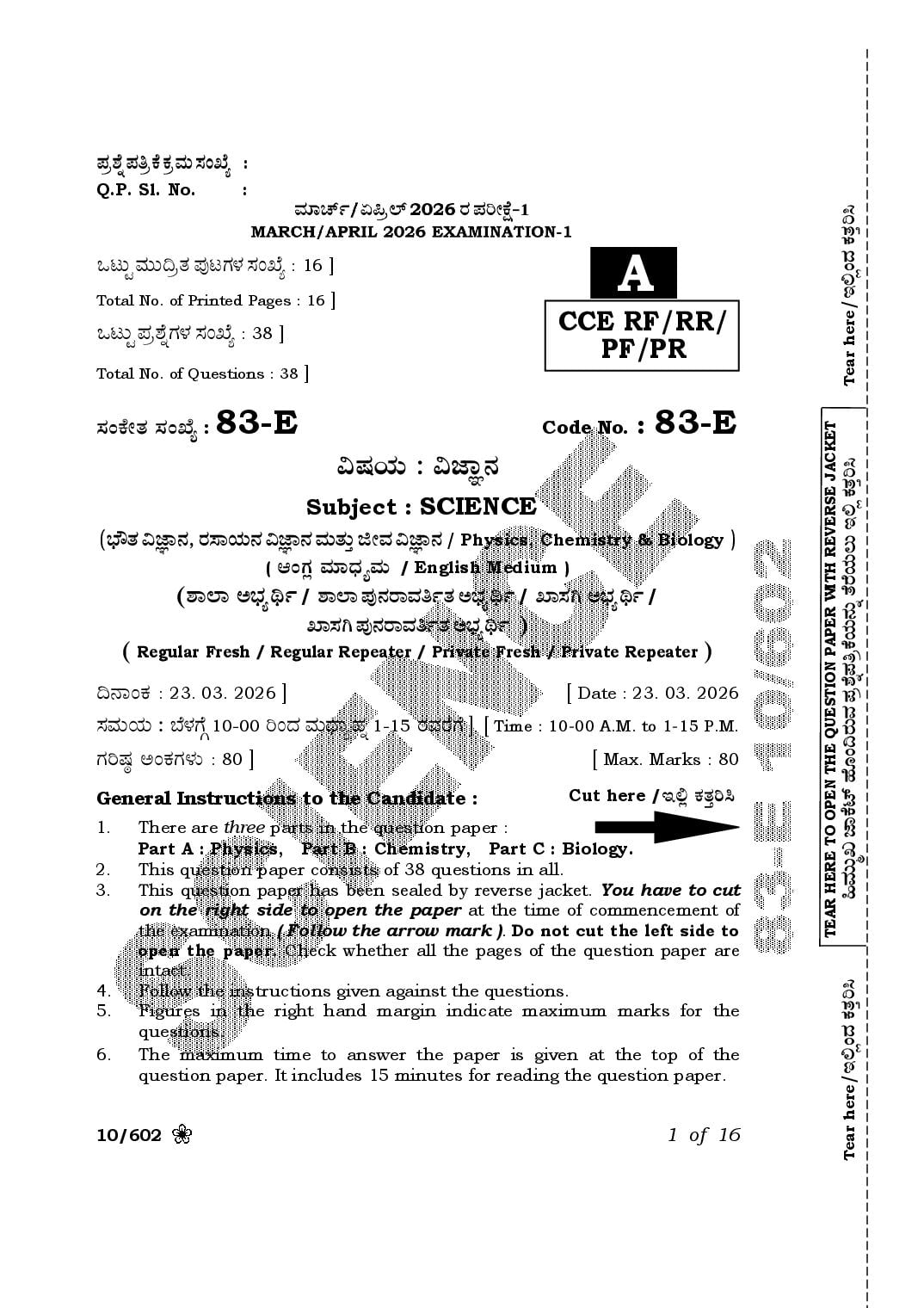
Karnataka SSLC Question Paper 2026 Science
Finished viewing? Save it for later —
Download Karnataka SSLC Question Paper 2026 Science (PDF · 32 pages)About Karnataka SSLC Question Paper 2026 Science
Karnataka SSLC Question Paper 2026 Science is available here for free download. Published by Karnataka Board for Class 10, this question paper can be viewed online or downloaded as a PDF (32 pages). Candidates preparing for Class 10 can use Karnataka SSLC Question Paper 2026 Science to understand the exam pattern, the type of questions asked, and the overall difficulty level.
Frequently Asked Questions
How can I download Karnataka SSLC Question Paper 2026 Science?
Open this page and click the Download button to save Karnataka SSLC Question Paper 2026 Science as a PDF. It is completely free on AglaSem Docs.
Is Karnataka SSLC Question Paper 2026 Science free to download?
Yes. Karnataka SSLC Question Paper 2026 Science can be viewed online and downloaded as a PDF free of cost on AglaSem Docs.
How many pages does Karnataka SSLC Question Paper 2026 Science have?
Karnataka SSLC Question Paper 2026 Science contains 32 pages, which you can read online or download together as a single PDF.
Where can I find more Class 10 study material?
You can find more Class 10 question papers, sample papers, syllabus, and answer keys on AglaSem Docs.
Karnataka SSLC Question Paper 2026 Science – Text
Read the full text of this question paper below — useful to quickly search, copy and reference the content online without downloading the PDF.
📄 View text version (32 pages)
Page 1
Q.P. Sl. No. :
Tear here/CÈÉí¨Ü PÜñܤÄÔ
Joár ÊÜáá©ÅñÜ ±ÜâoWÜÙÜ ÓÜíTæ : 16 ]
Total No. of Printed Pages : 16 ]
A
Joár ±ÜÅÍæ°WÜÙÜ ÓÜíTæ : 38 ] CCE RF/RR/
PF/PR
Total No. of Questions : 38 ]
—⁄MOÊfi}⁄ —⁄MSÊ¿ : 83-E Code No. : 83-E
TEAR HERE TO OPEN THE QUESTION PAPER WITH REVERSE JACKET
…Œ⁄æ⁄fl : …e¤k´⁄
×ÊÜáá¾S hÝPæp… Öæãí©ÃÜáÊÜ ±ÜÅÍ氱ܣÅPæ¿á®Üá° ñæÃæ¿áÆá CÈÉ PÜñܤÄÔ
Subject : SCIENCE
(»èñÜ ËþÝ®Ü, ÃÜÓÝ¿á®Ü ËþÝ®Ü ÊÜáñÜᤠiàÊÜ ËþÝ®Ü / Physics, Chemistry & Biology )
( AMV⁄« »⁄·¤®⁄¥¿»⁄fl / English Medium )
(ÍÝÇÝ A»Ü¦ì / ÍÝÇÝ ±Üâ®ÜÃÝÊÜ£ìñÜ A»Ü¦ì / TÝÓÜX A»Ü¦ì /
TÝÓÜX ±Üâ®ÜÃÝÊÜ£ìñÜ A»Ü¦ì )
( Regular Fresh / Regular Repeater / Private Fresh / Private Repeater )
¶´¤MO⁄ : 23. 03. 2026 ] [ Date : 23. 03. 2026
ÓÜÊÜá¿á : ¸æÙÜWæY 10-00 Äí¨Ü ÊÜá«ÝÂÖÜ° 1-15 ÃÜÊÜÃæWæ ] [ Time : 10-00 A.M. to 1-15 P.M.
V⁄¬Œ⁄r @MO⁄V⁄◊⁄fl : 80 ] [ Max. Marks : 80
General Instructions to the Candidate : Cut here /B∆« O⁄}⁄°¬“
1. There are three parts in the question paper :
Part A : Physics, Part B : Chemistry, Part C : Biology.
2. This question paper consists of 38 questions in all.
3. This question paper has been sealed by reverse jacket. You have to cut
on the right side to open the paper at the time of commencement of
the examination ( Follow the arrow mark ). Do not cut the left side to
open the paper. Check whether all the pages of the question paper are
intact.
Tear here/CÈÉí¨Ü PÜñܤÄÔ
4. Follow the instructions given against the questions.
5. Figures in the right hand margin indicate maximum marks for the
questions.
6. The maximum time to answer the paper is given at the top of the
question paper. It includes 15 minutes for reading the question paper.
10/602 1 of 16
Page 2
PART – A
( PHYSICS )
I. Four alternatives are given for each of the following
questions / incomplete statements. Choose the correct
alternative and write the complete answer along with its
letter of alphabet. 2×1=2
1. The power of a lens is + 2D. Then the focal length of that
lens is
(A) 0·5 m (B) 2 m
(C) 0·2 m (D) 5 m
2. The resistivities of some materials at 20°C are given in the
table below :
Materials Resistivity ( Ωm )
K 2·63 × 10 − 8
L 5·20 × 10 − 8
M 1·60 × 10 − 8
N 6·84 × 10 − 8
The best conductor of electricity among these materials is
(A) N (B) K
(C) M (D) L
10/602 2 of 16
Page 3
II. Answer the following questions : 2×1=2
3. Write the symbol diagram of the following components
used in the electric circuit :
i) Rheostat
ii) Wire crossing without joining
4. How many times the magnetic field produced by a circular
coil of a conductor having 5 turns is larger than the
magnetic field produced by a coil of 1 turn ?
III. Answer the following questions : 3×2=6
5. Observe the figure given below. Among the resistors A and
B, through which of the resistors more current flows ?
Give reason for your answer.
10/602 3 of 16
Page 4
6. What is the colour of danger signal lights ? Why is that
colour used ?
7. a) State Fleming’s left hand rule.
b) What is the potential difference between the live wire
and the neutral wire in domestic electric circuit in
our country ?
IV. Answer the following questions : 3×3=9
8. What is presbyopia ? What are the reasons for this
defect ? Suggest a remedy for this defect.
OR
What is short-sightedness ? What are the reasons for this
defect ? How can this defect be corrected ?
9. What is fuse ? What are the reasons for causing overload
and short circuit in an electric circuit ?
OR
What is earth wire ? Explain the function of the earth wire.
10/602 4 of 16
Page 5
10. Draw the ray diagram that shows the image formation
when an object is kept at ‘C’ of a concave mirror. Write the
nature of the image formed.
[ C : Centre of curvature ]
V. Answer the following questions : 2×4=8
11. a) State the laws of refraction of light.
b) Mention any two differences between convex mirror
and convex lens.
OR
a) What is magnification ? Write the formula used to
calculate the magnification of the image produced by
a lens.
b) State the laws of reflection of light.
12. Two resistors having resistance 2 Ω are first connected in
series and then in parallel in an electric circuit to a
potential difference of 6 V. Find the electric power of this
circuit in series and parallel combinations.
10/602 5 of 16
Page 6
PART – B
( CHEMISTRY )
VI. Four alternatives are given for each of the following
questions / incomplete statements. Choose the correct
alternative and write the complete answer along with its
letter of alphabet. 3×1=3
13. The gas liberated when dilute sulphuric acid is added to
zinc is
(A) Oxygen (B) Hydrogen
(C) Nitrogen (D) Chlorine
14. To make pure iron hard and strong,
(A) it will be fused with some other metals
(B) anodisation will be done
(C) zinc will be added
(D) carbon will be added in definite proportion
15. The unique property of carbon to form a large molecule by
forming bonds with other carbon atoms is
(A) Tetravalency (B) Inflammability
(C) Catenation (D) Allotropism
10/602 6 of 16
Page 7
VII. Answer the following questions : 3×1=3
16. How many single and double bonds are present in
C3H7COOH molecule ?
17. Observe the given equation.
W (
Pb NO3 )2 → X PbO + Y NO 2 + Z O 2
Which numbers respectively will be in the positions W, X,
Y and Z when this equation is balanced ?
18. Which metal among aluminium and copper is used as
reducing agent in the extraction of manganese metal ?
Why ?
VIII. Answer the following questions : 3×2=6
19. While diluting an acid, water should not be added to acid.
Why ?
20. Write the name, molecular formula and structural formula
of the compound obtained when one hydrogen atom of
ethane is replaced by –CHO group.
21. Write any two differences between roasting and
calcination.
OR
Show the formation of sodium chloride molecule by the
transfer of electrons with the help of electron dot diagram.
10/602 7 of 16
Page 8
IX. Answer the following questions : 3×3=9
22. Write the molecular formula of the following compounds
and mention two uses of each :
i) Washing soda
ii) Plaster of Paris.
OR
a) What is water of crystallistion ?
b) Name the salts used in the following.
i) In fire extinguishers
ii) Bleaching of wood pulp in paper factories.
23. Observe the solutions of compounds given below and
answer the following questions :
Pb ( NO 3 ) 2 , BaCl 2 , Na 2 SO 4 , KI.
a) Which solutions are to be reacted with each other to
get white precipitate ? Mention the type of this
reaction.
b) Which positive and negative ions combine to form
this precipitate ?
10/602 8 of 16
Page 9
24. Draw the diagram of the arrangement of the apparatus
used to show the action of steam on a metal. Label the
following parts :
i) Metal sample
ii) Delivery tube
X. Answer the following question : 1×4=4
25. a) Carbon could not form C 4 − anion or C 4 + cation.
Why ?
b) Explain the mechanism of the cleaning action of
soap.
OR
a) Write the electron dot structures of the following
molecules :
i) Nitrogen molecule
ii) Ethene molecule.
b) Explain the oxidation reaction of converting ethanol
into ethanoic acid.
10/602 9 of 16
Page 10
PART – C
( BIOLOGY )
XI. Four alternatives are given for each of the following
questions / incomplete statements. Choose the correct
alternative and write the complete answer along with its
letter of alphabet. 3×1=3
26. The important role of stomata in transportation of water
is
(A) performing continuous transpiration
(B) absorbing carbon dioxide
(C) releasing oxygen
(D) creating upward tension
27. As the food moves forward in the human digestive system
the enzymes that help for the digestion respectively are
(A) Pepsin → Trypsin → Lypase
(B) Amylase → Pepsin → Lypase
(C) Lypase → Amylase → Trypsin
(D) Trypsin → Pepsin → Amylase
10/602 10 of 16
Page 11
28. Observe the given diagram. The response shown by part X
is
(A) Positive thigmotropism and directional movement
(B) Positive geotropism and independent movement
(C) Positive phototropism and non-directional
movement
(D) Positive chemotropism and independent movement
XII. Answer the following questions : 3×1=3
29. Draw the diagram that shows the germination of pollen on
stigma.
10/602 11 of 16
Page 12
30. Identify the group of plants that can be grown by
vegetative propagation among the following.
P : Rose, Jackfruit, Bryophyllum
Q : Money plant, Mustard, Watermelon
R : Banana, Rose, Hibiscus
S : Papaya, Hibiscus, Mustard.
31. The number of male turtles in the sea shore is decreasing
nowadays. What is the reason for this ?
XIII. Answer the following questions : 2×2=4
32. Name the glands that secrete the following hormones and
mention the function of these hormones.
i) Insulin
ii) Thyroxin.
OR
10/602 12 of 16
Page 13
Mention two important plant hormones that help for the
growth of the stem. Give an example for the hormone that
stops the growth of the plant.
33. The rate of respiration is more in which organism among
Human and Fish ? Why ?
XIV. Answer the following questions : 3×3=9
34. Mention the function of each part of the human brain
given below :
i) Cerebrum ( Forebrain )
ii) Cerebellum
iii) Medulla
35. a) Define the following :
i) Food chain
ii) Biomagnification.
b) Mention the importance of ozone.
OR
10/602 13 of 16
Page 14
a) What are biodegradable substances ? Write two
examples for decomposers.
b) Which synthetic chemical is responsible for the
depletion of the ozone layer ?
36. A red flowering pea plant ( RR ) is crossed with a white
flowering pea plant ( rr ). Show the result of F2 generation
with the help of checker board. Write the phenotypic and
genotypic ratio of the plants obtained in F2 generation.
XV. Answer the following question : 1×4=4
37. Draw the diagram that shows the cross-section of human
heart and label the following parts :
i) Septum
ii) Right atrium.
XVI. Answer the following question : 1×5=5
38. a) How does a fertilized egg develop into a foetus in the
female uterus ? How does the embryo get
nourishment in mother’s womb ? Explain.
10/602 14 of 16
Page 15
b) What are the changes that occur in a flower after
fertilization ?
OR
a) List any two methods of contraception that human
beings usually follow.
b) How does menstrual cycle occur ? Explain.
c) Write any two differences between self and cross
pollination.
10/602 15 of 16
Page 16
10/602 16 of 16
Page 17
±ÜÅÍæ° ±Ü£ÅPæ PÜÅÊÜá ÓÜíTæ :
Q.P. Sl. No. :
Joár ÊÜáá©ÅñÜ ±ÜâoWÜÙÜ ÓÜíTæ : 16 ]
Total No. of Printed Pages : 16 ]
A
Joár ±ÜÅÍæ°WÜÙÜ ÓÜíTæ : 38 ] CCE RF/RR/
Total No. of Questions : 38 ] PF/PR
TEAR HERE TO OPEN THE QUESTION PAPER WITH REVERSE JACKET
ÓÜíPæàñÜ ÓÜíTæ : 83-K Code No. : 83-K
×ÊÜáá¾S hÝPæp… Öæãí©ÃÜáÊÜ ±ÜÅÍ氱ܣÅPæ¿á®Üá° ñæÃæ¿áÆá CÈÉ PÜñܤÄÔ
ËÐÜ¿á : ËþÝ®Ü
Subject : SCIENCE
»èñÜ ËþÝ®Ü, ÃÜÓÝ¿á®Ü ËþÝ®Ü ÊÜáñÜᤠiàÊÜ ËþÝ®Ü / Physics, Chemistry & Biology
PܮܰvÜ ÊÜÞ«ÜÂÊÜá / Kannada Medium
ÍÝÇÝ A»Ü¦ì / ÍÝÇÝ ±Üâ®ÜÃÝÊÜ£ìñÜ A»Ü¦ì / TÝÓÜX A»Ü¦ì / TÝÓÜX ±Üâ®ÜÃÝÊÜ£ìñÜ A»Ü¦ì
Regular Fresh / Regular Repeater / Private Fresh / Private Repeater
©®ÝíPÜ 23. 03. 2026 ] [ Date : 23. 03. 2026
ÓÜÊÜá¿á ¸æÙÜWæY 10-00 Äí¨Ü ÊÜá«ÝÂÖÜ° 1-15 ÃÜÊÜÃæWæ ] [ Time : 10-00 A.M. to 1-15 P.M.
WÜÄÐÜu AíPÜWÜÙÜá 80 ] [ Max. Marks : 80
±ÜÄàûݦìWÝX ÓÝÊÜޮܠÓÜãaÜ®æWÜÙÜá
1. D ±ÜÅÍ氱ܣÅPæ¿áÈÉ »ÝWÜ&A : »èñÜ ËþÝ®Ü, »ÝWÜ&B : ÃÜÓÝ¿á®Ü ËþÝ®Ü,
»ÝWÜ&C : iàÊÜ ËþÝ®Ü GíŸ ÊÜáãÃÜá »ÝWÜWÜÚÊæ. Cut here/CÈÉ PÜñܤÄÔ
2. D ±ÜÅÍ氱ܣÅPæ¿áá Joár 38 ±ÜÅÍæ°WÜÙÜ®Üá° Öæãí©¨æ.
3. D ±ÜÅÍ氱ܣÅPæ¿á®Üá° ×ÊÜáá¾S hÝPæp… ÊÜáãÆPÜ ÊæãÖÜÃÜá ÔàÇ… ÊÜÞvÜÇÝX¨æ. ±ÜÄàûæ
±ÝÅÃÜí»ÜÊÝWÜáÊÜ ÓÜÊÜá¿áPæR ¯ÊÜá¾ ±ÜÅÍ氱ܣÅPæ¿á ŸÆŸ© ±ÝÍÜÌìÊÜ®Üá° PÜñܤÄÔ ¸Ý|¨Ü
WÜáÃÜáñÜ®Üá° A®ÜáÓÜÄÔ . GvÜŸ© ±ÝÍÜÌìÊÜ®Üá° PÜñܤÄÓܸæàw. ±ÜÅÍ氱ܣÅPæ¿áÈÉ GÇÝÉ ±ÜâoWÜÙÜá
CÊæÁáà Gí¨Üá ±ÜÄàüÔPæãÚÛ.
±ÜÅÍæ°WÜÚWæ PæãqrÃÜáÊÜ ÓÜãaÜ®æWÜÙÜ®Üá° ±ÝÈÔ.
Tear here/CÈÉí¨Ü PÜñܤÄÔ
4.
5. ŸÆ»ÝWܨÜÈÉ PæãqrÃÜáÊÜ AíQWÜÙÜá ±ÜÅÍæ°WÜÚXÃÜáÊÜ ±Üä|ì AíPÜWÜÙÜ®Üá° ÓÜãbÓÜáñܤÊæ.
6. ±ÜÅÍ氱ܣÅPæ¿á®Üá° K©PæãÙÜÛÆá 15 ¯ËáÐÜWÜÙÜ PÝÇÝÊÜPÝÍÜÊÜâ ÓæàĨÜíñæ, EñܤÄÓÜÆá
¯WÜ©±ÜwÓÜÇÝ¨Ü ÓÜÊÜá¿áÊÜ®Üá° ±ÜÅÍ氱ܣÅPæ¿á ÊæáàÇݽWܨÜÈÉ ¯àvÜÇÝX¨æ.
10/601 1 of 16
Page 18
»ÝWÜ & A
( »èñÜ ËþÝ®Ü )
I. PæÙÜX®Ü ±ÜÅÍæ°WÜÚWæ A¥ÜÊÝ A±Üä|ì ÖæàÚPæWÜÚWæ ®ÝÆáR ±Ü¿Þì¿á EñܤÃÜWÜÙÜ®Üá°
¯àvÜÇÝX¨æ. AÊÜâWÜÙÜÈÉ ÓÜãPܤÊÝ¨Ü Jí¨Üá EñܤÃÜÊÜ®Üá° BÄÔ, A¨ÜÃÜ PÜÅÊÜÞûÜÃܨæãvÜ®æ
±Üä|ì EñܤÃÜÊÜ®Üá° ŸÃæÀáÄ 2×1=2
1. Jí¨Üá ÊÜáÓÜãÃÜ¨Ü ÓÝÊÜá¥ÜÂì + 2D BX¨æ. BWÜ B ÊÜáÓÜãÃÜ¨Ü ÓÜíWÜÊÜá¨ÜãÃÜ
(A) 05 Ëáà. (B) 2 Ëáà.
(C) 02 Ëáà. (D) 5 Ëáà.
2. 20C ®ÜÈÉ PæÆÊÜâ ÊÜÓÜá¤WÜÙÜ Ãæãà«ÜÎàÆñæ¿á®Üá° PæÙÜX®Ü PæãàÐÜrPܨÜÈÉ ¯àvÜÇÝX¨æ
ÊÜÓÜá¤WÜÙÜá Ãæãà«ÜÎàÆñæ m
K 263 × 10 8
L 520 × 10 8
M 160 × 10 8
N 684 × 10 8
D ÊÜÓÜá¤WÜÙÜÈÉ AñÜáÂñܤÊÜáÊÝ¨Ü Ë¨ÜáÂñ…ÊÝÖÜPÜ
(A) N (B) K
(C) M (D) L
10/601 2 of 16
Page 19
II. PæÙÜX®Ü ±ÜÅÍæ°WÜÚWæ EñܤÄÔ 2×1=2
3. ˨ÜáÂñ… ÊÜáívÜƨÜÈÉ E±ÜÁãàXÓÜáÊÜ PæÙÜX®Ü ZoPÜWÜÙÜ bÖæ°¿á bñÜÅÊÜ®Üá°
ŸÃæÀáÄ
i) ÄÁãàÓÝrp…
ii) Óæà±Üìvæ CÆÉ¨æ ¨Ýq¨Ü ñÜí£
4. 5 ÓÜáñÜá¤WÜÙÜ®Üá° Öæãí©ÃÜáÊÜ ÊÝÖÜPÜ ñÜí£ ÓÜáÃÜáÚÀáí¨Ü EípÝ¨Ü PÝíñÜûæàñÜÅÊÜâ,
1 ÓÜáñÜᤠCÃÜáÊÜ ÓÜáÃÜáÚÀáí¨Ü EípÝ¨Ü PÝíñÜûæàñÜÅQRíñÜ GÐÜár ±Üoár
A˜PÜÊÝXÃÜáñܤ¨æ
III. PæÙÜX®Ü ±ÜÅÍæ°WÜÚWæ EñܤÄÔ 3×2=6
5. PæÙÜWæ PæãqrÃÜáÊÜ bñÜÅÊÜ®Üá° WÜÊÜá¯Ô. A ÊÜáñÜᤠB Ãæãà«ÜPÜWÜÙÜÈÉ, ¿ÞÊÜ
Ãæãà«ÜPÜ¨Ü ÊÜáãÆPÜ Öæbc®Ü ˨ÜáÂñ…±ÜÅÊÝÖÜÊÜâ ÖÜÄ¿ááÊÜâ¨Üá ¯ÊÜá¾ EñܤÃÜPæR
PÝÃÜ| Pæãw.
10/601 3 of 16
Page 20
6. A±Ý¿á¨Ü ÓÜíPæàñÜ ©à±ÜWÜÙÜ Ÿ|¡ ¿ÞÊÜâ¨Üá B Ÿ|¡ÊÜ®Üá° HPæ
ŸÙÜÓÜÇÝWÜáÊÜâ¨Üá
7. a) ¶æÉËáíW…®Ü GvÜWæç ¯¿áÊÜáÊÜ®Üá° ¯ÃÜã²Ô.
b) ®ÜÊÜá¾ ¨æàÍܨÜÈÉ WÜêÖÜ Ë¨ÜáÂñ…ÊÜáívÜÆ¨Ü ÓÜiàÊÜ ñÜí£ ÊÜáñÜᤠñÜoÓܧ ñÜí£WÜÙÜ
®ÜvÜáÊÜ| Ë»ÜÊÝíñÜÃÜ GÐÜár
IV. PæÙÜX®Ü ±ÜÅÍæ°WÜÚWæ EñܤÄÔ 3×3=9
8. ²ÅÓ…ŸÁãà²¿Þ Gí¨ÜÃæà®Üá D ¨æãàÐÜPæR PÝÃÜ|WÜÙæà®Üá D ¨æãàÐÜPæR
Jí¨Üá ±ÜÄÖÝÃÜÊÜ®Üá° ÓÜãbÔ.
A¥ÜÊÝ
ÓÜËáà±Ü ¨ÜêÑr Gí¨ÜÃæà®Üá D ¨æãàÐÜPæR PÝÃÜ|WÜÙæà®Üá D ¨æãàÐÜÊÜ®Üá° ÖæàWæ
ÓÜıÜwÓÜŸÖÜá¨Üá
9. ¶ÜäÂÓ… Gí¨ÜÃæà®Üá ˨ÜáÂñ…ÊÜáívÜƨÜÈÉ KÊÜÃ…Çæãàv… ÊÜáñÜᤠÖÜêÓÜÌÊÜáívÜÆ
EípÝWÜÆá PÝÃÜ|WÜÙæà®Üá
A¥ÜÊÝ
»Üã ÓÜí±ÜPÜì ñÜí£ Gí¨ÜÃæà®Üá »Üã ÓÜí±ÜPÜì ñÜí£¿á PÝ¿áìÊÜ®Üá° ËÊÜÄÔ.
10/601 4 of 16
Page 21
10. Jí¨Üá ¯ÊÜá° ¨Ü±Üì|¨Ü C ®ÜÈÉ ÊÜÓÜá¤Êæäí¨Ü®Üá° CÄÔ¨ÝWÜ ±ÜÅ£¹íŸ
EípÝWÜáËPæ¿á®Üá° ñæãàÄÓÜáÊÜ ÃæàTÝbñÜÅÊÜ®Üá° ŸÃæÀáÄ. EípÝWÜáÊÜ
±ÜÅ£¹íŸ¨Ü ÓÜÌ»ÝÊÜÊÜ®Üá° ŸÃæÀáÄ.
[ C ÊÜPÜÅñÝ Pæàí¨ÜÅ ]
V. PæÙÜX®Ü ±ÜÅÍæ°WÜÚWæ EñܤÄÔ 2×4=8
11. a) ¸æÙÜQ®Ü ÊÜQÅà»ÜÊÜ®Ü¨Ü ¯¿áÊÜáWÜÙÜ®Üá° ¯ÃÜã²Ô.
b) ²à®Ü ¨Ü±Üì| ÊÜáñÜᤠ²à®Ü ÊÜáÓÜãÃÜWÜÙÜ ®ÜvÜáÊÜ| ¿ÞÊÜâ¨Ý¨ÜÃÜã GÃÜvÜá
ÊÜÂñÝÂÓÜWÜÙÜ®Üá° £ÚÔ.
A¥ÜÊÝ
a) ÊÜ«Üì®æ Gí¨ÜÃæà®Üá Jí¨Üá ÊÜáÓÜãÃÜ©í¨Ü EípÝ¨Ü ±ÜÅ£¹íŸ¨Ü
ÊÜ«Üì®æ¿á®Üá° PÜívÜá×w¿áÆá ŸÙÜÓÜáÊÜ ÓÜãñÜÅÊÜ®Üá° ŸÃæÀáÄ.
b) ¸æÙÜQ®Ü ±ÜÅ£¶ÜÆ®Ü¨Ü ¯¿áÊÜáWÜÙÜ®Üá° ŸÃæÀáÄ.
12. Jí¨Üá ˨ÜáÂñ…ÊÜáívÜƨÜÈÉ 2 Ãæãà«ÜËÃÜáÊÜ GÃÜvÜá Ãæãà«ÜPÜWÜÙÜ®Üá° Êæã¨ÜÆá
ÓÜÃÜ~ PÜÅÊÜá¨ÜÈÉ ®ÜíñÜÃÜ ÓÜÊÜÞíñÜÃÜ PÜÅÊÜá¨ÜÈÉ 6 V Ë»ÜÊÝíñÜÃÜPæR ÓÜí±ÜQìÓÜÇÝX¨æ.
ÓÜÃÜ~ ÖÝWÜã ÓÜÊÜÞíñÜÃÜ hæãàvÜOæ¿áÈÉ D ÊÜáívÜÆ¨Ü Ë¨ÜáÂñ… ÓÝÊÜá¥ÜÂìÊÜ®Üá°
PÜívÜá×wÀáÄ.
10/601 5 of 16
Page 22
»ÝWÜ & B
ÃÜÓÝ¿á®Ü ËþÝ®Ü
VI. PæÙÜX®Ü ±ÜÅÍæ°WÜÚWæ A¥ÜÊÝ A±Üä|ì ÖæàÚPæWÜÚWæ ®ÝÆáR ±Ü¿Þì¿á EñܤÃÜWÜÙÜ®Üá°
¯àvÜÇÝX¨æ. AÊÜâWÜÙÜÈÉ ÓÜãPܤÊÝ¨Ü Jí¨Üá EñܤÃÜÊÜ®Üá° BÄÔ, A¨ÜÃÜ PÜÅÊÜÞûÜÃܨæãvÜ®æ
±Üä|ì EñܤÃÜÊÜ®Üá° ŸÃæÀáÄ 3×1=3
13. ÓÜñÜáËWæ ÓÝÃÜÄPܤ ÓÜÆã#éÄP… BÊÜáÉÊÜ®Üá° ¸æÃæÔ¨ÝWÜ ¹vÜáWÜvæ¿ÞWÜáÊÜ A¯Æ,
(A) BQÕg®…
(B) ÖæçvæãÅàg®…
(C) ®æçpæãÅàg®…
(D) PæãÉàÄ®…
14. ÍÜá¨Üœ Pܹº|ÊÜ®Üá° PÜt| ÊÜáñÜᤠŸÆ¿ááñÜÊܮݰXÓÜÆá,
(A) CñÜÃÜ ÇæãàÖÜWÜÙæãí©Wæ C¨Ü®Üá° ÓÜíÁãàiÓÜÇÝWÜáÊÜâ¨Üá
(B) B®æãàwàPÜÃÜ|ÊÜ®Üá° ÊÜÞvÜÇÝWÜáÊÜâ¨Üá
(C) ÓÜñÜáÊÜ®Üá° ÓæàÄÓÜÇÝWÜáÊÜâ¨Üá
(D) ¯WÜ©ñÜ ±ÜÅÊÜÞ|¨ÜÈÉ PÝŸì®… A®Üá° ÓæàÄÓÜÇÝWÜáÊÜâ¨Üá
10/601 6 of 16
Page 23
15. CñÜÃÜ PÝŸì®… ±ÜÃÜÊÜÞ|áWÜÙæãí©Wæ Ÿí«ÜWÜÙÜ®Üá° ÃÜbÔPæãívÜá ¨æãvÜx
A|áÊÜ®Üá° EíoáÊÜÞvÜáÊÜ PÝŸì®…®Ü ËÍæàÐÜ WÜá|
(A) aÜñÜáÊæàìÇæ¯Õ
(B) ¨ÜÖÜÂÎàÆñæ
(C) Pæo¯àPÜÃÜ|
(D) ŸÖÜáÃÜã±Üñæ
VII. PæÙÜX®Ü ±ÜÅÍæ°WÜÚWæ EñܤÄÔ 3×1=3
16. C3H7COOH A|áË®ÜÈÉÃÜáÊÜ HPÜŸí«Ü ÊÜáñÜᤠ©ÌŸí«ÜWÜÙÜá GÐÜár
17. PæãqrÃÜáÊÜ ÓÜËáàPÜÃÜ|ÊÜ®Üá° WÜÊÜá¯Ô
W Pb NO3 X PbO + Y NO 2 + Z O 2
2
D ÓÜËáàPÜÃÜ|ÊÜ®Üá° ÓÜĨÜãXÔ¨ÝWÜ W, X, Y ÊÜáñÜᤠZ Óݧ®ÜWÜÙÜÈÉ®Ü A|áWÜÙÜ
ÓÜíTæÂWÜÙÜá PÜÅÊÜáÊÝX ¿ÞÊÜâ¨ÝXÃÜáñܤÊæ
18. ÊÜÞÂíWܯàÓ… ÇæãàÖÜ¨Ü E¨ÜœÃÜOæ¿áÈÉ AÆãÂË᯿áí ÖÝWÜã ñÝÊÜáÅ CÊÜâWÜÙÜÈÉ
¿ÞÊÜ ÇæãàÖÜÊÜ®Üá° A±ÜPÜÐÜì|PÝÄ¿ÞX ŸÙÜÓÜÇÝWÜáÊÜâ¨Üá HPæ
VIII. PæÙÜX®Ü ±ÜÅÍæ°WÜÚWæ EñܤÄÔ 3×2=6
19. BÊÜáÉÊÜ®Üá° ÓÝÃÜÄPܤWæãÚÓÜáÊÝWÜ, BÊÜáÉPæR ¯àÃÜ®Üá° ÓæàÄÓܸÝÃܨÜá. HPæ
10/601 7 of 16
Page 24
20. D¥æà¯®Ü Jí¨Üá ÖæçvæãÅàg®… ±ÜÃÜÊÜÞ|áÊÜ®Üá° –CHO WÜáí²¯í¨Ü Óݧ®Ü
±ÜÆÉoWæãÚÔ¨ÝWÜ EípÝWÜáÊÜ ÓÜí¿ááPܤ¨Ü ÖæÓÜÃÜá, A|áÓÜãñÜÅ ÊÜáñÜá¤
ÃÜaÜ®ÝÓÜãñÜÅÊÜ®Üá° ŸÃæÀáÄ.
21. ÖÜáÄ¿ááËPæ ÊÜáñÜᤠPÝÓÜáËPæWÜÙÜ ®ÜvÜáÊÜ| ¿ÞÊÜâ¨Ý¨ÜÃÜã GÃÜvÜá ÊÜÂñÝÂÓÜWÜÙÜ®Üá°
ŸÃæÀáÄ.
A¥ÜÊÝ
CÇæPÝó®…WÜÙÜ ÊÜWÝìÊÜOæÀáí¨Ü Óæãàw¿áí PæãÉàÃæçv… A|á EípÝWÜáËPæ¿á®Üá°
CÇæPÝó®… aÜáQR bñÜÅ¨Ü ÓÜÖÝ¿á©í¨Ü ñæãàÄÔ.
IX. PæÙÜX®Ü ±ÜÅÍæ°WÜÚWæ EñܤÄÔ 3×3=9
22. PæÙÜX®Ü ÓÜí¿ááPܤWÜÙÜ A|áÓÜãñÜÅÊÜ®Üá° ŸÃæÀáÄ ÊÜáñÜᤠ±ÜÅ£Áãí¨ÜÃÜ GÃÜvÜá
E±ÜÁãàWÜWÜÙÜ®Üá° £ÚÔ.
i) ÊÝÑíW… ÓæãàvÝ
ii) ±ÝÉÓÜrÃ… B¶… ±ÝÂÄàÓ…
A¥ÜÊÝ
a) ÓÜ#qQàPÜÃÜ| ¯àÃÜá Gí¨ÜÃæà®Üá
b) PæÙÜX®ÜÊÜâWÜÙÜÈÉ ŸÙÜÓÜáÊÜ ÆÊÜ|WÜÙÜ®Üá° ÖæÓÜÄÔ
i) ¸æíQ BÄÓÜáÊÜ E±ÜPÜÃÜ|WÜÙÜÈÉ
ii) PÝWÜ¨Ü PÝTÝì®æ¿áÈÉ ÊÜáÃÜ¨Ü £ÃÜáÙÜ®Üá° aÜÆáÊæ ÊÜÞvÜáÊÝWÜ
10/601 8 of 16
Page 25
23. PæÙÜWæ PæãqrÃÜáÊÜ ÓÜí¿ááPܤ ÊÜÓÜá¤WÜÙÜ ¨ÝÅÊÜ|WÜÙÜ®Üá° WÜÊÜá¯Ô ÊÜáñÜᤠPæÙÜX®Ü
±ÜÅÍæ°WÜÚWæ EñܤÄÔ
Pb NO3 2, BaCl 2, Na2SO4, KI
a) ¹Ú Ÿ|¡¨Ü ±ÜÅûæà±ÜÊÜ®Üá° ±Üvæ¿áÆá ±ÜÃÜÓܳÃÜ ÊÜ£ìÓܸæàPÝ¨Ü ¨ÝÅÊÜ|WÜÙÜá
¿ÞÊÜâÊÜâ D QÅÁá¿á Ë«ÜÊÜ®Üá° £ÚÔ.
b) ¿ÞÊÜ «Ü®Ü ÊÜáñÜᤠMá| A¿Þ®ÜáWÜÙÜ ÓÜíÁãàg®æÀáí¨Ü D ±ÜÅûæà±ÜÊÜâ
EípÝWÜáÊÜâ¨Üá
24. ÇæãàÖÜ¨Ü ÊæáàÇæ Öܸæ¿á ÊÜñÜì®æ¿á®Üá° ñæãàÄÓÜÆá E±ÜÁãàXÓÜáÊÜ
E±ÜPÜÃÜ|WÜÙÜ hæãàvÜOæ¿á bñÜÅÊÜ®Üá° ŸÃæÀáÄ. PæÙÜX®Ü »ÝWÜWÜÙÜ®Üá° WÜáÃÜá£Ô
i) ÇæãàÖÜ¨Ü aÜãÃÜá
ii) ¯WÜìÊÜá®Ü ®ÝÙÜ
X. PæÙÜX®Ü ±ÜÅÍæ°Wæ EñܤÄÔ 1×4=4
25. a) PÝŸì®… ±ÜÃÜÊÜÞ|áWÜÙÜá C4 B®… A¿Þ®Üá A¥ÜÊÝ C4 PÝÂp…
A¿Þ®ÜáWÜÙÜ®Üá° Eíoá ÊÜÞvÜáÊÜâ©ÆÉ. HPæ
b) ÓÝŸã®Üá ÓÜÌaÜfWæãÚÓÜáÊÜ ±ÜÅQÅÁá¿á®Üá° ËÊÜÄÔ.
A¥ÜÊÝ
10/601 9 of 16
Page 26
a) PæÙÜX®Ü A|áWÜÙÜ CÇæPÝó®… aÜáQR ÃÜaÜ®æWÜÙÜ®Üá° ŸÃæÀáÄ
i) ®æçpæãÅàg®… A|á
ii) D¦à®… A|á
b) G¥æ®ÝÇ… A®Üá° G¥Ü®æãàÀáP… BÊÜáÉÊÝX ±ÜÄÊÜ£ìÓÜáÊÜ EñÜRÐÜìOæ
QÅÁá¿á®Üá° ËÊÜÄÔ.
»ÝWÜ & C
( iàÊÜ ËþÝ®Ü )
XI. PæÙÜX®Ü ±ÜÅÍæ°WÜÚWæ A¥ÜÊÝ A±Üä|ì ÖæàÚPæWÜÚWæ ®ÝÆáR ±Ü¿Þì¿á EñܤÃÜWÜÙÜ®Üá°
¯àvÜÇÝX¨æ. AÊÜâWÜÙÜÈÉ ÓÜãPܤÊÝ¨Ü Jí¨Üá EñܤÃÜÊÜ®Üá° BÄÔ, A¨ÜÃÜ PÜÅÊÜÞûÜÃܨæãvÜ®æ
±Üä|ì EñܤÃÜÊÜ®Üá° ŸÃæÀáÄ 3×1=3
26. ¯àÄ®Ü ÓÝWÝ~Pæ¿áÈÉ ±ÜñÜÅÃÜí«ÜÅWÜÙÜ ±ÜÅÊÜááS ±ÝñÜÅÊæí¨ÜÃæ,
(A) ¯ÃÜíñÜÃÜ ¸ÝÐܳËÓÜgì®æ ®ÜvæÓÜáÊÜâ¨Üá
(B) PÝŸì®… væçBPæÕ„v… A®Üá° ×àÃÜáÊÜâ¨Üá
(C) BQÕg®… A®Üá° ¹vÜáWÜvæ ÊÜÞvÜáÊÜâ¨Üá
(D) ÊæáàÆá¾S ÓæÙæñÜ ÓÜêÑrÓÜáÊÜâ¨Üá
10/601 10 of 16
Page 27
27. ÊÜÞ®ÜÊÜ®Ü iàOÝìíWÜÊÜäÂÖܨÜÈÉ BÖÝÃÜÊÜâ ÊÜááí¨ÜPæR aÜÈÔ¨Üíñæ ià|ìQÅÁáWæ
ÓÜÖÝ¿áÊÜÞvÜáÊÜ Q|ÌWÜÙÜá PÜÅÊÜáÊÝX,
(A) ±æ²Õ®… → qŲծ… → Çæç±æàÓ…
(B) AÊæáçÇæàÓ… → ±æ²Õ®… → Çæç±æàÓ…
(C) Çæç±æàÓ… → AÊæáçÇæàÓ… → qŲծ…
(D) qŲծ… → ±æ²Õ®… → AÊæáçÇæàÓ…
28. PæãqrÃÜáÊÜ bñÜÅÊÜ®Üá° WÜÊÜá¯Ô. C¨ÜÃÜÈÉ »ÝWÜ X ñæãàÄÓÜáÊÜ ±ÜÅ£QÅÁá¿áá
(A) «Ü®Ü ÓܳÍÝì®ÜáÊÜñÜì®æ ÊÜáñÜᤠ¯¨æàìÎñÜ aÜÆ®æ
(B) «Ü®Ü WÜáÃÜáñÝÌ®ÜáÊÜñÜì®æ ÊÜáñÜᤠÓÜÌñÜíñÜÅ aÜÆ®æ
(C) «Ü®Ü ¨ÜᣠA®ÜáÊÜñÜì®æ ÊÜáñÜᤠ¯¨æàìÎñÜÊÜÆÉ¨Ü aÜÆ®æ
(D) «Ü®Ü ÃÝÓÝ¿á¯PÝ®ÜáÊÜñÜì®æ ÊÜáñÜᤠÓÜÌñÜíñÜÅ aÜÆ®æ
10/601 11 of 16
Page 28
XII. PæÙÜX®Ü ±ÜÅÍæ°WÜÚWæ EñܤÄÔ 3×1=3
29. ÍÜÇÝPÝWÜÅ¨Ü ÊæáàÇæ ±ÜÃÝWÜ¨Ü ÊæãÙæ¿ááËPæ¿á®Üá° ñæãàÄÓÜáÊÜ bñÜÅÊÜ®Üá° ŸÃæÀáÄ.
30. PæÙÜX®ÜÊÜâWÜÙÜÈÉ PÝ¿ág ÓÜíñÝ®æãàñܳ£¤Àáí¨Ü ¸æÙæÓÜŸÖÜá¨Ý¨Ü ÓÜÓÜÂWÜÙÜ WÜáí±Ü®Üá°
WÜáÃÜá£Ô
P WÜáÇݹ, ÖÜÆÓÜá, ŸÅÁãàµÆÉí
Q ÊÜᯱÝÉíp…, ÓÝÔÊæ, PÜÆÉíWÜw
R ¸ÝÙæ, WÜáÇݹ, ¨ÝÓÜÊÝÙÜ
S ±Ü±Ý¿á, ¨ÝÓÜÊÝÙÜ, ÓÝÔÊæ
31. ÓÜÊÜáá¨ÜÅ £àÃܨÜÈÉÃÜáÊÜ WÜívÜá BÊæáWÜÙÜ ÓÜíñÜ£¿áá C£¤àb®Ü ©®ÜWÜÙÜÈÉ
üà~ÓÜᣤ¨æ. C¨ÜPæR PÝÃÜ|Êæà®Üá
XIII. PæÙÜX®Ü ±ÜÅÍæ°WÜÚWæ EñܤÄÔ 2×2=4
32. PæÙÜX®Ü ÖÝÊæãàì®ÜáWÜÙÜ®Üá° ÓÜÅËÓÜáÊÜ WÜÅí¦WÜÙÜ®Üá° ÖæÓÜÄÔ ÊÜáñÜᤠD
ÖÝÊæãàì®ÜáWÜÙÜ PÝ¿áì £ÚÔ
i) C®ÜáÕÈ®…
ii) ¥æçÃÝQÕ®…
A¥ÜÊÝ
PÝívÜ¨Ü ¸æÙÜÊÜ~WæWæ ÓÜÖÜPÜÄÓÜáÊÜ GÃÜvÜá ÓÜÓÜ ÖÝÊæãàì®ÜáWÜÙÜ®Üá° £ÚÔ. ÓÜÓܨÜ
¸æÙÜÊÜ~Wæ¿á®Üá° ¯ÈÉÓÜáÊÜ ÖÝÊæãàì¯Wæ Jí¨Üá E¨ÝÖÜÃÜOæ Pæãw.
10/601 12 of 16
Page 29
33. ÊÜÞ®ÜÊÜ ÊÜáñÜᤠËáà®Üá, CÊÜâWÜÙÜÈÉ ¿ÞÊÜ iàË¿áÈÉ EÔÃÝo¨Ü ¨ÜÃÜÊÜâ
ÖæaÝcX¨æ HPæ
XIV. PæÙÜX®Ü ±ÜÅÍæ°WÜÚWæ EñܤÄÔ 3×3=9
34. PæÙÜWæ PæãqrÃÜáÊÜ ÊÜÞ®ÜÊÜ®Ü Ëá¨ÜáÚ®Ü ±ÜÅ£ »ÝWÜ¨Ü PÝ¿áìÊÜ®Üá° £ÚÔ
i) ÊÜáÖÝÊÜáÔ¤ÐÜR ÊÜááÊæᾨÜáÙÜá
ii) A®ÜáÊÜáÔ¤ÐÜR
iii) ÊæávÜáÇÝÉ
35. a) PæÙÜX®ÜÊÜâWÜÙÜ®Üá° ÊÝÂTݯÔ
i) BÖÝÃÜ ÓÜÃܱÜÚ
ii) hæçËPÜ ÓÜíÊÜ«Üì®æ
b) Khæãà®…®Ü ±ÝÅÊÜááSÂñæ¿á®Üá° £ÚÔ.
A¥ÜÊÝ
a) hæçËPÜ ËZo¯à¿á ÊÜÓÜá¤WÜÙæí¨ÜÃæà®Üá ËZoPÜ iàËWÜÚWæ GÃÜvÜá
E¨ÝÖÜÃÜOæ ŸÃæÀáÄ.
b) ¿ÞÊÜ ÓÜíÍæÉàÑñÜ ÃÝÓÝ¿á¯PÜÊÜâ Khæãà®… ±Ü¨ÜÃÜ¨Ü PÜáÔñÜPæR PÝÃÜ|ÊÝX¨æ
10/601 13 of 16
Page 30
36. Pæí±Üâ ÖÜãÊÜâ ¹vÜáÊÜ ŸpÝ~ ÓÜÓÜÂÊÜ®Üá° ( RR ) ¹Ú ÖÜãÊÜâ ¹vÜáÊÜ ŸpÝ~
ÓÜÓܨæãí©Wæ ( rr ) AvÜxÖÝÀáÓÜÇÝX¨æ. F 2 ²àÚWæ¿á ¶ÜÈñÝíÍÜÊÜ®Üá° aÜPÜRÃ…
¸æãàv…ì®Ü ÓÜÖÝ¿á©í¨Ü ñæãàÄÔ. F 2 ²àÚWæ¿áÈÉ ¨æãÃæñÜ ÓÜÓÜÂWÜÙÜ ÊÜÂPܤÃÜã±Ü
ÊÜáñÜᤠià®… ®ÜÊÜáã®æ A®Üá±ÝñÜÊÜ®Üá° ŸÃæÀáÄ.
XV. PæÙÜX®Ü ±ÜÅÍæ°Wæ EñܤÄÔ 1×4=4
37. ÊÜÞ®ÜÊÜ®Ü ÖÜê¨Ü¿á¨Ü dæà¨Ü ®æãàoÊÜ®Üá° ñæãàÄÓÜáÊÜ bñÜÅ ŸÃæ¨Üá, PæÙÜX®Ü
»ÝWÜWÜÙÜ®Üá° WÜáÃÜá£Ô
i) Óæ±ÜrÊÜå…
ii) ŸÆÖÜêñÜáRü
XVI. PæÙÜX®Ü ±ÜÅÍæ°Wæ EñܤÄÔ 1×5=5
38. a) ¯ÍæàaÜ®ÜWæãívÜ AívÜÊÜâ ÔŒà¿á WÜ»ÜìPæãàÍܨÜÈÉ ÖæàWæ »ÜãÅ|ÊÝX
¸æÙæ¿ááñܤ¨æ ñÝÀá¿á WÜ»Üì¨ÜÈÉ »ÜãÅOÝíPÜáÃÜÊÜâ ÖæàWæ ±æäàÐÜOæ¿á®Üá°
±Üvæ¿ááñܤ¨æ ËÊÜÄÔ.
b) ¯ÍæàaÜ®Ü¨Ü ®ÜíñÜÃÜ ÖÜãË®ÜÈÉ EípÝWÜáÊÜ Ÿ¨ÜÇÝÊÜOæWÜÙÜá ¿ÞÊÜâÊÜâ
A¥ÜÊÝ
10/601 14 of 16
Page 31
a) ÊÜÞ®ÜÊÜÃÜá ÓÝÊÜÞ®ÜÂÊÝX A®ÜáÓÜÄÓÜáÊÜ ¿ÞÊÜâ¨Ý¨ÜÃÜã GÃÜvÜá
WÜ»Üì¯Ãæãà«ÜPÜ Ë«Ý®ÜWÜÙÜ®Üá° ±Üqr ÊÜÞw.
b) MáñÜáaÜPÜÅÊÜâ ÖæàWæ EípÝWÜáÊÜâ¨Üá ËÊÜÄÔ.
c) ÓÜÌQà¿á ÊÜáñÜᤠ±ÜÃÜQà¿á ±ÜÃÝWÜ ÓܳÍÜìWÜÙÜ ®ÜvÜáÊÜ| ¿ÞÊÜâ¨Ý¨ÜÃÜã GÃÜvÜá
ÊÜÂñÝÂÓÜWÜÙÜ®Üá° £ÚÔ.
10/601 15 of 16
Page 32
10/601 16 of 16
Document Details
| Board / Org | Karnataka Board |
| Exam | Class 10 |
| Type | Question Paper |
| Pages | 32 |
| Language | english |
| Updated | 24 Sep 2026 |