Manipur Board Class 11 Syllabus 2027 Economics
Finished viewing? Save it for later —
Download Manipur Board Class 11 Syllabus 2027 Economics (PDF · 5 pages)About Manipur Board Class 11 Syllabus 2027 Economics
Manipur Board Class 11 Syllabus 2027 Economics is available here for free download. Published by Manipur Board for Class 11, this syllabus can be viewed online or downloaded as a PDF (5 pages). Candidates preparing for Class 11 can use Manipur Board Class 11 Syllabus 2027 Economics to understand the exam pattern, the type of questions asked, and the overall difficulty level.
Frequently Asked Questions
How can I download Manipur Board Class 11 Syllabus 2027 Economics?
Open this page and click the Download button to save Manipur Board Class 11 Syllabus 2027 Economics as a PDF. It is completely free on AglaSem Docs.
Is Manipur Board Class 11 Syllabus 2027 Economics free to download?
Yes. Manipur Board Class 11 Syllabus 2027 Economics can be viewed online and downloaded as a PDF free of cost on AglaSem Docs.
How many pages does Manipur Board Class 11 Syllabus 2027 Economics have?
Manipur Board Class 11 Syllabus 2027 Economics contains 5 pages, which you can read online or download together as a single PDF.
Where can I find more Class 11 study material?
You can find more Class 11 question papers, sample papers, syllabus, and answer keys on AglaSem Docs.
Manipur Board Class 11 Syllabus 2027 Economics – Text
Read the full text of this syllabus below — useful to quickly search, copy and reference the content online without downloading the PDF.
📄 View text version (6 pages)
Page 1
Manipur Board Class
11 Syllabus 2027
Economics
EXAM YEAR TYPE SUBJECT
Manipur Class 11 2027 Syllabus Economics
Notes · Sample Papers · Previous Year Papers · Mock Tests
Page 2
m .co
m .co s e m
se g l a
a
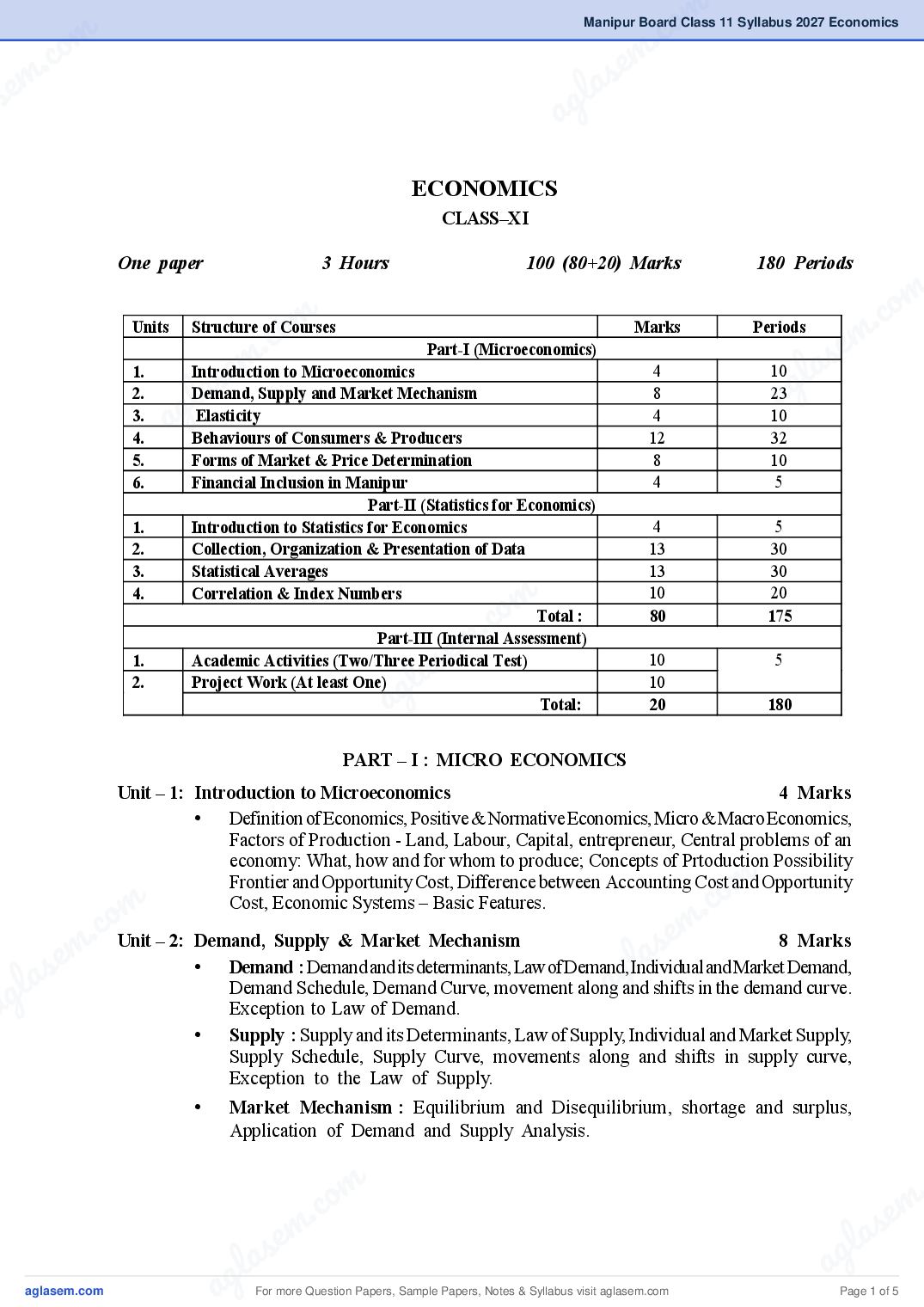
ECONOMICS
CLASS–XI
One paper 3 Hours 100 (80+20) Marks 180 Periods
m
m .co
.co m
Units Structure of Courses Marks Periods
m Part-I (Microeconomics)
s e
e 10 la
1.
2.
l s
Introduction to Microeconomics
a
Demand, Supply and Market Mechanism
4
8 a
23 g
3. ag Elasticity 4 10
4. Behaviours of Consumers & Producers 12 32
5. Forms of Market & Price Determination 8 10
6. Financial Inclusion in Manipur 4 5
Part-II (Statistics for Economics)
1. Introduction to Statistics for Economics 4 5
2. Collection, Organization & Presentation of Data 13 30
3. Statistical Averages 13 30
4. Correlation & Index Numbers
m 10 20
m .coTotal :
Part-III (Internal Assessment)
80 175
1. s e
Academic Activities (Two/Three Periodical Test) 10 5
2. Project Work (At least One)
g la 10
a Total: 20 180
PART – I : MICRO ECONOMICS
Unit – 1: Introduction to Microeconomics 4 Marks
• Definition of Economics, Positive & Normative Economics, Micro & Macro Economics,
Factors of Production - Land, Labour, Capital, entrepreneur, Central problems of an
economy: What, how and for whom to produce; Concepts of Prtoduction Possibility
m
.co
Frontier and Opportunity Cost, Difference between Accounting Cost and Opportunity
m Cost, Economic Systems – Basic Features.
c. oUnit – 2: Demand, Supply & Market Mechanism s em
e m l a 8 Marks
las •
g
Demand : Demand and its determinants, Law of Demand, Individual and Market Demand,
a and shifts in the demand curve.
ag Demand Schedule, Demand Curve, movement along
Exception to Law of Demand.
• Supply : Supply and its Determinants, Law of Supply, Individual and Market Supply,
Supply Schedule, Supply Curve, movements along and shifts in supply curve,
Exception to the Law of Supply.
• Market Mechanism : Equilibrium and Disequilibrium, shortage and surplus,
Application of Demand and Supply Analysis.
m .
.co s e m
s em l a
g la ag
a For more Question Papers, Sample Papers, Notes & Syllabus visit Page 1 of 5
Page 3
(a) Price Elasticity of Demand.
(b) Income Elasticity of Demand.
(c) Cross Elasticity of Demand.
*(Definitions only)
Factors Affecting the Elasticity of Demand.
Methods of Calculating Price Elasticity –
1. Percentage Method.
2. Geometric Method.
3. Total Expenditure Method.
Simple Numerical Problems on Each Method.
Elasticity of Supply – Measurement of Elasticity of Supply,
1. Percentage Method.
2. Geometric Method.
Unit – 4: Behaviour of Consumers and Producers 12 Marks
• Consumer Behaviour – Meaning of Utility, Total Utility, Marginal Utility, Law of Diminishing
Marginal Utility, Consumer’s Equilibrium.
• Cost – Concepts and Relationship between Short Run and Long Run Costs (all costs
Total Cost, Total Fixed Cost, Total Variable Cost; Average Fixed Cost, Average Variable
Cost and Marginal Cost).
• Revenue – Total Revenue,Average Revenue and Marginal Revenue. Producer’s Equilibrium-
meaning and its conditions-under (a) Total Revenue - Total Cost Approach and (b)
Marginal Revenue- Marginal Cost Approach.
Unit – 5: Forms of Market & Price Determination 8 Marks
• Forms of Market – Perfect Competition, Monopoly, Monopolistic Competition, Obligopoly
and Monopsony - their meaning and basic features.
• Price determination under Perfect Competition.
Unit – 6: Financial Inclusion in Manipur 4 Marks
• Concepts and objectives of financial inclusion.
• Achievements of financial inclusion in Manipur
PART – II : STATISTICS FOR ECONOMICS
Unit – 1: Introduction to Statistics for Economics 4 Marks
• Meaning, Scope, Importance and limitations of Statistics with special reference to Economics.
For more Question Papers, Sample Papers, Notes & Syllabus visit Page 2 of 5
Page 4
m .co
m .co s e m
se g l a
a
Unit – 2: Collection, Organization and Presentation of Data 13 Marks
• Collection of Data – Sources of Data – Primary and Secondary, Method of
Collecting Data. Some Important Sources of Secondary Data.
• Organization of Data – Meaning and Types of Variables, Frequency.
m
.co
• Presentation of Data – Tabulation, Diagrammatic presentation (bar diagrams,
o m
pie-diagrams, line graphs, histogram, polygon and O-give curves).
m
c
. Averages s e
• se
m
Unit – 3: Statistical 13 Marks
l a
l a Mean, Mode, Median and Quartiles.
ag
Unit – 4:g Correlation and Index Numbers
a 10 Marks
• Meaning and significance, Scatter diagram, Measure of Correlation – Karl Pearson’s
method (two variable ungrouped data) Spearman’s Rank Correlation..
• Introduction to Index Numbers : meaning, Laspeyre’s, Paasche’s & Fisher’s Index;
Wholesale Price Index, Consumer Price Index and Index of Industrial Production
uses of Index Numbers.
Unit – 5: Project Work 20 Marks
o m
c
. & not exhaustive. Project work should bed o n e
m
(The list of Projects is only Exemplary
e complete at least one project
during the course of studies. One student sshould
from the following list)
g la
(i) Consumer Awareness a amongst households through collection of Primary Data
by designing a questionnaire.
(ii) Productivity Awareness amongst enterprises through use of statistical data from
statistical tables from newspapers/RBI Bulletin/Budget/Census Reports/Economic
Survey, etc.
(iii) Demand, Supply and Market Equilibrium : Each student shall choose any vegetable
of her/his choice. Interview three consumers to find out what their demand would
be at 5 different price levels of the commodity. Interview 3 vegetable vendors
m
m to find out what they would supply at each of the same 5 price levels.
.co
m .co Based on the data collected, a student will :
s e m
s e (a) Construct individual and market demand and supply schedules.
g l a
g la a
(b) Determine if there is an equilibrium price that will prevail in the market and
a explain how the market will react if the price is above and below the determined
equilibrium price.
The results of project should highlight :
• Understanding of the concepts of demand, supply and equilibrium price.
• Construction of an individual and market demand and supply schedules.
• Understanding of how equilibrium price is determined in the market.
m .
.co s e m
s em l a
g la ag
a For more Question Papers, Sample Papers, Notes & Syllabus visit Page 3 of 5
Page 5
Visit a local shop/industry/school/restaurant and understand its production process.
Interview the owner to understand what the accountancy profit in for the production
unit.
Your discussions should also be able to detail :
(a) The fixed and variable factors and their associated costs.
(b) The normal profit of the production unit.
(c) Are there any implicit costs.
The conclusions should show :
• Understanding of a production process.
• Reorganization of fixed and variable factors in a production process.
• Association of fixed and variable costs of production.
• Determination of revenue of production unit.
(v) Role of PDS in assuring supply of necessities in rural areas. If don’t understand
the context of this project we are already giving on market equilibrium.
Students will visit the local ration shops to collect information on :
(a) Number of consumers
(b) Availability/Shortage of necessary goods.
PRESCRIBED TEXTBOOKS :
1. Statistics for Economics
Published by : NCERT
2. Introduction to Microeconomic Theory
By: H.L. Ahuja
Published by: S. Chand & Co., Ltd., New Delhi.
3. Financial Inclusion in Manipur:
By: Dr. Arambam Sanatomba Singh
Published by : Ereima Book Club, Hiyangthang, Imphal West
REFERENCE BOOKS :
1. Introductory Microeconomics
By : T.R. Jain & V.K. Ohri
Published by: VK Global Publication Pvt. Ltd., New Delhi.
2. Introductory Microeconomics
By : Radha Bahuguna
Published by: Dhanpat Rai & Co., New Delhi.
3. Statistics for Economics
By : Radha Bahuguna
Published by: Dhanpat Rai & Co., New Delhi.
4. Statistics for Economics
By : T.R. Jain & V.K. Ohri
Published by: VK Global Publication Pvt. Ltd., New Delhi.
——§§§——
For more Question Papers, Sample Papers, Notes & Syllabus visit Page 4 of 5
Page 6
m .co
m .co s e m
se g l a
DESIGN OF
a
QUESTION PAPER
Subject : ECONOMICS
Class : XI
Full Mark : 80
Time : 3 Hours
WEIGHTAGE TO OBJECTIVES
Objectives Marks Percentage
m
.co
Knowledge (K) 12 15
m
.co m
I Understanding (U) 40 50
Application (A) 24 30
s e
s emSkill (S) 4 5
l a
g laWEIGHTAGE TO FORMS OF QUESTIONS: Total: 80 100
ag
a Form of Questions No. of Question
Time
Marks Percentage
(in minute)
Essay/Long Answer (E/LA) 4 86 32 40
II Short Answer (SA-I) 6 42 24 30
Short Answer (SA-II) 4 20 8 10
Very Short Answer (VSA) 6 12 6 7.5
MCQ 10 20 10 12.5
Total: 30 180 80 100
WEIGHTAGE TO CONTENT:
m
UNIT CONTENTS
m .co Marks Percentage
Part –I Microeconomics
s e
la
1. Introduction to Microeconomics 4 5
2.
3. Elasticity ag
Demand, Supply & Market Mechanism 8
4
10
5
4. Behavior of Consumers & Producers 12 15
III 5. Forms of Market & Price Determination 8 10
6. Financial Inclusion in Manipur 4 5
Part – II Statistics for Economics
1. Introduction to Statistics for Economics 4 5
2. Collection, Organisation and Presentation of Data 13 16.25
3. Statistical Averages 13 16.25
4. Correlation and Index Numbers 10
m 12.5
m .co
Total : 80 100
.co em1010
Part – III Internal Assessment
e m
IV 1. Academic Activities (Two/Three Periodical Test)
l a s 50
las 2. Project Work * (At least One)
g
50
SCHEME OF SECTIONS : Three sections: (i) Microeconomics (40 a
Total : 20 100
ag V marks), (ii) Statistics for
Economics (40 marks) and (iii) Internal Assessment (20 marks).
VI SCHEME OF OPTIONS : (i) 50% of SA-I & 100% of E/LA with internal option, (ii) Two questions of
MCQ will be Assertion-Reasoning Type Question and One Question of SA-I will be Source-based Question.
DIFFICULTY LEVEL :
Difficult : 30% of the total marks
VII
Average : 50% of the total marks
Easy : 20% of the total marks
m .
Abbreviation : K(Knowledge),U(Understanding),C(Comprehension), Exp.(Expression), Skill(S), E(Essay Type), SA (Short
c o
Answer Type), VSA (Very Short Answer Type), MCQ(Multiple Choice Question).
* Components of Project .Work: (i) Introduction (2 marks), (ii) Contents/Observation (4 marks), (iii) Conclusion (1 mark) and e m
e m l as
s
(iii) Viva Voce (3 marks).
l a a g
a g For more Question Papers, Sample Papers, Notes & Syllabus visit Page 5 of 5
Document Details
| Board / Org | Manipur Board |
| Exam | Class 11 |
| Type | Syllabus |
| Pages | 5 |
| Updated | 04 Nov 2026 |