NIOS Class 12 April 2024 Question Paper Painting
Finished viewing? Save it for later —
Download NIOS Class 12 April 2024 Question Paper Painting (PDF · 20 pages)About NIOS Class 12 April 2024 Question Paper Painting
NIOS Class 12 April 2024 Question Paper Painting is available here for free download. Published by NIOS for National Institute of Open Schooling Class 12, this question paper can be viewed online or downloaded as a PDF (20 pages). Candidates preparing for National Institute of Open Schooling Class 12 can use NIOS Class 12 April 2024 Question Paper Painting to understand the exam pattern, the type of questions asked, and the overall difficulty level.
Frequently Asked Questions
How can I download NIOS Class 12 April 2024 Question Paper Painting?
Open this page and click the Download button to save NIOS Class 12 April 2024 Question Paper Painting as a PDF. It is completely free on AglaSem Docs.
Is NIOS Class 12 April 2024 Question Paper Painting free to download?
Yes. NIOS Class 12 April 2024 Question Paper Painting can be viewed online and downloaded as a PDF free of cost on AglaSem Docs.
How many pages does NIOS Class 12 April 2024 Question Paper Painting have?
NIOS Class 12 April 2024 Question Paper Painting contains 20 pages, which you can read online or download together as a single PDF.
Where can I find more National Institute of Open Schooling Class 12 study material?
You can find more National Institute of Open Schooling Class 12 question papers, sample papers, syllabus, and answer keys on AglaSem Docs.
NIOS Class 12 April 2024 Question Paper Painting – Text
Read the full text of this question paper below — useful to quickly search, copy and reference the content online without downloading the PDF.
📄 View text version (20 pages)
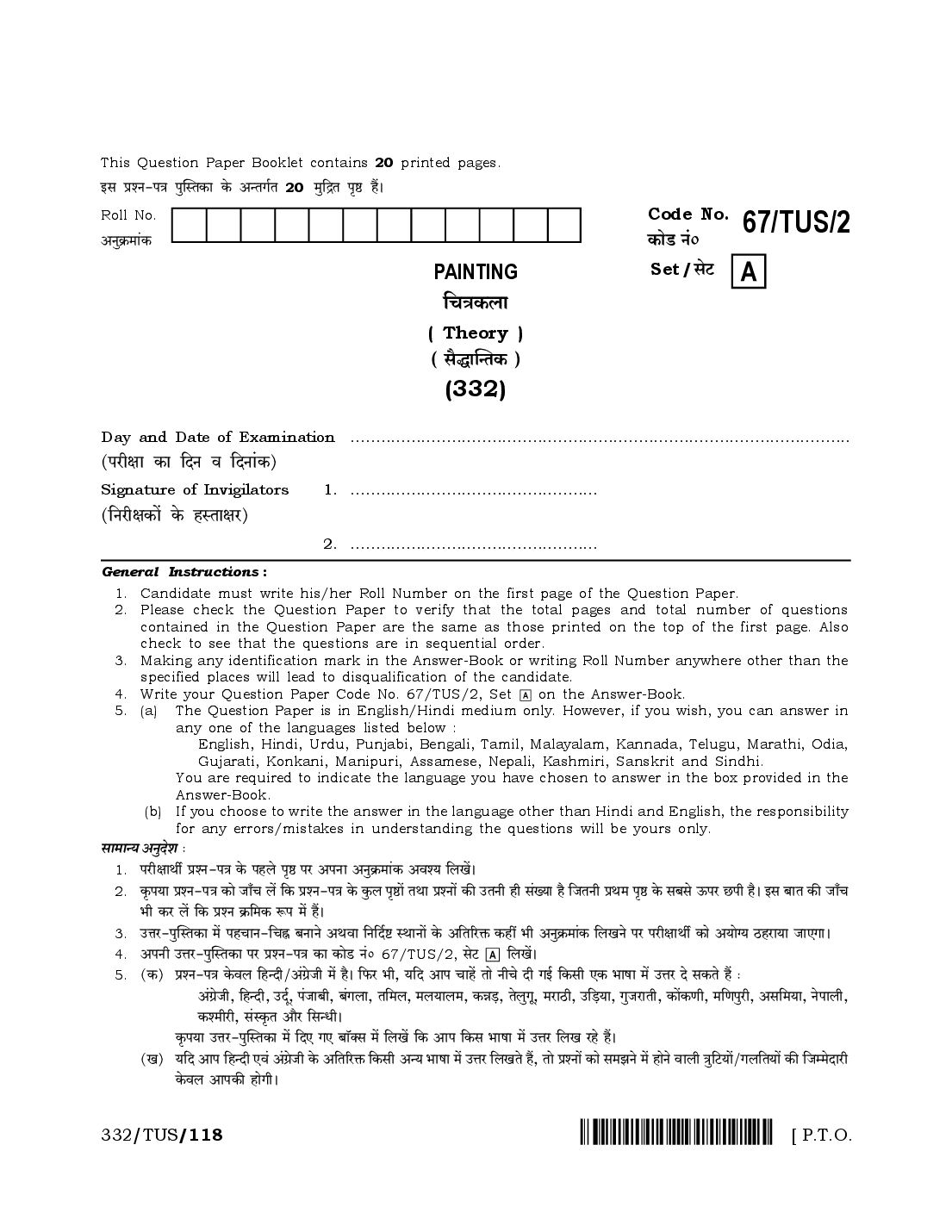
Page 1
Bg àíZ-nÌ nwpñVH$m Ho$ AÝVJ©V 20 ‘w{ÐV n¥ð> h¢&
Roll No. Code No.
67/TUS/2
u
AZwH$« ‘m§H$ H$moS> Z§0
PAINTING Set / goQ>
{MÌH$bm
( Theory )
( g¡ÕmpÝVH$ )
(332)
Day and Date of Examination ...................................................................................................
(narjm H$m {XZ d {XZm§H$)
Signature of Invigilators 1. .................................................
({ZarjH$m| Ho$ hñVmja)
2. .................................................
General Instructions :
1. Candidate must write his/her Roll Number on the first page of the Question Paper.
2. Please check the Question Paper to verify that the total pages and total number of questions
contained in the Question Paper are the same as those printed on the top of the first page. Also
check to see that the questions are in sequential order.
3. Making any identification mark in the Answer-Book or writing Roll Number anywhere other than the
specified places will lead to disqualification of the candidate.
4. Write your Question Paper Code No. 67/TUS/2, Set u on the Answer-Book.
5. (a) The Question Paper is in English/Hindi medium only. However, if you wish, you can answer in
any one of the languages listed below :
English, Hindi, Urdu, Punjabi, Bengali, Tamil, Malayalam, Kannada, Telugu, Marathi, Odia,
Gujarati, Konkani, Manipuri, Assamese, Nepali, Kashmiri, Sanskrit and Sindhi.
You are required to indicate the language you have chosen to answer in the box provided in the
Answer-Book.
(b) If you choose to write the answer in the language other than Hindi and English, the responsibility
for any errors/mistakes in understanding the questions will be yours only.
gm‘mݶ AZwXoe …
1. narjmWu àíZ-nÌ Ho$ nhbo n¥ð> na AnZm AZwH«$‘m§H$ Adí¶ {bI|&
2. H¥$n¶m àíZ-nÌ H$mo Om±M b| {H$ àíZ-nÌ Ho$ Hw$b n¥ð>m| VWm àíZm| H$s CVZr hr g§»¶m h¡ {OVZr àW‘ n¥ð> Ho$ g~go D$na N>nr h¡& Bg ~mV H$s Om±M
^r H$a b| {H$ àíZ H«${‘H$ ê$n ‘| h¢&
3. CÎma-nwpñVH$m ‘| nhMmZ-{M• ~ZmZo AWdm {Z{X©ï> ñWmZm| Ho$ A{V[aº$ H$ht ^r AZwH«$‘m§H$ {bIZo na narjmWu H$mo A¶mo½¶ R>ham¶m OmEJm&
4. AnZr CÎma-nwpñVH$m na àíZ-nÌ H$m H$moS> Z§0 67/TUS/2, goQ u {bI|&
5. (H$) n«íZ-nÌ Ho$db {hÝXr/A§JoO « r ‘| h¡& {’$a ^r, ¶{X Amn Mmh| Vmo ZrMo Xr JB© {H$gr EH$ ^mfm ‘| CÎma Xo gH$Vo h¢ …
A§JoO
« r, {hÝXr, CXÿ©, n§Om~r, ~§Jbm, V{‘b, ‘b¶mb‘, H$Þ‹S>, VobwJy, ‘amR>r, C{‹S>¶m, JwOamVr, H$m|H$Ur, ‘{Unwar, Ag{‘¶m, Zonmbr,
H$í‘rar, g§ñH¥$V Am¡a {gÝYr&
H¥$n¶m CÎma-nwpñVH$m ‘| {XE JE ~m°³g ‘| {bI| {H$ Amn {H$g ^mfm ‘| CÎma {bI aho h¢&
(I) ¶{X Amn {hÝXr Ed§ A§JoO « r Ho$ A{V[aº$ {H$gr Aݶ ^mfm ‘| CÎma {bIVo h¢, Vmo àíZm| H$mo g‘PZo ‘| hmoZo dmbr Ìw{Q>¶m|/Jb{V¶m| H$s {Oå‘oXmar
Ho$db AmnH$s hmoJr&
332/TUS/118 [ P.T.O.
Page 2
1. This Question Paper Booklet contains two Question Papers—one based
on revised study materials marked as NEW SYLLABUS and the other based
on pre-revised study materials marked as OLD SYLLABUS.
2. NEW SYLLABUS is for those candidates who have registered for 2023–2024
(Stream–I and Block–I) admission and are appearing in April–2024
Examinations.
3. OLD SYLLABUS is for those candidates who had registered before
2023–2024 (Stream–I and Block–I) admission.
4. Candidates are to answer only one Question Paper from the given two
Question Papers.
5. Candidates are not allowed to mix questions from the given two
Question Papers.
‘hÎdnU
y © {ZXe
}
1. Bg àíZ-nÌ nwpñVH$m ‘| Xmo àíZ-nÌ h¢—EH$ g§emo{YV Aܶ¶Z gm‘J«r na AmYm[aV h¡ {Og
na Z¶m nmR>çH«$‘ A§{H$V h¡ VWm Xÿgam g§emoYZ go nyd© Aܶ¶Z gm‘J«r na AmYm[aV h¡ {Og
na nwamZm nmR>çH«$‘ A§{H$V h¡&
2. Z¶m nmR>çH«$‘ CZ narjm{W©¶m| Ho$ {bE h¡, {OZH$m Zm‘m§H$Z 2023–2024 (ñQ´>r‘–I Am¡a
ãbm°H$–I) ‘| hþAm h¡ VWm Omo Aà¡b–2024 ‘| narjm ‘| ~¡R>Zo Om aho h¢&
3. nwamZm nmR>çH«$‘ CZ narjm{W©¶m| Ho$ {bE h¡, {OZH$m Zm‘m§H$Z 2023–2024 (ñQ´>r‘–I Am¡a
ãbm°H$–I) Ho$ nhbo hþAm h¡&
4. narjmWu {XE JE Xmo àíZ-nÌm| ‘| go Ho$db EH$ àíZ-nÌ go hr CÎma {bI|&
5. narjmWu H$mo Xmo àíZ-nÌm| Ho$ àíZm| H$mo {‘bmH$a CÎma XoZo H$s AZw‘{V Zht h¡&
332/TUS/118 2
Page 3
This Question Paper consists of 26 questions.
Bg àíZ-nÌ Ho$ AÝVJ©V 26 àíZ h¢&
PAINTING
{MÌH$bm
( Theory )
( g¡ÕmpÝVH$ )
(332)
Time : 1½ Hours ] [ Maximum Marks : 40
g‘¶ … 1½ KÊQ>o ] [ nyUmªH$ … 40
Note : (i) This question paper consists of 26 questions in all.
(ii) All questions are compulsory.
(iii) Marks are given against each question.
(iv) Section—A consists of Question Nos. 1 to 8—Multiple Choice-type
questions (MCQs) carrying 1 mark each. Select and write the most
appropriate option out of the four options given in each of these
questions. An internal choice has been provided in some of these
questions.
(v) Section—B consists of Objective-type questions—Question Nos. 9 to 20.
(a) Read the passage and attempt Question Nos. 9 to 12 carrying
1 mark each.
(b) Fill in the blanks and attempt Question Nos. 13 to 16 carrying
1 mark each.
(c) Read the passage and attempt Question Nos. 17 to 20 carrying
1 mark each.
(vi) Section—C consists of Subjective-type questions—Question Nos. 21 to 26.
(a) Question Nos. 21 to 23—Very Short questions carrying 2 marks
each to be answered in the range of 30–40 words. An internal choice
has been provided in some of these questions.
(b) Question No. 24—Short Answer-type question carrying 4 marks to
be answered in the range of 70–80 words. An internal choice has
been provided in this question.
(c) Question Nos. 25 and 26—Short Answer-type questions carrying
5 marks each to be answered in the range of 90–100 words. An
internal choice has been provided in some of these questions.
332/TUS/118 3 [ P.T.O.
Page 4
(ii) g^r àíZ A{Zdm¶© h¢&
(iii) à˶oH$ àíZ Ho$ A§H$ CgHo$ gm‘Zo {XE JE h¢&
(iv) IÊS>—H$ ‘| àíZ g§»¶m 1 go 8 VH$ ~hþ{dH$ënr¶ àíZ h¢, {OZ‘| à˶oH$ 1 A§H$ H$m h¡& à˶oH$
àíZ ‘| {XE JE Mma {dH$ënm| ‘| go g~go Cn¶wº$ {dH$ën H$m M¶Z H$a| Am¡a {bI|& BZ‘| go Hw$N>
àíZm| ‘| Am§V[aH$ {dH$ën {X¶m J¶m h¡&
(v) IÊS>—I ‘| àíZ g§»¶m 9 go 20 VH$ dñVw{Zð> àH$ma Ho$ àíZ h¢&
(H$) n[aÀN>oX H$mo n‹T>H$a àíZ g§»¶m 9 go 12 VH$ Ho$ CÎma X|, {OZ‘| à˶oH$ 1 A§H$ H$m h¡&
(I) àíZ g§»¶m 13 go 16 VH$ [aº$ ñWmZ ^aZo go g§~§{YV àíZ h¢, {OZ‘| à˶oH$ 1 A§H$ H$m h¡&
(J) n[aÀN>oX H$mo n‹T>H$a àíZ g§»¶m 17 go 20 VH$ Ho$ CÎma X|, {OZ‘| à˶oH$ 1 A§H$ H$m h¡&
(vi) IÊS>—J ‘| àíZ g§»¶m 21 go 26 VH$ {df¶naH$ àH$ma Ho$ àíZ h¢&
(H$) àíZ g§»¶m 21 go 23 VH$ A{V bKyÎmar¶ àíZ h¢, {OZ‘| à˶oH$ 2 A§H$m| H$m h¡, {OZHo$
CÎma 30 go 40 eãXm| ‘| XoZo h¢& BZ‘| go Hw$N> àíZm| ‘| Am§V[aH$ {dH$ën {X¶m J¶m h¡&
(I) àíZ g§»¶m 24, 4 A§H$m| H$m bKyÎmar¶ àíZ h¡, {OgH$m CÎma 70 go 80 eãXm| ‘| XoZm h¡&
Bg‘| EH$ Am§V[aH$ {dH$ën {X¶m J¶m h¡&
(J) àíZ g§»¶m 25 Am¡a 26, 5 A§H$m| Ho$ bKyÎmar¶ àíZ h¢, {OZHo$ CÎma 90 go 100 eãXm|
‘| XoZo h¢& BZ‘| go Hw$N> àíZm| ‘| Am§V[aH$ {dH$ën {X¶m J¶m h¡&
(1) Answers of all questions are to be given in the Answer-Book given to you.
g^r àíZm| Ho$ CÎma AmnH$mo Xr JB© CÎma-nwpñVH$m ‘| hr {bI|&
(2) 15 minutes time has been allotted to read this question paper. The question
paper will be distributed at 2:15 p.m. From 2:15 p.m. to 2:30 p.m., the
students will read the question paper only and will not write any answer on
the Answer-Book during this period.
Bg àíZ-nÌ H$mo n‹T>Zo Ho$ {bE 15 {‘ZQ> H$m g‘¶ {X¶m J¶m h¡& àíZ-nÌ H$m {dVaU Xmonha
2:15 ~Oo {H$¶m OmEJm& 2:15 ~Oo go 2:30 ~Oo VH$ N>mÌ Ho$db àíZ-nÌ H$mo n‹T>|Jo Am¡a Bg Ad{Y
Ho$ Xm¡amZ do CÎma-nwpñVH$m na H$moB© CÎma Zht {bI|Jo&
SECTION–A
IÊS>–H$
1. Where are Bhimbetka Caves situated? 1
(A) Gujarat (B) Punjab
(C) Bhopal (D) Bihar
^r‘~oQ>H$m Jw’$mE± H$hm± pñWV h¢?
(A) JwOamV (B) n§Om~
(C) ^monmb (D) {~hma
332/TUS/118 4
Page 5
(A) Basohli (B) Guler
(C) Kangra (D) Chamba
{dídê$n–I n|qQ>J H$s e¡br ³¶m h¡?
(A) ~gmobr (B) Jwboa
(C) H$m±J‹S>m (D) M§~m
3. In which of the following caves is the artwork ‘Mara Vijaya’ located? 1
(A) Cave 9 (B) Cave 1
(C) Cave 16 (D) Cave 17
{ZåZ{b{IV ‘| go {H$g Jw’$m ‘| H$bmH¥${V "‘mam {dO¶m' pñWV h¡?
(A) Jw’$m 9 (B) Jw’$m 1
(C) Jw’$m 16 (D) Jw’$m 17
4. In which year did J. Cockburn discover the fossilized bones of rhinoceros
in the Ken River valley? 1
(A) 1881 (B) 1891
(C) 1851 (D) 1872
{H$g df© Oo0 H$m°H$~Z© Zo Ho$Z ZXr KmQ>r ‘| J¢S>m| H$s Ordmí‘ h{È>¶m| H$s ImoO H$s?
(A) 1881 (B) 1891
(C) 1851 (D) 1872
5. Which of the following paintings is called the lyrical style of painting? 1
(A) Mughal painting (B) Pahari painting
(C) Company school of painting (D) Rajasthani painting
{ZåZ{b{IV {MÌm| ‘| go {H$go {MÌH$bm H$s JrVmË‘H$ e¡br H$hm OmVm h¡?
(A) ‘wJb {MÌH$bm (B) nhm‹S>r {MÌH$bm
(C) H§$nZr ñHy$b Am°’$ n|qQ>J (D) amOñWmZr {MÌH$bm
6. In which cave is ‘ The Prince and The Princess’ located? 1
(A) Cave 18 (B) Cave 14
(C) Cave 16 (D) Cave 17
332/TUS/118 5 [ P.T.O.
Page 6
(A) Jw’$m 18 (B) Jw’$m 14
(C) Jw’$m 16 (D) Jw’$m 17
Or / AWdm
What is the medium of the work ‘Bear, Tiger and Birds’ ?
(A) Mural (B) Thumb printing
(C) Acrylic on canvas (D) Watercolour
"^mby, ~mK Am¡a njr' H$m¶© H$m ‘mܶ‘ ³¶m h¡?
(A) {^{Îm{MÌ (B) A±JyR>o H$m ‘wÐU
(C) H¡$Ýdg na EoH«o${bH$ (D) Oba§J{Z{‘©V {MÌ
7. Choose the correct period for the painting ‘Padmapani Bodhisattva’. 1
(A) 2nd–6th CCE (B) 5th–9th CCE
(C) 1st–2nd CCE (D) None of the above
n|qQ>J "nÙnm{U ~mo{YgÎd' Ho$ {bE ghr Ad{Y H$m M¶Z H$s{OE&
(A) Xÿgar–N>R>r gr0 gr0 B©0 (B) nm±Mdt–Zm¡dt gr0 gr0 B©0
(C) àW‘–Xÿgar gr0 gr0 B©0 (D) Cn¶w©º$ ‘| go H$moB© Zht
Or / AWdm
In folk and tribal art, a twig is turned into
(A) palette (B) mug
(C) brush (D) pigment
bmoH$ Am¡a OZOmVr¶ H$bm ‘| EH$ Q>hZr H$mo _____ ‘| ~Xb {X¶m OmVm h¡&
(A) a§Jn{Å>H$m (B) bmoQ>m
(C) Vy{bH$m (D) a§J
8. Fresco paintings are executed upon
(A) freshly primed canvas (B) wet lime plaster
(C) linen cloth (D) handmade sheet 1
’«o$ñH$mo n|qQ>J {H$g na {Zînm{XV {H$E OmVo h¡§?
(A) VmOm àmB‘oS> H¡$Ýdg (B) Jrbm MyZm ßbmñQ>a
(C) {bZoZ H$m H$n‹S>m (D) hñV{Z{‘©V erQ>
332/TUS/118 6
Page 7
IÊS>–I
Based on the given passage answer the following questions (Q. Nos. 9–12) :
Prehistoric Painting of India
Rock paintings or early Stone Age paintings are magical and unique. It was one
of the oldest forms of art history of human civilization in India that began in the
Paleolithic Period or old Stone Age, roughly 2·5 million years ago to 10000 BC.
In the Paleolithic Period, early humans lived in caves and used stone for hunting
birds and wild animals to save their lives. Early men then started painting and
drawing on the walls of caves during the Paleolithic era, some 40000 years ago.
Many paintings were found from the Mesolithic Period, around 12000 years ago
from the present time. That period was the earliest discovery of prehistoric art in
India.
ZrMo {XE JE n[aÀN>oX Ho$ AmYma na {ZåZ{b{IV àíZm| Ho$ CÎma Xr{OE (àíZ g§»¶m 9–12) :
^maV H$s àmJ¡{Vhm{gH$ {MÌH$bm
e¡b {MÌ ¶m àma§{^H$ nmfmU ¶wJ Ho$ {MÌ OmXþB© Am¡a A{ÛVr¶ h¢& ¶h ^maV ‘| ‘mZd gä¶Vm Ho$ H$bm B{Vhmg
Ho$ g~go nwamZo ê$nm| ‘| go EH$ Wm Omo nwamnmfmU H$mb ¶m nwamZo nmfmU ¶wJ ‘| ewê$ hþAm Wm, bJ^J 2·5
{‘{b¶Z gmb nhbo 10000 B©gm nyd© VH$& nwamnmfmU H$mb ‘|, àma§{^H$ ‘mZd Jw’$mAm| ‘| ahVo Wo Am¡a AnZo
OrdZ H$mo ~MmZo Ho$ {bE n{j¶m| Am¡a O§Jbr OmZdam| Ho$ {eH$ma Ho$ {bE nËWa H$m BñVo‘mb H$aVo Wo& àma§{^H$
nwéfm| Zo bJ^J 40000 gmb nhbo nwamnmfmU ¶wJ Ho$ Xm¡amZ Jw’$mAm| H$s Xrdmam| na n|qQ>J Am¡a S´>mB§J ewê$
H$s& dV©‘mZ g‘¶ go bJ^J 12000 gmb nhbo ‘ogmo{b{WH$ H$mb go H$B© {MÌ nmE JE Wo& dh Ad{Y
^maV ‘| àmJ¡{Vhm{gH$ H$bm H$s g~go nwamZr ImoO Wr&
9. _____ is considered one of the oldest forms of art history of human
civilization in India. 1
_____ H$mo ^maV ‘| ‘mZd gä¶Vm Ho$ H$bm B{Vhmg Ho$ g~go nwamZo ê$nm| ‘| go EH$ ‘mZm OmVm h¡&
10. In which period did the early Stone Age begin? 1
àma§{^H$ nmfmU ¶wJ {H$g H$mb ‘| ewê$ hþAm Wm?
11. The early humans lived in caves and used _____ for hunting birds. 1
àma§{^H$ ‘Zwî¶ Jw’$mAm| ‘| ahVo Wo Am¡a n{j¶m| H$m {eH$ma H$aZo Ho$ {bE _____ H$m BñVo‘mb H$aVo Wo&
12. The time period of Mesolithic is around _____ years ago from the present
time. 1
‘ogmo{b{WH$ H$s g‘¶ Ad{Y dV©‘mZ g‘¶ go bJ^J _____ gmb nhbo h¡&
332/TUS/118 7 [ P.T.O.
Page 8
[aº$ ñWmZ ^[aE (àíZ g§»¶m 13–16) :
13. Gond painting is a famous art form of _____ State. 1
Jm|S> n|qQ>J _____ amÁ¶ H$m EH$ à{gÕ H$bm-ê$n h¡&
14. Madhubani painting is a famous art form of _____ State. 1
‘Yw~Zr n|qQ>J _____ amÁ¶ H$m EH$ à{gÕ H$bm-ê$n h¡&
15. Pattachitra is a famous art form of _____ State. 1
nÅ>{MÌ _____ amÁ¶ H$m EH$ à{gÕ H$bm-ê$n h¡&
16. Warli painting is a famous art form of _____ State. 1
dmabr n|qQ>J _____ amÁ¶ H$m EH$ à{gÕ H$bm-ê$n h¡&
Based on the given passage answer the following questions (Q. Nos. 17–20) :
Fresco and Tempera in Indian Art
In prehistoric times man was very dependent on nature. Rock paintings from
that period found worldwide show human figures hunting a beast, at war with
each other, carrying clubs and projectiles and celebrating a victory with dance
and animal figures in the movement. At that time, these paintings represent
animals as Gods. In India, prehistoric rock paintings came to light when
Archibald Carlleyle of the Archaeological Survey of India discovered rock
paintings which he thought dated from the Stone Age at Sohagihat in the
Mirzapur district of Uttar Pradesh in 1867 and 1868. These paintings today
provide an insight into the life of the people who painted them. In 1881,
J. Cockburn found fossilized rhinoceros’ bones in the valley of the Ken River in
the Mirzapur region as well as a painting of a rhinoceros hunted by three men
in a shelter near Roap Village. In 1924, Sir John Marshall, Rai Bahadur Daya
Ram Sahni, Madho Sarup Vats, Rakhal Das Banerji and E. J. H. Mackay led
excavations on the banks of the river Ravi and Indus, leading to the discovery
of civilization thousands of years old. The seals, coins, statuettes and
terracottas found at these sites have animal figures painted or carved.
332/TUS/118 8
Page 9
^maVr¶ H$bm ‘| ’«o$ñH$mo Am¡a Q>oånam
àmJ¡{Vhm{gH$ H$mb ‘| ‘Zwî¶ àH¥${V na ~hþV {Z^©a Wm& Xþ{Z¶m ^a ‘| nmE JE Cg H$mb Ho$ am°H$ {MÌm| ‘|
‘mZd AmH¥${V¶m| H$mo EH$ OmZda H$m {eH$ma H$aVo hþE, EH$-Xÿgao Ho$ gmW ¶wÕ ‘|, ³b~ Am¡a àmoOo³Q>mBb
bo OmVo hþE, Am¡a Am§XmobZ ‘| Z¥Ë¶ Am¡a OmZdam| H$s AmH¥${V¶m| Ho$ gmW OrV H$m OíZ ‘ZmVo hþE {XIm¶m
J¶m h¡& Cg g‘¶, ¶o {MÌ OmZdam| H$mo XodVmAm| Ho$ ê$n ‘| Xem©Vo h¢& ^maV ‘|, àmJ¡{Vhm{gH$ e¡b{MÌm| H$m
àH$me V~ Am¶m O~ ^maVr¶ nwamVÎd gd}jU Ho$ AmMu~mëS> H$mbm©Bb Zo 1867 Am¡a 1868 ‘| CÎma àXoe
Ho$ {‘Om©nwa {Obo Ho$ gmohmJrhmQ> ‘| nmfmU ¶wJ go g§~§{YV e¡b{MÌm| H$s ImoO H$s& ¶o {MÌ AmO CZ bmoJm|
Ho$ OrdZ ‘| A§VÑ©{ï> àXmZ H$aVo h¢, {OÝhm|Zo CÝh| {M{ÌV {H$¶m Wm& 1881 ‘| Oo0 H$m°H$~Z© H$mo {‘Om©nwa joÌ
‘| Ho$Z ZXr H$s KmQ>r ‘| J¢S>m| H$s h{È>¶m| Ho$ Ordmí‘ {‘bo gmW hr amon Jm±d Ho$ nmg EH$ Aml¶ ‘| VrZ
nwéfm| Ûmam {eH$ma {H$E JE J¢S>o H$s EH$ n|qQ>J ^r {‘br& 1924 ‘|, ga Om°Z ‘me©b, am¶ ~hmXþa X¶m am‘
gmhZr, ‘mYmo gê$n dËg, amImb Xmg ~ZOu Am¡a B©0 Oo0 EM0 ‘¡Ho$ Zo amdr Am¡a qgYw ZXr Ho$ VQ> na IwXmB©
H$m ZoV¥Ëd {H$¶m, {Oggo hOmam| gmb nwamZr gä¶Vm H$s ImoO hþB©& BZ ñWbm| na nmB© OmZo dmbr ‘wham|, {g¸$m|,
à{V‘mAm| Am¡a Q>oamH$moQ>m ‘| OmZdam| H$s AmH¥${V¶m± {M{ÌV ¶m Z¸$mer H$s JB© h¢&
17. Rock paintings from prehistoric times found worldwide show _____. 1
Xþ{Z¶m ^a ‘| nmE OmZo dmbo àmJ¡{Vhm{gH$ H$mb Ho$ am°H$ {MÌ _____ {XImVo h¢&
18. In India, prehistoric rock paintings were discovered by _____. 1
^maV ‘|, àmJ¡{Vhm{gH$ e¡b{MÌm| H$s ImoO _____ Ûmam H$s JB© Wr&
19. _____ found fossilized rhinoceros’ bones in the valley of the Ken River in
the Mirzapur region in 1881. 1
1881 ‘| _____ H$mo {‘Om©nwa joÌ ‘| Ho$Z ZXr H$s KmQ>r ‘| J¢S>m| H$s h{È>¶m| Ho$ Ordmí‘ {‘bo&
20. Various painted or carved artefacts have been found from the bank
of _____. 1
_____ Ho$ VQ> go {d{^Þ {M{ÌV ¶m Z¸$merXma H$bmH¥${V¶m± {‘br h¢&
Or / AWdm
The rock paintings represent animals as _____.
e¡b{MÌ OmZdam| H$mo _____ Ho$ ê$n ‘| Xem©Vo h¢&
332/TUS/118 9 [ P.T.O.
Page 10
IÊS>–J
Answer the following questions (in minimum 30 words) :
{ZåZ{b{IV àíZm| Ho$ CÎma Xr{OE (ݶyZV‘ 30 eãXm| ‘|) :
21. Write a short note on animal forms found in the Indus pottery. 2
qgYw Ho$ ~V©Zm| ‘| nmE OmZo dmbo OmZdam| Ho$ ê$nm| na EH$ g§{já {Q>ßnUr {b{IE&
22. Write about the development of company painting in India. 2
^maV ‘| H§$nZr {MÌH$bm Ho$ {dH$mg Ho$ ~mao ‘| {b{IE&
23. Explain the painting ‘Journeys End’. 2
n|qQ>J "OZu E§S>' H$s ì¶m»¶m H$s{OE&
Or / AWdm
Explain the characteristic features of the ‘Bhimbetka Rock paintings’.
"^r‘~oQ>H$m e¡b{MÌm|' H$s {d{eï> {deofVmAm| H$mo ñnï> H$s{OE&
Answer the following question (in minimum 70 words) :
{ZåZ{b{IV àíZ H$m CÎma Xr{OE (ݶyZV‘ 70 eãXm| ‘|) :
24. Write a brief note on Raja Ravi Varma. Explain his artwork ‘Subhadra’s
Abduction’. 4
amOm a{d d‘m© na EH$ g§{já {Q>ßnUr {b{IE& CZH$s H$bmH¥${V "gw^Ðm H$m AnhaU' H$s ì¶m»¶m H$s{OE&
Or / AWdm
Describe the painting ‘Palanquin’.
n|qQ>J "n¡bZ²H$sZ' H$m dU©Z H$s{OE&
332/TUS/118 10
Page 11
{ZåZ{b{IV àíZm| Ho$ CÎma Xr{OE (ݶyZV‘ 100 eãXm| ‘|) :
25. ‘‘Amrita Sher-Gil’s paintings reflect a strong influence of the Western
modes of painting.’’ Explain the given statement supporting her themes
and names of paintings. 5
""A‘¥Vm eoa{Jb Ho$ {MÌ {MÌH$bm Ho$ npíM‘r VarH$m| Ho$ EH$ ‘O~yV à^md H$mo Xem©Vo h¢&'' CZHo$ {df¶m|
Am¡a {MÌm| Ho$ Zm‘m| H$m g‘W©Z H$aZo dmbo {XE JE H$WZ H$s ì¶m»¶m H$s{OE&
Or / AWdm
Differentiate between the painting styles of Bhimbetka Rock painting and
Ajanta Cave painting.
^r‘~oQ>H$m am°H$ n|qQ>J Am¡a AO§Vm Jw’$m n|qQ>J H$s n|qQ>J e¡{b¶m| Ho$ ~rM A§Va H$s{OE&
26. Write about any two styles of Pahari painting. Explain the themes and
characteristic features of the styles of the painting. 5
nhm‹S>r {MÌH$bm H$s {H$Ýht Xmo e¡{b¶m| Ho$ ~mao ‘| {b{IE& {MÌH$bm H$s e¡{b¶m| H$s {df¶-dñVw Am¡a
{d{eï> {deofVmAm| H$mo ñnï> H$s{OE&
Or / AWdm
Write a brief note on Kangra Art, explaining the themes and uniqueness
of the paintings.
{MÌm| Ho$ {df¶ Am¡a {d{eï>Vm H$mo g‘PmVo hþE H$m±J‹S>m H$bm na EH$ g§{já {Q>ßnUr {b{IE&
332/TUS/118 11 [ P.T.O.
Page 12
This Question Paper consists of 21 questions.
Bg àíZ-nÌ Ho$ AÝVJ©V 21 àíZ h¢&
PAINTING
{MÌH$bm
( Theory )
( g¡ÕmpÝVH$ )
(332)
Time : 1½ Hours ] [ Maximum Marks : 30
g‘¶ … 1½ KÊQ>o ] [ nyUmªH$ … 30
Note : (i) This question paper consists of 21 questions in all.
(ii) All questions are compulsory.
(iii) Marks are given against each question.
(iv) Section—A consists of Question Nos. 1 to 6—Multiple Choice-type
questions (MCQs) carrying 1 mark each. Select and write the most
appropriate option out of the four options given in each of these
questions. An internal choice has been provided in some of these
questions.
(v) Section—B consists of Objective-type questions—Question Nos. 7 to 15.
(a) Read the passage and attempt Question Nos. 7 to 10 carrying
1 mark each.
(b) Read the passage and attempt Question Nos. 11 to 15 carrying
1 mark each.
(vi) Section—C consists of Subjective-type questions—Question Nos. 16 to 21.
(a) Question Nos. 16 to 19—Very Short questions carrying 2 marks
each to be answered in the range of 30–40 words. An internal choice
has been provided in some of these questions.
(b) Question No. 20—Short Answer-type question carrying 3 marks to
be answered in the range of 50–60 words. An internal choice has
been provided in this question.
(c) Question No. 21—Long Answer-type question carrying 4 marks to
be answered in the range of 70–80 words. An internal choice has
been provided in this question.
332/TUS/118 12
Page 13
(ii) g^r àíZ A{Zdm¶© h¢&
(iii) à˶oH$ àíZ Ho$ A§H$ CgHo$ gm‘Zo {XE JE h¢&
(iv) IÊS>—H$ ‘| àíZ g§»¶m 1 go 6 VH$ ~hþ{dH$ënr¶ àíZ h¢, {OZ‘| à˶oH$ 1 A§H$ H$m h¡& à˶oH$
àíZ ‘| {XE JE Mma {dH$ënm| ‘| go g~go Cn¶wº$ {dH$ën H$m M¶Z H$a| Am¡a {bI|& BZ‘| go Hw$N>
àíZm| ‘| Am§V[aH$ {dH$ën {X¶m J¶m h¡&
(v) IÊS>—I ‘| àíZ g§»¶m 7 go 15 VH$ dñVw{Zð> àH$ma Ho$ àíZ h¢&
(H$) n[aÀN>oX H$mo n‹T>H$a àíZ g§»¶m 7 go 10 VH$ Ho$ CÎma X|, {OZ‘| à˶oH$ 1 A§H$ H$m h¡&
(I) n[aÀN>oX H$mo n‹T>H$a àíZ g§»¶m 11 go 15 VH$ Ho$ CÎma X|, {OZ‘| à˶oH$ 1 A§H$ H$m h¡&
(vi) IÊS>—J ‘| àíZ g§»¶m 16 go 21 VH$ {df¶naH$ àH$ma Ho$ àíZ h¢&
(H$) àíZ g§»¶m 16 go 19, 2 A§H$ Ho$ A{V bKyÎmar¶ àíZ h¢, {OZHo$ CÎma 30 go 40 eãXm|
‘| XoZo h¢& BZ‘| go Hw$N> àíZm| ‘| Am§V[aH$ {dH$ën {X¶m J¶m h¡&
(I) àíZ g§»¶m 20, 3 A§H$m| H$m bKyÎmar¶ àíZ h¡, {OgH$m CÎma 50 go 60 eãXm| ‘| XoZm h¡&
Bg‘| EH$ Am§V[aH$ {dH$ën {X¶m J¶m h¡&
(J) àíZ g§»¶m 21, 4 A§H$m| H$m XrK© CÎmar¶ àíZ h¡, {OgH$m CÎma 70 go 80 eãXm| ‘| XoZm
h¡& Bg‘| EH$ Am§V[aH$ {dH$ën {X¶m J¶m h¡&
(1) Answers of all questions are to be given in the Answer-Book given to you.
g^r àíZm| Ho$ CÎma AmnH$mo Xr JB© CÎma-nwpñVH$m ‘| hr {bI|&
(2) 15 minutes time has been allotted to read this question paper. The question
paper will be distributed at 2:15 p.m. From 2:15 p.m. to 2:30 p.m., the
students will read the question paper only and will not write any answer on
the Answer-Book during this period.
Bg àíZ-nÌ H$mo n‹T>Zo Ho$ {bE 15 {‘ZQ> H$m g‘¶ {X¶m J¶m h¡& àíZ-nÌ H$m {dVaU Xmonha
2:15 ~Oo {H$¶m OmEJm& 2:15 ~Oo go 2:30 ~Oo VH$ N>mÌ Ho$db àíZ-nÌ H$mo n‹T>|Jo Am¡a Bg Ad{Y
Ho$ Xm¡amZ do CÎma-nwpñVH$m na H$moB© CÎma Zht {bI|Jo&
SECTION–A
IÊS>–H$
1. What is the medium of Chauri Bearer (Yakshini)? 1
(A) Terracotta (B) Sandstone
(C) Bronze (D) Copper
332/TUS/118 13 [ P.T.O.
Page 14
(A) Q>oamH$moQ>m (B) ~bwAm nËWa
(C) H$m§ñ¶ (D) Vm‘«
2. Who painted ‘Bani Thani’ ? 1
(A) Nihal Chand (B) Sahibdin
(C) Manaku (D) Guman
"~Ur-R>Ur' {MÌ Ho$ {MÌH$ma H$m¡Z h¢?
(A) {Zhmb MÝX (B) gm{h~XrZ
(C) ‘ZHy$ (D) Jw‘Z
3. In which area is the story of Dhola Maru popular? 1
(A) Bihar (B) Tamil Nadu
(C) Kerala (D) Rajasthan
{H$g àmÝV ‘| "T>mobm-‘mê$' H$s ào‘H$Wm àM{bV h¡?
(A) {~hma (B) V{‘bZmSw>
(C) Ho$ab (D) amOñWmZ
Or / AWdm
Name the painter of Maru Ragini.
(A) Nihal Chand (B) Sahibdin
(C) Guman (D) Manaku
"‘mê$ am{JZr' Ho$ {MÌH$ma H$m Zm‘ ~VmBE&
(A) {Zhmb MÝX (B) gm{h~XrZ
(C) Jw‘mZ (D) ‘ZHy$
332/TUS/118 14
Page 15
(A) Mother Teresa (B) Adornment of Bride
(C) Thorn Prick (D) Crucifixion
EZ0 Eg0 ~oÝÐo H$m ~Zm¶m hþAm {MÌ BZ‘| go H$m¡Z-gm h¡?
(A) ‘Xa Q>oaogm (B) XþëhZ H$m ûm§¥Jma
(C) Wm°Z© {àH$ (D) H«y${g{’$³eZ
5. Where did Ramkinkar study art? 1
(A) Delhi College of Art (B) Santiniketan
(C) J. J. School of Art (D) Madras School of Art
am‘qH$H$a Zo H$hm± go H$bm H$s {ejm àmá H$s?
(A) {X„r H$bm ‘hm{dÚmb¶ (B) empÝV{ZHo$VZ
(C) Oo0 Oo0 ñHy$b Am°’$ AmQ>© (D) ‘Ðmg ñHy$b Am°’$ AmQ>©
6. How are the human figures drawn in Warli painting? 1
(A) With triangle and straight line (B) With light and shade
(C) With very thick line (D) With dots
dabr {MÌH$mar ‘| ‘mZd AmH¥${V¶m| H$mo {H$g àH$ma ~Zm¶m OmVm h¡?
(A) {Ì^wO Am¡a gabaoIm go (B) àH$me Am¡a N>m¶m go
(C) ~hþV ‘moQ>r aoIm go (D) {~ÝXþAm| H$s ghm¶Vm go
332/TUS/118 15 [ P.T.O.
Page 16
IÊS>–I
Based on the given passage answer the following questions (Q. Nos. 7–10) :
Rajasthani painting flourished from 16th CAD to 19th CAD. It was inspired and
influenced by Jain manuscript painting of Gujarat. This painting style matured
during 17th CAD. Its popularity spread all over Rajasthan and attained the
appreciation of the common man and the royal court equally. Though the
technique and style remained basically the same as that of mural of the
classical period, but it borrowed few things from Mughal painting in the later
period.
Rajasthani painting can be divided in four groups as Rajasthani school,
Bundelkhand school, Pahari school and Sikh school. There are many centres
in these regions, which are famous for these miniature paintings. Some of these
centres are Jaipur, Mewar, Malwa, Nathdwara, Udaipur, Jodhpur, Bikaner,
Kota, Bundi, Kishengarh, etc.
Themes of these paintings are mainly Puranic or Epic. Krishna-Leela is the
most popular theme along with some stories of the Mahabharata and
Ramayana. Folklore of Rajasthan like Dhola Maru and Roopmati and
Baz Bahadur are also illustrated in these paintings.
Characteristic Features :
There is a lot of variety in the style of Rajasthani school in handling the natural
scene, architectural structure and human figures.
Faces are generally shown in profile. Both the male and female figures show
suppleness and emotion in their large eyes. The influence of the Mughal court
is very clear in the dress and costumes. Same influence is notable in the
drawings of building and palaces in these paintings during the later period.
{XE JE n[aÀN>oX Ho$ AmYma na {ZåZ{b{IV àíZm| Ho$ CÎma Xr{OE (àíZ g§»¶m 7–10) :
amOñWmZr {MÌH$bm H$m B{Vhmg gZ² 16 dt eVmãXr go 19 dt eVmãXr VH$ ’¡$bm hþAm h¡& ¶h O¡Z nwñVH$
e¡br, JwOamV go ào[aV Am¡a à^m{dV hþAm& 17 dt eVmãXr ‘| amOñWmZr e¡br ‘| A{YH$ {MÌ ~Zo& nyao amOñWmZ
‘| BgH$s bmoH${à¶Vm ’¡$br hþB© h¡ VWm Am‘ OZVm Ed§ emhr Xa~ma Zo g‘mZ ê$n go BgH$s gamhZm H$s h¡&
hmbm±{H$ e¡br ‘| VH$ZrH$ ‘ybV… emór¶ H$bm Ho$ {^{Îm{MÌ Ho$ g‘mZ hr h¡, bo{H$Z ~mX Ho$ H$mb ‘|, BgZo
‘wJb {MÌH$bm go Hw$N> MrO CYma br h¡&
amOñWmZr e¡br H$s ‘w»¶ Mma emImE±—amOñWmZr e¡br (amOñWmZ joÌ), ~wÝXob e¡br (~wÝXobIÊS> joÌ), nhm‹S>r
e¡br (n§Om~ Am¡a J‹T>dmb) Am¡a {gI e¡br ‘| {d^º$ h¢& ¶hm± {‘{ZEMa n|qQ>J Ho$ H$B© à{gÕ H|$Ð hþE—
O¶nwa, ‘odm‹S>, ‘mbdm, ZmWÛmam, CX¶nwa, OmoYnwa, ~rH$mZoa, H$moQ>m, ~±yXr, {H$eZJ‹T> Am{X&
332/TUS/118 16
Page 17
H¥$îU-brbm ^r H$m’$s bmoH${ච{df¶ h¡& T>mobm-‘mê$ VWm ê$n‘Vr Am¡a ~mO ~hmXþa O¡go amOñWmZ Ho$
bmoH$JrVm| H$m ^r {MÌU {H$¶m J¶m h¡&
{d{eï> {deofVmE± :
àmH¥${VH$ Ñí¶, ñWmn˶ g§aMZm VWm ‘mZd AmH¥${V¶m| H$mo g±^mbZo ‘| amOñWmZr ñHy$b H$s e¡br ‘| ~hþV
{d{dYVm h¡&
àmo’$mBb ‘| Am‘Vm¡a na Mohao {XImE OmVo h¢& nwéf VWm ‘{hbm AmH¥${V¶m± AnZr ~‹S>r-~‹S>r Am±Im| ‘| H$mo‘bVm
Am¡a ^mdZm Xem©Vr h¢& nmoemH$ Am¡a doe^yfm ‘| ‘wJb Xa~ma H$m à^md ~hþV ñnï> h¡& ~mX H$s Ad{Y Ho$
Xm¡amZ BZ {MÌH$bmAm| ‘| ^dZ Ed§ ñWmZm| Ho$ aoIm{MÌm| ‘| ^r ¶hr à^md C„oIZr¶ h¡&
7. (a) When did Rajasthani painting flourish? 1
Or
(b) Find the date of its maturity.
(H$) amOñWmZr {MÌH$bm H$m {dH$mg H$~ hþAm?
AWdm
(I) amOñWmZr e¡br Ho$ n[an¹$ hmoZo H$s {V{W ~VmBE&
8. (a) Name the painting style from which Rajasthani paintings are
borrowed. 1
Or
(b) Name at least two centres of Rajasthani painting.
(H$) amOñWmZr {MÌH$bm {H$g {MÌH$bm e¡br go à^m{dV hþB©, CgH$m Zm‘ ~VmBE&
AWdm
(I) amOñWmZr {MÌH$bm Ho$ Xmo Ho$ÝÐm| Ho$ Zm‘ ~VmBE&
332/TUS/118 17 [ P.T.O.
Page 18
Or
(b) How these painters show human face?
(H$) Bg e¡br Ho$ ‘w»¶ {df¶ ³¶m h¢?
AWdm
(I) ¶o {MÌH$ma ‘mZd H$m Moham H¡$go ~ZmVo Wo?
10. What are the folklores they illustrated in the paintings? 1
CÝhm|Zo AnZr {MÌH$bmAm| ‘| H$m¡Z-H$m¡Z gr bmoH$-H$WmAm| H$m dU©Z {H$¶m h¡?
Based on the given passage answer the following questions (Q. Nos. 11–15) :
Abanindranath Tagore, a member of famous Tagore family of Kolkata, wanted
to develop a form of art which could be identified as Indian art and at the same
time contemporary in style. His studio in the balcony of Tagores palace at
Jorasanko became a centre of this art movement and around him gradually
built up the Bengal School, including such artists as Nandalal Bose, Sarada
Ukil, Asit Kumar Haldar, Chugtai and others.
{XE JE n[aÀN>oX Ho$ AmYma na {ZåZ{b{IV àíZm| Ho$ CÎma Xr{OE (àíZ g§»¶m 11–15) :
H$mobH$mVm Ho$ {d»¶mV R>mHw$a n[adma Ho$ AdZrÝÐZmW R>mHw$a H$bm H$m Eogm ê$n {dH${gV H$aZm MmhVo Wo, {Ogo
^maVr¶ H$bm Ho$ ê$n ‘| nhMmZm Om gHo$ Am¡a gmW hr e¡br ‘| g‘H$mbrZ ^r ~Zm¶m Om gHo$& Omo‹S>mgm±H$mo
Ho$ R>mHw$a n[adma Ho$ ^dZ Ho$ EH$ ~maOo ‘| CZH$m ñQy>{S>¶mo Bg H$bm Am§XmobZ H$m Ho$ÝÐ ~Z J¶m Am¡a
Yrao-Yrao CZHo$ Amgnmg ~§Jmb ñHy$b H$m {Z‘m©U hþAm, Bg Am§XmobZ ‘| ZÝXbmb ~mog, emaXm CH$sb,
A{gV Hw$‘ma hbXma, MwJVmB© Am{X O¡go H$bmH$ma em{‘b Wo&
11. (a) To which family did Abanindranath belong? 1
Or
(b) What was the aim of Abanindranath?
(H$) AdZrÝÐZmW {H$g {d»¶mV n[adma Ho$ gXñ¶ Wo?
AWdm
(I) AdZrÝÐZmW H$m CÔoí¶ ³¶m Wm?
332/TUS/118 18
Page 19
AdZrÝÐZmW H$m ñQy>{S>¶mo H$hm± pñWV Wm?
13. Where did Bengal School develop? 1
~§Jmb ñHy$b H$m {dH$mg H$hm± hþAm?
14. Who was the Guru of Nandalal Bose? 1
Z§Xbmb ~mog Ho$ Jwé H$m¡Z Wo?
15. Name one of the students of Abanindranath who was non-bengali. 1
AdZrÝÐZmW Ho$ Cg EH$ {dÚmWu H$m Zm‘ ~VmBE, Omo ~§Jmbr Zht Wm&
SECTION–C
IÊS>–J
Answer the following questions (in minimum 30 words) :
{ZåZ{b{IV àíZm| Ho$ CÎma Xr{OE (ݶyZV‘ 30 eãXm| ‘|) :
16. Describe the ‘Mara Vijaya’ painting of Ajanta. 2
AOÝVm Ho$ {MÌ "‘mam {dO¶m' H$m dU©Z H$s{OE&
17. Identify the characteristics of Phad paintings. 2
’$‹S> {MÌm| H$s {d{eï>VmAmo§ H$mo ñnï> H$s{OE&
18. Describe the aesthetic qualities of Nataraja Sculpture of Chola. 2
MmobH$mb H$s ZQ>amO ‘y{V© Ho$$ gm¢X¶©~moY H$m dU©Z H$s{OE&
19. How did folk art influence Jamini Roy’s paintings? 2
Om{‘Zr am¶ H$s {MÌH$bm H$mo bmoH$-H$bmAm| Zo {H$g àH$ma à^m{dV {H$¶m?
Or / AWdm
Explain the colonial influence on Indian painting of 19th CCE.
19 dr§ eVmãXr ‘| ^maVr¶ {MÌH$bm na Am¡n{Zdo{eH$ H$bm Ho$ à^md H$m C„oI H$s{OE&
332/TUS/118 19 [ P.T.O.
Page 20
{ZåZ{b{IV àíZ H$m CÎma Xr{OE (ݶyZV‘ 50 eãXm| ‘|) :
20. Describe the symbols of the sculpture ‘ Trimurti’. 3
"{Ì‘y{V©' Ho$ àVrH$m| H$m dU©Z H$s{OE&
Or / AWdm
Evaluate the development and nature of Mauryan Art.
‘m¡¶©H$mb H$s H$bm Ho$ {dH$mg Am¡a àH¥${V H$m ‘yë¶m§H$Z H$s{OE&
Answer the following question (in minimum 70 words) :
{ZåZ{b{IV àíZ H$m CÎma Xr{OE (ݶyZV‘ 70 eãXm| ‘|) :
21. Assess the role of Rabindranath Tagore in formulation of a new form of art. 4
{MÌH$bm ‘| EH$ Z¶r e¡br H$mo à{Vnm{XV H$aZo ‘| adrÝÐZmW Q>¡Jmoa H$s ^y{‘H$m H$m ‘yë¶m§H$Z H$s{OE&
Or / AWdm
Explain the influence of Indian art on Amrita Sher-Gil.
A‘¥Vm eoa{Jb na ^maVr¶ H$bm Ho$ à^md H$m dU©Z H$s{OE&
332/TUS/118 [24V—3000] 20
Document Details
| Board / Org | NIOS |
| Exam | National Institute of Open Schooling Class 12 |
| Type | Question Paper |
| Pages | 20 |
| Language | english |
| Updated | 24 Sep 2026 |