KSET 2020 Question Paper Life Science
Finished viewing? Save it for later —
Download KSET 2020 Question Paper Life Science (PDF · 16 pages)About KSET 2020 Question Paper Life Science
KSET 2020 Question Paper Life Science is available here for free download. Published by Karnataka Exams for Karnataka State Eligibility Test, this question paper can be viewed online or downloaded as a PDF (16 pages). Candidates preparing for Karnataka State Eligibility Test can use KSET 2020 Question Paper Life Science to understand the exam pattern, the type of questions asked, and the overall difficulty level.
Frequently Asked Questions
How can I download KSET 2020 Question Paper Life Science?
Open this page and click the Download button to save KSET 2020 Question Paper Life Science as a PDF. It is completely free on AglaSem Docs.
Is KSET 2020 Question Paper Life Science free to download?
Yes. KSET 2020 Question Paper Life Science can be viewed online and downloaded as a PDF free of cost on AglaSem Docs.
How many pages does KSET 2020 Question Paper Life Science have?
KSET 2020 Question Paper Life Science contains 16 pages, which you can read online or download together as a single PDF.
Where can I find more Karnataka State Eligibility Test study material?
You can find more Karnataka State Eligibility Test question papers, sample papers, syllabus, and answer keys on AglaSem Docs.
KSET 2020 Question Paper Life Science – Text
Read the full text of this question paper below — useful to quickly search, copy and reference the content online without downloading the PDF.
📄 View text version (16 pages)
Page 1
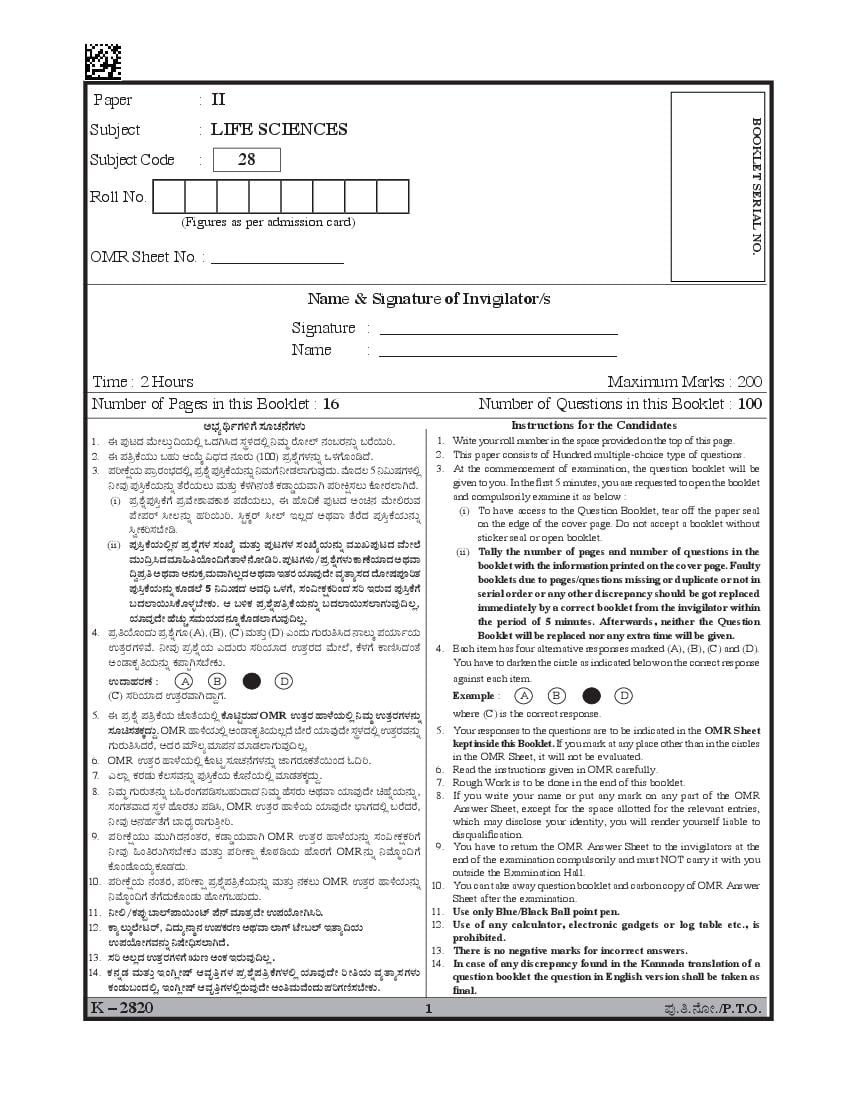
Booklet SERIAL No.
Subject : Life Sciences
Subject Code : 28
Roll No.
(Figures as per admission card)
OMR Sheet No. : ____________________
Name & Signature of Invigilator/s
Signature : _________________________________
Name : _________________________________
Time : 2 Hours Maximum Marks : 200
Number of Pages in this Booklet : 16 Number of Questions in this Booklet : 100
A»Ü¦ìWÜÚWæ ÓÜãaÜ®æWÜÙÜá Instructions for the Candidates
1. D ±Üâo¨Ü ÊæáàÆᤩ¿áÈÉ J¨ÜXst ÓܧÙܨÜÈÉ ¯ÊÜá¾ ÃæãàÇ… ®ÜíŸÃÜ®Üá° ŸÃæÀáÄ. 1. Write your roll number in the space provided on the top of this page.
2. D ±Ü£ÅPæ¿áá ŸÖÜá BÁáR Ë«Ü¨Ü ®ÜãÃÜá (100) ±ÜÅÍæ°WÜÙÜ®Üá° JÙÜWæãíw¨æ. 2. This paper consists of Hundred multiple-choice type of questions.
3. ±ÜÄàPæÒ¿á ±ÝÅÃÜí»Ü¨È
Ü É, ±ÜÅÍæ° ±ÜâÔ¤P¿
æ á®Üá° ¯ÊÜáWæ ¯àvÜÇÝWÜáÊÜâ¨Üá. Êæã¨ÜÆ 5 ¯ËáÐÜWÜÙÜÈÉ 3. At the commencement of examination, the question booklet will be
¯àÊÜâ ±ÜâÔ¤Pæ¿á®Üá° ñæÃæ¿áÆá ÊÜáñÜᤠPæÙÜX®Üíñæ PÜvÝx¿áÊÝX ±ÜÄàQÒÓÜÆá PæãàÃÜÇÝX¨æ. given to you. In the first 5 minutes, you are requested to open the booklet
(i) ±ÜÅÍæ°±ÜâÔ¤PæWæ ±ÜÅÊæàÍÝÊÜPÝÍÜ ±Üvæ¿áÆá, D Öæã©Pæ ±Üâo¨Ü Aíb®Ü ÊæáàÈÃÜáÊÜ and compulsorily examine it as below :
±æà±ÜÃ… ÔàÆ®Üá° ÖÜÄÀáÄ. ÔrPÜRÃ… ÔàÇ… CÆÉ¨Ü A¥ÜÊÝ ñæÃæ¨Ü ±ÜâÔ¤Pæ¿á®Üá° (i) To have access to the Question Booklet, tear off the paper seal
on the edge of the cover page. Do not accept a booklet without
ÔÌàPÜÄÓܸæàw.
sticker seal or open booklet.
(ii) ±ÜâÔ¤Pæ¿áÈÉ®Ü ±ÜÅÍæ°WÜÙÜ ÓÜíTæ ÊÜáñÜᤠ±ÜâoWÜÙÜ ÓÜíTæ¿á®Üá° ÊÜááS±Üâo¨Ü ÊæáàÇæ
(ii) Tally the number of pages and number of questions in the
ÊÜáá©Åst ÊÜÞ×£Áãí©Wæ ñÝÙæ ®æãàwÄ. ±ÜâoWÜÙÜá/±ÜÅÍæ°WÜÙÜá PÝOæ¿Þ¨Ü A¥ÜÊÝ
booklet with the information printed on the cover page. Faulty
©Ì±ÜÅ£ A¥ÜÊÝ A®ÜáPÜÅÊÜáÊÝXÆÉ¨Ü A¥ÜÊÝ CñÜÃÜ ¿ÞÊÜâ¨æà ÊÜÂñÝÂÓÜ¨Ü ¨æãàÐܱÜäÄñÜ booklets due to pages/questions missing or duplicate or not in
±ÜâÔ¤Pæ¿á®Üá° PÜãvÜÇæ 5 ¯ËáÐÜ¨Ü AÊܘ JÙÜWæ, ÓÜíËàPÜÒPÜÄí¨Ü ÓÜÄ CÃÜáÊÜ ±ÜâÔ¤PæWæ serial order or any other discrepancy should be got replaced
Ÿ¨ÜÇÝÀáÔPæãÙÜÛ¸æàPÜá. B ŸÚPÜ ±ÜÅÍ氱ܣÅPæ¿á®Üá° Ÿ¨ÜÇÝÀáÓÜÇÝWÜáÊÜâ©ÆÉ, immediately by a correct booklet from the invigilator within
¿ÞÊÜâ¨æà ÖæaÜác ÓÜÊÜá¿áÊÜ®Üã° PæãvÜÇÝWÜáÊÜâ©ÆÉ. the period of 5 minutes. Afterwards, neither the Question
4. ±ÜÅ£Áãí¨Üá ±ÜÅÍæ°WÜã (A), (B), (C) ÊÜáñÜᤠ(D) Gí¨Üá WÜáÃÜá£Ô¨Ü ®ÝÆáR ±Ü¿Þì¿á Booklet will be replaced nor any extra time will be given.
EñܤÃÜWÜÚÊæ. ¯àÊÜâ ±ÜÅÍæ°¿á G¨ÜáÃÜá ÓÜÄ¿Þ¨Ü EñܤÃÜ¨Ü ÊæáàÇæ, PæÙÜWæ PÝ~Ô¨Üíñæ 4. Each item has four alternative responses marked (A), (B), (C) and (D).
AívÝPÜꣿá®Üá° PܱݳXÓܸæàPÜá. You have to darken the circle as indicated below on the correct response
E¨ÝÖÜÃÜOæ : A B C D against each item.
(C) ÓÜÄ¿Þ¨Ü EñܤÃÜÊÝX¨ÝªWÜ. Example : A B C D
5. D ±ÜÅÍæ° ±Ü£ÅPæ¿á hæãñæ¿áÈÉ PæãqrÃÜáÊÜ OMR EñܤÃÜ ÖÝÙæ¿áÈÉ ¯ÊÜá¾ EñܤÃÜWÜÙÜ®Üá° where (C) is the correct response.
ÓÜãbÓÜñÜPÜR¨Üáª. OMR ÖÝÙæ¿áÈÉ AívÝPÜꣿáÆÉ¨æ ¸æàÃæ ¿ÞÊÜâ¨æà Óܧ٨
Ü È
Ü É EñܤÃÊ
Ü ®Ü áÜ ° 5. Your responses to the questions are to be indicated in the OMR Sheet
WÜáÃÜá£Ô¨ÜÃæ, A¨ÜÃÜ ÊÜåèÆÂÊÜÞ±Ü®Ü ÊÜÞvÜÇÝWÜáÊÜâ©ÆÉ. kept inside this Booklet. If you mark at any place other than in the circles
6. OMR EñܤÃÜ ÖÝÙæ¿áÈÉ Pæãor ÓÜãaÜ®æWÜÙÜ®Üá° hÝWÜÃÜãPÜñæÀáí¨Ü K©Ä. in the OMR Sheet, it will not be evaluated.
6. Read the instructions given in OMR carefully.
7. GÇÝÉ PÜÃÜvÜá PæÆÓÜÊÜ®Üá° ±ÜâÔ¤Pæ¿á Pæã®æ¿áÈÉ ÊÜÞvÜñÜPÜR¨Üáª.
7. Rough Work is to be done in the end of this booklet.
8. ¯ÊÜá¾ WÜáÃÜáñÜ®Üá° Ÿ×ÃÜíWܱÜwÓÜŸÖÜá¨Ý¨Ü ¯ÊÜá¾ ÖæÓÜÃÜá A¥ÜÊÝ ¿ÞÊÜâ¨æà bÖæ°¿á®Üá°, 8. If you write your name or put any mark on any part of the OMR
ÓÜíWÜñÜÊÝ¨Ü ÓܧÙÜ ÖæãÃÜñÜá ±ÜwÔ, OMR EñܤÃÜ ÖÝÙæ¿á ¿ÞÊÜâ¨æà »ÝWܨÜÈÉ ŸÃæ¨ÜÃæ, Answer Sheet, except for the space allotted for the relevant entries,
¯àÊÜâ A®ÜÖÜìñæWæ ¸Ý«ÜÂÃÝWÜᣤàÄ. which may disclose your identity, you will render yourself liable to
9. ±ÜÄàPæÒ¿áá ÊÜááX¨Ü®ÜíñÜÃÜ, PÜvÝx¿áÊÝX OMR EñܤÃÜ ÖÝÙæ¿á®Üá° ÓÜíËàPÜÒPÜÄWæ disqualification.
¯àÊÜâ ×í£ÃÜáXÓܸæàPÜá ÊÜáñÜᤠ±ÜÄàPÝÒ PæãsÜw¿á ÖæãÃÜWæ OMR®Üá° ¯Êæã¾í©Wæ 9. You have to return the OMR Answer Sheet to the invigilators at the
end of the examination compulsorily and must not carry it with you
Pæãívæã¿áÂPÜãvܨÜá. outside the Examination Hall.
10. ±ÜÄàPæÒ¿á ®ÜíñÜÃÜ, ±ÜÄàPÝÒ ±ÜÅÍ氱ܣÅPæ¿á®Üá° ÊÜáñÜᤠ®ÜPÜÆá OMR EñܤÃÜ ÖÝÙæ¿á®Üá° 10. You can take away question booklet and carbon copy of OMR Answer
¯Êæã¾í©Wæ ñæWæ¨ÜáPæãívÜá ÖæãàWÜŸÖÜá¨Üá. Sheet after the examination.
11. ¯àÈ/PܱÜâ³ ¸ÝÇ…±ÝÀáíp… ±æ®… ÊÜÞñÜÅÊæà E±ÜÁãàXÔÄ. 11. Use only Blue/Black Ball point pen.
12. PÝÂÆáRÇæàoÃ…, ˨Üá®ݾ®Ü E±ÜPÜÃÜ| A¥ÜÊÝ ÇÝW… pæàŸÇ… CñÝ©¿á 12. Use of any calculator, electronic gadgets or log table etc., is
E±ÜÁãàWÜÊÜ®Üá° ¯Ðæà˜ÓÜÇÝX¨æ. prohibited.
13. There is no negative marks for incorrect answers.
13. ÓÜÄ AÆÉ¨Ü EñܤÃÜWÜÚWæ Má| AíPÜ CÃÜáÊÜâ©ÆÉ .
14. In case of any discrepancy found in the Kannada translation of a
14. PܮܰvÜ ÊÜáñÜᤠCíXÉàÐ… BÊÜ꣤WÜÙÜ ±ÜÅÍ氱ܣÅPæWÜÙÜÈÉ ¿ÞÊÜâ¨æà Äࣿá ÊÜÂñÝÂÓÜWÜÙÜá question booklet the question in English version shall be taken as
PÜívÜáŸí¨ÜÈÉ, CíXÉàÐ… BÊÜ꣤WÜÙÜÈÉÃÜáÊÜâ¨æà Aí£ÊÜáÊæí¨Üá ±ÜÄWÜ~ÓܸæàPÜá. final.
K – 2820 1 ±Üâ.£.®æãà./P.T.O.
Page 2
Paper – II
Note : This paper contains Hundred (100) objective type questions. Each question carries two (2)
marks. All questions are compulsory.
1. The constituent monosaccharide in chitin 5. Left-handed helix is found in
is (A) B-DNA (B) A-DNA
(A) D-Glucose (C) C-DNA (D) Z-DNA
(B) D-Xylose
6. pH = pK, when
(C) N-acetyl D-glucosamine
(A) [Proton acceptor] = 1/2[Proton
(D) D-Galactose
donor]
2. An example for aromatic amino acid is (B) [Proton acceptor] = [Proton donor]
(A) Methionine (C) [Proton acceptor] = 2[Proton donor]
(D) 2[Proton acceptor] = [Proton donor]
(B) Valine
(C) Alanine 7. Match the following with reference to protein
(D) Tyrosine structure and modifying reagents.
Column A Column B
3. Which functional group is never found in
i. Mercapto ethanol a. Peptide
alpha amino acids ?
bond
(A) NH2 (B) COOH ii. Guanidine b. Disulphide
(C) CHO (D) S-CH3 hydrochloride bridge
iii. Urea c. Hydrogen
4. Ramachandran plot displays bond
(A) Allowed angles of Phi and Psi for iv. Dithiothreitol d. Ionic bond
polypeptide backbone
(A) i - a, ii - d, iii - b, iv - c
(B) Preferred amino acids in a helix
(B) i - b, ii - c, iii - c, iv - b
(C) The hydropathy of amino acids
(C) i - c, ii - b, iii - a, iv - d
(D) Angles of rotation of R-group of
amino acids (D) i - d, ii - a, iii - c, iv - a
Paper II 2 K – 2820
Page 3
vitamins with their names in column B nuclear division (mitosis) followed by
Column A Column B cytoplasmic division (cytokinesis) occurs
during
a. Vitamin D i. Tocopherol
(A) G1 phase (B) S phase
b. Vitamin E ii. Thiamine
(C) G2 phase (D) M phase
c. Vitamin B6 iii. Pyridoxine
d. Vitamin B1 iv. Calciferol 13. Which of the following pair matches
(A) a - (i), b - (ii), c - (iii), d - (iv) with membrane transport process and its
primary function ?
(B) a - (i), b - (ii), c - (iv), d - (iii)
(A) Exocytosis – the movement of
(C) a - (iv), b - (i), c - (iii), d - (ii)
macromolecules into the cell
(D) a - (iv), b - (i), c - (ii), d - (iii)
(B) Pinocytosis – the uptake of water and
solutes into the cell
9. Where are the ion carriers located in a cell ?
(C) Osmosis – passive diffusion of small
(A) Cell membranes
solutes
(B) Intercellular spaces
(D) Phagocytosis - secretion of large
(C) Cell wall particles from the cell
(D) Nucleus
14. The core of the nucleosome consists of
10. Which of the following cell organelle
contain DNA ? (A) H1, H2A, H2B, H4
(A) Golgi complex (B) H2A, H2B, H3, H4
(B) Endoplasmic reticulum (C) H1, H2A, H2B, H3
(C) Ribosome (D) H1, H2A, H3, H4
(D) Mitochondria
15. The concept of pH homeostasis is
11. In which of the following organelles (A) The ability of the microbe to control
β-oxidation of long chain fatty acids is its internal pH
initiated with an object of shortening the
chain length ? (B) The ability of the microbe to control
its external pH
(A) Lysosomes
(C) The ability of the microbe to grow on
(B) Peroxisomes acidic pH
(C) Microsomes (D) The ability of the microbe to grow on
(D) Golgi alkaline pH
K – 2820 3 Paper II
Page 4
of the Kreb’s cycle plus two unique folding of many proteins is made more
enzymes, malate synthetase and isocitrate efficient by a special class of protein
lyase is called
(A) Glyoxylate cycle (A) Gag-Pol fusion protein
(B) Glycolate pathway
(B) Protease
(C) Calvin cycle
(C) Chaperone
(D) TCA cycle
(D) Ubiquitin
17. The maximum coiling of the chromosomes
is observed during 21. Which of the following process takes
(A) Pachytene of meiosis place in the 3′ – 5′ direction ?
(B) Metaphase of mitosis (A) RNA editing
(C) Anaphase of meiosis I (B) RNA replication
(D) Telophase of meiosis II (C) DNA replication
(D) RNA splicing
18. During replication, the long strands of
DNA in a cell’s nucleus get tangled 22. In eukaryotic cells, the tRNA genes 5s,
making it harder for a cell to read genes. rRNA genes, some snRNA genes and
But ______ enzyme can prevent tangling. genes for other small RNAs are transcribed by
(A) DNA ligase
(A) RNA polymerase I
(B) DNA replicase
(B) RNA polymerase II
(C) DNA topoisomerase
(C) RNA polymerase III
(D) DNA isomerase
(D) Reverse Transcriptase
19. Which of the following are the non-coding
23. The role of gRNA is
RNAs ?
(A) Chemical modification of rRNA
(A) rRNA, miRNA and mRNA
(B) Self splicing
(B) rRNA, tRNA and mRNA
(C) miRNA, tRNA and mRNA (C) Polyadenylation
(D) rRNA, miRNA and tRNA (D) RNA editing
Paper II 4 K – 2820
Page 5
damage caused by large change in the of the following as their signalling molecule
in quorum sensing ?
structure of the DNA double helix is
called (A) N-acyl homoserine lactones (AHL)
(B) Autoinducing peptide (AIP)
(A) Mismatch repair
(C) Salicylic acid
(B) Base excision repair (D) Histidine kinase
(C) DNA interstand cross-link repair
29. Which of the following is the tumour
(D) Nucleotide excision repair suppressor gene ?
(A) Neuroblastoma
25. Fermentation of one molecule of (B) p53
glucose to ethanol and CO 2 require
(C) SRY
_________ O2 molecule(s).
(D) Retinoblastoma
(A) 36 (B) 24
(C) 0 (D) 1 30. Rous sarcoma virus was first discovered
in
(A) Monkey (B) Rat
26. Which of the following signalling molecule
does NOT bind to nuclear receptor ? (C) Rabbit (D) Chicken
(A) Cortisol 31. MHC molecule on antigen-presenting
cells which presents foreign peptides to
(B) Acetyl choline helper cells is
(C) Testosterone (A) Class I MHC molecule
(D) Vitamin D3 (B) Class II MHC molecule
(C) Class III MHC molecule
27. Which of the following describes cell-cell (D) Class I and Class III MHC molecule
junction ?
32. The correct sequence of events in
(A) Occluding and claudin mediate cell- producing an antibody response to an
cell contact antigen is
(B) Adherence junctions occur as (A) Antigen → APC → Th → B→ Plasma
continuous bands cell → Ab
(B) Antigen → Th → APC → B →
(C) Occluding junctions are abundant in Plasma cell → Ab
cell under stress
(C) Antigen → B → Th → Plasma cell →
(D) Inorganic ions are able to pass APC → Ab
through anchoring junction to permit (D) Antigen → APC → Th → B →
cell coupling Cytokine → Ab
K – 2820 5 Paper II
Page 6
destroyed and used for vaccination is anterior structure in the Drosophila embryo
considered
requires the product of ________ gene.
(A) A toxoid (B) A toxin
(A) Hunchback (B) Pax-6
(C) Virulent (D) Attenuated
(C) Bicoid (D) Nanos
34. Which of the following is an autoimmune
disease ?
38. During microsporogenesis the tapetum is
(A) Cystic fibrosis
formed from
(B) Multiple sclerosis
(C) Sickle cell anaemia (A) Sporogenous cells
(D) Dyslexia (B) Parietal cells
(C) Epithelial cells
35. Which of the following is not the portal of
entry for bacterial pathogens in the plant (D) Endogenous cells
host ?
(A) Stomata 39. Floral development in Arabidopsis and
(B) Hydathode Antirrhinium is under genetic control of
(C) Lenticel _________ genes.
(D) Plasmodesmata (A) Gurke (B) Homeotic
(C) Hobbit (D) Fackel
36. Choose the correct match :
40. Which of the following is the master
Category I Category II
gene involved in sex determination in
i. IgA 1. Basophils
Drosophila ?
ii. IgE 2. δ heavy chain
iii. IgG 3. Secretory component (A) Sxl (B) Sdc
iv. IgM 4. Pentamer (C) Xol (D) Nanos
5. Cross placenta
(A) i - 2, ii - 1, iii - 3, iv - 5 41. Products of maternal genome molecules
that are placed in the Drosophila egg are
(B) i - 3, ii - 5, iii - 2, iv - 1
(C) i - 2, ii - 3, iii - 5, iv - 4 (A) DNA (B) Proteins
(D) i - 3, ii - 1, iii - 5, iv - 4 (C) RNA (D) Enzymes
Paper II 6 K – 2820
Page 7
Prize for discovery of growth hormone ?
(A) Induced pluripotent stem cells (A) Jasmonic acid
(B) Oncogene (B) Gibberellin
(C) Okazaki fragments (C) Auxin
(D) Ethylene
(D) Cancer stem cells
47. The fixation of CO2 in C4 cycle takes
43. Caspases are involved in the process of place by
(A) DNA replication (A) α-Ketoglutarate
(B) Recombination (B) Oxaloacetate
(C) Apoptosis (C) Phospho-phenol pyruvate
(D) Antibody synthesis (D) Dihydroxy acetone phosphate
44. Q cycle occurs in the mitochondria as well 48. Which of the following bacteria is a
as in the chloroplast. Its main function is non-heterocystous and non-symbiotic
nitrogen fixing bacteria ?
(A) Coupling 2e transfer with 1e
(A) Anabaena
transfer
(B) Rhizobium
(B) It is a part of complex III in the
respiratory chain as well as in Z scheme (C) E. coli
of photosynthetic electron transfer (D) Azotobacter
(C) It acts a buffer of protons
49. During electron transport, the extra energy
(D) It is involved in thermogenesis in carried by the electron is utilized in the
animals and in plants growing in low formation of
temperatures (A) ATP (B) ADP
(C) NADP (D) NADPH2
45. C4 plants are photosynthetically more
efficient than that of C3 plants, because of
50. Which of the following is not a secondary
the absence of _________ in C4 plants.
metabolite ?
(A) Cyclic electron transport (A) Alkaloids
(B) Non-cyclic electron transport (B) Phenols
(C) Photorespiration (C) Flavonoids
(D) Photoperiodism (D) α-Ketoglutaric acid
K – 2820 7 Paper II
Page 8
one molecule of N2 is on the walls of
(A) 12 (B) 16 (A) Arteries
(C) 20 (D) 24 (B) Veins
52. Hair cells are components of ________ (C) Myocardium
sensory organ. (D) Ventricle
(A) Vision (B) Taste
56. Which one of the following nerve centre
(C) Smell (D) Hearing
is NOT involved in the regulation of
excreting urine from the urinary bladder
53. Match the hormones to the glands producing
them. (Micturition) ?
(A) Spinal cord
Group A Group B
(B) Brain stem
i. Oxytocin 1. Ovary
(C) Cerebral cortex
ii. Insulin 2. Pituitary
(D) Dura matter
iii. Calcitonin 3. Pineal
iv. Estrogen 4. Pancreas 57. Which of the following organ regulates
5. Thyroid the ionic balance in man ?
(A) i - 5, ii - 4, iii - 2, iv - 1 (A) Liver (B) Kidney
(B) i - 4, ii - 2, iii - 5, iv - 3 (C) Heart (D) Pancreas
(C) i - 2, ii - 4, iii - 5, iv - 1
58. The pituitary gland stimulates the adrenal
(D) i - 1, ii - 4 iii - 2, iv - 3
glands to make cortisol. Cortisol is
increased during all of the following situation
54. Myogenic heart contraction is initiated
except
by
(A) Myocytes (A) Morning hours
(B) Endothelial cells (B) Stress
(C) Purkinje cells (C) Illness
(D) Transitional cells (D) Night time
Paper II 8 K – 2820
Page 9
unit of vertebrate excretory system ? nomenclature.
Definition Nomenclature
(A) Kidney
a. Normal appearance i. Pleiotropy
(B) Henle’s loop of genetically
controlled traits
(C) Neuron in the phenotype
(D) Nephron b. Genes having ii. Codominance
more than one
primary effect
60. A couple has a female child with disease c. Phenotype produced iii. Phenocopy
and two unaffected children. Neither by environmental
effect is same as the
parent nor any of the four biological phenotype produced
grandparents of the affected child has by a genotype
had this disease. Which one of the d. Both alleles of a iv. Penetrance
following is the most likely genetic gene express
themselves in the
explanation? heterozygotes
v. Expressivity
(A) Autosomal recessive
(B) X-linked dominant (A) a - iv, b - i, c - iii, d - ii
(B) a - v, b - iii, c - i, d - iv
(C) X-linked recessive
(C) a - iii, b - iv, c - ii, d-v
(D) Autosomal dominant (D) a - i, b - v, c - iv, d - iii
61. Which one of the following is correct for 63. Which of the following combination is
the linkage in Drosophila ? the components of genetic variance ?
(A) Additive genetic variance + Recessive
(A) Complete in both males and females variance + Interaction variance
(B) Incomplete in both males and (B) Additive genetic variance +
Dominance variance + Interaction
females variance
(C) Complete in males and incomplete in (C) Additive genetic variance +
Dominance variance + Inversion
females variance
(D) Complete in females and incomplete (D) Additive genetic variance +
Dominance variance + Independent
in males
K – 2820 9 Paper II
Page 10
nomenclature :
(A) Nano meter
Processes Nomenclature
(B) Milli micron
a. Genes are i. Transformation
(C) Centimorgan transferred by
cell to cell contact
(D) Milli meter
b. Genes are ii. Transduction
65. Which of the following is the value of lod transferred
score for two-point mapping in human inside virus
system ? particles
(A) + 3 and – 2 c. Genes are iii. Sexduction
transferred into
(B) – 3 and + 2
cells as free
(C) + 3 and – 3
molecules
(D) – 3 and + 3 d. Bacterial cell iv. Conjugation
gains access to
66. Which of the following chromosomal
foreign DNA
aberration is crossing over suppressor ?
through modified
(A) Translocation F-factor
(B) Inversion (A) a - iv, b - iii, c - ii, d - i
(C) Deletion (B) a - iv, b - i, c - iii, d - ii
(C) a - iv, b - ii, c - i, d - iii
(D) Duplication
(D) a - iii, b - iv, c - i, d - ii
67. The gene is the basic unit of
69. Classification system for prokaryotic
(A) function, mutation and coding species based on the 16s rRNA was
proposed by
(B) function, recombination and coding
(A) Carl Woese
(C) function, mutation and noncoding (B) John Hutchinson
(D) f u n c t i o n , r e c o m b i n a t i o n a n d (C) Alexopoulos and Mims
mutation (D) Kary Mullis
Paper II 10 K – 2820
Page 11
system of plant classification ? contain _______as the main strengthening
compound.
(A) Takhtajan’s system
(A) Chitin
(B) Hutchinson’s system
(B) Gelatine
(C) Engler and Prantl’s system
(C) Murein
(D) Bentham and Hooker’s system
(D) Lignin
71. In taxonomic hierarchy, the “Phylum”
75. Goblet cells are found interspersed in the
was introduced by
_______epithelial tissue.
(A) Linnaeus
(A) Columnar
(B) Haeckel
(B) Cuboidal
(C) Fabricius (C) Squamous
(D) John Ray (D) Ciliated
72. Which one of the following organisms 76. _________is the example for “Dead-end
belong to Kingdom Protista ? Phylum”.
(A) Slime molds (A) Porifera
(B) Blue Green Bacteria (B) Cnidaria
(C) Mosses (C) Annelida
(D) Sponges (D) Nematoda
73. ______ does NOT belong to Gram positive 77. Which of the following is the State bird
Bacteria. of Karnataka ?
(A) Lactobacillus (A) House Sparrow
(B) Azotobacter (B) Indian Roller
(C) Staphylococcus (C) Koel
(D) Bacillus (D) Peacock
K – 2820 11 Paper II
Page 12
through how many States in India ? temperature range of
(A) 60 – 80°C (B) 40 – 50°C
(A) 5 (B) 4
(C) 30 – 40°C (D) – 20 – 10°C
(C) 6 (D) 7
82. A situation of ecological niche where
79. In an ecosystem, the number of deer similar species can exist in the same area
but use resources at different times is
was counted as 2500 in one year. In the
following year, the number increased to (A) Competitive exclusion
2750. If the birth rate of the deer is 0.3 (B) Resource partitioning
what will be the death rate ? (C) Fundamental niche
(A) 0.5 (B) 0.3 (D) Interspecies competition
(C) 0.2 (D) 0.1 83. The artificial chromosome is used to clone
_________ DNA segment.
80. In an ecosystem, there was a large lake (A) 1 kb
with plenty of fish. A human settlement (B) 10 kb
grew in the vicinity of the lake and the
(C) 20 kb
fish population began to decline. Identify
(D) 200 kb and above
the possible sequence of events leading
to the decline in fish population 84. _________ is an area that acts as a
(A) Increased human population – boundary or a transition between two
ecosystems.
increased light pollution – fish unable
to breed – decline in fish population (A) Ecocline
(B) Ecotone
(B) Lake polluted with sewage – algal
(C) Edge effect
bloom – decline in dissolved oxygen
– increased fish death (D) Ecological niche
(C) Increase in human population – 85. Which of the following statement about
increased use of lake water – fish K-selected species is FALSE ?
spawn decrease (A) minimal parental care
(D) Increased human population – (B) fewer offspring
environmental pollution – acid rain (C) large body size
– decrease in lake pH – fish died (D) long life expectancy
Paper II 12 K – 2820
Page 13
showed that apes and other mammals evolved during
(A) Life can be created in the lab ________ period.
(B) If all the components of life are (A) Quaternary
provided, a primordial cell will be (B) Tertiary
formed in the lab (C) Cambrian
(C) Simple molecules can give rise to (D) Cretaceous
complex molecules
(D) Atoms can combine to give 91. Existence of two or more genotypes for
molecules a given trait in a population is called
(A) Pleiotropism
87. FISH technique is used for the localization
of _________ on a chromosome. (B) Monomorphism
(A) Protein (B) Gene (C) Mutualism
(C) Enzyme (D) Haplotype (D) Polymorphism
88. In a population, the frequencies of genes 92. Female wasps have a choice of being a
‘A’ and ‘a’ have reached a steady state. single foundress, she builds a nest and
Which of the following frequencies indicate lays eggs. Alternately she can join a
that the population is in Hardy-Weinberg colony of wasps and help in the colony
equilibrium ? activities, but cannot breed. Although
there is no “Fitness” advantage for the
(A) 0.064, 0.48, 0.09 wasp, this behaviour has evolved as an
(B) 0.49, 0.42, 0.09 evolutionarily stable strategy. Which
of the following is probably one of the
(C) 0.36, 0.36, 0.09
reasons for this ?
(D) 0.49, 0.48, 0.36
(A) She is taken care off in the colony
89. A random change in the frequencies of (B) She has a chance of taking over as the
alleles within a small population is queen and then breed
(A) Genetic load (C) She can lay her eggs in the colony
even though she is not supposed to
(B) Heterosis do so
(C) Genetic drift (D) She has less work to do since other
(D) Homeostasis members share the work
K – 2820 13 Paper II
Page 14
for evolution of multigene families ? the questions (97-100) based on the passage:
(A) Gene duplication and Inversion Humans share the planet with as many as 8.7 ± 1.3
(B) Unequal crossing-over and million different forms of life. Linnaeus, in
Translocation his day, was confident he had captured the
entire world of living things. He named about
(C) Random mutation and Deletion
10,000 species, most of which were confined
(D) Both Duplication and unequal to Europe. Current estimates range from
crossing 3 million(m) to 100 m. Many of those species
will be extinct before scientists have even
94. Who proposed the “Great chain of
registered their presence.
being” in the field of evolution ?
Researchers who have analysed the hierarchical
(A) Wallace
categorisation of life on earth to estimate how
(B) Linnaeus many undiscovered species exist, say the
(C) Aristotle diversity of life is not equally divided between
(D) Anaximander land and ocean. Three-quarters of the 8.7 m
species – the majority of which are insects –
95. Which part of the brain is mainly involved are on land; only one-quarter, 2.2 m are in the
in special memory ? deep, even though 70% of the earth’s surface is
water. We know we are losing species because
(A) Amygdala
of human activity, but we can’t really appreciate
(B) Hippocampus the magnitude of species lost until we know
(C) Cerebellum what species are there. An astonishing 86%
of all plants and animals on land and 91% of
(D) Temporal lobe
those in the seas have yet to be named and
catalogued.
96. Of the several methods used for
construction of phylogenetic tree which The Swedish biologist devised a hierarchical, tree-
one of the following uses character-based like structure where each individual species was
method ? classed in a series of progressively larger groups,
(A) Bootstrap method culminating at the kingdom level. Thus, a single
species of hermit crab is classified in the order
(B) Neighbour joining
Decapoda, which belongs to the subphylum
(C) Maximum likelihood of Crustacea, phylum of Arthropoda, and
(D) Linkage finally the animal kingdom.
Paper II 14 K – 2820
Page 15
on 1.2 m species, detected patterns between those of undiscovered species ?
hierarchical groupings which they could use to (A) Researchers estimated the bacterial
infer the existence of missing species that species from the DNA data
have not yet been described. They estimate (B) Infer existence of missing species
from existing data on 1.2 million
that the various forms of life on the planet species
included 7.8 million species of animal, 298,000
(C) By constructing hierarchical tree-
species of plant and 611,000 species of like structure where each individual
mushrooms, mould and other fungi along species was classed in a series
with 36,400 species of Protozoa, single-celled of progressively larger groups,
culminating at the kingdom
organisms and 27,500 species of algae. The
researchers did not venture to put an estimate (D) A beetle expert calculated the insect
species based on his experiment of
on the number of bacteria. collecting 1100 new species of beetle
In 1979, Terry Erwin, a beetle expert at the from a single type of tree in the forest
of Panama
Smithsonian Institution in Washington, went
out into the jungles of Panama, rolled some 98. The number of species on planet earth
sheeting on the ground and sprayed several have been estimated by different methods.
Which of the following is NOT the total
trees with pesticide. He discovered the bodies number of estimated species ?
of more than 1,100 new species of beetle from
(A) 8.7 ± 1.3 million
the canopy of a single type of tree. There
(B) 3 to 100 million
could be as many as 30 m species of insects in
tropical rain forests alone, calculated Erwin. The (C) 1.2 million
scientists note that identifying and describing (D) 7.8 million animal species
new life forms is expensive and slow, especially
99. What is the estimated number of
when set against the magnitude of species yet mushrooms, moulds and other fungi ?
to be found or catalogued.
(A) 36,400 (B) 611,000
Barely 14% of creatures on earth have been (C) 298,000 (D) 27,500
logged in central databases – just 9% of those are
in the seas, the study noted. Most of those species 100. _________ percent of organisms have
been entered in the central data base.
waiting to be discovered will be small and they
are likely to be concentrated in remote areas or (A) 14% (B) 91%
the ocean depths. (C) 86% (D) 9%
K – 2820 15 Paper II
Page 16
Paper II 16 K – 2820
Document Details
| Board / Org | Karnataka Exams |
| Exam | Karnataka State Eligibility Test |
| Type | Question Paper |
| Pages | 16 |
| Updated | 24 Sep 2026 |