KSET 2020 Question Paper Mathematical Sciences
Finished viewing? Save it for later —
Download KSET 2020 Question Paper Mathematical Sciences (PDF · 24 pages)About KSET 2020 Question Paper Mathematical Sciences
KSET 2020 Question Paper Mathematical Sciences is available here for free download. Published by Karnataka Exams for Karnataka State Eligibility Test, this question paper can be viewed online or downloaded as a PDF (24 pages). Candidates preparing for Karnataka State Eligibility Test can use KSET 2020 Question Paper Mathematical Sciences to understand the exam pattern, the type of questions asked, and the overall difficulty level.
Frequently Asked Questions
How can I download KSET 2020 Question Paper Mathematical Sciences?
Open this page and click the Download button to save KSET 2020 Question Paper Mathematical Sciences as a PDF. It is completely free on AglaSem Docs.
Is KSET 2020 Question Paper Mathematical Sciences free to download?
Yes. KSET 2020 Question Paper Mathematical Sciences can be viewed online and downloaded as a PDF free of cost on AglaSem Docs.
How many pages does KSET 2020 Question Paper Mathematical Sciences have?
KSET 2020 Question Paper Mathematical Sciences contains 24 pages, which you can read online or download together as a single PDF.
Where can I find more Karnataka State Eligibility Test study material?
You can find more Karnataka State Eligibility Test question papers, sample papers, syllabus, and answer keys on AglaSem Docs.
KSET 2020 Question Paper Mathematical Sciences – Text
Read the full text of this question paper below — useful to quickly search, copy and reference the content online without downloading the PDF.
📄 View text version (24 pages)
Page 1
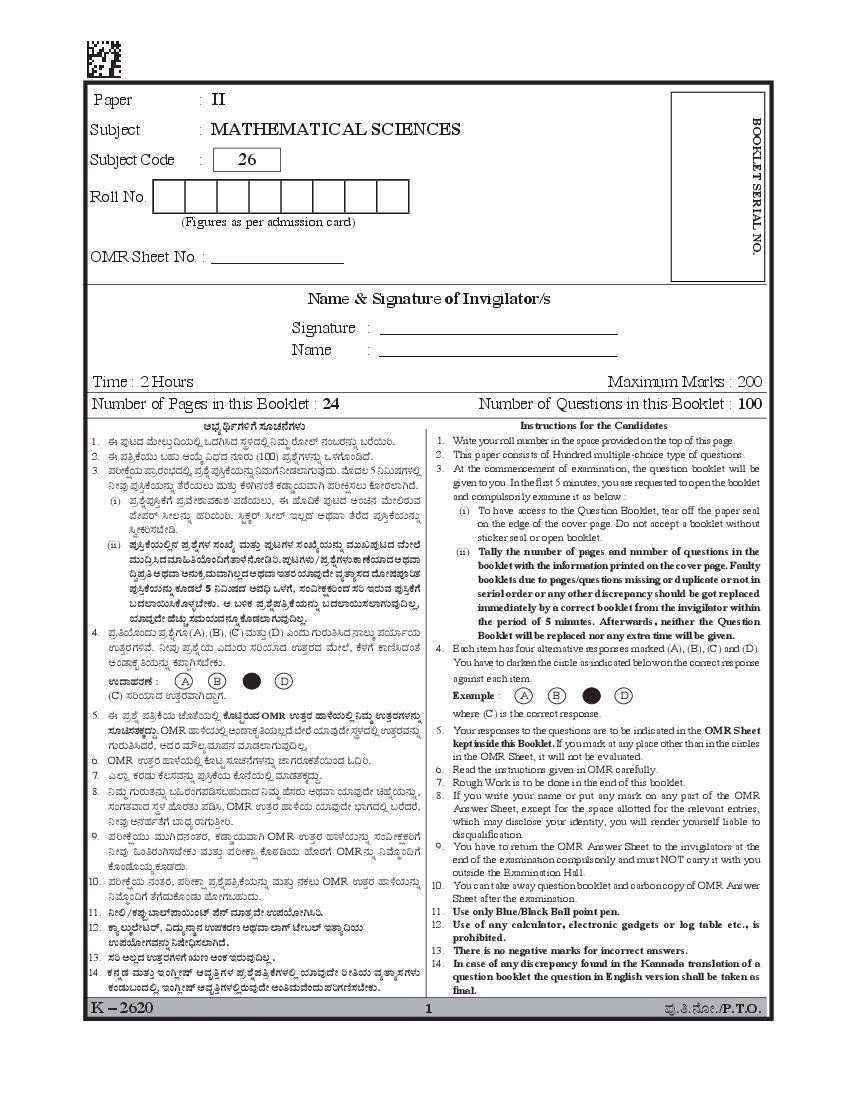
Booklet SERIAL No.
Subject : Mathematical Sciences
Subject Code : 26
Roll No.
(Figures as per admission card)
OMR Sheet No. : ____________________
Name & Signature of Invigilator/s
Signature : _________________________________
Name : _________________________________
Time : 2 Hours Maximum Marks : 200
Number of Pages in this Booklet : 24 Number of Questions in this Booklet : 100
A»Ü¦ìWÜÚWæ ÓÜãaÜ®æWÜÙÜá Instructions for the Candidates
1. D ±Üâo¨Ü ÊæáàÆᤩ¿áÈÉ J¨ÜXst ÓܧÙܨÜÈÉ ¯ÊÜá¾ ÃæãàÇ… ®ÜíŸÃÜ®Üá° ŸÃæÀáÄ. 1. Write your roll number in the space provided on the top of this page.
2. D ±Ü£ÅPæ¿áá ŸÖÜá BÁáR Ë«Ü¨Ü ®ÜãÃÜá (100) ±ÜÅÍæ°WÜÙÜ®Üá° JÙÜWæãíw¨æ. 2. This paper consists of Hundred multiple-choice type of questions.
3. ±ÜÄàPæÒ¿á ±ÝÅÃÜí»Ü¨È
Ü É, ±ÜÅÍæ° ±ÜâÔ¤P¿
æ á®Üá° ¯ÊÜáWæ ¯àvÜÇÝWÜáÊÜâ¨Üá. Êæã¨ÜÆ 5 ¯ËáÐÜWÜÙÜÈÉ 3. At the commencement of examination, the question booklet will be
¯àÊÜâ ±ÜâÔ¤Pæ¿á®Üá° ñæÃæ¿áÆá ÊÜáñÜᤠPæÙÜX®Üíñæ PÜvÝx¿áÊÝX ±ÜÄàQÒÓÜÆá PæãàÃÜÇÝX¨æ. given to you. In the first 5 minutes, you are requested to open the booklet
(i) ±ÜÅÍæ°±ÜâÔ¤PæWæ ±ÜÅÊæàÍÝÊÜPÝÍÜ ±Üvæ¿áÆá, D Öæã©Pæ ±Üâo¨Ü Aíb®Ü ÊæáàÈÃÜáÊÜ and compulsorily examine it as below :
±æà±ÜÃ… ÔàÆ®Üá° ÖÜÄÀáÄ. ÔrPÜRÃ… ÔàÇ… CÆÉ¨Ü A¥ÜÊÝ ñæÃæ¨Ü ±ÜâÔ¤Pæ¿á®Üá° (i) To have access to the Question Booklet, tear off the paper seal
on the edge of the cover page. Do not accept a booklet without
ÔÌàPÜÄÓܸæàw.
sticker seal or open booklet.
(ii) ±ÜâÔ¤Pæ¿áÈÉ®Ü ±ÜÅÍæ°WÜÙÜ ÓÜíTæ ÊÜáñÜᤠ±ÜâoWÜÙÜ ÓÜíTæ¿á®Üá° ÊÜááS±Üâo¨Ü ÊæáàÇæ
(ii) Tally the number of pages and number of questions in the
ÊÜáá©Åst ÊÜÞ×£Áãí©Wæ ñÝÙæ ®æãàwÄ. ±ÜâoWÜÙÜá/±ÜÅÍæ°WÜÙÜá PÝOæ¿Þ¨Ü A¥ÜÊÝ
booklet with the information printed on the cover page. Faulty
©Ì±ÜÅ£ A¥ÜÊÝ A®ÜáPÜÅÊÜáÊÝXÆÉ¨Ü A¥ÜÊÝ CñÜÃÜ ¿ÞÊÜâ¨æà ÊÜÂñÝÂÓÜ¨Ü ¨æãàÐܱÜäÄñÜ booklets due to pages/questions missing or duplicate or not in
±ÜâÔ¤Pæ¿á®Üá° PÜãvÜÇæ 5 ¯ËáÐÜ¨Ü AÊܘ JÙÜWæ, ÓÜíËàPÜÒPÜÄí¨Ü ÓÜÄ CÃÜáÊÜ ±ÜâÔ¤PæWæ serial order or any other discrepancy should be got replaced
Ÿ¨ÜÇÝÀáÔPæãÙÜÛ¸æàPÜá. B ŸÚPÜ ±ÜÅÍ氱ܣÅPæ¿á®Üá° Ÿ¨ÜÇÝÀáÓÜÇÝWÜáÊÜâ©ÆÉ, immediately by a correct booklet from the invigilator within
¿ÞÊÜâ¨æà ÖæaÜác ÓÜÊÜá¿áÊÜ®Üã° PæãvÜÇÝWÜáÊÜâ©ÆÉ. the period of 5 minutes. Afterwards, neither the Question
4. ±ÜÅ£Áãí¨Üá ±ÜÅÍæ°WÜã (A), (B), (C) ÊÜáñÜᤠ(D) Gí¨Üá WÜáÃÜá£Ô¨Ü ®ÝÆáR ±Ü¿Þì¿á Booklet will be replaced nor any extra time will be given.
EñܤÃÜWÜÚÊæ. ¯àÊÜâ ±ÜÅÍæ°¿á G¨ÜáÃÜá ÓÜÄ¿Þ¨Ü EñܤÃÜ¨Ü ÊæáàÇæ, PæÙÜWæ PÝ~Ô¨Üíñæ 4. Each item has four alternative responses marked (A), (B), (C) and (D).
AívÝPÜꣿá®Üá° PܱݳXÓܸæàPÜá. You have to darken the circle as indicated below on the correct response
E¨ÝÖÜÃÜOæ : A B C D against each item.
(C) ÓÜÄ¿Þ¨Ü EñܤÃÜÊÝX¨ÝªWÜ. Example : A B C D
5. D ±ÜÅÍæ° ±Ü£ÅPæ¿á hæãñæ¿áÈÉ PæãqrÃÜáÊÜ OMR EñܤÃÜ ÖÝÙæ¿áÈÉ ¯ÊÜá¾ EñܤÃÜWÜÙÜ®Üá° where (C) is the correct response.
ÓÜãbÓÜñÜPÜR¨Üáª. OMR ÖÝÙæ¿áÈÉ AívÝPÜꣿáÆÉ¨æ ¸æàÃæ ¿ÞÊÜâ¨æà Óܧ٨
Ü È
Ü É EñܤÃÊ
Ü ®Ü áÜ ° 5. Your responses to the questions are to be indicated in the OMR Sheet
WÜáÃÜá£Ô¨ÜÃæ, A¨ÜÃÜ ÊÜåèÆÂÊÜÞ±Ü®Ü ÊÜÞvÜÇÝWÜáÊÜâ©ÆÉ. kept inside this Booklet. If you mark at any place other than in the circles
6. OMR EñܤÃÜ ÖÝÙæ¿áÈÉ Pæãor ÓÜãaÜ®æWÜÙÜ®Üá° hÝWÜÃÜãPÜñæÀáí¨Ü K©Ä. in the OMR Sheet, it will not be evaluated.
6. Read the instructions given in OMR carefully.
7. GÇÝÉ PÜÃÜvÜá PæÆÓÜÊÜ®Üá° ±ÜâÔ¤Pæ¿á Pæã®æ¿áÈÉ ÊÜÞvÜñÜPÜR¨Üáª.
7. Rough Work is to be done in the end of this booklet.
8. ¯ÊÜá¾ WÜáÃÜáñÜ®Üá° Ÿ×ÃÜíWܱÜwÓÜŸÖÜá¨Ý¨Ü ¯ÊÜá¾ ÖæÓÜÃÜá A¥ÜÊÝ ¿ÞÊÜâ¨æà bÖæ°¿á®Üá°, 8. If you write your name or put any mark on any part of the OMR
ÓÜíWÜñÜÊÝ¨Ü ÓܧÙÜ ÖæãÃÜñÜá ±ÜwÔ, OMR EñܤÃÜ ÖÝÙæ¿á ¿ÞÊÜâ¨æà »ÝWܨÜÈÉ ŸÃæ¨ÜÃæ, Answer Sheet, except for the space allotted for the relevant entries,
¯àÊÜâ A®ÜÖÜìñæWæ ¸Ý«ÜÂÃÝWÜᣤàÄ. which may disclose your identity, you will render yourself liable to
9. ±ÜÄàPæÒ¿áá ÊÜááX¨Ü®ÜíñÜÃÜ, PÜvÝx¿áÊÝX OMR EñܤÃÜ ÖÝÙæ¿á®Üá° ÓÜíËàPÜÒPÜÄWæ disqualification.
¯àÊÜâ ×í£ÃÜáXÓܸæàPÜá ÊÜáñÜᤠ±ÜÄàPÝÒ PæãsÜw¿á ÖæãÃÜWæ OMR®Üá° ¯Êæã¾í©Wæ 9. You have to return the OMR Answer Sheet to the invigilators at the
end of the examination compulsorily and must not carry it with you
Pæãívæã¿áÂPÜãvܨÜá. outside the Examination Hall.
10. ±ÜÄàPæÒ¿á ®ÜíñÜÃÜ, ±ÜÄàPÝÒ ±ÜÅÍ氱ܣÅPæ¿á®Üá° ÊÜáñÜᤠ®ÜPÜÆá OMR EñܤÃÜ ÖÝÙæ¿á®Üá° 10. You can take away question booklet and carbon copy of OMR Answer
¯Êæã¾í©Wæ ñæWæ¨ÜáPæãívÜá ÖæãàWÜŸÖÜá¨Üá. Sheet after the examination.
11. ¯àÈ/PܱÜâ³ ¸ÝÇ…±ÝÀáíp… ±æ®… ÊÜÞñÜÅÊæà E±ÜÁãàXÔÄ. 11. Use only Blue/Black Ball point pen.
12. PÝÂÆáRÇæàoÃ…, ˨Üá®ݾ®Ü E±ÜPÜÃÜ| A¥ÜÊÝ ÇÝW… pæàŸÇ… CñÝ©¿á 12. Use of any calculator, electronic gadgets or log table etc., is
E±ÜÁãàWÜÊÜ®Üá° ¯Ðæà˜ÓÜÇÝX¨æ. prohibited.
13. There is no negative marks for incorrect answers.
13. ÓÜÄ AÆÉ¨Ü EñܤÃÜWÜÚWæ Má| AíPÜ CÃÜáÊÜâ©ÆÉ .
14. In case of any discrepancy found in the Kannada translation of a
14. PܮܰvÜ ÊÜáñÜᤠCíXÉàÐ… BÊÜ꣤WÜÙÜ ±ÜÅÍ氱ܣÅPæWÜÙÜÈÉ ¿ÞÊÜâ¨æà Äࣿá ÊÜÂñÝÂÓÜWÜÙÜá question booklet the question in English version shall be taken as
PÜívÜáŸí¨ÜÈÉ, CíXÉàÐ… BÊÜ꣤WÜÙÜÈÉÃÜáÊÜâ¨æà Aí£ÊÜáÊæí¨Üá ±ÜÄWÜ~ÓܸæàPÜá. final.
K – 2620 1 ±Üâ.£.®æãà./P.T.O.
Page 2
Paper – II
Note : This paper contains hundred (100) objective type questions of two (2) marks
each. All questions are compulsory.
∞
1. The number of pairs of integers a and b 2n + 1
3. The series ∑ ( −1)
n
is
satisfying 0 < a < b and ab = ba is n =1 3n + 5
(A) Divergent
(A) 0
(B) Convergent
(B) 1
(C) Conditionally convergent
(C) 2
(D) Absolutely convergent
(D) infinite
4. The radius of convergence of the power
∞
(2 n )!(3n )! series
2. Let ∑ −− (I) and
n= 0 n !( 4 n )! ∞
1 2 n
∞ ∑ 1 + 1 + ... 1 + z n is
1 n n n
∑ 3n+2
−− (II) then n =1
n =1
n 2n
e
(A)
(A) Series (I) converges and series (II) 4
diverges
4
(B)
(B) Series (I) diverges and series (II) e
converges
(C) 4e
(C) Both the series (I) and (II)
converge
(D) e4
(D) Both the series (I) and (II) diverge
Paper II 2 K-2620
Page 3
8. The sum of the series
(A) compact
(B) connected 12 12 + 22 12 + 22 + 32
+ + + .... is
1! 2! 3!
(C) compact but not connected
(D) neither compact nor connected 6
(A)
e
6. Suppose that g : → is continuous 6
(B)
on and g(x) = 0, for every rational x. 17e
Then
17e
(A) g ( ) 7 <0 (C)
6
(B) g ( 7 ) > 0 6e
(D)
17
(C) g ( 7 ) = 0
(D) g ( 7 ) ≠ 0
n 3
lim
(
9. The value of n→∞ 1 + 2 n is
)
7. Let fn : → be differentiable for each
n = 1, 2, ..., with | fn′ (x) | ≤ 1, for all n and x.
(A) 1
Assume lim fn (x) = g(x) . Then
n →∞
(A) g is continuous for all x (B) + ∞
(B) g is continuous only for x > 0
(C) 0
(C) g is continuous only for x < 0
(D) 2
(D) g is not continuous
K-2620 3 Paper II
Page 4
10. Which one of the following statements 12. lim + + ... + =
n →∞ n 2 3 n + 1
is false ?
(A) 0
(A) If f is bounded and has finitely many (B) ∞
discontinuities on [a, b], then f is (C) 1
Riemann integrable on [a, b]
(D) limit does not exist
(B) If f is monotonic on [a, b], then f is
13. Let R denote an arbitrary 3 × 4 matrix
Riemann integrable on [a, b] of rank 2 and O denote the 3 × 4 matrix
all of whose entries are 0. What is the
(C) If f is continuous on [a, b], then f is rank of the following 12 × 16 matrix ?
Riemann integrable on [a, b]
R O R O
(D) If f and g are not Riemann integrable R −R R − R
on [a, b], then fg is not Riemann O R O R
O O O R
integrable on [a, b]
(A) 2
(B) 4
11. Let f : 2 → 1 be defined by
xy (C) 6
f (x, y) = 2 , if (x, y) ≠ (0, 0)
x + y2 (D) 8
and f(0, 0) = 0. Which one of the
following statement is true ? 14. Let A be a real 2 × 2 matrix such that A8 = I
but A4 ≠ I, where I denotes the identity
(A) D1 f(0, 0) = 0 matrix of size 2 × 2. Then the trace of A
equals
(B) f is not continuous at (0, 0)
(A) ± 2
(C) D2 f(0, 0) = 0 (B) 0
(C) ±1
(D) f is continuous at (0, 0)
1
(D) ±
2
Paper II 4 K-2620
Page 5
15. Let M be a real 3 × 3 matrix which has 18. The matrix is positive definite
1 x
0, 1 and – 1 as eigenvalues. Which of
if and only if
the following is not true of M ?
(A) x > 0
(A) M8 + M4 = M6 + M2 1
(B) x >
2
(B) M7 + 3M2 + 2M = M6 + 2M4 + 3M3 1
(C) x >
3
(C) M8 + 3M2 + 2M = M6 + 2M4 + 3M 3
(D) x > 2
(D) M9 + 3M2 + 2M = M6 + 2M4 + 3M3
19. Let V be the vector space of all n × n
real skew-symmetric matrices. then
16. A 4 × 4 real matrix has rank 3. What is dimRV is
the rank of its adjoint ? 1
(A) n ( n + 1)
2
(A) 3
(B) n2 – 1
(B) 1 n
(C)
2
(C) 2 1
(D) ( n − 1) n
2
(D) cannot be determined from the
given data 1 1
20. Let A = . Choose the correct
4 1
17. How many different (non-equivalent) statement in the following.
non-degenerate symmetric bilinear
(A) A is not diagonalizable
forms are there on 4 ?
(B) A is diagonalizable and its diagonal
(A) 2 3 0
form is
0 −1
(B) 5 −3 0
(C) A is similar to
(C) 4 0 1
−1 0
(D) A is similar to
(D) infinitely many 0 −3
K-2620 5 Paper II
Page 6
vectors in . Then, the vectors x + y,
4
from a set of 101 elements where order
y + z and z + x are does not count and repetitions allowed is
(A) linearly independent 101
(A)
71
(B) linearly dependent 101
(B)
70
(C) linearly independent only if x, y, z
130
(C)
are pairwise orthogonal 30
(D) will span a 2-dimensional 131
(D)
71
subspace of 4
24. If p is prime number and g is a non-zero
element of the field p with p elements,
22. The dimension of the subspace W of
then the order of g in the multiplicative
n, where W is given by group, p \ {0}
W = {(x1, x2,...,xn)|xi∈ , 1 ≤ i ≤ n and
(A) is always p
x1 + x2 + ... + xn = 0} is
(B) is always less than p – 1
(A) 0 (C) is always greater than 1
(D) can be less than p – 1
(B) n
25. The number of generators of the cyclic
(C) n – 1 group of order 30 is
(A) 20 (B) 8
(D) 2
(C) 1 (D) 15
Paper II 6 K-2620
Page 7
a multiplicative unit, then
f(X) = X4 + X3 + X2 + X + 6 is
(A) R may not contain a field
(A) irreducible over the field of
(B) R contains an ideal not equal to (0)
and not equal to R rational numbers
(C) The only ideals of are (0) and R (B) irreducible over the field of real
numbers
(D) R contains a field with 5 elements
(C) product of two irreducible
polynomials over the field of
27. If R is a unique factorization domain,
then rational numbers
(A) R is a principal ideal domain (D) product of three irreducible
polynomials over the field of
(B) R is a Euclidean domain
rational numbers
(C) Any sub ring of R is a unique
factorization domain
(D) R may have a non-zero prime ideal 30. In the symmetric group S 4 on four
that is not maximal symbols, the number of elements of
order exactly 4 is
28. The number of monic irreducible (A) 8
polynomials of degree 2 over the field
(B) 3
7 of 7 elements is
(C) 1
(A) 21 (B) 28
(C) 42 (D) 49 (D) 6
K-2620 7 Paper II
Page 8
33. For | z | < 1, ∏ ∑ z
10 k m
31. In the polynomial ring [x] over real =
k= 0 m = 0
numbers, which one of the following is
z
true ? (A)
1 + z2
(A) Every ideal in [x] is generated by z
(B)
an element of degree 1 1 − z2
1
(C)
(B) Every ideal in [x] is generated by 1+ z
an element of degree ≤ 2 1
(D)
1− z
(C) Every prime ideal in [x] is generated
by an element of degree ≤ 2
∞
zn n2
34. The series ∑ + n , (z ∈ ),
(D) Every maximal ideal in [x] is n = 0 n! z
generated by an element of degree 1 converges for
(A) | z | < 1
32. Which one of the following quotient (B) | z | >1
rings is a field ?
(C) | z | = 1
(A) 3[X] / X2 + X + 1 , where 3 is the (D) z ≠ 0
finite field with three elements
1 ez − 1
2 πi |z|∫= 2 z 2 (z − 1)
(B) [X] / (X – 3)
35. dz =
(A) e
(C) Q [X] / X2 + X + 1
(B) e – 2
(D) 2[X] / (X3 + X2 + X + 1 ), where 2 (C) e – 1
is the finite field with two elements (D) 2e
Paper II 8 K-2620
Page 9
Consider the following subsets of 3. is correct ?
A = {(x, y, z) ∈ 3 | xyz = 0} (A) Finite topological spaces are never
B = {(x, y, z) ∈ 3 | xyz = 1} connected
C = {(x, y, z) ∈ 3 | x2 + y2 + z2 = 1} (B) Infinite set with finite complement
topology is connected
Then which one of the following
statement is correct ? (C) If X is connected and A is a proper
subset of X then BdA = φ
(A) A and B are homeomorphic
(D) A connected space is always path
(B) A and C are homeomorphic
connected
(C) B and C are homeomorphic
(D) B and C are nonhomeomorphic 39. Which one of the following statement is
correct ?
37. Let A and B be subsets of a topological (A) w in the box topology is
space X. Then which one of the following metrizable
need not be true ?
(B) w in the product topology is
(A) A ∪ B ⊂ A ∪ B metrizable
(B) A ∩ B ⊂ A ∩ B (C) J in the product topology is
metrizable
(C) A − B ⊂ A − B
(D) n is not metrizable
(D) A ∪ B ⊂ A ∪ B
K-2620 9 Paper II
Page 10
Y = (–1, π) ∪ (e, 5) ∪ (5, 8) of are y(0) = 0, the largest h such that, existence
of the solution in | x | ≤ h, predicted by
(A) (–1, π), (e, 5) and [5, 8) Picard’s theorem is
(A) 1
(B) (–1, 5) and (5, 8) 4
(B) 1
(C) (–1, π) ∪ (e, 5) ∪ [5, 8] 3
(C) 1 2
(D) [–1, 5] and [5, 8]
(D) 1
41. If f1 and f2 are linearly independent 43. The general partial differential equation
solutions of y ′′ + p(x) y ′ + q(x)y = 0, of second order for a function of two
then independent variables x and y
f ′′f − f ′′ f
(A) p(x) = 1 2 2 1 and ∂2z ∂2z ∂2z
f2′f1 − f1′f2 R 2 +S + T 2 + f (x, y, z, p, q ) = 0
∂x ∂ x∂ y ∂y
f ′′ f ′ − f ′′f ′
q ( x) = 2 1 1 2 where R, S and T are continuous
f1f2′ − f2 f1′
functions of x and y and possessing
f1′f2 − f2′f1 partial derivatives defined on some
(B) p(x) = and
f2′f1 + f1′f2 domain D on the xy-plane, then it is
f ′f ′ + f ′′f said to be
q ( x) = 2 1 1 2
f1f2′ − f2 f1′
(A) Parabolic at a point (x, y) in D if
f1′f2′′− f2′f1′′ S2 – 4RT > 0
(C) p(x) = and
f2′f1 − f1′f2
(B) Hyperbolic at a point (x, y) in D if
f ′f ′′− f ′f ′′
q ( x) = 2 1 1 2 S2 – 4RT = 0
f1f2′ − f2 f1′
(C) Elliptic at a point (x, y) in D if
f ′f − f ′′ f
(D) p(x) = 1 2 2 1 and S2 – 4RT < 0
f2 f1′ − f1f2′
f f ′′− f f ′′ (D) Hyperbolic at a point (x, y) in D if
q ( x) = 2 1 1 2 S2 – 4RT < 0
f1′f2 − f2′f1
Paper II 10 K-2620
Page 11
∂u ∂u
problem +u = 6 x , u (0, y) = 3y, x 1 2 4 8
∂x ∂y
then the value of u (1, 1) is f(x) 3 7 21 73 ,
(A) 2 the piecewise linear interpolating
polynomial for 1 ≤ x ≤ 2 is
(B) 3
(C) 1 (A) p(x) = 4x + 1
(D) 4
(B) p(x) = 4x –1
(C) p(x) = 6x – 3
45. The sufficient condition for the
convergence of Newton-Raphson (D) p(x) = 2x + 3
f (a n )
iteration scheme a n +1 = a n − , is
f ′ (a n ) 47. The functional
2
(A) | f (a n )f ′(a n ) |<| f ′′(a n ) | J[ y ] = ∫ (t 2 + y ′ 2 − 2 ty ′)dt with y(0) = 0
0
and y(2) = 3 has
f (a n )f ′′(a n )
(B) >1
[f ′′(a n )] 2
(A) no solution
f (a n )f ′ (a n ) (B) an infinite number of solutions
(C) <1
[f ′′(a n )] 2
(C) exactly two solutions
f (a n )f ′′(a n )
(D) <1 (D) a unique solution
[ f ′ (a n ) ]
2
K-2620 11 Paper II
Page 12
2 50. The eigenvalues of the Sturm – Liouville
48. If y(t ) = t + ∫ y(s)ds , then which of the problem are
0
following statement is true ? (A) Complex with negative imaginary
part
1
(A) The iterated kernels are n−1 , (B) Complex with positive imaginary
3
n = 1, 2, 3,...... part
(C) Real and negative
(B) The resolvent kernel is 3
(D) Real and non-negative
1
(C) y = t +
4 51. The Green’s function for the boundary
1
2 d2y
value problem + λy = x ,
(D) y(t ) = t + ∫ s ds dx
0
( )
y(0) = y π = 0 is
2
2t
49. The solution of the Initial value problem x 1 − π ; 0 ≤ x < t
(A) G(x, t ) =
d2y dy 1 − 2 x t ; t < x ≤ π
− 2 − 3y = 2e x − 10 sin x ,
dx 2
dx π
2
y(0) = 2, y´(0) = 4, is
2x
1 − π ; 0 ≤ x < t
(A) y = 3 e 3 x + 2e − x − e x + 2 cos x − sinx
(B) G (x, t ) =
2
1 − 2 t ; t < x ≤ π
π
2
(B) y = 3 e 3 x + 2e − x − 2e x + 2 sin x − cos x
2 2x
t 1 + π ; 0 ≤ x < t
(C) G (x, t ) =
3 1
(C) y = e3 x + 2e − x − e x + 2 sin x − cos x 1 + 2 x ; t < x ≤ π
2 2 π
2
3 1
(D) y = e 3 x + e − x − 2e x + 2 sin x − cos x 2t
2 2 x 1 + π ; 0 ≤ x < t
(D) G (x, t ) =
1 + 2 x ; t < x ≤ π
π
2
Paper II 12 K-2620
Page 13
equation in a square
the iteration matrix H, the rate of
uxx + uyy = – 1, | x | ≤ 1, | y | ≤ 1, u = 0 at
x = ± 1 and at y = ± 1 is convergence of the iterative method is
5
(A) (1 − x)(1 − y 2 )
6 (A) γ = eρ(H)
5
(B) (1 − x 2 )(1 − y) (B) γ = log10[ρ(H)]
16
5
(C) (1 + x 2 )(1 + y 2 ) (C) γ = – log10[ρ(H)]
16
5 (D) γ = 2 log10[ρ(H)]
(D) (1 − x 2 )(1 − y 2 )
16
53. If HG is the iteration matrix of 55. If E, ∆,∇, δ are the shift, forward,
Gauss-Seidal Scheme, HJ is the backward and central difference
iteration matrix of Jacobi scheme for
operators respectively, then which of
solving AX = b, then which one of the
the following is not true ?
following is true ?
(A) ∆ = E – 1
(A) ρ(HG) = [ρ(HJ)]2
ρ(H J ) (B) ∇ = 1 – E–1
(B) ρ(HG) =
(C) δ = E – ∆
(C) ρ(HG) = ρ(HJ)
(D) ρ(HG) = [ρ(HJ)]3 (D) δ = E1/2 – ∇
K-2620 13 Paper II
Page 14
f´(2.0) obtained by using the method d2y
value problem − λy = 0 with
based on linear interpolation for the dx 2
following data ? y(a) = y(b) = 0 can be transformed to
i 0 1 2 (A) Non homogeneous Fredholm
integral equation
xi 2.0 2.2 2.6
fi 0.69315 0.78846 0.95551 (B) Homogeneous Fredholm integral
equation
(A) 0.49619 (C) Volterra integral equation of first
kind
(B) 0.19642
(D) Volterra integral equation of second
(C) 0.47655
kind
(D) – 0.47655
59. The solution of the integral equation
x
57. If uxx + uyy = 0 in a given region, then φ(x) = x + ∫ (ξ − x)φ(ξ)dξ is
0
u(x, y) cannot have a relative maximum
(A) cosx
or minimum inside the region unless
(B) sinx
(A) u(x, y) = sinx cosy
(C) sin–1x
(B) u(x, y) = x 2 y
(D) tanx
(C) u(x, y) is constant
(D) u(x, y) = x y2
Paper II 14 K-2620
Page 15
and bob mass m, θ being the generalized the null hypothesis means
co-ordinate, then for small θ, the Lagrangian
(A) The distribution of the test statistic
of this system can be written as
does not depend on parameter θ
1
(A) L(θ, θ ) = m (l θ − g l θ )
2 2 2
2 (B) The distribution of the test statistic
1
(B) L(θ, θ ) = m (l 2θ 2 − g θ) is always continuous
2
(C) The distribution of the test statistic
(C) L(θ, θ ) = 1 m (l 2θ − g l θ)
2 does not depend on the distribution
1
(D) L(θ, θ ) = m (l θ + g l θ) from which sample was drawn
2 2
2
(D) The distribution of the test statistic
is a discrete distribution always
61. In a Markov chain, states i and j are
communicating. Then which one of the
63. Data on rainfall for the month of
following is not true ?
June 2016 is available for Bengaluru
(A) Either both are transient or both are city. Which one of the following tests is
persistent most appropriate when the distribution
(B) Both have same period of rainfall is random ?
(C) If j is aperiodic, then stationary (A) Run test
solution lim p ijn = 1 , where µij is
n →∞ µ ij (B) Wilcoxon Rank-Sum test
the expected number of transitions
(C) Sign test
to state j
(D) pii = pjj (D) Median test
K-2620 15 Paper II
Page 16
I = (–2, 2). Which of the following is
with mean λ. Given that X is ⊂ AN
true ?
estimator with mean λ and variance
(A) P (X ∈ I) > P(Y ∈ I)
λ
. Then ⊂ AN estimator of e–λ with
n (B) P (X ∈ I) = P(Y ∈ I)
asymptotic mean and variance is (C) P (X ∈ I) < 2P(Y ∈ I)
(D) 2P (X ∈ I) < P(Y ∈ I)
−2 λ
(A) e AN e − λ , e
X
n
67. Let X be a binomial (n, p) and
3
(B) e AN e − λ , e −2 λ λ
X
p( X = n ) = p( X = n − 1), then
n 10
(A) n = 10, p = 1
4
(C) e X AN e − λ , e − λ λ
2
n (B) n = 20, p = 1
4
(C) n = 20, p = 3
4
(D) e AN λ, λ
2
X
n (D) n = 10, p = 3
4
65. For a random sample of size n from the
Poisson distribution with parameter λ, 68. Let X have pdf f(x) = 2x , 0 < x< 1. What
the MLE of Ψ(λ) = (1 + λ).e–λ is is the pdf of the median of a random
sample of size 3 from X ?
(A) (1 + n ∑ X i ) . e − X
(A) 12x3(1 – x4), 0 < x < 1
(B) (1 + nX ) . e i
−∑X
(B) 12x3(1 – x2), 0 < x < 1
(C) (1 + X ) . e − nX (C) 12x2(1 – x3), 0 < x < 1
(D) (1 + X ) . e − X (D) 12x3(1 – x3), 0 < x < 1
Paper II 16 K-2620
Page 17
pdf f(x . λ) = e–λx, x > 0, λ > 0. Then the arrival times of n events s1, s2,..., sn have
p (0 < p < 1) quantile of this r.v. X is
th
the same distribution as that of n order
(A) λlog (1 – p) statistics corresponding to n independent
random observations from
(B) – λlog (1 – p)
(A) Gamma(n, λ)
1
(C) log(1 − p)
λ (B) Uniform (0, t)
1
(D) − log(1 − p)
λ (C) Exponential (λt)
(
(D) Binomial n, 1 t )
70. Let {Xn} be a sequence of independent
random variables such that
1 1 72. Let {Xn} be a Markov chain with state
P( X n = n ) = 2 n 2 , P( X n = − n ) = 2 n 2 {0, 1, 2} with following transition
1 probability matrix
and P( X n = 0) = 1 − 2 for n = 1, 2, 3,... .
n
Which of the following is true ? 1 0 1
2 2
P = 1 2 0
(A) WLLN holds and SLLN holds 3 3
0 0 1
(B) WLLN does not hold but SLLN then P(X3 = 2|X1 = 0)
holds
(A) 3 4
(C) WLLN holds but SLLN does not
(B) 1 2
hold
1
(C) 3
(D) Neither WLLN nor SLLN hold
(D) 1 8
K-2620 17 Paper II
Page 18
from Cauchy distribution with location
distributions is not complete ? parameter µ, with Fisher information
contained in one observation about µ is
1 . Then, the Rao-Score test statistic
(A) U(0, θ), θ > 0 2
for testing H0 : µ = 0 against H1 : µ ≠ 0 is
2
(B) N(θ, 1), –∞ < θ < ∞ 2 n 2x i
(A) ∑
n i =1 1 + x 2i
(C) N(0, θ), 0 < θ < ∞ 1 n 2x i
(B) ∑
n i =1 1 + x 2i
(D) P(λ), λ > 0 2 n xi
(C) ∑
n i =1 1 + x 2i
2
2 n 2x i
(D) ∑
n i =1 1 + x i
74. Suppose that –5, –8, 1, –10, 4, 5.7, 8
and 9 are independent observations from
76. Following matrix gives the distance of
U(–θ, θ), θ > 0, θ unknown. Then, the five objects {1, 2, 3, 4, 5}
0
MLE of θ is 9 0
D=3 7 0
(A) 10
6 5 9 0
11 10 2 8 0
(B) 8 Clusters are formed using single linkage
algorithm, then which of the following
(C) 9 are in the same cluster ?
(A) {1, 2}
(D) 1 (B) {5, 4}
(C) {2, 4}
(D) {1, 4}
Paper II 18 K-2620
Page 19
classification of number of members in sample from the pdf
two populations π1 and π2. 1 −
x
f ( x, θ, η) = θ
e η
xθ – 1, x > 0,
Actual Membership θη
given that η is known, which of the
π1 π2
Predicted
following is sufficient for θ ?
Membership π1 20 5
π2 (A) X1 + . . . + Xn
3 25
Then the percent apparent error rate is (B) X1 + . . . + Xn – 1
(A) 17.8% (C) X12 + . . . + X 2n
(B) 12%
(D) X13 + . . . + X 3n
(C) 25%
(D) 15.1%
80. Let X and Y be independent standard
exponential random variables. Which
78. Given the hazard rate r(t) = λαtα – 1, t > 0, of the following is correct ?
λ > 0, α > 1, what is the corresponding
pdf ? (A) XY has exponential distribution
α −1 − λt α X
(A) αλt e ,t > 0 (B)
Y
has exponential distribution
(B) αλ α −1t α −1e −(λt ) , t > 0
α
(C) Maximum of X and Y has exponential
α distribution
(C) αλ α t α −1e − λt , t > 0
α (D) Minimum of X and Y has exponential
(D) αλα t α e − λt , t > 0
distribution
K-2620 19 Paper II
Page 20
P(A1∪A2) = P(A1) + P(A2) when holding cost Rs. 0.04, set up cost Rs. 100
and demand rate 25 per unit time, what
(A) A1 and A2 are independent
is the economic lot size ?
(B) A1 and A2 are mutually exclusive
100
(A)
(C) A1 is contained in A2 2
(D) A2 is contained in A1 (B) 100
(C) 200
82. If {Xn, n ≥ 0} is a Markov chain on
500
{1, 2, 3} with transition probability (D)
2 3 2
0
5 5
matrix , P = 0 3 2 ,
5 5 84. What is the average number of customers
3 2
0 in an M/G/1 queueing system with
5 5
arrival rate λ, service rate µ, variance of
what is its stationary distribution ?
service time σ2 and traffic intensity ρ ?
3 2 λ 2 σ 2 + ρ2 1
(A) 0, , (A) +
5 5
2 λ (1 − ρ) µ
1 2 2
(B) , , λ 2 σ 2 + ρ2
5 5 5 (B)
2 (1 − ρ)
1 2
(C) , , 0 λ 2 σ 2 + ρ2
3 3 (C) +ρ
2 (1 − ρ)
1 1 1
(D) , , λ 2 σ 2 + ρ2
3 3 3 (D)
2 λ (1 − ρ)
Paper II 20 K-2620
Page 21
maximum number of estimable linear
which of the following is not true ?
parametric functions in a linear model ?
(A) Trace of the design matrix k
(A) I is a g-inverse of the
λv v
(B) Determinant of the design matrix
information matrix
(C) Rank of the design matrix
k E
(D) Permanent of the design matrix (B) I v − vv is a g-inverse of the
λv v
information matrix, where Evv is a
86. With reference to a full rank
Gauss-Markov model, which of the v × v matrix of 1’s
following is not true ?
λv
(C) I is the information matrix
(A) The design matrix has full column k v
rank
(B) Every linear parametric function is λv E
(D) I v − vv is the information
estimable k v
(C) Least squares estimator of the matrix
parameter vector is not unique
(D) Least squares estimator of the 89. Given that X has t-distribution with
parameter vector is unique
degrees of freedom n and EX = 0 and
87. If X and Y are i.i.d. with characteristic EX2 = ∞, what is n ?
function ϕ, what is the characteristic
function of X – Y ? (A) 1
(A) 1 (B) 2
(B) |ϕ|2 (C) 3
(C) ϕ2
(D) 5
(D) 0
K-2620 21 Paper II
Page 22
probability of head 1 2 and an unfair which one of the following estimator is
one with probability of head 1 3 , but BLUE ?
otherwise look identical. A coin is
(A) Generalized least squares estimator
selected at random and tossed, falling
head up. How likely is it that it is the (B) Ordinary least squares estimator
fair one ?
(C) Ridge estimator
(A) 1 3
(D) Instrumental variable estimator
(B) 2 5
(C) 1 2 93. Given that the Durlin-Watson d-test
statistic is zero, what is the first order
(D) 3 5 autocorrelation ?
(A) Perfectly positive
91. If (X, Y) has probability mass function (B) Zero
n − k −l
(C) Perfectly negative
n! l l 5
P( X = k , Y = l ) =
k ! l !( n − k − l )! 4 k 3l 12 (D) Non-negative
k, l = 0, 1, 2,..., n, k + l ≤ n .
What is the conditional distribution of
X given Y = 1 ? 94. The value of the objective function
at an optimal solution of the linear
3 programming problem,
(A) Binomial n − 1,
8
Minimize x + y subject to x – y = –5,
5
(B) Binomial n − 1, x ≥ 0, y ≥ 0 will be
12
(A) –5
1
(C) Binomial n − 1, (B) 0
3
(C) 5
1
(D) Binomial n − 1,
4 (D) 10
Paper II 22 K-2620
Page 23
interactions are confounded with the intraclass correlation between units, of
following blocks ? systematic sample mean with simple
Block 1 : (1) ad ac ab cd bd bc abcd random sample mean (under usual
notation) is
Block 2 : a d c b acd abd abc bcd
N−n
(A) 1 + ρ ( n − 1)
(A) AB N −1
(B) AC N−n
(B)
(C) ABC 1 + ρ ( n − 1)
(D) ABCD N −1
(C) 1 + ρ ( n − 1)
N−n
96. The regression estimator y + b ( X − x ) N −1
(D)
reduces to the ratio estimator whenever 1 + ρ ( n − 1)
b equals to
99. Boys arrive in a queue according to a
(A) 0 Poisson process with rate α1 and girls
arrive in the same queue according
(B) y to another Poisson process with rate
x α2. The arrivals of boys and girls are
independent. What is the probability that
(C) y
the first arrival in the queue is a girl ?
(D) 1 α1 α2
(A) (B)
α1 + α 2 α1 + α 2
97. What is the probability that a particular α1 α2
(C) (D)
unit is included in a sample of size n from α2 α1
a population of size N using SRSWOR ?
100. Which of the following is satisfied by
n −1
(A) the OLS residual vector in the regression
N −1
model with n observations ?
n (A) It is correlated with the regressor
(B)
N (B) It is homoscedastic and
n autocorrelated
(C) (C) It is heteroscedastic and auto
N −1
correlated
N−n (D) The number of independent
(D) N −1
components in it is n – 1
K-2620 23 Paper II
Page 24
Paper II 24 K-2620
Document Details
| Board / Org | Karnataka Exams |
| Exam | Karnataka State Eligibility Test |
| Type | Question Paper |
| Pages | 24 |
| Updated | 24 Sep 2026 |