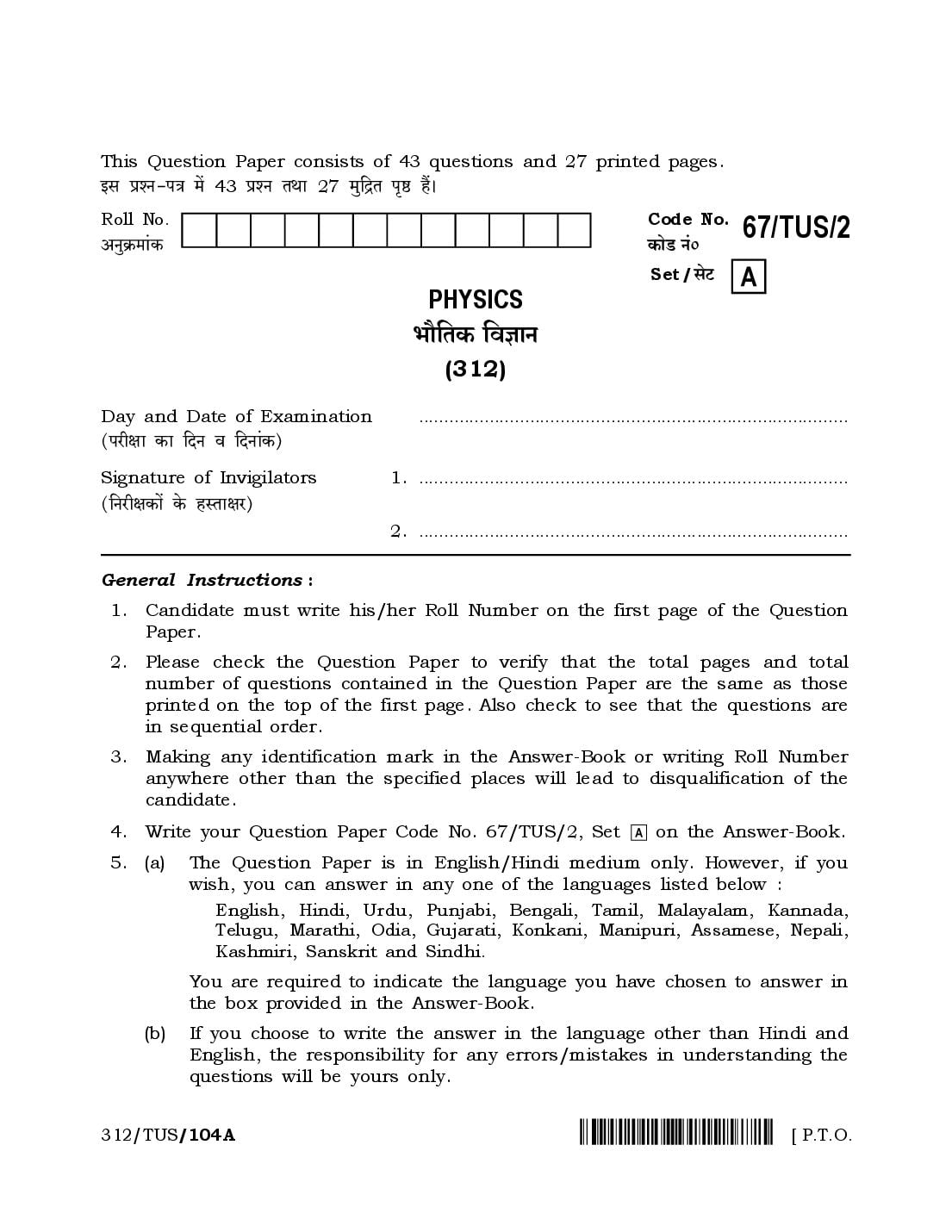
NIOS Class 12 April 2024 Question Paper Physics
Finished viewing? Save it for later —
Download NIOS Class 12 April 2024 Question Paper Physics (PDF · 27 pages)About NIOS Class 12 April 2024 Question Paper Physics
NIOS Class 12 April 2024 Question Paper Physics is available here for free download. Published by NIOS for National Institute of Open Schooling Class 12, this question paper can be viewed online or downloaded as a PDF (27 pages). Candidates preparing for National Institute of Open Schooling Class 12 can use NIOS Class 12 April 2024 Question Paper Physics to understand the exam pattern, the type of questions asked, and the overall difficulty level.
Frequently Asked Questions
How can I download NIOS Class 12 April 2024 Question Paper Physics?
Open this page and click the Download button to save NIOS Class 12 April 2024 Question Paper Physics as a PDF. It is completely free on AglaSem Docs.
Is NIOS Class 12 April 2024 Question Paper Physics free to download?
Yes. NIOS Class 12 April 2024 Question Paper Physics can be viewed online and downloaded as a PDF free of cost on AglaSem Docs.
How many pages does NIOS Class 12 April 2024 Question Paper Physics have?
NIOS Class 12 April 2024 Question Paper Physics contains 27 pages, which you can read online or download together as a single PDF.
Where can I find more National Institute of Open Schooling Class 12 study material?
You can find more National Institute of Open Schooling Class 12 question papers, sample papers, syllabus, and answer keys on AglaSem Docs.
NIOS Class 12 April 2024 Question Paper Physics – Text
Read the full text of this question paper below — useful to quickly search, copy and reference the content online without downloading the PDF.
📄 View text version (27 pages)
Page 1
Bg àíZ-nÌ ‘| 43 àíZ VWm 27 ‘w{ÐV n¥ð> h¢&
Roll No. Code No.
67/TUS/2
u
AZwH$« ‘m§H$ H$moS> Z§0
Set / goQ>
PHYSICS
^m¡{VH$ {dkmZ
(312)
Day and Date of Examination .....................................................................................
(narjm H$m {XZ d {XZm§H$)
Signature of Invigilators 1. .....................................................................................
({ZarjH$m| Ho$ hñVmja)
2. .....................................................................................
General Instructions :
1. Candidate must write his/her Roll Number on the first page of the Question
Paper.
2. Please check the Question Paper to verify that the total pages and total
number of questions contained in the Question Paper are the same as those
printed on the top of the first page. Also check to see that the questions are
in sequential order.
3. Making any identification mark in the Answer-Book or writing Roll Number
anywhere other than the specified places will lead to disqualification of the
candidate.
4. Write your Question Paper Code No. 67/TUS/2, Set u on the Answer-Book.
5. (a) The Question Paper is in English/Hindi medium only. However, if you
wish, you can answer in any one of the languages listed below :
English, Hindi, Urdu, Punjabi, Bengali, Tamil, Malayalam, Kannada,
Telugu, Marathi, Odia, Gujarati, Konkani, Manipuri, Assamese, Nepali,
Kashmiri, Sanskrit and Sindhi.
You are required to indicate the language you have chosen to answer in
the box provided in the Answer-Book.
(b) If you choose to write the answer in the language other than Hindi and
English, the responsibility for any errors/mistakes in understanding the
questions will be yours only.
312/TUS/104A [ P.T.O.
Page 2
1. narjmWu àíZ-nÌ Ho$ nhbo n¥ð> na AnZm AZwH«$‘m§H$ Adí¶ {bI|&
2. H¥$n¶m àíZ-nÌ H$mo Om±M b| {H$ àíZ-nÌ Ho$ Hw$b n¥ð>m| VWm àíZm| H$s CVZr hr g§»¶m h¡ {OVZr àW‘ n¥ð> Ho$ g~go
D$na N>nr h¡& Bg ~mV H$s Om±M ^r H$a b| {H$ àíZ H«${‘H$ ê$n ‘| h¢&
3. CÎma-nwpñVH$m ‘| nhMmZ-{M• ~ZmZo AWdm {Z{X©ï> ñWmZm| Ho$ A{V[aº$ H$ht ^r AZwH«$‘m§H$ {bIZo na narjmWu H$mo
A¶mo½¶ R>ham¶m OmEJm&
4. AnZr CÎma-nwpñVH$m na àíZ-nÌ H$m H$moS> Z§0 67/TUS/2, goQ u {bI|&
5. (H$) n«íZ-nÌ Ho$db {hÝXr/A§J«oOr ‘| h¡& {’$a ^r, ¶{X Amn Mmh| Vmo ZrMo Xr JB© {H$gr EH$ ^mfm ‘| CÎma Xo
gH$Vo h¢ …
A§J«oOr, {hÝXr, CXÿ©, n§Om~r, ~§Jbm, V{‘b, ‘b¶mb‘, H$Þ‹S>, VobwJy, ‘amR>r, C{‹S>¶m, JwOamVr, H$m|H$Ur,
‘{Unwar, Ag{‘¶m, Zonmbr, H$í‘rar, g§ñH¥$V Am¡a {gÝYr&
H¥$n¶m CÎma-nwpñVH$m ‘| {XE JE ~m°³g ‘| {bI| {H$ Amn {H$g ^mfm ‘| CÎma {bI aho h¢&
(I) ¶{X Amn {hÝXr Ed§ A§J«oOr Ho$ A{V[aº$ {H$gr Aݶ ^mfm ‘| CÎma {bIVo h¢, Vmo àíZm| H$mo g‘PZo ‘| hmoZo dmbr
Ìw{Q>¶m|/Jb{V¶m| H$s {Oå‘oXmar Ho$db AmnH$s hmoJr&
312/TUS/104A 2
Page 3
^m¡{VH$ {dkmZ
(312)
Time : 3 Hours ] [ Maximum Marks : 80
g‘¶ … 3 KÊQ>o ] [ nyUmªH$ … 80
Note : (i) This Question Paper consists of 43 questions in all.
(ii) All questions are compulsory.
(iii) Marks are given against each question.
(iv) Use log tables if required.
(v) Section—A consists of
(a) Question Nos. 1 to 16—multiple choice type questions (MCQs)
carrying 1 mark each. Select and write the most appropriate option
out of the four options given in each of these questions. An internal
choice has been provided in some of these questions. You have to
attempt only one of the given choices in such questions.
(b) Question Nos. 17 to 28—objective type questions carrying 2 marks
each (with 2 sub-parts of 1 mark each). Attempt these questions as
per the instructions given for each.
(vi) Section—B consists of
(a) Question Nos. 29 to 37—very short answer type questions carrying
2 marks each and to be answered in the range of 30 to 50 words.
(b) Question Nos. 38 to 41—short answer type questions carrying
3 marks each and to be answered in the range of 50 to 80 words.
(c) Question Nos. 42 and 43—long answer type questions carrying
5 marks each and to be answered in the range of 80 to 120 words.
{ZX}e … (i) Bg àíZ-nÌ ‘| Hw$b 43 àíZ h¢&
(ii) g^r àíZ A{Zdm¶© h¢&
(iii) à˶oH$ àíZ Ho$ {bE A§H$ {XE JE h¢&
(iv) ¶{X Amdí¶H$ hmo, Vmo bm°J Qo~b H$m Cn¶moJ H$a|&
(v) IÊS>—H$ ‘| gpå‘{bV h¡
(a) àíZ g§»¶m 1 go 16—~hþ{dH$ënr àH$ma Ho$ àíZ (MCQs), à˶oH$ 1 A§H$ H$m& à˶oH$ àíZ
‘| {XE JE Mma {dH$ënm| ‘| go g~go Cn¶wº$ {dH$ën H$mo MwZH$a {bI|& BZ‘| go Hw$N> àíZm|
‘| Am§V[aH$ {dH$ën {X¶m J¶m h¡& Eogo àíZm| Ho$ {bE Ho$db EH$ {dH$ën H$m M¶Z H$a|&
(b) àíZ g§»¶m 17 go 28—dñVw{Zð> àH$ma Ho$ àíZ, à˶oH$ 2 A§H$ H$m (2 Cn^mJ, à˶oH$
1 A§H$ H$m)& BZ àíZm| Ho$ CÎma {XE JE {ZX}e Ho$ AZwgma X|&
312/TUS/104A 3 [ P.T.O.
Page 4
(a) àíZ g§»¶m 29 go 37—A{V g§{já CÎma dmbo àíZ, à˶oH$ 2 A§H$ H$m Ed§ 30 go
50 eãXm| ‘| CÎma XoZm h¡&
(b) àíZ g§»¶m 38 go 41—g§{já CÎma dmbo àíZ, à˶oH$ 3 A§H$ H$m Ed§ 50 go 80 eãXm|
‘| CÎma XoZm h¡&
(c) àíZ g§»¶m 42 Am¡a 43—XrK©-CÎmar¶ àíZ, à˶oH$ 5 A§H$ H$m Ed§ 80 go 120 eãXm|
‘| CÎma XoZm h¡&
(1) Answers of all questions are to be given in the Answer-Book given to you.
g^r àíZm| Ho$ CÎma AmnH$mo Xr JB© CÎma-nwpñVH$m ‘| hr {bI|&
(2) 15 minutes time has been allotted to read this Question Paper. The Question
Paper will be distributed at 2:15 p.m. From 2:15 p.m. to 2:30 p.m., the
students will read the Question Paper only and will not write any answer on
the Answer-Book during this period.
Bg àíZ-nÌ H$mo n‹T>Zo Ho$ {bE 15 {‘ZQ> H$m g‘¶ {X¶m J¶m h¡& àíZ-nÌ H$m {dVaU Xmonha ‘|
2:15 ~Oo {H$¶m OmEJm& 2:15 ~Oo go 2:30 ~Oo VH$ N>mÌ Ho$db àíZ-nÌ H$mo n‹T>|Jo Am¡a Bg Ad{Y
Ho$ Xm¡amZ do CÎma-nwpñVH$m na H$moB© CÎma Zht {bI|Jo&
SECTION—A
IÊS>—H$
Note : For Question Nos. 1 to 16, an internal choice has been provided in
some of these questions. You have to attempt only one of the given
choices in such questions.
{ZX}e … àíZ g§0 1 go 16 Ho$ {bE, Hw$N> àíZm| ‘| Am§V[aH$ {dH$ën {X¶m J¶m h¡& Eogo àíZm| ‘| {XE JE
{dH$ënm| ‘| go AmnH$mo Ho$db EH$ {dH$ën MwZZm h¡&
1. Pressure due to a liquid column does not depend on
(A) its density
(B) its viscosity
(C) its height
(D) acceleration due to gravity at the place 1
{H$gr Ðd-ñVå^ H$m Xm~ {Z^©a Zht H$aVm h¡
(A) BgHo$ KZËd na
(B) BgH$s í¶mZVm na
(C) BgH$s D±$MmB© na
(D) Cg ñWmZ na JwéËd Ho$ H$maU ËdaU na
312/TUS/104A 4
Page 5
(A) interference (B) diffraction
(C) polarization (D) dispersion 1
dfm© Ho$ níMmV² AmH$me ‘| BÝÐYZwf ~ZZo H$s H$maU^yV n[aKQ>Zm h¡
(A) ì¶{VH$aU (B) {ddV©Z
(C) Y«wdU (D) dU©-{djonU
3. When a constant net external force acts on a body, which of the following
physical quantities may not change? 1
(A) Position (B) Speed
(C) Velocity (D) Acceleration
O~ {H$gr qnS> na H$moB© AMa ZoQ> ~mø ~b Amamo{nV hmoVm h¡, Vmo {ZåZ{b{IV ‘| go {H$g ^m¡{VH$
am{e ‘| H$moB© n[adV©Z Zht hmoJm?
(A) pñW{V (B) Mmb
(C) doJ (D) ËdaU
Or / AWdm
A force F acts on a body of mass m for t seconds. The change in its linear
momentum will be
(A) Ft (B) Fm
F F
(C) (D)
t m
m Ð춑mZ Ho$ {H$gr qnS> na t goH§$S> Ho$ {bE H$moB© ~b F bJm¶m OmVm h¡& BgHo$ aoIr¶ g§doJ ‘|
n[adV©Z hmoJm
(A) Ft (B) Fm
F F
(C) (D)
t m
4. A body of mass m is thrown vertically upwards in air with an initial
velocity v. Its kinetic energy at a height h will be
1 1
(A) equal to mv 2 (B) more than mv 2
2 2
1 1
(C) less than mv 2 (D) mgh – mv 2 1
2 2
312/TUS/104A 5 [ P.T.O.
Page 6
^yVb go h D±$MmB© na BgH$s J{VO D$Om© H$m ‘mZ hmoJm
1 1
(A) mv 2 Ho$ ~am~a (B) mv 2 go A{YH$
2 2
1 1
(C) mv 2 go H$‘ (D) mgh – mv 2
2 2
5. Which of the following phenomena is not exhibited by sound waves? 1
(A) Refraction (B) Diffraction
(C) Interference (D) Polarization
Üd{Z Va§J| {ZåZ{b{IV ‘| go {H$g n[aKQ>Zm H$m àXe©Z Zht H$aVr h¢?
(A) AndV©Z (B) {ddV©Z
(C) ì¶{VH$aU (D) Y«wdU
6. Which of the following harmonics of its fundamental note is missing
from the sounds produced by a closed pipe? 1
(A) Second harmonic (B) Third harmonic
(C) Fifth harmonic (D) Seventh harmonic
~ÝX nmBn Ûmam CËnÞ Üd{Z¶m| ‘| ‘yb ñda H$s {ZåZ{b{IV ‘| go H$m¡Z-gr g§ZmXr JwUmd¥{Îm àmá Zht
hmoVr?
(A) {ÛVr¶ g§ZmXr JwUmd¥{Îm (B) V¥Vr¶ g§ZmXr JwUmd¥{Îm
(C) n§M‘ g§ZmXr JwUmd¥{Îm (D) gá‘ g§ZmXr JwUmd¥{Îm
oil drop (in air) having charge ne and
7. An electric field E holds an
mass m. The magnitude of E is
(A) ne/(mg) (B) mg/(ne)
(C) nge/m (D) nmg/e 1
H$mo
B© d¡ÚwV joÌ E , m Ð춑mZ Ed§ ne Amdoe H$s EH$ Vob H$s ~y±X H$mo (hdm ‘|) YmaU H$aVm h¡&
E H$m n[a‘mU h¡
(A) ne/(mg) (B) mg/(ne)
(C) nge/m (D) nmg/e
312/TUS/104A 6
Page 7
(A) A m–1 (B) C2 m–2
(C) V m–1 (D) C m–2 1
d¡ÚwV joÌ H$m SI ‘mÌH$ h¡
(A) A m–1 (B) C2 m–2
(C) V m–1 (D) C m–2
Or / AWdm
Two concentric spherical surfaces of radii r and 2r have a point charge q
at their centre. The electric flux through these surfaces will be in the ratio
(A) 1 : 1 (B) 1 : 2
(C) 2 : 1 (D) 1 : 4
r Ed§ 2r {ÌÁ¶m Ho$ Xmo Jmobr¶ n¥ð>m| Ho$ C^¶{Zð> Ho$ÝÐ na EH$ {~ÝXþ Amdoe q pñWV h¡& BZ n¥ð>m| go
JwOaZo dmbo d¡ÚwV âb³gm| H$m AZwnmV hmoJm
(A) 1 : 1 (B) 1 : 2
(C) 2 : 1 (D) 1 : 4
9. To obtain the maximum resistance, three resistors r1, r2 and r3 should be
connected as
(A) (B)
(C) (D) 1
312/TUS/104A 7 [ P.T.O.
Page 8
‘| Omo‹S>m OmZm Mm{hE?
(A) (B)
(C) (D)
Or / AWdm
A wire of length L and diameter D will have the minimum resistance when
its length and diameter are
D
(A) L and D (B) 2L and
2
L D
(C) and 2D (D) L and
2 2
bå~mB© L VWm ì¶mg D dmbo EH$ Vma H$m à{VamoY ݶyZV‘ hmoJm O~ Cg Vma H$s bå~mB© Am¡a ì¶mg
hm|Jo
D
(A) L Ed§ D (B) 2L Ed§
2
L D
(C) Ed§ 2D (D) L Ed§
2
2
10. The light waves from two coherent sources of intensity I interfere.
In interference pattern, if the intensity of light at minima is zero, the
intensity of light at maxima is
(A) I 2 (B) I
(C) 2I (D) 4I 1
I Vrd«Vm Ho$ Xmo g§gº$ òmoVm| go AmZo dmbr àH$me Va§J| ì¶{VH$aU H$aVr h¢& ì¶{VH$aU n¡Q>Z© ‘| ¶{X
{ZpåZð> na àH$me H$s Vrd«Vm eyݶ hmo, Vmo C{ƒð> na àH$me H$s Vrd«Vm hmoJr
(A) I 2 (B) I
(C) 2I (D) 4I
312/TUS/104A 8
Page 9
A single-slit diffraction pattern is obtained using a beam of red light. When
red light is replaced by blue light
(A) the diffraction pattern disappears
(B) there is no change in the diffraction pattern
(C) the diffraction fringes become narrower and get crowded together
(D) the diffraction fringes become broader and move further apart
bmb àH$me nw§O H$m Cn¶moJ H$aHo$ EH$ EH$b-{Par {ddV©Z n¡Q>Z© àmá {H$¶m J¶m h¡& O~ bmb àH$me
H$mo Zrbo àH$me Ûmam à{VñWm{nV {H$¶m OmVm h¡
(A) {ddV©Z n¡Q>Z© Jm¶~ hmo OmVm h¡
(B) {ddV©Z n¡Q>Z© ‘| H$moB© n[adV©Z Zht hmoVm
(C) {ddV©Z q’«$O| g§H$sU© hmo OmVr h¢ Am¡a nmg-nmg Am OmVr h¢
(D) {ddV©Z q’«$O| Am¡a Mm¡‹S>r hmo OmVr h¢ Am¡a EH$-Xÿgao go Xÿa hmo OmVr h¢
11. Hydrogen atoms are excited from ground state to a state with quantum
number 4. The maximum number of spectral lines emitted will be
(A) 2 (B) 3
(C) 5 (D) 6 1
hmBS´>moOZ na‘mUw H$mo CÔr{nV H$aHo$ ݶyZV‘ D$Om© AdñWm go ¹$m§Q>‘ g§»¶m 4 H$s AdñWm ‘| bm¶m
J¶m h¡& Bggo CËg{O©V hmoZo dmbr ñno³Q´>‘r aoImAm| H$s A{YH$V‘ g§»¶m hmoJr
(A) 2 (B) 3
(C) 5 (D) 6
12. Two solid spheres of the same metal having masses M and 8M fall
simultaneously in a viscous liquid. If their terminal velocities are v and nv,
then the value of n is
(A) 2 (B) 4
(C) 8 (D) 16 1
312/TUS/104A 9 [ P.T.O.
Page 10
h¢& ¶{X CZHo$ AÝ˶ doJ v Am¡a nv hm|, Vmo n H$m ‘mZ hmoJm
(A) 2 (B) 4
(C) 8 (D) 16
Or / AWdm
Two spherical drops of the same liquid have their volumes in the ratio
1 : 8. The ratio of the excess pressures over the atmospheric pressure
inside them will be
(A) 8 : 1 (B) 2 : 1
(C) 1 : 1 (D) 1 : 2
EH$ hr Ðd H$s Xmo JmobmH$ma ~y±Xm| Ho$ Am¶VZm| ‘| AZwnmV 1 : 8 h¡& dm¶w‘ÊS>br¶ Xm~ H$s VwbZm ‘|
CZHo$ ^rVa Ho$ Xm~m{Y³¶m| ‘| AZwnmV hmoJm
(A) 8 : 1 (B) 2 : 1
(C) 1 : 1 (D) 1 : 2
13. 10 capacitors, each of capacitance 5 F, are connected first in parallel and
then in series. The ratio of the maximum and minimum capacitance so
obtained in the two combinations is
(A) 100 : 1 (B) 50 : 1
(C) 10 : 1 (D) 5 : 1 1
10 g§Ym[aÌ, {OZ‘| go à˶oH$ H$s Ym[aVm 5 F h¡, nhbo nmíd©H«$‘ Am¡a {’$a loUrH«$‘ ‘| Omo‹S>o OmVo
h¢& Xmo g§¶moOZm| ‘| Bg àH$ma àmá A{YH$V‘ Am¡a ݶyZV‘ Ym[aVmAm| H$m AZwnmV h¡
(A) 100 : 1 (B) 50 : 1
(C) 10 : 1 (D) 5 : 1
312/TUS/104A 10
Page 11
If a very thin metal foil is introduced between the plates of a parallel-plate
capacitor of capacitance C, at its centre, its new capacitance will be
(A) zero (B) 2C
C
(C) C (D)
2
¶{X C Ym[aVm Ho$ {H$gr g‘m§Va ßboQ> g§Ym[aÌ H$s ßboQ>m| Ho$ ~rMm|-~rM YmVw H$s EH$ A˶ÝV nVbr
nÞr à{dï> H$amB© OmE, Vmo BgH$s Z¶r Ym[aVm hmo OmEJr
(A) eyݶ (B) 2C
C
(C) C (D)
2
14. The order of magnitude of best suited frequency of e.m. radiations to be
used to observe a particle of radius 3 × 10⁻⁴ cm will be
(A) 1012 (B) 1013
(C) 1014 (D) 1015 1
3 × 10⁻⁴ cm {ÌÁ¶m Ho$ {H$gr H$U Ho$ àojU Ho$ {bE Cn¶moJ ‘| bmE OmZo dmbo {dÚwV²-Mwå~H$s¶
{d{H$aU H$s gdm©{YH$ Cn¶wº$ Amd¥{Îm Ho$ n[a‘mU H$s H$mo{Q> hmoJr
(A) 1012 (B) 1013
(C) 1014 (D) 1015
Or / AWdm
If the angle of maximum polarization on the surface of a medium is P, the
velocity of light v in the medium is given by (c is speed of light in vacuum)
(A) v c tan P (B) v c cot P
(C) v c sec P (D) v c cosec P
¶{X {H$gr ‘mܶ‘ H$s gVh na A{YH$V‘ Y«wdU H$m H$moU P hmo, Vmo Cg ‘mܶ‘ ‘| àH$me H$m doJ
v hmoJm ({Zdm©V ‘| àH$me H$s Mmb c h¡)
(A) v c tan P (B) v c cot P
(C) v c sec P (D) v c cosec P
312/TUS/104A 11 [ P.T.O.
Page 12
will be
(A) 3an (B) 9an
1
(C) 3 an (D) a 1
3 n
~moh²a {ÌÁ¶m an Ho$ nXm| ‘| hmBS´>moOZ na‘mUw H$s V¥Vr¶ H$jm H$s {ÌÁ¶m hmoJr
(A) 3an (B) 9an
1
(C) 3 an (D) a
3 n
Or / AWdm
The ionization energy of hydrogen atom is 13·6 eV. The ionization energy
of helium atom is
(A) 54·4 eV (B) 27·2 eV
(C) 13·6 eV (D) 6·8 eV
hmBS´>moOZ na‘mUw H$s Am¶ZrH$aU D$Om© 13·6 eV h¡& hr{b¶‘ na‘mUw H$s Am¶ZrH$aU D$Om© hmoJr
(A) 54·4 eV (B) 27·2 eV
(C) 13·6 eV (D) 6·8 eV
16. Which of the following devices has its I-V characteristics in the fourth
quadrant of Cartesian coordinate system? 1
(A) Zener diode (B) Photodiode
(C) LED (D) Solar cell
{ZåZ{b{IV ‘| go {H$g ¶w{º$ Ho$ I-V A{^bjU H$mVu¶ {ZX}em§H$ àUmbr Ho$ MVwW© ¹$mS´>|Q> ‘| hmoVo h¢?
(A) µOoZa S>m¶moS> (B) ’$moQ>mSo >m¶moS>
(C) Eb0 B©0 S>r0 (D) gm¡a gob
312/TUS/104A 12
Page 13
Some of these questions have 4 sub-parts. You have to attempt any 2
sub-parts out of the 4 sub-parts in such questions.
{ZX}e … àíZ g§»¶m 17 go 28 VH$ 2 A§H$ Ho$ dñVw{Zð> àH$ma Ho$ àíZ h¢& BZ‘| go Hw$N> àíZm| ‘| 4
Cn^mJ {XE JE h¢& Bg àH$ma Ho$ àíZm| ‘| AmnH$mo {XE JE 4 Cn^mJm| ‘| go {H$Ýht 2 Cn^mJm|
Ho$ CÎma XoZo h¢&
17. Read the passage given below and answer any two of the four questions
that follow it : 1×2=2
Sadi Carnot visualized an ideal engine consisting of an ideal cylinder fitted
with a piston of perfectly frictionless and insulating material and filled with
a perfect gas, and there was an ideal heat source maintained at a constant
temperature T1, an ideal heat sink at a constant lower temperature T2, and
a lid of perfectly insulating material. Carnot showed that even this ideal
engine cannot convert 100% of heat into work and its efficiency does not
depend on the working substance.
Each cycle of a Carnot engine involves two isothermal strokes and two
adiabatic strokes. The indicator diagram of Carnot cycle is shown in the
figure below.
ZrMo {XE JE AZwÀN>oX H$mo n{‹T>E Am¡a {’$a BgHo$ AmJo {XE JE Mma àíZm| ‘| go {H$Ýht Xmo Ho$ CÎma
Xr{OE :
gmXr H$mZm} Zo EH$ AmXe© BÝOZ H$s H$ënZm H$s {Og‘| EH$ AmXe© {gqbS>a bJm hþAm Wm, Omo nyU©V…
Kf©U{dhrZ Am¡a VmnamoYr nXmW© Ho$ {nñQ>Z go ¶wº$ Wm VWm Bg‘| H$moB© AmXe© J¡g ^ar Wr, Am¡a gmW
hr EH$ AmXe© D$î‘m òmoV Wm {OgH$m Vmn T1 AMa ~ZmE aIm Om gH$Vm Wm, EH$ AmXe© D$î‘m
qgH$ Wr Omo AnojmH¥$V {ZåZVa Vmn T2 na ~Zr ahVr Wr VWm EH$ nyU©V… VmnamoYr nXmW© H$m T>¸$Z
Wm& H$mZm} Zo Xem©¶m {H$ ¶h AmXe© BÝOZ ^r 100% D$î‘m H$mo H$m¶© ‘| ê$nm§V[aV Zht H$a gH$Vm
Wm Am¡a BgH$s XjVm H$m¶©H$mar nXmW© na {Z^©a Zht H$aVr Wr&
H$mZm} BÝOZ Ho$ à˶oH$ MH«$ ‘| Xmo g‘Vmnr¶ MaU Am¡a Xmo éÕmoî‘r¶ MaU em{‘b hmoVo h¢& H$mZm} MH«$
H$m g§gyMH$ AmaoI {ZåZ {MÌ ‘| Xem©¶m J¶m h¡&
312/TUS/104A 13 [ P.T.O.
Page 14
(A) an isothermal expansion stroke is followed by an adiabatic
expansion stroke
(B) an isothermal compression stroke is followed by an isothermal
expansion stroke
(C) an isothermal expansion stroke is followed by an adiabatic
compression stroke
(D) an isothermal expansion stroke is followed by an isothermal
compression stroke
EH$ H$mZm} MH«$ ‘|
(A) EH$ g‘Vmnr¶ {dñVmaU MaU Ho$ ~mX EH$ éÕmoî‘r¶ {dñVmaU MaU AmVm h¡
(B) EH$ g‘Vmnr¶ g§nrS>Z MaU Ho$ ~mX EH$ g‘Vmnr¶ {dñVmaU MaU AmVm h¡
(C) EH$ g‘Vmnr¶ {dñVmaU MaU Ho$ ~mX EH$ éÕmoî‘r¶ g§nrS>Z MaU AmVm h¡
(D) EH$ g‘Vmnr¶ {dñVmaU MaU Ho$ ~mX EH$ g‘Vmnr¶ g§nrS>Z MaU AmVm h¡
(b) In a Carnot engine, heat is
(A) absorbed during isothermal expansion and released during
isothermal compression
(B) absorbed during isothermal expansion and released during
adiabatic compression
(C) absorbed during adiabatic expansion and released during
isothermal compression
(D) absorbed during adiabatic compression and released during
isothermal expansion
{H$gr H$mZm} BÝOZ ‘| D$î‘m
(A) g‘Vmnr¶ {dñVmaU Ho$ Xm¡amZ Ademo{fV hmoVr h¡ Am¡a g‘Vmnr¶ g§nrS>Z Ho$ Xm¡amZ {d‘wº$
hmoVr h¡
(B) g‘Vmnr¶ {dñVmaU Ho$ Xm¡amZ Ademo{fV hmoVr h¡ Am¡a éÕmoî‘r¶ g§nrS>Z Ho$ Xm¡amZ {d‘wº$
hmoVr h¡
(C) éÕmoî‘r¶ {dñVmaU Ho$ Xm¡amZ Ademo{fV hmoVr h¡ Am¡a g‘Vmnr¶ g§nrS>Z Ho$ Xm¡amZ {d‘wº$
hmoVr h¡
(D) éÕmoî‘r¶ g§nrS>Z Ho$ Xm¡amZ Ademo{fV hmoVr h¡ Am¡a g‘Vmnr¶ {dñVmaU Ho$ Xm¡amZ {d‘wº$
hmoVr h¡
312/TUS/104A 14
Page 15
(A) heat absorbed
(B) heat released
(C) (heat absorbed – heat released)
(D) (heat absorbed + heat released)
à˶oH$ MH«$ ‘| H$m¶© ‘| n[ad{V©V hmoZo dmbr D$î‘m H$m n[a‘mU hmoVm h¡
(A) Ademo{fV D$î‘m Ho$ ~am~a
(B) {d‘wº$ D$î‘m Ho$ ~am~a
(C) (Ademo{fV D$î‘m – {d‘wº$ D$î‘m) Ho$ ~am~a
(D) (Ademo{fV D$î‘m + {d‘wº$ D$î‘m) Ho$ ~am~a
(d) Working substance for a heat engine can be
(A) necessarily steam
(B) necessarily petrol
(C) necessarily a perfect gas
(D) any gas
D$î‘m BÝOZ Ho$ {bE H$m¶©H$mar nXmW© hmo gH$Vm h¡
(A) A{Zdm¶©V… ^mn
(B) A{Zdm¶©V… noQ´>mob
(C) A{Zdm¶©V… H$moB© AmXe© J¡g
(D) H$moB© ^r J¡g
312/TUS/104A 15 [ P.T.O.
Page 16
1×2=2
( electron; nucleus; neutron; proton; -particles )
(a) In chemical reactions, _____ is not affected.
(b) The best projectile for triggering a nuclear reaction is _____.
(c) When 238 nucleus is bombarded with a neutron, along with the
92 U
nucleus of 239
93 Np , some energy and one _____ is released.
(d) When nitrogen gas was bombarded with high energy _____, nitrogen
gas got transformed into oxygen.
ZrMo H$moð>H$ ‘| {XE JE eãXm| H$m Cn¶moJ H$aHo$ dm³¶m| H$mo nyam H$s{OE (H$moB© Xmo) :
(Bbo³Q´>m°Z; Zm{^H$; ݶyQ´>m°Z; àmoQ>m°Z; -H$U)
(H$) amgm¶{ZH$ A{^{H«$¶mAm| ‘|, _____ à^m{dV Zht hmoVm&
(I) {H$gr Zm{^H$s¶ A{^{H«$¶m H$mo ewê$ H$aZo Ho$ {bE gdm}Îm‘ àjonH$ hmoVm h¡ _____&
239
(J) O~ 23892 U Zm{^H$ na ݶyQ´>m°Z go àhma {H$¶m OmVm h¡, Vmo 93
Np Ho$ Zm{^H$ Ho$ gmW Hw$N>
D$Om© Am¡a EH$ _____ CËg{O©V hmoVm h¡&
(K) O~ ZmBQ´>moOZ J¡g na Cƒ D$Om© _____ H$s ~m¡N>ma H$s JB©, Vmo ZmBQ´>moOZ J¡g Am°³grOZ J¡g
‘| ê$nm§V[aV hmo JB©&
19. Read the passage given below and answer any two of the four questions
that follow it : 1×2=2
To find the net force acting on a body, we consider only the external forces.
Because, all internal forces between its molecules will add to zero as per
the Newton’s third law of motion. The same law also tells us that to find
the various external forces acting on the body, we will have to take into
account the various bodies in the surroundings of the body which interact
with it.
The net force acting on the body is determined geometrically by applying
the law of polygon or algebraically by applying the method of resolution of
vectors.
The body is in translational equilibrium if the net force acting on the body
is zero.
(a) While calculating the resultant force acting on a body, why do we not
take into account the interaction forces between its molecules?
312/TUS/104A 16
Page 17
two forces?
(c) What are the conditions under which a body stays in equilibrium
under three forces?
(d)
A book is placed on a table. What are the various forces acting on the
book?
ZrMo {XE JE AZwÀN>oX H$mo n{‹T>E Am¡a BgHo$ AmJo {XE JE Mma àíZm| ‘| go {H$Ýht Xmo Ho$ CÎma Xr{OE :
{H$gr qnS> na bJZo dmbo ZoQ> ~b H$mo kmV H$aZo Ho$ {bE h‘ Ho$db Bg na bJZo dmbo ~mø ~bm|
na {dMma H$aVo h¢& ³¶m|{H$, BgHo$ AUwAm| Ho$ ~rM bJZo dmbo g^r Am§V[aH$ ~bm| H$m ¶moJ Vmo ݶyQ>Z
Ho$ J{V Ho$ V¥Vr¶ {Z¶‘ Ho$ AZwgma eyݶ hmo OmVm h¡& dhr {Z¶‘ h‘| ¶h ^r ~VmVm h¡ {H$ {H$gr qnS>
na bJZo dmbo {d{^Þ ~mø ~bm| H$mo kmV H$aZo Ho$ {bE h‘| Bg qnS> Ho$ Mmam| Amoa {dÚ‘mZ CZ Aݶ
qnS>m| H$mo OmZZm hmoVm h¡ Omo Bg qnS> Ho$ gmW Aݶmoݶ{H«$¶mE± H$aVo h¢&
{H$gr qnS> na bJZo dmbo ZoQ> ~b Ho$ {ZYm©aU Ho$ {bE ¶m Vmo h‘ Á¶m{‘Vr¶ {d{Y ‘| ~hþ^wO Ho$ {Z¶‘
H$m Cn¶moJ H$aVo h¢ ¶m {’$a ~rOJ{UVr¶ ê$n go g{Xemo| Ho$ {d¶moOZ H$s {d{Y H$m Cn¶moJ H$aVo h¢&
¶{X {H$gr qnS> na bJZo dmbo ZoQ> ~b H$m ‘mZ eyݶ hmoVm h¡, Vmo qnS> ñWmZmÝVar¶ gmå¶mdñWm ‘|
hmoVm h¡&
(H$) {H$gr qnS> na bJZo dmbo ~bm| H$m n[aUm‘r ~b kmV H$aZo Ho$ {bE h‘ qnS> Ho$ AUwAm| Ho$
~rM bJZo dmbo nmañn[aH$ ~bm| H$mo JUZm ‘| ³¶m| Zht bmVo h¢?
(I) {H$g eV© Ho$ VhV H$moB© qnS> Bg na Xmo ~b bJo hmoZo Ho$ ~mdOyX gmå¶mdñWm ‘| ~Zm
ahVm h¡?
(J) do ³¶m eV] h¢ {OZHo$ VhV H$moB© qnS> Bg na VrZ ~b bJo hmoZo Ho$ ~mdOyX gmå¶mdñWm ‘| ~Zm
ahVm h¡?
(K)
EH$ nwñVH$ {H$gr ‘oO na aIr h¡& nwñVH$ na bJZo dmbo {d{^Þ ~b H$m¡Z-H$m¡Z go h¢?
312/TUS/104A 17 [ P.T.O.
Page 18
(a) The SI unit of energy is _____.
(b) The other name for joule per second is _____.
(c) 1 kWh is the unit of _____.
(d) 1 horsepower = _____ watt.
[aº$ ñWmZm| H$s ny{V© H$s{OE (H$moB© Xmo) :
(H$) D$Om© H$m SI ‘mÌH$ _____ h¡&
(I) Oyb à{V goH§$S> H$m Xÿgam Zm‘ _____ h¡&
(J) 1 kWh _____ H$m ‘mÌH$ h¡&
(K) 1 hm°g©nmda = _____ dmQ> hmoVm h¡&
21. Write ‘ True’ for correct statement and ‘False’ for incorrect statement
(any two) : 1×2=2
(a) Kerosene oil rises in the wick of a lantern due to the force of surface
tension.
(b) A raindrop falls on the earth’s surface with its terminal velocity.
(c) The time in which a body falling freely in air attains terminal velocity
depends on the density of air.
2T
(d) The excess pressure inside a soap bubble of radius r is equal to ,
r
where T is the surface tension of the soap solution.
ghr H$WZ Ho$ {bE "g˶' Am¡a JbV H$WZ Ho$ {bE "Ag˶' {b{IE (H$moB© Xmo) :
(H$) bmbQ>oZ H$s ~Îmr ‘| Ho$amogrZ Vob n¥ð> VZmd Ho$ ~b Ho$ H$maU D$na M‹T>Vm h¡&
(I) dfm© H$s ~y±X n¥Ïdr H$s gVh na AnZo AÝ˶ doJ go {JaVr h¡&
(J) dh g‘¶, {Og‘| dm¶w ‘| ñdV§ÌVmnyd©H$ {JaVm hþAm H$moB© qnS> AnZm AÝ˶ doJ àmá H$aVm h¡,
dm¶w Ho$ KZËd na {Z^©a H$aVm h¡&
2T
(K) r {ÌÁ¶m Ho$ {H$gr gm~wZ Ho$ ~wb~wbo Ho$ ^rVa Xm~m{Y³¶ hmoVm h¡, Ohm± T gm~wZ Ho$ {db¶Z
r
H$m n¥ð> VZmd h¡&
312/TUS/104A 18
Page 19
(any two) : 1×2=2
Column—I Column—II
(a) Temperature (i) Clausius statement of second
law of thermodynamics
(b) Conservation of energy (ii) Kelvin-Planck statement of
second law of thermodynamics
(c) Non-attainability of 100% (iii) First law of thermodynamics
efficiency by a heat engine
(d) Impossibility of self-transfer of heat (iv) Zeroth law of thermodynamics
from a body at lower temperature
to a body at higher temperature
H$m°b‘—I ‘| Xr JB© g§H$ënZm H$m {‘bmZ H$m°b‘—II ‘| {XE JE CgHo$ g§JV {Z¶‘ go H$s{OE
(H$moB© Xmo) :
H$m°b‘—I H$m°b‘—II
(a) Vmn (i) D$î‘mJ{VH$s Ho$ {ÛVr¶ {Z¶‘ H$m ³bm°{g¶g
H$WZ
(b) D$Om© g§ajU (ii) D$î‘mJ{VH$s Ho$ {ÛVr¶ {Z¶‘ H$m Ho$pëdZ-
ßbm§H$ H$WZ
(c) D$î‘m BÝOZ H$m 100% XjVm àmá Z H$a gH$Zm (iii) D$î‘mJ{VH$s H$m àW‘ {Z¶‘
(d) D$î‘m H$m ñd¶‘od {ZåZ Vmn dmbo qnS> go Cƒ (iv) D$î‘mJ{VH$s H$m eyݶdm± {Z¶‘
Vmn dmbo qnS> H$s Amoa àdm{hV Z hmo gH$Zm
23. Fill in the blanks : 1×2=2
(a) When two waves of frequency and ( ) superpose, the number of
beats produced will be _____.
(b) The intensity ratio of two waves is 1 : 16. Their amplitude ratio will
be _____.
[aº$ ñWmZm| H$s ny{V© H$s{OE :
(H$) O~ Ed§ ( ) Amd¥{Îm H$s Xmo Va§J| AܶmamonU H$aVr h¢, Vmo CËnÞ hmoZo dmbo {dñn§Xm| H$s
g§»¶m _____ hmoJr&
(I) Xmo Va§Jm| H$s Vrd«VmAm| H$m AZwnmV 1 : 16 h¡& CZHo$ Am¶m‘m| ‘| AZwnmV hmoJm _____&
312/TUS/104A 19 [ P.T.O.
Page 20
Column—II) produced in the devices : 1×2=2
Column—I Column—II
(a) Sonometer (i) Electromagnetic waves
(b) Resonance column (ii) Longitudinal stationary waves
(iii) Transverse progressive waves
(iv) Transverse stationary waves
H$m°b‘—I ‘| Xr JB© ¶w{º$¶m| H$m {‘bmZ H$m°b‘—II ‘| Xr JB© CZHo$ Ûmam CËnÞ Va§Jm| Ho$ àH$ma Ho$
gmW H$s{OE :
H$m°b‘—I H$m°b‘—II
(a) gmoZmo‘rQ>a (i) {dÚwV²-Mwå~H$s¶ Va§J|
(b) AZwZmX Z{bH$m (ii) AZwX¡¿¶© AàJm‘r Va§J|
(iii) AZwàñW àJm‘r Va§J|
(iv) AZwàñW AàJm‘r Va§J|
25. Write ‘ True’ for correct statement and ‘False’ for incorrect statement : 1×2=2
(a) Angular dispersion for any two colours is independent of the angle of
prism.
(b) Angular width of primary rainbow is more than the angular width of
secondary rainbow.
ghr H$WZ Ho$ {bE "g˶' Am¡a JbV H$WZ Ho$ {bE "Ag˶' {b{IE :
(H$) {H$Ýht ^r Xmo a§Jm| Ho$ {bE H$moUr¶ n[ajonU H$m ‘mZ {àÁ‘ H$moU na {Z^©a Zht H$aVm h¡&
(I) àmW{‘H$ BÝÐYZwf H$s H$moUr¶ Mm¡‹S>mB© {ÛVr¶H$ BÝÐYZwf H$s H$moUr¶ Mm¡‹S>mB© go A{YH$ hmoVr h¡&
26. Match the name of the device given in Column—I with the expression
of the principle it is based given in Column—II (symbols have their usual
significances) : 1×2=2
Column—I Column—II
(a) Barometer (i) Upthrust = Weight of displaced fluid
(b) Hydraulic brake (ii) P = hdg
(iii) F2A1 F1A2
(iv) F 6 rv
312/TUS/104A 20
Page 21
Ho$ 춧OH$m| go H$s{OE (àVrH$-{M•m| H$m AnZm gmYmaU AW© br{OE) :
H$m°b‘—I H$m°b‘—II
(a) Xm~‘mnr (i) CËßbmdZ ~b = {dñWm{nV Ðd H$m ^ma
(b) hmBS´>m°{bH$ ~«oH$ (ii) P = hdg
(iii) F2A1 F1A2
(iv) F 6 rv
27. Fill in the blanks : 1×2=2
(a) The efficiency of a heat engine working between temperatures T1 and
T2 (T1 T2 ) will always be less than _____.
(b)
The figure given above is an indicator diagram of a thermodynamic
process AB. The work done in the process is given by _____.
[aº$ ñWmZm| H$s ny{V© H$s{OE :
(H$) T1 Ed§ T2 (T1 T2 ) Vmnm| Ho$ ~rM {H«$¶maV {H$gr D$î‘m BÝOZ H$s XjVm h‘oem _____ go
H$‘ hr ahoJr&
(I)
D$na {X¶m J¶m {MÌ {H$gr D$î‘mJ{VH$ àH«$‘ AB H$m g§gyMH$ AmaoI h¡& àH«$‘ ‘| {H$¶m J¶m
H$m¶© h¡ _____&
312/TUS/104A 21 [ P.T.O.
Page 22
Column—II : 1×2=2
Column—I Column—II
(a) (i) 6·0
(b) (ii) 0·5
(iii) 1·5
(iv) 2·2
H$m°b‘—I ‘| {XE JE n[anW H$m {‘bmZ H$m°b‘—II ‘| {XE JE BgHo$ à{VamoY go H$s{OE :
H$m°b‘—I H$m°b‘—II
(a) (i) 6·0
(b) (ii) 0·5
(iii) 1·5
(iv) 2·2
312/TUS/104A 22
Page 23
IÊS>—I
29. A boy throws a ball vertically upwards with a velocity v0 and catches it
when it returns. What will be the change in the linear momentum of the
ball? 2
EH$ b‹S>H$m {H$gr J|X H$mo D$Üdm©YaV… D$na H$s Amoa v0 doJ go ’|$H$Vm h¡ Am¡a O~ ¶h dmng bm¡Q>Vr
h¡, Vmo nH$‹S> boVm h¡& J|X Ho$ aoIr¶ g§doJ ‘| {H$VZm n[adV©Z hmoJm?
Or / AWdm
Give any two methods of reducing friction between two surfaces.
Xmo n¥ð>m| Ho$ ~rM Kf©U KQ>mZo H$s H$moB© Xmo {d{Y¶m± ~VmBE&
30. Name any two phenomena based on scattering of light. 2
àH$me Ho$ àH$sU©Z na AmYm[aV {H$Ýht Xmo n[aKQ>ZmAm| Ho$ Zm‘ ~VmBE&
Or / AWdm
State Raman effect.
a‘Z à^md H$m H$WZ {b{IE&
31. Write the symbol of (a) p-n junction and (b) p-n-p transistor. 2
(H$) p-n g§{Y Ed§ (I) p-n-p Q´>m§{OñQ>a H$m àVrH$ ~VmBE&
Or / AWdm
Draw the diagram showing an n-p-n transistor in (a) common-base
configuration and (b) common-emitter configuration with proper biasing.
n-p-n Q´>m§{OñQ>a H$m (H$) C^¶{Zð>-AmYma {dݶmg Ed§ (I) C^¶{Zð>-CËgO©H$ {dݶmg ‘| Cn¶wº$
~m¶gZ {XImVo hþE AmaoI ~ZmBE&
32. In Young’s double-slit experiment, how is a dark fringe produced on the
screen? 2
¶§J Ho$ {Û{Par à¶moJ ‘| nX} na AXrá q’«$µO H¡$go ~ZVr h¡?
312/TUS/104A 23 [ P.T.O.
Page 24
In a single-slit diffraction pattern, what can we say about the (a) relation
between the width of the central bright fringe and the widths of the other
fringes and (b) intensity of various bright fringes?
{H$gr EH$b-{Par {ddV©Z n¡Q>Z© ‘| (H$) Ho$ÝÐr¶ Xrá q’«$µO H$s Mm¡‹S>mB© Ed§ Aݶ q’«$µOm| H$s Mm¡‹S>mB© Ho$
~rM Ho$ g§~§Y Ho$ ~mao ‘| VWm (I) {d{^Þ Xrá q’«$µOm| H$s Vrd«Vm Ho$ g§~§Y ‘| Amn ³¶m H$h
gH$Vo h¢?
33. Out of X-rays and microwaves, which radiation is more likely to produce
photo-emission from a given material? Explain. 2
X-{H$aUm| Ed§ gyú‘-Va§Jm| ‘| go {H$g {d{H$aU Ûmam {H$gr {XE JE nXmW© go ’$moQ>mo-CËgO©Z H$am gH$Zo
H$s A{YH$ g§^mdZm h¡? ì¶m»¶m H$s{OE&
34. Write the expression relating the current gain in common-emitter
configuration () with current gain in common-base configuration (), and
show that as the value of approaches 1, the value of increases towards
infinity. 2
C^¶{Zð>-CËgO©H$ {dݶmg ‘| Ymam-bpãY () VWm C^¶{Zð>-AmYma {dݶmg ‘| Ymam-bpãY () Ho$
~rM g§~§Y H$m 춧OH$ {b{IE Am¡a Xem©BE {H$ O¡go-O¡go H$m ‘mZ 1 H$s Amoa ~‹T>Vm h¡, H$m
‘mZ AZ§V H$s Amoa ~‹T>Vm h¡&
35. A long straight wire carries a current of 3 A. Calculate the magnitude of the
magnetic field at a point 10 cm away from the wire. 2
{H$gr bå~o grYo Vma ‘| 3 A H$s Ymam àdm{hV hmo ahr h¡& Vma go 10 cm Xÿa pñWV {H$gr {~ÝXþ
na BgHo$ H$maU Mwå~H$s¶ joÌ Ho$ n[a‘mU H$m n[aH$bZ H$s{OE&
36. Two polaroids are set to give maximum transmission. By what angle should
either polaroid be rotated to reduce the intensity of transmitted light to
(a) half and (b) zero? 2
Xmo nmoboam°BS>m| H$mo Bg àH$ma g‘m¶mo{OV {H$¶m J¶m h¡ {H$ CZgo hmoH$a A{YH$V‘ àH$me g§M[aV hmoVm
h¡& BZ‘| go {H$gr ^r nmoboam°BS> H$mo {H$VZo H$moU na Kw‘mZm Mm{hE {H$ g§M[aV àH$me H$s Vrd«Vm H$‘
hmoH$a (H$) AmYr ah OmE Ed§ (I) eyݶ hmo OmE?
37. A radioactive substance decays to 1 of its activity in 25 days. Calculate its
32
half-life. 2
1
{H$gr ao{S>¶moEop³Q>d nXmW© H$s g{H«$¶Vm 25 {XZm| ‘| AnZr àma§{^H$ g{H«$¶Vm H$s 32 hmo OmVr h¡&
BgH$s AY©-Am¶w H$m n[aH$bZ H$m{OE&
312/TUS/104A 24
Page 25
of masses in the ratio 1 : 1 : 3. The two pieces of equal mass fly off
perpendicular to each other with a speed of 30 m s–1 each. Find the velocity
of the heavier fragment. 3
1 kg Ð춑mZ Ho$ {dam‘mdñWm ‘| aIo JE EH$ qnS> ‘| {dñ’$moQ> hmoVm h¡ Am¡a ¶h VrZ IÊS>m| ‘| Qy>Q>
OmVm h¡ {OZHo$ Ð춑mZm| ‘| 1 : 1 : 3 H$m AZwnmV h¡& g‘mZ Ð춑mZ dmbo XmoZm| IÊS> EH$-Xÿgao Ho$
bå~dV² 30 m s–1 H$s Mmb go C‹S> OmVo h¢& ^mar IÊS> H$m doJ kmV H$s{OE&
Or / AWdm
Explain how you will determine the impulse of a force, when the force is
(a) constant and (b) variable.
ì¶m»¶m H$s{OE {H$ Amn {H$gr ~b H$m AmdoJ H¡$go kmV H$a|Jo, O~{H$ ¶h ~b (H$) AMa hmo Ed§
(I) Ma hmo&
39. Two large charged plane sheets of charge densities and –2are arranged
vertically and parallel with a seperation d between them. Deduce the
expression for the electric field at a point (a) to the left of the first sheet,
(b) to the right of the second sheet and (c) between the two sheets. 3
Ed§ –2 Amdoe KZËd H$s Xmo {demb Amdo{eH$ g‘Vb erQ>| D$Üdm©YaV… g‘m§Va Bg àH$ma aIr
JB© h¢ {H$ CZHo$ ~rM d Xÿar aho& (H$) nhbr erQ> Ho$ ~mBª Amoa Ho$ {H$gr {~ÝXþ na, (I) Xÿgar erQ>
Ho$ Xm{hZr Amoa Ho$ {H$gr {~ÝXþ na VWm (J) XmoZm| erQ>m| Ho$ ~rM Ho$ {H$gr {~ÝXþ na d¡ÚwV joÌ Ho$
{bE 춧OH$ {ZJ{‘V H$s{OE&
Or / AWdm
An electric dipole, having two charges of q coulomb
seperated by a small
distance d, is held in a uniform electric field E making an angle with
E . Obtain the expression for the potential energy of the dipole in
(a) stable equilibrium and (b) unstable equilibrium. Also, calculate the
work done to turn the dipole from stable to unstable equilibrium position.
EH$ d¡ÚwV {ÛY«
wd, {Og‘|
q Hy$bm°‘ Ho$ Xmo Amdoe EH$ N>moQ>r Xÿar d Ûmam n¥W¸¥$V h¢, {H$gr EH$g‘mZ
d¡ÚwV joÌ E ‘|, E go H$moU ~ZmVo hþE aIm J¶m h¡& Bg {ÛY«wd H$s (H$) ñWm¶r gmå¶mdñWm ‘|
Am¡a (I) AñWm¶r gmå¶mdñWm ‘| pñW{VO D$Om© Ho$ {bE 춧OH$ {ZH$m{bE& {ÛY«wd H$mo ñWm¶r go Kw‘mH$a
AñWm¶r gmå¶mdñWm ‘| bmZo Ho$ {bE {H$E OmZo dmbo H$m¶© H$m n[aH$bZ ^r H$s{OE&
40. State Faraday’s laws of electromagnetic induction and explain them with the
help of an example. 3
{dÚwV²-Mwå~H$s¶ àoaU g§~§Yr ’¡$amS>o Ho$ {Z¶‘ {b{IE Am¡a EH$ CXmhaU H$s ghm¶Vm go CZH$s ì¶m»¶m
H$s{OE&
312/TUS/104A 25 [ P.T.O.
Page 26
(a) 7460 watt into hp
(b) 360 kJ into kWh
{ZåZ{b{IV H$mo ~X{bE :
(H$) 7460 dmQ> H$mo hp ‘|
(I) 360 kJ H$mo kWh ‘|
42. A metallic rod of length l is rotated with a frequency . One end of the rod is
hinged at the centre and the other end at the circumference of a circular
metallic ring. It is rotating about an axis passing through the centre and
normal to the plane of the ring. A constant and uniform magnetic field B
parallel to the axis is present everywhere. (a) Obtain an expression for the
e.m.f. induced between the centre and the ring. (b) Given that the rod has
resistance R, how much power will be generated? 5
l bå~mB© H$s YmVw H$s EH$ N>‹S> H$mo Amd¥{Îm go Kw‘m¶m OmVm h¡& N>‹S> H$m EH$ {gam EH$ d¥ÎmmH$ma
YmVw Ho$ db¶ Ho$ Ho$ÝÐ na Myb ‘| {Q>H$m h¡ Am¡a Xÿgam {gam BgH$s n[a{Y na aIm h¡& ¶h N>‹S> db¶
Ho$ Ho$ÝÐ go JwOaZo dmbr BgHo$ g‘VbHo$ A{^bå~dV² Aj Ho$ n[aV… Ky‘Vr h¡& Aj Ho$ g‘mÝVa EH$
AMa Am¡a EH$g‘mZ Mwå~H$s¶ joÌ B gd©Ì {dÚ‘mZ h¡& (H$) db¶ Ho$ Ho$ÝÐ Am¡a n[a{Y Ho$ ~rM
ào[aV e.m.f. Ho$ {bE 춧OH$ ì¶wËnÞ H$s{OE& (I) ¶h {X¶m J¶m h¡ {H$ N>‹S> H$m à{VamoY R h¡, Vmo
{H$VZr e{º$ O{ZV hmoJr?
Or / AWdm
A device X is connected across an AC source of voltage V V0 sin t .
The current through X is given by
I I 0 sin t
2
(a) Identify the device X and write the expression for its reactance.
(b) Draw the graphs showing variation of (i) voltage and (ii) current with
time for one cycle.
(c) Draw the phasor diagram for X.
312/TUS/104A 26
Page 27
Ymam
I I 0 sin t
2
h¡&
(H$) ¶w{º$ X H$s nhMmZ H$s{OE Am¡a BgHo$ à{VKmV Ho$ {bE 춧OH$ {b{IE&
(I) EH$ MH«$ Ho$ {bE, g‘¶ Ho$ gmW (i) dmoëQ>Vm Ed§ (ii) Ymam ‘| hmoZo dmbo n[adV©Z H$mo Xem©Vm
hþAm J«m’$ ~ZmBE&
(J) X Ho$ {bE ’o$µOa AmaoI ~ZmBE&
43. Give the Boolean expression, logic symbol, truth table and implementation
circuit of NOT gate. 5
NOT JoQ> Ho$ {bE ~y{b¶Z 춧OH$, VH©$-àVrH$, g˶Vm gmaUr Ed§ A{^ny{V© n[anW ~ZmBE&
Or / AWdm
What is a rectifier? What characteristic of a p-n junction makes it suitable
for use as rectifier? Draw the circuit diagram for a half-wave rectifier, and
show the input and output voltage. What is done to remove fluctuations
from the output?
{Xï>H$mar ³¶m hmoVm h¡? p-n g§{Y H$m dh H$m¡Z-gm A{^bjU h¡, Omo Bgo {Xï>H$mar Ho$ ê$n ‘| Cn¶moJ
Ho$ {bE Cn¶wº$ ~ZmVm h¡? AY©-Va§J {Xï>H$mar H$m n[anW AmaoI ~ZmBE Am¡a BgH$s {Zdoe Ed§ {ZJ©‘
dmoëQ>Vm Xem©BE& {ZJ©‘ ‘| go CƒmdMZ Xÿa H$aZo Ho$ {bE ³¶m {H$¶m OmVm h¡?
312/TUS/104A [24V—1500×3] 27
Document Details
| Board / Org | NIOS |
| Exam | National Institute of Open Schooling Class 12 |
| Type | Question Paper |
| Pages | 27 |
| Language | english |
| Updated | 24 Sep 2026 |