Karnataka SSLC Question Paper 2021 Maths for Tamil Medium
Finished viewing? Save it for later —
Download Karnataka SSLC Question Paper 2021 Maths for Tamil Medium (PDF · 32 pages)About Karnataka SSLC Question Paper 2021 Maths for Tamil Medium
Karnataka SSLC Question Paper 2021 Maths for Tamil Medium is available here for free download. Published by Karnataka Board for Class 10, this question paper can be viewed online or downloaded as a PDF (32 pages). Candidates preparing for Class 10 can use Karnataka SSLC Question Paper 2021 Maths for Tamil Medium to understand the exam pattern, the type of questions asked, and the overall difficulty level.
Frequently Asked Questions
How can I download Karnataka SSLC Question Paper 2021 Maths for Tamil Medium?
Open this page and click the Download button to save Karnataka SSLC Question Paper 2021 Maths for Tamil Medium as a PDF. It is completely free on AglaSem Docs.
Is Karnataka SSLC Question Paper 2021 Maths for Tamil Medium free to download?
Yes. Karnataka SSLC Question Paper 2021 Maths for Tamil Medium can be viewed online and downloaded as a PDF free of cost on AglaSem Docs.
How many pages does Karnataka SSLC Question Paper 2021 Maths for Tamil Medium have?
Karnataka SSLC Question Paper 2021 Maths for Tamil Medium contains 32 pages, which you can read online or download together as a single PDF.
Where can I find more Class 10 study material?
You can find more Class 10 question papers, sample papers, syllabus, and answer keys on AglaSem Docs.
Karnataka SSLC Question Paper 2021 Maths for Tamil Medium – Text
Read the full text of this question paper below — useful to quickly search, copy and reference the content online without downloading the PDF.
📄 View text version (32 pages)
Page 1
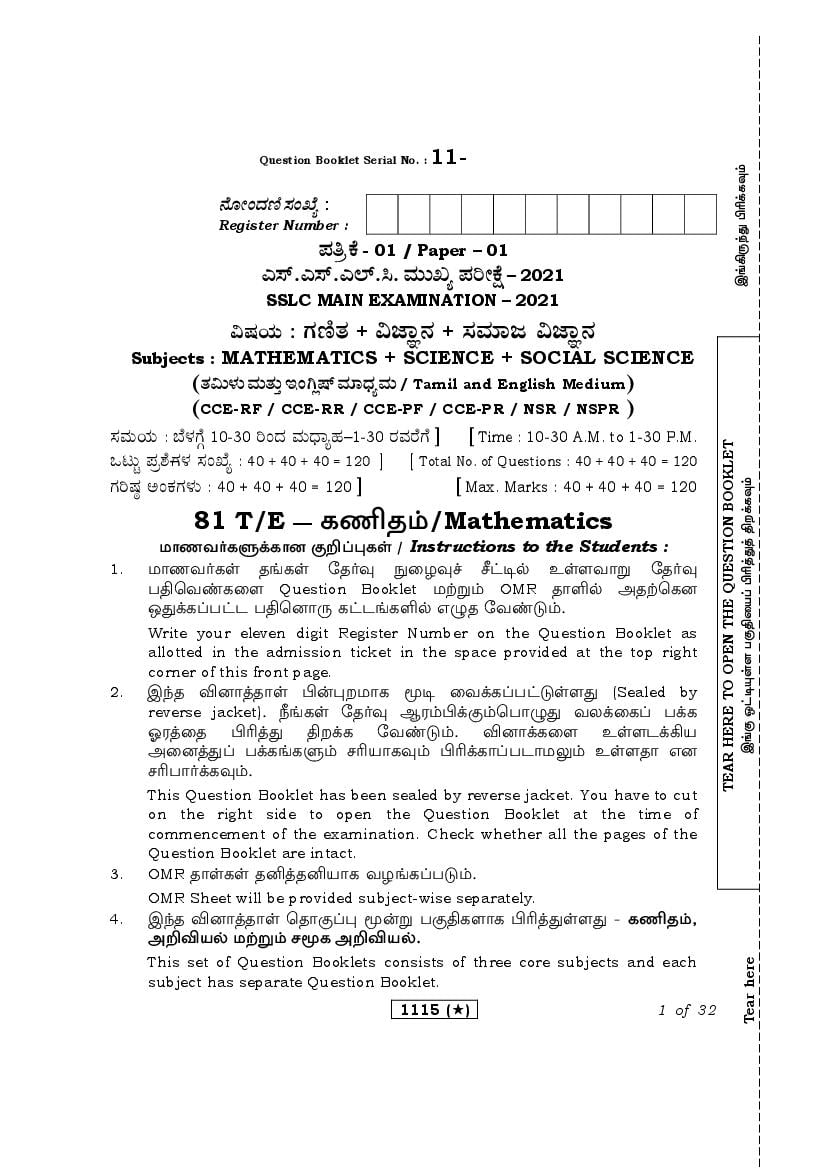
Ce°⁄k’ ©¨dL‹m
®æãàí¨Ü~ ÓÜíTæ :
Register Number :
±Ü£ÅPæ - 01 / Paper – 01
GÓ….GÓ….GÇ….Ô. ÊÜááS ±ÜÄàûæ – 2021
SSLC MAIN EXAMINATION – 2021
…Œ⁄æ⁄fl : V⁄{}⁄ + …e¤k´⁄ + —⁄»⁄·¤d …e¤k´⁄
Subjects : MATHEMATICS + SCIENCE + SOCIAL SCIENCE
(ñÜËáÙÜá ÊÜáñÜᤠCíXÉÐ… ÊÜÞ«ÜÂÊÜá / Tamil and English Medium)
(CCE-RF / CCE-RR / CCE-PF / CCE-PR / NSR / NSPR )
—⁄»⁄flæ⁄fl : ∑Ê◊⁄VÊX 10-30 ¬M•⁄ »⁄fl®¤¿‘⁄-1-30 ¡⁄»⁄¡ÊVÊ ] [ Time : 10-30 A.M. to 1-30 P.M.
TEAR HERE TO OPEN THE QUESTION BOOKLET
Jlflo Æ⁄√ÀÊ-V⁄◊⁄ —⁄MSÊ¿ : 40 + 40 + 40 = 120 ] [ Total No. of Questions : 40 + 40 + 40 = 120
Ceœ Jh•Ÿs[ Tœß˚Vl ©¨j’j ß\dL‹m
V⁄¬Œ⁄r @MO⁄V⁄◊⁄fl : 40 + 40 + 40 = 120 ] [ Max. Marks : 40 + 40 + 40 = 120
81 T/E — Pou®/Mathematics
©õnÁºPÐUPõÚ SÔ¨¦PÒ / Instructions to the Students :
1. ©õnÁºPÒ u[PÒ ÷uºÄ ~øÇÄa ^miÀ EÒÍÁõÖ ÷uºÄ
£vöÁsPøÍ Question Booklet ©ØÖ® OMR uõÎÀ AuØöPÚ
JxUP¨£mh £vöÚõ¸ Pmh[PÎÀ GÊu ÷Ásk®.
Write your eleven digit Register Number on the Question Booklet as
allotted in the admission ticket in the space provided at the top right
corner of this front page.
2. C¢u ÂÚõzuõÒ ¤ß¦Ó©õP ‰i øÁUP¨£mkÒÍx (Sealed by
reverse jacket). }[PÒ ÷uºÄ Bµ®¤US®ö£õÊx Á»UøP¨ £UP
Kµzøu ¤›zx vÓUP ÷Ásk®. ÂÚõUPøÍ EÒÍhUQ¯
AøÚzx¨ £UP[PЮ \›¯õPÄ® ¤›UPõ¨£hõ©¾® EÒÍuõ GÚ
\›£õºUPÄ®.
This Question Booklet has been sealed by reverse jacket. You have to cut
on the right side to open the Question Booklet at the time of
commencement of the examination. Check whether all the pages of the
Question Booklet are intact.
3. OMR uõÒPÒ uÛzuÛ¯õP ÁÇ[P¨£k®.
OMR Sheet will be provided subject-wise separately.
4. C¢u ÂÚõzuõÒ öuõS¨¦ ‰ßÖ £SvPÍõP ¤›zxÒÍx & Pou®,
AÔ¯À ©ØÖ® \‰P AÔ¯À.
Tear here
This set of Question Booklets consists of three core subjects and each
subject has separate Question Booklet.
1115 ( ) 1 of 32
Page 2
120 ÂÚõUPÒ EÒÍÚ.
(i) Pou® & ÂÚõ GsPÒ 1 to 40
(ii) AÔ¯À & ÂÚõ GsPÒ 41 to 80
(iii) \‰P AÔ¯À & ÂÚõ GsPÒ 81 to 120
40 questions are provided against each subject. This set of Question
Booklets contains 120 questions in all.
(i) Mathematics – Question Numbers 1 to 40
(ii) Science – Question Numbers 41 to 80
(iii) Social Science – Question Numbers 81 to 120
6. JÆöÁõ¸ ÂÚõÂØS® J¸ ©v¨ö£s ÁÇ[P¨£k®. AøÚzx
ÂÚõÂØS® Pmhõ¯©õP Âøh¯ÎUP ÷Ásk®. JÆöÁõ¸ \›¯õÚ
ÂÚõÂØS® J¸ ©v¨ö£s ÁÇ[P¨£k®. uÁÓõÚ ÂøhPÐUS
(negative marks) Gvº©øÓ ©v¨ö£sPÒ CÀø».
Each question carries one mark. Answering all the questions is
compulsory and each correct answer will be awarded one mark. There
will be no negative marking for wrong answers.
7. ÷uºÂß ÷£õx PÁÛUP ÷Ási¯øÁ
a) ÂÚõzuõøÍ PÁÚ©õP¨ £izx¨ £õºUPÄ®.
b) Ámhzøu •Êø©¯õP {µ¨£, P¸¨¦ AÀ»x }» Ásn ø©
Eøh¯ GÊx÷Põø»¨ £¯ß£kzu»õ®. OMR uõÎÀ Ámhzøu
{µ¨¦® ÷£õx, PÁÚ©õP {µ¨£ ÷Ásk®. {µ¨¤¯ ¤ßÚº
Aøu ©õØÓ÷Áõ, \› ö\´Á÷uõ, ÷ÁÖ QÖUPÀP÷Íõ Ch®
ö£ÖuÀ Thõx.
GkzxUPõmk : 20 B® ÂÚõÂØPõÚ \›¯õÚ Âøh Auß
Á›ø\°À EÒÍ A, B, C, D CÀ C GߣuõP C¸¨¤ß,
öPõkUP¨£mkÒÍ |õßS Ámh[PÎÀ C GßÓ GÊzx EÒÍ
Ámhzøu }»® AÀ»x P¸¨¦ {Ó ø© öPõsh GÊx÷Põ»õÀ
{ǼhÄ® ÷Ásk®.
ÂÚõ Gs : 20) A B C D (Cx GkzxUPõmk ©mk÷©)
c) OMR uõÒPøÍ ©hUP÷Áõ, ÷\u® ÂøÍÂUP÷Áõ Thõx.
AÆÁõÖ ÷\u® ÂøÍÂzx ©v¨ö£sPÒ SøÓ¢uõÀ AuØS
©õnÁºPÒ uõß ö£õÖ¨÷£ØP ÷Ásk®.
1115 ( ) 2 of 32
Page 3
a) Read the questions carefully.
b) Completely darken / shade the relevant circle against Question
Number in the OMR Sheet using blue / black ball point pen. Do not
try to alter the entry and not to do any stray marks on OMR Sheet.
Example : In the question booklet, if C is the correct answer for
Question No. 20, then in the OMR Sheet shade the option C using
blue / black ball point pen as follows.
Question No. 20) A B C D ( This is an example only )
c) Do not fold, tear, wrinkle or staple on the OMR Sheet.
8. J¸ ÂÚõÂØS, JßÔØUS® ÷©Ø¨£mh (circle) Ámh[PøÍ
{µ¨¤ÚõÀ, A¢u Âøh uÁÓõÚuõP P¸v AuØS ©v¨ö£s
öPõkUP¨£hõx/ÁÇ[P¨£hõx.
If more than one circle is shaded for a given question, such answer is
treated as wrong and no marks will be given.
9. ©õnÁºPЮ, Aøu PsPõo¨£õ͸® OMR uõÎÀ AuØöPÚ
JxUP¨£mh Ch[PÎÀ øPö¯õ¨£® Ch÷Ásk®.
Student and Room Invigilator should sign in the OMR Sheet in the space
provided.
1115 ( ) 3 of 32
Page 4
ÂøhzuõÒPøÍ (subject-wise) £SvÁõ›¯õP \›£õºzx
÷uºÁõÍ›h® J¨£øhUP ÷Ásk®.
Candidate should return the subject-wise answered OMR Sheet to the
Room Invigilator before leaving the examination hall.
11. ÷uºÂß ÷£õx ©õnÁºPÒ u[PÐøh¯ (Rough work) ÷ÁÖ
SÔ¨¦PøÍ ÂÚõzuõÎß Pøh] £UPzvÀ AuØöPÚ JxUP¨£mh
ChzvÀ ©mk÷© GÊv¨ £õºUP ÷Ásk®.
Rough work can be done in the space provided at the end of the Question
Booklet.
12. ©õnÁºPÒ PõÀS÷»mhº, øP÷£], ì©õºm PiPõµ® ©ØÖ® CßÚ
¤Ó ªßÚÝ E£Pµn[PøÍ ÷uºÂß ö£õÊx EÒ÷Í Gkzx ö\À»
AÝ©v°Àø».
Calculators, Mobiles, Smart Watches and any other electronic equipment
are not allowed inside the examination hall.
1115 ( ) 4 of 32
Page 5
Subject : MATHEMATICS
RÌU Põq® ÂÚõUPÒ/•ØÖ¨ ö£Óõu öuõhºPÐUPõÚ |õßS
ÂøhPÐÒ \›¯õÚ ÂøhUPõÚ SÔ±møhz ÷uº¢öukzx
öPõkUP¨£mkÒÍ OMR uõÎÀ P¸¨¦ AÀ»x }» Ásn ø©
öPõsh GÊx ÷Põ»õÀ SÔ¨¤mh Ámhzøu {µ¨¦P : 40 × 1 = 40
Four choices are given for each of the following questions / incomplete
statements. Choose the correct answer among them and shade the correct
option in the OMR Answer Sheet given to you with a black / blue ball point
pen. 40 × 1 = 40
1. J¸ Tmkzöuõhº Á›ø\°ß n Áx EÖ¨¦ an = 4n + 5 GÚ öPõsk
Azöuõh›ß 5Áx EÖ¨¦
(A) 20 (B) 14
(C) 25 (D) 24
The nth term of an Arithmetic Progression is an = 4n + 5. Then its 5th
term is
(A) 20 (B) 14
(C) 25 (D) 24
2. 5 x 2 = 2 ( 2x + 3 ) GßÓ C¸£ia \©ß£õmøh ö£õx ÁiÁzvÀ GÊx®
÷£õx AÀ»x ÂÁ›US® ÷£õx QøhUS® uÛ EÖ¨¦ AÀ»x
{ø»¯õÚ (constant term) EÖ¨¦
(A) 5 (B) 6
(C) 4 (D) –6
When the quadratic equation 5 x 2 = 2 ( 2x + 3 ) is expressed in the
standard form, the constant term obtained is
(A) 5 (B) 6
(C) 4 (D) –6
1115 ( ) 5 of 32
Page 6
T/E ( RF/RR/PF/PR/NSR/NSPR
RF/RR/PF/PR/ )
3. x – 2y = 0 ©ØÖ® 3x
3 + 4y – 20 = 0 GߣøÁPÍõP C¸¨£x
(A) öÁmkU ÷PõkPÒ
(B) Jß÷Óõh JßÖ ö£õ¸¢x® ÷PõkPÒ
(C) Cøn¯õÚ ÷PõkPÒ
(D) JßÖUöPõßÖ ö\[SzuõÚ
ö ÷PõkPÒ
x – 2y = 0 and 3x + 4y
4 – 20 = 0 are
(A) Intersecting lines (B) Coincident lines
(C) Parallel lines (D) Perpendicular lines
4. Áøµ£hzvÀ Põmh¨£mhx ÷£õ» C¸UPUTi¯ ÷PõkPøÍ öPõsk
EÒÍ \©ß£õkPÒ
©ß£õkPÒ
(A) x + y = 1 ©ØÖ® 2x – y = 1
(B) 2x + y = 2 ©ØÖ® x + y = 2
(C) 2x – y = 2 ©ØÖ® 4x – y = 4
(D) y – x = 0 ©ØÖ® x – y = 1
1115 ( ) 6 of 32
Page 7
T/E ( RF/RR/PF/PR/NSR/NSPR
RF/RR/PF/PR/ )
The pair of equations of lines as shown in the graph are
(A) x + y = 1 and 2x
2 –y=1
(B) 2x + y = 2 and x + y = 2
(C) 2x – y = 2 and 4x
4 –y=4
(D) y – x = 0 and x – y = 1
5. a1x + b1y + c1 = 0 ©ØÖ® a 2 x + b 2y + c 2 = 0 GßÓ Cµsk ©õÔPøÍU
öPõskÒÍ J¸ ÷\õi
÷ J¸£ia \©ß£õkPÒ
©ß£õkPÒ Cøn¯õÚ ÷PõkPÍõP
C¸UQÓx GÛÀ AuØPõÚ \›¯õÚ
›¯õÚ J¨¤mk ÂQu öuõhº¨¦
a1 b1 c1 a1 b1 c1
(A) = ≠ (B) = =
a2 b2 c2 a2 b2 c2
a1 b1 a1 b1
(C) ≠ (D) =
a2 b2 b2 a2
1115 ( ) 7 of 32
Page 8
a 2 x + b2y + c 2 = 0 are parallel lines then the correct relation of their
coefficients is
a1 b1 c1 a1 b1 c1
(A) = ≠ (B) = =
a2 b2 c2 a2 b2 c2
a1 b1 a1 b1
(C) ≠ (D) =
a2 b2 b2 a2
6. 2x + 3y + 7 = 0 ©ØÖ® ax + by + 14 = 0 GßÓ ÷PõkPÎß ÷\õi¯õÚx
Jß÷Óõh JßÖ ö£õ¸¢xQÓx GÛÀ ‘a’ ©ØÖ® ‘b’ US \©©õÚ
©v¨¦PÒ •øÓ÷¯
(A) 2 ©ØÖ® 3 (B) 3 ©ØÖ® 2
(C) 4 ©ØÖ® 6 (D) 1 ©ØÖ® 2
If the pair of lines 2x + 3y + 7 = 0 and ax + by + 14 = 0 are coincident
lines then the values of ‘a’ and ‘b’ are respectively equal to
(A) 2 and 3 (B) 3 and 2
(C) 4 and 6 (D) 1 and 2
7. ¤ß Á¸£øÁPÎÀ Gx Tmkzöuõhº Á›ø\°À EÒÍx ?
(A) 1, – 1, – 2, ..........
(B) 1, 5, 9, ..............
(C) 2, – 2, 2, – 2, ............
(D) 1, 2, 4, 8, ..........
1115 ( ) 8 of 32
Page 9
(A) 1, – 1, – 2, ..........
(B) 1, 5, 9, ..............
(C) 2, – 2, 2, – 2, ............
(D) 1, 2, 4, 8, ..........
8. – 3, – 1, 1, 3, ....... GßÓ Tmköuõhº Á›ø\°À 11Áx EÖ¨¦
(A) 23 (B) – 23
(C) – 17 (D) 17
The 11th term of the Arithmetic Progression – 3, – 1, 1, 3, ....... is
(A) 23 (B) – 23
(C) – 17 (D) 17
9. J¸ Tmkzöuõhº Á›ø\°À •uÀ 10 EÖ¨¦PÎß TkuÀ 155 BS®
©ØÖ® A÷u Tmkzöuõh›À •uÀ 9 EÖ¨¦PÎß TkuÀ 126 GÛÀ
A¢u öuõh›À 10Áx EÖ¨¦
(A) 27 (B) 126
(C) 29 (D) 25
The sum of the first 10 terms of an Arithmetic Progression is 155 and the
sum of the first 9 terms of the same progression is 126 then the 10th term
of the progression is
(A) 27 (B) 126
(C) 29 (D) 25
1115 ( ) 9 of 32
Page 10
©v¨¦
7
(A) 7 (B)
2
7
(C) –7 (D) −
2
If one root of the equation 2 x 2 + ax + 6 = 0 is 2, then the value of ‘a’ is
7
(A) 7 (B)
2
7
(C) –7 (D) −
2
11. px 2 + qx + r = 0 GßÓ C¸£ia \©ß£õmiß ¤›¨¦ Gs (discriminant)
BP C¸¨£x
(A) q 2 − 4 pr (B) q 2 + 4 pr
2
(C) p − 4 pr (D) p 2 + 4qr
The discriminant of the Quadratic equation px 2 + qx + r = 0 is
(A) q 2 − 4 pr (B) q 2 + 4 pr
2
(C) p − 4 pr (D) p 2 + 4qr
12. 4, x, 10 Gß£Ú J¸ Tmkzöuõhº Á›ø\°À EÒÍöuÛÀ x Cß
©v¨¦
(A) 14 (B) –6
(C) –7 (D) 7
If 4, x, 10 are in Arithmetic Progression the value of x is
(A) 14 (B) –6
(C) –7 (D) 7
1115 ( ) 10 of 32
Page 11
−b ± b 2 − 4ac
(A) x =
2a
−b ± b 2 + 4ac
(B) x =
2a
−b − b 2 − 4c
(C) x =
2a
−b + b 2 − 4ac
(D) x =
2a
The roots of the quadratic equation ax 2 + bx + c = 0 are
−b ± b 2 − 4ac
(A) x =
2a
−b ± b 2 + 4ac
(B) x =
2a
−b − b 2 − 4c
(C) x =
2a
−b + b 2 − 4ac
(D) x =
2a
14. (x – 3) (x + 2) = 0 GßÓ \©ß£õmiß ‰»[PÒ
(A) – 3, 2 (B) 3, – 2
(C) – 3, – 2 (D) 3, 2
The roots of the equation ( x – 3 ) ( x + 2 ) = 0 are
(A) – 3, 2 (B) 3, – 2
(C) – 3, – 2 (D) 3, 2
1115 ( ) 11 of 32
Page 12
A¢u •ÊUPÒ
(A) 7 ©ØÖ® 20 (B) 13 ©ØÖ® 14
(C) 1 ©ØÖ® 26 (D) – 13 ©ØÖ® – 14
If the sum of two consecutive integers is 27, then the integers are
(A) 7 and 20 (B) 13 and 14
(C) 1 and 26 (D) – 13 and – 14
16. £hzvÀ sin θ Âß ©v¨¦
1 3
(A) (B)
2 2
2
(C) 3 (D)
3
In the figure, the value of sin θ is
1 3
(A) (B)
2 2
2
(C) 3 (D)
3
1115 ( ) 12 of 32
Page 13
(A) 1 (B) –1
(C) 2 (D) 0
The value of ( sin 30° + cos 60° – tan 45° ) is
(A) 1 (B) –1
(C) 2 (D) 0
18. 3 + sec 2 θ US \©®
(A) 4 + tan 2 θ (B) 4 + cot 2 θ
(C) 2 + cot 2 θ (D) 3 + cot 2 θ
3 + sec 2 θ is equal to
(A) 4 + tan 2 θ (B) 4 + cot 2 θ
(C) 2 + cot 2 θ (D) 3 + cot 2 θ
19. J¸ ÷Põ¦µzvß Ai¨£Sv°¼¸¢x 30 «. yµzvÀ uøµ©mhzvÀ
EÒÍ J¸ ¦Òΰ¼¸¢x, ÷Põ¦µzvß Ea]°ß HØÓU÷Põn® 30°
BP EÒÍx. A¨£i¯õÚõÀ ÷Põ¦µzvß E¯µ®
(A) 10 «. (B) 30 «.
(C) 10 3 «. (D) 30 3 «.
The angle of elevation of the top of a tower from a point on the ground,
which is 30 metres away from the foot of the tower, is 30°. Then the height
of the tower is
(A) 10 m (B) 30 m
(C) 10 3 m (D) 30 3 m
1115 ( ) 13 of 32
Page 14
(A) 2 (B) 1
1 3
(C) – (D)
2 2
The value of ( sin θ × cosec θ ) is
(A) 2 (B) 1
1 3
(C) – (D)
2 2
21. A ( x1 , y1 ) ©ØÖ® B ( x 2 , y2 ) GßÓ ¦ÒÎPøÍ CønUS®
÷Põmkzxsiß ø©¯¨¦ÒÎø¯ Psk¤iUS® `zvµ®
x 2 + x1 y 2 + y1 x 2 − x1 y 2 − y1
(A) , (B) ,
2 2 2 2
x 2 + y2 x1 + y1 x 2 + x1 y 2 + y1
(C) , (D) ,
3 3 3 3
The formula to find the mid-point of the line segment joining the points
A ( x1 , y1 ) and B ( x 2 , y 2 ) is
x 2 + x1 y 2 + y1 x 2 − x1 y 2 − y1
(A) , (B) ,
2 2 2 2
x 2 + y2 x1 + y1 x 2 + x1 y 2 + y1
(C) , (D) ,
3 3 3 3
1115 ( ) 14 of 32
Page 15
(A) ( x1 − x 2 )2 + ( y1 − y 2 )2 (B) ( x 2 − x1 )2 − ( y 2 − y1 )2
(C) ( x1 + x 2 )2 − ( y1 + y 2 )2 (D) ( x 2 + x1 )2 + ( y 2 + y1 )2
The distance between the points ( x1 , y1 ) and ( x 2 , y 2 ) is
(A) ( x1 − x 2 )2 + ( y1 − y 2 )2 (B) ( x 2 − x1 )2 − ( y 2 − y1 )2
(C) ( x1 + x 2 )2 − ( y1 + y 2 )2 (D) ( x 2 + x1 )2 + ( y 2 + y1 )2
23. Põn¨£mh uµÄ ©v¨¦PÎÀ v¸®£v¸®£ ªP AvP •øÓ°À
Á¸QßÓ ©v¨¦US
(A) \µõ\› (Mean) (B) •Pk (Mode)
(C) Cøh{ø» (Median) (D) Ãa_ (Range)
The value among the observations of most repeated scores of the data is
(A) the mean (B) the mode
(C) the median (D) the range
24. ¤ßÁ¸® ©v¨¦PÐUS \µõ\›
©v¨¦PÒ 1 3 5 7
(A) 16 (B) 5
(C) 1.6 (D) 4
The Mean of the following scores is
Marks 1 3 5 7
(A) 16 (B) 5
(C) 1.6 (D) 4
1115 ( ) 15 of 32
Page 16
CøÁUPÐUPõÚ öuõhº¦
(A) 3 Cøh{ø»¯ÍÄ = 2 \µõ\› + •Pk
(B) 3 \µõ\› = 2 Cøh{ø»¯ÍÄ + •Pk
(C) \µõ\› = 3 Cøh{ø»¯ÍÄ + •Pk
(D) •Pk = 3 \µõ\› + 2 Cøh{ø»¯ÍÄ
The relation among the Mean, Mode and Median is
(A) 3 Median = 2 Mean + Mode (B) 3 Mean = 2 Median + Mode
(C) Mean = 3 Median + Mode (D) Mode = 3 Mean + 2 Median
26. Kº E¸øÍø¯ ö©ÊPõÀ (wax) ö\´¯¨£mkÒÍx. Aøu E¸UQ
•ÊÁx©õP J¸ ÷PõÍ©õP ©Ö Aa_ ö\´uõÀ Auß PÚ¯ÍÄ
(A) E¸øÍ°ß PÚ¯ÍÄ ÷£õ» 2 ©h[SPÒ
(B) E¸øÍ°ß PÚ¯ÍÂÀ £õv
(C) E¸øÍ°ß PÚ¯ÍÄ ÷£õ» 3 ©h[SPÒ
(D) E¸øÍ°ß PÚ¯ÍÄUS \©®
A cylinder made of wax is melted and recast completly into a sphere. Then
the volume of the sphere is
(A) two times the volume of the cylinder
(B) half the volume of the cylinder
(C) 3 times the volume of the cylinder
(D) equal to the volume of the cylinder
1115 ( ) 16 of 32
Page 17
`zvµ®
¤ ›Âß ÷© À GÀø» − ¤ ›Âß RÌ GÀø»
(A)
2
¤ ›Âß ÷© À GÀø» × ¤ ›Âß RÌ GÀø»
(B)
3
¤ ›Âß ÷© À GÀø» + ¤ ›Âß RÌ GÀø»
(C)
2
¤ ›Âß ÷© À GÀø» + ¤ ›Âß RÌ GÀø»
(D)
3
The formula to find the mid-point of the class interval is
Upper limit − lower limit
(A)
2
Upper limit × lower limit
(B)
3
Upper limit + lower limit
(C)
2
Upper limit + lower limit
(D)
3
28. ∆ ABC CÀ XY || BC GÛÀ
AX AC
(A) =
AB AY
AX AY
(B) =
BX CY
AX XY
(C) =
BX AY
AB AC
(D) =
BX AY
1115 ( ) 17 of 32
Page 18
AX AC AX AY
(A) = (B) =
AB AY BX CY
AX XY AB AC
(C) = (D) =
BX AY BX AY
29. öPõkzxÒÍ Cµsk •U÷Põn[PøÍ PÁÛUPÄ® ©ØÖ® ¤ßÁ¸®
AÍÄPÎÀ DF Cß }Ízøu PshÔP :
(A) 6 2 ö\.«. (B) 3 2 ö\.«.
(C) 4.2 ö\.«. (D) 8.4 ö\.«.
Observe the given two triangles and then identify the length of DF in the
following :
(A) 6 2 cm (B) 3 2 cm
(C) 4.2 cm (D) 8.4 cm
1115 ( ) 18 of 32
Page 19
∆ PQR Cß £µ¨£ÍÄ = 100 ö\.«. 2 , AB = 8 ö\.«. GÛÀ PQ Cß }Í®
(A) 12 ö\.«. (B) 15 ö\.«.
(C) 10 ö\.«. (D) 8 ö\.«.
∆ ABC ~ ∆ PQR. Area of ∆ ABC = 64 cm 2 and the area of ∆ PQR = 100 cm 2 .
If AB = 8 cm then the length of PQ is
(A) 12 cm (B) 15 cm
(C) 10 cm (D) 8 cm
31. ∆ ABC CÀ B = 90° ©ØÖ® BD ⊥ AC. AB = 6 ö\.«., BC = 8 ö\.«.
GÛÀ CD Cß }Í®
(A) 10 ö\.«. (B) 6.4 ö\.«.
(C) 4.8 ö\.«. (D) 3.6 ö\.«.
1115 ( ) 19 of 32
Page 20
the length of CD is
(A) 10 cm (B) 6.4 cm
(C) 4.8 cm (D) 3.6 cm
32. öPõkzxÒÍ £mzvÀ "O' øÁ ø©¯©õP EÒÍ J¸ ÁmhzvØS AT J¸
öuõk÷Põk. OT = 4 ö\.«. ¦ÒÎ "A'°À AT öuõk÷Põk
Áøµ¯¨£mkÒÍx. OTA = 30° GÛÀ AT °ß }Í®
(A) 4 ö\.«. (B) 2 ö\.«.
(C) 2 3 ö\.«. (D) 4 3 ö\.«.
1115 ( ) 20 of 32
Page 21
centre O such that OT = 4 cm. If ∠ OTA = 30° then AT is
(A) 4 cm (B) 2 cm
(C) 2 3 cm (D) 4 3 cm
33. öPõkzxÒÍ £hzvÀ "O' øÁ ø©¯©õP EÒÍ J¸ ÁmhzvØS PA,
PBC ©ØÖ® CD Gß£Ú öuõk÷PõkPÒ. PC = 8 ö\.«. ©ØÖ®
AP = 5 ö\.«. GÛÀ CD öuõk÷Põmiß }Í®
(A) 5 ö\.«. (B) 3 ö\.«.
(C) 8 ö\.«. (D) 13 ö\.«.
1115 ( ) 21 of 32
Page 22
centre O. If PC = 8 cm and AP = 5 cm, the length of the tangent CD is
(A) 5 cm (B) 3 cm
(C) 8 cm (D) 13 cm
34. ¤ß Á¸£øÁPÎÀ uÁÓõÚ TØÖ AÀ»x ÁõUQ¯® (wrong statement)
(A) J¸ öuõk÷Põk J¸ ÁmhzvØS \›¯õP J¸ ¦ÒΰÀ
öuõmkUöPõÒQÓx
(B) J¸ ÷|ºU÷Põk J¸ ÁmhzvØS Áøµ²® ÷£õx A¢u ÷Põk J¸
¦ÒÎ ÁȯõP £õ´¢x ö\À¾®
(C) ÁmhzvØS AuÝøh öuõk÷PõmhõÀ öuõk® ö£õxÁõÚ
¦ÒÎø¯ öuõk® ¦ÒÎ GßÓøÇUQ÷Óõ®
(D) H÷uÝ® J¸ ¦ÒΰÀ ÁmhzvØS Áøµ¯¨£k® öuõk÷Põk
BÚx BµzvØS ö\[SzuõP C¸QÓx
The wrong statement in the following is
(A) a tangent to a circle touches the circle exactly at one point
(B) when a straight line is drawn to a circle it always passes through a
point on the circle
(C) the point common to the circle and its tangent is called the point of
contact
(D) the tangent drawn at any point to a circle is perpendicular to the
radius drawn at the point of contact
1115 ( ) 22 of 32
Page 23
¦Òΰ¼¸¢x A¢u ÁmhzvØS Cµsk öuõk÷PõkPÒ Áøµ²®
÷£õx ¤ß£ØÓUTi¯ Akzu £i{ø» (next step) Gx?
(A)
(B)
(C)
(D)
1115 ( ) 23 of 32
Page 24
tangents to a circle from an external point ‘T ’, given in the figure ?
(A)
(B)
(C)
(D)
1115 ( ) 24 of 32
Page 25
Bµzvß AÍÄ
(A) 49 ö\.«. (B) 14 ö\.«.
(C) 21 ö\.«. (D) 7 ö\.«.
The surface area of a sphere is 616 sq.cm. Then the radius of the same
sphere is
(A) 49 cm (B) 14 cm
(C) 21 cm (D) 7 cm
37. £hzvÀ Põmi²ÒÍx ÷£õ» C¸US® J¸ T®¤ß PÚ¯ÍÄ
(A) πr 2 h (B) πr ( r + l )
1
(C) πr 2 h (D) πr l
3
The volume of a cone as shown in the figure is
(A) πr 2 h (B) πr ( r + l )
1
(C) πr 2 h (D) πr l
3
1115 ( ) 25 of 32
Page 26
÷|ºÁmh Kº E¸øÍ ÁiÁ P»Ûß (£õzvµ®) Bµ® r ö\.«. ©ØÖ®
Auß E¯µ® h ö\.«. GÛÀ A¢u P»Ûß ö©õzu ¦Ó£µ¨£ÍÄ
Psk¤iUS® `zvµ®
(A) ( π r 2 + 2πrh ) ö\.«. 2 (B) 2πrh ö\.«. 2
1
(C) π r 2h ö\.«. 3 (D) ( π r 2 + h ) ö\.«. 2
3
The formula to find the total surface area of a right circular based
cylindrical vessel of base radius r cm and height h cm opened at one end is
(A) ( π r 2 + 2πrh ) cm 2 (B) 2πrh cm 2
1
(C) π r 2h cm 3 (D) ( π r 2 + h ) cm 2
3
39. £hzvÀ Põmh¨£mhx ÷£õ¾ÒÍ J¸ T®¤ß CøhUPshzvß
ÁøÍÄ £µ¨£ÍÄ Psk¤iUS® `zvµ®
1 1
(A) π l ( r1 + r 2 ) (B) π h ( r12 + r2 2 + r1 r 2 )
3 3
(C) πl ( r1 + r2 ) (D) π l ( r1 − r2 )
1115 ( ) 26 of 32
Page 27
figure the formula used is
1 1
(A) π l ( r1 + r 2 ) (B) π h ( r12 + r2 2 + r1 r 2 )
3 3
(C) πl ( r1 + r2 ) (D) π l ( r1 − r2 )
40. J¸ vs© Aøµ ÷PõÍzvß ö©õzu ¦Ó¨£µ¨£ÍÄ 462 ö\.«.2.
AuÝøh ÁøÍÄ £µ¨£ÍÄ 308 ö\.«.2 GÛÀ A¢u Aøµ÷PõÍzvß
Ai¨£UP¨£µ¨£ÍÄ BP EÒÍøÁ
(A) 308 ö\.«. 2 (B) 231 ö\.«. 2
(C) 154 ö\.«. 2 (D) 1078 ö\.«. 2
The total surface area of solid hemisphere is 462 cm 2 . If the curved
surface area of it is 308 cm 2 , then the area of the base of the hemisphere
is
(A) 308 cm 2 (B) 231 cm 2
(C) 154 cm 2 (D) 1078 cm 2
1115 ( ) 27 of 32
Page 28
( SPACE FOR ROUGH WORK )
1115 ( ) 28 of 32
Page 29
( SPACE FOR ROUGH WORK )
1115 ( ) 29 of 32
Page 30
( SPACE FOR ROUGH WORK )
1115 ( ) 30 of 32
Page 31
( SPACE FOR ROUGH WORK )
1115 ( ) 31 of 32
Page 32
Document Details
| Board / Org | Karnataka Board |
| Exam | Class 10 |
| Type | Question Paper |
| Pages | 32 |
| Language | tamil |
| Updated | 22 Jul 2026 |