APTET Question Paper with Answers 17 Jun 2018 Paper 2 Maths and Science (Shift 1)
Finished viewing? Save it for later —
Download APTET Question Paper with Answers 17 Jun 2018 Paper 2 Maths and Science (Shift 1) (PDF · 66 pages)About APTET Question Paper with Answers 17 Jun 2018 Paper 2 Maths and Science (Shift 1)
APTET Question Paper with Answers 17 Jun 2018 Paper 2 Maths and Science (Shift 1) is available here for free download. Published by Andhra Pradesh Exams for Andhra Pradesh Teacher Eligibility Test, this question paper can be viewed online or downloaded as a PDF (66 pages). Candidates preparing for Andhra Pradesh Teacher Eligibility Test can use APTET Question Paper with Answers 17 Jun 2018 Paper 2 Maths and Science (Shift 1) to understand the exam pattern, the type of questions asked, and the overall difficulty level.
Frequently Asked Questions
How can I download APTET Question Paper with Answers 17 Jun 2018 Paper 2 Maths and Science (Shift 1)?
Open this page and click the Download button to save APTET Question Paper with Answers 17 Jun 2018 Paper 2 Maths and Science (Shift 1) as a PDF. It is completely free on AglaSem Docs.
Is APTET Question Paper with Answers 17 Jun 2018 Paper 2 Maths and Science (Shift 1) free to download?
Yes. APTET Question Paper with Answers 17 Jun 2018 Paper 2 Maths and Science (Shift 1) can be viewed online and downloaded as a PDF free of cost on AglaSem Docs.
How many pages does APTET Question Paper with Answers 17 Jun 2018 Paper 2 Maths and Science (Shift 1) have?
APTET Question Paper with Answers 17 Jun 2018 Paper 2 Maths and Science (Shift 1) contains 66 pages, which you can read online or download together as a single PDF.
Where can I find more Andhra Pradesh Teacher Eligibility Test study material?
You can find more Andhra Pradesh Teacher Eligibility Test question papers, sample papers, syllabus, and answer keys on AglaSem Docs.
APTET Question Paper with Answers 17 Jun 2018 Paper 2 Maths and Science (Shift 1) – Text
Read the full text of this question paper below — useful to quickly search, copy and reference the content online without downloading the PDF.
📄 View text version (57 pages)
Page 1
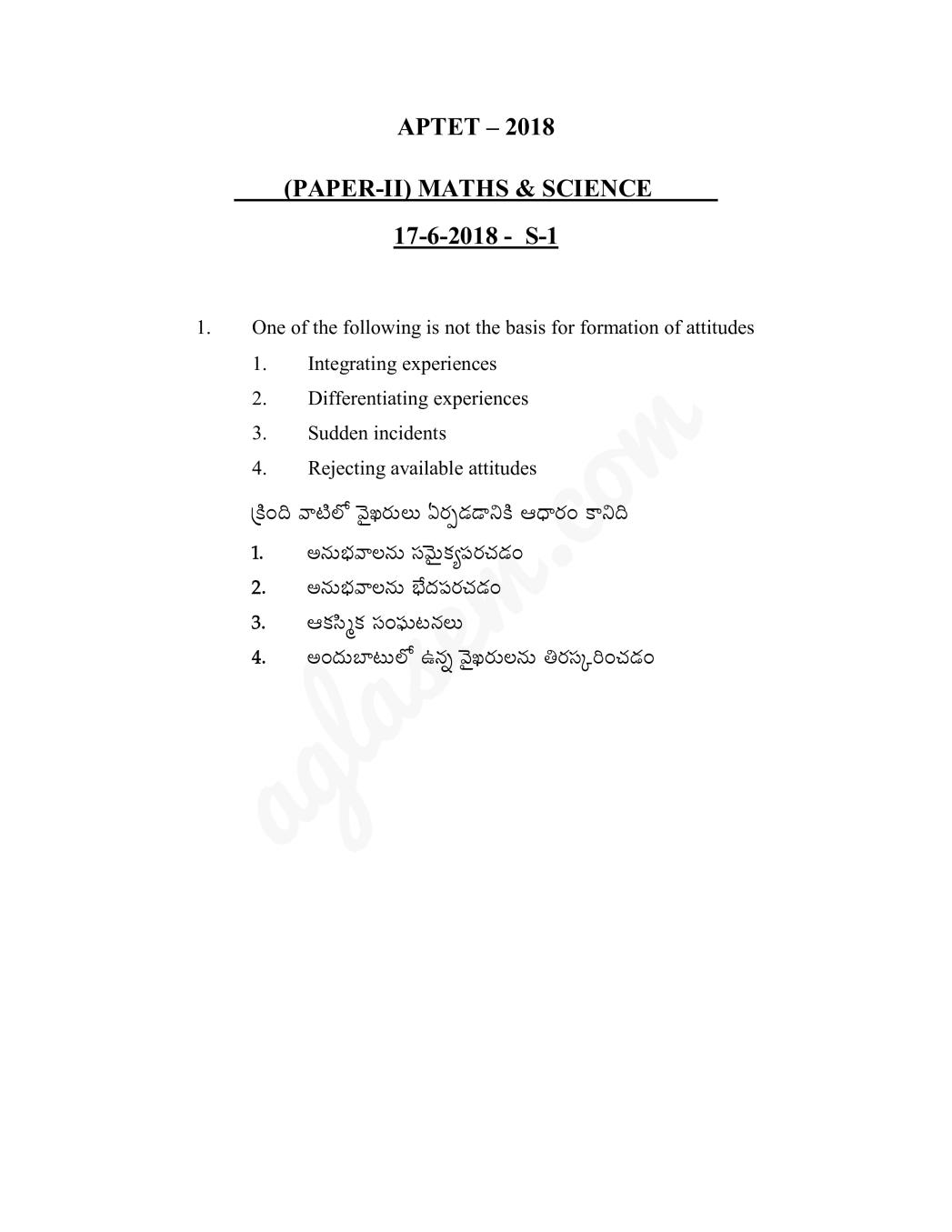
(PAPER-II) MATHS & SCIENCE
17-6-2018 - S-1
1. One of the following is not the basis for formation of attitudes
1. Integrating experiences
2. Differentiating experiences
3. Sudden incidents
4. Rejecting available attitudes
Page 2
‘Initiative Vs Guilt’ is present in the children of this age
group.
1. 1½ – 3 years
2. 6 – 12 years
3. 3 – 6 years
4. 12 – 20 years
Vs
1½ – 3
6 – 12
3–6
12 – 20
3. One of the following is not a social factor that influences
student’s learning
1. Self control of the student
2. Stress felt by the student
3. Social maturity of the student
4. Heredity of the student
Page 3
1. Persons with interpersonal intelligence
2. Persons with naturalistic intelligence
3. Persons with Bodily kinaesthetic intelligence
4. Persons with Intrapersonal intelligence
5. At this level of Kohlberg’s moral development, the morality
will be assessed in terms of physical punishment
1. Pre conventional morality
2. Post conventional morality
3. Conventional morality
4. Natural conventional morality
Page 4
great writer. The defense mechanism that applies here is
1. Identification
2. Displacement
3. Compensation
4. Regression
7. According to Golman ‘the skills Reliability, Adaptability,
Innovations’ come under this dimension of emotional
intelligence
1. Self awareness
2. Self motivation
3. Self regulation
4. Empathy
Page 5
phobia
1. Acrophobia
2. Monophobia
3. Claustrophobia
4. Haemotophobia
9. Objectivity is more in this method
1. Introspection
2. Experimental
3. Observation
4. Interview
Page 6
achievement’ the dependent variable is
1. Students achievement
2. Memory
3. Health
4. Home work
11. The psychologist who expressed that a child is born with
‘Language Acquisition Device’ - LAD
1. Bandura
2. Chomsky
3. Rogers
4. Vygotsky
LAD
Page 7
Personality is
1. Impatience
2. Despair
3. Social instability
4. Foresight
13. This statement is not true with regard to the class room
implications of Piaget’s cognitive development theory
1. Process is important rather than answers
2. Teaching the lesson basing on the readiness for
learning
3. Preparing the children to think like elders
4. Accepting the individual differences in progress and
development
Page 8
and the capacity of performance achieved with the
cooperation of more knowledgeable people is called as
1. Zone of Proximal development
2. Zone of distant development
3. Zone of middle development
4. Zone of Temporary development
15. As per Gilgord’s classification the people who learn easily
performing experiments and enacting are called
1. Bodily Kinesthetic learners
2. Auditory learners
3. Visual learners
4. Special learners
Page 9
implications of insight learning
1. Drilling should be encouraged
2. Construction of knowledge should be made in the
students
3. Motivate students towards learning
4. Importance should be given to whole aspect rather
than parts
17. A driver with a habit of driving vehicle with right side
steering was given a vehicle with left side steering suddenly.
The type of transfer of training in this case is
1. Negative
2. Positive
3. Zero
4. Bilateral
Page 10
stimulus in Pavlov’s experiment after extinction for a period
is called,
1. Extinction
2. Spontaneous recovery
3. Higher order conditioning
4. Discrimination
19. ‘Teaching machine’ is the result of this theory
1. Classical conditioning
2. Trail and Error learning
3. Operant conditioning
4. Insight learning
Page 11
learning
1. Retention, Attention, Performance, Reinforcement
2. Performance, Retention, Attention, Reinforcement
3. Attention, Performance, Retention, Reinforcement
4. Attention, Retention, Performance, Reinforcement
21. Reading the dramas of Shakespeare for the purpose of
examination is
1. Intrinsic Motivation
2. Extrinsic Motivation
3. Achievement Motivation
4. Artificial Motivation
Page 12
1. Concentration
2. Interference
3. Repression
4. Disuse
23. As per RTE Act - 2009 and Rules of Government of
Andhra Pradesh the Upper Primary school should exist in the
habitation within a radius of
1. 1 km.
2. 2 km.
3. 3 km.
4. 5 km.
RTE Act - 2009,
Page 13
1. Discussions
2. Distance learning
3. Resource based learning
4. Programmed learning
25. The counseling method which was constructed on the basis of
the presumption that the counselee has the capacity, reasoning
and the counselee needs only support from the counselor to
utilize them is
1. Directive
2. Non directive
3. Eclectic
4. Authoritative
Page 14
learning is
1. Structured inquiry
2. Confirmation inquiry
3. Guided inquiry
4. True inquiry
27. This is not the characteristic of collaborative learning class
room
1. Students work interdependently
2. Co-operation among the students is less
3. Personal responsibility and accountability exists in
students
4. Students solve the problems by working in groups
Page 15
takes place through
1. Regular teacher + Resource teacher
2. Regular teacher + Itinerant teacher
3. Regular teacher with specialized training
4. Teaching through distance programmes
29. According to Bruner this is not related to the sequential order
of methods for providing subject related learning content
1. Enactive method
2. Iconic method
3. Symbolic method
4. Insight method
Page 16
‘Teacher Centered classroom’
1. Evaluation is an independent process
2. Importance to results only
3. Activities are selected by students
4. Construction of knowledge takes place
Page 26
scrutiny.
Choose the meaning of the word, ‘scrutiny’ in the sentence
above.
1. Property acceptable as security for a loan.
2. Close and careful examination.
3. Quality of being stubborn.
4. A strong feeling in favour of others.
62. Tagore was a versatile person.
This sentence says that;
1. Tagore possessed many talents.
2. Tagore wrote poetry only.
3. Tagore could not write novels.
4. Tagore helped many people.
63. Choose the prefix that means ‘forward’.
1. bene -
2. pro -
3. mono -
4. intro -
Page 27
1. Jubilant
2. Favourite
3. Fabric
4. Choros
65. Identify the word with the same pronunciation as ‘some’.
1. Came
2. Sum
3. Come
4. Shame
66. He was a brilliant student right from the start.
Choose the antonym of the word ‘right.’
1. Wrong
2. Left
3. Inexactly
4. Stright
67. This old man brought up an orphan.
Choose the meaning of the phrasal verb “brought up.”
1. Raised
2. Praised
3. Rose
4. Arose
Page 28
The purpose of using ‘may’ in this sentence is;
1. to express purpose
2. to express permission
3. to express concession
4. to express doubt
69. This is …………….. universal truth.
Choose the correct word to fill the blank.
1. a
2. an
3. the
4. No article is needed.
70. Don’t throw stones …….. birds.
Choose the correct preposition that fits the blank.
1. on
2. at
3. to
4. with
Page 29
This sentence has;
1. a relative clause
2. a defining relative clause
3. a noun clause
4. a noun phrase in apposition
72. Don’t make a noise.
This sentence indicates;
1. a request
2. a wish
3. an order
4. a statement
73. He will be coming.
The correct question tag for this sentence is;
1. didn’t he ?
2. won’t he ?
3. doesn’t he ?
4. will he ?
Page 30
1. Don’t go there
2. Don’t you go there
3. Do what I say
4. I shall meet him
75. Ram says to Sita, “ I like Coffee.”
Choose the reported speech of the sentence above.
1. Ram asks Sita if she likes coffee.
2. Ram says that Sita likes coffee.
3. Ram said to Sita that she liked coffee.
4. Ram tells Sita that he likes coffee.
76. A lot of money …………… wasted.
Choose the correct form of verb to complete the sentence.
1. are
2. were
3. was
4. have
Page 31
Choose the correct tense form that fits the blank.
1. wrote
2. writes
3. was writing
4. was written
78. Choose the noun form from the following.
1. pavement
2. amazed
3. deserve
4. passed
79. Choose the linker that can be used to indicate sequence.
1. Yet
2. Secondly
3. On the other hand
4. All the same.
80. He signed the agreement. That was foolish.
The meaning of these two sentences can be conveyed as;
1. He foolishly signed the agreement.
2. The agreement was foolish to be signed.
3. He was fooled because of the agreement.
4. The agreement made him a fool.
Page 32
following.
1. When you saw the movie?
2. When do you saw the movie?
3. When did you see the movie?
4. When did you saw the movie?
82. I had about sixty rupees in my suitcase
This sentence can be ended with;
1. a full stop
2. a question mark
3. a comma
4. an exclamatory mark
83. Inverted commas are used;
1. to separate the clauses
2. to mark the exact words of a speaker
3. to avoid the repeation
4. to mark off the nominative of address
84. Choose the sentence in passive voice.
1. Fleming discovered penicillin.
2. Fleming was discover penicillin.
3. Penicillin was discovered by Fleming.
4. Penicillin was discover by Fleming.
Page 33
Choose the correct expression that fits the blank.
1. so great as
2. the greatest
3. the greater
4. as great as
86. I request you to attend my elder sister’s marriage on 7th of
next month along with your family.
The above information appears in;
1. a story about a marriage
2. a letter of invitation
3. a diary entry
4. an essay on marriages.
87. Choose the list of words in correct alphabetical order.
1. go, went, gone, going
2. going, gone, went, go
3. went, gone, going, go
4. go, going, gone, went
Page 34
Choose the synonym of the word ‘gloomy.’
1. dirty
2. muddy
3. bright
4. sad
89. Read the following passage and choose the correct
answer to the question.
Glenn Cunningham was a good runner. In races at school, he
ran faster than his friends. “I want to become the fastest
runner in the world,” Glenn told himself.
One day, there was a big fire at Glenn’s school. His
legs were burnt very badly. The doctors looked at his legs and
said that he would not be able to run again.
The determination of Glenn was;
1. to save the burning people.
2. to create fire at school.
3. to become the fastest runner in the world.
4. to burn people very badly.
Page 35
answer to the question.
Glenn Cunningham was a good runner. In races at school, he
ran faster than his friends. “I want to become the fastest
runner in the world,” Glenn told himself.
One day, there was a big fire at Glenn’s school. His
legs were burnt very badly. The doctors looked at his legs and
said that he would not be able to run again.
Glenn ran faster than his friends because;
1. he wanted to stand first.
2. he wanted to escape from the fire.
3. he wanted to meet the doctor.
4. he wanted to burn his legs.
Page 36
is equal to
A, B n(A) = 4 n(A B) = 7
n(B)
1. 4
2. 11
3. 3
4. 20
92. If 2log(x + 3) = log81 then the value of x.
2log(x + 3) = log81 x
1. 6
2. 5
3. 7
4. 8
1
93. If 2 = 1.414 then the value of is
2 2
1
2 = 1.414
2 2
1. 0.0352
2. 3.541
3. 0.3535
4. 0.2525
Page 37
then the other zero is :
2x2 + Kx – 15
15
1.
2
2. 5
5
3.
2
4. –1
95. a1x + b1y + c1 = 0; a2x + b2y + c2 = 0 are two straight lines.
a1 b1 c1
If , then the lines are
a2 b2 c2
1. Intersecting lines
2. Parallel lines
3. Coincident lines
4. Perpendicular lines
a1x + b1y + c1 = 0; a2x + b2y + c2 = 0
a1 b1 c1
a2 b2 c2
1.
2.
3.
4.
Page 38
is (in cm)
1. 57
2. 67
3. 35
4. 43
97. The numbers 10, 12, 14, x–3, x, x+2, 25 are in ascending
order. If the median is 15 then the value of x is
10, 12, 14, x–3, x, x+2, 25
x
1. 16
2. 15
3. 17
4. 18
98. If A = 4x2 + y2 – 6xy; B = 3y2 + 12x2 – 2xy
Then 2A + B is equal to
A = 4x2 + y2 – 6xy; B = 3y2 + 12x2 – 2xy
2A + B
1. 20x2 – 5y2 – 14xy
2. 20x2 + 5y2 – 14xy
3. 15x2 – 4y2 + 12xy
4. –15x2 + 4y2 + 2xy
Page 39
angle is (in degrees)
34o
1. 63
2. 53
3. 43
4. 73
100. If 125 5x+7 = 1 then the value of x is
125 5x+7 = 1 x
1. 10
2. –10
3. 7
4. –7
101. One of the exterior angles of a triangle is 125o and the interior
opposite angles are in the ratio 2 : 3 then one of the interior
angle is (in degrees)
125o
2:3
1. 38
2. 48
3. 50
4. 58
Page 40
102. If Tan = then 7 Sin2 + 3 Cos2 is equal to
3
1
Tan = 7 Sin2 + 3 Cos2
3
1. 1
2. 2
3. 3
4. 4
12
103. If Cos A = then the value of Sin A is
13
12
Cos A = Sin A
13
12
1.
13
5
2.
13
13
3.
5
5
4.
12
Page 41
number is
1
1.
6
1
2.
3
2
3.
5
1
4.
2
105. If (–1, 5) is the midpoint of the line joining the points (–4, a),
(2, 8) then the value of ‘a’ is
(–4, a), (2, 8) (–1, 5)
‘a’
1. 1
2. 2
3. 3
4. 4
Page 42
5 sq. units then the value of ‘t’ is
(t, 2t), (–2, 6), (3, 1)
‘t’
1
1.
2
1
2.
2
3. 2
4. –2
107. If three angles of a quadrilateral are 60o, 80o and 120o then the
fourth angle is (in degrees)
60o, 80o, 120o
1. 80
2. 90
3. 95
4. 100
Page 43
ratio is 2 then first term is
3
1.
2
1
2.
2
3. 2
4. 3
109. If the 17th term of an Arithmetic Progression exceeds its 10th
term by 7 then the common difference is
1. 4
2. 3
3. 1
4. 0
110. Discriminant of the quadratic equation 2x2 – 4x + 3 = 0 is
2x2 – 4x + 3 = 0
1. –8
2. 8
3. 0
4. 15
Page 44
12cm, 10cm respectively, then its total surface area is
(in cm2)
1. 700
2. 800
3. 900
4. 890
112. G.C.D of 72, 252 is 36 then their L.C.M is
72, 252
1.
2. 504
3. 325
4. 175
113. If the slope of the line joining the points (2, 5) and (x, 3) is 2
then the value of x is
(2, 5) (x, 3)
x
1. 3
2. 2
3. 1
4. –1
Page 45
121 cm2. If EF = 15.4 cm then BC is equal to (in cm)
ABC DEF
EF = 15.4
BC
1. 12.2
2. 11.2
3. 10.2
4. 4.5
Page 46
words
(A) Techne (B) Arsmathematica (C) Manthanein
1. A&B
2. B&C
3. C&A
4. A, B & C
“Mathematics”
(A) Techne (B) Arsmathematica (C) Manthanein
1. A B
2. B C
3. C A
4. A, B C
Page 47
1. Skill
2. Application
3. Understanding
4. Knowledge
1.
2.
3.
4.
117. The characteristic feature that belongs to “Synthetic Method”
is
1. Hypothesis to Conclusion
2. Specific to General
3. Concrete to Abstract
4. Example to Principle
1.
2.
3.
4.
Page 48
1. Presentation
2. Application
3. Association
4. Preparation
1.
2.
3.
4.
119. Following is the demerit of the oral work
1. Previous knowledge of the students can be tested
2. Correct the articulation errors of the students
3. It depends mostly on the memory of the students
4. Enhances speed and accuracy
1.
2.
3.
4.
Page 49
test item
“Write the decimal number 303.03 in expanded form”
1. Representation – Visualisation
2. Communication
3. Connection
4. Reasoning – Proof
1.
2.
3.
4.
Page 50
1. Bar magnet
2. Horse shoe magnet
3. Ring magnet
4. Load stone
122. In Celsius scale thermometer each division is equal to (in ºC)
ºC
1. 1
2. 0.1
3. 0.2
4. 10
Page 51
1. Earth, Mercury
2. Earth, Venus
3. Venus, Uranus
4. Uranus, Neptune
124. The situation that has only potential energy is
1. flying air craft
2. a rolling stone
3. stretched rubber band
4. flowing water
Page 52
critical angle of glass - air interface is (in degrees)
1. 0
2. 30
3. 45
4. 60
Joule
126. is equal to
Colomb
1. 1 Watt
2. 1 Volt
3. 1 Ampere
4. 1 Ohm
Page 53
1. Red
2. Pink
3. Yellow
4. Colourless
128. The chemical nature of a non-metallic oxide is
1. Acidic
2. Basic
3. Amphoteric
4. Neutral
Page 54
1. Carbon dioxide
2. Carbon monoxide
3. Hydrogen sulphide
4. Hydrogen
130. In galvanization, iron is coated with
1. Tin
2. Chromium
3. Nickel
4. Zinc
Page 55
1. Glass
2. Metals
3. Plastics
4. Wood
132. The mixture of water and diesel is an example for
1. Colloidal solution
2. True solution
3. Miscible mixture
4. Immiscible mixture
Page 56
1. Aphids
2. Honeybees
3. Soldier ants
4. Drones
134. The joint between the upper jaw and the rest of the head is
1. Hinge Joint
2. Fixed Joint
3. Pivot Joint
4. Ball and Socket Joint
Page 57
1. Tomato
2. Cauliflower
3. Pear
4. Sugarcane
1.
2.
3.
4.
136. The process of killing larvae inside a cocoon before silk
reeling is
1. Stuffing
2. Sealing
3. Stifling
4. Stalking
Page 58
by
1. Robert Hook
2. Robert Brown
3. Felice Fontana
4. Jan Swammerdam
138. ‘Helicobacter pylori’ is responsible for
1. Peptic ulcer
2. Jaundice
3. Uterine cancer
4. Hepatitis - D
1.
2.
3.
4. D
Page 59
1. Hydrolysis
2. Pyrolysis
3. Methanation
4. Eutrofication
140. ‘Lichens’ are the colonies of
1. Bacteria and Fungi
2. Algae and Fungi
3. Virus and Algae
4. Bacteria and Virus
Page 60
1. Fungiform papillae
2. Circumvallate papillae
3. Foliate papillae
4. Filiform papillae
142. Find the correct pair with reference to vitamins and their
chemical names
1. A – Ascorbic acid
2. D – Calciferol
3. B1 – Biotin
4. E – Phylloquinone
1. A–
2. D–
3. B1 –
4. E–
Page 61
1. Scopolamine
2. Reserpine
3. Pyrithroid
4. Caffine
144. Number of synergids, antipodals and egg cells in an
embryo sac of a flower in majority flowering plants
respectively are
1. 3, 2, 2
2. 2, 3, 1
3. 1, 2, 3
4. 4, 1, 2
Page 62
1. it is abstract
2. it takes long time to achieve
3. it is a long-term goal
4. it is measurable
Page 63
content to be specified to the local needs in the whole
curriculum is
147. John Dewy’s Pragramatism is the basis for the following
method
1. Discussion Method
2. Project Method
3. Lecture Demonstration Method
4. Lecture Method
Page 64
1. Flannel Board
2. Bulletin Board
3. Chart
4. Radio
149. In the laboratory dry sand is to be sprinkled on the flames
when fire accidents take place due to the following reason.
1. Electric flames
2. Liquids that catches fire easily
3. Commonly flammable substances
4. Flames from metals
Page 65
characteristic feature
1. Reliability
2. Comprehensiveness
3. Validity
4. Interpretability
Page 66
Paper-II(A)- Telugu Medium-Set-L (M&S) 17.06.2018 Morning Session
Q.Nos CDP Q.Nos Telugu Q.Nos English Q.Nos Maths Q.Nos Science
1 4 31 2 61 2 91 3 121 4
2 3 32 4 62 1 92 1 122 2
3 4 33 3 63 2 93 3 123 3
4 1 34 1 64 4 94 3 124 3
5 1 35 1 65 2 95 3 125 2
6 3 36 4 66 3 96 2 126 2
7 3 37 2 67 1 97 4 127 4
8 1 38 1 68 1 98 2 128 1
9 2 39 3 69 1 99 4 129 3
10 1 40 2 70 2 100 2 130 4
11 2 41 4 71 3 101 3 131 3
12 4 42 1 72 3 102 4 132 4
13 3 43 2 73 2 103 2 133 1
14 1 44 4 74 2 104 4 134 2
15 1 45 3 75 4 105 2 135 4
16 1 46 1 76 3 106 3 136 3
17 1 47 2 77 4 107 4 137 2
18 2 48 4 78 1 108 1 138 1
19 3 49 4 79 2 109 3 139 2
20 4 50 4 80 1 110 1 140 2
21 2 51 4 81 3 111 3 141 4
22 1 52 3 82 1 112 2 142 2
23 3 53 1 83 2 113 3 143 3
24 1 54 3 84 3 114 2 144 2
25 2 55 2 85 2 115 3 145 4
26 2 56 2 86 2 116 3 146 1
27 2 57 2 87 4 117 1 147 2
28 1 58 3 88 4 118 4 148 3
29 4 59 1 89 3 119 3 149 4
30 2 60 3 90 1 120 2 150 3
Document Details
| Board / Org | Andhra Pradesh Exams |
| Exam | Andhra Pradesh Teacher Eligibility Test |
| Type | Question Paper |
| Pages | 66 |
| Updated | 30 Apr 2026 |