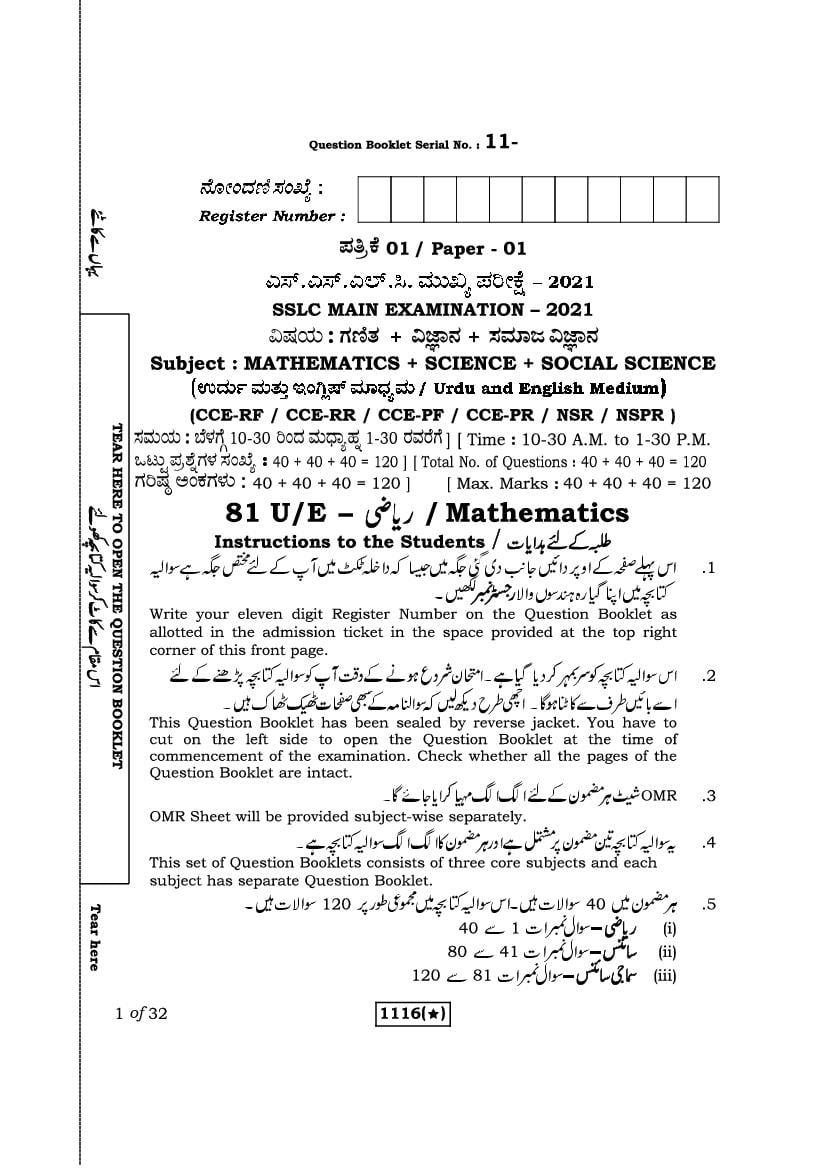
Karnataka SSLC Question Paper 2021 Maths for Urdu Medium
Finished viewing? Save it for later —
Download Karnataka SSLC Question Paper 2021 Maths for Urdu Medium (PDF · 32 pages)About Karnataka SSLC Question Paper 2021 Maths for Urdu Medium
Karnataka SSLC Question Paper 2021 Maths for Urdu Medium is available here for free download. Published by Karnataka Board for Class 10, this question paper can be viewed online or downloaded as a PDF (32 pages). Candidates preparing for Class 10 can use Karnataka SSLC Question Paper 2021 Maths for Urdu Medium to understand the exam pattern, the type of questions asked, and the overall difficulty level.
Frequently Asked Questions
How can I download Karnataka SSLC Question Paper 2021 Maths for Urdu Medium?
Open this page and click the Download button to save Karnataka SSLC Question Paper 2021 Maths for Urdu Medium as a PDF. It is completely free on AglaSem Docs.
Is Karnataka SSLC Question Paper 2021 Maths for Urdu Medium free to download?
Yes. Karnataka SSLC Question Paper 2021 Maths for Urdu Medium can be viewed online and downloaded as a PDF free of cost on AglaSem Docs.
How many pages does Karnataka SSLC Question Paper 2021 Maths for Urdu Medium have?
Karnataka SSLC Question Paper 2021 Maths for Urdu Medium contains 32 pages, which you can read online or download together as a single PDF.
Where can I find more Class 10 study material?
You can find more Class 10 question papers, sample papers, syllabus, and answer keys on AglaSem Docs.
Karnataka SSLC Question Paper 2021 Maths for Urdu Medium – Text
Read the full text of this question paper below — useful to quickly search, copy and reference the content online without downloading the PDF.
📄 View text version (32 pages)
Page 1
a »Ð V Œ
:
:
: :
: :
: :
èc g
nÅ^ ÂD ZΙ^ »Ð x£kZ
& ] c Z@ nƥ
D ZÎì ( –n Æ \ W~ ]¼ ZŠÀ 6~( ˆ~Š + Y N ZŠ 6 z Z Æ ™¬ kZ
X KZg Ñ Zz VÎy {g Š C Z ~^ Â
n Æ " 7 ^ ÂD ZÎÃ\ W‰zÆ ä ƒ qzÑy JZ Xì Š c Š™2uÃ^ ÂD ZÎkZ
X ÷u VÇ] ,XÆ) Ü ZÎÀBNŠ b§hZ X ǃ R »Ð s§N !Ð Z
X Çñ Y c Z™½µ Z µ Z nÆ y*CÅ
Xì^ ÂD Zε Zµ Z»y*Cgz Zì Œ6 y*&^ ÂD ZÎt
X ÷ ] Ñ ZÎ 6 gî¦ù~^ ÂD ZÎkZX ÷ ] Ñ ZÎ ~ y*C
Ð ] ZwZÎD èc g
Ð ] ZwZÎDb‚
Ð ] ZwZÎDb‚Y
Page 2
X σ7åg â tðÃ6 [ Z ßX Çñ Y
: y JZ È ZgzŠ
X B| 7 gNÃ] Ñ ZÎxÓ
z Z7 w! Y &{ (6 } ] ZŠÆ ~z )Šñ~ Å Ã[ Z {” [ NZÆ \ W
Åä ™çFˆ Æ ä ™„0 ¶Å[ Zg ! qZ 6 Å X , ™o b§hZ Ð à
X‰ N Î: y ¶~gz¢)6 Å gz Z, ™: ÒÃ
~ ÅÃ\ WÂì B W[ Z 9n Æ wZÎ~^ Â C Ñ ZÎÆ \ W¤Z : wV
oÐ à z Z7 w! Å8gY &{ („ 6 } ] ZŠÆ B W ‰ bŠÐ WÆ wZÎ
X ǃ *™
(ì wV¡) wZÎ
4H
5G
X , ™ÿF 5_:gz Z , hz%: Ô, h M: Ô, hñ: ~ ]gßÌËÃÅ
Page 3
kZgz Z Çñ Y HgYßÃ[ Z, Z Âñ Y H o6 Vz] ZŠ {Š c iÐ qZ n Æ [ ZÆ wZÎˤZ
X Ð N YØŠ7¾g â nÆ
X ǃ *™\ŠÃg »VZôgz Z D¨ ¤6 V»ˆÅ (nÆ ä ™\Š ~ Å
Page 4
43Xe ÃD¨ ¤¬ Ðå Ð { Çy JZ
X}Š
Y Y H w EZ n Æ x» ™Ã( à { {Š™ë Z ~ y WÆ ^  à ZÎ
Xì
5µ
3½ÓG
Xì qN* Yá ~ { Çy JZ ] Ñ W7 Z¼ZÆ nËgz Za Zz ^g Z Ôb! ñÔ{ ðG
Page 5
Subject : MATHEMATICS
$%& '% ( !"#
!2$8 230 45 % (676 OMR # , -./ 0 + )*
40 × 1 = 40
Four choices are given for each of the following questions / incomplete
statements. Choose the correct answer among them and shade the correct
option in the OMR Answer Sheet given to you with a black / blue ball
point pen. 40 × 1 = 40
> ? @ 5A BC an = 4n + 5> ? @n'9:;<= .1
14 (B) 20 (A)
24 (D) 25 (C)
The nth term of an Arithmetic Progression is an = 4n + 5. Then its 5th
term is
(A) 20 (B) 14
(C) 25 (D) 24
> R Q @ MN OP 6 JKL F GH I 5 x 2 = 2 ( 2x + 3 ) @D E @ 2.
SN(Constant term)
6 (B) 5 (A)
–6 (D) 4 (C)
When the quadratic equation 5 x 2 = 2 ( 2x + 3 ) is expressed in the
standard form, the constant term obtained is
(A) 5 (B) 6
(C) 4 (D) –6
5 of 32 1116( )
Page 6
U/E (RF/RR/PF/PR/NSR/NSPR)
TU ?B @D?V@ 3x + 4y – 20 = 0 @ x – 2y = 0 .3
"TUW @MNX (B) "TU`a (A)
"TUW @MN Y6Z[@ \ (D) "TUbc d (C)
x – 2y = 0 and 3x + 4y – 20 = 0 are
(A) Intersecting lines (B) Coincident lines
(C) Parallel lines (D) Perpendicular lines
f
Z] ?B @D^W @MN _, ki jheg lm .4
2x – y = 1 @ x + y = 1 (A)
x + y = 2 @ 2x + y = 2 (B)
4x – y = 4 @ 2x – y = 2 (C)
x–y=1 @ y–x=0 (D)
6 of 32 1116( )
Page 7
(A) x+y=1 and 2x – y = 1
(B) 2x + y = 2 and x + y = 2
(C) 2x – y = 2 and 4x – y = 4
(D) y–x=0 and x – y = 1
bc dj a 2x + b2y + c 2 = 0 @ a1x + b1y + c1 = 0 Z] ?B @D^r @s@ .5
f
n o pq k?@[b 9h ?uv B?Nt$ _ITU
a1 b1 c1 a1 b1 c1
= = (B) = ≠ (A)
a2 b2 c2 a2 b2 c2
a1 b a1 b1
= 1 (D) ≠ (C)
b2 a2 a2 b2
7 of 32 1116( )
Page 8
a 2 x + b2y + c 2 = 0 are parallel lines then the correct relation of their
coefficients is
a1 b1 c1 a1 b1 c1
(A) = ≠ (B) = =
a2 b2 c2 a2 b2 c2
a1 b1 a1 b
(C) ≠ (D) = 1
a2 b2 b2 a2
. ‘b’ @ ‘a’ B " x$ _ TU Xax + by + 14 = 0 @ 2x + 3y + 7 = 0 w @D .6
yz {
2 @ 3 (B) 3 @ 2 (A)
2 @ 1 (D) 6 @ 4 (C)
If the pair of lines 2x + 3y + 7 = 0 and ax + by + 14 = 0 are coincident
lines then the values of ‘a’ and ‘b’ are respectively equal to
(A) 2 and 3 (B) 3 and 2
(C) 4 and 6 (D) 1 and 2
C(A.P.)9:;< .7
1, – 1, – 2, .......... (A)
1, 5, 9, .............. (B)
2, – 2, 2, – 2, ............ (C)
1, 2, 4, 8, .......... (D)
8 of 32 1116( )
Page 9
(A) 1, – 1, – 2, ..........
(B) 1, 5, 9, ..............
(C) 2, – 2, 2, – 2, ............
(D) 1, 2, 4, 8, ..........
k> ? @ 11h > ? @) |' –3, –1, 1, 3, …… 9:;< .8
– 23 (B) 23 (A)
17 (D) – 17 (C)
The 11th term of the Arithmetic Progression – 3, – 1, 1, 3, ....... is
(A) 23 (B) – 23
(C) – 17 (D) 17
;<!C 126 •€ ' ' 9 } ~ @ 155 •€ ' ' 10 } ~ (A.P.) 9: ;< .9
SN> ? @10'9:
126 (B) 27 (A)
25 (D) 29 (C)
The sum of the first 10 terms of an Arithmetic Progression is 155 and the
sum of the first 9 terms of the same progression is 126 then the 10th term
of the progression is
(A) 27 (B) 126
(C) 29 (D) 25
9 of 32 1116( )
Page 10
• \ '2 x 2 + ax + 6 = 0 @DE @ .10
7
(B) 7 (A)
2
7
− (D) –7 (C)
2
If one root of the equation 2 x 2 + ax + 6 = 0 is 2, then the value of ‘a’
is
7
(A) 7 (B)
2
7
(C) –7 (D) −
2
SN(Discriminant)ƒ' px 2 + qx + r = 0 @DE @ .11
q 2 + 4 pr (B) q 2 − 4 pr (A)
p 2 + 4qr (D) p 2 − 4 pr (C)
The Discriminant of the quadratic equation px 2 + qx + r = 0 is
(A) q 2 − 4 pr (B) q 2 + 4 pr
(C) p 2 − 4 pr (D) p 2 + 4qr
„N{.x B?N (A.P.)9:;<4, x, 10 j .12
–6 (B) 14 (A)
7 (D) –7 (C)
If 4, x, 10 are in Arithmetic Progression the value of x is
(A) 14 (B) –6
(C) –7 (D) 7
10 of 32 1116( )
Page 11
−b ± b 2 − 4ac
x = (A)
2a
−b ± b 2 + 4ac
x = (B)
2a
−b − b 2 − 4c
x = (C)
2a
−b + b 2 − 4ac
x = (D)
2a
The roots of the quadratic equation ax 2 + bx + c = 0 are
−b ± b 2 − 4ac
(A) x =
2a
−b ± b 2 + 4ac
(B) x =
2a
−b − b 2 − 4c
(C) x =
2a
−b + b 2 − 4ac
(D) x =
2a
…N @•‚ (x–3)(x+2)=0 @D .14
3, –2 (B) – 3, 2 (A)
3, 2 (D) – 3, –2 (C)
The roots of the equation ( x – 3 ) ( x + 2 ) = 0 are
(A) – 3, 2 (B) 3, –2
(C) – 3, –2 (D) 3, 2
11 of 32 1116( )
Page 12
…N 9 (!C 27 •€' 9 (g d@ .15
14 @ 13 (B) 20 @ 7 (A)
−14 @ −13 (D) 26 @ 1 (C)
If the sum of two consecutive integers is 27, then the integers are
(A) 7 and 20 (B) 13 and 14
(C) 1 and 26 (D) – 13 and – 14
{. sin θ F .16
3 1
(B) (A)
2 2
2
(D) 3 (C)
3
In the figure, the value of sin θ is
1 3
(A) (B)
2 2
2
(C) 3 (D)
3
12 of 32 1116( )
Page 13
–1 (B) 1 (A)
0 (D) 2 (C)
The value of ( sin 30° + cos 60° – tan 45° ) is
(A) 1 (B) –1
(C) 2 (D) 0
Cb@D 3 + sec 2 θ .18
4 + cot 2 θ (B) 4 + tan 2 θ (A)
3 + cot 2 θ (D) 2 + cot 2 θ (C)
3 + sec 2 θ is equal to
(A) 4 + tan 2 θ (B) 4 + cot 2 θ
(C) 2 + cot 2 θ (D) 3 + cot 2 θ
ˆ ˆ ˆ
•• ‘†@ c'’“. @ ,‰C6•Ž kŒh 30 metres ,†‡ @ ‰Š \ 6‹c .19
ˆ
}”@ . @ BC30°
30 m (B) 10 m (A)
30 3 m (D) 10 3 m (C)
The angle of elevation of the top of a tower from a point on the ground,
which is 30 metres away from the foot of the tower, is 30°. Then the height
of the tower is
(A) 10 m (B) 30 m
(C) 10 3 m (D) 30 3 m
13 of 32 1116( )
Page 14
1 (B) 2 (A)
3 1
(D) − (C)
2 2
The value of ( sin θ × cosec θ ) is
(A) 2 (B) 1
1 3
(C) – (D)
2 2
˜™'Šš@ —`aW @M] IB ( x 2 , y2 ) @ A ( x1 , y1 )T– .21
x 2 − x1 y 2 − y1 x 2 + x1 y 2 + y1
, (B) , (A)
2 2 2 2
x 2 + x1 y 2 + y1 x 2 + y2 x + y1
, (D) , 1 (C)
3 3 3 3
The formula to find the mid-point of the line segment joining the points
A ( x1 , y1 ) and B ( x 2 , y2 ) is
x 2 + x1 y 2 + y1 x 2 − x1 y 2 − y1
(A) , (B) ,
2 2 2 2
x 2 + y2 x + y1 x 2 + x1 y 2 + y1
(C) , 1 (D) ,
3 3 3 3
14 of 32 1116( )
Page 15
( x 2 − x1 )2 − ( y 2 − y1 )2 (B) ( x1 − x 2 )2 + ( y1 − y 2 )2 (A)
( x 2 + x1 )2 + ( y 2 + y1 )2 (D) ( x1 + x 2 )2 − ( y1 + y 2 )2 (C)
The distance between the points ( x1 , y1 ) and ( x 2 , y 2 ) is
(A) ( x1 − x 2 )2 + ( y1 − y 2 )2 (B) ( x 2 − x1 )2 − ( y 2 − y1 )2
(C) ( x1 + x 2 )2 − ( y1 + y 2 )2 (D) ( x 2 + x1 )2 + ( y 2 + y1 )2
•l Q @Mž @ Ÿ ) c,o ¡¢ .23
L£ (B) 4œ (A)
( Range )¦ (D) ¤¥@ (C)
The value among the observations of most repeated scores of the data is
(A) the mean (B) the mode
(C) the median (D) the range
4œ '§ • .24
¨q 1 3 5 7
5 (B) 16 (A)
4 (D) 1.6 (C)
The Mean of the following scores is
Marks 1 3 5 7
(A) 16 (B) 5
(C) 1.6 (D) 4
15 of 32 1116( )
Page 16
¤¥@ 3 =4œ 2 + L£ (A)
4œ 3 =¤¥@2 +L£ (B)
4œ =¤¥@3 +L£ (C)
L£ =4œ 3 +¤¥@ 2 (D)
The relation among the Mean, Mode and Median is
(A) 3 Median = 2 Mean + Mode (B) 3 Mean = 2 Median + Mode
(C) Mean = 3 Median + Mode (D) Mode = 3 Mean + 2 Median
°')±$)²OPB ž³ KL F.)±$6 ¯ ,« $¬j IM - =®,G£ .26
SN´@ '° M - (A)
SNK µ'° M - (B)
SN´3'° M - (C)
SNg g ° M - (D)
A cylinder made of wax is melted and recast completely into a sphere.
Then the volume of the sphere is
(A) two times the volume of the cylinder
(B) half the volume of the cylinder
(C) 3 times the volume of the cylinder
(D) equal to the volume of the cylinder
16 of 32 1116( )
Page 17
(A)
(B)
(C)
(D)
The formula to find the mid-point of the class interval is
Upper limit − lower limit
(A)
2
Upper limit × lower limit
(B)
3
Upper limit + lower limit
(C)
2
Upper limit + lower limit
(D)
3
( BN XY || BC ∆ ABC .28
AX AY AX AC
= (B) = (A)
BX CY AB AY
AB AC AX XY
= (D) = (C)
BX AY BX AY
17 of 32 1116( )
Page 18
AX AC AX AY
(A) = (B) =
AB AY BX CY
AX XY AB AC
(C) = (D) =
BX AY BX AY
f » »
!¿À.}Á.DF, m Nt$ ¹6 º¼½¼¾@ # .29
3 2 cm (B) 6 2 cm (A)
8.4 cm (D) 4.2 cm (C)
Observe the given two triangles and then identify the length of DF in the
following :
(A) 6 2 cm (B) 3 2 cm
(C) 4.2 cm (D) 8.4 cm
18 of 32 1116( )
Page 19
}Á.PQBNAB = 8 cm
15 cm (B) 12 cm (A)
8 cm (D) 10 cm (C)
∆ ABC ~ ∆ PQR. Area of ∆ ABC = 64 cm 2 and the area of ∆ PQR = 100 cm 2
. If AB = 8 cm then the length of PQ is
(A) 12 cm (B) 15 cm
(C) 10 cm (D) 8 cm
. CD B N BC = 8 cm @ AB = 6 cmj C BD ⊥ AC @ B = 90° ∆ ABC Ä .31
}Á
6.4 cm (B) 10 cm (A)
3.6 cm (D) 4.8 cm (C)
19 of 32 1116( )
Page 20
then the length of CD is
(A) 10 cm (B) 6.4 cm
(C) 4.8 cm (D) 3.6 cm
Å
C|Ê,ÈÉ AT§Çl— !C A §ÇŠ' AT §Ç—'Zg W @ Æ O F .32
{.ATBN ∠OTA = 30°j !COT = 4 cmË
2 cm (B) 4 cm (A)
4 3 cm (D) 2 3 cm (C)
20 of 32 1116( )
Page 21
centre O such that OT = 4 cm. If ∠OTA = 30° then AT is
(A) 4 cm (B) 2 cm
(C) 2 3 cm (D) 4 3 cm
Å
@ PC = 8 cm j !CO Æ Í " §Ç TU Zg CD @ PBC ‰PA, FÌb .33
}Á.CD§Çl—BNAP = 5 cm
3 cm (B) 5 cm (A)
13 cm (D) 8 cm (C)
21 of 32 1116( )
Page 22
centre O. If PC = 8 cm and AP = 5 cm, the length of the tangent CD is
(A) 5 cm (B) 3 cm
(C) 8 cm (D) 13 cm
Î, m .34
f Å
C $Ï6Š\ iÐIZg §Çl— (A)
f Å Å
C Ñ$N,Š Zg ÒÓ— l |ÊIZg (B)
f Å
C ԧǑŠŠÕÖ'§Çl— @ Zg (C)
f Å
C N Y6§Ç‘Š×Ø ÙÚ‰§Çl—|Ê6Š=IZg (D)
The wrong statement in the following is
(A) a tangent to a circle touches the circle exactly at one point
(B) when a straight line is drawn to a circle it always passes through a
point on the circle
(C) the point common to the circle and its tangent is called the point of
contact
(D) the tangent drawn at any point to a circle is perpendicular to the
radius drawn at the point of contact
22 of 32 1116( )
Page 23
_I¿Ø.Z] §ÇTl UW @MžÜIZg \ , ‘T’ Š›@Û FÌb .35
f
!CF.G•Ý W @Mž Þ« ¿Ø?ß!Cx$
(A)
(B)
(C)
(D)
23 of 32 1116( )
Page 24
tangents to a circle from an external point ‘T’ given in the figure ?
(A)
(B)
(C)
(D)
24 of 32 1116( )
Page 25
14 cm (B) 49 cm (A)
7 cm (D) 21 cm (C)
The surface area of a sphere is 616 sq.cm. Then the radius of the same
sphere is
(A) 49 cm (B) 14 cm
(C) 21 cm (D) 7 cm
SN°'T@á# â F .37
πr ( r + l ) (B) πr 2 h (A)
1
πr l (D) πr 2 h (C)
3
The volume of a cone as shown in the figure is
(A) πr 2 h (B) πr ( r + l )
1
(C) πr 2 h (D) πr l
3
25 of 32 1116( )
Page 26
å'æg F› - Z9ab@g äa W @ã }”@ h cm @ )9a ÙÚ r cm .38
SN‰N \ '瘙'à à
2πrh cm 2 (B) ( π r 2 + 2πrh ) cm 2 (A)
1
( π r 2 + h ) cm 2 (D) π r 2h cm 3 (C)
3
The formula to find the total surface area of a right circular based
cylindrical vessel of base radius r cm and height h cm opened at one end is
(A) ( π r 2 + 2πrh ) cm 2 (B) 2πrh cm 2
1
(C) π r 2h cm 3 (D) ( π r 2 + h ) cm 2
3
ˆ
SN˜™'M$Gë (CSA) à à)è'éê T@á, -. qëÌb F .39
1 1
π h ( r12 + r2 2 + r1 r 2 ) (B) π l ( r1 + r 2 ) (A)
3 3
π l ( r1 − r 2 ) (D) πl ( r1 + r 2 ) (C)
26 of 32 1116( )
Page 27
figure the formula used is
1 1
(A) π l ( r1 + r 2 ) (B) π h ( r12 + r2 2 + r1 r 2 )
3 3
(C) πl ( r1 + r 2 ) (D) π l ( r1 − r 2 )
Z9a )$Ú!C 308 cm 2 à à)è @ 462 cm 2 à àå')$Ú§ì .40
SNÃ '
231 cm 2 (B) 308 cm 2 (A)
1078 cm 2 (D) 154 cm 2 (C)
The total surface area of solid hemisphere is 462 cm 2 . If the curved
surface area of it is 308 cm 2 , then the area of the base of the hemisphere
is
(A) 308 cm 2 (B) 231 cm 2
(C) 154 cm 2 (D) 1078 cm 2
27 of 32 1116( )
Page 28
[Space for Rough Work]
28 of 32 1116( )
Page 29
[Space for Rough Work]
29 of 32 1116( )
Page 30
[Space for Rough Work]
30 of 32 1116( )
Page 31
[Space for Rough Work]
31 of 32 1116( )
Page 32
Document Details
| Board / Org | Karnataka Board |
| Exam | Class 10 |
| Type | Question Paper |
| Pages | 32 |
| Language | urdu |
| Updated | 22 Jul 2026 |