Manipur Board Class 11 Syllabus 2027 Education
Finished viewing? Save it for later —
Download Manipur Board Class 11 Syllabus 2027 Education (PDF · 5 pages)About Manipur Board Class 11 Syllabus 2027 Education
Manipur Board Class 11 Syllabus 2027 Education is available here for free download. Published by Manipur Board for Class 11, this syllabus can be viewed online or downloaded as a PDF (5 pages). Candidates preparing for Class 11 can use Manipur Board Class 11 Syllabus 2027 Education to understand the exam pattern, the type of questions asked, and the overall difficulty level.
Frequently Asked Questions
How can I download Manipur Board Class 11 Syllabus 2027 Education?
Open this page and click the Download button to save Manipur Board Class 11 Syllabus 2027 Education as a PDF. It is completely free on AglaSem Docs.
Is Manipur Board Class 11 Syllabus 2027 Education free to download?
Yes. Manipur Board Class 11 Syllabus 2027 Education can be viewed online and downloaded as a PDF free of cost on AglaSem Docs.
How many pages does Manipur Board Class 11 Syllabus 2027 Education have?
Manipur Board Class 11 Syllabus 2027 Education contains 5 pages, which you can read online or download together as a single PDF.
Where can I find more Class 11 study material?
You can find more Class 11 question papers, sample papers, syllabus, and answer keys on AglaSem Docs.
Manipur Board Class 11 Syllabus 2027 Education – Text
Read the full text of this syllabus below — useful to quickly search, copy and reference the content online without downloading the PDF.
📄 View text version (6 pages)
Page 1
Manipur Board Class
11 Syllabus 2027
Education
EXAM YEAR TYPE SUBJECT
Manipur Class 11 2027 Syllabus Education
Notes · Sample Papers · Previous Year Papers · Mock Tests
Page 2
m .co
m .co s e m
se g l a
a
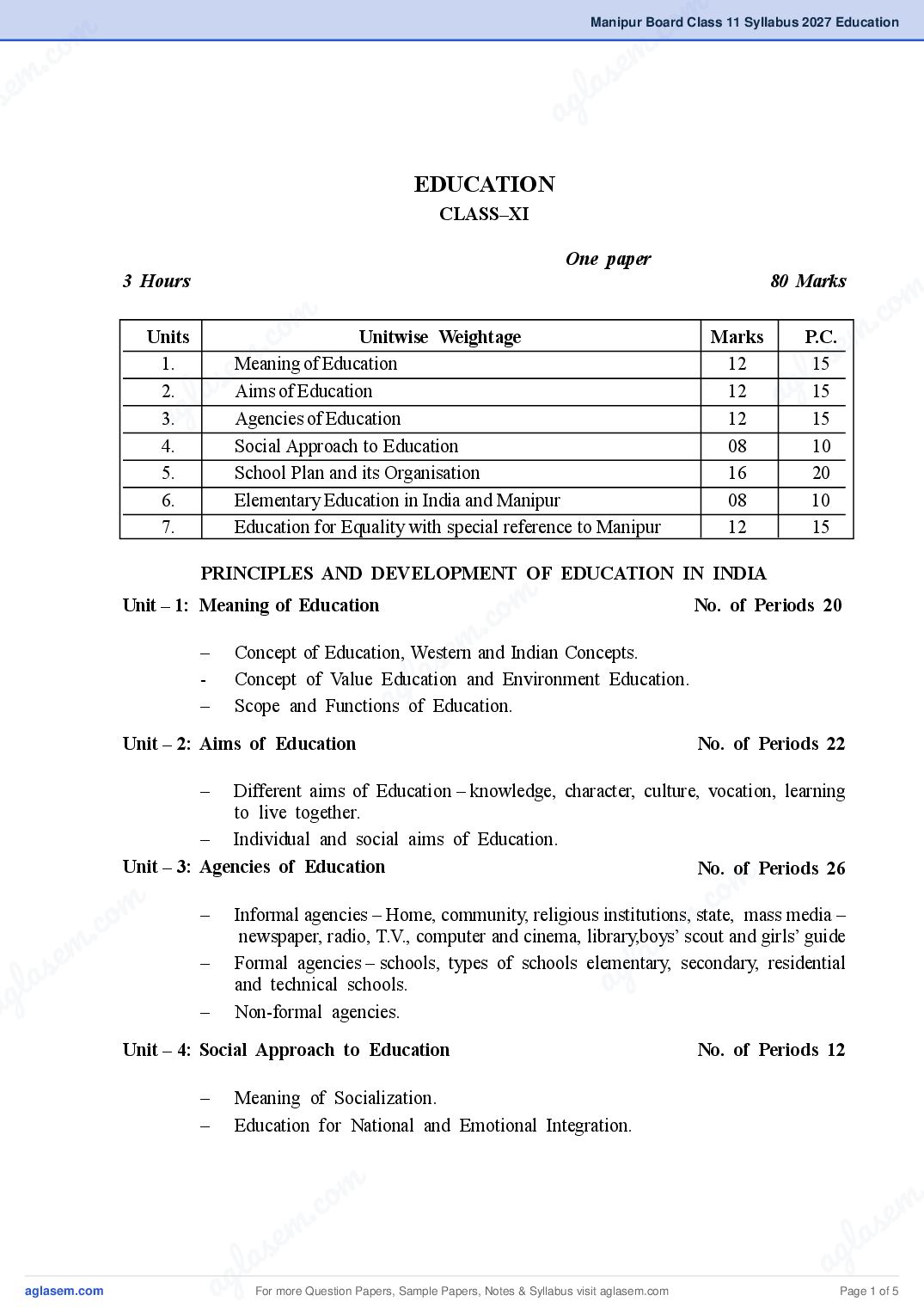
EDUCATION
CLASS–XI
One paper
3 Hours 80 Marks
m
m .co
Units
m .co Unitwise Weightage Marks P.C.
s e m
1.
s e Meaning of Education 12
l a
15
2.
g l a Aims of Education 12 ag 15
a
3. Agencies of Education 12 15
4. Social Approach to Education 08 10
5. School Plan and its Organisation 16 20
6. Elementary Education in India and Manipur 08 10
7. Education for Equality with special reference to Manipur 12 15
PRINCIPLES AND DEVELOPMENT OF EDUCATION IN INDIA
m
.co
Unit – 1: Meaning of Education No. of Periods 20
e m
–
- las
Concept of Education, Western and Indian Concepts.
Concept of Value Education and Environment Education.
– ag
Scope and Functions of Education.
Unit – 2: Aims of Education No. of Periods 22
–Different aims of Education – knowledge, character, culture, vocation, learning
to live together.
– Individual and social aims of Education.
Unit – 3: Agencies of Education No. of Periods 26
o m
m c
. mass media –
.co m
– Informal agencies – Home, community, religious institutions, state,
m s e scout and girls’ guide
newspaper, radio, T.V., computer and cinema, library,boys’
s e g la secondary, residential
– Formal agencies – schools, types of schools elementary,
g la and technical schools. a
a – Non-formal agencies.
Unit – 4: Social Approach to Education No. of Periods 12
– Meaning of Socialization.
– Education for National and Emotional Integration.
m .
.co s e m
s em l a
g la ag
a For more Question Papers, Sample Papers, Notes & Syllabus visit Page 1 of 5
Page 3
– Physical and human resources : School building and other equipments, teachers’ role
in relation to school and society.
– Curriculum – concepts, principles of Secondary school curriculum construction
– Co-curricular activities – meaning, objectives, activities and Organisations.
Unit – 6: Elementary Education in India and Manipur No. of Periods 15
– Brief survey of elementary Education in India and Manipur at the time of
Independence.
– Constitutional provisions for Elementary Education (Articles 45, 51A & 86th
Amendment of Indian Constitution 2002, implementation of SSA in Manipur and Norms
and standards of a school specified in RTE Act 2009.
Unit – 7: Education for equality with special reference to Manipur No. of Periods 18
– Concept of Education for equality.
– Development of education of girls at the elementary stage in Manipur.
– Problems of girls’ education in Manipur at the elementary stage and its remedial
measures.
– Problems of education of SC and ST students in Manipur.
PRESCRIBED TEXTBOOKS :
1. New Approach to Education (Class-XI)
By : Dr. Marami Goswami
Published by : Ashok Publication, Guwahati, Assam
2. An Introduction to Education
By : Jatin Borua
Published by : Sri Shaskar Dutta Baruah; LBS Publication, Panbazar, Guwahati.
3. Education In Manipur
By : Jamini Devi
Published by : Raj Pravina Brothers, Imphal
——§§§——
For more Question Papers, Sample Papers, Notes & Syllabus visit Page 2 of 5
Page 4
m .co
m .co s e m
se g l a
a
DESIGN OF
QUESTION PAPER
Subject : EDUCATION
Class : XI
Full Mark : 80
m
.co
Time : 3 Hours
m
.co
WEIGHTAGE TO OBJECTIVES
m s e m
s e
Objectives Marks Percentage
l a
a ag
Knowledge(K) 16 20
I
g lUnderstanding (U) 40 50
a Application (A) 24 30
Total : 80 100
WEIGHTAGE TO FORM OF QUESTIONS:
Form of Questions No. of Question Time (in minute) Marks Percentage
Essay/Long Answer (E/LA) 04 72 32 40
Short Answer (SA-I) 04 36 16 20
II Short Answer (SA-II) 06 27 12 15
Very Short Answer (VSA) 08 18 08 10
m
.co
MCQ 12 27 12 15
Total: 34 180 80 100
e m
WEIGHTAGE TO CONTENT:
UNIT /CONTENTS :
las Marks Percentage
I. Meaning of Education
ag 12 15
II. Aims of Education 12 15
III. Agencies of Education 12 15
III IV. Social Approach to Education 08 10
V School Plan and its Organization 16 20
VI. Elementary Education In India and Manipur 08 10
VII. Education for Equality with Special Reference to Manipur 12 15
Total: 80 100
IV SCHEME OF SECTIONS : Nil
m
.co
V SCHEME OF OPTIONS : 50% in SA-I & 100% in Essay Type Questions/LA
m
.co em
DIFFICULTY LEVEL :
e m VI Difficult
Average
: 30% of the total marks
: 50% of the total marks
la s
las Easy : 20% of the total marks
a g
ag Special Instruction: 1) Two questions of MCQ will be Assertion-Reasoning type question.
2) One question of SA-1 will be source based question.
Abbreviation : K(Knowledge), U(Understanding), C(Comprehension), Exp.(Expression), Skill(S),
E(Essay Type), SA (Short Answer Type), VSA (Very Short Answer Type),
MCQ(Multiple Choice Question)
m .
.co s e m
s em l a
g la ag
a For more Question Papers, Sample Papers, Notes & Syllabus visit Page 3 of 5
Page 5
INTERNAL ASSESSMENT
20 MARKS
1. Periodic Tests (Average of 2 tests conducted) – 10 Marks
Conduct of Periodic Tests:
Periodic Test is a Pen and Paper assessment which is to be conducted by the subject teachers.
The format of periodic test must have question items with a balance mix, such as, very short
answer (VSA), short answer (SA) and long answer (LA) to effectively assess the knowledge,
understanding, application and skills. The modalities of the PT are as follows:
a) Mode: The periodic test is to be taken in the form of pen-paper test.
b) Schedule: In the entire Academic Year, two Periodic Tests may be conducted as follows:
Test Pre-Mid-term (PT-I) and Post Mid-Term (PT-II)
Tentative Month July-August and November December
This is only a suggestive schedule and schools may conduct periodic tests as per their
convenience.
c) Average of Marks: Once schools complete the conduct of all the two periodic tests and
the average of the two shall be taken as the final marks for PT.
d) The school will ensure simple documentation to keep a record of performance.
e) Sharing of Feedback/Performance: The students’ achievement in each test must be
shared with the students and their parents to give them an overview of the level of learning
that has taken place during different periods. Feedback will help parents formulate
interventions (conducive ambience, support materials, motivation and morale-boosting) to
further enhance learning. A teacher, while sharing the feedback with student or parent, should
be empathetic, non-judgmental and motivating. It is recommended that the teacher share best
examples/performances of IA with the class to motivate all learners.
2. Project undertaken during the academic year at school level – 10 Marks
A. Project Report – 08 Marks
1. Introduction – 1 Mark
2. Statement of Purpose – 1 Mark
3. Research Question – 1 Mark
4. Methodology – 2 Marks
5. Data Analysis – 2 Marks
6. Conclusion – 1 Mark
B. Viva – based on the project work – 02 Marks
* At least 5 periods may be allotted for project report preparation.
For more Question Papers, Sample Papers, Notes & Syllabus visit Page 4 of 5
Page 6
m .co
m .co s e m
se g l a
a
CLASS-XI
(EDUCATION)
SUGGESTIVE TOPICS FOR PROJECT WORKS:-
m
m
1. Impact of vocational education to solving the problem of unemployment. .co
.co
2. As an agency of education help to create adverse effect in children i.e. cinema,
m s e m
s e
television, computer. Give remedies.
l a
g l a
3. Impact of Digital Technology and Mass media on Education in Manipur.
ag
a 4. Co-curricular activities in a rural Higher Secondary School.
5. Suggestion for beautifying the school campus.
6. The teacher we need in Manipur today.
7. Report of a picnic programme.
8. Education as tool for National integration for present Manipur.
9. Problems of Girls Education in Elementary level in Manipur and Remedial
measures.
10. Education for Equality: Status of Girls and marginalized communities in Manipur.
m
m .co
s e
g la
a
m
m .co
m .co s e m
s e g l a
g la a
a
m .
.co s e m
s em l a
g la ag
a For more Question Papers, Sample Papers, Notes & Syllabus visit Page 5 of 5
Document Details
| Board / Org | Manipur Board |
| Exam | Class 11 |
| Type | Syllabus |
| Pages | 5 |
| Updated | 04 Nov 2026 |