CBSE Class 12 History Question Paper 2020 Set 61-4-1
Finished viewing? Save it for later —
Download CBSE Class 12 History Question Paper 2020 Set 61-4-1 (PDF · 24 pages)About CBSE Class 12 History Question Paper 2020 Set 61-4-1
CBSE Class 12 History Question Paper 2020 Set 61-4-1 is available here for free download. Published by CBSE for Class 12, this question paper can be viewed online or downloaded as a PDF (24 pages). Candidates preparing for Class 12 can use CBSE Class 12 History Question Paper 2020 Set 61-4-1 to understand the exam pattern, the type of questions asked, and the overall difficulty level.
Frequently Asked Questions
How can I download CBSE Class 12 History Question Paper 2020 Set 61-4-1?
Open this page and click the Download button to save CBSE Class 12 History Question Paper 2020 Set 61-4-1 as a PDF. It is completely free on AglaSem Docs.
Is CBSE Class 12 History Question Paper 2020 Set 61-4-1 free to download?
Yes. CBSE Class 12 History Question Paper 2020 Set 61-4-1 can be viewed online and downloaded as a PDF free of cost on AglaSem Docs.
How many pages does CBSE Class 12 History Question Paper 2020 Set 61-4-1 have?
CBSE Class 12 History Question Paper 2020 Set 61-4-1 contains 24 pages, which you can read online or download together as a single PDF.
Where can I find more Class 12 study material?
You can find more Class 12 question papers, sample papers, syllabus, and answer keys on AglaSem Docs.
CBSE Class 12 History Question Paper 2020 Set 61-4-1 – Text
Read the full text of this question paper below — useful to quickly search, copy and reference the content online without downloading the PDF.
📄 View text version (24 pages)
Page 1
.
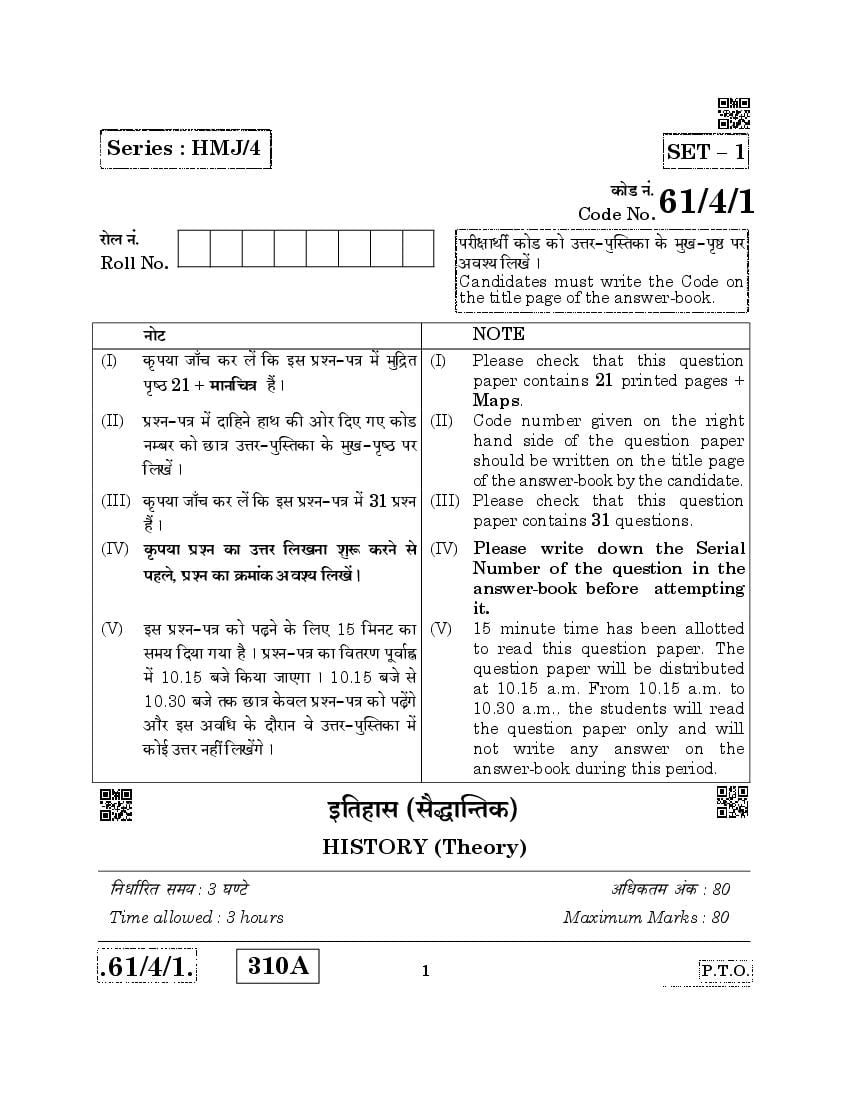
Code No. 61/4/1
. - -
Roll No.
Candidates must write the Code on
the title page of the answer-book.
NOTE
(I) - (I) Please check that this question
21 + paper contains 21 printed pages +
Maps.
(II) - (II) Code number given on the right
- - hand side of the question paper
should be written on the title page
of the answer-book by the candidate.
(III) - 31 (III) Please check that this question
paper contains 31 questions.
(IV) (IV) Please write down the Serial
, Number of the question in the
answer-book before attempting
it.
(V) - 15 (V) 15 minute time has been allotted
- to read this question paper. The
question paper will be distributed
10.15 10.15
at 10.15 a.m. From 10.15 a.m. to
10.30 - 10.30 a.m., the students will read
- the question paper only and will
not write any answer on the
answer-book during this period.
()
HISTORY (Theory)
{ZYm©[aV g‘¶ : 3 KÊQ>o A{YH$V‘ A§H$ : 80
Time allowed : 3 hours Maximum Marks : 80
.61/4/1. 310A 1 P.T.O.
Page 2
(i) - – , , ,
(ii) - 1 20 1
(iii) - 21 24 3
100
(iv) - 25 27 8
350
(v) - 28 30 6
(vi) -- 31 ,
(vii)
(viii) , - , - ,
-
(ix) , ,
:
1. ,
1
2.
(1)
(2)
(3)
(4)
?
(a) (1), (3) (4) (b) (2), (3) (4)
(c) (1), (2) (3) (d) (1), (2) (4) 1
.61/4/1. 2
Page 3
Read the following instructions very carefully and strictly follow them :
(i) This question paper comprises five sections – A, B, C, D and E. All
questions are compulsory.
(ii) Section A – Q. no. 1 to 20 are very short-answer type questions carrying
1 mark each. They are required to be answered in one word or one sentence
each.
(iii) Section B – Q. no. 21 to 24 are short-answer type of questions carrying
3 marks each. Answer to each of them should not exceed 100 words.
(iv) Section C – Q. no. 25 to 27 are long-answer type questions carrying
8 marks each. Answer to each of them should not exceed 350 words.
(v) Section D – Q. no. 28 to 30 are source based questions carrying 6 marks
each.
(vi) Section E – Question No. 31 is a map question that includes identification
and location of significant test items. Attach the map with the answer-book.
(vii) Answer should be brief and to the point also the above word limit be
adhered to as far as possible.
(viii) There is no overall choice. However, an internal choice has been
provided in two questions of one mark, one question of three marks,
three questions of eight marks and map question. You have to
attempt only one of the choices in such questions.
(ix) In addition to this, separate instructions are given with each section
and question, wherever necessary.
SECTION : A
Answer all the questions given below.
1. Name the Director-General of Archaeological Survey of India (ASI) who
announced the discovery of Mohenjodaro in the Indus Valley to the World. 1
2. Consider the following statements regarding the Priest King of Harappa :
According to Archaeologists :
(1) Priest king held political power.
(2) He was related with Mesopotamian History.
(3) He was related with Harappan religion.
(4) His authoritarian rule could be one of the cause of the decline of
Harappa.
Which one of the following statement is correct ?
(a) (1), (3) and (4) (b) (2), (3) and (4)
(c) (1), (2) and (3) (d) (1), (2) and (4) 1
.61/4/1. 3 P.T.O.
Page 4
1
3
1
4. ,
‘’ ‘’
(a)
(b) ‘’
(c)
(d) 1
5. ‘’ ? 1
? 1
.61/4/1. 4
Page 5
century CE related to this figure. 1
Note : The following question is for the visually impaired candidates
only in lieu of Q. No. 3.
State any one source to know about the Kushana rulers. 1
4. Identify the best reason for considering King Ashoka as ‘Devanampiya’
and ‘Piyadassi’ by his subjects.
(a) Ashoka commissioned the edicts himself.
(b) He adopted the title of ‘Devaputra’.
(c) Epigraphists have concluded him as Devanampiya.
(d) He did well being of society through Dhamma. 1
5. Who was the author of the book ‘Arthashastra’ written during Mauryan
empire ? 1
OR
Who was the founder of the Mauryan Empire ? 1
.61/4/1. 5 P.T.O.
Page 6
(a) (b)
(c) (d) 1
7. 1
8. ?
(a)
(b) -
(c) ,
(d) , 1
9. 18 ?
(a) (b)
(c) (d) 1
10. -
(1) (2)
(3) (4)
(a) (1), (3), (4) (2)
(b) (2), (1), (3) (4)
(c) (1), (4), (3) (2)
(d) (4), (1), (2) (3) 1
11.
“ ”
” 1
.61/4/1. 6
Page 7
(a) Rajagraha (b) Ujjain
(c) Taxila (d) Gandhara 1
7. Explain one point of difference between the gold coins issued by the
Kushanas and the Gupta rulers. 1
8. Which one of the following statements is appropriate about Ibn Battuta ?
(a) He was Qazi during Muhammad Bin Tughlaq’s empire.
(b) He had written Kitab-Ul-Hind in Arabic.
(c) He translated Sanskrit, Pali and Prakrit work in Arabic.
(d) He was a Physician, Philosopher and Historian. 1
9. Who among the following western theorist developed the idea of oriental
despotism in the 18th century ?
(a) Montesquieu (b) Rousseau
(c) Voltaire (d) Karl Marx 1
10. Arrange the following dynasties of Vijayanagara Empire in chronological
order :
(1) Sangama (2) Aravidu
(3) Tuluva (4) Saluva
Choose the correct option :
(a) (1), (3), (4) and (2)
(b) (2), (1), (3) and (4)
(c) (1), (4), (3) and (2)
(d) (4), (1), (2) and (3) 1
11. Read the information given below :
Identify and name the system followed in the Mughal society.
“Remuneration for the work was paid through small daily allowances. It
was the micro level exchange network operated in the villages.” 1
.61/4/1. 7 P.T.O.
Page 8
-I -II
(i) (a)
(ii) (b)
(iii) (c)
(iv) (d)
(a) (i)-d, (ii)-c, (iii)-b, (iv)-a
(b) (i)-b, (ii)-d, (iii)-a, (iv)-c
(c) (i)-a, (ii)-b, (iii)-c, (iv)-d
(d) (i)-b, (ii)-c, (iii)-a, (iv)-d 1
13. :
1
14. ,
1
15. - ?
(a)
(b)
(c)
(d) 1
16. ‘ ’ ( ) ?
(a) (b)
(c) (d) 1
.61/4/1. 8
Page 9
List-I List-II
(i) Amil Guzar (a) Accountant
(ii) Mandals (b) Revenue collector
(iii) Patwari (c) Panchayat Headmen
(iv) Diwan (d) Supervisor
Choose the correct option :
(a) (i)-d, (ii)-c, (iii)-b, (iv)-a
(b) (i)-b, (ii)-d, (iii)-a, (iv)-c
(c) (i)-a, (ii)-b, (iii)-c, (iv)-d
(d) (i)-b, (ii)-c, (iii)-a, (iv)-d 1
13. Study the following chart and find out the name of the Administrative
System of Mughals.
1
14. Name the Portuguese writer who wrote detailed account of trade and
society of south India in the sixteenth century. 1
15. Which one of the following statement is NOT appropriate about Ain-i-
Akbari ?
(a) It was written by Abul Fazl.
(b) It was a gazetteer of the empire.
(c) It was sponsored and commissioned by Akbar.
(d) Its data was uniformly collected from all the provinces. 1
16. Who among the following painted “Relief of Lucknow” ?
(a) Thomas Jones Barker (b) Hanery Havelock
(c) Joseph Noel (d) Colin Campbell 1
.61/4/1. 9 P.T.O.
Page 10
, 1
18. – (A) (R)
(A) :
(R) :
(a) (A) (R) (R) (A)
(b) (A) (R) (R) (A)
(c) (A) , (R)
(d) (R) , (A) 1
19. 1857
?
(a)
(b)
(c)
(d) 1
20. 19
(1)
(2)
(3)
(a) (1) (2) (b) (2) (3)
(c) (1) (3) (d) (3) 1
.61/4/1. 10
Page 11
OR
Name the fort built by British East India Company in Madras. 1
18. Given below are the two statements, one labelled as Assertion (A) and the
other labelled as Reason (R) :
Assertion (A) : British built imperial European architectural style buildings
in Bombay.
Reason (R) : Familiar landscape in an alien country.
(a) Both (A) and (R) are correct and (R) is the correct explanation of (A) .
(b) Both (A) and (R) are correct but (R) is not the correct explanation of (A).
(c) (A) is correct but (R) is not correct.
(d) (R) is correct but (A) is not correct. 1
19. Which one of the following statements was not a justified reason for the
annexation of Awadh by British in 1857 ?
(a) Wajid Ali Shah was unpopular ruler.
(b) Subsidiary Alliance System was accepted by Wajid Ali Shah at ease.
(c) Mangal Pandey initiated the revolt from Awadh.
(d) Material benefits were given to the taluqdars by the British. 1
20. Consider the following statements regarding the census conducted by
British in the 19th century in India.
(1) The growth of the cities were monitored through census.
(2) Municipal Corporation was to administer it.
(3) Census operations were appropriate as social data was easily converted
to economic data.
Which of the following statement(s) is/are correct ?
(a) (1) and (2) only (b) (2) and (3) only
(c) (1) and (3) only (d) only (3) 1
.61/4/1. 11 P.T.O.
Page 12
21. “
” 3
“ ”
3
22. , 3
23.
? 3
24. “ ”
3
– (8 3 = 24)
25. ..
8
8
26. -- 8
8
27. ‘ ’ ?
8
“ ”
8
.61/4/1. 12
Page 13
21. “Archaeologists have used evidence from material remains to piece
together parts of Harappan history.” Justify the statement with reference
to the principles of classification. 3
OR
“Harappan script is considered as an enigmatic script.” Justify the
statement with suitable agruments. 3
22. Describe any three innovations that the rulers of Vijayanagara introduced
in the construction of temples. 3
23. Why did some of our leaders advocate a strong centre during the debate in
the Constituent Assembly on the proposed federal structure of the Indian
State ? Explain. 3
24. “Ryotwari system had put the ryots of Bombay Deccan in critical
situation.” Explain the statement with any three examples. 3
SECTION : C (8 3 = 24)
25. Describe the contribution of V.S. Suthankar in reconstructing social
history through the critical edition of Mahabharata. 8
OR
Describe the life of untouchables in the ancient period. 8
26. Examine the idea of Sulh-i-Kul as the cornerstone of Akbar’s enlighted
rule. 8
OR
Examine the life in Harem or domestic world of the Mughals. 8
27. How did different sections of the Indian society react on the Non-Cooperation
Movement ? 8
OR
‘Gandhiji had mobilized a wider discontentment against the British rule
in the Salt Satyagraha.’ Explain. 8
.61/4/1. 13 P.T.O.
Page 14
28.
,
() ?
;
?....
, !
...
(28.1) 2
(28.2) ? 2
(28.3) 2
.61/4/1. 14
Page 15
28. Read the following source carefully and answer the questions that follow :
The Therigatha
This unique Buddhist text, part of the Sutta Pitaka, is a collection of
verses composed by bhikkhunis. It provides an insight into women’s social
and spiritual experiences. Punna, a dasi or slave woman, went to the river
each morning to fetch water for her master’s household. There she would
daily see a Brahmana performing bathing rituals. One morning she spoke
to him. The following are verses composed by Punna, recording her
conversation with the Brahmana :
I am a water carrier :
Even in the cold
I have always gone down to the water
frightened of punishment
Or the angry words of high class women.
So what are you afraid of Brahmana,
That makes you go down to the water
(Though) your limbs shake with the bitter cold ?
The Brahmana replied :
I am doing good to prevent evil;
anyone young or old
who has done something bad
is freed by washing in water.
Punna said:
Whoever told you
You are freed from evil by washing in the water ? …
In that case all the frogs and turtles
Would go to heaven, and so would the water snakes
and crocodiles !
(Instead) Don’t do that thing,
the fear of which
leads you to the water.
Stop now Brahmana !
Save your skin from the cold …
(28.1) Explain the ideas of Punna with two examples. 2
(28.2) What justification did the Brahmana give for his daily dip in river ? 2
(28.3) Explain the core of Buddhist philosophy that is being conveyed through
their Gatha. 2
.61/4/1. 15 P.T.O.
Page 16
?
,
,
,
()
.....
(29.1)
? 2
(29.2)
? 2
(29.3) 2
.61/4/1. 16
Page 17
A Demon ?
This is an excerpt from a poem by Karaikkal Ammiyar in which she
describes herself :
The female Pey (demoness)
with … bulging veins,
protruding eyes, white teeth and shrunken stomach,
red haired and jutting teeth
lengthy shins extending till the ankles,
shouts and wails
while wandering in the forest.
this is the forest of Alankatu,
which is the home of our father (Shiva)
who dances … with his matted hair
thrown in all eight directions, and with cool limbs.
(29.1) Analyze how Karaikkal Ammaiyar had depicted herself different
from the traditional nature of beauty. 2
(29.2) Analyze how this composition of Ammaiyar pose a challenge to
patriarchal norms. 2
(29.3) Analyse any two aspects of renunciation of her social obligations. 2
.61/4/1. 17 P.T.O.
Page 18
“”
,
- -
-
-
-
-
-
-
-
(30.1) 2
(30.2) , ? 2
(30.3)
? 2
.61/4/1. 18
Page 19
What “recovering” women meant
Here is the experience of a couple, recounted by Prakash Tandon in his
Punjabi Century, an autogiograpical social history of colonial Punjab :
In one instance, a Sikh youth who had run amuck during the partition
persuaded a massacring crowd to let him take away a young, beautiful
Muslim girl. They got married, and slowly fell in love with each other.
Gradualy memories of her parents, who had been killed, and her former
life faded. They were happy together, and a little boy was born. Soon,
however, social workers and the police, labouring assiduously to recover
abducted women, began to track down the couple. They made inquiries in
the Sikh’s home district of Jalandhar; he got scent of it and the family ran
away to Calcutta. The social workers reached Calcutta. Meanwhile, the
couple’s friends tried to obtain a stay-order from the court but the law was
taking its ponderous course. From Calcutta the couple escaped to some
obscure Punjab village, hoping that the police would fail to shadow them.
But the police caught up with them and began to question them. His wife
was expecting again and now nearing her time. The Sikh sent the little
boy to his mother and took his wife to a sugar-cane field. He made her as
comfortable as he could in a pit while he lay with a gun, waiting for the
police, determined not to lose her while he was alive. In the pit he
delivered her with his own hands. The next day she ran high fever, and in
three days she was dead. He had not dared to take her to the hospital. He
was so afraid the social workers and the police would take her away.
(30.1) Explain any two reasons of massacre happened during partition of
India ? 2
(30.2) Why were the social workers and police tracking down the young
couple ? 2
(30.3) Do you think the authorities were right in trying to take back the girl ?
Explain reasons to support your answer. 2
.61/4/1. 19 P.T.O.
Page 20
31. (a) -
(i)
(ii)
(iii) 3
(b) A, B
C
3
31
(a) 3
3
(b) 3
__________
.61/4/1. 20
Page 21
31. (a) On the given political map of India, locate and label the following with
appropriate symbols :
(i) Bodh Gaya
(ii) Panipat or Ajmer
(iii) Vijayanagara or Chandragiri 3
(b) On the same outline map of India three places related to the
National Movement have been marked as A, B and C. Identify them
and write their names on the lines drawn near them. 3
Note : The following are for visually impaired candidates only in lieu
of Q. No. 31.
(a) Name any three places considered sacred in Buddhism. 3
OR
Name any three Mughal imperial major cities. 3
(b) Name any three places related to the Indian National Movement. 3
__________
.61/4/1. 21 P.T.O.
Page 22
Page 23
Page 24
Document Details
| Board / Org | CBSE |
| Exam | Class 12 |
| Type | Question Paper |
| Pages | 24 |
| Updated | 22 Jul 2026 |