HBSE Class 12 Sample Paper 2027 Accountancy Marking Scheme
Finished viewing? Save it for later —
Download HBSE Class 12 Sample Paper 2027 Accountancy Marking Scheme (PDF · 17 pages)About HBSE Class 12 Sample Paper 2027 Accountancy Marking Scheme
HBSE Class 12 Sample Paper 2027 Accountancy Marking Scheme is available here for free download. Published by Haryana Board for Class 12, this answer key can be viewed online or downloaded as a PDF (17 pages). Candidates preparing for Class 12 can use HBSE Class 12 Sample Paper 2027 Accountancy Marking Scheme to understand the exam pattern, the type of questions asked, and the overall difficulty level.
Frequently Asked Questions
How can I download HBSE Class 12 Sample Paper 2027 Accountancy Marking Scheme?
Open this page and click the Download button to save HBSE Class 12 Sample Paper 2027 Accountancy Marking Scheme as a PDF. It is completely free on AglaSem Docs.
Is HBSE Class 12 Sample Paper 2027 Accountancy Marking Scheme free to download?
Yes. HBSE Class 12 Sample Paper 2027 Accountancy Marking Scheme can be viewed online and downloaded as a PDF free of cost on AglaSem Docs.
How many pages does HBSE Class 12 Sample Paper 2027 Accountancy Marking Scheme have?
HBSE Class 12 Sample Paper 2027 Accountancy Marking Scheme contains 17 pages, which you can read online or download together as a single PDF.
Where can I find more Class 12 study material?
You can find more Class 12 question papers, sample papers, syllabus, and answer keys on AglaSem Docs.
HBSE Class 12 Sample Paper 2027 Accountancy Marking Scheme – Text
Read the full text of this answer key below — useful to quickly search, copy and reference the content online without downloading the PDF.
📄 View text version (18 pages)
Page 1
HBSE Class 12 Sample
Paper 2027
Accountancy Marking
Scheme
EXAM YEAR TYPE SUBJECT
Haryana Class 12 2027 Answer Key Accountancy
Notes · Sample Papers · Previous Year Papers · Mock Tests
Page 2
m .co
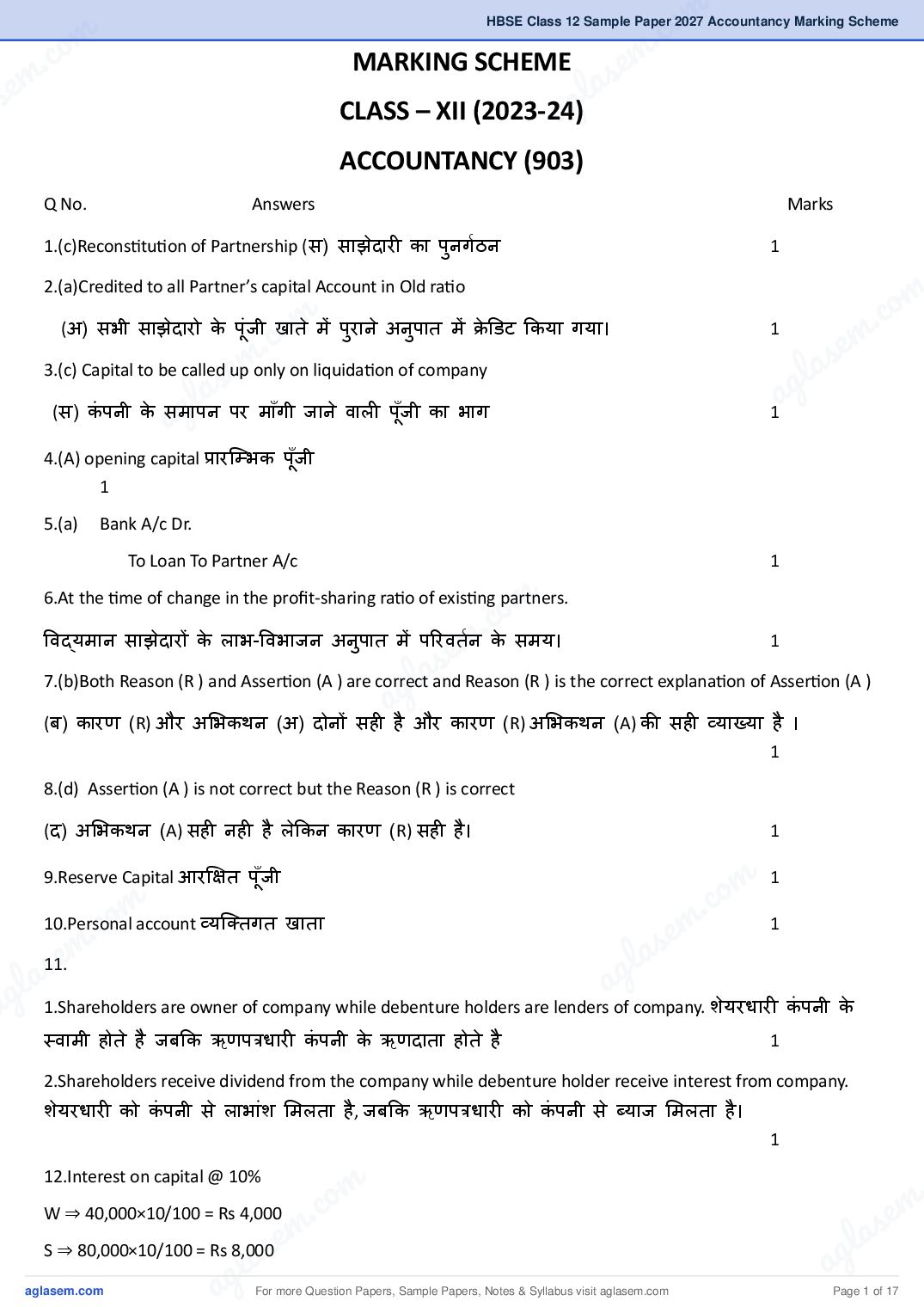
m .co MARKING SCHEME
s e m
se g l a
a
CLASS – XII (2023-24)
ACCOUNTANCY (903)
Q No. Answers Marks
1.(c)Reconstitution of Partnership (स) साझेदारी का पुनर्गठन 1
2.(a)Credited to all Partner’s capital Account in Old ratio
m
m .co
.co
(अ) सभी साझेदारो के पज
ूं ी खाते में परु ाने अनप
ु ात में ्ቅेडिट ककया र्या। 1
e m
em l as
s
3.(c) Capital to be called up only on liquidation of company
la पर मााँर्ी जाने वाली पजाँ ी का भार् ag
ag
(स) कूंपनी के समापन 1
4.(A) opening capital ्ቚारम्भभक पज
ाँ ी
1
5.(a) Bank A/c Dr.
To Loan To Partner A/c 1
m
6.At the time of change in the profit-sharing ratio of existing partners.
o
ववद्यमान साझेदारों के लाभ-ववभाजन अनुपात में पररवतगm
. c
न के समय। 1
s e
g l
7.(b)Both Reason (R ) and Assertion (A ) are correctaand Reason (R ) is the correct explanation of Assertion (A )
a
(ब) कारण (R) और अभभकथन (अ) दोनों सही है और कारण (R) अभभकथन (A) की सही व्याख्या है ।
1
8.(d) Assertion (A ) is not correct but the Reason (R ) is correct
(द) अभभकथन (A) सही नही है लेककन कारण (R) सही है। 1
9.Reserve Capital आर्ቌित पाँजी
m 1
m c. o
.co
10.Personal account व्यम्ततर्त खाता
s em 1
s em
11.
g la
g la1.Shareholders are owner of company while debenture holders are lenders of company. शेयरधारी कूंपनी के
a
a
स्वामी होते है जबकक ऋणप्ቔधारी कूंपनी के ऋणदाता होते है 1
2.Shareholders receive dividend from the company while debenture holder receive interest from company.
शेयरधारी को कूंपनी से लाभाूंश भमलता है , जबकक ऋणप्ቔधारी को कूंपनी से ब्याज भमलता है।
1
12.Interest on capital @ 10%
m .
W ⇒ 40,000×10/100 = Rs 4,000
m .co s e m
S ⇒ 80,000×10/100 = Rs 8,000se l a
g la ag
a For more Question Papers, Sample Papers, Notes & Syllabus visit Page 1 of 17
Page 3
Profit wrongly distributed equal to amount of interest. 1
Particulars W S
Interest on capital Cr. 4,000 80,000
Distribution of losses in 1:1 Dr. 6,000 6,000
Net Effect 2,000 (Dr) 2,000 (Cr.)
Date Particulars L.F. Debit Credit
(Rs.) (Rs.)
W’s Capital A/c Dr. 2,000 2,000
To S’s Capital A/c
1
OR
Features of partnership (any two) 1+1
1. Two or more persons दो या दो से अधधक व्यम्तत
2. Agreement between partners साझेदारों के बीच ठहराव
3. Sharing of profit लाभों के बूंटवारा
4. Existence of business and profit motive व्यवसाय की उपम्स्तधथ एवूं लाभ कमाने का उद्दे श्य
5. Relationship of principal and agent स्वामी और एजेंट का सूंबूंध
13.(i)Calculation of Actual Average Profit: ½
Average Profit 70,000
Less: Abnormal Profit 5,000
Actual Average Profit: 65,000
(ii) Normal Profits=Capital Invested ×Normal Rate of Return/100 ½
=5,50,000×10/100= Rs55,000
(iii)Super Profit = Actual Average Profit -Normal Profit ½
=65,000 -55,000 =Rs10,000
(iv) Goodwill = Super Profit × Number of years purchased ½
=Rs10,000×4 = Rs40,000.
For more Question Papers, Sample Papers, Notes & Syllabus visit Page 2 of 17
Page 4
m .co
m .co OR
s e m
se 1. Goodwill is an intangible asset. It is non-visible but it is not a fictitious
g a
lasset. (Any Two 1+1)
a
2. It cannot be separated from the business and therefore cannot be sold like other identifiable and separable
assets, without disposing off the business as a whole.
3. The value of goodwill has no relation to the amount invested or cost incurred in order to build it.
1.ख्यातत एक अमतग सूंपवि है। यह अदृश्य है लेककन यह एक काल्पतनक सूंपवि नहीूं है।
2. इसे व्यवसाय से अलर् नहीूं ककया जा सकता है और इसभलए इसे सूंपणग रूप से व्यवसाय का तनपटान ककए
m
बबना अन्य पहचान योग्य और अलर्-अलर् सूंपवियों की तरह बेचा नहीूं जा सकता है।
c o m m। .co
. s e
3. ख्यातत के मल्य का इसेmबनाने के भलए तनवेश की र्ई राभश या खचग की र्ई लार्त से कोई सूंबूंध नहीूं है
s e g l a
g l a a
14.
a
JOURNAL (1+1)
Date Particulars L.F Debit (Rs.) Credit (Rs.)
1. Bank A/c Dr. 1,00,000
To Premium for goodwill A/c 1,00,000
(For brining goodwill in cash ) . c om
e m
Premium for goodwill A/c Dr.
las
2. To A’s Capital A/c ag 1,00,000
To B’s Capital A/c 40,000
( Transfer of premium for goodwill to 60,000
sacrificing partner’s in sacrificing ratio)
o m
m c
. Two) (1+1)
.co
15. (Any
e m
m OF
eBASIS l as
s
la DIFFERENCE
SACRIFICING RATIO
ag
GAINING RATIO
ag
It is the ratio in which old partner It is the ratio in which the
surrender a part of their share in remaining partners acquire the
the favour of new partner. outgoing partner’s share.
MEANING अर्थ
यह वो अनप
ु ात है म्जसमे परु ाने यह वह अनप
ु ात है म्जसमे शेष
साझेदार द्वारा नए साझेदार के साझेदारों द्वारा अवकाश ्ቇहण
m .
.co s e m
s em l a
g la ag
a For more Question Papers, Sample Papers, Notes & Syllabus visit Page 3 of 17
Page 5
ृ क साझेदार के
ककया जाता है। हहस्से को ्ቚाप्त ककया जाता है।
Gaining ratio is calculated at the
Sacrificing ratio is calculated at time of death or retirement of
the time of the admission of the the partner.
WHEN partner.
CALCULATED लाभ ्ቚाम्प्त अनुपात ककसी
त्यार् अनप
ु ात नए साझेदार के
गणना का समय साझेदार के फमग से अवकाश
फमग में ्ቚवेश के समय तनकाला
्ቇहण अथवा मत्ृ यु के समय
जाता है।
तनकाला जाता है।
It is calculated to determine the
It is calculated to determine the amount of compensation to be
amount of compensation to be paid by each of the gaining
paid by the incoming partner to partner to the outgoing partner
the sacrificing partner as as premium for goodwill or
PURPOSE OF
CALCULATION premium for goodwill or goodwill.
goodwill.
गणना का उद्देश्य अवकाश ्ቇह करने वाले साझेदार
नए साझेदार के हहस्से की ख्यातत
को दी र्ई ख्यातत की राभश शेष
की राभश को त्यार् अनुपात में
साझेदारों द्वार लाभ ्ቚाम्प्त
पुराने साझेदारों में बााँटा जाता है।
अनुपात में दी जाती है।
CALCULATION Old Ratio- New Ratio New Ratio- Old ratio
गणना का स्ቔ
ू परु ाना अनप
ु ात- नया अनप
ु ात नया अनप
ु ात- परु ाना अनप
ु ात
For more Question Papers, Sample Papers, Notes & Syllabus visit Page 4 of 17
Page 6
m .co
m .co s e m
se g l a
a
m
m .co
m .co s e m
s e l a
g l a ag
a
m
m .co
s e
g la
a
17. JOURNAL (1+1+1)
Date Particulars L.F Debit (Rs.) Credit (Rs.)
1. X’s Capital A/c Dr. 5,000
m
m To Y’s Capital A/c 5,000
.co
.co (Being realization expenses to be
s e m
s em borne by X, paid by Y)
g l a
g la 2. Y’s Loan A/c Dr. a
a 50,000
To Bank A/c
48,000
To Realisation A/c
2,000
(Y’s Loan of Rs.50,000 settled at
Rs.48,000.)
m .
.co s e m
s em l a
g la ag
a For more Question Papers, Sample Papers, Notes & Syllabus visit Page 5 of 17
Page 7
(When creditors take over the assets
no entry is to be passed).
TOTAL 55,000 55,000
18. JOURNAL (6x ½ )
Date Particulars L.F Debit (Rs.) Credit (Rs.)
I. Bank A/c Dr. 2,00,000
To 12% debentures application
and allotment A/c
2,00,000
(Application money received)
12% debentures application and
allotment A/c Dr.
2,00,000
To 12% debentures A/c
2,00,000
(Transfer of application money to
debentures A/c)
Bank A/c Dr.
II. To 12% debentures application 1,96,000
and allotment A/c
(Application money received )
1,96,000
12% debentures application and
allotment A/c Dr.
Discount on issue of debentures A/c
Dr. 1,96,000
To 12% debentures A/c
(Transfer of application money to 4,000
debentures A/c issued at 2%
discount)
2,00,000
III. Bank A/c Dr. 2,10,000
To 12% debentures application 2,10,000
and allotment A/c
(Application money received )
12% debentures application and
allotment A/c Dr.
2,10,000
For more Question Papers, Sample Papers, Notes & Syllabus visit Page 6 of 17
Page 8
m .co
m .co To 12% debentures A/c
s e m 2,00,000
se To securities premium ReserveA/c
g l a 10,000
(Transfer of application money to
a
debentures A/c issued at 5%
premium)
19.
X’s Investment:- ½ m
Date Amount m
c. o Months Product
m .co
m s e
1.01.2002 5,000
s e 12 5,000 x 12 = 60,000
l a
1.07.2002 g l
5,000
a 06 5,000 x 6 = 30,000 ag
Total
a 90,000
Y’s Investment:- ½
Date Amount Months Product
1.05.2002 10,000 08
m
10,000 x 08 = 80,000
o
1.07.2002 10,000 06 c
. x 6 = 60,000
10,000
e m
Total
l as 1,40,000
ag
Z’s Investment:- ½
Date Amount Months Product
1.05.2002 15,000 06 15,000 x 06= 90,000
Total 90,000
m
m .co
m .co
The ratio of X’s, Y’s and Z’s Investment for one month
s em+1/2 +1/2)
(1/2
s e g la
la
= 90,000 : 1,40,000 : 90,000
g a
a = 9 : 14 : 9
X’s share of profit = 16,000 x 9/32 = 4,500
Y’s share of profit = 16,000 x 14/32 = 7,000
Z’s share of profit = 16,000 x 9/32 = 4,500
m .
.co s e m
s em l a
g la ag
a For more Question Papers, Sample Papers, Notes & Syllabus visit Page 7 of 17
Page 9
Page 10
m .co
m .co s e m
se g l a
a
m
m .co
m.co s e m
s e l a
g l a ag
a OR
As per the Partnership Act, 1932, a new partner can be admitted into the firm with the consent of all the
existing partners, unless otherwise agreed upon. The following conditions led to the addition of a new partner:
1. When the firm is in an expansion mode and requires fresh capital. 3 marks
2. When the new partners possess expertise which can be beneficial for the business expansion of the
firm.
m
.co
3. When the partner in question is a person of reputation and adds goodwill to the firm.
s em
साझेदारी अधधतनयम, 1932 के अनुसार, एक नए साझेदार को सभी मौजदा साझेदारों की सहमतत से फमग में
्ቚवेश हदया जा सकता है , जब तक कक अन्यथा g la न हो। तनभनभलखखत शतों के कारण एक नए साथी
सहमतत
a
को जोडा र्या:
1. जब फमग के ववस्तार के भलए अधधक पूंजी की आवश्यकता है।
2. जब नए साझेदारों के पास ववशेष्ञता हो जो फमग के व्यवसाय ववस्तार के भलए फायदे मूंद हो।
3. जब ववचाराधीन साझीदार ्ቚभावशाली व ववख्यात व्यम्तत हो और फमग में उसके ्ቚवेश से फमग की ख्यातत
m
और ्ቚततष्ठा में वद्
c o m ृ धध हो।
m .co
When .the new partner brings his/her share of goodwill in cash and the goodwillsiseretained in the business.
e m l a
l as
Accounting Entries:-
a g 2 marks
ag
m .
.co s e m
s em l a
g la ag
a For more Question Papers, Sample Papers, Notes & Syllabus visit Page 9 of 17
Page 11
Sr. No. Particulars L.F Debit Credit
Bank A/c Dr. 19,80,000
To Equity Share Capital A/c 19,80,000
(Being application money received)
Equity share Application A/c Dr. 19,80,000
To Equity share capital A/c 15,00,000
To Equity share allotment A/c 3,00,000
To Bank A/c 1,80,000
(Being shares allotted and balance refunded)
Equity share allotment A/c Dr.
To Equity share capital A/c 25,00,000
To securities premium reserve A/c 20,00,000
(being share allotment money including 5,00,000
premium due)
Bank A/c Dr.
Calls in arrears A/c Dr.
21,99,500
To Equity share allotment A/c
2,000
To calls in advance A/c
For more Question Papers, Sample Papers, Notes & Syllabus visit Page 10 of 17
Page 12
m (being allotment money received) .co
m .co s e m22,00,000
se Equity share capital A/c Dr.
g l a 1,500
Securities premium reserve A/c Dr.
a
To share forfeited A/c 7,000
To calls in arrears A/c 1,000
(Being 1000 share forfeited for non-payment of 6,000
allotment including premium)
2,000
m
.co
Bank A/c Dr.
m
To share capital A/c.co s e m
s em l a
ag
To Securities Premium Reserve A/c
g la share reissued at Rs.14 per
share)
a
(Being forfeited
14,000
7,000
Share forfeited A/c Dr.
7,000
To Capital Reserve A/c
(being share forfeited money transferred to
capital reserve A/c)
m
c. o 6,000
e m 6,000
las
ag
OR
i. Calls in arrears: - Calls in arrears are the amount that is called with respect to share and if not paid
before the due date. The call money can also be called allotment money, and the company can call it. If
m
.co
any failure or default arises to send the call money, it may be known as the calls in arrears. For the calls
o min arrears, a separate account should be opened and maintained.
m sheet. It used to
Them
c
. applied in the call of arrears can be reflected in the share capital of thesebalance
s
account
eshown as the deducted amount of subscribed but not fully paid under-subscribed
g l a capital.
laThe amount is known as paid-up capital, and the charge of interest at 10% ap.a is chargeable in the call of
be
g
a arrears. Though, it depends on the provision of the articles of the company itself. The company directors have
the right to cut off or wave off the interest rate on arrears calls. (2.5)
ii. Calls in advance: - Calls in advance are the excessive amount received by any company in advance
upon which has been called up. If a company is allowed and authorised by its articles, it may accept the
amount from the shareholders. The advance amount can be transferred to the account specially
opened for the call in advance, known as call in the advance account.
m .
.co
The amount that the company does not call should not be credited to the capital account. It appears
s e m
em
separately on the company’s balance sheet as its liabilities. To make the shares fully paid, companies may use
s l a
la
such amounts. Once the amount gets transferred to the account, it can be known as the call in advance is
g ag
a For more Question Papers, Sample Papers, Notes & Syllabus visit Page 11 of 17
Page 13
by the shareholders. (2.5)
अदि याचना:- अदि याचना वह राभश है म्जसे शेयर के सूंबूंध में माूंर्ा जाता है और इसका भुर्तान देय ततधथ
से पहले नहीूं ककया जाता है। याधचत पज
ाँ ी को आबूंटन पाँजी भी कहा जा सकता है और कूंपनी इसकी माूंर् कर
सकती है। यहद माूंर् राभश भेजने में कोई ववफलता या चक उत्पन्न होती है, तो इसे अदि याचन कहा जा
सकता है। अदि याचन के भलए एक अलर् खाता खोला जाना चाहहए और उसका रखरखाव ककया जाना
चाहहए।
अदि याचना के भलए खोले र्ए खाते को तल
ु न प्ቔ के शेयर पूंजी में पररल्ቌित ककया जा सकता है। इस
राभश को म्स्तधथ वववरण के समता एवूं दातयत्व पि में सदै व ्ቚाधथगत परन्तु पणगतः चक
ु ता पाँजी नही में से
घटाकर हदखाई जाती है।
इस राभश को ्ቚदि पज
ूं ी के रूप में जाना जाता है, और 10% ्ቚततवषग के हहसाब से ब्याज का ्ቚभार अदि
याचना में शाभमल होता है। हालााँकक, यह कूंपनी के लेखों के ्ቚावधान पर ही तनभगर करता है। कूंपनी के
तनदे शकों को बकाया कॉल पर ब्याज दर में कटौती या छट देने का अधधकार रखते है।
पवगदि याचना:- पवगदि याचना ककसी भी कूंपनी द्वारा अध्ቇम में ्ቚाप्त की र्ई अत्यधधक राभश है , म्जस पर
माूंर् की र्ई है। यहद ककसी कूंपनी को उसके अन्ततनगयमो द्वारा अनम
ु त और अधधकृत ककया जाता है , तो वह
शेयरधारकों से राभश स्वीकार कर सकती है। अध्ቇम राभश को अध्ቇम याचना के भलए ववशेष रूप से खोले र्ए
खाते में स्थानाूंतररत ककया जा सकता है , म्जसे अध्ቇम याचना खाते के रूप में जाना जाता है।
कूंपनी द्वारा कॉल नहीूं की जाने वाली राभश को पज
ूं ी खाते में जमा नहीूं ककया जाना चाहहए। यह कूंपनी के
म्स्तधथ वववरण में इसकी देनदाररयों के रूप में अलर् से हदखाई दे ता है। शेयरों को परी तरह से भुर्तान करने
के भलए, कूंपतनयाूं ऐसी राभशयों का ्ቚयोर् कर सकती हैं। एक बार जब राभश खाते में स्थानाूंतररत हो जाती है ,
तो इसे में पवगदि याचना बूंद होने के रूप में जाना जा सकता है। यह याचना ककए जाने तक वतगमान
दे नदाररयों के नाम से आता है , और राभश शेयरधारकों द्वारा दे य हो जाती है।
23. Items disclosed under ‘Short term provision’ (any two) (½ + ½ )
अल्पकाभलक ्ቚावधान (कोई दो)
1. Provision for doubtful debts. सम्न्दग्ध ऋणों के भलए आयोजन
2. Provision for employees benefits. कमगचारी कल्याण आयोजन
3. Provision for taxation. कराधान के भलए आयोजन
24. Bank Charges (बैंक शुल्क) 1
For more Question Papers, Sample Papers, Notes & Syllabus visit Page 12 of 17
Page 14
m .co
m .co
25. Short term. अल्पकाल
s e m 1
g la (A)
se 26. (A) Both (A) and (R) is true, but (R) is not a true explanation of Assertion 1
a
(A) (A) और (R) दोनों सही हैं, लेककन (R), वववरण (A) की सही व्याख्या नहीूं है।
27. (D) at a point of time 1
समय के ककसी एक बबूंद ु पर
m
m .co
.co
28. (1) Balance with Banks – Current assets
e m
em l as
s
(2) Investment In debentures – Current liabilities
a – Noncurrent liabilities
lsalary ag
g
(3) Outstanding
a
(4) Authorised Capital – shareholder’s funds
29. Proprietary Ratio = Proprietor’s funds/ Total assets ½
Total Assets = Debts × 2
m
.co
= Rs.5,00,000 × 2 = Rs.10,00,000 1
em
Proprietor’s Funds = (Equity Share Capital) + (Preference Share Capital) + (Surplus)
s
g la – 40% of 10,00,000) = 2,50,000 + 62,500 + 6,00,000 =
= (5,00,000 × 0.5) + (5,00,000 × 0.5 × 25%) + (10,00,000
Rs.9,12,500 a 1
Proprietary Ratio = 9,12,500/ 10,00,000 = 0.912:1 ½
OR
A mathematical expression of the mutual relation between two numbers is called a ratio. Ratio is simply the
expression of one number in terms of another number. It can be expressed as a fraction, rate or percentage.
m1
c o m m.co
m . of Ratio Analysis: - (any two)
Utilities s e (1+1)
s e g l a
g la1. Easy to understand the financial position of the firm a
a 2. Measure of expressing the financial performance and position:
3. Intra-firm analysis on the financial information over many number of years
4. Possibility for Financial planning and control.
दो सूंख्याओूं के पारस्पररक सूंबध
ूं को र्खणतीय रूप से ्ቚकट करना अनप
ु ात कहलाता है। अनप
ु ात साधारणतया
m .
.co
एक सूंख्या को दसरी सूंख्या के सूंदभग में ्ቚकट करना है। इसे अूंश (fraction),दर (rate) अथवा ्ቚततशत
s e m
em
(percentage) के रूप में दशागया जा सकता है।
s l a
g la ag
a For more Question Papers, Sample Papers, Notes & Syllabus visit Page 13 of 17
Page 15
ु ात ववश्लेषण की उपयोधर्ताएाँ :- (कोई दो)
1. फमग की वविीय म्स्थतत को समझने में आसानी
2. वविीय ्ቚदशगन और म्स्थतत को व्यतत करने का उपाय:
3. कई वषों की वविीय जानकारी पर अूंतर-फमग ववश्लेषण
4. वविीय योजना और तनयूं्ቔण की सूंभावना।
30.
Cash Flow from investing activities (½ marks for each transaction)
Particulars Amount
Purchase of Building (4,00,000)
Sale of Building 2,00,000
Purchase of non-current investment (2,00,000)
Sale of Non-Current Investment 3,00,000
Sale of Trade Mark 1,50,000
Interest received on debentures 10,000
Dividend received 5,000
Rent received 20,000
Purchase of goodwill (1,00,000)
Cash flow from investing activities 1,85,000
OR
A cash flow statement is an important tool used to manage finances by tracking the cash flow for an organization.
This statement is one of the three key reports (with the income statement and the balance sheet) that help in
determining a company’s performance. It is usually helpful for making cash forecast to enable short term planning.
1
The cash flow statement shows the source of cash and helps you monitor incoming and outgoing money. Incoming
cash for a business comes from operating activities, investing activities and financial activities. The statement also
informs about cash outflows, expenses paid for business activities and investment at a given point in time. The
information that you get from the cash flow statement is beneficial for the management to take informed decisions
for regulating business operations.
The various objectives of preparing cash flow statement are as follows:- (1X4)
(i) The first and most important objective of cash flow statement is that it helps to ascertain the gross inflows and
out flows of cash and cash equivalents from operating, investing and financial activities.
(ii) A cash flow statement helps in determining the various causes for change in the cash balances during an
accounting period.
For more Question Papers, Sample Papers, Notes & Syllabus visit Page 14 of 17
Page 16
m .co
m .co e m
(iii) A cash flow statement is also prepared to determine the liquidity position of the organisation.
s
la of cash in future.
se (iv) Moreover a cash flow statement is prepared to know about the requirement
g
a
रोकड ्ቚवाह वववरण एक महत्वपणग उपकरण है म्जसका उपयोर् ककसी सूंर्ठन के भलए रोकड ्ቚवाह को देखकर ववि
का ्ቚबूंधन करने के भलए ककया जाता है। यह वववरण तीन ्ቚमुख ररपोटों (आय वववरण और तुलन प्ቔ के साथ) में
से एक है जो कूंपनी के ्ቚदशगन को तनधागररत करने में मदद करता है। यह आमतौर पर अल्पावधध तनयोजन को
सिम करने के भलए नकद पवागनुमान बनाने में सहायक होता है।
m
c o m
रोकड ्ቚवाह वववरण नकदी के ्ቨोत को हदखाता है और ्ቚाप्त और भुर्तान रोकड पर नजर रखने में आपकी मदद
m .co
करता है। ककसी व्यवसाय के भलए
m . आने वाली नकदी पररचालन र्ततववधधयों, तनवेश र्ततववधधयों और वविीयse
s e g
र्ततववधधयों से आती है।a वववरण, नकदी के बहहवागह, व्यावसातयक र्ततववधधयों के भलए भुर्तान ककए र्एlaखचों और
gl तनवेश के बारे में भी सधचत करता है। रोकड ्ቚवाह वववर से आपको जो जानकारीa
एक तनम्श्चत समयaपर भमलती
है, वह व्यवसाय सूंचालन को ववतनयभमत करने के भलए उधचत तनणगय लेने के भलए ्ቚबूंधन के भलए फायदेमूंद होती
है।
रोकड ्ቚवाह वववरण तैयार करने के ववभभन्न उद्दे श्य इस ्ቚकार हैं: -
(i)रोकड ्ቚवाह वववरण का पहला और सबसे महत्वपणग उद्दे श्य यह है कक यह पररचालन, तनवेश और वविीय
m
.co
र्ततववधधयों से नकदी और नकद समकिों के सकल अूंतवागह और बहहवागह का पता लर्ाने में मदद करता है।
m
s e
(ii) रोकड ्ቚवाह वववरण एक लेखा अवधध के दौरान कैश बैलेंस में बदलाव के ववभभन्न कारणों को तनधागररत करने में
मदद करता है। g la
a
(iii) सूंर्ठन की तरलता म्स्थतत तनधागररत करने के भलए एक नकदी ्ቚवाह वववरण भी तैयार ककया जाता है।
(iv) इसके अलावा भववष्य में नकदी की आवश्यकता के बारे में जानने के भलए एक रोकड ्ቚवाह वववरण तैयार ककया
जाता है।
m
m .co
m .co s e m
s e g l a
g la a
a
m .
.co s e m
s em l a
g la ag
a For more Question Papers, Sample Papers, Notes & Syllabus visit Page 15 of 17
Page 17
23. Data, Report, Ledger, Hardware, Software. (any two) ½ marks
each
24. (i)Accounting transactions ½ marks
(ii) Accounting software each
25. (C) Assets, Capital, Liabilities, Revenue and Expenses 1
26. (C) Column between start and end points of Excel sheet 1
27. (C) Data is not made available to everybody. 1
28. Sequential codes:- Sequential codes are those codes in which the numbers or letters are 1
arranged in a consecutive order.These types of codes are mostly applied in source documents
such as cheques, invoices.
It also helps in document search by tracking a relevant document based on the code or by identifying
the missing codes in a document based on the numbers.
Mnemonic codes:- Mnemonic codes are those codes that consist of alphabets or abbreviations as
symbols for codifying a piece of information. E.g. HQ for headquarters, DLI for Delhi in train bookings.
1
29. A graph is defined as a diagram or a pictorial representation that represents the interrelation 1
between data or values in an organized manner.
The three advantages of graphs are as follows: (any two)
1. It makes data presentable and easy to understand. 1+1
2. It helps in summarizing the data in a crisp manner.
3. It helps in the comparison of data in a better way.
OR
Types of vouchers (any three):
(i) Contra voucher: Used for fund transfer between cash and Bank A/c only. This voucher is used if
cash is withdrawn from Bank for ofÏce or deposited in the Bank from ofÏce. 1+1+1
(ii) Receipt Voucher: All the inflow of money is recorded through receipt voucher. Such receipts may
be towards any income such as receipts from Debtors, loan/advance taken or refund of loan/advance
etc.
(iii) Payment Voucher: All outflow of money is recorded through payment voucher such payments
may be towards any purchases, Expenses, due to creditors, loan/advance etc.
(iv) Journal Voucher: It is an adjustment voucher, normally used for non-cash transactions like
adjustment between ledgers.
30. The error is #NUM! Error. The steps to correct it are: 1
1. Optionally, click the cell that displays the error, click the button that appears and then click
show calculation steps.
1
2. Review the following causes and solutions: Using an unacceptable argument in the function
that requires anumeric argument. Make sure that the arguments used in the function are
For more Question Papers, Sample Papers, Notes & Syllabus visit Page 16 of 17
Page 18
m numbers. Using a worksheet function that iterates, such as IRR or RATE,mand the function .co
m .co s e function.
se g l a
cannot find the result. Use a different starting value for the worksheet
2
a
3. Then click the Microsoft button > Excel option and then click the formulas category.
1
OR
m
m .co
m .co s e m
s e l a
g l a ag
a 5
m
m .co
s e
g la
a
m
m .co
m .co s e m
s e g l a
g la a
a
m .
.co s e m
s em l a
g la ag
a For more Question Papers, Sample Papers, Notes & Syllabus visit Page 17 of 17
Document Details
| Board / Org | Haryana Board |
| Exam | Class 12 |
| Type | Answer Key |
| Pages | 17 |
| Updated | 03 Nov 2026 |