AP 10th Class Marking Scheme 2019 General Science - Paper 1 (English Medium)
Finished viewing? Save it for later —
Download AP 10th Class Marking Scheme 2019 General Science - Paper 1 (English Medium) (PDF · 14 pages)About AP 10th Class Marking Scheme 2019 General Science - Paper 1 (English Medium)
AP 10th Class Marking Scheme 2019 General Science - Paper 1 (English Medium) is available here for free download. Published by Andhra Pradesh Board for Class 10, this solution can be viewed online or downloaded as a PDF (14 pages). Candidates preparing for Class 10 can use AP 10th Class Marking Scheme 2019 General Science - Paper 1 (English Medium) to understand the exam pattern, the type of questions asked, and the overall difficulty level.
Frequently Asked Questions
How can I download AP 10th Class Marking Scheme 2019 General Science - Paper 1 (English Medium)?
Open this page and click the Download button to save AP 10th Class Marking Scheme 2019 General Science - Paper 1 (English Medium) as a PDF. It is completely free on AglaSem Docs.
Is AP 10th Class Marking Scheme 2019 General Science - Paper 1 (English Medium) free to download?
Yes. AP 10th Class Marking Scheme 2019 General Science - Paper 1 (English Medium) can be viewed online and downloaded as a PDF free of cost on AglaSem Docs.
How many pages does AP 10th Class Marking Scheme 2019 General Science - Paper 1 (English Medium) have?
AP 10th Class Marking Scheme 2019 General Science - Paper 1 (English Medium) contains 14 pages, which you can read online or download together as a single PDF.
Where can I find more Class 10 study material?
You can find more Class 10 question papers, sample papers, syllabus, and answer keys on AglaSem Docs.
AP 10th Class Marking Scheme 2019 General Science - Paper 1 (English Medium) – Text
Read the full text of this solution below — useful to quickly search, copy and reference the content online without downloading the PDF.
📄 View text version (14 pages)
Page 1
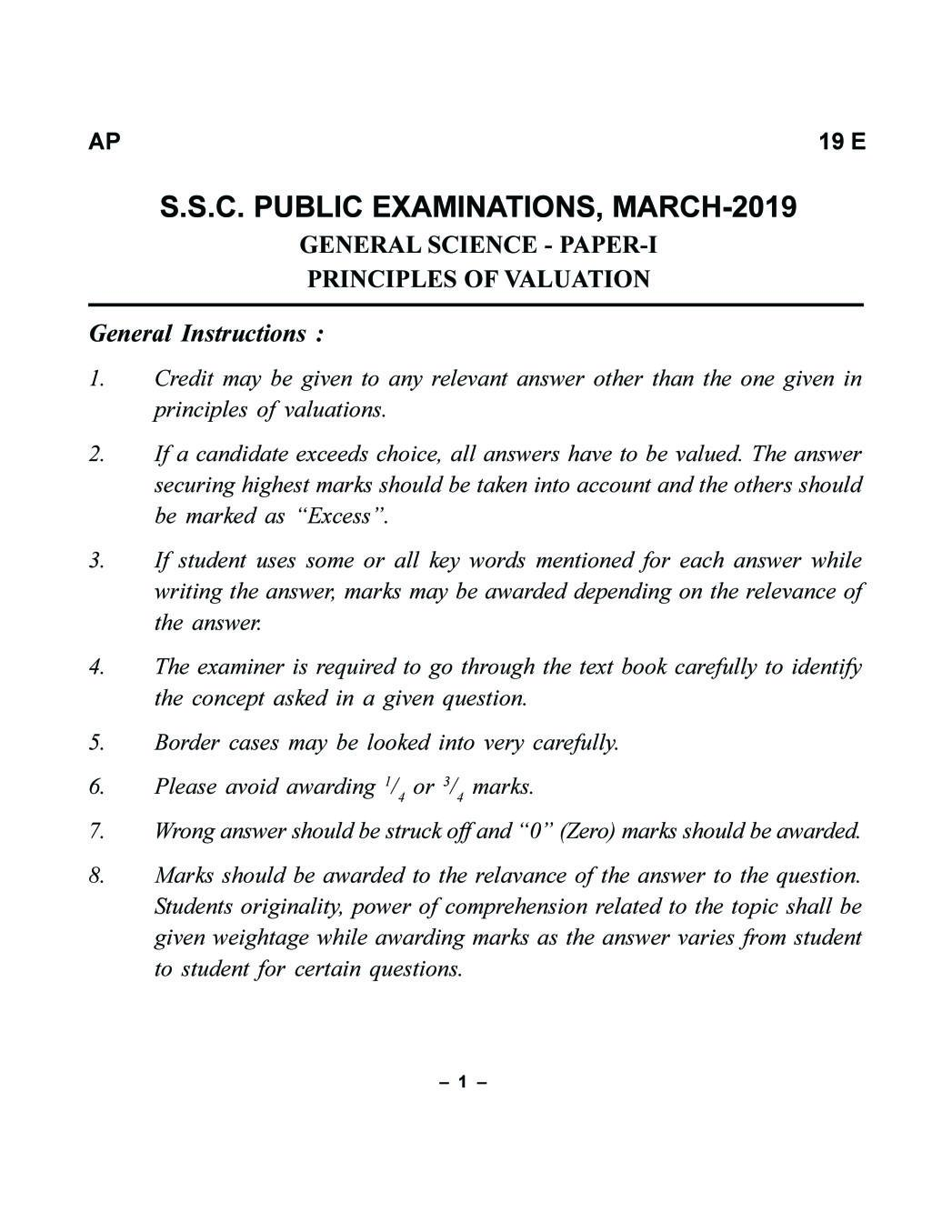
S.S.C. PUBLIC EXAMINATIONS, MARCH-2019
GENERAL SCIENCE - PAPER-I
PRINCIPLES OF VALUATION
General Instructions :
1. Credit may be given to any relevant answer other than the one given in
principles of valuations.
2. If a candidate exceeds choice, all answers have to be valued. The answer
securing highest marks should be taken into account and the others should
be marked as Excess.
3. If student uses some or all key words mentioned for each answer while
writing the answer, marks may be awarded depending on the relevance of
the answer.
4. The examiner is required to go through the text book carefully to identify
the concept asked in a given question.
5. Border cases may be looked into very carefully.
6. Please avoid awarding 1/4 or 3/4 marks.
7. Wrong answer should be struck off and 0 (Zero) marks should be awarded.
8. Marks should be awarded to the relavance of the answer to the question.
Students originality, power of comprehension related to the topic shall be
given weightage while awarding marks as the answer varies from student
to student for certain questions.
1
Page 2
PART-A
SECTION-I
Q.No. Description Key words Distribution
1. Principle of method of mixtures Method of 1M
Mixtures
2. Are all mirrors have same surfaces ?
(or)
Are the mirrors that generally
used in our home and rear view 1M
mirrors used by drivers same ?
(or)
Any other relevant question.
3. Mg Magnesium 1M
4. Cation (or) + ion
Positivity charged ion 1M
2
Page 3
Q.No. Description Key words Distribution
SECTION-II
5. 1) 'B' city B 1M
2) At 11 : 30 AM 1M
2M
6. a) Concave mirror 1M
b) Virtual image, erected image
and enlarged image 1M
Give one mark to any two
characteristics of the above
2M
7. Prism, Piece of white chart, 1M
Pencil, Pins, Scale and Protractor
To find the angle of minimum 1M
deviation graph is required.
2M
3
Page 4
Q.No. Description Key words Distribution
8. (X) Na 1/ M
2
Atomic size gradually decreases 1/ M
2
from left to right in a period.
(Y) Na 1/ M
2
Na is larger than Mg and
Mg is larger than Mg2+. 1/ M
2
Hence Na is larger than Mg2+
Note : Give 1/2 mark to any
other relevant suitable
explanation.
2M
9. 1) 2, 3-di ethyl-cyclo hexan-1-ol 1) 2, 3 di 1M
ethyl
cyclo
hexanol
2) Alcohol 2) OH 1M
2M
4
Page 5
Q.No. Description Key words Distribution
SECTION-III
10. Lenses are
i) used for correcting
eye defects 4 Marks
ii) Used as magnifying lens for any
iii) Used in Microscopes four points
iv) Used in Telescopes
v) Used in Binoculars
vi) Used in Cinema Projectors
vii) Used in Cameras
4M
(or)
Total consumption of current
in 30 days
= {(
3 × 40 × 5) + (2 × 80 × 12 ) + (5 × 60 × 1)}30
1000
1M
= (600 + 1920
1000
+ 300 )30 2820 × 30
=
1000
1M
= 84.6 KWH 1M
Cost of 1 unit (KWH) charge = Rs. 3.00/-
Cost of 84.6 KWH = 84.6 × 3
= Rs. 253.80/- 1M
4M
5
Page 6
Q.No. Description Key words Distribution
11. As per the balanced equation
2Al + Fe2O3 → Al2O3 + 2Fe
54U + 160U → 102U + 112U 1M
54 gm + 160 gm → 102 gm + 112 gm 1M
Aluminium → Iron
54 gms → 112 gms
54 kgs → 112 kgs 1M
Hence if 54 kg of Aluminium is used
we can get 112 kg of Iron. 1M
4M
6
Page 7
Q.No. Description Key words Distribution
(or)
Bohr's Model of Hydrogen Atom :
1) Electrons in an atom occupy Stationary
stationary orbits of fixed energy Orbits 1M
at different distances from the K, L, M, N ...
nucleus.
2) When an electron jumps from
a lower energy state to higher Absorbs or
energy state it absorbs energy emits energy 1M
or emits energy when such a jump
occur from a higher energy state to
a lower energy state.
3) The energies of an electron in an
atom can have only certain values
E1, E2, E3 ..... that is the energy is
quantized. The states
corresponding to these energies Energy 1M
are called stationary states and quantized
the possible values of the energy
are called energy levels.
Limitations :
Bohr's model failed to account for 1M
splitting of line spectra.
Note : Award marks to any relevant
Bohr's model and other limitations
of it also.
4M
7
Page 8
Q.No. Description Key words Distribution
12. Aim : To understand lateral shift
of light rays through glass slab.
Material required : Plank, Chart
paper, Clamps, Scale, Pencil, 1M
Thin glass slab and Pins.
Procedure :
1) Place a piece of chart on a plank
and clamp it.
2) Place a glass slab in the middle
of the paper. Draw boarder line
along the edges of the slab by
using a pencil. Name it as
A, B, C, D.
3) Draw normal line to AB at
mid point O. Draw an incident
ray to the normal with an
incident angle ∠ i .
8
Page 9
Q.No. Description Key words Distribution
4) On the incident ray fix the pins at
P and Q and looking into the
otherside fix another two points
R, S such that they appear 1M
in a straight line.
S e
R
1M
O
Q
P
9
Page 10
Q.No. Description Key words Distribution
Observation : The angles of
incidence and emergence are equal ∠i = ∠e
(∠i = ∠e )
Conclusion :
1) The incident and emergent rays
(PQ, RS) are parallel.
2) Measure the distance between
the parallel rays (PQ, RS). This
distance is called "Lateral Shift". 1M
4M
10
Page 11
Q.No. Description Key words Distribution
(or)
Aim : Reaction of bases with metals.
Materials required : Test tube,
deliverytube, glass trough, candle, 1M
soap water, NaOH solution and Zinc
granules.
Procedure :
1) Place a few granules of zinc metal
in a test tube and add
10 ml of sodium hydroxide
solution and warm the contents
of the test tube.
2) Pass the gas being evolved through
the soap water.
3) Bring a burning candle near 1M
the gas filled bubble.
11
Page 12
Q.No. Description Key words Distribution
Observations : We will notice the
gas evolved burns with a pop
sound indicating H2 Hydrogen 1M
The reaction is written as follows.
2NaOH + Zn → Na2ZnO2 + H2↑ 1M
Note : It is not possible of all metals.
(Marks should be awarded for any
other relevant activity.)
4M
13. AC Generator (or) DC Generator Dynamo 1M
Rotation
A
S
N B
Slip rings
Brushes
AC Generator
12
Page 13
Q.No. Description Key words Distribution
Rotation
A
S
N B
Commutator 3M
Brush
R
DC Generator
Note : Award 3 marks to any one of
AC or DC Generator. 4M
(or)
Magnetic Separation 1M
Powdered ore
Magnetic
wheel
Non Magnetic
wheel 3M
Moving belt
Non Magnetic ore Magnetic ore
Magnetic Separation
4M
13
Page 14
PART-B
SECTION-IV 20 × 1/2 M = 10 M
14. A 24. A
15. B 25. D
16. C 26. B
17. C 27. D
18. D 28. D
19. C 29. B
20. D 30. A
21. D 31. A
22. D 32. A
23. B 33. C
14
Document Details
| Board / Org | Andhra Pradesh Board |
| Exam | Class 10 |
| Type | Solution |
| Pages | 14 |
| Updated | 09 Jun 2026 |