NIOS Class 12 April 2024 Question Paper Sociology
Finished viewing? Save it for later —
Download NIOS Class 12 April 2024 Question Paper Sociology (PDF · 32 pages)About NIOS Class 12 April 2024 Question Paper Sociology
NIOS Class 12 April 2024 Question Paper Sociology is available here for free download. Published by NIOS for National Institute of Open Schooling Class 12, this question paper can be viewed online or downloaded as a PDF (32 pages). Candidates preparing for National Institute of Open Schooling Class 12 can use NIOS Class 12 April 2024 Question Paper Sociology to understand the exam pattern, the type of questions asked, and the overall difficulty level.
Frequently Asked Questions
How can I download NIOS Class 12 April 2024 Question Paper Sociology?
Open this page and click the Download button to save NIOS Class 12 April 2024 Question Paper Sociology as a PDF. It is completely free on AglaSem Docs.
Is NIOS Class 12 April 2024 Question Paper Sociology free to download?
Yes. NIOS Class 12 April 2024 Question Paper Sociology can be viewed online and downloaded as a PDF free of cost on AglaSem Docs.
How many pages does NIOS Class 12 April 2024 Question Paper Sociology have?
NIOS Class 12 April 2024 Question Paper Sociology contains 32 pages, which you can read online or download together as a single PDF.
Where can I find more National Institute of Open Schooling Class 12 study material?
You can find more National Institute of Open Schooling Class 12 question papers, sample papers, syllabus, and answer keys on AglaSem Docs.
NIOS Class 12 April 2024 Question Paper Sociology – Text
Read the full text of this question paper below — useful to quickly search, copy and reference the content online without downloading the PDF.
📄 View text version (32 pages)
Page 1
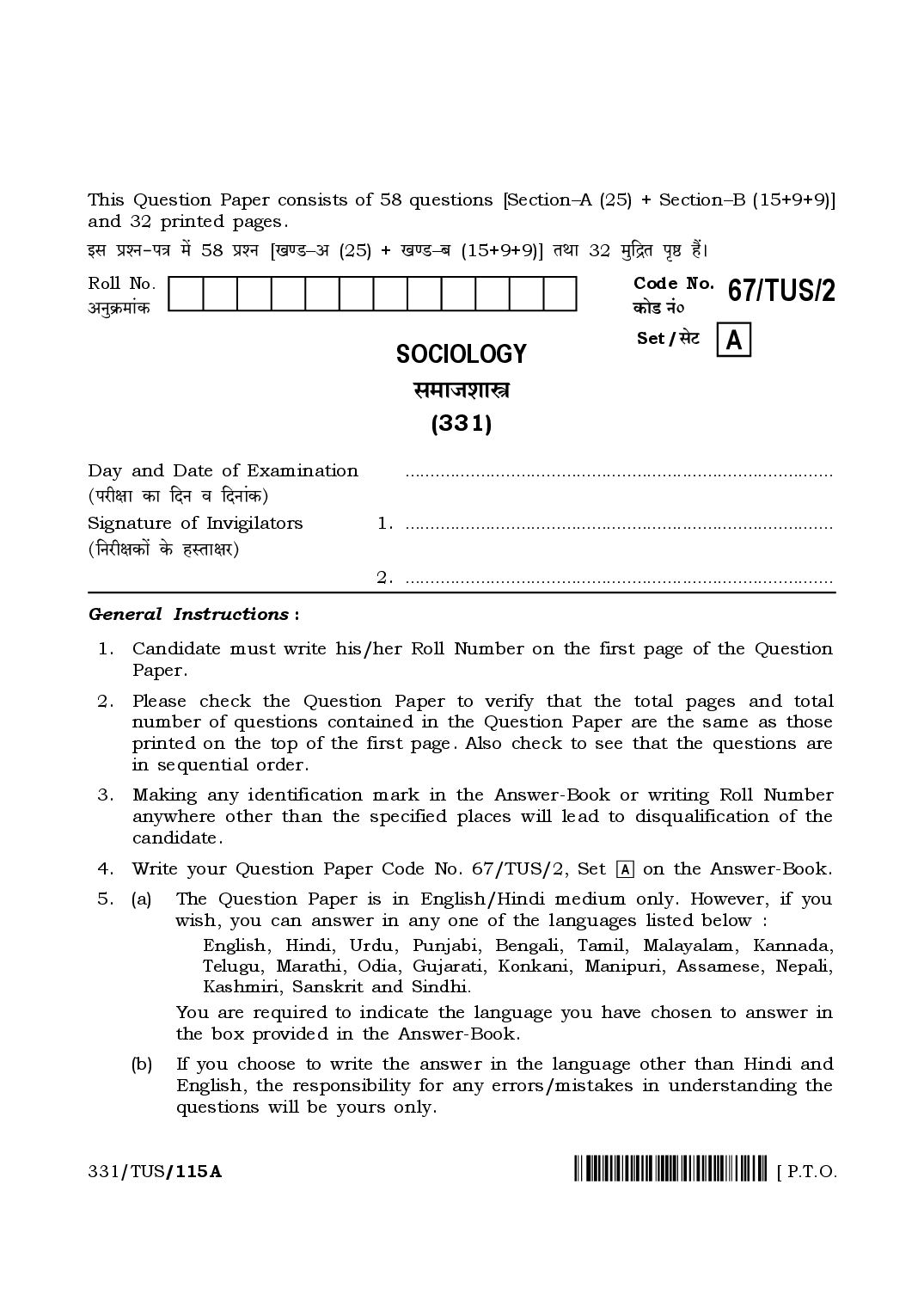
and 32 printed pages.
Bg àíZ-nÌ ‘| 58 àíZ [ IÊS>–A (25) + IÊS>–~ (15+9+9)] VWm 32 ‘w{ÐV n¥ð> h¢&
Roll No. Code No.
67/TUS/2
u
AZwH«$‘m§H$ H$moS> Z§0
Set / goQ>
SOCIOLOGY
g‘mOemó
(331)
Day and Date of Examination .....................................................................................
(narjm H$m {XZ d {XZm§H$)
Signature of Invigilators 1. .....................................................................................
({ZarjH$m| Ho$ hñVmja)
2. .....................................................................................
General Instructions :
1. Candidate must write his/her Roll Number on the first page of the Question
Paper.
2. Please check the Question Paper to verify that the total pages and total
number of questions contained in the Question Paper are the same as those
printed on the top of the first page. Also check to see that the questions are
in sequential order.
3. Making any identification mark in the Answer-Book or writing Roll Number
anywhere other than the specified places will lead to disqualification of the
candidate.
4. Write your Question Paper Code No. 67/TUS/2, Set u on the Answer-Book.
5. (a) The Question Paper is in English/Hindi medium only. However, if you
wish, you can answer in any one of the languages listed below :
English, Hindi, Urdu, Punjabi, Bengali, Tamil, Malayalam, Kannada,
Telugu, Marathi, Odia, Gujarati, Konkani, Manipuri, Assamese, Nepali,
Kashmiri, Sanskrit and Sindhi.
You are required to indicate the language you have chosen to answer in
the box provided in the Answer-Book.
(b) If you choose to write the answer in the language other than Hindi and
English, the responsibility for any errors/mistakes in understanding the
questions will be yours only.
331/TUS/115A [ P.T.O.
Page 2
1. narjmWu àíZ-nÌ Ho$ nhbo n¥ð> na AnZm AZwH«$‘m§H$ Adí¶ {bI|&
2. H¥$n¶m àíZ-nÌ H$mo Om±M b| {H$ àíZ-nÌ Ho$ Hw$b n¥ð>m| VWm àíZm| H$s CVZr hr g§»¶m h¡ {OVZr àW‘ n¥ð> Ho$ g~go
D$na N>nr h¡& Bg ~mV H$s Om±M ^r H$a b| {H$ àíZ H«${‘H$ ê$n ‘| h¢&
3. CÎma-nwpñVH$m ‘| nhMmZ-{M• ~ZmZo AWdm {Z{X©ï> ñWmZm| Ho$ A{V[aº$ H$ht ^r AZwH«$‘m§H$ {bIZo na narjmWu H$mo
A¶mo½¶ R>ham¶m Om¶oJm&
4. AnZr CÎma-nwpñVH$m na àíZ-nÌ H$m H$moS> Z§0 67/TUS/2, goQ u {bI|&
5. (H$) n«íZ-nÌ Ho$db {hÝXr/A§J«oOr ‘| h¡& {’$a ^r, ¶{X Amn Mmh| Vmo ZrMo Xr JB© {H$gr EH$ ^mfm ‘| CÎma Xo
gH$Vo h¢ …
A§J«oOr, {hÝXr, CXÿ©, n§Om~r, ~§Jbm, V{‘b, ‘b¶mb‘, H$Þ‹S>, VobwJy, ‘amR>r, C{‹S>¶m, JwOamVr, H$m|H$Ur,
‘{Unwar, Ag{‘¶m, Zonmbr, H$í‘rar, g§ñH¥$V Am¡a {gÝYr&
H¥$n¶m CÎma-nwpñVH$m ‘| {XE JE ~m°³g ‘| {bI| {H$ Amn {H$g ^mfm ‘| CÎma {bI aho h¢&
(I) ¶{X Amn {hÝXr Ed§ A§J«oOr Ho$ A{V[aº$ {H$gr Aݶ ^mfm ‘| CÎma {bIVo h¢, Vmo àíZm| H$mo g‘PZo ‘| hmoZo dmbr
Ìw{Q>¶m|/Jb{V¶m| H$s {Oå‘oXmar Ho$db AmnH$s hmoJr&
331/TUS/115A 2
Page 3
g‘mOemó
(331)
Time : 3 Hours ] [ Maximum Marks : 100
g‘¶ … 3 KÊQ>o ] [ nyUmªH$ … 100
Note : (i) This Question Paper consists of 49 questions in all.
(ii) All questions are compulsory.
(iii) Marks are given against each question.
(iv) Section—A consists of Question Nos. 1 to 25 and Section—B consists of
Question Nos. 26 to 49.
(a) Question Nos. 1 to 17 and 41 to 43—are Multiple-choice questions
(MCQs) carrying 1 mark each (1×20=20). Select and write the most
appropriate option (A, B, C or D). An internal choice has been
provided in some of these questions. You have to attempt only one
of the given choices in such questions.
(b) Question Nos. 18 to 25 and 44 to 47—are other Objective-type
questions. Q. Nos. 18, 19 and 21 carry 2 marks (with 2 sub-parts
of 1 mark each) and Q. No. 20 carries 5 marks (with 5 sub-parts of
1 mark each), Q. No. 22 carries 3 marks (with 3 sub-parts of
1 mark each), Q. Nos. 23, 24 and 25 carry 4 marks (with 4 sub-
parts of 1 mark each), as well as Q. Nos. 44 to 47 carry 1 mark
each. Attempt as per the instructions given therein with each such
question at 18 to 25 and 44 to 47.
(v) Section—B at numbers 26 to 49 consists of descriptive-type questions
as follows :
(a) Question Nos. 26 to 31 and 48—are Very short answer-type
questions carry 2 marks each (2×7=14), to be answered in the range
of 80 to 120 words.
(b) Question Nos. 32 to 38—are Short answer-type questions, carry
3 marks each (3×7=21), to be answered in the range of 150 to 200
words.
(c) Question Nos. 39, 40 and 49—are Long answer-type questions carry
5 marks each (5×3=15), to be answered in the range of 400 to 500
words.
(vi) For Optional Module, attempt all questions either from Optional
Module—I or Optional Module—II.
{ZX}e … (i) Bg àíZ-nÌ ‘| Hw$b 49 àíZ h¢&
(ii) g^r àíZ A{Zdm¶© h¢&
(iii) à˶oH$ àíZ Ho$ A§H$ CgHo$ gm‘Zo A§{H$V h¡§&
331/TUS/115A 3 [ P.T.O.
Page 4
(a) àíZ g§»¶m 1 go 17 Ed§ 41 go 43 ~hþ{dH$ënr¶ àíZ h¢, à˶oH$ H$m 1 A§H$ h¡
(1×20=20)& g~go Cn¶wº$ {dH$ën (A, B, C ¶m D) MwZH$a {b{IE& Hw$N> àíZm| ‘|
AmÝV[aH$ {dH$ën {X¶m J¶m h¡& Eogo àíZm| ‘| go {H$gr EH$ H$m CÎma Xr{OE&
(b) àíZ g§»¶m 18 go 25 Ed§ 44 go 47 Aݶ dñVw{Zð> àíZ h¡|& àíZ g§»¶m 18, 19 Ed§
21 ‘| à˶oH$ Ho$ 2 A§H$ h¢ (1 A§H$ dmbo 2 Cn-^mJmo§ g{hV) Ed§ àíZ g§»¶m 20 Ho$ 5
A§H$ h¢ (1 A§H$ dmbo 5 Cn-^mJmo§ g{hV), àíZ g§»¶m 22 Ho$ 3 A§H$ h¢ (1 A§H$ dmbo
3 Cn-^mJmo§ g{hV), àíZ g§»¶m 23, 24 Ed§ 25 ‘| à˶oH$ Ho$ 4 A§H$ h¢ (1 A§H$ dmbo
4 Cn-^mJmo§ g{hV), àíZ g§»¶m 44 go 47 ‘| à˶oH$ H$m 1 A§H$ h¡& BZ àíZm| Ho$ CÎma
18 go 25 VWm 44 go 47 ‘| {XE JE {ZX}emZwgma Xr{OE&
(v) IÊS>—I ‘| àíZ g§»¶m 26 go 49 VH$ dU©ZmË‘H$ àíZ h¢ :
(a) àíZ g§»¶m 26 go 31 Ed§ 48 A{V bKyÎmar¶ àíZ h¢, à˶oH$ Ho$ 2 A§H$ h¢ (2×7=14),
à˶oH$ H$m CÎma 80 go 120 eãXm| H$s gr‘m Ho$ A§Xa Xr{OE&
(b) àíZ g§»¶m 32 go 38 bKyÎmar¶ àíZ h¢, à˶oH$ Ho$ 3> A§H$ h¢ (3×7=21), à˶oH$ H$m
CÎma 150 go 200 eãXm| H$s gr‘m Ho$ A§Xa Xr{OE&
(c) àíZ g§»¶m 39, 40 Ed§ 49 XrK©-CÎmar¶ àíZ h¢, à˶oH$ Ho$ 5> A§H$ h¢ (5×3=15), à˶oH$
H$m CÎma 400 go 500 eãXm| H$s gr‘m Ho$ A§Xa Xr{OE&
(vi) d¡H$pënH$ ‘m°S²>¶yb Ho$ {bE, d¡H$pënH$ ‘m°S²>¶yb—I AWdm d¡H$pënH$ ‘m°S²>¶yb—II Ho$ g^r àíZm| Ho$
CÎma Xr{OE&
(1) Answers of all questions are to be given in the Answer-Book given to you.
g^r àíZm| Ho$ CÎma AmnH$mo Xr JB© CÎma-nwpñVH$m ‘| hr {bI|&
(2) 15 minutes time has been allotted to read this question paper. The question
paper will be distributed at 2:15 p.m. From 2:15 p.m. to 2:30 p.m., the
students will read the question paper only and will not write any answer on
the Answer-Book during this period.
Bg àíZ-nÌ H$mo n‹T>Zo Ho$ {bE 15 {‘ZQ> H$m g‘¶ {X¶m J¶m h¡& àíZ-nÌ H$m {dVaU Xmonha ‘|
2:15 ~Oo {H$¶m OmEJm& Xmonha 2:15 ~Oo go 2:30 ~Oo VH$ N>mÌ Ho$db àíZ-nÌ H$mo n‹T>|Jo Am¡a
Bg Ad{Y Ho$ Xm¡amZ do CÎma-nwpñVH$m na H$moB© CÎma Zht {bI|Jo&
SECTION—A
IÊS>—H$
Answer all multiple-choice questions : 1×17=17
g^r ~hþ{dH$ënr¶ àíZm| Ho$ CÎma Xr{OE :
1. (i) Which among the following is a feature of a community? 1
(A) It is associated with a definite territory
(B) Sense of belongingness is stronger
331/TUS/115A 4
Page 5
(D) All of the above
{ZåZ ‘| go g‘wXm¶ H$s {deofVm H$m¡Z-gr h¡?
(A) EH$ {ZpíMV joÌ go g§~§{YV
(B) AnZonZ H$s ‘O~yV ^mdZm
(C) EH$ ‘yV© ApñVËd
(D) Cn¶w©º$ g^r
Or / AWdm
(ii) In sociology, society refers to a sum total of _____ existing between
individuals.
(A) relationships (B) institutions
(C) associations (D) communities
g‘mOemó ‘| g‘mO ì¶{º$¶m| Ho$ ~rM ~Z aho _____ Ho$ ¶moJ H$s Amoa g§Ho$V H$aVm h¡&
(A) g§~§Ym| (B) g§ñWmAm|
(C) g§Km| (D) g‘wXm¶m|
2. (i) Which among the following is a feature of a socialist society as stated
by Marx? 1
(A) Ideal society
(B) No classes
(C) No struggle
(D) All of the above
{ZåZ ‘| go ‘m³g© Ûmam ~VmB© JB© g‘mOdmXr g‘mO H$s {deofVm H$m¡Z-gr h¡?
(A) AmXe© g‘mO
(B) dJm] H$m dJuH$aU Z hmo
(C) H$moB© g§Kf© Z hmo
(D) Cn¶w©º$ g^r
331/TUS/115A 5 [ P.T.O.
Page 6
(ii) When non-material culture does not adjust readily to material
changes, it results in
(A) diffusion (B) acculturation
(C) cultural lag (D) isolation
O~ A^m¡{VH$ g§ñH¥${V erK«Vm go ^m¡{VH$ n[adV©Zm| go Vmb‘ob Zht aI nmVr, V~ CgH$m ZVrOm
_____ hmoVm h¡&
(A) àgma (B) g§ñH¥${V-g§H«$‘U$
(C) gm§ñH¥${VH$ {nN>‹S>mnZ (D) EH$m§V
3. Elections are a form of political communication between the
(A) people
(B) political parties
(C) government and the governed
(D) None of the above 1
MwZmd ({Zdm©MZ) _____ Ho$ ~rM EH$ amOZ¡{VH$ g§dmX H$m¶‘ H$aVo h¢>&
(A) bmoJm|
(B) amOZ¡{VH$ nm{Q>©¶mo§
(C) emgH$ Am¡a em{gV
(D) Cn¶w©º$ ‘| go H$moB© Zht
4. Which of the following is an important feature of urban societies? 1
(A) Marriage (B) Kinship
(C) Anonymity (D) Personality
{ZåZ ‘| go ZJar¶ g‘mO H$s g~go ‘hÎdnyU© {deofVm H$m¡Z-gr h¡?
(A) {ddmh (B) ZmVoXmar
(C) Jw‘Zm‘r (D) ì¶{º$Ëd
331/TUS/115A 6
Page 7
(A) Association (B) Society
(C) Community (D) Neighbourhood
{ZåZ ‘| go ³¶m bmoJm| Ho$ Ûmam AnZo {d{eï> bú¶ H$s ny{V© Ho$ {bE ~Zm¶m J¶m h¡?
(A) g§K (B) g‘mO
(C) g‘wXm¶ (D) n‹S>mog
6. (i) Kins may not always be related by blood or marital ties rather there
might be imaginary relationships called
(A) consanguineal
(B) affinal
(C) fictive
(D) None of the above 1
ZmVoXma h‘oem EH$-Xÿgao go aº$ ¶m {ddmh Ûmam Ow‹S>o Zht hmoVo h¢ A{nVw H$B© ~ma ~mobMmb ‘|
BÝh| ZmVoXma ‘mZm OmVm h¡& Eogo ZmVoXma _____ H$hbmVo h¢&
(A) g‘aº$
(B) d¡dm{hH$
(C) H$mën{ZH$
(D) Cn¶w©º$ ‘| go H$moB© Zht
Or / AWdm
(ii) Mention the degree of kinship for example—Father’s brother’s wife,
father’s sister’s husband, etc., from those given below.
(A) Primary (B) Secondary
(C) Tertiary (D) Cousins
ZmVoXma H$s {ZH$Q>Vm Ho$ AmYma na {XE JE CXmhaU H$m àH$ma ~VmBE, CXmhaU—{nVm Ho$ ^mB©
H$s nËZr, {nVm H$s ~hZ H$m n{V, B˶m{X&
(A) àmW{‘H$ (B) {ÛVr¶H$
(C) V¥Vr¶H$ (D) ^mB©-~hZm| Ho$ ~ƒo
331/TUS/115A 7 [ P.T.O.
Page 8
(A) 62% (B) 64%
(C) 65% (D) 33% 1
gZ² 2001 H$s àmW{‘H$ OZJUZm [anmoQ>© Ho$ AZwgma, h‘mao Xoe ‘| _____ bmoJ gmja h¢&
(A) 62% (B) 64%
(C) 65% (D) 33%
8. (i) The first education policy in our country was formulated in
(A) 1960 (B) 1980
(C) 1784 (D) 1967 1
h‘mao Xoe ‘| nhbr {ejm Zr{V gZ² _____ ‘| bmJy H$s JB©&
(A) 1960 (B) 1980
(C) 1784 (D) 1967
Or / AWdm
(ii) As per the 1991 Census Report among States and Union Territories,
which State has the highest literacy rate?
(A) Orissa (B) Bihar
(C) Kerala (D) Karnataka
gZ² 1991 H$s OZJUZm [anmoQ>© Ho$ AZwgma, amÁ¶m| Am¡a H|$Ðem{gV àXoem| ‘| go {H$g amÁ¶ H$s
gmjaVm Xa g~go D±$Mr Wr?
(A) Amo{S>em (B) {~hma
(C) Ho$ab (D) H$Zm©Q>H$
331/TUS/115A 8
Page 9
stratification. 1
(A) Non-hereditary
(B) Does not permit mobility
(C) Endogamy is not strictly practised
(D) Achievement and skills are important
{ZåZ ‘| go Cg H$maU H$mo Mw{ZE, Omo gm‘m{OH$ ñVarH$aU H$s EH$ àUmbr Ho$ ê$n ‘| dJ© Ho$ ~mao ‘|
ghr Zht h¡&
(A) J¡a-d§emZwJV
(B) AnZo dJ© go D$na CR>Zo H$s ‘Zmhr
(C) gJmoÌ {ddmh H$m J§^raVm go nmbZ Z H$aZm
(D) CnbpãY¶m± Am¡a H$m¡eb ‘hÎdnyU© h¢
10. (i) Choose from the following the term that defines rules and norms that
are laid down by society for the conduct of its members. 1
(A) Laws (B) Mores
(C) Customs (D) Traditions
{ZåZ ‘| go Cg Q>‘© H$mo Mw{ZE Omo g‘mO Ûmam g‘mO Ho$ gXñ¶mo§ Ho$ AmMaU Ho$ {bE {ZYm©[aV
{Z¶‘m| Am¡a ‘mZX§S>m| H$mo n[a^m{fV H$aVm h¡&
(A) H$mZyZ (B) AmMma-{dMma
(C) àWmE± (D) naånamE±
Or / AWdm
(ii) Ferdinand Tonnies, a German sociologist, coined which of the
following terms?
(A) Bourgeoise
(B) Gemeinschaft
(C) Gesellschaft
(D) Both (B) and (C)
331/TUS/115A 9 [ P.T.O.
Page 10
(A) ny±Orn{V dJ©
(B) O¡{‘ZemâQ>
(C) OogobemâQ>
(D) (B) Am¡a (C) XmoZm|
11. (i) One of the major issues which India is facing is
(A) illiteracy (B) population explosion
(C) dowry (D) alcoholism 1
^maV {OZ à‘wI ‘wÔm| H$m gm‘Zm H$a ahm h¡, CZ‘| go EH$ h¡
(A) {ZajaVm (B) OZg§»¶m {dñ’$moQ>
(C) XhoO (D) EoëH$mohm°{bÁ‘
Or / AWdm
(ii) Dowry, nepotism, dishonesty, etc., are which of the following forms of
corruption?
(A) Social (B) Political
(C) Administrative (D) Professional
XhoO, ^mB©-^VrOmdmX, ~oB©‘mZr B˶m{X {H$g àH$ma Ho$ ^«ï>mMma h¢?
(A) gm‘m{OH$ (B) amOZr{VH$
(C) àemg{ZH$ (D) ì¶mdgm{¶H$
12. Which of the following defines the contextual view or field view of the
Indian social system? 1
(A) Jati
(B) Varna
(C) Caste
(D) None of the above
331/TUS/115A 10
Page 11
H$aVm h¡?
(A) Om{V
(B) dU©
(C) H$mñQ>
(D) Cn¶w©º$ ‘| go H$moB© Zht
13. (i) Daniel in his study of racial discrimination wished to discover the
extent of racial discrimination in
(A) Britain (B) France
(C) India (D) South Africa 1
Om{V ^oX^md Ho$ AnZo emoY ‘| S>o{Z¶b Zo OmVr¶ ^oX^md H$s gr‘m H$m nVm _____ ‘| bJmZm
Mmhm&
(A) {~«Q>oZ (B) ’«$m§g
(C) ^maV (D) X{jU A’«$sH$m
Or / AWdm
(ii) A society cannot be fully understood without comparing with other
(A) people
(B) institutions
(C) societies
(D) None of the above
EH$ g‘mO H$m nyU© Aܶ¶Z V~ VH$ Zht {H$¶m Om gH$Vm h¡ O~ VH$ CgH$s VwbZm Xÿgao _____
go Z H$s OmE&
(A) bmoJm|
(B) g§Km|
(C) g‘mOm|
(D) Cn¶w©º$ ‘| go H$moB© Zht
331/TUS/115A 11 [ P.T.O.
Page 12
governments have been created in the villages? 1
(A) Panchayati Raj
(B) Judicial system
(C) Reservation system
(D) None of the above
{H$g àUmbr H$s ewéAmV Ho$ ‘mܶ‘ go Jm±dm| ‘| ñWmZr¶ ñdemgZ H$m {Z‘m©U {H$¶m J¶m h¡?
(A) n§Mm¶Vr amO
(B) ݶm¶nm{bH$m àUmbr
(C) AmajU àUmbr
(D) Cn¶w©º$ ‘| go H$moB© Zht
15. (i) Which of the following groups is not an integral part of the caste
system? 1
(A) Scheduled Castes (B) Scheduled Tribes
(C) Backward Classes (D) OBCs
{ZåZ ‘| go H$m¡Z-gm g‘yh Om{V àUmbr H$m Am§V[aH$ A§J Zht h¡?
(A) AZwgy{MV Om{V¶m± (B) AZwgy{MV OZOm{V¶m±
(C) {nN>‹S>o dJ© (D) Aݶ {nN>‹S>o dJ©
Or / AWdm
(ii) Scheduled Tribes have been conscious of their identity since long, so
they organized movements against
(A) Zamindars
(B) Jagirdars
(C) British rule
(D) All of the above
331/TUS/115A 12
Page 13
Ho$ {Ibm’$ Am§XmobZ MbmE&
(A) O‘tXmam|
(B) OmJraXmam|
(C) {~«{Q>e amO
(D) Cn¶w©º$ g^r
16. Which of the following groups were not allowed to Sanskritize their
status? 1
(A) Brahmins
(B) Untouchables
(C) High castes
(D) None of the above
{ZåZ ‘| go {H$g g‘yh H$mo AnZo ñVa (àpñW{V) H$mo g§ñH¥$VrH$aU H$aZo H$s BOmOV Zht h¡?
(A) ~«m÷U
(B) ANy>V
(C) Cƒ Om{V¶m±
(D) Cn¶w©º$ ‘| go H$moB© Zht
17. (i) A neighbourhood or a village is good example of which of the
following? 1
(A) Community (B) Society
(C) Urbanization (D) Association
EH$ n‹S>mog ¶m Jm±d {ZåZ ‘| go {H$gH$m ~hþV AÀN>m CXmhaU h¡?
(A) g‘wXm¶ (B) g‘mO
(C) eharH$aU (D) g§K
331/TUS/115A 13 [ P.T.O.
Page 14
(ii) A society is a collection or aggregation of individuals. This definition
is given by
(A) sociologist (B) political scientist
(C) layman (D) anthropologist
EH$ g‘mO H$mo ì¶{º$¶m| Ho$ g‘yh ¶m g‘wƒ¶ Ho$ ê$n ‘| {ZåZ ‘| go {H$gZo n[a^m{fV {H$¶m?
(A) g‘mOemór (B) amOZ¡{VH$ d¡km{ZH$
(C) gmYmaU ì¶{º$ (D) ‘mZdemór
18. Fill in the blanks (any two) : 1×2=2
(a) The relationship between son-in-law and father-in-law is an example
of _____.
(consanguineal/affinal/avunculocal/descriptive)
(b) In terms of degree of kinship, the primary kins of our first degree kins
are our _____ kins.
(primary/secondary/tertiary/affinal)
(c) Kinship terms which are used by us for indirectly referring to a person
are known as kinship _____.
(terms of address/elementary terms/derivative terms/
terms of reference)
{H$Ýht Xmo [aº$ ñWmZmo| H$s ny{V© H$s{OE :
(H$) Xm‘mX Am¡a ggwa H$s ZmVoXmar _____ H$m CXmhaU h¡&
(g‘aº$/d¡dm{hH$/‘mVwb/{ddaUmË‘H$)
(I) {ZH$Q>Vm na AmYm[aV ZmVoXmar Ho$ AZwgma h‘mao àW‘ H$mo{Q> Ho$ ZmVoXma Ho$ àmW{‘H$ ZmVoXma h‘mao
_____ ZmVoXma hmoVo h¢&
(àmW{‘H$/{ÛVr¶H$/V¥Vr¶H$/d¡dm{hH$)
(J) ZmVoXmar nX, {OZH$m Cn¶moJ h‘ {H$gr Aà˶j ì¶{º$ Ho$ {bE H$aVo h¢ CÝh| _____ H$hVo h¢&
(gå~moYZ Ho$ VarHo$/àmapå^H$ nX/H¥${Ì‘ nX/g§X^©gyMH$ nX)
331/TUS/115A 14
Page 15
(a) Simple tribal societies do not have any rigid _____.
(system/institution/social stratification/kinship ties)
(b) The form of religion where tribals worship any non-living body like a
stone or wood is known as _____.
(totemism/naturism/animatism/animism)
(c) Tribals feel they are the sons of soil hence they have a strong sense
of _____ identity.
(caste/ethnic/religious/linguistic)
{H$Ýht Xmo [aº$ ñWmZmo| H$s ny{V© H$s{OE :
(H$) gab Am{Xdmgr g‘mO ‘| H$moB© H$R>moa _____ Zht hmoVm&
(àUmbr/g§ñWm/gm‘m{OH$ ñVarH$aU/ZmVoXmar g§§~§Y)
(I) Y‘© H$m dh ê$n, Ohm± Am{Xdmgr {H$gr O‹S> nXmW© O¡go nËWa ¶m bH$‹S>r H$mo nyOVo h¢, Cgo _____
Ho$ Zm‘ go OmZm OmVm h¡&
(Q>moQo>‘dmX/àH¥${VdmX/MoVZdmX/OrddmX)
(J) Am{Xdmgr AnZo Amn H$mo {‘Å>r H$s g§VmZ ‘mZVo h¢ Bg{bE CZHo$ A§Xa EH$ ‘O~yV _____ nhMmZ
H$s ^mdZm h¡&
(Om{V/OmVr¶/Ym{‘©H$/^mfmB©)
20. Fill in the blanks any five of the following (write in one word) : 1×5=5
(a) Joint family where extension of the family is along horizontal lines is
_____.
(b) Kibbutz is a unique family system found in _____.
(c) A family grouping made of husband-wife and relatives on both sides
is _____.
(d) The term which applies to only one particular kin category is known
as _____.
(e) The term that describes a person’s bilateral set of relatives is _____.
331/TUS/115A 15 [ P.T.O.
Page 16
directly rather through a third person or symbol is _____.
(g) A set of kins who traces their descent from a common ancestor
through known links is _____.
{ZåZ ‘| go {H$Ýht nm±M> [aº$ ñWmZm| H$s ny{V© H$s{OE (EH$ eãX ‘| {b{IE) :
(H$) g§¶wº$ n[adma, Omo {dñV¥V h¡ Am¡a Bg‘| n[adma Ho$ ^mB© EH$ hr N>V Ho$ ZrMo ahVo h¢, h¡ _____&
(I) {H$~wQ²>O EH$ AZmoIr n[adma àUmbr h¡ Omo _____ ‘| nmB© OmVr h¡&
(J) Eogo n[adma H$m g‘yh, {Og‘| n{V-nËZr Am¡a XmoZm| Va’$ Ho$ [aíVoXma hm|, h¡ _____&
(K) dh nX, Omo {H$gr EH$ {deof ZmVoXmar H$s loUr na bmJy hmoVm h¡, h¡ _____&
(L>) EH$ ì¶{º$ Ho$ ‘mV¥ Am¡a {nV¥ XmoZm| d§eH«$‘m| H$mo Xem©Zo dmbm nX _____ H$hbmVm h¡&
(M) Xmo ZmVoXmam| Ho$ ~rM O~ H$moB© à˶j ê$n go ~mVMrV Zht hmoVr h¡, ~pëH$ Vrgao ì¶{º$ Ho$ ‘mܶ‘
go gå~moYZ hmoVm h¡, Vmo Cgo _____ H$hVo h¢&
(N>) EH$ Eogo ZmVoXmamo§ H$m g‘yh, Omo EH$ g‘mZ nyd©O AWdm d§e go n[a{MV H${‹S>¶m| Ho$ ‘mܶ‘ go
g§~Õ hmoVo h¢, h¡ _____&
21. Write True or False (any two) : 1×2=2
(a) Rhythms of nature, cycle of night and day, seasons of sowing, reaping,
harvesting, etc., are examples of fluctuating change.
(b) Conflict theory states that every pattern of action, belief and
interaction tends to generate an opposing reaction.
(c) Social change is a universal process.
ghr ¶m JbV {b{IE (H$moB© Xmo) :
(H$) àH¥${V H$s b¶, amV Am¡a {XZ H$m MH«$, ~wAmB©, H$Q>mB© Ho$ ‘m¡g‘ Am{X CVma-M‹T>md (Xmobm¶‘mZ
n[adV©Z) Ho$ àVrH$ h§¡&
(I) g§Kf© Ho$ {gÕm§V Ho$ AZwgma à˶oH$ àH$ma H$s {H«$¶m, {dídmg Am¡a AÝV{H«©$¶m EH$ {dnarV
à{V{H«$¶m H$mo OÝ‘ XoZo H$m à¶ËZ H$aVr h¡&
(J) gm‘m{OH$ n[adV©Z EH$ {dídì¶mnr à{H«$¶m h¡&
331/TUS/115A 16
Page 17
(a) Every group is structurally organized.
(b) Nomenclature is not a characteristic of a social group.
(c) Family as an association is a group whereas an institution family is
not a group.
(d) Based on the presence or absence of formal rules, groups can be
defined as formal or informal.
(e) Open groups are those where membership is not voluntary.
ghr ¶m JbV {b{IE (H$moB© VrZ) :
(H$) à˶oH$ g‘yh g§aMZmË‘H$ ê$n go g§J{R>V h¡&
(I) Zm‘nÕ{V gm‘m{OH$ g‘yh H$s {deofVm Zht h¡&
(J) n[adma EH$ g{‘{V Ho$ ê$n ‘| EH$ g‘yh h¡ O~{H$ EH$ g§ñWm Ho$ ê$n ‘| g‘yh Zht h¡&
(K) {H$gr Am¡nMm[aH$ {Z¶‘ H$s CnpñW{V AWdm AZwnpñW{V ‘| g‘yh H$mo Am¡nMm[aH$ ¶m AZm¡nMm[aH$
g‘yh ‘| n[a^m{fV {H$¶m Om gH$Vm h¡&
(L>) Iwbm g‘yh dh h¡ {OgH$s gXñ¶Vm EopÀN>H$ Zht hmoVr h¡&
23. Answer any four (Assertion, Reasoning) : 1×4=4
{H$Ýht Mma Ho$ CÎma Xr{OE (Xmdm, VH©$) :
(i) Based on the following, identify the correct option :
Assertion (A) : The direction of evolution cannot be reversed from the
complex stage to the simple stage.
Reason (R) : Evolution is an irreversible process.
(A) (A) is true, but (R) is false
(B) (A) is false, but (R) is true
(C) Both (A) and (R) are true
(D) Both (A) and (R) are false
331/TUS/115A 17 [ P.T.O.
Page 18
Xmdm (A) : H«${‘H$ {dH$mg H$s J{Verb {Xem O{Q>b pñW{V go gmYmaU H$s Amoa Zht bm¡Q>mB©
Om gH$Vr&
VH©$ (R) : H«${‘H$ {dH$mg EH$ An[adV©Zr¶ à{H«$¶m h¡&
(A) (A) ghr h¡, na (R) JbV h¡
(B) (A) JbV h¡, na (R) ghr h¡
(C) (A) Am¡a (R) XmoZm| ghr h¢
(D) (A) Am¡a (R) XmoZm| JbV h¢
(ii) Based on the following, identify the correct option :
Assertion (A) : Social change is not a value-neutral phenomenon.
Reason (R) : Subjective preference of different people is not given
importance while studying social change.
(A) (A) is true, but (R) is false
(B) (A) is false, but (R) is true
(C) Both (A) and (R) are true
(D) Both (A) and (R) are false
{ZåZ Ho$ AmYma na ghr {dH$ën H$mo nhMm{ZE :
Xmdm (A) : gm‘m{OH$ n[adV©Z ‘yë¶-VQ>ñW àH«$‘ Zht h¡&
VH©$ (R) : {d{^Þ bmoJm| H$s {df¶JV ¶m ì¶{º$JV ng§X H$mo gm‘m{OH$ n[adV©Z Ho$ Aܶ¶Z ‘|
‘hÎd Zht {X¶m OmVm&
(A) (A) ghr h¡, na (R) JbV h¡
(B) (A) JbV h¡, na (R) ghr h¡
(C) (A) Am¡a (R) XmoZm| ghr h¢
(D) (A) Am¡a (R) XmoZm| JbV h¢
331/TUS/115A 18
Page 19
Assertion (A) : In French Revolution, the rule of the emperor came to
an end suddenly.
Reason (R) : Revolution is a sudden and abrupt overthrow of the
existing social order.
(A) (A) is true, but (R) is false
(B) (A) is false, but (R) is true
(C) Both (A) and (R) are true
(D) Both (A) and (R) are false
{ZåZ Ho$ AmYma na ghr {dH$ën H$mo nhMm{ZE :
Xmdm (A) : ’«$m§g H$s amÁ¶H«$m§{V ‘| g‘«mQ> H$s gÎmm EH$X‘ g‘má hmo JB© Wr&
VH©$ (R) : ‘m¡OyXm gm‘m{OH$ ì¶dñWm H$mo AMmZH$ Am¡a AmH$pñ‘H$ CIm‹S> ’|$Ho$ OmZo H$s pñW{V
H«$m§{V hmoVr h¡&
(A) (A) ghr h¡, na (R) JbV h¡
(B) (A) JbV h¡, na (R) ghr h¡
(C) (A) Am¡a (R) XmoZm| ghr h¢
(D) (A) Am¡a (R) XmoZm| JbV h¢
(iv) Based on the following, identify the correct option :
Assertion (A) : The notion of development is not a recent
phenomenon.
Reason (R) : It is a strategy of unplanned social change.
(A) (A) is true, but (R) is false
(B) (A) is false, but (R) is true
(C) Both (A) and (R) are true
(D) Both (A) and (R) are false
331/TUS/115A 19 [ P.T.O.
Page 20
Xmdm (A) : {dH$mg H$s AdYmaUm hmb hr Ho$ dfm] ‘| {dH${gV Zht hþB© h¡&
VH©$ (R) : ¶h EH$ A{Z¶mo{OV gm‘m{OH$ n[adV©Z H$s aUZr{V hmoVr h¡&
(A) (A) ghr h¡, na (R) JbV h¡
(B) (A) JbV h¡, na (R) ghr h¡
(C) (A) Am¡a (R) XmoZm| ghr h¢
(D) (A) Am¡a (R) XmoZm| JbV h¢
(v) Based on the following, identify the correct option :
Assertion (A) : Socialization is a social process.
Reason (R) : It helps the child to grow and develop physically and
mentally.
(A) (A) is true, but (R) is false
(B) (A) is false, but (R) is true
(C) Both (A) and (R) are true
(D) Both (A) and (R) are false
{ZåZ Ho$ AmYma na ghr {dH$ën H$mo nhMm{ZE :
Xmdm (A) : g‘mOrH$aU EH$ gm‘m{OH$ à{H«$¶m h¡&
VH©$ (R) : ¶h ~ƒo H$s emar[aH$ Am¡a ‘mZ{gH$ d¥{Õ Am¡a {dH$mg ‘| ghm¶Vm H$aVr h¡&
(A) (A) ghr h¡, na (R) JbV h¡
(B) (A) JbV h¡, na (R) ghr h¡
(C) (A) Am¡a (R) XmoZm| ghr h¢
(D) (A) Am¡a (R) XmoZm| JbV h¢
331/TUS/115A 20
Page 21
Assertion (A) : The agents of socialization are school, family, social
norms and values of society.
Reason (R) : These are egalitarian forces.
(A) (A) is true, but (R) is false
(B) (A) is false, but (R) is true
(C) Both (A) and (R) are true
(D) Both (A) and (R) are false
{ZåZ Ho$ AmYma na ghr {dH$ën H$mo nhMm{ZE :
Xmdm (A) : g‘mOrH$aU Ho$ ‘mܶ‘ {dÚmb¶, n[adma, gm‘m{OH$ à{V‘mZ VWm g‘mO Ho$ Z¡{VH$
‘yë¶ hmoVo h¢&
VH©$ (R) : ¶o g‘Vm‘ybH$ e{º$¶m± h¢
(A) (A) ghr h¡, na (R) JbV h¡
(B) (A) JbV h¡, na (R) ghr h¡
(C) (A) Am¡a (R) XmoZm| ghr h¢
(D) (A) Am¡a (R) XmoZm| JbV h¢
24. Match Column—A with Column—B (any four) : 1×4=4
Column—A Column—B
(a) Family in which one is born (i) Functions of a family
(b) A form of family based on residence (ii) Family of orientation
(c) Socialization of children and (iii) Urbanization
enculturation
(d) Families where husband and wife (iv) Avunculocal
both are earning but don’t have
children
(e) A factor that has brought changes (v) Familistic organization
in the family
(f) Joint family in India is a (vi) DINKS
331/TUS/115A 21 [ P.T.O.
Page 22
H$m°b‘—A H$m°b‘—B
(a) n[adma {Og‘| ì¶{º$ H$m OÝ‘ hþAm h¡ (i) n[adma Ho$ àH$m¶©
(b) {Zdmg ñWmZ na AmYm[aV n[adma H$m àH$ma (ii) A{^{dݶmg H$m n[adma
(c) ~ƒmo§ H$m g‘mOrH$aU Am¡a g§ñH¥${VH$aU (iii) eharH$aU
(d) Eogo n[adma, {OZ‘| n{V Am¡a nËZr XmoZm| H$s Am¶ (iv) ‘mVwb ñWmZr¶ (Edݳ¶wbmoH$b)
hmoVr h¡, bo{H$Z CZH$m H$moB© ~ƒm Zht hmoVm
(e) EH$ H$maU Omo n[adma ‘| n[adV©Z bmVm h¡ (v) ¶h EH$ n[admadmXr g§JR>Z h¡
(f) ^maV ‘| g§¶wº$ n[adma h¡ EH$ (vi) DINKS
25. Read the passage carefully and then answer the questions that follow
(any four) : 1×4=4
The followers of Judaism are known as Jews. The ancient Indian
settlements of Jews are in Cochin and Maharashtra. The Jews of Cochin
have maintained their religious identity for at least a millennium. It was
in 1020 AD that the King of Cochin gave the Jews the right to live and
enjoy privileges, such as the right to ride elephants and to go with a state
umbrella, etc. Later, the Jews came to be divided into two groups—the
White Jews, who were lighter in their skin color and traced their kinship
to the original migrants and the Black Jews who were dark skinned.
By contrast the Jews in Maharashtra are large in number. These Jews are
known as Bene Israel, i.e., Sons of Israel. They live in several Konkani—
speaking villages as oil pressers, since oil pressing is not a prestigious
occupation, they do not rank high in their villages. As they do not work
on Saturdays, they are also known as Saturday Oilmen.
(a) Name the religion of the Jews. 1
(b) Name the ancient Indian settlements of the Jews. 1
(c) Mention the rights and privileges granted by the King of Cochin for the
Jews. 1
(d) Differentiate between the ‘White Jews’ and ‘Black Jews’. 1
(e) What were the Jews of Maharashtra called? 1
(f) Why were the Jews of Maharashtra also called ‘Saturday Oilmen’? 1
331/TUS/115A 22
Page 23
¶hÿXr Y‘© Ho$ ‘mZZo dmbmo§ H$mo ¶hÿXr H$hVo h¢& nwamZo ^maVr¶ ¶hÿ{X¶m| Ho$ Ka ¶m Amdmg H$moMrZ Ed§
‘hmamï´> ‘| h¢& H$moMrZ Ho$ ¶hÿ{X¶m| Zo AnZr nhMmZ H$‘-go-H$‘ EH$ {‘bo{Z¶‘ go ~Zm aIr h¡& H$hVo
h¢ {H$ 1020 eVmãXr ‘| H$moMrZ Ho$ amOm Zo ¶hÿ{X¶m| H$mo OrdZ-{Zdm©h H$m A{YH$ma d {deof A{YH$ma
{XE Wo& BZ {deof A{YH$mam| ‘| hmWr H$s gdmar Am¡a amOH$s¶ N>Var H$mo boH$a MbZm Wm& ~mX ‘|
¶o ¶hÿXr Xmo g‘yhm| ‘| ~±Q> J¶o—nhbm g‘yh ídoV ¶hÿXr {OZH$s ËdMm gµ’o$X Wr Am¡a Omo AnZo AmnH$mo
‘m¡{bH$ ¶hÿXr ‘mZVo Wo, Xÿgam g‘yh dh {OZH$m a§J H$mbm Wm&
‘hmamï´> ‘| ¶hÿ{X¶mo§ H$s g§»¶m A{YH$ h¡& ¶o ~oZo BOamBb ¶mZr BOamBb Ho$ nwÌ H$hbmVo h¢& H$mo§H$Ur
^mfm ~mobZo dmbo Hw$N> Jm±dm| ‘| ¶o ahVo h¢ Am¡a Vob H$m Y§Ym H$aVo h¢ ³¶m|{H$ Vobr H$m Y§Ym à{V{ð>V
ì¶dgm¶ Zht h¡, BÝh| Jm±dmo§ ‘| D±$Mm XOm© Zht {X¶m OmVm h¡& ¶o e{Zdma H$mo H$m‘ Zht H$aVo AV…
BÝh| e{Zdmar Vobr ^r H$hVo h¢&
(H$) ¶hÿ{X¶m| Ho$ Y‘© H$m Zm‘ {b{IE&
(I) nwamZo g‘¶ ‘| ^maV ‘| ¶hÿ{X¶mo§ H$s ~pñV¶m| Ho$ Zm‘ {b{IE&
(J) H$moMrZ Ho$ amOm Ûmam ¶hÿ{X¶m| H$mo {XE JE A{YH$mam| d {deof A{YH$mam| H$m C„oI H$s{OE&
(K) "ídoV ¶hÿXr' Am¡a "H$mbo ¶hÿXr' ‘| A§Va ñnï> H$s{OE&
(L>) ‘hmamï´> Ho$ ¶hÿXr ³¶m H$hbmVo Wo>?
(M) ‘hmamï´> Ho$ ¶hÿXr "e{Zdmar Vobr' ^r ³¶m| H$ho OmVo Wo>?
SECTION—B
IÊS>—I
Answer the following questions in around 80 to 120 words each :
{ZåZ{b{IV ‘| go à˶oH$ àíZ H$m CÎma bJ^J 80 go 120 eãXm| ‘| {b{IE :
26. What is functionalist perspective in Sociology? 2
g‘mOemó ‘| H$m¶©j‘ {d{Y (àH$m¶m©Ë‘H$ n[aàoú¶) ³¶m h¡?
27. Distinguish between hypergamy and hypogamy. 2
AZwbmo‘ Am¡a à{Vbmo‘ {ddmh ‘| A§Va ñnï> H$s{OE&
Or / AWdm
Distinguish between ‘natural inequalities between people’ and ‘social
inequalities’.
"bmoJm| ‘| àmH¥${VH$ J¡a-~am~ar' Am¡a "gm‘m{OH$ J¡a-~am~ar' ‘| A§Va ñnï>> H$s{OE&
331/TUS/115A 23 [ P.T.O.
Page 24
a service class? 2
H$mb© ‘m³g© Ho$ AZwgma, emgH$ dJ© Am¡a godm dJ© ‘| ³¶m A§Va hmoVm h¡?
29. What was the task and recommendation of the Mandal Commission that
was instituted in 1979? 2
‘ÊS>b H$‘reZ, Omo 1979 ‘| J{R>V hþAm Wm, CgH$m CÔoí¶ Am¡a {g’$m[ae ³¶m Wt?
30. State how mores function as social control agents. 2
bmoH$mMma gm‘m{OH$ {Z¶§ÌU EO|Q> Ho$ ê$n ‘| {H$g àH$ma H$m‘ H$aVo h§¡?
31. Explain the political causes of poverty. 2
Jar~r Ho$ amOZ¡{VH$ H$maUm| H$m C„oI H$s{OE&
Or / AWdm
Explain the second stage of population transition.
OZg§»¶m g§H«$‘U H$s Xÿgar AdñWm H$m dU©Z H$s{OE&
Answer the following questions in around 150 to 200 words each :
{ZåZ{b{IV ‘| go à˶oH$ àíZ H$m CÎma bJ^J 150 go 200 eãXm| ‘| {b{IE :
32. Discuss the relationship between Sociology and Economics. 3
g‘mOemó Ed§ AW©emó Ho$ ~rM g§~§Y H$m C„oI H$s{OE&
33. Discuss interviews as a technique of data collection. 3
gmjmËH$ma Am±H$‹S>o EH$Ì H$aZo H$s EH$ VH$ZrH$ h¡, Bg na MMm© H$s{OE&
34. Mention the features of Westernization. 3
npíM‘rH$aU H$s {deofVmAm| H$m dU©Z H$s{OE&
35. “School and educational institutions are important agents of socialization.”
Justify. 3
""{dÚmb¶ Am¡a e¡j{UH$ g§ñWmE± g‘mOrH$aU Ho$ ‘hÎdnyU© ‘mܶ‘ h¢&'' {ddoMZm H$s{OE&
331/TUS/115A 24
Page 25
Discuss family as an agent of socialization. ½×6=3
n[adma g‘mOrH$aU H$m EH$ ‘mܶ‘ h¡& C„oI H$s{OE&
36. Explain the purpose of social control. 3
gm‘m{OH$ {Z¶§ÌU Ho$ A{^àm¶ (CÔoí¶) H$m dU©Z H$s{OE&
Or / AWdm
Differentiate between informal and formal means of social control.
gm‘m{OH$ {Z¶§ÌU Ho$ AZm¡nMm[aH$ Am¡a Am¡nMm[aH$ gmYZmo§ ‘| A§Va ñnï> H$s{OE&
37. Justify with suitable reasons as to why Scheduled Tribes are facing an
identity crisis. 3
AZwgy{MV OZOm{V¶m± AnZr nhMmZ Ho$ g§H$Q> go ³¶m| OyP ahr h¢, C{MV H$maUm| go Am¡{M˶ {gÕ
H$s{OE&
38. Discuss the prohibitive rules of marriage in the selection of marital
partners. 3
OrdZ-gmWr Ho$ daU Ho$ {bE {ddmh Ho$ {ZfoYmË‘H$ {Z¶‘m| H$s MMm© H$s{OE&
Or / AWdm
Discuss Weber’s idea of ‘Ruling class’ as opposed to Karl Marx.
H$mb© ‘m³g© Ho$ "emgH$ dJ©' Ho$ ~mao ‘| {XE JE {dMmam| go AbJ do~a H$s AmbmoMZm na MMm© H$s{OE&
Answer the following questions in around 400 to 500 words each :
{ZåZ{b{IV ‘| go à˶oH$ àíZ H$m CÎma bJ^J 400 go 500 eãXm| ‘| {b{IE :
39. Describe the socio-economic problems of population explosion. (Any five
points) 1×5=5
OZg§»¶m {dñ’$moQ> H$s gm‘m{OH$-Am{W©H$ g‘ñ¶mAm| H$m dU©Z H$s{OE& (H$moB© nm±M q~Xþ)
40. Identify and explain the changes brought about in the functions of a
family. 5
n[adma Ho$ H$m¶m] ‘| AmE n[adV©Zm| H$mo nhMm{ZE Am¡a CZH$m C„oI H$s{OE&
Or / AWdm
Define joint family. Highlight the characteristics of a joint family system.
g§¶wº$ n[adma H$mo n[a^m{fV H$s{OE& g§¶wº$ n[adma àUmbr H$s {deofVmAm| na àH$me S>m{bE&
331/TUS/115A 25 [ P.T.O.
Page 26
( Status of Women )
d¡H$pënH$ ‘m°S²>¶yb>–I
( ‘{hbmAm| H$m gm‘m{OH$ ñVa )
41. Name the reformer whose name is associated with the Child Marriage
Restraint Act of 1929. 1
(A) Raja Ram Mohan Roy (B) Ishwar Chandra Vidyasagar
(C) Har Bilas Sarda (D) Dayanand Saraswati
~mb {ddmh {ZamoYH$ A{Y{Z¶‘, 1929 {H$g gwYmaH$ Ho$ Zm‘ Ho$ gmW Ow‹S>r h¡?
(A) amOm am‘ ‘mohZ am¶ (B) B©ídaMÝÐ {dÚmgmJa
(C) ha{~bmg emaXm (D) X¶mZ§X gañdVr
42. Who founded Maharashtra’s first school for Dalit girls? 1
(A) Maharshi Karve (B) Jyotiba Phule
(C) B. R. Ambedkar (D) Pandita Ramabai
‘hmamï´> ‘| X{bV b‹S>{H$¶m| Ho$ {bE nhbo {dÚmb¶ H$s ñWmnZm {H$gZo H$s?
(A) ‘h{f© H$d} (B) Á¶mo{V~m ’w$bo
(C) ~r0 Ama0 A§~oS>H$a (D) n§{S>Vm a‘m~mB©
43. Which Act confers, self-earned property with equal share in ancestral
property, rights on women? 1
(A) The Dowry Prohibition Act of 1961
(B) The Equal Remuneration Act, 1976
(C) The Hindu Marriage Act of 1955
(D) The Hindu Succession Act, 1956
331/TUS/115A 26
Page 27
¶h {H$g A{Y{Z¶‘ Ho$ A§VJ©V AmVm h¡?
(A) XhoO {ZfoY A{Y{Z¶‘, 1961
(B) g‘mZ doVZ A{Y{Z¶‘, 1976
(C) {hÝXÿ {ddmh A{Y{Z¶‘, 1955
(D) {hÝXÿ CÎmam{YH$ma A{Y{Z¶‘, 1956
Or / AWdm
Which of the following Acts provides for payment of equal wages for men
and women for equal work?
(A) The Dowry Prohibition Act of 1961
(B) The Equal Remuneration Act, 1976
(C) The Hindu Marriage Act of 1955
(D) The Hindu Succession Act, 1956
{ZåZ{b{IV ‘| go H$m¡Z-go A{Y{Z¶‘ Ho$ AZwgma nwéf d ór H$mo g‘mZ H$m‘ H$aZo Ho$ {bE g‘mZ
doVZ H$m àmdYmZ h¡?
(A) XhoO {ZfoY A{Y{Z¶‘, 1961
(B) g‘mZ doVZ A{Y{Z¶‘, 1976
(C) {hÝXÿ {ddmh A{Y{Z¶‘, 1955
(D) {hÝXÿ CÎmam{YH$ma A{Y{Z¶‘, 1956
44. The sex ratio in India as per 2001 Census is _____.
(Fill in the blank) 1
gZ² 2001 H$s OZJUZm Ho$ AZwgma, ^maV ‘| qbJ AZwnmV _____ h¡&
([aº$ ñWmZ ^[aE)
45. A woman in the Mahabharata who exhibited a greater sense of
independence and courage was main heroine _____.
(Fill in the blank) 1
‘hm^maV H$s ‘w»¶ Zm{¶H$m _____ H$mo EH$ gmhgr Am¡a ñdVÝÌ ór Ho$ ê$n ‘| aIm h¡&
([aº$ ñWmZ ^[aE)
331/TUS/115A 27 [ P.T.O.
Page 28
During the period of _____, child marriage was encouraged and widow
marriage was looked down upon.
(Fill in the blank)
_____ Ho$ ¶wJ ‘| ~mb-{ddmh H$mo ~‹T>mdm {X¶m OmVm Wm Am¡a {dYdm {ddmh H$mo hrZ Ñ{ï> go XoIm
OmVm Wm&
([aº$ ñWmZ ^[aE)
46. The marriage in which a man has more than one wife
(Define in one word) 1
Eogm {ddmh, {Og‘| EH$ ì¶{º$ H$s EH$ go A{YH$ npËZ¶m± hmo§
(EH$ eãX ‘| n[a^m{fV H$s{OE)
Or / AWdm
_____ refers to the number of females per 1000 males.
(Fill in the blank)
_____ ~VmVm h¡, à{V 1000 nwéfmo§ na {ó¶m| H$s g§»¶m&
([aº$ ñWmZ ^[aE)
47. Feminists use terms such as patriarchy, male domination, female
subordination, etc., to explain gender discrimination.
(Write True or False) 1
‘{hbmdmXr Eogr AdYmaUmAm| H$mo H$m‘ ‘| bmVo h¢ O¡go {H$ {nV¥gÎmmË‘H$Vm, nwéf à^wËd, ór AYrZñWVm
Am{X {OZgo b¢{JH$ ^oX^md ñnï> ê$n go {XImB© XoVm h¡&
(ghr ¶m JbV {b{IE)
48. Differentiate between organized and unorganized sectors. 2
g§J{R>V Am¡a Ag§J{R>V joÌm| ‘| A§Va ñnï> H$s{OE&
Or / AWdm
Under what circumstances can gender equality be achieved?
{H$Z n[apñW{V¶m| Ho$ A§VJ©V b¢{JH$ g‘mZVm H$mo àmá {H$¶m Om gH$Vm h¡?
331/TUS/115A 28
Page 29
discrimination must be completely eliminated from the educational
system, yet it persists. Give reasons. (Any five points) 1×5=5
1986 ‘| ~Zr amï´>r¶ {ejm Zr{V Zo ¶h ~hþV ñnï> ê$n go H$hm h¡ {H$ b¢{JH$ ^oX^md H$mo {ejm ì¶dñWm
go EH$X‘ hQ>m XoZm Mm{hE na A^r VH$ ¶h H$m¶‘ h¡& BgHo$ H$maU {b{IE& (H$moB© nm±M q~Xþ)
Or / AWdm
In Independent India, certain legislative steps were taken to improve the
status of women. Examine and discuss the impact/effectiveness of these
policies on their status. (Any five points) 1×5=5
ñdVÝÌ ^maV ‘| ‘{hbmAmo§ H$s pñW{V ‘| gwYma Ho$ {bE Hw$N> {dYm¶r H$X‘ CR>mE JE& CZH$s pñW{V
na BZ Zr{V¶m| Ho$ à^md/à^mderbVm H$s Om±M Am¡a MMm© H$s{OE& (H$moB© nm±M q~Xþ)
OPTIONAL MODULE–II
( Indian Culture )
d¡H$pënH$ ‘m°S²>¶yb>–II
( ^maVr¶ g§ñH¥${V )
41. Which of the following activities do you think best exemplifies Indian
culture? 1
(A) High five (B) Fist bump
(C) Shaking hands (D) Touching elders’ feet
AmnHo$ AZwgma {ZåZ{b{IV ‘| go H$m¡Z-gr J{V{d{Y ^maVr¶ g§ñH¥${V H$m g~go AÀN>m CXmhaU h¡?
(A) hmB ’$mBd (B) {’$ñQ> ~ån
(C) hmW {‘bmZm (D) ~‹S>mo§ Ho$ n¡a Ny>Zm
42. Based on the following, identify the correct option : 1
Assertion (A) : Culture is a way of life that is common to a group of
people.
Reason (R) : It includes a collection of beliefs and attitudes, shared
understanding and patterns of behaviour.
(A) (A) is true, but (R) is false
(B) (A) is false, but (R) is true
(C) Both (A) and (R) are true
(D) Both (A) and (R) are false
331/TUS/115A 29 [ P.T.O.
Page 30
Xmdm (A) : EH$ OZg‘yh Ûmam AnZmB© JB© OrdZ-e¡br H$m g‘J« ê$n g§ñH¥${V hmoVm h¡&
VH©$ (R) : Bg‘| {dídmgm| Am¡a Ñ{ï>H$mo>Um| H$m EH$ g§J«h, gmPm g‘P Am¡a ì¶dhma Ho$ VarHo$ em{‘b h¢&
(A) (A) ghr h¡, na (R) JbV h¡
(B) (A) JbV h¡, na (R) ghr h¡
(C) (A) Am¡a (R) XmoZm| ghr h¢
(D) (A) Am¡a (R) XmoZm| JbV h¢
43. ‘Ploughs, sickle, musical instruments, etc.,’ relate to which of the
following? 1
(A) Culture is space bound (B) Culture is time bound
(C) Material culture (D) Non-material culture
"hb, h±{g¶m, Jm¶Z-dmÚ-¶§Ì, B˶m{X' {ZåZ ‘| go {H$ggo g§~§{YV h§¡?
(A) g§ñH¥${V ñWmZ~Õ h¡ (B) g§ñH¥${V g‘¶~Õ h¡
(C) ^m¡{VH$ g§ñH¥${V (D) A^m¡{VH$ g§ñH¥${V
Or / AWdm
“All human beings have technology to manipulate their natural
environment to sustain their life.” Identify to which of the following
characteristics of culture it belongs.
(A) Culture is universal
(B) Culture is stable, yet it is also dynamic
(C) Culture is learned behaviour
(D) None of the above
331/TUS/115A 30
Page 31
H$s VH$ZrH$ OmZVo h¢&'' ¶h {ZåZ ‘| go g§ñH¥${V H$s {H$g {deofVm go g§~§{YV h¡, nhMm{ZE&
(A) g§ñH¥${V gmd©^m¡{‘H$ h¡
(B) g§ñH¥${V pñWa h¡, Am¡a {’$a J{Verb ^r h¡
(C) g§ñH¥${V EH$ grIm hþAm ì¶dhma h¡
(D) Cn¶w©º$ ‘| go H$moB© Zht
44. _____ is a process of education without a formal school.
(Fill in the blank) 1
_____ {~Zm Am¡nMm[aH$ ñHy$b Ho$ MbZo dmbr EH$ ghO {ejm à{H«$¶m h¡&
([aº$ ñWmZ ^[aE)
45. Time and _____ make culture dynamic.
(Fill in the blank) 1
g‘¶ Am¡a _____ g§ñH¥${V H$mo J{Verb ~ZmVo h¢&
([aº$ ñWmZ ^[aE)
Or / AWdm
Something which is not inherited but gained through effort or over time or
both is _____.
(Fill in the blank)
Hw$N> ^r Omo na§nam go àmá Z hmo A{nVw à¶ËZ Ûmam ¶m EH$ g‘¶ ‘| ¶m XmoZmo§ Ûmam àmá H$s J¶r hmo
Cgo _____ H$hVo h¢&
([aº$ ñWmZ ^[aE)
46. The art and science of designing and erecting buildings
(Define in one word) 1
^dZ H$s {S>µOmBqZJ d {Z‘m©U H$s H$bm Am¡a {dkmZ
(EH$ eãX ‘| n[a^m{fV H$s{OE)
Or / AWdm
A formal account in writing systematically of some subjects
(Define in one word)
{H$gr {df¶ H$m ì¶dpñWV ê$n go {b{IV ‘| Am¡nMm[aH$ {ddaU
(EH$ eãX ‘| n[a^m{fV H$s{OE)
331/TUS/115A 31 [ P.T.O.
Page 32
specific group of people.
(Write True or False) 1
AmXe© à{V‘mZ EH$ {d{eï> OZ-g‘wXm¶ Ho$ {bE Img VarHo$ ¶m ñVa H$s AmXe© ~mV| Zht h¢&
(ghr ¶m JbV {b{IE)
48. After political liberation, what steps were taken by the Government of India
to promote science and technology? (Write any two points) 1×2=2
amOZr{VH$ ñdV§ÌVm Ho$ ~mX ^maV gaH$ma Zo {dkmZ Am¡a VH$ZrH$ H$mo àmoËgm{hV H$aZo Ho$ {bE H$m¡Z-
go H$X‘ CR>mE? ({H$Ýht Xmo H$m C„oI H$s{OE)
Or / AWdm
Explain the two distinct schools that emerged in Indian architecture. 1×2=2
^maVr¶ dmñVwH$bm Ho$ Xmo {^Þ g‘yhmo§ H$s ì¶m»¶m H$s{OE&
49. “During the Mughal period, fine art rose to a standard of considerable
excellence.” Justify with suitable examples. (Any five points) 1×5=5
""‘wJb H$mb ‘| b{bV H$bm ‘hÎdnyU© CËH$f© Ho$ ñVa na Om nhþ±Mr Wr&'' CXmhaU g{hV Am¡{M˶
{gÕ H$s{OE& (H$moB© nm±M q~Xþ)
Or / AWdm
“The paintings of Ancient India are master pieces of all times.” Justify with
suitable examples. (Any five points) 1×5=5
""àmMrZ ^maV H$s {MÌH$mar g^r H$mbm| ‘| A{^Zd ahr h¡&'' C{MV CXmhaU XoH$a BgH$m Am¡{M˶ {gÕ
H$s{OE& (H$moB© nm±M q~Xþ)
331/TUS/115A [24V—400×3] 32
Document Details
| Board / Org | NIOS |
| Exam | National Institute of Open Schooling Class 12 |
| Type | Question Paper |
| Pages | 32 |
| Language | english |
| Updated | 24 Sep 2026 |