CBSE Class 12 Question Paper 2025 Biotechnology
Finished viewing? Save it for later —
Download CBSE Class 12 Question Paper 2025 Biotechnology (PDF · 16 pages)About CBSE Class 12 Question Paper 2025 Biotechnology
CBSE Class 12 Question Paper 2025 Biotechnology is available here for free download. Published by CBSE for Class 12, this question paper can be viewed online or downloaded as a PDF (16 pages). Candidates preparing for Class 12 can use CBSE Class 12 Question Paper 2025 Biotechnology to understand the exam pattern, the type of questions asked, and the overall difficulty level.
Frequently Asked Questions
How can I download CBSE Class 12 Question Paper 2025 Biotechnology?
Open this page and click the Download button to save CBSE Class 12 Question Paper 2025 Biotechnology as a PDF. It is completely free on AglaSem Docs.
Is CBSE Class 12 Question Paper 2025 Biotechnology free to download?
Yes. CBSE Class 12 Question Paper 2025 Biotechnology can be viewed online and downloaded as a PDF free of cost on AglaSem Docs.
How many pages does CBSE Class 12 Question Paper 2025 Biotechnology have?
CBSE Class 12 Question Paper 2025 Biotechnology contains 16 pages, which you can read online or download together as a single PDF.
Where can I find more Class 12 study material?
You can find more Class 12 question papers, sample papers, syllabus, and answer keys on AglaSem Docs.
CBSE Class 12 Question Paper 2025 Biotechnology – Text
Read the full text of this question paper below — useful to quickly search, copy and reference the content online without downloading the PDF.
📄 View text version (16 pages)
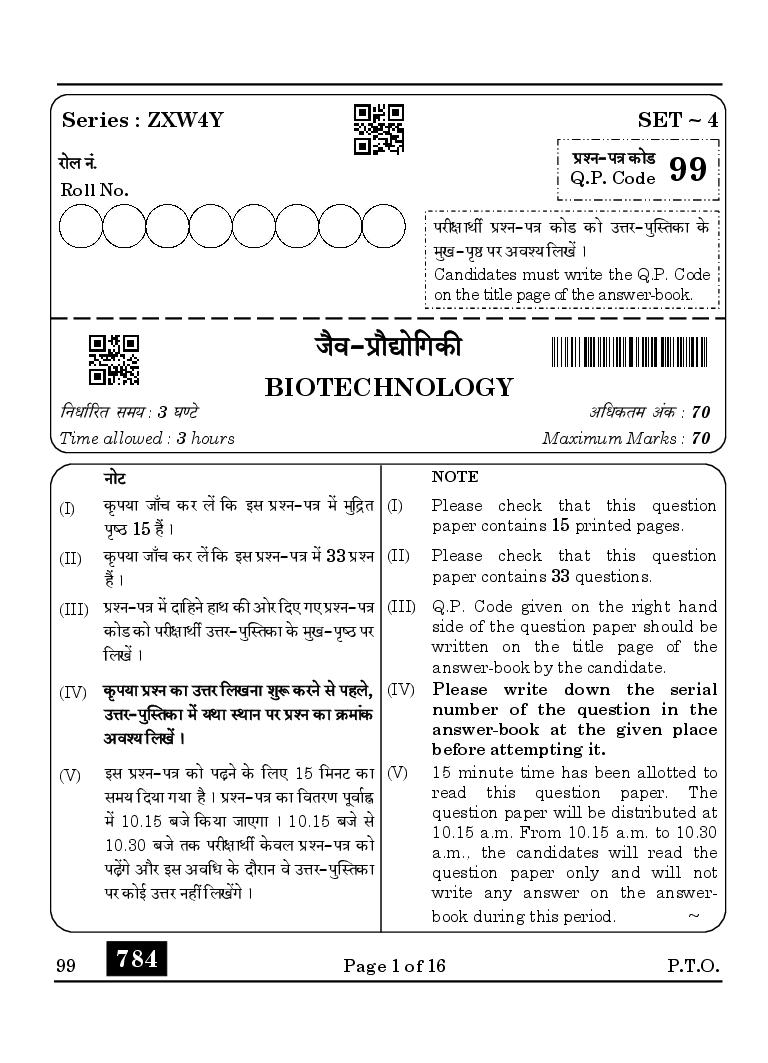
Page 1
. -
Roll No.
Q.P. Code 99
- -
-
Candidates must write the Q.P. Code
on the title page of the answer-book.
-
BIOTECHNOLOGY
{ZYm©[aV g‘¶ : 3 KÊQ>o A{YH$V‘ A§H$ : 70
Time allowed : 3 hours Maximum Marks : 70
NOTE
(I) - (I) Please check that this question
15 paper contains 15 printed pages.
(II) - 33 (II) Please check that this question
paper contains 33 questions.
(III) - - (III) Q.P. Code given on the right hand
- - side of the question paper should be
written on the title page of the
answer-book by the candidate.
(IV) , (IV) Please write down the serial
- number of the question in the
answer-book at the given place
before attempting it.
(V) - 15 (V) 15 minute time has been allotted to
- read this question paper. The
question paper will be distributed at
10.15 10.15
10.15 a.m. From 10.15 a.m. to 10.30
10.30 - a.m., the candidates will read the
- question paper only and will not
write any answer on the answer-
book during this period. ~
99 784 Page 1 of 16 P.T.O.
Page 2
:
(i) - 33
(ii) - – -, , ,
(iii) – : 1 16 1
(iv) – : 17 21 - 2
(v) – : 22 28 - 3
(vi) – : 29 30 4
(vii) – : 31 33 - 5
(viii) - , –
–
1. r-
, : 1
(A) T2 (B) T4
(C) (D) M-13 ( )
2. (PER) ,
1
(A) 1g
(B) 100 g
(C) 1 g
(D) 100 g
99 Page 2 of 16
~
Page 3
Read the following instructions carefully and follow them :
(i) This Question paper contains 33 questions. All questions are compulsory.
(ii) Question paper is divided into five sections – Section A, B, C, D and E.
(iii) Section A : Questions number 1 to 16 are Multiple Choice Type Questions
(MCQs). Each question carries 1 mark.
(iv) Section B : Questions number 17 to 21 are Very Short Answer (VSA)
Type Questions. Each question carries 2 marks.
(v) Section C : Questions number 22 to 28 are Short Answer (SA) Type
Questions. Each question carries 3 marks.
(vi) Section D : Questions number 29 and 30 are Case Study-based Questions,
carrying 4 marks each. Each question has sub-parts with internal choice in
one sub-part.
(vii) Section E : Questions number 31 to 33 are Long Answer (LA) Type
Questions. Each question carries 5 marks.
(viii) There is no overall choice given in the question paper. However, an
internal choice has been provided in few questions in all the Sections
except Section – A.
SECTION – A
1. The DNA ligase enzyme that is frequently used to ligate different DNA
fragments in order to generate rDNA molecules is isolated from : 1
(A) T2 Bacteriophage
(B) T4 Bacteriophage
(C) Lambda Bacteriophage
(D) M13 filamentous phage
2. Protein Efficiency Ratio (PER) is used as a measure of growth expressed
in terms of : 1
(A) Weight gain of an adult by consuming 1 g of food protein.
(B) Weight gain of an adult by consuming 100 g of food protein.
(C) Protein nitrogen that is retained by the body by consuming 1 g of food
protein.
(D) Protein nitrogen that is retained by the body by consuming 100 g of
food protein.
99 Page 3 of 16 P.T.O.
~
Page 4
(A) (B)
(C) (D)
4. ApoE () _____ 1
(A) HIV ( )
(B)
(C)
(D)
5. 1
(A) (B)
(C) (D)
6. -
? 1
(A) M-13 (B)
(C) pUC (D) pBR 322
7. () 1
(A) (B)
(C) (SCID) (D)
8.
1
(A) (B)
(C) (D)
9. _____ 1
(A) (B) GENSCAN
(C) UniProtKB (D) RefSeq
99 Page 4 of 16
~
Page 5
(A) Eight (B) Sixteen
(C) Four (D) Two
4. Single base difference in ApoE gene is associated with : 1
(A) Resistance to HIV (Human Immunodeficiency Virus)
(B) Migraine
(C) Huntington disease
(D) Alzheimer’s disease
5. One of the carbon source used in microbial cell culture is : 1
(A) Olive oil (B) Cereal grains
(C) Ammonium salts (D) Growth factors
6. A biotechnologist wants to obtain a gene sequence in single stranded form.
Which bacteriophage based vector should he choose to obtain the desired
result ? 1
(A) M13 based vector
(B) Bacteriophage Lambda based vector
(C) Plasmid cloning vector of pUC family
(D) Plasmid vector pBR 322
7. Absence of the enzyme adenosine deaminase in humans causes : 1
(A) Thallasemia (B) Sickle cell anaemia
(C) SCID (D) Mad cow disease
8. The technique to isolate and grow human embryonic stem cells in culture
was developed by : 1
(A) Ceasar Milstein (B) James Thomson
(C) George Kohler (D) George Gay
9. Gene prediction for bacterial genomes can be done by using the computer
program _______. 1
(A) GeneMark (B) GENSCAN
(C) UniProtKB (D) RefSeq
99 Page 5 of 16 P.T.O.
~
Page 6
(A) (B)
(C) (D) ( )
11. () : 1
(A) (B)
(C) (D)
12. 1
(A)
(B)
(C)
(D)
13 16 , – (A) (R)
(A), (B), (C) (D)
:
(A) (A) (R) (R), (A)
(B) (A) (R) , (R), (A)
(C) (A) , (R)
(D) (A) , (R)
13. (A) : CO2 ()
(R) : CO2
1
14. (A) : ()
(R) :
1
99 Page 6 of 16
~
Page 7
(A) Seed storage proteins (B) Soya protein
(C) Milk proteins (D) Whey protein concentrates
11. Identification of disease specific proteins can be done by using the
approach of : 1
(A) Functional proteomics (B) Structural proteomics
(C) Expression proteomics (D) Proteome mining
12. Herceptin is a monoclonal antibody approved for : 1
(A) Therapy of early stage breast cancer.
(B) Reversal of acute rejection of transplanted organs.
(C) Stimulation of erythropoiesis.
(D) Use in certain patients having a heart attack.
For Questions 13 to 16, two statements are given – one labelled Assertion (A)
and other labelled Reason (R). Select the correct answer to these questions
from the codes (A), (B), (C) and (D) as given below :
(A) Both Assertion (A) and Reason (R) are true and the Reason (R) is the
correct explanation of the Assertion (A).
(B) Both Assertion (A) and Reason (R) are true, but the Reason (R) is not
the correct explanation of the Assertion (A).
(C) Assertion (A) is true, but Reason (R) is false.
(D) Assertion (A) is false, but Reason (R) is true.
13. Assertion (A) : CO2 incubators prevent the desiccation of the animal cell
culture medium.
Reason (R) : A pan of water is kept at all times in a CO2 incubator
chamber to maintain high relative humidity. 1
14. Assertion (A) : Contact inhibition is absent in cancer cells.
Reason (R) : Normal cells stop growing when they reach the walls of
the container. 1
99 Page 7 of 16 P.T.O.
~
Page 8
(R) : 1
16. (A) :
(Hb)
(scHb) -
(R) : - (scHb)
(Hb) 1
–
17. (a) ? 2
(b) 2
18.
() 2
19. ‘ ’ ( ) ?
2
. 19
19. ‘RefSeq database’ ? 2
20. () 2
21. ?
? 2
99 Page 8 of 16
~
Page 9
Reason (R) : All proteins are enzymes. 1
16. Assertion (A) : One of the first attempts to study the molecular basis of
sickle cell anaemia was to compare the electrophoretic
mobility of normal haemoglobin (Hb) and sickle cell
haemoglobin (scHb).
Reason (R) : Sickle cell haemoglobin (scHb) moved faster than normal
haemoglobin (Hb) in electrophoresis. 1
SECTION – B
17. (a) What is the principle of mass spectrometry ? Write its important
application. 2
OR
(b) Describe briefly, the charge relay system that operates in
chymotrypsin enzyme. 2
18. With a suitable example, explain briefly, why the number of predicted
genes do not correlate with the genome size and the number of
chromosomes in an organism. 2
19. Why is chronic mylogenous leukemia caused ? Name the technique used
to know the status of this disease. 2
Alternative Question for Visually Impaired in lieu of Q. No. 19.
19. What are the uses of the data provided in RefSeq database ? 2
20. Outline the important steps for isolation of recombinant insulin
(Humulin) from Escherichia coli. 2
21. What is the most common cause of foaming in microbial culture medium ?
Which problems are created by foaming in microbiological processes ? 2
99 Page 9 of 16 P.T.O.
~
Page 10
22. /
3
23. (a)
: 3
(i)
(ii)
(iii) ()
(b) ()
- 3
24. (tPA) (-) ?
tPA 3
24
24. “ ( )” ? ( )
- 3
25.
3
26. () , ?
() 3
27. (PHB)
() ?
PHB ()
3
99 Page 10 of 16
~
Page 11
22. Elaborate upon the scientific relevance for therapeutic usefulness of whey
with specific examples. 3
23. (a) Mention the important features that were incorporated in each of the
following vectors : 3
(i) COSMIDS
(ii) Shuttle Vectors
(iii) Expression Vectors
OR
(b) Explain the method of Blue-White selection used for screening of
recombinant cells containing desired plasmid with gene of interest. 3
24. What is the mode of action of tissue Plasminogen Activator (tPA) ? Draw a
schematic representation to show the method of production of tPA
through mammalian cell culture. 3
Alternative Question for Visually Impaired in lieu of Q. No. 24
24. What are stem cells ? Write the two broad types of mammalian stem cells
and an application of each. 3
25. Although not required for cell growth, antibiotics are added in animal cell
culture medium. Give reason. Name two such antibiotics. 3
26. It is very difficult to produce hybrids in case of interspecific and
intergeneric crosses. Why ? Briefly describe the technique to obtain such
novel hybrids. 3
27. Transgenic plants can be used as factories to produce
polyhydroxybutyrate (PHB) on a large scale. How was Arabidopisis plant
engineered for the same ?
State the drawback of producing PHB by fermentation using bacterium
Alcaligenes eutrophus. 3
99 Page 11 of 16 P.T.O.
~
Page 12
cDNA ()
:
? 3
–
: 29 30 () [(i), (ii)
(iii)]
29.
()
, , :
5' (dNTPs)
ddNTPs (2′, 3′ )
( dNTP )
,
ddNTPs
()
(i) () ()
? 1
(ii) dNTPs ddNTPs
ddNTPs ? 2
(iii) () ddNTPs
? 1
(iii) ? 1
99 Page 12 of 16
~
Page 13
between normal and cancerous cells. How will you interpret the result
obtained on a microarray, if red and green coloured fluors were used for
labelling the cDNA probes of normal and cancerous cells respectively ? 3
SECTION – D
Instructions : Q. Nos. 29 and 30 are case-based questions. Each of these
questions have sub-parts [(i), (ii) and (iii)] with internal choice in one
sub-part.
29. Sanger’s method of DNA sequencing is a widely used technique to
determine the nucleotide sequence of a DNA fragment. Primers are
extended using the single strand DNA template as a guide, where the
normal substrates i.e. deoxynucleotide 5′ triphosphates (dNTPs) are
incorporated in the growing DNA chain. This method is based upon the
principle of chain termination by ddNTPs (2′, 3′ dideoxynucleotide tri
phosphates) which, if incorporated into each extending chain (instead of
the required dNTP) cause termination. Radioactive primers may be used
to visualize separated strands in the gel by autoradiography. Nowadays,
DNA sequencing have become automated, where ddNTPs are conjugated
with fluorescent molecules and the gels obtained are scanned by laser.
(i) Why are primers required in Sanger’s method of DNA sequencing ? 1
(ii) Write the difference between dNTPs and ddNTPs. What is the
function of ddNTPs in Sanger’s method of DNA sequencing ? 2
(iii) What is the advantage of using ddNTPs conjugated with fluorescent
molecules in automated method of DNA sequencing ? 1
OR
(iii) Which enzyme is used in Sanger’s method of DNA sequencing ? 1
99 Page 13 of 16 P.T.O.
~
Page 14
:
, ,
, ,
,
, , , , () ,
,
(i) ? 1
(ii)
2
(iii) “ ()” ? 1
(iii) ‘’ 1
–
31. (a)
() 5
(b) - 5
32. (a) () 5
(b) ( – RFLP)
? 5
33. (a) “” ?
5
(b) ? -
? 5
______________
99 Page 14 of 16
~
Page 15
have been developed by introduction of foreign genes into crop plants,
using cell and tissue culture systems. The explants are cultured on a
suitable nutrient medium which provides macro-nutrients,
micronutrients, carbon source, vitamins, amino acids alongwith plant
hormones required for growth, cell division and development of plant cells
in culture. Plant cell culture and applications deal with various types of
cultures such as organ culture, explant culture, callus culture, cell
suspension culture, protoplast culture, mass cell culture and each of these
have widespread uses in plant regeneration, genetic transformation
studies, and many more applications of plant cell and tissue culture.
(i) What is meant by explant culture ? 1
(ii) Mention hormones that are used for promoting growth and cell
division of plant cells in culture. 2
(iii) What is meant by “Protoplast” ? 1
OR
(iii) Write an application of callus culture. 1
SECTION – E
31. (a) Explain the technique of peptide mapping used to compare normal
haemoglobin with sickle cell haemoglobin. 5
OR
(b) Mention any five protein based products with an example of each. 5
32. (a) Describe the basic steps of Recombinant DNA Technology. 5
OR
(b) Describe the procedure involved in Restriction Fragment Length
Polymorphism (RFLP) technique. Why is this technique used in
forensic sciences ? 5
33. (a) What is a “metagenome” ? Describe the metagenomics approach and
write its importance to study microorganisms. 5
OR
(b) How is a continuous culture system maintained in microbial
culture ? What are its advantages over Fed-batch culture ? 5
____________
99 Page 15 of 16 P.T.O.
~
Page 16
~
Document Details
| Board / Org | CBSE |
| Exam | Class 12 |
| Type | Question Paper |
| Pages | 16 |
| Updated | 24 Sep 2026 |