CBSE Class 12 Sample Paper 2027 Solution (Marking Scheme) for Entrepreneurship
Finished viewing? Save it for later —
Download CBSE Class 12 Sample Paper 2027 Solution (Marking Scheme) for Entrepreneurship (PDF · 6 pages)About CBSE Class 12 Sample Paper 2027 Solution (Marking Scheme) for Entrepreneurship
CBSE Class 12 Sample Paper 2027 Solution (Marking Scheme) for Entrepreneurship is available here for free download. Published by CBSE for Class 12, this solution can be viewed online or downloaded as a PDF (6 pages). Candidates preparing for Class 12 can use CBSE Class 12 Sample Paper 2027 Solution (Marking Scheme) for Entrepreneurship to understand the exam pattern, the type of questions asked, and the overall difficulty level.
Frequently Asked Questions
How can I download CBSE Class 12 Sample Paper 2027 Solution (Marking Scheme) for Entrepreneurship?
Open this page and click the Download button to save CBSE Class 12 Sample Paper 2027 Solution (Marking Scheme) for Entrepreneurship as a PDF. It is completely free on AglaSem Docs.
Is CBSE Class 12 Sample Paper 2027 Solution (Marking Scheme) for Entrepreneurship free to download?
Yes. CBSE Class 12 Sample Paper 2027 Solution (Marking Scheme) for Entrepreneurship can be viewed online and downloaded as a PDF free of cost on AglaSem Docs.
How many pages does CBSE Class 12 Sample Paper 2027 Solution (Marking Scheme) for Entrepreneurship have?
CBSE Class 12 Sample Paper 2027 Solution (Marking Scheme) for Entrepreneurship contains 6 pages, which you can read online or download together as a single PDF.
Where can I find more Class 12 study material?
You can find more Class 12 question papers, sample papers, syllabus, and answer keys on AglaSem Docs.
CBSE Class 12 Sample Paper 2027 Solution (Marking Scheme) for Entrepreneurship – Text
Read the full text of this solution below — useful to quickly search, copy and reference the content online without downloading the PDF.
📄 View text version (7 pages)
Page 1
CBSE Class 12 Sample
Paper 2027 Solution
(Marking Scheme) for
Entrepreneurship
EXAM YEAR TYPE SUBJECT
CBSE Class 12 2027 Solutions Entrepreneurship
Notes · Sample Papers · Previous Year Papers · Mock Tests
Page 2
m .co
c. o
e m
em
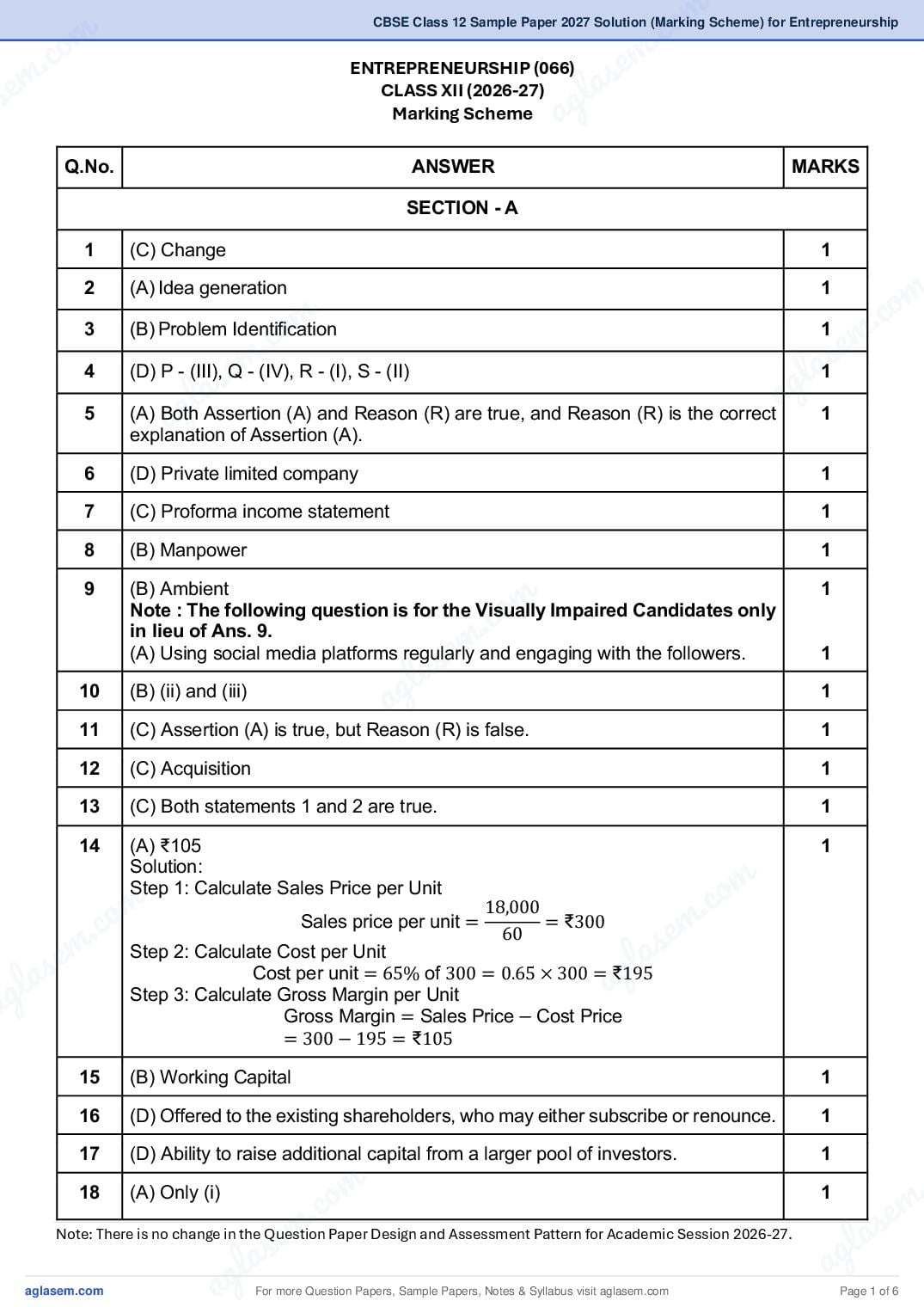
ENTREPRENEURSHIP (066)
l a s
s CLASS XII (2026-27)
Marking Scheme a g
Q.No. ANSWER MARKS
SECTION - A
1 (C) Change 1
o m
c
2 (A) Idea generation 1
m .
3
.co
(B) Problem Identification 1
s e m
e m l a
4
a s
lAssertion (A) and Reason (R) are true, and Reason (R) is the correct a
(D) P - (III), Q - (IV), R - (I), S - (II)
g 1
5
ag
(A) Both 1
explanation of Assertion (A).
6 (D) Private limited company 1
7 (C) Proforma income statement 1
8 (B) Manpower 1
om
9 (B) Ambient 1
. c
Note : The following question is for the Visually Impaired Candidates only
em
in lieu of Ans. 9.
l a s
(A) Using social media platforms regularly and engaging with the followers. 1
10 (B) (ii) and (iii)
a g 1
11 (C) Assertion (A) is true, but Reason (R) is false. 1
12 (C) Acquisition 1
13 (C) Both statements 1 and 2 are true. 1
14 (A) ₹105 1
m
co
Solution:
m .
Step 1: Calculate Sales Price per Unit
c. o se
m
18,000
Sales price per unit = = ₹300
em Step 2: Calculate a
60
s g l
la
Cost per Unit
g a
Cost per unit = 65% of 300 = 0.65 × 300 = ₹195
a Step 3: Calculate Gross Margin per Unit
Gross Margin = Sales Price − Cost Price
= 300 − 195 = ₹105
15 (B) Working Capital 1
16 (D) Offered to the existing shareholders, who may either subscribe or renounce. 1
17 (D) Ability to raise additional capital from a larger pool of investors. 1
m .
c. o e m
18 (A) Only (i) 1
e m la s
a s g
g l a
a For more Question Papers, Sample Papers, Notes & Syllabus visit Page 1 of 6
Page 3
19 A Analytical planning: Carefully identifying the product or service features, design 1
as well as the resources that will be needed.
Resource organization: Obtaining the required resources, materials, 1
technology, human or capital resources.
OR
19 B Idea germination: This is the seeding stage of a new idea. It is the stage where
the entrepreneur recognises that an opportunity exists. The idea germination 2
takes place according to interest, curiosity of the entrepreneur according to
which opportunity is explored and exploited to its best potential. Creative idea
germinates besides the interest, the need of a specific problem or area of study.
20 (I) The element of the business plan being performed by Ritika is Production 1
Planning and Control, which is a part of the Production Plan.
(II) This element helps entrepreneurs by monitoring the flow of production, 1
controlling quality, identifying delays or bottlenecks, and taking corrective
measures to ensure that goods are produced efficiently, on time, and with
minimum defects.
21 A (I) Mutual agency: The business of partnership can be carried on by all the 1
partners or any one of them acting for all. Thus, every partner is principal as
well as agent of other partners and of the firm.
(II) The applicability of the mutual agency feature in a partnership firm:
• Each partner is liable for acts performed by other partners. ½
• Each partner can bind other partners and the firm by his acts done in the ½
ordinary course of business.
OR
21 B Number of members: A private company has a minimum of two and a maximum 1
of fifty members, whereas a public company has a minimum of seven members
with no maximum limit.
Transferability of shares: In a private company, the right to transfer shares is 1
restricted, whereas in a public company, shares are freely transferable.
22 (I) The promotional approach used by Shoreal is Below-the-Line Promotion. 1
(II) Personalised Communication: Below-the-line promotion allows direct and 1
personal contact with customers, helping the firm communicate product
features more effectively. (Any other relevant feature to be awarded marks)
23 (I) The pricing strategy used by the company is Variable Pricing. 1
(II) Under variable pricing, the same product is sold at different prices on the 1
basis of quantity or size offered. This strategy helps the enterprise attract
different categories of customers and increase overall sales, as buyers can
choose a pack size according to their needs and paying capacity.
Note: The following questions are for the Visually Impaired Candidates
only in lieu of Ans. 23.
(I) Cost-plus pricing strategy: Under the cost-plus pricing strategy, a company 1
first calculates the total cost of production of a product, including all costs, and
then adds a fixed margin of profit to determine the selling price.
(II) One advantage of cost-plus pricing strategy:
This pricing strategy ensures recovery of all costs along with a guaranteed 1
margin of profit, making it simple and safe for the company to use.
For more Question Papers, Sample Papers, Notes & Syllabus visit Page 2 of 6
Page 4
m .co
c. o 24
e m
em l a s
s g
!"# 1
a
Economic Order Quantity (EOQ)= / $
! & ',)** & ',!** ½
=/
+*
= 300 units ½
OR
Working Capital = Current Assets − Current Liabilities 1
= (₹30,000 + ₹50,000 + ₹40,000) − (₹35,000 + ₹15,000) ½
= ₹ 70,000 ½
o m
c
SECTION C
m .
25
.co market reports and social media posts to understand 1sem
Read Trend: “She studied
em“She also observed competitors and local supermarkets to see gla1
their needs and challenges.”
l
Watch Trend:
s
a were in demand and which gaps existed.” a 1
g
Talk aTrend: “Additionally, she conducted surveys and talked to potential
what products
customers and nutrition experts to understand their preferences and
challenges.”
26 Benefits Urban Ride gained by scanning the business environment:
• Identification of Opportunities: Keeping track of external changes helps 1
a business spot opportunity early.
• Formulation of Strategies: Understanding market threats and 1
m
opportunities aids in crafting strategies to address threats and seize
. co
opportunities.
em
• Tapping Useful Resources: Knowledge of the external environment 1
a s
enables a company to acquire raw materials, technology, and financial
l
g
resources efficiently.
27 A a
While selecting a channel of distribution, an entrepreneur should consider the
following product-related factors:
• Nature of the Product: Perishable, fragile, or technical products require 1
shorter and more direct channels, whereas durable goods can be
distributed through longer channels.
• Unit Value of the Product: High-value products generally use direct 1
channels to reduce costs and maintain control, while low-value products
m
are distributed through indirect channels.
c. o
1
m
• Standardised vs Customised Product: Standardised products are
c. o em
suitable for indirect distribution, whereas customised or made-to-order
em s
products require direct contact with customers.
s la
ag
(Any other relevant point to be awarded marks)
la 27 B
OR
ag Indirect distribution channels involve intermediaries between the producer and
the consumer. The main indirect channels available to an entrepreneur are:
Producer → Retailer → Consumer: Used when retailers purchase goods 1
directly from producers and sell them to consumers.
Producer → Wholesaler → Retailer → Consumer: Suitable for large-scale 1
distribution where wholesalers buy in bulk and supply to retailers.
Producer → Agent → Wholesaler → Retailer → Consumer: Agents act as 1
intermediaries who help in selling goods on behalf of the producer.
m .
c. o s e m
e m la
a s g
g l a
a For more Question Papers, Sample Papers, Notes & Syllabus visit Page 3 of 6
Page 5
franchisee together. This document explains what the franchisor expects from
the franchisee in running the business.
(II) Main ingredients of a Franchise Agreement are:
• Contract Explanation ½
• Operations Manual ½
• Proprietary Statements ½
• Ongoing Site Maintenance ½
OR
28 B Internal expansion refers to the growth of a business through gradual increase
in its own activities, such as adding new machines, increasing production
capacity, or entering new fields of production and marketing. It is carried out 1½
within the existing organisation by using its own resources such as issue of
shares, retained profits or long-term securities.
Whereas;
External expansion takes place when two or more existing concerns combine
their operations to expand business activities and pursue common objectives. 1½
It involves business combination where separate units merge, cooperate or
integrate for mutual benefit or maximum profits.
29 (I) The appropriate yardstick to ascertain the efficiency of operations and 1
profitability of CleanRide Services is Return on Investment (ROI).
(II) Calculation of Profitability
Given,
Gross Profit = ₹ 6,00,000
Tax @ 20% = ₹ 1,20,000
Net Profit = ₹6,00,000 − ₹1,20,000 = ₹4,80,000 1
Net Profit
ROI = × 100 ½
Total Capital Employed
4,80,000
= × 100 = 9.6% ½
50,00,000
SECTION D
30 (I) The idea field that streamlined the launch of Qudrat is natural resources. 1
(II) The two elements of the PESTEL model highlighted in the case are:
• Environmental factor, reflected through the use of eco-friendly raw 1
materials and focus on reducing pollution.
• Technological factor, evident from the use of advanced and automated 1
production processes to ensure quality and efficiency.
(III) The component of the financial plan illustrated is the sales forecast or 2
revenue projection, as the enterprise estimates a revenue of ₹3 crore in its
second year, indicating expected future sales and economic feasibility of the
venture.
For more Question Papers, Sample Papers, Notes & Syllabus visit Page 4 of 6
Page 6
m .co
c. o 31
e m
em l a s
s g
(I) Format of Business Plan:
a
Meeting I: Elevator Pitch 1
Meeting 2: Presentation Business Plan 1
(II) Objective of Format used in Meeting 3: A detailed business plan is a
comprehensive written document containing information related to market
analysis, operations, financial projections, and risk factors. Its objective is to 2
provide complete and detailed information to formal investors for thorough
evaluation of the business proposal.
(III) The format of business plan not used by the company is the Internal 1
m
Operational Plan.
m .co
co
32 (I) Aurora Enterprises Ltd. has adopted the Acquisition strategy for expansion. 1
. e m
s
(II) Reasons behind adopting the Acquisition strategy for expansion:
e m
• Quick entry into a new market helps an enterprise enter a new business
l a
1
l a s
or market quickly without starting operations from scratch.
ag
ag
• Access to existing resources and capabilities provides immediate access 1
to technology, infrastructure, skilled manpower and established systems.
• Reduction of risk and uncertainty reduces business risk as the enterprise 1
already has a proven market presence.
• Synergy and economies of scale leads to synergistic benefits where the 1
combined strengths of enterprises result in better efficiency and cost
advantages.
33 A Product Classic Roast Mocha Blend Herbal
m
co
Coffee
.
Selling price per unit 100 80 50
em
(₹) (a)
Variable cost per 50
l a s
40 20
a g
unit (₹) (b)
Contribution 50 40 30
margin per unit
(a) – (b)
Sales Mix % 20% 30% 50%
!* ,* )*
Step 1: 50 x '** = 10 40 x '** = 12 30 x '** = 15
Weighted Average 1½
Contribution per
unit
m
co
Step 2:
m .
c. o
Total Weighted-average contribution margin per unit (WACM) = 10 + 12 + 15
m
se
= ₹37 ½
em Overall Break-even point = .*(/0#*+ $1*2$/* l a8*2 64(#
Step 3:
las g
!"#$% '()*+ ,"-#
g
3"4#2(56#("4
a
7$2/(4
a
'+,-*,***
1
= ,.
½
= 40,000 units. ½
Step 4: Product wise Break-even point
Break-even point of Classic Roast = 40,000 x 20% = 8,000 units ½
Break-even point of Mocha Blend = 40,000 x 30% = 12,000 units ½
Break-even point of Herbal Coffee = 40,000 x 50% = 20,000 units ½
OR
m .
c. o s e m
e m la
a s g
g l a
a For more Question Papers, Sample Papers, Notes & Syllabus visit Page 5 of 6
Page 7
even analysis is a technique used to determine the level of sales (or revenue 2
generated) that equals all the expenses required for generating that revenue. It
is not more than the expenses (i.e. no profit) nor is it less than the expenses
(i.e. no loss). In other words, there is neither loss nor profit.
(II) Anaya can use this analysis to effectively manage her multi-product
business as break-even analysis:
• determines the minimum level of output to be produced, setting profit 1
goal and sales target.
• determines the products that are not contributing to meet the fixed
expenses and thus brings up the item for discussion in management 1
meetings about its continuity.
• Identifies the effect of change in quantity of output upon the profits. 1
34 A (I) An Angel Investor is an individual who provides financial support to start-ups
or early-stage enterprises, usually in exchange for ownership equity, and often 2
offers guidance and mentoring based on personal business experience.
(II) Role of an Angel Investor in building an enterprise: Most angel investors are
current or retired executives, business owners or high net worth individuals who
have the knowledge, expertise, and funds that help start-ups match up to 3
industry standards. Apart from investing funds, most angels provide proactive
advice, guidance, industry connections and mentoring start-ups in its early
days. Their objective is to create great companies by providing value creation,
and simultaneously helping investors realize a high return on investments.
OR
34 B (I) Features of Venture Capital Finance:
• Provides long-term capital to high-risk, high-growth businesses. 1
• Investment is made in the form of equity or convertible securities, not 1
loans. (Any other relevant feature to be awarded marks)
(II) Venture Capital support startups during early stage of their business
through:
• Seed capital finance - It refers to the capital required by an entrepreneur
for conducting research at pre-commercialization stage. During this 1
stage, the entrepreneur has to convince the investor (VC) why his
idea/product is worthwhile.
• Startup finance - This is also called the start-up stage. A business plan
is presented by the entrepreneur to the VC firm. A management team is
being formed to run the venture. While the organisation is being set up, 1
the idea/product gets its form. The management-team establishes a
feasible production line to produce the product.
• Second-round financing - At this stage, we presume that the idea has
been transformed into a product and is being produced and sold. The
entrepreneur, at this stage, needs assistance from the Venture Capitalist 1
for expansion, modernization, diversification so that the economies of
scale and stability could be attained.
For more Question Papers, Sample Papers, Notes & Syllabus visit Page 6 of 6
Document Details
| Board / Org | CBSE |
| Exam | Class 12 |
| Type | Solution |
| Pages | 6 |
| Updated | 29 Oct 2026 |