CBSE Class 12 Sample Paper 2027 Solution (Marking Scheme) for Physical Education
Finished viewing? Save it for later —
Download CBSE Class 12 Sample Paper 2027 Solution (Marking Scheme) for Physical Education (PDF · 5 pages)About CBSE Class 12 Sample Paper 2027 Solution (Marking Scheme) for Physical Education
CBSE Class 12 Sample Paper 2027 Solution (Marking Scheme) for Physical Education is available here for free download. Published by CBSE for Class 12, this solution can be viewed online or downloaded as a PDF (5 pages). Candidates preparing for Class 12 can use CBSE Class 12 Sample Paper 2027 Solution (Marking Scheme) for Physical Education to understand the exam pattern, the type of questions asked, and the overall difficulty level.
Frequently Asked Questions
How can I download CBSE Class 12 Sample Paper 2027 Solution (Marking Scheme) for Physical Education?
Open this page and click the Download button to save CBSE Class 12 Sample Paper 2027 Solution (Marking Scheme) for Physical Education as a PDF. It is completely free on AglaSem Docs.
Is CBSE Class 12 Sample Paper 2027 Solution (Marking Scheme) for Physical Education free to download?
Yes. CBSE Class 12 Sample Paper 2027 Solution (Marking Scheme) for Physical Education can be viewed online and downloaded as a PDF free of cost on AglaSem Docs.
How many pages does CBSE Class 12 Sample Paper 2027 Solution (Marking Scheme) for Physical Education have?
CBSE Class 12 Sample Paper 2027 Solution (Marking Scheme) for Physical Education contains 5 pages, which you can read online or download together as a single PDF.
Where can I find more Class 12 study material?
You can find more Class 12 question papers, sample papers, syllabus, and answer keys on AglaSem Docs.
CBSE Class 12 Sample Paper 2027 Solution (Marking Scheme) for Physical Education – Text
Read the full text of this solution below — useful to quickly search, copy and reference the content online without downloading the PDF.
📄 View text version (6 pages)
Page 1
CBSE Class 12 Sample
Paper 2027 Solution
(Marking Scheme) for
Physical Education
EXAM YEAR TYPE SUBJECT
CBSE Class 12 2027 Solutions Physical Education
Notes · Sample Papers · Previous Year Papers · Mock Tests
Page 2
m .co
e m
em
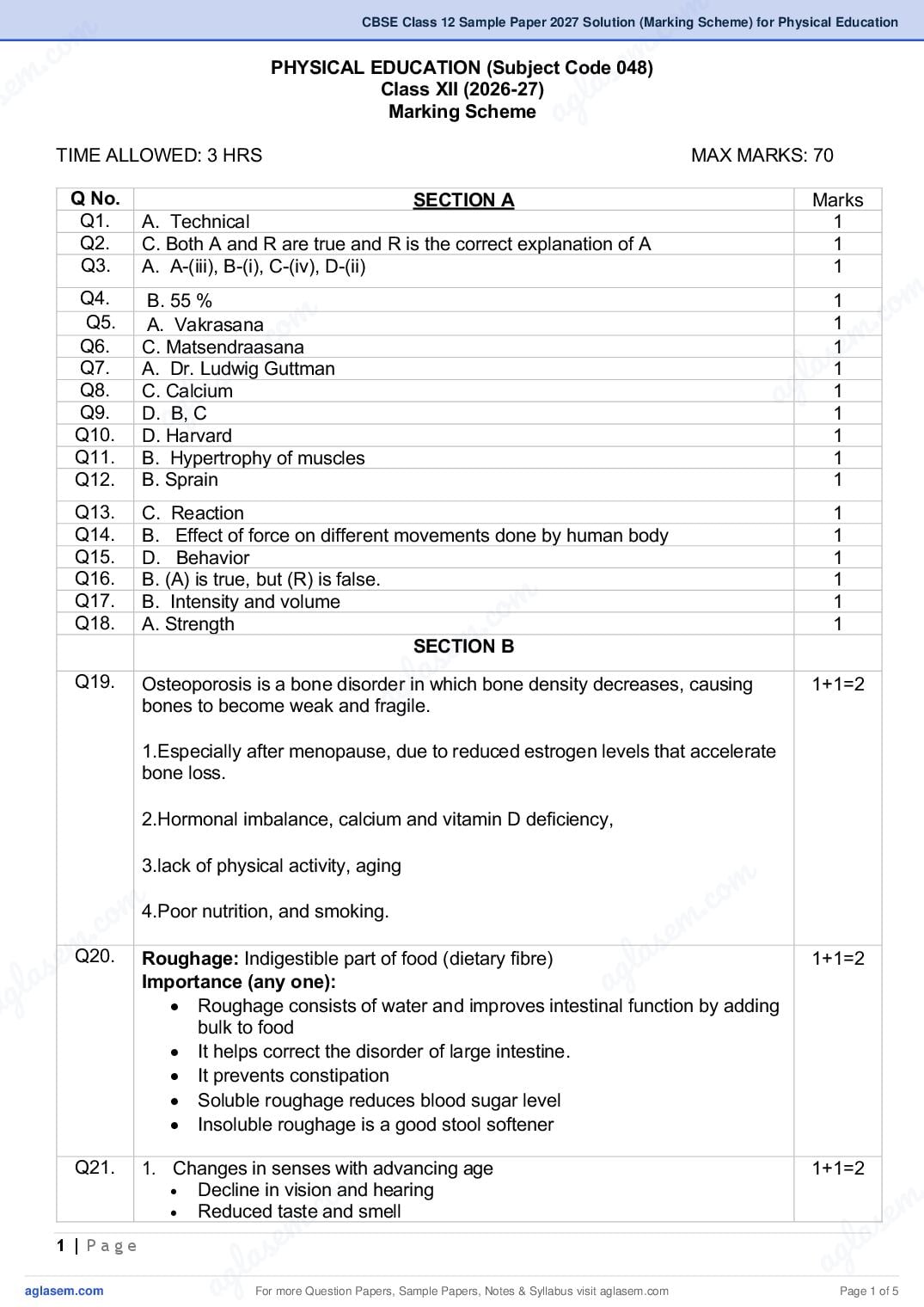
PHYSICAL EDUCATION (Subject Code 048)
s Class XII (2026-27)
Marking Scheme a g
TIME ALLOWED: 3 HRS MAX MARKS: 70
Q No. SECTION A Marks
Q1. A. Technical 1
Q2. C. Both A and R are true and R is the correct explanation of A 1
Q3. A. A-(iii), B-(i), C-(iv), D-(ii) 1
m
m .co
Q4. B. 55 % 1
.co e m
Q5. A. Vakrasana 1
Q6.
e m
C. Matsendraasana
l a
1
s
Q7.
a s
A. Dr. Ludwig Guttman
l ag
1
ag
Q8. C. Calcium 1
Q9. D. B, C 1
Q10. D. Harvard 1
Q11. B. Hypertrophy of muscles 1
Q12. B. Sprain 1
Q13. C. Reaction 1
Q14. B. Effect of force on different movements done by human body 1
Q15. D. Behavior 1
m
Q16. B. (A) is true, but (R) is false. 1
. co
Q17. B. Intensity and volume 1
em
Q18. A. Strength 1
a s
SECTION B
g l
a
Q19. Osteoporosis is a bone disorder in which bone density decreases, causing 1+1=2
bones to become weak and fragile.
1.Especially after menopause, due to reduced estrogen levels that accelerate
bone loss.
2.Hormonal imbalance, calcium and vitamin D deficiency,
m
3.lack of physical activity, aging
m4.Poor nutrition, and smoking. .co
c. o se
m
s emQ20. Roughage: Indigestible part of food (dietary fibre) g l a
la a
1+1=2
ag
Importance (any one):
• Roughage consists of water and improves intestinal function by adding
bulk to food
• It helps correct the disorder of large intestine.
• It prevents constipation
• Soluble roughage reduces blood sugar level
• Insoluble roughage is a good stool softener
m .
Q21. 1. Changes in senses with advancing age 1+1=2
.co e m
• Decline in vision and hearing
m
• Reduced taste and smell
e la s
1|Page
l a s a g
ag For more Question Papers, Sample Papers, Notes & Syllabus visit Page 1 of 5
Page 3
With advancing age, the efficiency of sensory organs gradually
decreases.
Vision becomes weaker due to reduced elasticity of the eye lens.
Hearing ability declines, making it difficult to hear high-frequency
sounds.
Sense of taste and smell also reduces, affecting appetite.
Reaction time becomes slower, which may affect balance, coordination,
and overall physical performance
Q22. What is PRICE? 2
P – Protection
R – Rest
I – Ice
C – Compression
E – Elevation
Q23. • Over-dependence on rewards reduces self-interest 2
• External pressure decreases internal enjoyment
• Rewards shift focus from learning to winning prizes
• Loss of self-satisfaction
Q24. • Plank 1+1=2
• Wall push
• Static shoulder press
• Holding dumbbells without movement
• Isometric push-up hold
SECTION C
Q25. 1. League tournament is considered the best method to judge the strongest
team because every team gets equal opportunities to play against all
other teams.
2. It eliminates the factor of luck as no team is eliminated after a single loss.
3. This format provides fair competition and accurate ranking.
4. Teams can improve performance match by match. 2+1=3
The winner is declared using British Method that is point system.
Generally, a team gets 2 points for a win, 1 point for a draw, and 0 points
for a loss. The team with maximum points is declared the winner.
Q26. Scoliosis is a position in which the spine is tilted to either side of the body. It is 1+2=3
a position of lateral curvature or sideways curvature of the spine.
Causes:
(a) Birth defect
(b) Lifting of weight towards one side in routine
(c) Arthritis, Paralysis or Rickets
(d) Cerebral palsy and muscular dystrophy
Q27. Meaning: Participation of all, including CWSN 3
Need: Equality, social integration
Implementation:
• Modified rules
• Adapted equipment
• Inclusive programs
2|Page
For more Question Papers, Sample Papers, Notes & Syllabus visit Page 2 of 5
Page 4
m .co
em
em l a s
s Q28. Proteins: Body-building nutrients a g 1+2=3
Functions (any two):
• Growth and repair
• Muscle development
• Enzyme formation
Daily requirement: ~1 g/kg body weight
m
co
Q29. Advantages of Friction 3
e.g.
o m m .
c
Gymnastics- To. increase the frictional force between rod and hands. s e
m a
se The lifter needs more friction between their feet and the floor to agl
preventlaslipping while lifting heavy weights.
Weightlifting-
a g Badminton racket had a knot of clothing that increases the
Badminton-
frictional force of the player’s hand due to which the racket does not slip
Q30. Self-esteem: Feeling of self-worth 3
Enhancement:
• Success in sports
• Social interaction
• Confidence building
m
co
• Peer recognition
.
em
Q31. 1. Fixture Based Questions 1x4=4
(i) (A) Single Knockout
(ii) (B) N-1
(iii) (A) 42 a g
(iv) (C) Elimination
OR
(C) 12
(VISUALLY IMPAIRED)
(i) (C) Seeding
(ii) (A) 6
(iii) (A) (NB+1)/2
m
co
(iv) (A) Knockout
m .
OR
m
se
(C) Round Robin Tournament
s emQ32. IPC: gla
a a
International Paralympic Committee 1x4=4
l
ag
Name reason: Started for paraplegic athletes
Governing body: IPC
Formed: 1989
Q33. 1. (b) Sprain – It involves overstretching or tearing of ligaments around a 1x4=4
joint.
2. R.I.C.E. Method:
R – Rest: Stop playing to prevent further damage.
m .
.co
I – Ice: Apply ice packs to reduce swelling and pain.
s e m
e m la
3|Page
l a s ag
ag For more Question Papers, Sample Papers, Notes & Syllabus visit Page 3 of 5
Page 5
E – Elevation: Keep the injured area above heart level to minimize swelling.
3. Difference:
Sprain – Ligament injury (e.g., twisted ankle).
Strain – Muscle or tendon injury (e.g., pulled hamstring).
4. Preventive Measures:
Proper warm-up and stretching before play.
Wearing appropriate footwear and protective gear.
OR
Possible Effects: Chronic pain, joint instability, ligament tear, or repeated
injuries
Q34. Diabetes Mellitus is a chronic metabolic disorder in which the body is 2+1+2-
unable to regulate blood glucose (sugar) levels due to: =5
• insufficient production of insulin, or
• improper utilization of insulin by body.
As a result, the level of glucose in the blood becomes abnormally high
(hyperglycaemia).
Type 1 Diabetes
Type 2 Diabetes
Diagram – 1 mark
Benefits – any four
• Controls diabetes
• Improves digestion
• Improves posture
• Strengthens muscles
• Reduces stress
Q35. • Forward Roll 1+2+2=
• Backward Roll 5
• Jumping Half Turn
• Jumping Full Turn
(a) Jumping Half Turn
• In Jumping Half Turn, the subject jumps vertically upward from both
feet.
• While in the air, the performer turns the body 180 degrees (half
rotation).
• The performer lands on both feet, maintaining balance and control.
• Arms may be used freely to assist rotation and balance.
Purpose / importance:
• Tests coordination, balance, and motor control
• Indicates ability to learn and perform new motor skills
4|Page
For more Question Papers, Sample Papers, Notes & Syllabus visit Page 4 of 5
Page 6
m .co
e m
em
(b) Jumping Full Turn
s a
• In Jumping Full Turn, the subject jumps upward from a standing
position. g
• During the jump, the performer rotates the body 360 degrees (full turn)
in the air.
• The performer lands safely on both feet without losing balance.
• Proper coordination of arms, legs, and trunk is required.
Purpose / importance:
• Measures advanced coordination, agility, and motor educability
m
• Reflects the learner’s capacity to acquire complex motor skills
m .co
c. o s e m
e m l a
training, s g
Q36.
a
The sports training cycle is a systematic and planned process of 1+4=5
g l of an athlete at the right time of competition.
divided into different time phases, which aims at achieving peak
a
a Cycle
performance
1. Micro
• The shortest unit of the training cycle.
• Usually lasts for one week (5–7 days).
• Includes daily training sessions, rest, and recovery.
• Focuses on specific training objectives like strength, speed, or skill
improvement.
2. Meso Cycle
m
• The medium-term training phase.
. co
• Generally, lasts for 3 to 6 weeks.
em
• Consists of several micro cycles combined together.
s
• Aims at development of a particular fitness component, such as
endurance or strength.
g l a
a
3. Macro Cycle
• The longest phase of the training cycle.
• Usually covers one full season or one year.
• Includes pre-season, competitive season, and transition period.
• Main aim is to achieve peak performance during major
competitions.
Q37. A projectile is an object which is thrown or projected into the air and, 2+3=5
m
after leaving the hand or an implement, moves under the influence of
co
gravity alone.
m .
c. o m
Once released, no further force acts on it except gravity.
em se
Factors – Explain any three
s la
• Angle of projection
la
• Velocity
a g
ag • Height of release
• Gravity
• Air resistance
m .
.co s e m
e m la
5|Page
l a s a g
ag For more Question Papers, Sample Papers, Notes & Syllabus visit Page 5 of 5
Document Details
| Board / Org | CBSE |
| Exam | Class 12 |
| Type | Solution |
| Pages | 5 |
| Updated | 29 Oct 2026 |