Edudel Syllabus Class 11 Computer Science
Finished viewing? Save it for later —
Download Edudel Syllabus Class 11 Computer Science (PDF · 4 pages)About Edudel Syllabus Class 11 Computer Science
Edudel Syllabus Class 11 Computer Science is available here for free download. Published by Delhi School Education for Class 11, this syllabus can be viewed online or downloaded as a PDF (4 pages). Candidates preparing for Class 11 can use Edudel Syllabus Class 11 Computer Science to understand the exam pattern, the type of questions asked, and the overall difficulty level.
Frequently Asked Questions
How can I download Edudel Syllabus Class 11 Computer Science?
Open this page and click the Download button to save Edudel Syllabus Class 11 Computer Science as a PDF. It is completely free on AglaSem Docs.
Is Edudel Syllabus Class 11 Computer Science free to download?
Yes. Edudel Syllabus Class 11 Computer Science can be viewed online and downloaded as a PDF free of cost on AglaSem Docs.
How many pages does Edudel Syllabus Class 11 Computer Science have?
Edudel Syllabus Class 11 Computer Science contains 4 pages, which you can read online or download together as a single PDF.
Where can I find more Class 11 study material?
You can find more Class 11 question papers, sample papers, syllabus, and answer keys on AglaSem Docs.
Edudel Syllabus Class 11 Computer Science – Text
Read the full text of this syllabus below — useful to quickly search, copy and reference the content online without downloading the PDF.
📄 View text version (4 pages)
Page 1
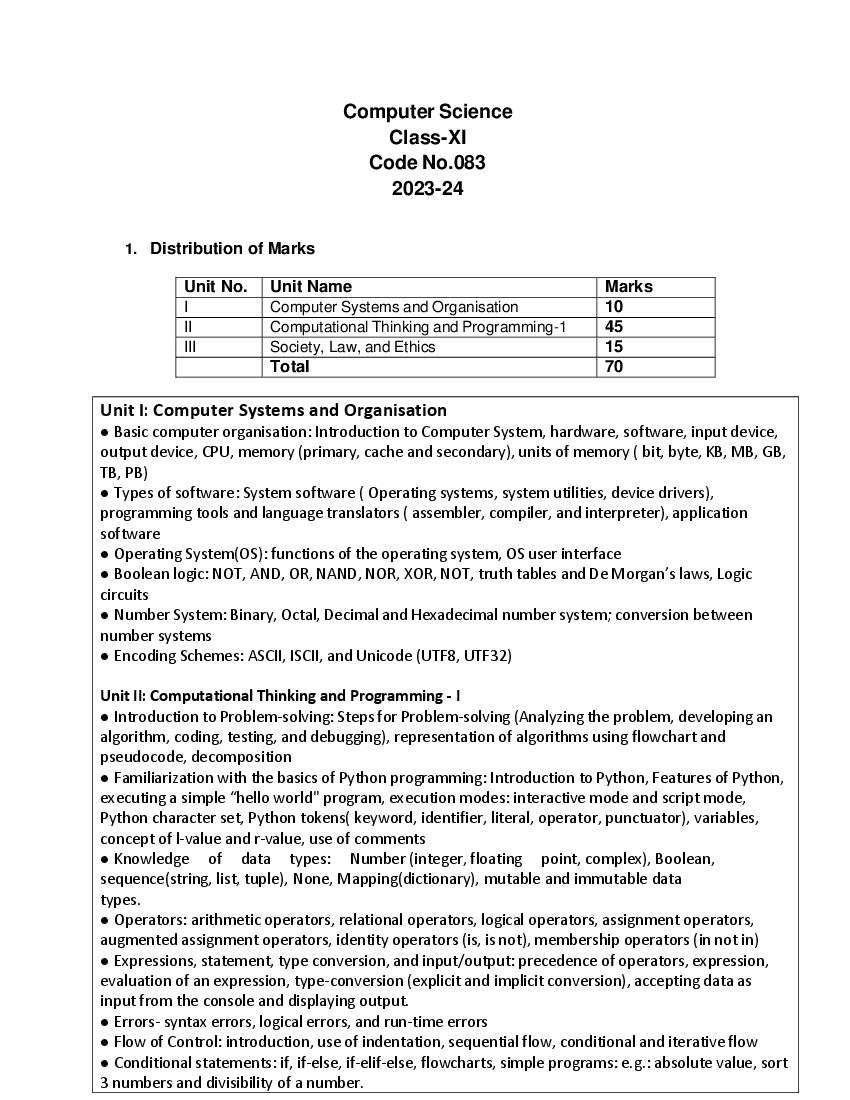
Class-XI
Code No.083
2023-24
1. Distribution of Marks
Unit No. Unit Name Marks
I Computer Systems and Organisation 10
II Computational Thinking and Programming-1 45
III Society, Law, and Ethics 15
Total 70
Unit I: Computer Systems and Organisation
● Basic computer organisation: Introduction to Computer System, hardware, software, input device,
output device, CPU, memory (primary, cache and secondary), units of memory ( bit, byte, KB, MB, GB,
TB, PB)
● Types of software: System software ( Operating systems, system utilities, device drivers),
programming tools and language translators ( assembler, compiler, and interpreter), application
software
● Operating System(OS): functions of the operating system, OS user interface
● Boolean logic: NOT, AND, OR, NAND, NOR, XOR, NOT, truth tables and De Morgan’s laws, Logic
circuits
● Number System: Binary, Octal, Decimal and Hexadecimal number system; conversion between
number systems
● Encoding Schemes: ASCII, ISCII, and Unicode (UTF8, UTF32)
● Introduction to Problem-solving: Steps for Problem-solving (Analyzing the problem, developing an
algorithm, coding, testing, and debugging), representation of algorithms using flowchart and
pseudocode, decomposition
● Familiarization with the basics of Python programming: Introduction to Python, Features of Python,
executing a simple “hello world" program, execution modes: interactive mode and script mode,
Python character set, Python tokens( keyword, identifier, literal, operator, punctuator), variables,
concept of l-value and r-value, use of comments
● Knowledge of data types: Number (integer, floating point, complex), Boolean,
sequence(string, list, tuple), None, Mapping(dictionary), mutable and immutable data
types.
● Operators: arithmetic operators, relational operators, logical operators, assignment operators,
augmented assignment operators, identity operators (is, is not), membership operators (in not in)
● Expressions, statement, type conversion, and input/output: precedence of operators, expression,
evaluation of an expression, type-conversion (explicit and implicit conversion), accepting data as
input from the console and displaying output.
● Errors- syntax errors, logical errors, and run-time errors
● Flow of Control: introduction, use of indentation, sequential flow, conditional and iterative flow
● Conditional statements: if, if-else, if-elif-else, flowcharts, simple programs: e.g.: absolute value, sort
3 numbers and divisibility of a number.
Page 2
nested loops, suggested programs: generating pattern, summation of series, finding the factorial of a
positive number, etc.
● Strings: introduction, string operations (concatenation, repetition, membership and slicing),
traversing a string using loops, built-in functions/methods–len(), capitalize(), title(), lower(), upper(),
count(), find(), index(), endswith(), startswith(), isalnum(), isalpha(), isdigit(), islower(), isupper(),
isspace(),lstrip(), rstrip(), strip(), replace(), join(), partition(), split()
• Completion of the Mid-Term Syllabus by 15th September 2023
• MID TERM EXAM
● Lists: introduction, indexing, list operations (concatenation, repetition, membership and slicing),
traversing a list using loops, built-in functions/methods–len(), list(), append(), extend(), insert(),
count(), index(), remove(), pop(), reverse(), sort(), sorted(), min(), max(), sum(); nested lists,
suggested programs: finding the maximum, minimum, mean of numeric values stored in a list; linear
search on list of numbers and counting the frequency of elements in a list.
● Tuples: introduction, indexing, tuple operations (concatenation, repetition, membership and
slicing); built-in functions/methods – len(), tuple(), count(), index(), sorted(), min(), max(), sum(); tuple
assignment, nested tuple; suggested programs: finding the minimum, maximum, mean of values
stored in a tuple; linear search on a tuple of numbers, counting the frequency of elements in a tuple.
● Dictionary: introduction, accessing items in a dictionary using keys, mutability of a dictionary
(adding a new term, modifying an existing item), traversing a dictionary, built-in
functions/methods – len(),dict(), keys(),values(),items(), get(), update(),del(),del, clear(), fromkeys(),
copy(), pop(), popitem(), setdefault(), max(), min(), sorted(); Suggested programs: count the number
of times a character appears in a given string using a dictionary, create a dictionary with names of
employees, their salary and access them.
● Introduction to Python modules: Importing module using ‘import <module>’ and using from
statement, importing math module (pi, e, sqrt(), ceil(), floor(), pow(), fabs(), sin(), cos(), tan());
random module (random(), randint(), randrange()), statistics module (mean(), median(), mode()).
Unit III: Society, Law and Ethics
● Digital Footprints
● Digital Society and Netizen: net etiquettes, communication etiquettes, social media etiquettes
● Data Protection: Intellectual property rights (copyright, patent, trademark), violation of
IPR(plagiarism, copyright infringement, trademark infringement),open-source software and licensing
(Creative Commons, GPL and Apache)
● Cyber Crime: definition, hacking, eavesdropping, phishing and fraud emails, ransomware, cyber
trolls, cyber bullying
● Cyber safety: safely browsing the web, identity protection, confidentiality
● Malware: viruses, trojans, adware
● E-waste management: proper disposal of used electronic gadgets.
● Information Technology Act (IT Act)
● Technology and society: Gender and disability issues while teaching and using computers
• Complete the Annual Syllabus by 31st January 2024
• ANNUAL EXAM
• Complete Syllabus will be covered in Annual Exam
Page 3
S.No. UnitName Marks (Total=30)
1. LabTest (12marks)
Python program (60% logic + 20% documentation + 20% 12
code quality)
2. ReportFile +Viva (10marks)
Report file: Minimum 20 Python programs 7
Viva voce 3
3. Project (that uses most of the concepts that have been 8
learnt)
3. Suggested Practical List
Python Programming
● Input a welcome message and display it.
● Input two numbers and display the larger / smaller number.
● Input three numbers and display the largest / smallest number.
● Generate the following patterns using nested loops:
Pattern-1 Pattern-2 Pattern-3
* 12345 A
** 1234 AB
*** 123 ABC
**** 12 ABCD
***** 1 ABCDE
● Write a program to input the value of x and n and print the sum of the following series:
⮚ 1 + 𝑥 + 𝑥2 + 𝑥3 + 𝑥4 + ⋯ 𝑥𝑛
⮚ 1 − 𝑥 + 𝑥2 − 𝑥3 + 𝑥4 − ⋯ 𝑥𝑛
2 3 4 𝑛
𝑥+𝑥 +𝑥 +𝑥 +⋯𝑥
⮚ 2 3 4 𝑛
𝑥2 𝑥3 𝑥4 𝑥𝑛
𝑥 + + + +⋯
2! 3! 4! 𝑛!
⮚
● Determine whether a number is a perfect number, an Armstrong number or a palindrome.
● Input a number and check if the number is a prime or composite number.
● Display the terms of a Fibonacci series.
● Compute the greatest common divisor and least common multiple of two integers.
● Count and display the number of vowels, consonants, uppercase, lowercase characters in
string.
● Input a string and determine whether it is a palindrome or not; convert the case of characters
Page 4
● Find the largest/smallest number in a list/tuple
● Input a list of numbers and swap elements at the even location with the elements at the odd
location.
● Input a list/tuple of elements, search for a given element in the list/tuple.
● Create a dictionary with the roll number, name and marks of n students in a class and display
the names of students who have marks above 75.
4. Suggested Reading Material
● NCERT Textbook for Computer Science (Class XI)
● Support Material on CBSE website
Document Details
| Board / Org | Delhi Board |
| Exam | Class 11 |
| Type | Syllabus |
| Pages | 4 |
| Updated | 22 Jul 2026 |