PSEB 12th Class Syllabus 2023 Accountancy
Finished viewing? Save it for later —
Download PSEB 12th Class Syllabus 2023 Accountancy (PDF · 5 pages)About PSEB 12th Class Syllabus 2023 Accountancy
PSEB 12th Class Syllabus 2023 Accountancy is available here for free download. Published by Punjab Board for Class 12, this syllabus can be viewed online or downloaded as a PDF (5 pages). Candidates preparing for Class 12 can use PSEB 12th Class Syllabus 2023 Accountancy to understand the exam pattern, the type of questions asked, and the overall difficulty level.
Frequently Asked Questions
How can I download PSEB 12th Class Syllabus 2023 Accountancy?
Open this page and click the Download button to save PSEB 12th Class Syllabus 2023 Accountancy as a PDF. It is completely free on AglaSem Docs.
Is PSEB 12th Class Syllabus 2023 Accountancy free to download?
Yes. PSEB 12th Class Syllabus 2023 Accountancy can be viewed online and downloaded as a PDF free of cost on AglaSem Docs.
How many pages does PSEB 12th Class Syllabus 2023 Accountancy have?
PSEB 12th Class Syllabus 2023 Accountancy contains 5 pages, which you can read online or download together as a single PDF.
Where can I find more Class 12 study material?
You can find more Class 12 question papers, sample papers, syllabus, and answer keys on AglaSem Docs.
PSEB 12th Class Syllabus 2023 Accountancy – Text
Read the full text of this syllabus below — useful to quickly search, copy and reference the content online without downloading the PDF.
📄 View text version (5 pages)
Page 1
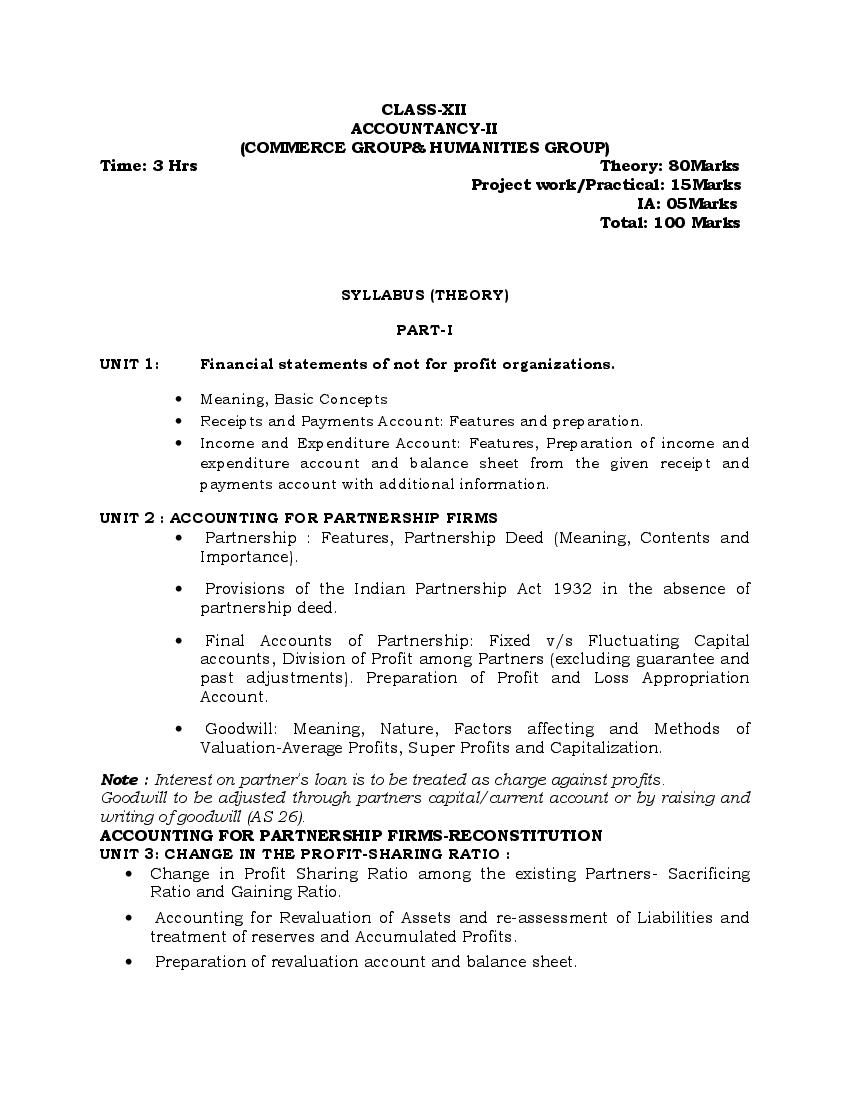
ACCOUNTANCY-II
(COMMERCE GROUP& HUMANITIES GROUP)
Time: 3 Hrs Theory: 80Marks
Project work/Practical: 15Marks
IA: 05Marks
Total: 100 Marks
SYLLABUS (THEORY)
PART-I
UNIT 1: Financial statements of not for profit organizations.
• Meaning, Basic Concepts
• Receipts and Payments Account: Features and preparation.
• Income and Expenditure Account: Features, Preparation of income and
expenditure account and balance sheet from the given receipt and
payments account with additional information.
UNIT 2 : ACCOUNTING FOR PARTNERSHIP FIRMS
• Partnership : Features, Partnership Deed (Meaning, Contents and
Importance).
• Provisions of the Indian Partnership Act 1932 in the absence of
partnership deed.
• Final Accounts of Partnership: Fixed v/s Fluctuating Capital
accounts, Division of Profit among Partners (excluding guarantee and
past adjustments). Preparation of Profit and Loss Appropriation
Account.
• Goodwill: Meaning, Nature, Factors affecting and Methods of
Valuation-Average Profits, Super Profits and Capitalization.
Note : Interest on partner’s loan is to be treated as charge against profits.
Goodwill to be adjusted through partners capital/current account or by raising and
writing of goodwill (AS 26).
ACCOUNTING FOR PARTNERSHIP FIRMS-RECONSTITUTION
UNIT 3: CHANGE IN THE PROFIT-SHARING RATIO :
• Change in Profit Sharing Ratio among the existing Partners- Sacrificing
Ratio and Gaining Ratio.
• Accounting for Revaluation of Assets and re-assessment of Liabilities and
treatment of reserves and Accumulated Profits.
• Preparation of revaluation account and balance sheet.
Page 2
• Admission of a Partner:- Effect of Admission of Partner, Change in Profit
Sharing Ratio, Accounting Treatment of Goodwill (as per accounting
standard 26). Revaluation of Assets and re-assessment of Liabilities,
Treatment of Reserves and Accumulated profits, Adjustment of Capital
Accounts and Preparation of balance sheet.
UNIT 5 : RETIREMENT AND DEATH OF A PARTNER :
• Effect of Retirement/Death of a Partner on change in Profit Sharing Ratio,
Treatment of Goodwill (As per AS 26),
• Treatment of Revaluation of Assets and re-assessment of liabilities,
• Adjustment of Accumulated Profits and Reserves. Adjustment of capitals
accounts and preparation of balance sheet.
• Preparation of loan account of retiring partner. Calculation of deceased
partner’s share of profit till the date of death.
UNIT 6 : DISSOLUTION OF PARTNERSHIP FIRMS
• Dissolution of partnership firm: Meaning Dissolution of Partnership and
partnership Firm,
• Types of dissolution of firm,
• Settlement of Accounts : Preparation of Realisation Account, Capital
Accounts of partners and Cash/Bank Account (excluding Piecemeal
Distribution, Sale to a Company and Insolvency of a Partners).
Note : (i) The realized value of each asset must be given at the time of dissolution. (ii)
In case, realisation expenses are borne by a partner, clear indication should be given
regarding the payment thereof.
NOTE: Students may choose only one Part from Part II and Part III.
PART -II
UNIT-7: ACCOUNTING FOR SHARE CAPITAL
• Share and Share Capital : Meaning, Nature and Types
Accounting for Share Capital : Issue and Allotment of Equity and Preference
Shares, Public subscription of shares - over subscription (prorata adjustment of
excess application money) and under subscription share.
•Issue of shares at Par and at Premium, Calls in Advance and Calls in
Arrears (excluding interest), Issue of Shares for Consideration other
than cash.
• Accounting Treatment of Forfeiture and Re-issue of Forfeited Shares.
UNIT 8 : ACCOUNTING FOR DEBENTURES :
• Debentures: Meaning, Types of Debentures, Issue at Par, Premium
and at a Discount,
• Issue of Debentures for Consideration other than cash, Debenture
Issues as Collateral Security –concept, interest on debentures. Writing
of discount/loss on issue of debentures.
Page 3
• Creation of Debenture Redemption Reserve.
Note : Related sections of the Companies Act, 2013 will apply.
UNIT 9: ANALYSIS OF FINANCIAL STATEMENTS
• Financial Statement of Company: Statement of Profit and loss and
Balance Sheet in the prescribed form with major heading and sub
heading (As per schedule III to the Companies Act, 2013).
•
• Note : Exceptional items, extraordinary items and profit/loss from
discontinued operations are excluded.
• Financial Statement Analysis:- Meaning, Objectives, Importance, and
Limitations.
• Tools for Financial Statements Analysis:- Comparative Statements,
Common Size Statement.
• Accounting Ratio:- Meaning, Objectives, Types and Computation.
• (a) Liquidity Ratio:- Current Ratio, Liquidity Ratio.
• (b) Solvency Ratio:- Debt to Equity Ratio, Total Assets to Debt Ratio,
Proprietary Ratio and Interest Coverage Ratio.
• (c) Activity Ratio: Inventory Turnover, Trade Receivables Turnover
Ratio, Trade Payables Turnover Ratio and Working Capital Turnover
Ratio.
• (d) Profitability Ratio:- Gross Profit Ratio, Operating Ratio, Operating
Profit Ratio, Net Profit Ratio and Return on Investment.
Note: Net profit ratio is to be calculated on the basis of profit before and
after tax.
UNIT 10: CASH FLOW STATEMENT
• Cash Flow Statement: Meaning, Objectives and Preparation (As per
AS-3 Revised) (Indirect Method only),
• Adjustments related to Depreciation and amortisation, profit or loss
on sale of assets including investments, Dividend (final and interim)
and Tax
• Bank overdraft and cash credit to be treated as short term
borrowings.
• Current investments to be taken as Marketable securities unless
otherwise specified.
Note: Previous years’ Proposed dividend to be given effect, as per
prescribed in AS-4, Events occurring after the balance sheet date. Current
years’ proposed dividend will be accounted for in the next year after it is
declared by the shareholders.
Page 4
PART-III
COMPUTERISED ACCOUNTING SYSTEM
UNIT 7: OVERVIEW OF COMPUTERIZED ACCOUNTING SYSTEM
• Concepts and Types of Computerized Accounting System(CAS)
• Features of a Computerized Accounting System
• Structure of a Computerized Accounting System
UNIT 8: USING COMPUTERIZED ACCOUNTING SYSTEM
• Steps in installation of CAS, preparation of chart of accounts,
codification and hierarchy of account heads.
• Data Entry, Data Validation and Data Verification.
• Adjustment Entries, Preparation of Financial Statements, Closing
Entries and Opening Entries.
• Security of CAS and security features generally available in CAS
(Students are expected to understand and practice the entire
accounting process using an accounting package). TALLY ERP-9
(Educational Version)
UNIT 9: ACCOUNTING USING DATA BASE MANAGEMENT SYSTEM (DBMS)
• Concepts of DBMS.
• Objective in DBMS: Tables, Queries, Forms, Reports.
• Creating Data Tables for Accounting
• Using queries, forms and reports for generating accounting
information, Applications of DBMS in generating accounting
information such as shareholders records, sale reports, customers
profile, suppliers profile payroll, employees' profile and petty cash
register.
UNIT 10: ACCOUNTING APPLICATION OF ELECTRONIC SPREAD SHEET
• Concept of an Electronic Spread Sheet (ES).
• Features offered by Electronic Spread Sheet.
• Applications of Electronic Spread Sheet in generating Accounting
Information,
Preparing Depreciation Schedule, Loan Repayment Schedule, Payroll Accounting
and other such applications.
Practical work
Practical work is for those students who choose Part-II of the syllabus.
Time: 1 ½ Hours Max Marks 15
1. The syllabus of practical work is same as prescribed for the theory paper i.e.
Part I and Part II.
Page 5
some short answer questions based on the prescribed syllabus.
3. Division of Marks:
1 Project Note Book 3 marks
2 Total five questions of 3 marks each (3×3)=9 marks
will be set. The students are required
to attempt any three
3 Viva Voce 3 marks
Division of Marks for internal assessment
1 Book Bank 2 marks
2 Average of periodic tests 3 marks
Practical is for those students who choose Part-III of the
syllabus.
Time: 1 ½ Hours Max Marks: 15
1. The syllabus of practical work is same as prescribed for the theory paper of
part-III.
2. Practical Note book will consist of the entire practical performed in the
computer laboratory based on the prescribed syllabus.
3. Division of Marks:
1 Practical Note Book 3 marks
2 The students are required to perform any three (3×3)=9 marks
practicals out of the given Five of 3 marks each.
3 Viva Voce 3 marks
Division of Marks for internal assessment
1 Book Bank 2 marks
2 Average of Periodic Tests 3marks
Document Details
| Board / Org | Punjab Board |
| Exam | Class 12 |
| Type | Syllabus |
| Pages | 5 |
| Updated | 22 Jul 2026 |