NBSE Class 11 Question Paper 2022 Biology
Finished viewing? Save it for later —
Download NBSE Class 11 Question Paper 2022 Biology (PDF · 3 pages)About NBSE Class 11 Question Paper 2022 Biology
NBSE Class 11 Question Paper 2022 Biology is available here for free download. Published by Nagaland Board for Class 11, this question paper can be viewed online or downloaded as a PDF (3 pages). Candidates preparing for Class 11 can use NBSE Class 11 Question Paper 2022 Biology to understand the exam pattern, the type of questions asked, and the overall difficulty level.
Frequently Asked Questions
How can I download NBSE Class 11 Question Paper 2022 Biology?
Open this page and click the Download button to save NBSE Class 11 Question Paper 2022 Biology as a PDF. It is completely free on AglaSem Docs.
Is NBSE Class 11 Question Paper 2022 Biology free to download?
Yes. NBSE Class 11 Question Paper 2022 Biology can be viewed online and downloaded as a PDF free of cost on AglaSem Docs.
How many pages does NBSE Class 11 Question Paper 2022 Biology have?
NBSE Class 11 Question Paper 2022 Biology contains 3 pages, which you can read online or download together as a single PDF.
Where can I find more Class 11 study material?
You can find more Class 11 question papers, sample papers, syllabus, and answer keys on AglaSem Docs.
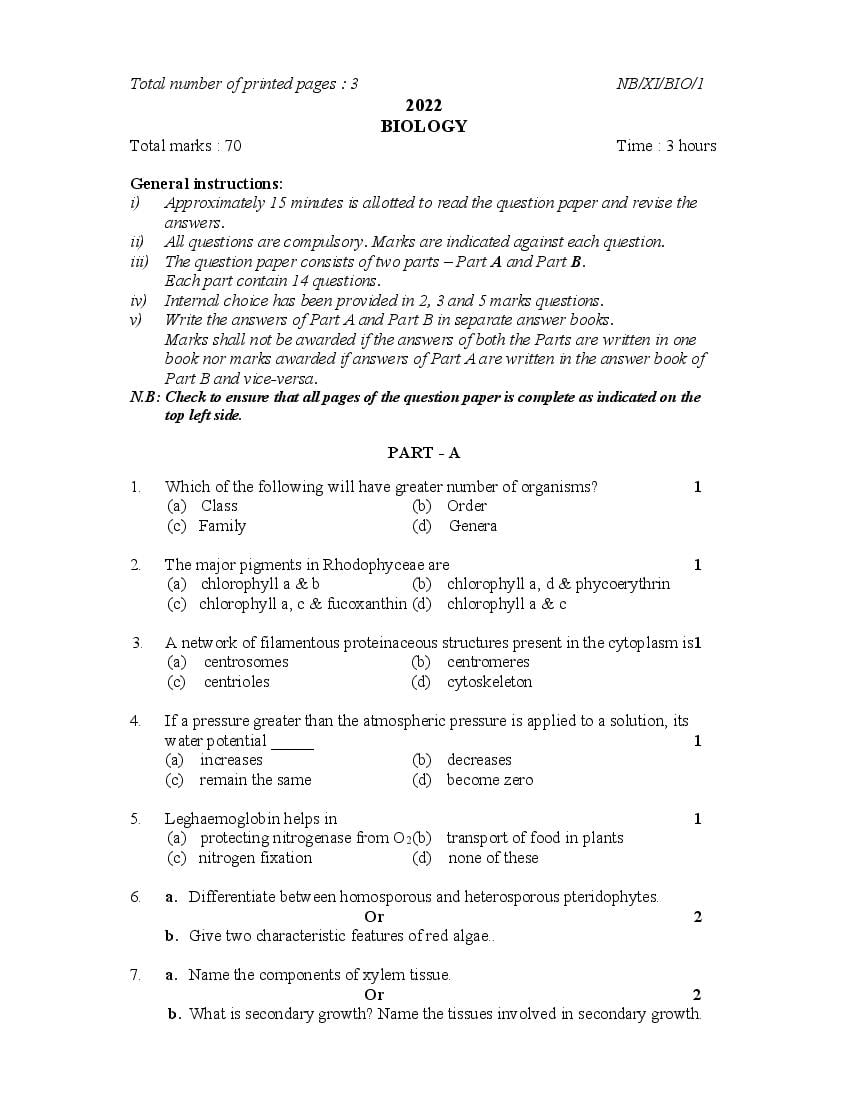
NBSE Class 11 Question Paper 2022 Biology – Text
Read the full text of this question paper below — useful to quickly search, copy and reference the content online without downloading the PDF.
📄 View text version (3 pages)
Page 1
2022
BIOLOGY
Total marks : 70 Time : 3 hours
General instructions:
i) Approximately 15 minutes is allotted to read the question paper and revise the
answers.
ii) All questions are compulsory. Marks are indicated against each question.
iii) The question paper consists of two parts – Part A and Part B.
Each part contain 14 questions.
iv) Internal choice has been provided in 2, 3 and 5 marks questions.
v) Write the answers of Part A and Part B in separate answer books.
Marks shall not be awarded if the answers of both the Parts are written in one
book nor marks awarded if answers of Part A are written in the answer book of
Part B and vice-versa.
N.B: Check to ensure that all pages of the question paper is complete as indicated on the
top left side.
PART - A
1. Which of the following will have greater number of organisms? 1
(a) Class (b) Order
(c) Family (d) Genera
2. The major pigments in Rhodophyceae are 1
(a) chlorophyll a & b (b) chlorophyll a, d & phycoerythrin
(c) chlorophyll a, c & fucoxanthin (d) chlorophyll a & c
3. A network of filamentous proteinaceous structures present in the cytoplasm is1
(a) centrosomes (b) centromeres
(c) centrioles (d) cytoskeleton
4. If a pressure greater than the atmospheric pressure is applied to a solution, its
water potential _____ 1
(a) increases (b) decreases
(c) remain the same (d) become zero
5. Leghaemoglobin helps in 1
(a) protecting nitrogenase from O2 (b) transport of food in plants
(c) nitrogen fixation (d) none of these
6. a. Differentiate between homosporous and heterosporous pteridophytes.
Or 2
b. Give two characteristic features of red algae..
7. a. Name the components of xylem tissue.
Or 2
b. What is secondary growth? Name the tissues involved in secondary growth.
Page 2
8. a. Write two characteristics of prokaryotic cells.
Or 2
b. What are lysosomes? Give its one important function.
9. a. Describe the arrangement of floral members in relation to their insertion or
thalamus.
Or 3
b. Differentiate between autumn wood and spring wood.
10. a. Explain the development of root nodule formation..
Or 3
b. What are macro-nutrients? Mention two essential nutrients and its function.
11. a. State the law of limiting factors. Who proposed this law?
b. Define respiratory quotient. Calculate the RQ for carbohydrates.
12. a. Describe the structure of nucleus with the help of a diagram.
b. Describe the structure of chloroplast with the help of a diagram.
13. a. What is photophosphorylation? Explain cyclic photophosphorylation with the
help of a diagram.
Or 5
b. Describe C4 pathway with diagrammatic representation.
14. a. Explain tricarboxylic acid cycle with the help of schematic representation.
Or 5
b. What are plant growth regulators? Discuss four physiological effects of
auxins.
PART - B
1. The fungi imperfecti is called 1
(a) ascomycetes (b) basidomycetes
(c) deuteromycetes (d) fructose lichens
2. Bioluminescence is seen in 1
(a) Arthropoda (b) Ctenophora
(c) Coelenterata (d) Echinodermata
3. The most abundant protein in animal world is 1
(a) cellulose (b) collagen
(c) insulin (d) RUBISCO
Page 3
4. Succus entericus is the name given to 1
(a) intestinal juice (b) intestinal glands
(c) appendix (d) swelling in the gut
5. The hormone responsible for fight and flight response is 1
(a) adrenaline (b) thyroxine
(c) ADH (d) oxytocin
6. a. What is meant by ‘alternation of generation’?
Or 2
b. Name the largest phylum of kingdom Animalia. Mention two characteristic
features of this phylum.
7. a. State two functions of the epithelial tissues.
Or 2
b. List out two differences between exocrine and endocrine glands.
8. a. Write two similarities between catalysts and enzymes.
Or 2
b. Differentiate between mitosis and meiosis.
9. a. Explain in brief the respiratory system of cockroach.
Or 3
b. Explain in brief the digestive system of frog.
10. a. Write a note on the exchange of gases in human.
Or 3
b. Who are called universal donor and why?
11. a. Give a brief account on the mechanism of synaptic transmission.
b. ‘Even though pituitary gland is very small, it releases majority of the
hormones’, name the various types of hormones released by it.
12. a. Mention the catalytic cycle of an enzymatic action. Draw the structure
of a purine and a pyrimidine.
b. Define Karyokinesis. Explain briefly the prophase-I stage of meiosis.
13. a. Explain the various types of grouping of blood.
b. Define micturition. Explain the regulation of kidney function.
14. a. Give a brief account on the various types of joints in the human body.
Or 5
b. What is endocrine system? Name the hormones secreted by thyroid gland
and write about its functions.
********************