CLAT LLM 2024 Sample Paper
Finished viewing? Save it for later —
Download CLAT LLM 2024 Sample Paper (PDF · 47 pages)About CLAT LLM 2024 Sample Paper
CLAT LLM 2024 Sample Paper is available here for free download. Published by NLUs for Common Law Admission Test, this sample paper can be viewed online or downloaded as a PDF (47 pages). Candidates preparing for Common Law Admission Test can use CLAT LLM 2024 Sample Paper to understand the exam pattern, the type of questions asked, and the overall difficulty level.
Frequently Asked Questions
How can I download CLAT LLM 2024 Sample Paper?
Open this page and click the Download button to save CLAT LLM 2024 Sample Paper as a PDF. It is completely free on AglaSem Docs.
Is CLAT LLM 2024 Sample Paper free to download?
Yes. CLAT LLM 2024 Sample Paper can be viewed online and downloaded as a PDF free of cost on AglaSem Docs.
How many pages does CLAT LLM 2024 Sample Paper have?
CLAT LLM 2024 Sample Paper contains 47 pages, which you can read online or download together as a single PDF.
Where can I find more Common Law Admission Test study material?
You can find more Common Law Admission Test question papers, sample papers, syllabus, and answer keys on AglaSem Docs.
CLAT LLM 2024 Sample Paper – Text
Read the full text of this sample paper below — useful to quickly search, copy and reference the content online without downloading the PDF.
📄 View text version (47 pages)
Page 1
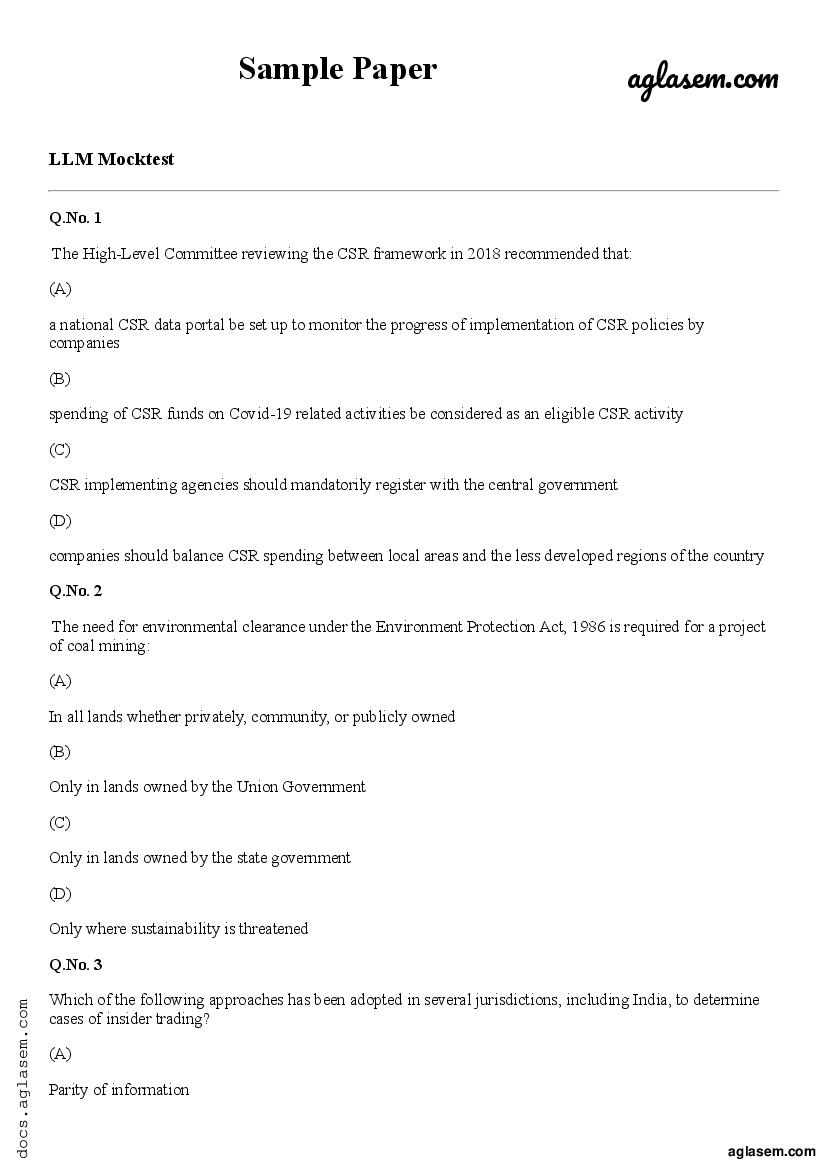
LLM Mocktest
Q.No. 1
The High-Level Committee reviewing the CSR framework in 2018 recommended that:
(A)
a national CSR data portal be set up to monitor the progress of implementation of CSR policies by
companies
(B)
spending of CSR funds on Covid-19 related activities be considered as an eligible CSR activity
(C)
CSR implementing agencies should mandatorily register with the central government
(D)
companies should balance CSR spending between local areas and the less developed regions of the country
Q.No. 2
The need for environmental clearance under the Environment Protection Act, 1986 is required for a project
of coal mining:
(A)
In all lands whether privately, community, or publicly owned
(B)
Only in lands owned by the Union Government
(C)
Only in lands owned by the state government
(D)
Only where sustainability is threatened
Q.No. 3
Which of the following approaches has been adopted in several jurisdictions, including India, to determine
cases of insider trading?
(A)
Parity of information
Page 2
Lifting the corporate veil
(C)
Indoor management
(D)
Constructive notice
Q.No. 4
In A Rajan, which of the following are essential prerequisites for an insider to fall within the mischief of
“insider trading” under the Securities and Exchange Board of India (Prohibition of Insider Trading)
Regulations, 1992 (the “Insider Trading Regulations”)?
(A)
Lack of access to price sensitive information
(B)
A profit motive
(C)
Mens rea
(D)
Abstaining from dealing in securities of a company about which the insider has price sensitive information.
Q.No. 5
Which of the following element is not required for the formation of decision regarding a moral duty?
(A)
rationality
(B)
Objectivity
(C)
Subjectivity
(D)
Knowledge regarding the circumstances
Q.No. 6
Parliament gave effect to Article 17 by enacting:
(A)
The Abolition of Untouchability Act, 1951
Page 3
The Protection of Civil Rights Act, 1955
(C)
The Constitutional Offences Act, 1951
(D)
The Untouchability Offences (Prohibition, Protection, and Remedies) Act, 1950
Q.No. 7
The Supreme Court judgment excerpted above held that compliance with Sections 65A and 65B of the
Indian Evidence Act, 1872 for admitting secondary evidence of electronic records is:
(A)
Mandatory as held in the case of Anvar v. Basheer, (2014) 10 SCC 473
(B)
Discretionary upon the trial court judge to insist or waive the requirement
(C)
To be read together with the mode of proof of non-electronic documents under Sections 62-65, Indian
Evidence Act, 1872
(D)
None of the above
Q.No. 8
What did A Rajan hold regarding the information related to the termination of the shareholders’ agreements
between GIPL and SIL?
(A)
It was not in the respondent’s possession
(B)
It had no impact on the closing price of GIPL’s shares
(C)
It was not price sensitive information
(D)
It was price sensitive information
Q.No. 9
The petition filed by the Indian Young Lawyers Association in this case was a:
(A)
Page 4
(B)
Public Interest Litigation
(C)
Writ Appeal from a petition filed under Article 226
(D)
None of the above
Q.No. 10
in which of the following reports the Law Commission of india advocated for appointment of retired judges
as ad-hoc judges in the interest of clearing backlogs of cases in the High Courts?
(A)
One Hundred eighty eighth report on proposals for Constitution of Hi-tech Fast-track Commercial divisions
in High Courts (2003).
(B)
Fourteenth report on reforms in Judicial Administration (1958).
(C)
One twentieth report on manpower Planning in Judiciary: A blueprint (1987).
(D)
One Hundred eighteenth report on method of Appointments to Subordinate Courts/ Subordinate Judiciary
(1986).
Q.No. 11
The chief objective of the Government’s aspirational district programme is to:
(A)
ensure access to financial services like banking, remittance, credit, insurance, pension in an affordable
manner
(B)
promote entrepreneurship in India in manufacturing and other sectors
(C)
improve India’s ranking in the Human Development Index
(D)
facilitate easy access to credit facilities for people belonging to vulnerable populations
Q.No. 12
Page 5
everything beneath the surface down to the centre of the earth. iii. Entitled to everything below the surface
except those minerals included under the MMDRA.
(A)
All are correct
(B)
Only i is correct
(C)
Only i and ii are correct
(D)
Only i and iii are correct
Q.No. 13
Based on the passage above, which of the following is Waldron most likely to agree with?
(A)
Legislators always make laws based on their party’s ideology, rather than any non-partisan interests
(B)
Legislators make laws based on non-partisan considerations
(C)
Laws are made on the basis of the needs and demands of society from time to time
(D)
Law and law-making can be understood using the partisan or the neutral model
Q.No. 14
Under the Indian Evidence Act, 1872, oral evidence as to the contents of documents:
(A)
Cannot be admitted
(B)
Generally cannot be admitted except when accepted as admissible secondary evidence under Section 65,
Indian Evidence Act, 1872
(C)
Generally can be admitted except when barred by the rule against hearsay
(D)
Generally can be admitted except when considered unreliable due to impeachment of the witness
Page 6
Section 29 of the Trademarks Act, 1999, applicable in this case, considers which of the following as an
infringement of a trademark?
(A)
Misrepresentation of ownership of a trademark
(B)
Infringement of an unregistered trademark
(C)
Interference with exclusive right to use a registered trade mark
(D)
Infringement of a registered trademark by use of an identical or deceptively similar trademark in relation to
identical or similar goods
Q.No. 16
The Supreme Court in Anvar v. Basheer, (2014) 10 SCC 473, overruled the decision of State (NCT of Delhi)
v. Navjot Sandhu, (2005) 11 SCC 600, on which of its holdings?
(A)
That in cases of criminal conspiracy, the method of proof of the conspiracy is controlled by Section 10,
Indian Evidence Act, 1872, and not Section 65B.
(B)
That irrespective of compliance with Section 65B, contents of electronic documents could be proved through
Sections 62-65 of the Indian Evidence Act, 1872.
(C)
That electronic documents being a special class of general documents, had to be proved through expert
opinion under Section 45, Indian Evidence Act, 1872.
(D)
That the document sought to be proved must first be marked and then admitted into evidence for its contents,
and that this sequence may not be reversed
Q.No. 17
Which of these activities is not specified in Schedule VII of the Companies Act, 2013?
(A)
promoting education and employment enhancing vocation skills
(B)
eradicating hunger, poverty and malnutrition
(C)
Page 7
(D)
maintenance of law and order
Q.No. 18
General elections are held again in Partyland, and yet again, the Public Party wins power. It now introduces a
new law, which provides that legislators who vote against their party whip may not be disqualified from
membership of their party for that reason alone. Which of the models of law described in the passage does
this new law align most closely with?
(A)
The neutral model of law
(B)
The partisan model of law
(C)
Equally with both, the neutral and the partisan model of law
(D)
With neither the neutral nor the partisan model of law
Q.No. 19
In Indian evidence law, the proof of the contents of documents must necessarily follow a sequence of
procedure; this sequence (not necessarily covering all stages) can be illustrated as:
(A)
Admitting the document, marking the document, authenticating the document
(B)
Authenticating the document, receiving evidence of its contents, marking the document
(C)
Proving the contents of the document, authenticating the document, marking the document
(D)
Marking the document, authenticating the document, receiving the document as evidence
Q.No. 20
Section 6 of the General Clauses Act, 1897 protects rights, privileges, obligations and liabilities in cases of
repeal of an enactment. The majority in KK Singh held that: i. The Ordinance that ‘ceases to operate’ is
distinct from a law that is void. ii. An Ordinance that ‘ceases to operate’ is distinct from a temporary statute.
iii. An Ordinance that ‘ceases to operate’ is distinct from a repealed statute. iv. An Ordinance that ‘ceases to
operate’ is not ‘saved’ in the absence of any ‘savings clause’ in Article 213.
(A)
i, ii, and iii are correct
Page 8
ii and iii are correct
(C)
i and iii are correct
(D)
All the above are correct
Q.No. 21
Who among the following is the author of the work Mare Liberium, and is also often called the ‘Father’ of
modern international law?
(A)
Jeremy Bentham
(B)
Baruch Spinoza
(C)
Hugo Grotius
(D)
Mohamed ElBaradei
Q.No. 22
“The falsehood of legal positivism resides in envisaging that the law consists of only rules. However, this is a
serious mistake since legal principles partly determine the law in addition to rules. The distinction between
rules and principles is a logical one. Rules apply in an ‘all or nothing fashion.’ If the rule applies to the
circumstances, it determines a particular legal outcome. If it does not apply, it is simply irrelevant to the
outcome…..” according to:
(A)
ronald dworkin, taking rights Seriously,1977
(B)
John Finnis, Natural Law and Natural rights, 1980.
(C)
H.L.A.Hart, the Concept of Law, 1961.
(D)
raz, Joseph, Legal Principles and the Limits of Law, 1972.
Q.No. 23
CSR policy is based on which of the following principles?
Page 9
trusteeship and giving back to society
(B)
utmost good faith
(C)
leveraging India’s managerial, technological and innovative skills
(D)
promoting greater protection for the environment
Q.No. 24
Company A is incorporated in FY 2020-21, Company B is incorporated in FY 2019-20, and Company C is
incorporated in FY 2018-19. Which company is covered under Section 135(1) of the Companies Act, 2013
for CSR in FY 2020-21?
(A)
Company A
(B)
Company B
(C)
Company C
(D)
All the above
Q.No. 25
What does the term ‘latent ambiguity’ mean?
(A)
A glaring ambiguity, obvious from the face of the contract
(B)
A contractual term is reasonably, but not obviously, susceptible to more than one interpretation
(C)
A contractual term written in plain language and clearly understood
(D)
A contractual term that is illegal and against the public good
Q.No. 26
Page 10
undertake the mandate of the Assembly, under article 13(1) of the Charter of the United Nations to
“initiate studies and make recommendations for the purpose of ... encouraging the progressive
development of international law and its codification”?
(A)
The International Law Commission
(B)
The International Court of Justice
(C)
The International Criminal Court
(D)
The World Trade Organisation
Q.No. 27
Partyland is a democratic republic that has a federal legislative body called the Senate. The Senate is the
most powerful legislative body in the country, and its decisions cannot be overruled by the judiciary. The
Personal Party wins the general elections by an overwhelming majority and implements several of its
policies through legislation during its term in power. In the next general elections, the Public Party wins an
overwhelming majority at the polls and passes several legislation reversing the Personal Party’s changes. It
also introduces new laws to implement its own policies. Which of the following is Waldron most likely to
agree with?
(A)
Partyland is not an actual democracy
(B)
The situation in Partyland is an illustration of the neutral model of law
(C)
The situation in Partyland is an illustration of the partisan model of law
(D)
Partyland is not an actual republic
Q.No. 28
Which decision established the three elements of passing off, otherwise known as the “Classical Trinity”?
(A)
Academy of Motion Picture Arts v. GoDaddy.Com, Inc., (2015)
Page 11
Yahoo! Inc. v. Akash Arora and Another, (1999)
(C)
Reckitt & Colman Products Ltd. v. Borden Inc., (1990)
(D)
Coca-Cola Company v. Bisleri International Pvt. Ltd., (2009)
Q.No. 29
The Supreme Court determined whether a religious practice falls within Article 25 using the:
(A)
Essential Religious Practice Test
(B)
Sincerity of Belief Test
(C)
Proportionality Test
(D)
Constitutional Morality Test
Q.No. 30
Article 38(1) of the Statute of the International Court of Justice recognises certain sources of law that it must
apply in deciding disputes submitted to it. Which of the following is or are included under Article 38(1)?
(A)
International conventions, whether general or particular, establishing rules expressly recognised by the
contesting states
(B)
International custom, as evidence of a general practice accepted as law
(C)
The general principles of law recognized by civilized nations
(D)
All the above
Q.No. 31
The ICJ held hearings for provisional measures in response to Ukraine’s application excerpted above on
March 7, 2022. Which of the following did the Russian Federation do in relation to these hearings?
(A)
Page 12
matter
(B)
It chose not to appear before the ICJ, and did not submit any written pleadings either
(C)
It chose not to appear before the ICJ, and submitted written pleadings objecting to the ICJ’s jurisdiction over
the matter
(D)
It appeared before the ICJ, but chose not to submit any written pleadings
Q.No. 32
Which Indian State has the highest number of ‘aspirational districts’?
(A)
Jharkhand
(B)
West Bengal
(C)
Karnataka
(D)
Bihar
Q.No. 33
The power of the Governor to promulgate an Ordinance is subject to the Governor being satisfied that
“circumstances exist which render it necessary for him to take immediate action.” The 7-judge bench in KK
Singh held that the satisfaction of the Governor:
(A)
Is not subject to judicial review since it is a political question
(B)
Is subject to judicial review with regard to the relevancy of the material on which such satisfaction is based
(C)
Is subject to judicial review with regard to the adequacy of materials on which such satisfaction is based
(D)
None of the above
Q.No. 34
Page 13
whole or in part, a national, ethnical, racial or religious group”. Which of the following is not included in the
list of such acts under Article II of the Convention?
(A)
Killing members of the group
(B)
Promoting the cultural activities of the group
(C)
Imposing measures intended to prevent births within the group
(D)
Forcibly transferring children of the group to another group
Q.No. 35
Which judge on the bench in IYLA disagreed with Justice Chandrachud on the application of Article 17?
(A)
Justice R.F. Nariman
(B)
Justice Dipak Misra
(C)
Justice Indu Malhotra
(D)
None of the above
Q.No. 36
Who among the following first coined the term ‘genocide’?
(A)
Hersch Lauterpacht
(B)
Judge Radhabinod Pal
(C)
Raphael Lemkin
(D)
Mirjan Damaška
Q.No. 37
Page 14
Companies Act, 2013?
(A)
5% of the average net worth of the company of the preceding three financial years
(B)
2% of average net profits of the company made during the three immediately preceding financial years
(C)
7% of the average turnover of the company of the previous financial year
(D)
5% of the average net profits of the company made during the preceding financial year
Q.No. 38
A norm cannot become legally valid unless its content is fair and just in accordance to:
(A)
Legal Positivism
(B)
Natural Law
(C)
Historical School
(D)
Sociological School
Q.No. 39
Where the original document, such as the original computer device containing the electronic record is
produced before the court, the provisions of Section 65B(4) of the Indian Evidence Act, 1872 need not be
complied with. However, the owner of the device must be present as a witness and testify that the device
belongs to them. This function by a witness is most appropriately understood as:
(A)
The act of authentication of a document
(B)
The act of proving contents of a document
(C)
The act of corroborating the evidence of a document
(D)
The act of solving the problem of hearsay associated with documents
Page 15
Which of the following dormant provision of the Constitution of india has been invoked by the Supreme
Court of india for the appointment of ad hoc Judges to deal with the backlog of cases before the High
Courts?
(A)
Article 224A
(B)
Article 217
(C)
Article 224
(D)
Article 217A
Q.No. 41
Article 355 of the Constitution of India casts a duty upon the Union to protect every state against, inter alia,
internal disturbance. The Supreme Court has noted that the Sarkaria Commission recognised a range of
situations which could amount to internal disturbance, including:
(A)
Situations of financial exigencies
(B)
Breaches of public peace
(C)
Inefficient administration
(D)
None of the above
Q.No. 42
Which one of the following cases is a key precedent on contextual interpretation of contracts?
(A)
Louisa Carlill v. Carbolic Smoke Ball Company, [1892]
(B)
Dunlop Pneumatic Tyre Co. Ltd. v. New Garage & Motor Co. Ltd., [1914]
(C)
Investors Compensation Scheme Limited v. West Bromwich Building Society, [1997]
(D)
Page 16
Q.No. 43
The main complaint against the Defendant in the case excerpted above is that their mark is “______” to the
Plaintiff’s registered trademarks.
(A)
reasonably close in expression
(B)
same as
(C)
different from
(D)
deceptively similar
Q.No. 44
In A Rajan, the court opined that a person who wanted to indulge in insider trading would have:
(A)
Held on to the shares, and only sold them after the news about the termination of the shareholders’
agreements with SIL was made public.
(B)
Sold the shares before the news about the termination of the shareholders’ agreements with SIL was made
public.
(C)
Held on to the shares and not sold them under any circumstances whatsoever.
(D)
Never have bought GIPL’s shares in the first place.
Q.No. 45
Which of the following are the key facts in A Rajan?
(A)
The respondent sold the shares of the company about which he had unpublished price sensitive information
(“UPSI”) after the rise in price of the shares consequential to the disclosure of the UPSI.
(B)
The respondent did not possess any UPSI about the company whose shares he sold.
(C)
Page 17
shares consequential to the disclosure of the UPSI in his possession.
(D)
The response did not sell any shares of the company about which he had UPSI.
Q.No. 46
What is the extrinsic evidence that the Court used?
(A)
Work order under the Road Transport Contract
(B)
FCI’s Handling and Transport Contracts of 2010 and 2018
(C)
Tender documents filed by the contractors
(D)
FCI’s Handbook on Movement Operations
Q.No. 47
An F.I.R. is considered the first information of the commission of a cognizable offence. Where the
information discloses the commission of both cognizable offences as well as non-cognizable offences as part
of the same facts, such information must be treated in the following manner:
(A)
The entire information will be treated as disclosing cognizable offences and registered as an F.I.R.
(B)
The police officer will sever the parts disclosing non-cognizable offences and shall only register the parts
disclosing cognizable offences.
(C)
The police officer shall refer the informant to the jurisdictional Magistrate for a direction to register the
F.I.R., and thereafter, once such direction is received, register the F.I.R.
(D)
The F.I.R. registered, which contains information of non-cognizable offences, is subject to confirmation by a
Magistrate under Sections 156 and 157 of Cr.P.C.
Q.No. 48
In IYLA, Justice D.Y. Chandrachud held that Article 17 has:
(A)
Vertical application
(B)
Page 18
(C)
Indirect horizontal application
(D)
None of the above
Q.No. 49
Under the Constitution of India, all property and assets, which vested in the British Crown for the purposes
of the Government of the Dominion of India and Governor’s Provinces, stood:
(A)
Confiscated without payment
(B)
Repatriated back to the Crown
(C)
Vested in the Union of India
(D)
Vested in the Union of India and the states
Q.No. 50
Use of a trademark violates exclusive rights of the prior user or proprietor when:
(A)
usage has introduced differences or changes in the work
(B)
usage is likely to cause confusion and deception amongst members of the trade and public
(C)
usage of the work is authorised by the user or proprietor
(D)
the trademark enjoys goodwill
Q.No. 51
A plaintiff seeks to adduce a secondary electronic record into evidence and does not comply with the
requirements under Section 65B, Indian Evidence Act, 1872, for the same. The respondent does not object to
the admission of such evidence at trial. Subsequently, upon appeal, a ground is taken by the original
respondent that such evidence should not have been admitted as it did not comply with the procedure under
Section 65B. Relying on the Supreme Court’s judgment in Sonu v. State of Haryana, (2017) 8 SCC 570, the
court should hold:
(A)
Page 19
65B.
(B)
An appellate court should remand the matter to trial declaring the said evidence inadmissible.
(C)
An objection to the method of proof cannot be raised at the appellate stage as the original plaintiff cannot
rectify the error.
(D)
Since the respondent did not object to the admissibility of the evidence, the document is held to be proved.
Q.No. 52
The above excerpt has been taken from which of the following judgments, where the Supreme Court of india
sought to activate a dormant provision of the Constitution of india for the appointment of ad hoc Judges to
deal with the unprecedented backlog of cases pending before the High Courts ?
(A)
devendra Kumar Saxena v. Central bureau of investigation (Cbi), 2021 SCC OnLine SC 330.
(B)
m.K. ranjitsinh v. union of india, 2021 SCC OnLine SC 326.
(C)
Lok Prahari through its General Secretary S.N. Shukla, iAS (retd.) v. union of india, 2021 SCC OnLine SC
333.
(D)
Justice V. eswaraiah (retd.) v. union of india, 2021 SCC OnLine SC 310.
Q.No. 53
in which of the following cases the Supreme Court of india observed that for appointment of a retired Judge
as an ad hoc judge, the consent of such retired Judge is a pre-requisite for his/her appointment as an ad hoc
judge?
(A)
Ashok tanwar v. State of Himachal Pradesh, (2005) 2 SCC 104.
(B)
Supreme Court Advocates on record Association v. union of india, (2016) 5 SCC 1.
(C)
union of india v. Sankal Chand and Himatlal Sheth, (1977) 4 SCC 193.
(D)
Krishan Gopal v. Shri Prakash Chandra, (1974) 1 SCC 128.
Page 20
The Insider Trading Regulations are no longer in force. Which of the following is the current set of
regulations governing insider trading in India?
(A)
The FUTP Regulations
(B)
The SEBI (Issue of Capital and Disclosure Requirements) Regulations, 2018
(C)
The SEBI (Prohibition of Insider Trading) Regulations, 2015
(D)
The SEBI (Listing Obligations and Disclosure Requirements) Regulations 2015
Q.No. 55
Which of the following statements is true regarding the origin of the Collegium system for appointment of
judges?
(A)
Article 124A of the Constitution of india provides for the establishment of the collegium system.
(B)
the Judicial Appointments (Collegium System) Act, 1999 provides for the establishment of the collegium
system.
(C)
the Constitution of india does not provide for the establishment of the collegium system.
(D)
the National Judicial Appointments Commission supplements the collegium system for appointment of
judges.
Q.No. 56
In States which are bicameral, the Governor can promulgate an Ordinance only when:
(A)
Both Houses are not in session
(B)
When a Proclamation of Emergency is in operation
(C)
When the state has been placed under President’s rule
(D)
Page 21
Q.No. 57
In deciding whether the CoVID-19 pandemic and the ensuing lockdown imposed by the Central
Government to contain the spread of the pandemic, have created a public emergency as defined by the
explanation to Section 5 of the Factories Act, 1948 the Supreme Court in GMS held: i. The economic
slowdown caused by the pandemic constitutes a public emergency. ii. The situation created by the Covid-19
pandemic was similar to a national emergency caused by external aggression or war. iii. The economic
slowdown created by the CoVID-19 pandemic qualifies as an internal disturbance threatening the security of
the state.
(A)
Only i and iii are correct
(B)
Only ii and iii are correct
(C)
Only i and ii are correct
(D)
None of the above statements are correct
Q.No. 58
What is the test of prior use of trademark?
(A)
open, continuous, extensive, uninterrupted use and promotion for a long time
(B)
owner waives rights over trademark and permits subsequent use of the mark
(C)
reasonable parody, comment of a registered trademark
(D)
use of trademark in good faith mainly for a descriptive purpose
Q.No. 59
The Constitution of India provides that all properties within the territory of India that do not have a lawful
heir, successor or rightful owner, accrue to the Union or state where it is situate through:
(A)
Escheat
(B)
Lapse
Page 22
Bona vacantia
(D)
All the above
Q.No. 60
The MMDRA enacted by Parliament grants the Union Government the:
(A)
Right to obtain ownership of land containing mineral wealth
(B)
Power to exclude the State Government from ownership rights of land containing mineral wealth
(C)
Right to regulate the grant of mining rights
(D)
Right to impose taxes on all mining activities
Q.No. 61
Justice D.Y. Chandrachud’s reliance on Constituent Assembly Debates to determine the scope of Article 17 is
best explained by this method of constitutional interpretation:
(A)
Living Constitutionalism
(B)
Originalism
(C)
Structuralism
(D)
Textualism
Q.No. 62
An Ordinance promulgated by the Governor: i. shall be treated to be ‘law’ for the purposes of Article 13 of
the Constitution of India. ii. shall in all cases require the prior approval of the President. iii. shall not be
constrained by the subject-matter requirements of Article 246 read with the Seventh Schedule of the
Constitution of India.
(A)
i alone is correct
(B)
Page 23
(C)
i, ii and iii are correct
(D)
None of the above are correct
Q.No. 63
The Constitution of India, vests all lands, minerals, and other things of value under the ocean floor within
the territorial waters:
(A)
in the Union of India
(B)
in the respective states having a shoreline
(C)
in the Union and all states in the Union
(D)
Are treated as ‘res commune’
Q.No. 64
What is the defence of acquiescence?
(A)
no confusion or difference in essential features of the trademark
(B)
waiver of right over trademark and permission for use of the mark
(C)
invalidity of the registered trademark
(D)
use of the trademark in good faith
Q.No. 65
Which of the following statements is not true?
(A)
‘morality of duty’ is non-obligatory.
(B)
Page 24
(C)
rules of ‘morality of aspiration’ are a challenge to human conduct.
(D)
Human excellence is the end of ‘morality of aspiration’.
Q.No. 66
The judgment of the Supreme Court in Tomaso Bruno v. State of u.P., (2015) 3 SCC (Cri) 54, has been held
to be per incuriam. In law, a judgment is per incuriam when:
(A)
The judgment is against binding precedent of a higher court or larger bench.
(B)
The judgment is against binding provisions of law applicable to the subject.
(C)
Both (A) and (B)
(D)
Neither (A) nor (B)
Q.No. 67
Validity of law resides in the political sovereignty of the maker of that law refers to:
(A)
Legal Positivism
(B)
Natural Law
(C)
Historical School
(D)
Sociological School
Q.No. 68
Which of these is not, in itself, a defence to infringement of a registered trademark?
(A)
honest and concurrent use
(B)
Page 25
(C)
prior adoption and use
(D)
fair use
Q.No. 69
In the review petition against this judgment, the Supreme Court has framed which of the following questions
for determination by a 9-judge bench?
(A)
Scope of “public order, morality and health” in Article 25(1)
(B)
Scope of expression “section of Hindus” in Article 25(2)(b)
(C)
Scope of “judicial recognition” to PILs filed by people not belonging to a religious denomination to contest a
religious practice
(D)
All the above
Q.No. 70
Ukraine filed the application excerpted above concerning “a dispute . . . relating to the interpretation,
application and fulfilment of ” an international convention (the “Convention”), whose name has been
replaced with ‘[1]’ in the excerpt above. What is the full name of the Convention?
(A)
Convention on the Elimination of All Forms of Discrimination against Women, 1979
(B)
Convention on the Prevention and Punishment of the Crime of Genocide, 1948
(C)
International Covenant on Civil and Political Rights, 1966
(D)
Convention against Torture and Other Cruel, Inhuman or Degrading Treatment or Punishment, 1984
Q.No. 71
Which of the following falls within the scope of the Companies (CSR Policy) Rules, 2014?
(A)
determination of the amount of expenditure to be incurred by companies on CSR activities
Page 26
reporting on the amount remaining unspent by the Company for CSR activities with detailed reasons for
failing to spend the amount
(C)
impact assessment and disclosure requirements for CSR
(D)
detailing the company’s sponsorship activities for deriving marketing benefits for its products or services
Q.No. 72
‘the life of the law has not been logic: it has been experience’ is stated by:
(A)
Holmes
(B)
Dworkin
(C)
Cardozo
(D)
Amartya Sen
Q.No. 73
in Supreme Court Advocates on Record Association v. Union of India, (2016) 5 SCC 1, the Supreme Court
of india, by a ______ majority, restored the collegium system of appointment of judges by holding that the
National Judicial Appointments Commission Act, 2014 is ultra vires the Constitution of india.
(A)
3:2
(B)
4:1
(C)
6:1
(D)
4:3
Q.No. 74
The Supreme Court in Sarbananda Sonowal v. Union of India, AIR 2005 SC 2920, held that the duty of the
Union to protect every state against external aggression and internal disturbance extends to:
(A)
Page 27
(B)
Situations where there are large-scale cases of migration from other parts of India
(C)
Cases of external aggression which are similar to ‘war’
(D)
None of the above
Q.No. 75
The Supreme Court has indicated that matters that affect public order are to be determined: i. By looking at
the nature of the act, how violent it is irrespective of its context. ii. The degree and effect any action has on
the life of the community. iii. By consideration of factors related to the maintenance of law and order.
(A)
Only i and iii are correct
(B)
Only ii is correct
(C)
Only i and ii are correct
(D)
All the above statements are correct
Q.No. 76
In IYLA, the Supreme Court held that the worshippers of Lord Ayyappa:
(A)
are not a religious denomination because they have not registered themselves as such
(B)
are not a religious denomination because they do not have a distinct name, a common set of beliefs, and a
common organisational structure
(C)
are a religious denomination because they have been recognised as such by the state
(D)
are a religious denomination because they have consistently been treated as such by themselves as well as by
society in general
Q.No. 77
Page 28
(A)
a civil wrong
(B)
not actionable per se
(C)
a criminal wrong
(D)
violates fundamental rights
Q.No. 78
In the concluding part of the judgment excerpted above, preliminary inquiries were permitted for which of
the following class or classes of cases?
(A)
Offences related to matrimonial disputes
(B)
Allegations of corruption against public officers
(C)
Where the information was received after substantial delay, such as more than three months after the alleged
incident
(D)
All the above
Q.No. 79
Which of the following did the court in A Rajan say was clarified in SEBI v. Kanaiyalal Baldevbhai Patel,
(2017) 15 SCC 1, as regards the SEBI (Prohibition of Fraudulent and Unfair Trade Practices relating to
Securities Market) Regulations, 2003 (the “FUTP Regulations”)?
(A)
That mens rea is an indispensable requirement to attract the rigour of the FUTP Regulations
(B)
That mens rea is not an indispensable requirement to attract the rigour of the FUTP Regulations
(C)
That mens rea is not an indispensable requirement to attract the rigour of the Insider Trading Regulations
(D)
That mens rea is an indispensable requirement to attract the rigour of the Insider Trading Regulations
Page 29
Where primary evidence of an electronic record cannot be produced in court, and the secondary evidence is
not accompanied by a certificate required under Section 65B(4), Indian Evidence Act, 1872, the court may:
(A)
Never admit such evidence
(B)
May only admit such evidence where it is satisfied that procuring such a certificate for the party adducing the
document into evidence would result in unfair prejudice, and where the document is crucial evidence
(C)
May admit such evidence if satisfied that the party adducing such evidence was unable to procure the
certificate despite best efforts and that it was impossible for them to do so
(D)
Admit such evidence after a scrutiny of the fact it purports to prove, and only do so for the proof of relevant
facts, and never for the proof of facts in issue as defined under Section 3, Indian Evidence Act, 1872.
Q.No. 81
the concept of duty as characterised by Lon L. Fuller seems
(A)
dynamic
(B)
Static
(C)
Personal
(D)
Fictional
Q.No. 82
What reason did A Rajan give for selling his shares in the company about which he had UPSI?
(A)
He expected a huge rise in the share price of GIPL upon the disclosure of the UPSI in his possession.
(B)
It was a compulsory requirement under the shareholders’ agreement with SIL.
(C)
He needed funds to buy the securities of SIL.
(D)
Page 30
Q.No. 83
In the case of Pakala Narayanaswami v. King Emperor, 1939 Cri LJ 364 (PC), the Privy Council held that a
statement would be a confession if it:
(A)
Admitted the commission of the offence in the terms of the offence.
(B)
Admitted the commission of the ingredients for the commission of the offence.
(C)
Either (A) or (B)
(D)
Both (A) and (B)
Q.No. 84
The Factories Act, 1948, stipulates the maximum number of hours that can be worked per week and also that
overtime wages need to be double the normal wage rate. In GMS the exemption relied upon by State
government to extend the working hours to 12 hours a day and at the usual wage rate without payment of
overtime across all factories was deemed to be: i. Justified in view of the grave emergency cause by the
Covid-19 pandemic. ii. Violative of the rule of law. iii. Violative of just and humane conditions of work.
(A)
Only i and iii are correct
(B)
Only ii is correct
(C)
Only ii and iii are correct
(D)
All the above statements are correct
Q.No. 85
Consider the statements:
(i) the moralistic philosophy always strives to encroach into the area of morality of aspiration to bring it as
duty for the social living.
(ii) the moralistic philosophers compel us to embrace the pattern of human conduct, instead of making us
realize a pattern of life that is worthy of human nature.
Choose the correct answer from the code given below.
(A)
Page 31
(B)
both (i) and (ii) are untrue.
(C)
(i) is true and (ii) is untrue.
(D)
(ii) is true and (i) is untrue.
Q.No. 86
In Clause XII (Road Transport Contract), discussed in the extract above, the FCI may reimburse itself for
damages etc., as Liquidated Damages. What does the term ‘liquidated damages’ mean?
(A)
Stipulated amount payable on breach of contract
(B)
Amount payable for actual damage caused due to breach
(C)
Amount intended to secure performance of contract
(D)
Damages payable for breach, where the exact amount is not pre-agreed
Q.No. 87
Section 105 of the Transfer of Property Act, 1882 states that a lease of immovable property is a transfer of a
right to enjoy such property under certain conditions. The right to ‘enjoy such property’:
(A)
Includes the right to carry on mining operation in the surface of the land
(B)
Includes the right to carry on mining operation in the sub-soil of the land
(C)
Includes the right to extract the specified quantity of the minerals found therein, to remove and appropriate
that mineral
(D)
All the above
Q.No. 88
Which one of the following is not part of the Plaintiff’s claim for infringement in this case?
Page 32
trademark
(B)
tagline
(C)
patent
(D)
trade dress
Q.No. 89
Based on the passage, what was the impact of the cancellation of the shareholders’ agreements between SIL
and GIPL?
(A)
There was a decrease in the closing prices of the shares after this information was disclosed.
(B)
There was an increase in the closing prices of the shares after this information was disclosed.
(C)
There was no change in the closing prices of the shares after this information was disclosed.
(D)
The company’s securities were delisted from the stock exchange.
Q.No. 90
The Court referred to Union of India v. Raman Iron Foundry (1974), to explain that contractual terms cannot
be interpreted in isolation, following strict etymological rules or be guided by popular connotation of terms,
at variance with the contractual context. This principle of interpretation of contracts is known as
(A)
Ejusdem generis
(B)
Mischief rule
(C)
Literal rule
(D)
Rule of contextual interpretation
Q.No. 91
Page 33
i. Sub-soil rights are treated as ‘commons’ and are held by the State in public trust. ii. There is nothing in the
law which declares that all mineral wealth/ subsoil rights vest in the State. iii. The owner of the land can be
deprived of sub-soil rights by law.
(A)
i is correct
(B)
ii and iii are correct
(C)
i and iii are correct
(D)
None of the above is correct
Q.No. 92
In terms of the time when the certificate required under Section 65B(4) of the Indian Evidence Act, 1872
must be produced, and specifically in the context of criminal trials, the Supreme Court has held:
(A)
That the certificate must generally be produced at the time of production of documents, which would mean
filing of the chargesheet in a criminal case.
(B)
That the documents, if missing, or deficient, can be supplied at a later stage in the trial and the court can be
asked to take them on record.
(C)
That generally speaking, any application during trial to take additional documents on record must be
examined as to not cause unfair prejudice to the accused.
(D)
All the above
Q.No. 93
Based on the information provided in the passage, which of the following is the most accurate as regards the
Basic Structure doctrine in Indian constitutional law?
(A)
As it places limits on the amending power of Parliament, it is closer to the partisan rather than the neutral
model of law.
(B)
As it emerged from a series of judicial decisions rather than legislation, it is a product of partisan rather than
neutral law-making.
Page 34
It does not reflect any of the attributes of either the neutral or partisan model of law.
(D)
As it places limits on the amending power of Parliament, it is closer to the neutral rather than the partisan
model of law.
Q.No. 94
Principles requiring that laws be general, public, prospective, coherent, clear, stable, and practicable are
indispensable to law-making correspond to:
(A)
inner morality
(B)
method of logic
(C)
Legitimacy and transparency in law making
(D)
democratic law making
Q.No. 95
Article IX of the Convention provides that disputes between Contracting Parties relating to the interpretation,
application or fulfilment of the Convention, shall be submitted to the International Court of Justice (the
“ICJ”) at the request of:
(A)
The United Nations High Commissioner for Refugees
(B)
Any State not party to the dispute
(C)
The Secretary-General of the United Nations
(D)
Any of the parties to the dispute
Q.No. 96
The Constitution Bench in D.C. Wadhwa v. State of Bihar (1987) 1 SCC 378 held that re-promulgation of an
Ordinance was a ‘fraud on the Constitution’ because:
(A)
Legislative power is vested in the legislatures by the Constitution of India
Page 35
It is a colourable exercise of power under the Constitution of India
(C)
The role of the Executive is to implement a law, not make it
(D)
None of the above
Q.No. 97
What was the latent ambiguity in the contract discussed in the case excerpted above?
(A)
if the parties had capacity to perform the contract
(B)
if the parties intended to execute the contract
(C)
whether the term “charges” was exclusive of liability for demurrages
(D)
whether the Corporation can recover charges under the contract
Q.No. 98
Which of the following statements regarding the ‘morality of aspiration’ is untrue?
(A)
The morality of aspiration is based on inevitable rules for ordered social living.
(B)
The morality of aspiration impulses towards the perfection and excellence.
(C)
The law cannot regulate the morality of aspiration because it is subjective in nature.
(D)
The law cannot compel a man to adhere to the best of his human capabilities.
Q.No. 99
According to the Court, how was this Road Transport Contract different from FCI’s earlier contracts with
transport contractors?
(A)
FCI’s earlier contracts had expired
Page 36
The present contract did not include loading and unloading of foodgrains from the railway wagons within the
scope of contractor’s duties
(C)
Earlier contracts were executed by FCI with contractors who were both handlers and transporters
(D)
Earlier contracts were not validly executed
Q.No. 100
Article 213 requires the Governor to reserve an Ordinance for the consideration of the President: i. in all
cases when the state is placed under President’s Rule under Article 356. ii. when the Ordinance pertains to
the proviso to Article 304(b) and seeks to impose reasonable restrictions in the public interest on the freedom
of trade, commerce or intercourse with or within that state. iii. when the Ordinance is on a matter enumerated
in the Concurrent List (of the Seventh Schedule) and which is repugnant to a law made by Parliament.
(A)
i, ii, and iii are correct
(B)
ii and iii are correct
(C)
i and iii are correct
(D)
None is correct
Q.No. 101
In the case of Aghnoo Nagesia v. State of Bihar, AIR 1966 SC 119, the accused himself walked to the police
station and registered an F.I.R. against himself for the murder of his family members. There was no formal
information of the commission of the offence prior to the accused himself having the F.I.R. registered. Per
the judgment in the case, such an F.I.R. would be considered:
(A)
Violative of right against self-incrimination under Article 20(3) of the Constitution of India.
(B)
A statement that cannot be proved as a confession hit by Section 25, Indian Evidence Act, 1872.
(C)
A statement that can be used as substantive evidence against its maker, since there was no accusation against
him at the time he made the statement.
(D)
Page 37
the offence cannot be proved.
Q.No. 102
In the recent judgment of the Supreme Court in Netaji Achyut Shinde (Patil) v. State of Maharashtra, (2021)
SCC Online SC 247, a three-judge bench of the Court reiterated which of the following principles relating to
a FIR?
(A)
That a cryptic phone call, without complete details and information about the commission of a cognizable
offence cannot always be treated as a F.I.R.
(B)
That non-reading-over of the recorded complaint by the police to the informant will vitiate the recording of
the F.I.R.
(C)
That F.I.R.s are substantive pieces of evidence at the trial and can be duly proved to establish the facts in
issue at a trial.
(D)
That F.I.R.s are necessarily hearsay statements and cannot be relied upon to prove the truth of the matters
asserted therein.
Q.No. 103
The Court used the expression “Ex praecedentibus et consequentibus optima fit interpretatio”. What does
this mean?
(A)
Of the same kind
(B)
The best interpretation is made from the context
(C)
An exception proves the rule
(D)
No action arises on an immoral contract
Q.No. 104
A resolution by the Legislature disapproving an Ordinance promulgated under Article 213 by the Governor
is:
(A)
statutory in nature and has binding effect upon the Government
(B)
Page 38
(C)
a decision of the House relating to the control of its proceedings
(D)
an exercise of delegated legislation
Q.No. 105
The rationale of the Factories Act, 1948 in providing double the wage rate for periods of overtime work is
based on: i. Compensating the worker for the extra strain on their health in doing overtime work. ii. Enabling
the worker to maintain proper standard of health and stamina. iii. Protecting the worker against exploitation.
(A)
i, ii, and iii are correct
(B)
Only i and iii are correct
(C)
Only ii is correct
(D)
Only ii and iii are correct
Q.No. 106
KK Singh overruled two 5-Judge decisions of the Supreme Court, to hold:
(A)
An Ordinance which is not laid before the Legislature in the manner prescribed by Article 213 shall not have
any legal effect and consequences.
(B)
An Ordinance which is not laid before the Legislature in the manner prescribed by Article 213 shall be void
from the date that it should have obtained approval.
(C)
An Ordinance which is not laid before the Legislature in the manner prescribed by Article 213 shall be void
from the date the ordinance is replaced by a law made by the Legislature to replace the Ordinance.
(D)
An Ordinance which is not laid before the Legislature in the manner prescribed by Article 213 shall be
considered as a temporary statute.
Q.No. 107
According to the decision of the Supreme Court in Lalita Kumari, the police may not consider the
genuineness of information disclosing the commission of a cognisable offence at the time of registering an
F.I.R. What does this mean?
Page 39
That the informant must be believed for the purposes of registering the F.I.R.
(B)
That the information must be taken as true for the purposes of registering the F.I.R.
(C)
That the police cannot reject any information disclosing the commission of a cognisable offence on the basis
of it being false.
(D)
All the above
Q.No. 108
The High Court had held that the Corporation was only entitled to recover losses that were incurred due to
the contractor’s dereliction of duties under Section 73 of the Indian Contract Act, 1872. What does Section
73 provide for?
(A)
Obligation of parties to perform their promise
(B)
Compensation for breach of contract where penalty stipulated for
(C)
Compensation for loss or damage caused by breach of contract
(D)
Effect of refusal of party to perform promise wholly
Q.No. 109
In the passage above, what does the term “non-derogable” mean?
(A)
Cannot be extracted under any circumstances
(B)
Cannot be precisely determined
(C)
Cannot be infringed under any circumstances
(D)
None of the above
Q.No. 110
Page 40
Assembly of the State or where it is bicameral, before both the Houses. Keeping in mind the constitutional
provisions, an ordinance promulgated by the Governor can remain effective for a maximum period of:
(A)
Six weeks
(B)
Six months
(C)
Seven-and-a-half months
(D)
One year
Q.No. 111
The Supreme Court in Ram Manohar Lohia v. State of Bihar, AIR 1966 SC 740, Arun Ghosh v. State of
West Bengal, 1970 SCR 288, and later cases, has indicated that matters affecting law and order can be
determined:
(A)
Not by the nature of the act alone e.g., a case of stabbing of one person by another
(B)
The degree to which public tranquility is disturbed
(C)
Whether the even tempo of life of a community continues undisturbed or not
(D)
All the above
Q.No. 112
X gets his Will made. The final Will is drawn up by a scribe who takes down the dictation of the terms and
averments of the document, and thereafter, the Will is executed by the testator. The execution of the Will is
also attested to by two witnesses. Upon the death of X, the Will falls into controversy. Y, one of X’s sons,
challenges the validity of the Will. To prove due execution of the document, Z, X’s other son, who supports
the Will, calls one of the attesting witnesses to court. This witness states that he does not remember the due
execution of the Will nor does he remember attesting the Will. Thereafter, Z seeks to examine the scribe who
wrote the Will as a witness to its execution. Can the scribe be examined at this stage?
(A)
Yes, since one of the attesting witnesses has not recalled the execution, any other evidence is now admissible
to prove execution under Section 71, Indian Evidence Act, 1872.
(B)
Page 41
examined under Section 68, Indian Evidence Act, 1872.
(C)
No, since one attesting witness has denied the execution, no other evidence can prove the execution of the
Will.
(D)
Yes, since the scribe is a direct witness to the execution of the Will, and his evidence is admissible under
Section 60, Indian Evidence Act, 1872.
Q.No. 113
In Lalita Kumari the Supreme Court provides a timeline for the completion of preliminary inquiries by the
police prior to the registration of the F.I.R. As per the Court, such an inquiry should be concluded:
(A)
Within a period not exceeding fifteen days
(B)
Within a period not exceeding seven days
(C)
As expeditiously as possible but the Court did not specify a timeline
(D)
Within such time as may be permitted by the jurisdictional Magistrate
Q.No. 114
Which of the following is a proponent of the neutral model of law-making most likely to agree with?
(A)
Everyone agrees that democracy is desirable, and the fact that the voter turnout in recent years has increased
tremendously shows that law-making is non-partisan.
(B)
Everyone agrees that legislators should represent their constituents’ interests, and so, they should vote only
for laws that their party has promised to the electorate in the election manifesto.
(C)
Everyone agrees that child pornography is heinous, and that fact that politicians across parties have voted for
strong punishments to be imposed on child pornographers shows that law-making is non-partisan.
(D)
Everyone agrees that judges are not elected, and so, they should not have any law-making powers, directly
through legislation or indirectly through interpretation.
Q.No. 115
Page 42
law?
(A)
Common law doctrine evolves over time, and in some instances may take much longer to evolve than the
passage of a legislation.
(B)
Common law doctrine only evolves based on a form of reasoning specific to the law and is not affected by
the personal values or ideologies of judges.
(C)
The evolution of common law doctrine proceeds in a purely logical manner and is not affected by any
partisan values or ideology.
(D)
The evolution of common law doctrine is directed by the partisan interests of judges and is not divorced from
political values or ideology.
Q.No. 116
The Public Party wins a second term in power and introduces sweeping changes to Partyland’s laws. Judges
now have limited or no discretion in deciding cases but are expected to apply the codified laws of the country
strictly. Which of the models of law described in the passage do these changes align most closely with?
(A)
The neutral model of law
(B)
The partisan model of law
(C)
Equally with both, the neutral and the partisan model of law
(D)
With neither the neutral nor the partisan model of law
Q.No. 117
In order to prove infringement of copyright here, the Defendant’s work:
(A)
should be the exact reproduction of the Plaintiff's work/label
(B)
looks similar to or like a copy or is reproduction of substantial part of the Plaintiff's work
(C)
bears no resemblance to the Plaintiff's work/label
Page 43
should be created only by the Defendant or its authorised agents
Q.No. 118
Based on the passage, what is ‘insider trading’ under the Insider Trading Regulations?
(A)
Dealing in the securities of a company about which one does not have UPSI, without any desire to make a
profit.
(B)
Dealing in the securities of a company about which one has UPSI, without any desire to make a profit.
(C)
Dealing in the securities of a company about which one does not have UPSI, with the desire to make a
profit.
(D)
Dealing in the securities of a company about which one has UPSI, with the desire to make a profit.
Q.No. 119
‘i mean simply that history, in illuminating the past, illuminates the present, and in illuminating the present,
illuminates the future’ opined by:
(A)
roscoe Pound
(B)
benjamin Cardozo
(C)
duguit
(D)
Auguste Comte
Q.No. 120
Which of the following most strongly supports the neutral model of law and law-making?
(A)
The fact that once enacted, a legislation is regarded as an act of Parliament as a whole, rather than any
political party
(B)
The fact that party whips ensure party members vote in accordance with their party’s ideological position
(C)
Page 44
(D)
The fact that elections to legislatures are hotly contested
Answer Sheet
Q.No Answer
Q.No. 1 (A)
Q.No. 2 (A)
Q.No. 3 (D)
Q.No. 4 (C)
Q.No. 5 (C)
Q.No. 6 (B)
Q.No. 7 (C)
Q.No. 8 (C)
Q.No. 9 (B)
Q.No. 10 (A)
Q.No. 11 (C)
Q.No. 12 (C)
Q.No. 13 (A)
Q.No. 14 (B)
Q.No. 15 (C)
Q.No. 16 (A)
Q.No. 17 (A)
Q.No. 18 (A)
Q.No. 19 (C)
Q.No. 20 (D)
Q.No. 21 (C)
Q.No. 22 (A)
Q.No. 23 (B)
Q.No. 24 (A)
Q.No. 25 (C)
Q.No. 26 (A)
Q.No. 27 (A)
Q.No. 28 (D)
Q.No. 29 (A)
Q.No. 30 (B)
Q.No. 31 (A)
Page 45
Q.No. 33 (B)
Q.No. 34 (B)
Q.No. 35 (C)
Q.No. 36 (C)
Q.No. 37 (C)
Q.No. 38 (B)
Q.No. 39 (A)
Q.No. 40 (A)
Q.No. 41 (D)
Q.No. 42 (C)
Q.No. 43 (D)
Q.No. 44 (A)
Q.No. 45 (A)
Q.No. 46 (B)
Q.No. 47 (A)
Q.No. 48 (B)
Q.No. 49 (D)
Q.No. 50 (C)
Q.No. 51 (A)
Q.No. 52 (C)
Q.No. 53 (C)
Q.No. 54 (A)
Q.No. 55 (C)
Q.No. 56 (D)
Q.No. 57 (D)
Q.No. 58 (C)
Q.No. 59 (D)
Q.No. 60 (C)
Q.No. 61 (B)
Q.No. 62 (A)
Q.No. 63 (A)
Q.No. 64 (B)
Q.No. 65 (A)
(D)
Q.No. 66
Q.No. 67 (A)
Q.No. 68 (C)
Q.No. 69 (D)
Page 46
Q.No. 71 (D)
Q.No. 72 (A)
Q.No. 73 (B)
Q.No. 74 (A)
Q.No. 75 (B)
Q.No. 76 (B)
Q.No. 77 (A)
Q.No. 78 (D)
Q.No. 79 (A)
Q.No. 80 (C)
Q.No. 81 (A)
Q.No. 82 (A)
Q.No. 83 (C)
Q.No. 84 (C)
Q.No. 85 (A)
Q.No. 86 (D)
Q.No. 87 (D)
Q.No. 88 (B)
Q.No. 89 (C)
Q.No. 90 (B)
Q.No. 91 (B)
Q.No. 92 (D)
Q.No. 93 (C)
Q.No. 94 (A)
Q.No. 95 (A)
Q.No. 96 (B)
Q.No. 97 (A)
Q.No. 98 (A)
Q.No. 99 (A)
Q.No. 100 (B)
Q.No. 101 (B)
Q.No. 102 (A)
Q.No. 103 (B)
(A)
Q.No. 104
Q.No. 105 (A)
Q.No. 106 (A)
Q.No. 107 (D)
Page 47
Q.No. 109 (C)
Q.No. 110 (C)
Q.No. 111 (D)
Q.No. 112 (C)
Q.No. 113 (B)
Q.No. 114 (B)
Q.No. 115 (D)
Q.No. 116 (D)
Q.No. 117 (D)
Q.No. 118 (D)
Q.No. 119 (B)
Q.No. 120 (C)
Document Details
| Board / Org | NLUs |
| Exam | Common Law Admission Test |
| Type | Sample Paper |
| Pages | 47 |
| Updated | 15 Jul 2026 |