CLAT 2024 Sample Paper
Finished viewing? Save it for later —
Download CLAT 2024 Sample Paper (PDF · 63 pages)About CLAT 2024 Sample Paper
CLAT 2024 Sample Paper is available here for free download. Published by NLUs for Common Law Admission Test, this sample paper can be viewed online or downloaded as a PDF (63 pages). Candidates preparing for Common Law Admission Test can use CLAT 2024 Sample Paper to understand the exam pattern, the type of questions asked, and the overall difficulty level.
Frequently Asked Questions
How can I download CLAT 2024 Sample Paper?
Open this page and click the Download button to save CLAT 2024 Sample Paper as a PDF. It is completely free on AglaSem Docs.
Is CLAT 2024 Sample Paper free to download?
Yes. CLAT 2024 Sample Paper can be viewed online and downloaded as a PDF free of cost on AglaSem Docs.
How many pages does CLAT 2024 Sample Paper have?
CLAT 2024 Sample Paper contains 63 pages, which you can read online or download together as a single PDF.
Where can I find more Common Law Admission Test study material?
You can find more Common Law Admission Test question papers, sample papers, syllabus, and answer keys on AglaSem Docs.
CLAT 2024 Sample Paper – Text
Read the full text of this sample paper below — useful to quickly search, copy and reference the content online without downloading the PDF.
📄 View text version (63 pages)
Page 1
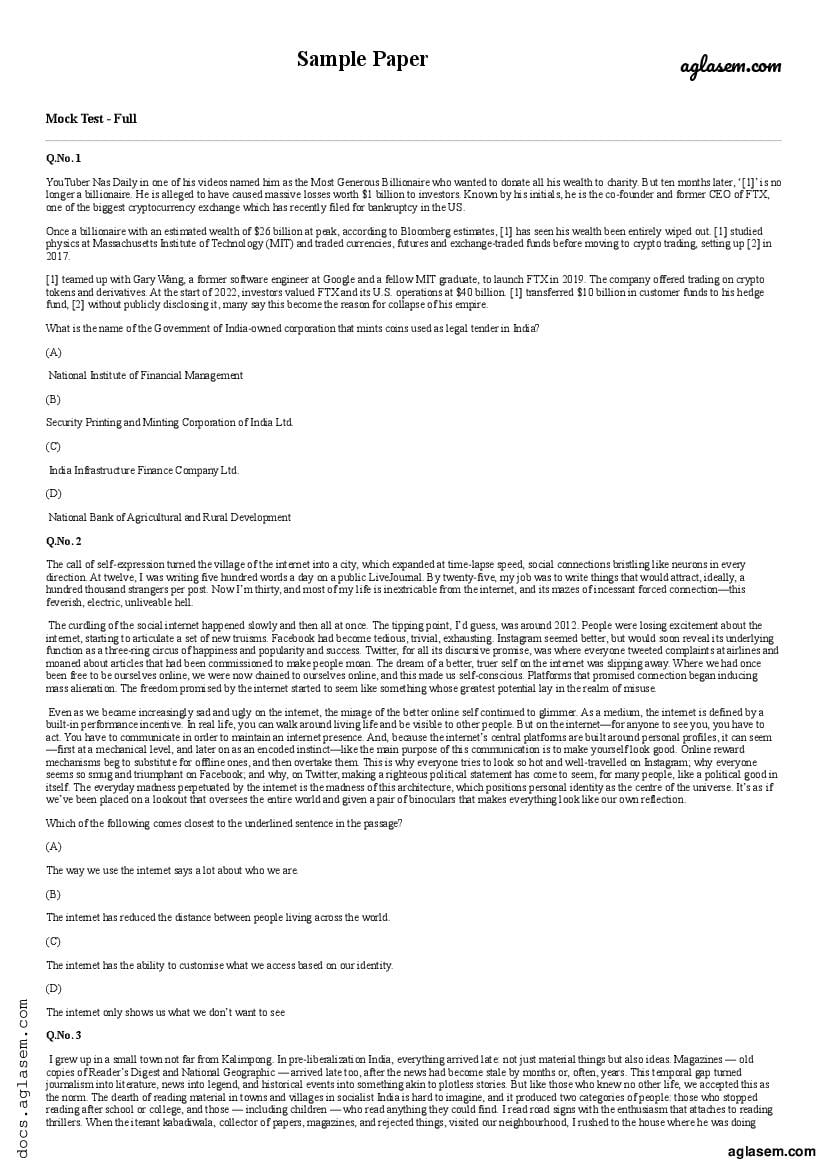
Mock Test - Full
Q.No. 1
YouTuber Nas Daily in one of his videos named him as the Most Generous Billionaire who wanted to donate all his wealth to charity. But ten months later, ‘[1]’ is no
longer a billionaire. He is alleged to have caused massive losses worth $1 billion to investors. Known by his initials, he is the co-founder and former CEO of FTX,
one of the biggest cryptocurrency exchange which has recently filed for bankruptcy in the US.
Once a billionaire with an estimated wealth of $26 billion at peak, according to Bloomberg estimates, [1] has seen his wealth been entirely wiped out. [1] studied
physics at Massachusetts Institute of Technology (MIT) and traded currencies, futures and exchange-traded funds before moving to crypto trading, setting up [2] in
2017.
[1] teamed up with Gary Wang, a former software engineer at Google and a fellow MIT graduate, to launch FTX in 2019. The company offered trading on crypto
tokens and derivatives. At the start of 2022, investors valued FTX and its U.S. operations at $40 billion. [1] transferred $10 billion in customer funds to his hedge
fund, [2] without publicly disclosing it, many say this become the reason for collapse of his empire.
What is the name of the Government of India-owned corporation that mints coins used as legal tender in India?
(A)
National Institute of Financial Management
(B)
Security Printing and Minting Corporation of India Ltd.
(C)
India Infrastructure Finance Company Ltd.
(D)
National Bank of Agricultural and Rural Development
Q.No. 2
The call of self-expression turned the village of the internet into a city, which expanded at time-lapse speed, social connections bristling like neurons in every
direction. At twelve, I was writing five hundred words a day on a public LiveJournal. By twenty-five, my job was to write things that would attract, ideally, a
hundred thousand strangers per post. Now I’m thirty, and most of my life is inextricable from the internet, and its mazes of incessant forced connection—this
feverish, electric, unliveable hell.
The curdling of the social internet happened slowly and then all at once. The tipping point, I’d guess, was around 2012. People were losing excitement about the
internet, starting to articulate a set of new truisms. Facebook had become tedious, trivial, exhausting. Instagram seemed better, but would soon reveal its underlying
function as a three-ring circus of happiness and popularity and success. Twitter, for all its discursive promise, was where everyone tweeted complaints at airlines and
moaned about articles that had been commissioned to make people moan. The dream of a better, truer self on the internet was slipping away. Where we had once
been free to be ourselves online, we were now chained to ourselves online, and this made us self-conscious. Platforms that promised connection began inducing
mass alienation. The freedom promised by the internet started to seem like something whose greatest potential lay in the realm of misuse.
Even as we became increasingly sad and ugly on the internet, the mirage of the better online self continued to glimmer. As a medium, the internet is defined by a
built-in performance incentive. In real life, you can walk around living life and be visible to other people. But on the internet—for anyone to see you, you have to
act. You have to communicate in order to maintain an internet presence. And, because the internet’s central platforms are built around personal profiles, it can seem
—first at a mechanical level, and later on as an encoded instinct—like the main purpose of this communication is to make yourself look good. Online reward
mechanisms beg to substitute for offline ones, and then overtake them. This is why everyone tries to look so hot and well-travelled on Instagram; why everyone
seems so smug and triumphant on Facebook; and why, on Twitter, making a righteous political statement has come to seem, for many people, like a political good in
itself. The everyday madness perpetuated by the internet is the madness of this architecture, which positions personal identity as the centre of the universe. It’s as if
we’ve been placed on a lookout that oversees the entire world and given a pair of binoculars that makes everything look like our own reflection.
Which of the following comes closest to the underlined sentence in the passage?
(A)
The way we use the internet says a lot about who we are.
(B)
The internet has reduced the distance between people living across the world.
(C)
The internet has the ability to customise what we access based on our identity.
(D)
The internet only shows us what we don’t want to see
Q.No. 3
I grew up in a small town not far from Kalimpong. In pre-liberalization India, everything arrived late: not just material things but also ideas. Magazines — old
copies of Reader’s Digest and National Geographic — arrived late too, after the news had become stale by months or, often, years. This temporal gap turned
journalism into literature, news into legend, and historical events into something akin to plotless stories. But like those who knew no other life, we accepted this as
the norm. The dearth of reading material in towns and villages in socialist India is hard to imagine, and it produced two categories of people: those who stopped
reading after school or college, and those — including children — who read anything they could find. I read road signs with the enthusiasm that attaches to reading
thrillers. When the iterant kabadiwala, collector of papers, magazines, and rejected things, visited our neighbourhood, I rushed to the house where he was doing
Page 2
Sometimes, on days when business was good, he allowed me a couple of copies of Sportsworld magazine for free. I’d run home and, ignoring my mother’s scolding,
plunge right in — consuming news about India’s victory in the Benson and Hedges Cup….
Two takeaways from these experiences have marked my understanding of the provincial reader’s life: the sense of belatedness, of everything coming late, and the
desire for pleasure in language. …. Speaking of belatedness, the awareness of having been born at the wrong time in history, of inventing things that had already
been discovered elsewhere, far away, without our knowledge or cooperation, is a moment of epiphany and deep sadness. I remember a professor’s choked voice,
narrating to me how all the arguments he’d made in his doctoral dissertation, written over many, many years of hard work (for there indeed was a time when PhDs
were written over decades), had suddenly come to naught after he’d discovered the work of C.W.E. Bigsby. This, I realised as I grew older, was one of the
characteristics of provincial life: that they (usually males) were saying trite things with the confidence of someone declaring them for the first time. I, therefore, grew
up surrounded by would-be Newtons who claimed to have discovered gravity (again). There’s a deep sense of tragedy attending this sort of thing — the sad
embarrassment of always arriving after the party is over. And there’s a harsh word for that sense of belatedness: “dated.” What rescues it is the unpredictability of
these anachronistic “discoveries” — the randomness and haphazardness involved in mapping connections among thoughts and ideas, in a way that hasn’t yet been
professionalised.
What according to the author is essential about the experience of being a ‘provincial reader’?
(A)
Belatedness in the sense of coming late for everything.
(B)
Over-eagerness.
(C)
Accepting a temporal gap between what was current in the wider world and the time at which these arrived in the provincial location.
(D)
None of the above
Q.No. 4
The Constitution of India guarantees to all its citizens certain fundamental freedoms, which are recognized as their fundamental rights. However, these fundamental
freedoms guaranteed by the Constitution of India are not absolute as no right can be. Each of these fundamental rights is liable to be controlled, curtailed and
regulated to some extent by laws made by the Parliament or the State Legislatures. Accordingly, the Constitution of India lays down the grounds and the purposes for
which a legislature can impose ‘reasonable restrictions’ on the rights guaranteed to citizens. The State cannot travel beyond the contours of these reasonable
restrictions in curbing the fundamental rights guaranteed to citizens. While determining the constitutional validity of a restriction imposed on a fundamental right by
a legislation, the Court is not concerned with the necessity of the restriction or the wisdom of the policy underlying it, but only whether the restriction is in excess of
the requirement, and whether the legislature has overstepped the Constitutional limitations. Two of the fundamental tights guaranteed to every citizen of India are-
the right to move freely throughout the territory of India and the right to reside and settle in any part of India. However, the State may impose reasonable restrictions
on these rights by law, in the interests of the general public or for the protection of the interests of any Scheduled Tribes.
A law was enacted by the Parliament of India which consisted of a provision making it mandatory for every person riding a two-wheeler in India, to wear a helmet,
failing which such person was made liable to a fine. Mr. X, a citizen of India, was fined for violation of the said provision. Mr. X challenged the constitutional
validity of the said provision. In the given situation, which of the following statements is correct?
(A)
The provision is violative of the Constitution of India because it is a restriction on the freedom to move freely throughout the territory of India.
(B)
The provision is not violative of the Constitution of India because it is a reasonable restriction on the freedom to move freely throughout the territory of India.
(C)
Mr. X’s fundamental right to move freely throughout the territory of India is violated.
(D)
Both (A) and (C).
Q.No. 5
The Government may defer the deadline for companies to deposit the unspent portion of their Corporate Social Responsibility (CSR) funds into specified bank
accounts in a move aimed at providing some relief in the fight against the COVID-19 and subsequent restrictions. Companies are required to spend at least 2% of
their average net profit of the preceding within three financial years on CSR. The Ministry has allowed firms to undertake projects on an ongoing basis on the
condition that any unspent amount must be deposited with a scheduled bank within 30 days of the end of the financial year. “Considering the current crisis, we
request your esteemed office to consider relaxation by providing extension of the timelines up to June 30, 2021,” the Institute of Company Secretaries of India said
in a letter to the Ministry. Experts said that while lockdowns and restrictions are less stringent than last year and companies have adapted to working online, many
professionals or their families have been affected by the infection, leaving teams short-staffed.
In 2019, which of the following Committees recommended that CSR expenditure should be made tax deductible expenditure?
(A)
Company Laws Committee
(B)
High Level Committee on Reform of Indian Company Law
(C)
High Level Committee on Corporate Social Responsibility
(D)
Page 3
Q.No. 6
When we hear the name SPACE, only one organization comes to mind: the Indian Space Research Organization (ISRO). The Indian Space Research Organization
(ISRO), located in Bengaluru, is the country’s first space agency. ISRO was founded in 1969 with the goal of developing and utilizing space technology for national
development while also conducting planetary exploration and space science research. The space research operations began in India in the early 1960s, at a time when
satellite applications were still in the experimental stages in the United States. Dr. Vikram Sarabhai, the founding father of India’s space programme, rapidly
recognized the benefits of space technologies after the live transmission of the Tokyo Olympic Games across the Pacific by the American satellite ‘Syncom-3’
demonstrated the power of communication satellites. The ISRO has launched various spacecrafts like the Chandrayaan, Astrosat, Microsat, GSAT etc. The
Government of India has also approved a regional spaceborne navigation system, which will consist of seven satellites. Out of these, four of them will be placed in
geosynchronous inclined orbit of 29° relative to the equatorial plane. Such an arrangement would mean all seven satellites would have continuous radio visibility
with Indian control stations.
Name the first dedicated mission launched by ISRO for studying the celestial sources in X-ray, optical and UV spectral bands simultaneously.
(A)
Amazonia
(B)
Astrosat
(C)
Gaganyaan - 1
(D)
Lunar Polar Exploration Mission
Q.No. 7
Former Governor of a State and National Democratic Alliance (NDA) candidate Droupadi Murmu was elected the 15th President of India, the first tribal woman to
be elected to the position and the youngest as well. She was declared elected on Thursday after four rounds of counting, although she had crossed the half-way mark
after the third round of counting itself, posting an unassailable lead over her rival and the Opposition’s candidate who conceded the election thereafter. Prime
Minister Narendra Modi was the first to greet Ms. Murmu at her residence in New Delhi after the third round of counting showed that she had crossed the half-way
mark.
Ms. Murmu hails from the Santhal tribe and was born in the district of Mayurbhanj, coming up the hard way in life, graduating and teaching in Odisha before
entering electoral politics at the local body level and later being elected MLA and serving as a Minister in the Biju Janata Dal-BJP coalition government from 2000
to 2004. She remained an MLA till 2009, representing Rairangpur in Odisha, a town that burst into celebrations since her name was announced as a candidate for the
post of President of India. She was known to intervene in stopping amendments to the Chota Nagpur Tenancy Act that was being brought in by the BJP government
of Raghubar Das, which involved changing land use in tribal areas.
The Rashtrapati Bhavan was formerly known as the Viceroy’s palace (during colonial times). Where did the Governor General reside before the transfer of the
British capital to Delhi in 1911?
(A)
Belvedere House
(B)
Raisina Palace
(C)
Secretariat Building
(D)
Writers’ Building
Q.No. 8
One of the justifications of Russia-Ukraine war Russian leader claimed that military action was necessary to stop Ukrainian attacks on the two break away regions of
Donetsk and Lugansk, which Russia recognized as sovereign states. President of Russia claimed that Russia could come under attack by Ukrainian far right
government, unless their influence in the country is diminished. He accused Western Nations of arming Kyiv against Russia. After being ordered by Russia’s leader
to invade the capital of Ukraine, Russian troops moved in several directions. As the first targets were hit, airports and the military HQs were located near cities
across Ukraine, then tanks and troops rolled into the country from the north, east, and south. The war has demolished most of the cities of the Ukraine and caused
irreparable damage to the humanity.
Which operation was launched by the Indian Government to bring back Indians from Ukraine during Russia-Ukraine war?
(A)
Operation Kyiv
(B)
Operation Ganga
(C)
Operation Rakshak
(D)
Page 4
Q.No. 9
The Constitution of India guarantees to all its citizens certain fundamental freedoms, which are recognized as their fundamental rights. However, these fundamental
freedoms guaranteed by the Constitution of India are not absolute as no right can be. Each of these fundamental rights is liable to be controlled, curtailed and
regulated to some extent by laws made by the Parliament or the State Legislatures. Accordingly, the Constitution of India lays down the grounds and the purposes for
which a legislature can impose ‘reasonable restrictions’ on the rights guaranteed to citizens. The State cannot travel beyond the contours of these reasonable
restrictions in curbing the fundamental rights guaranteed to citizens. While determining the constitutional validity of a restriction imposed on a fundamental right by
a legislation, the Court is not concerned with the necessity of the restriction or the wisdom of the policy underlying it, but only whether the restriction is in excess of
the requirement, and whether the legislature has overstepped the Constitutional limitations. Two of the fundamental tights guaranteed to every citizen of India are-
the right to move freely throughout the territory of India and the right to reside and settle in any part of India. However, the State may impose reasonable restrictions
on these rights by law, in the interests of the general public or for the protection of the interests of any Scheduled Tribes.
Mr. Z, a citizen of India, was issued a passport on June 1, 2020 by the Passport Office. Mr. Z was due to travel to Spain on July 15, 2021. On July 11, 2021, Mr. Z
received a letter from the Regional Passport Officer intimating him that it was decided by the Government of India to seize his passport “in public interest”. Mr. Z
was required to surrender his passport within seven days of the receipt of that letter. In the given situation, which of the following statements is correct?
(A)
Mr. Z can challenge the letter on the ground that it is violative of his fundamental right of free movement throughout the territory of India.
(B)
Mr. Z can challenge the letter on the ground that it is violative of his fundamental right to reside and settle in any part of India.
(C)
Mr. Z can challenge the letter on the ground that it is violative of the law relating to passports in India.
(D)
Mr. Z cannot challenge the letter on the ground that it is violative of his fundamental right(s) of free movement throughout the territory of India and/or to residence
and settlement in any part of India.
Q.No. 10
A special marriage, i.e., a marriage between persons from two different religious affiliations can be legally contracted in India under the provisions of the law
relating to special marriages. The law relating to special marriages provides for the registration of such marriages and for divorce in such cases. One of the modes in
which a special marriage can be legally terminated is through divorce by mutual consent of parties to the marriage. In order to obtain a divorce by mutual consent,
both the parties to the special marriage are required to jointly present a petition for divorce to the district court on the ground that they have been living separately for
one year or more, that they have not been able to live together and that they have mutually agreed that the marriage should be dissolved. At least six months after the
presentation of such petition, but not later than eighteen months after the presentation of such petition, the district court, after hearing the parties and after making the
necessary inquiry, and being satisfied that the marriage is a ‘special marriage’, and that the claims made in the petition are true, shall declare the marriage to be
dissolved. Further, the personal presence of the parties before the district court at the time of presenting the joint petition for divorce is not mandatory, as the parties
can satisfy the court even by affidavit that the requirements for granting divorce on mutual consent are fulfilled.
Ms. A, a Hindu female and Mr. B, a Christian male, got married as per the law relating to special marriages in January 2018. On January 26, 2021, Ms. A and Mr. B
jointly presented a petition for divorce by mutual consent before the district court on the ground that they have been inflicting mental cruelty on each other for a
period of three years and that they have mutually agreed that the marriage should be dissolved. In the given situation, which of the following statements is correct?
(A)
The district court shall pass a decree of divorce within six months after the presentation of petition for divorce by mutual consent.
(B)
The district court shall pass a decree of divorce after eighteen months of the presentation of petition for divorce by mutual consent.
(C)
The district court shall not immediately pass a decree of divorce by mutual consent.
(D)
The district court shall immediately pass a decree of divorce by mutual consent if it is satisfied that the marriage was valid.
Q.No. 11
Until the Keeladi site was discovered, archaeologists by and large believed that the Gangetic plains in the north urbanised significantly earlier than Tamil Nadu.
Historians have often claimed that large scale town life in India first developed in the Greater Magadha region of the Gangetic basin. This was during the ‘second
urbanisation’ phase. The ‘first urbanisation phase’ refers to the rise of the Harappan or Indus Valley Civilisation. Tamil Nadu was thought to have urbanised at this
scale only by the third century BCE. The findings at Keeladi push that date back significantly. … Based on linguistics and continuity in cultural legacies,
connections between the Indus Valley Civilisation, or IVC, and old Tamil traditions have long been suggested, but concrete archaeological evidence remained absent.
Evidence indicated similarities between graffiti found in Keeladi and symbols associated with the IVC. It bolstered the arguments of dissidents from the dominant
North Indian imagination, who have argued for years that their ancestors existed contemporaneously with the IVC. … All the archaeologists I spoke to said it was
too soon to make definitive links between the Keeladi site and the IVC. There is no doubt, however, that the discovery at Keeladi has changed the paradigm. In
recent years, the results of any new research on early India have invited keen political interest, because proponents of Hindu nationalism support the notion of Vedic
culture as fundamental to the origins of Indian civilisation. … The Keeladi excavations further challenge the idea of a single fountainhead of Indian life. They
indicate the possibility that the earliest identity that can recognisably be considered ‘Indian’ might not have originated in North India. That wasn’t all. In subsequent
seasons of the Keeladi dig, archaeologists discovered that Tamili, a variant of the Brahmi script used for writing inscriptions in the early iterations of the Tamil
language, could be dated back to the sixth century BCE, likely a hundred years before previously thought. So not only had urban life thrived in the Tamil lands, but
people who lived there had developed their own script. “The evolution of writing is attributed to Ashoka’s edicts, but 2600 years ago writing was prevalent in
Keeladi,” Mathan Karuppiah, a proud Madurai local, told me. “A farmer could write his own name on a pot he owned. The fight going on here is ‘You are not the
one to teach me to write, I have learnt it myself.’ ”
“The Keeladi excavations further challenge the idea of a single fountainhead of Indian life.” — in elaboration of this sentence, which of these options follows?
(A)
Page 5
(B)
Neither the Indus Valley Civilization, nor the ancient urban civilization of Magadha are clear explanations of how urban life emerged in the Keeladi region of
southern India in the third century BCE.
(C)
The Keeladi archaeological dig proved that Indian urban and modern life emerged independently in several historical periods and geographies, and no one theory is
enough to explain it.
(D)
None of the above
Q.No. 12
In an organization, the total number of employees working in various Departments viz. IT, Marketing, Purchase, HR, Accounts and Production are 4,500. The
information regarding department wise percentage of employees was collected and also record about gender ratio of employees was prepared. 18 percent of total
number of employees work in IT department and ratio of males to females in IT department is 2 : 1. In Marketing, ratio of males to females is 2 : 3 and number of
employees engaged in marketing is 20% of the total employment. 12% of the total numbers of workers are running the HR department and the ratio of males to
females in this department is 5 : 1. The fraction of male to females in production department is 3 : 2 and total number of persons employed in this department is 15%
of the total workforce. The number of persons occupied in purchase and accounts department is 24% and 11% respectively of the total number of workers. Gender
Ratio (Ratio of males to females) in Purchase department is 1 : 1 and in Accounts is 1 : 2.
How many females are employed in Purchase department?
(A)
450
(B)
540
(C)
495
(D)
595
Q.No. 13
Former Governor of a State and National Democratic Alliance (NDA) candidate Droupadi Murmu was elected the 15th President of India, the first tribal woman to
be elected to the position and the youngest as well. She was declared elected on Thursday after four rounds of counting, although she had crossed the half-way mark
after the third round of counting itself, posting an unassailable lead over her rival and the Opposition’s candidate who conceded the election thereafter. Prime
Minister Narendra Modi was the first to greet Ms. Murmu at her residence in New Delhi after the third round of counting showed that she had crossed the half-way
mark.
Ms. Murmu hails from the Santhal tribe and was born in the district of Mayurbhanj, coming up the hard way in life, graduating and teaching in Odisha before
entering electoral politics at the local body level and later being elected MLA and serving as a Minister in the Biju Janata Dal-BJP coalition government from 2000
to 2004. She remained an MLA till 2009, representing Rairangpur in Odisha, a town that burst into celebrations since her name was announced as a candidate for the
post of President of India. She was known to intervene in stopping amendments to the Chota Nagpur Tenancy Act that was being brought in by the BJP government
of Raghubar Das, which involved changing land use in tribal areas.
The first presidential election was held by the Election Commission in which year?
(A)
1952
(B)
1950
(C)
1948
(D)
1949
Q.No. 14
Until the Keeladi site was discovered, archaeologists by and large believed that the Gangetic plains in the north urbanised significantly earlier than Tamil Nadu.
Historians have often claimed that large scale town life in India first developed in the Greater Magadha region of the Gangetic basin. This was during the ‘second
urbanisation’ phase. The ‘first urbanisation phase’ refers to the rise of the Harappan or Indus Valley Civilisation. Tamil Nadu was thought to have urbanised at this
scale only by the third century BCE. The findings at Keeladi push that date back significantly. … Based on linguistics and continuity in cultural legacies,
connections between the Indus Valley Civilisation, or IVC, and old Tamil traditions have long been suggested, but concrete archaeological evidence remained absent.
Evidence indicated similarities between graffiti found in Keeladi and symbols associated with the IVC. It bolstered the arguments of dissidents from the dominant
North Indian imagination, who have argued for years that their ancestors existed contemporaneously with the IVC. … All the archaeologists I spoke to said it was
too soon to make definitive links between the Keeladi site and the IVC. There is no doubt, however, that the discovery at Keeladi has changed the paradigm. In
recent years, the results of any new research on early India have invited keen political interest, because proponents of Hindu nationalism support the notion of Vedic
culture as fundamental to the origins of Indian civilisation. … The Keeladi excavations further challenge the idea of a single fountainhead of Indian life. They
indicate the possibility that the earliest identity that can recognisably be considered ‘Indian’ might not have originated in North India. That wasn’t all. In subsequent
seasons of the Keeladi dig, archaeologists discovered that Tamili, a variant of the Brahmi script used for writing inscriptions in the early iterations of the Tamil
Page 6
people who lived there had developed their own script. “The evolution of writing is attributed to Ashoka’s edicts, but 2600 years ago writing was prevalent in
Keeladi,” Mathan Karuppiah, a proud Madurai local, told me. “A farmer could write his own name on a pot he owned. The fight going on here is ‘You are not the
one to teach me to write, I have learnt it myself.’ ”
Language, including a script similar to the Brahmi script, emerged in Keeladi in the sixth century BCE. Which of the following is the most convincing conclusion
from this statement?
(A)
Keeladi is a centre of culture and learning far superior to any others in ancient India.
(B)
People of Keeladi were illiterate and could not use language to inscribe on their pots and pans.
(C)
Ancient urban history of India, as we know it today, could significantly be altered by the findings of the advances achieved by the Keeladi civilization.
(D)
All the above
Q.No. 15
The depreciation of an economy’s currency is not a matter of concern in itself. The decline in value against major currencies has to be viewed within a set of
macroeconomic factors. The recent depreciation of the Indian rupee is a case in point. The rupee has been depreciating for a long time. What are of concern now are
the rate at which the depreciation is occurring and the underlying factors causing the change. The Russia-Ukraine war has disrupted supply chains causing
commodity prices to rise, leading to a worldwide hardening of inflationary trends. This, in turn, has caused major central banks to raise interest rates, forcing
investors back to the safe haven of the US dollar. For India, these headwinds from the global economy have caused several problems. The rise in international prices,
especially of crude oil, has led to a higher import bill and, hence, a greater demand for dollars. Higher interest rates in developed country markets have caused a
significant outflow of portfolio investments from India, aggravating the already climbing demand for dollars from a rising import bill. By May 2022, foreign
institutional investors had pulled out Rs. 1.50 lakh crore from Indian markets.
In the face of these pressures, the rupee, left to itself, would decline in value as the rupee-price of a dollar would increase substantially. One way the Reserve Bank
of India could stem the tide would be to sell off dollars in the market to ease the supply situation. However, this would mean that while the value of the rupee could
be contained, the nation’s foreign exchange kitty would start to erode further. The RBI has been doing exactly that. The challenge before the RBI is this: how much
to let the rupee depreciate and how much to intervene to prop it up? Too much depreciation would raise domestic inflation rates as the rupee-price of imports,
especially oil, would raise costs of production. It could trigger a rise in policy-controlled interest rates while closely monitoring inflationary expectations. The
biggest challenge is to navigate unpredictable international economic shocks in the near future. The Indian economy’s health is not exactly at its best. Exports may
not be able to take advantage of a falling rupee since international demand is expected to stagnate. India’s growth and employment situations are yet to stabilise to
what they were about a decade ago. The RBI has difficult choices: controlling inflation versus stimulating growth and stabilising the rupee without severely
diminishing the economy’s foreign exchange kitty.
Which of the following, if true, would most strengthen the author’s arguments for why Indian exports may not be able to take advantage of a falling rupee?
(A)
Economies across the world are witnessing a slowdown, and in such economies, demand for imports decreases substantially.
(B)
Economies across the world are booming, and there is an increasing demand for Indian exports.
(C)
A reduction in the volume of exports would be more than offset by the increased value of dollars that Indian exporters would earn.
(D)
Countries across the world have managed to find ways to insulate themselves from the effects of the Russia-Ukraine war and will need a lot of Indian imports to
sustain their new growth models.
Q.No. 16
To maintain the secular character of the Indian polity, not only does the Constitution of India guarantee freedom of religion to individuals and groups, but it is also
against the general policy of the Constitution of India that any money be paid out of the public funds for promoting or maintaining any particular religion.
Accordingly, it is provided in the Constitution of India that no person shall be compelled to pay any taxes, the proceeds of which are specifically appropriated in
payment of expenses for the promotion or maintenance of any particular religion or religious denomination. This does not prohibit the State from enacting a law to
incur expenses for the promotion or maintenance of any particular religion or religious denomination, but by such law, no person can be compelled to pay any tax,
the proceeds of which are to be so utilized. This, however, does not invalidate levy of a fee to provide some service. Thus, a fee can be levied on pilgrims to a
religious fair to meet the expenses of the measures taken to safeguard the health, safety and welfare of the pilgrims. Such fee levied by a State will be valid because
the object of such contribution is not to foster or preserve religion, but to control secular administration of religious institutions.
A State Government passed a law making it mandatory for all residents of the State to pay a hefty ‘pilgrimage tax’ so as to aid the State in organizing a popular
religious pilgrimage in that State. The said pilgrimage is undertaken only by followers of religion *X’ and draws a large number of followers of religion ‘X’ from all
over the country to the state every year. In the given situation, which of the following statements is correct?
(A)
' class="form-control">
The State Government's act is violative of the Constitution of India as it is not promoting or maintaining religion ‘xX’.
(B)
' class="form-control">
The State Government's act is not violative of the Constitution of India as it is not promoting or maintaining religion ‘X’.
Page 7
' class="form-control">
The State Government's act is violative of the Constitution of India as it is compelling citizens to pay tax for promoting or maintaining religion ‘X’.
(D)
' class="form-control">
The State Government's act is not violative of the Constitution of India as itis a measure to safeguard the health, safety and welfare of the pilgrims.
Q.No. 17
Where a spouse contracts a second marriage while the first marriage is still subsisting, the spouse would be guilty of the offence of bigamy under the penal law in
India, if it is proved that the first as well as the second marriages were legally valid, i.e., all the necessary ceremonies required by law or by custom have been
performed at the time of contracting the marriages. According to the penal law in India, if a person, who has a living husband or wife, marries again, then such
person is liable to be punished with imprisonment up to seven years along with a fine for committing the offence of bigamy. Although the penal law of India is
applicable to all citizens irrespective of their religious affiliations, an exception to the offence of bigamy may be created by the law relating to marriage applicable to
followers of a particular religion. Under the Hindu law relating to marriage, bigamy is not permitted. If a Hindu wife files a criminal complaint against her husband
on the ground that during the subsistence of her marriage, her husband had married a second wife by converting into another religion which legally permits having
more than one wife, then her husband is liable to be punished for the offence of bigamy. Further, the Hindu law relating to marriage also provides that the
punishment for offence of bigamy as provided in the penal law of India would be applicable to marriage between two Hindus.
Mr. A, a Hindu male, has been married to Ms. B, a Hindu female. Their marriage was solemnized as per Hindu rites and ceremonies. After his marriage to Ms. B,
Mr. A underwent religious conversion into a religion ‘X’ which legally permits males to have two wives. Thereafter, Mr. A got married to Ms. C, a female belonging
to religion ‘x’, in compliance with all the legal requirements of contracting a valid marriage under religion ‘X’. Ms. B filed a criminal complaint against Mr. A for
committing the offence of bigamy. In the given situation, which of the following statements is true?
(A)
Mr. Ais liable to be punished according to the Hindu law relating to marriage.
(B)
Mr. A is liable to be punished according to the penal law of India.
(C)
Mr. A has not committed the offence of bigamy.
(D)
Both (A) and (B).
Q.No. 18
The agriculture sector has experienced buoyant growth in the past two years. The sector, which is the largest employer of workforce, accounted for a sizeable 18.8
per cent (2021- 22) in Gross Value Added (GVA) of the country registering a growth of 3.6 per cent in 2020-21 and 3.9 per cent in 2021-22. Growth in allied sectors
including livestock, dairy and fisheries has been the major drivers of overall growth in the sector. When measured in total value of agricultural production, India is
ranked fourth largest in the world. Post-independence, there was a need to import food grains due to low-productivity, stagnant food-crop sector and poor rural
infrastructure making food self-sufficiency a major national goal. The introduction of the Green Revolution then yielded spectacular results and we became one of
the largest producers of many agricultural commodities such as rice, wheat, pulses, fruits and vegetables. From being a net importer of foods in the 1960s, India is
now a net exporter, thanks to Indian farmers and the Indian agriculture input industry.
India is the world’s largest producer of which of the following?
(A)
Poultry meat
(B)
Rice
(C)
Almonds
(D)
Milk
Q.No. 19
The call of self-expression turned the village of the internet into a city, which expanded at time-lapse speed, social connections bristling like neurons in every
direction. At twelve, I was writing five hundred words a day on a public LiveJournal. By twenty-five, my job was to write things that would attract, ideally, a
hundred thousand strangers per post. Now I’m thirty, and most of my life is inextricable from the internet, and its mazes of incessant forced connection—this
feverish, electric, unliveable hell.
The curdling of the social internet happened slowly and then all at once. The tipping point, I’d guess, was around 2012. People were losing excitement about the
internet, starting to articulate a set of new truisms. Facebook had become tedious, trivial, exhausting. Instagram seemed better, but would soon reveal its underlying
function as a three-ring circus of happiness and popularity and success. Twitter, for all its discursive promise, was where everyone tweeted complaints at airlines and
moaned about articles that had been commissioned to make people moan. The dream of a better, truer self on the internet was slipping away. Where we had once
been free to be ourselves online, we were now chained to ourselves online, and this made us self-conscious. Platforms that promised connection began inducing
mass alienation. The freedom promised by the internet started to seem like something whose greatest potential lay in the realm of misuse.
Even as we became increasingly sad and ugly on the internet, the mirage of the better online self continued to glimmer. As a medium, the internet is defined by a
built-in performance incentive. In real life, you can walk around living life and be visible to other people. But on the internet—for anyone to see you, you have to
act. You have to communicate in order to maintain an internet presence. And, because the internet’s central platforms are built around personal profiles, it can seem
Page 8
mechanisms beg to substitute for offline ones, and then overtake them. This is why everyone tries to look so hot and well-travelled on Instagram; why everyone
seems so smug and triumphant on Facebook; and why, on Twitter, making a righteous political statement has come to seem, for many people, like a political good in
itself. The everyday madness perpetuated by the internet is the madness of this architecture, which positions personal identity as the centre of the universe. It’s as if
we’ve been placed on a lookout that oversees the entire world and given a pair of binoculars that makes everything look like our own reflection.
All the following statements are ‘truisms’, except:
(A)
The internet has changed the way the world works.
(B)
A preference for cat videos can reveal a lot about your personality.
(C)
Like with any tool, digital technology has both advantages and disadvantages.
(D)
Only time can tell what the future holds.
Q.No. 20
Players are selected for Judo based on their body weights from the following 10 weight groups:
1. (48 kg - 52 kg) 6. (68 kg - 72 kg)
2. (52 kg - 56 kg) 7. (72 kg - 76 kg)
3. (56 kg - 60 kg) 8. (76 kg - 80 kg)
4. (60 kg - 64 kg) 9. (80 kg - 84 kg)
5. (64 kg - 68 kg) 10. (84 kg - 88 kg)
The average weight of the players after selecting one player from each group is 68 kg. If one of the players (named S) leaves the team, their average weight comes
down to 66.5 kg.
If S leaves the group and two new players join the group, their average weight increases to 68 kg. These players can NOT be from groups:
(A)
1 and 3
(B)
Both from group 7
(C)
4 and 10
(D)
5 and 9
Q.No. 21
The depreciation of an economy’s currency is not a matter of concern in itself. The decline in value against major currencies has to be viewed within a set of
macroeconomic factors. The recent depreciation of the Indian rupee is a case in point. The rupee has been depreciating for a long time. What are of concern now are
the rate at which the depreciation is occurring and the underlying factors causing the change. The Russia-Ukraine war has disrupted supply chains causing
commodity prices to rise, leading to a worldwide hardening of inflationary trends. This, in turn, has caused major central banks to raise interest rates, forcing
investors back to the safe haven of the US dollar. For India, these headwinds from the global economy have caused several problems. The rise in international prices,
especially of crude oil, has led to a higher import bill and, hence, a greater demand for dollars. Higher interest rates in developed country markets have caused a
significant outflow of portfolio investments from India, aggravating the already climbing demand for dollars from a rising import bill. By May 2022, foreign
institutional investors had pulled out Rs. 1.50 lakh crore from Indian markets.
In the face of these pressures, the rupee, left to itself, would decline in value as the rupee-price of a dollar would increase substantially. One way the Reserve Bank
of India could stem the tide would be to sell off dollars in the market to ease the supply situation. However, this would mean that while the value of the rupee could
be contained, the nation’s foreign exchange kitty would start to erode further. The RBI has been doing exactly that. The challenge before the RBI is this: how much
to let the rupee depreciate and how much to intervene to prop it up? Too much depreciation would raise domestic inflation rates as the rupee-price of imports,
especially oil, would raise costs of production. It could trigger a rise in policy-controlled interest rates while closely monitoring inflationary expectations. The
biggest challenge is to navigate unpredictable international economic shocks in the near future. The Indian economy’s health is not exactly at its best. Exports may
not be able to take advantage of a falling rupee since international demand is expected to stagnate. India’s growth and employment situations are yet to stabilise to
what they were about a decade ago. The RBI has difficult choices: controlling inflation versus stimulating growth and stabilising the rupee without severely
diminishing the economy’s foreign exchange kitty.
Which of the following is the author most likely to agree with?
(A)
It is a major cause for concern if an economy’s currency is depreciating.
(B)
Currency depreciation is not a reason for worry in itself, but if macroeconomic factors are not good, there may be a cause for concern.
(C)
Page 9
(D)
A central bank must always do everything in its power to stem the slightest depreciation of an economy’s currency.
Q.No. 22
While men and women are both considered to be more capable as they get older, only women bear the brunt of being seen as “less warm” as they age, new research
has found. This series of studies is reportedly the first to look at both gender and age to determine how perceptions of women and men differ. “It’s just stunning…
These stereotypes are so hard-wired and deeply entrenched that they come out even when absolutely identical information is provided about a man and a woman,”
Jennifer Chatman, Distinguished Professor of Management at UC Berkeley’s Haas School of Business, said. In an analysis of professors’ evaluations, female
professors witnessed a decline as they moved from their 30s to 40s, hitting an all-time low around the age of 47. All this while, the evaluation of male professors
remained consistent. Interestingly, after the age of 47, the evaluations for women increased again, becoming equal with those of men around the early 60s. “At that
point, there are different stereotypes of women, and they may benefit from being seen as more grandmotherly,” said Laura Kray, faculty director of the Center for
Equity, Gender, and Leadership at Berkeley Haas and an author of the study.
Women around the age of mid 30s to late 40s also face what is called “the motherhood penalty,” where assumptions around parenting duties lead people to believe
women are less committed to their careers than men. This has several repercussions, most particularly evident in hiring, promotions and wages. Women executives
further pointed out that they face “hyper-scrutiny” and “scepticism” which harks back to perceptions of likeability versus agency. Gendered networks in the
workplace, with men gaining greater access to senior leaders, become cemented mid-career, pose another difficulty for working women. Negative perceptions of
women in middle-age can also be linked to stereotypes around menopause. In 2008, psychologists studied the attitudes of people towards women in different
reproductive stages. They found that while the pregnant women or the woman with the baby were thought about in glowing terms, menopausal women were
associated with negative emotions, illness and ageing.
Which of the following is most likely to be true if the author’s statements about gendered networks in the workplace are true?
(A)
Mid-career women do not find it as easy to get access to senior leaders, who are usually male, as their male colleagues. They therefore find career progression or
new opportunities easier to come by.
(B)
Mid-career women find it easier to get access to senior leaders, who are usually male, as their male colleagues. They therefore find career progression or new
opportunities easier to come by.
(C)
Mid-career women do not find it as easy to get access to senior leaders, who are usually male, as their male colleagues. They therefore find career progression or
new opportunities harder to come by.
(D)
Mid-career women find it easier to get access to senior leaders, who are usually male, as their male colleagues. They therefore do not find career progression or new
opportunities harder to come by.
Q.No. 23
One of the justifications of Russia-Ukraine war Russian leader claimed that military action was necessary to stop Ukrainian attacks on the two break away regions of
Donetsk and Lugansk, which Russia recognized as sovereign states. President of Russia claimed that Russia could come under attack by Ukrainian far right
government, unless their influence in the country is diminished. He accused Western Nations of arming Kyiv against Russia. After being ordered by Russia’s leader
to invade the capital of Ukraine, Russian troops moved in several directions. As the first targets were hit, airports and the military HQs were located near cities
across Ukraine, then tanks and troops rolled into the country from the north, east, and south. The war has demolished most of the cities of the Ukraine and caused
irreparable damage to the humanity.
Ukraine was part of which country during 1922-1991?
(A)
Germany
(B)
Poland
(C)
USA
(D)
USSR
Q.No. 24
Until the Keeladi site was discovered, archaeologists by and large believed that the Gangetic plains in the north urbanised significantly earlier than Tamil Nadu.
Historians have often claimed that large scale town life in India first developed in the Greater Magadha region of the Gangetic basin. This was during the ‘second
urbanisation’ phase. The ‘first urbanisation phase’ refers to the rise of the Harappan or Indus Valley Civilisation. Tamil Nadu was thought to have urbanised at this
scale only by the third century BCE. The findings at Keeladi push that date back significantly. … Based on linguistics and continuity in cultural legacies,
connections between the Indus Valley Civilisation, or IVC, and old Tamil traditions have long been suggested, but concrete archaeological evidence remained absent.
Evidence indicated similarities between graffiti found in Keeladi and symbols associated with the IVC. It bolstered the arguments of dissidents from the dominant
North Indian imagination, who have argued for years that their ancestors existed contemporaneously with the IVC. … All the archaeologists I spoke to said it was
too soon to make definitive links between the Keeladi site and the IVC. There is no doubt, however, that the discovery at Keeladi has changed the paradigm. In
recent years, the results of any new research on early India have invited keen political interest, because proponents of Hindu nationalism support the notion of Vedic
culture as fundamental to the origins of Indian civilisation. … The Keeladi excavations further challenge the idea of a single fountainhead of Indian life. They
indicate the possibility that the earliest identity that can recognisably be considered ‘Indian’ might not have originated in North India. That wasn’t all. In subsequent
seasons of the Keeladi dig, archaeologists discovered that Tamili, a variant of the Brahmi script used for writing inscriptions in the early iterations of the Tamil
language, could be dated back to the sixth century BCE, likely a hundred years before previously thought. So not only had urban life thrived in the Tamil lands, but
people who lived there had developed their own script. “The evolution of writing is attributed to Ashoka’s edicts, but 2600 years ago writing was prevalent in
Page 10
one to teach me to write, I have learnt it myself.’ ”
BCE is the acronym for:
(A)
Before the Common Era
(B)
Before Colloquial Era
(C)
Before Chapel Eternal
(D)
Behind Christ Era
Q.No. 25
The post-truth era is, expectedly, marked by a discerning erosion of public trust in sources of information. Mass media — both traditional and new-age avatars —
has borne the brunt of this mistrust. And for good reasons too. Social media, its most popular platform, is a harbinger of falsity. It is thus encouraging to see that at
least the old guard of the media ecosystem — the newspaper — continues to defy this discouraging trend. A pan-India survey of media consumption by Lokniti
found that print media remains the most trusted source of information. The finding is consistent with the heartening surge in public endorsement of the reliability of
newspapers since the pandemic. An earlier survey, which attempted to examine the impact of the lockdown on ‘reading patterns’, had found that the number of
readers who used to spend over an hour on newspapers every day had risen to 38%, up from 16% in the pre-lockdown period. The increased trust in newspapers is
because the lockdowns coincided with the dissemination of the crudest kinds of misinformation about the pandemic in India and around the world and newspapers
played a pivotal role in exposing these lies.
But that is where the good news ends — for the print media, at least. Among other things, the data collated by the survey found deepening footprints of social media
in rural and urban constituencies while television continues to dominate the screen. These developments are consistent with global trends that reveal that the
newspaper industry is struggling to contain the migration of readers and revenue to other formats, especially digital media. Ironically, the pandemic, which saw a
resurgence in collective trust in newspapers, adversely affected the print media as traditional advertisers, reeling under the economic fallouts of Covid-19, cut back
on advertisements. But the crisis in print precedes the pandemic. Newspapers have been outpaced by speedier, but also spurious, sources of information. The
dominance of the image over text as a cultural phenomenon is another formidable challenge. The print media’s hopes of remaining competitive and profitable must,
therefore, centre on using this collective trust as a form of capital. Survival strategies, especially the revenue model, must be re-explored and the emphasis shifted to
in-depth analyses of news as well as eyecatching layouts now that newspapers are slower to reach news to the audience.
Based on the author’s arguments, which of the following, if true, would have resulted in the weakening, rather than deepening of public trust in newspapers since
the pandemic?
(A)
Newspapers were very careful in ensuring they reported accurate and true news during the lockdowns.
(B)
Newspapers played a leading role in exposing lies and misinformation spread during the lockdown.
(C)
Newspapers actively disseminated misinformation during the lockdowns and made no efforts to expose lies spread by others.
(D)
Newspapers alerted the public to the fact that a number of sources were spreading crude forms of misinformation during the pandemic.
Q.No. 26
The post-truth era is, expectedly, marked by a discerning erosion of public trust in sources of information. Mass media — both traditional and new-age avatars —
has borne the brunt of this mistrust. And for good reasons too. Social media, its most popular platform, is a harbinger of falsity. It is thus encouraging to see that at
least the old guard of the media ecosystem — the newspaper — continues to defy this discouraging trend. A pan-India survey of media consumption by Lokniti
found that print media remains the most trusted source of information. The finding is consistent with the heartening surge in public endorsement of the reliability of
newspapers since the pandemic. An earlier survey, which attempted to examine the impact of the lockdown on ‘reading patterns’, had found that the number of
readers who used to spend over an hour on newspapers every day had risen to 38%, up from 16% in the pre-lockdown period. The increased trust in newspapers is
because the lockdowns coincided with the dissemination of the crudest kinds of misinformation about the pandemic in India and around the world and newspapers
played a pivotal role in exposing these lies.
But that is where the good news ends — for the print media, at least. Among other things, the data collated by the survey found deepening footprints of social media
in rural and urban constituencies while television continues to dominate the screen. These developments are consistent with global trends that reveal that the
newspaper industry is struggling to contain the migration of readers and revenue to other formats, especially digital media. Ironically, the pandemic, which saw a
resurgence in collective trust in newspapers, adversely affected the print media as traditional advertisers, reeling under the economic fallouts of Covid-19, cut back
on advertisements. But the crisis in print precedes the pandemic. Newspapers have been outpaced by speedier, but also spurious, sources of information. The
dominance of the image over text as a cultural phenomenon is another formidable challenge. The print media’s hopes of remaining competitive and profitable must,
therefore, centre on using this collective trust as a form of capital. Survival strategies, especially the revenue model, must be re-explored and the emphasis shifted to
in-depth analyses of news as well as eyecatching layouts now that newspapers are slower to reach news to the audience.
How does the author suggest newspapers can overcome the problem of being outpaced by speedier sources of information?
(A)
They offer direct means by which newspapers can become faster to publish and deliver to readers.
(B)
They encourage a complete and immediate shift to digital media as a way of ensuring newspapers are not outpaced by other sources of information.
Page 11
They offer ways to reduce production costs, which would offset the losses caused by readers shifting allegiance to faster sources of information.
(D)
They offer alternative means for newspapers to become competitive and profitable, but do not solve the problem of how newspapers can become faster sources of
information.
Q.No. 27
The agriculture sector has experienced buoyant growth in the past two years. The sector, which is the largest employer of workforce, accounted for a sizeable 18.8
per cent (2021- 22) in Gross Value Added (GVA) of the country registering a growth of 3.6 per cent in 2020-21 and 3.9 per cent in 2021-22. Growth in allied sectors
including livestock, dairy and fisheries has been the major drivers of overall growth in the sector. When measured in total value of agricultural production, India is
ranked fourth largest in the world. Post-independence, there was a need to import food grains due to low-productivity, stagnant food-crop sector and poor rural
infrastructure making food self-sufficiency a major national goal. The introduction of the Green Revolution then yielded spectacular results and we became one of
the largest producers of many agricultural commodities such as rice, wheat, pulses, fruits and vegetables. From being a net importer of foods in the 1960s, India is
now a net exporter, thanks to Indian farmers and the Indian agriculture input industry.
The National Commission on Farmers, constituted in December 2004, which recommended the C2+50% formula for calculation of the Minimum Support Price,
was chaired by:
(A)
Ashok Gulati
(B)
P. Sainath
(C)
M.S. Swaminathan
(D)
Abhijit Sen
Q.No. 28
Why are we humans so susceptible to the doom and gloom of the news? Two reasons. The first is what psychologists call negativity bias: we’re more attuned to the
bad than the good. Back in our hunting and gathering days, we were better off being frightened of a spider or a snake a hundred times too often than one time too
few. Too much fear wouldn’t kill you; too little surely would.
Second, we’re also burdened with an availability bias. If we can easily recall examples of a given thing, we assume that thing is relatively common. The fact that
we’re bombarded daily with horrific stories about aircraft disasters, child snatchers and beheadings — which tend to lodge in the memory — completely skews our
view of the world.
In this digital age, the news we’re being fed is only getting more extreme. In the old days, journalists didn’t know much about their individual readers. They wrote
for the masses. But the people behind Facebook, Twitter and Google know you well. They know what shocks and horrifies you, they know what makes you click.
They know how to grab your attention and hold it so they can serve you the most lucrative helping of personalised ads. This modern media frenzy is nothing less
than an assault on the mundane. Because, let’s be honest, the lives of most people are pretty predictable. Nice, but boring. So while we’d prefer having nice
neighbours with boring lives, ‘boring’ won’t make you sit up and take notice. ‘Nice’ doesn’t sell ads. And so Silicon Valley keeps dishing us up ever more
sensational clickbait, knowing full well, as a Swiss novelist once quipped, that “News is to the mind what sugar is to the body.”
The author’s statements about negativity bias, if true, provide most support for which of the following conclusions?
(A)
We are more likely to notice a story about a billionaire donating their money to charity than a story about an airplane crash.
(B)
We are more likely to be attracted to a news article about a rise in life expectancy in our country than a news article about a murder in our city.
(C)
We are more likely to notice a story about increasing pollution levels than a story about improving educational levels in schools.
(D)
We are more likely to form our opinion of the world based on the information available to us rather than information we do not have access to.
Q.No. 29
I grew up in a small town not far from Kalimpong. In pre-liberalization India, everything arrived late: not just material things but also ideas. Magazines — old
copies of Reader’s Digest and National Geographic — arrived late too, after the news had become stale by months or, often, years. This temporal gap turned
journalism into literature, news into legend, and historical events into something akin to plotless stories. But like those who knew no other life, we accepted this as
the norm. The dearth of reading material in towns and villages in socialist India is hard to imagine, and it produced two categories of people: those who stopped
reading after school or college, and those — including children — who read anything they could find. I read road signs with the enthusiasm that attaches to reading
thrillers. When the iterant kabadiwala, collector of papers, magazines, and rejected things, visited our neighbourhood, I rushed to the house where he was doing
business. He bought things at unimaginably low prices from those who’d stopped having any use for them, and I rummaged through his sacks of old magazines.
Sometimes, on days when business was good, he allowed me a couple of copies of Sportsworld magazine for free. I’d run home and, ignoring my mother’s scolding,
plunge right in — consuming news about India’s victory in the Benson and Hedges Cup….
Two takeaways from these experiences have marked my understanding of the provincial reader’s life: the sense of belatedness, of everything coming late, and the
desire for pleasure in language. …. Speaking of belatedness, the awareness of having been born at the wrong time in history, of inventing things that had already
been discovered elsewhere, far away, without our knowledge or cooperation, is a moment of epiphany and deep sadness. I remember a professor’s choked voice,
narrating to me how all the arguments he’d made in his doctoral dissertation, written over many, many years of hard work (for there indeed was a time when PhDs
were written over decades), had suddenly come to naught after he’d discovered the work of C.W.E. Bigsby. This, I realised as I grew older, was one of the
Page 12
up surrounded by would-be Newtons who claimed to have discovered gravity (again). There’s a deep sense of tragedy attending this sort of thing — the sad
embarrassment of always arriving after the party is over. And there’s a harsh word for that sense of belatedness: “dated.” What rescues it is the unpredictability of
these anachronistic “discoveries” — the randomness and haphazardness involved in mapping connections among thoughts and ideas, in a way that hasn’t yet been
professionalised.
What use was the kabadiwala (wastepicker) to the author?
(A)
The kabadiwala bought up all her magazines.
(B)
The kabadiwala’s stock of books and magazines were of interest to the author.
(C)
The kabadiwala was about to steal the author’s magazines.
(D)
The author ordered books online which the kabadiwala delivered.
Q.No. 30
Surrogacy is defined by law as “a practice whereby one woman bears and gives birth to a child for an intending couple” and intends to hand over the child to them
after the birth, as per the Surrogacy (Regulation) Act, 2021 (the “SRA”). The SRA restricts altruistic surrogacy to legally wedded infertile Indian couples. The couple
is deemed eligible for surrogacy only if they have been married for five years. The SRA sets an age limitation for the couple. A husband must be between 26 and 55
years of age and a wife between 23 and 50 years. Further, Indian couples with biological or adopted children are prohibited from undertaking surrogacy, save for
some exceptions such as mentally or physically challenged children, or those suffering from a life-threatening disorder or fatal illness. The SRA provides that the
surrogate mother has to be a close relative of the couple (such as a sibling of one of the members of the couple), a married woman with a child of her own, aged
between 25 and 35 years, who has been a surrogate only once in her life. Even within this category of people, commercial surrogacy is banned in India and that
includes the “commercialisation of surrogacy services or procedures or its component services or component procedures”. The surrogate woman cannot be given
payments, rewards, benefits or fees, “except the medical expenses and such other prescribed expenses incurred on the surrogate mother and the insurance coverage
for the surrogate mother”.
A legal commentator points out some criticisms of the law. “Permitting limited conditional surrogacy to married Indian couples and disqualifying
other persons on basis of nationality, marital status, sexual orientation or age does not pass the test of equality,” he writes. He adds that
reproductive autonomy, inclusive of the right to procreation and parenthood is protected under Article 21 of the Constitution of India, which
guarantees the right to life and personal liberty. The intending parents typically sign a contract with the surrogate. The Indian Contract Act, 1972
(the “ICA”) provides that a valid contract has to be in writing, and signed in the presence of two witnesses. The ICA also provides that a contract
that is prohibited by any other law will not be valid under the ICA.
Queen runs a surrogacy clinic. She employs 54 women, aged between 25 and 35 years. They are all married women with one or more children. Most of them belong
to economically disadvantaged backgrounds. They choose to be surrogates because it gives them a reliable source of income. Kishore and Noor are intending
parents. They have been married 5 years, are both aged 35, and do not have children. Kishore has been certified as infertile. So, they decide to approach Queen’s
clinic. They sign a contract with the surrogate. The contract is in writing and is signed in the presence of two witnesses. As per the contract, Kishore and Noor are
required to remunerate the surrogate with
2lakhperχldb or nasarestofsurrogacy, and takecareofhermedical ≠ eds, ∈ clud ∈ gprovgherwithmedical ∈ surance. Ahea < hybabygirlisb or na
̲
2 lakh. The surrogate, supported by Queen, now wants to take Kishore and Noor to court, to demand that they make the payment.Will she succeed?
(A)
Yes, because Kishore and Noor are bound by the contract under the ICA.
(B)
Yes, because the intending parents and the surrogate meet the eligibility requirements under the SRA.
(C)
Yes, because the surrogate meets the eligibility requirements under the SRA.
(D)
No, because SRA allows only altruistic surrogacy, so the contract is not valid under the ICA.
Q.No. 31
When we hear the name SPACE, only one organization comes to mind: the Indian Space Research Organization (ISRO). The Indian Space Research Organization
(ISRO), located in Bengaluru, is the country’s first space agency. ISRO was founded in 1969 with the goal of developing and utilizing space technology for national
development while also conducting planetary exploration and space science research. The space research operations began in India in the early 1960s, at a time when
satellite applications were still in the experimental stages in the United States. Dr. Vikram Sarabhai, the founding father of India’s space programme, rapidly
recognized the benefits of space technologies after the live transmission of the Tokyo Olympic Games across the Pacific by the American satellite ‘Syncom-3’
demonstrated the power of communication satellites. The ISRO has launched various spacecrafts like the Chandrayaan, Astrosat, Microsat, GSAT etc. The
Government of India has also approved a regional spaceborne navigation system, which will consist of seven satellites. Out of these, four of them will be placed in
geosynchronous inclined orbit of 29° relative to the equatorial plane. Such an arrangement would mean all seven satellites would have continuous radio visibility
with Indian control stations.
APPLE, the first communication satellite of ISRO was launched from:
(A)
Satish Dhawan Space Centre, Sriharikota
(B)
Page 13
(C)
Kourou, French Guiana
(D)
SSLV Launching Station, Tamil Nadu
Q.No. 32
The Government may defer the deadline for companies to deposit the unspent portion of their Corporate Social Responsibility (CSR) funds into specified bank
accounts in a move aimed at providing some relief in the fight against the COVID-19 and subsequent restrictions. Companies are required to spend at least 2% of
their average net profit of the preceding within three financial years on CSR. The Ministry has allowed firms to undertake projects on an ongoing basis on the
condition that any unspent amount must be deposited with a scheduled bank within 30 days of the end of the financial year. “Considering the current crisis, we
request your esteemed office to consider relaxation by providing extension of the timelines up to June 30, 2021,” the Institute of Company Secretaries of India said
in a letter to the Ministry. Experts said that while lockdowns and restrictions are less stringent than last year and companies have adapted to working online, many
professionals or their families have been affected by the infection, leaving teams short-staffed.
Which of the following is the Corporate Social Responsibility (CSR) initiative of the erstwhile Facebook India to promote women entrepreneurship?
(A)
Shakti
(B)
Pragati
(C)
Lean In
(D)
Marching Forward
Q.No. 33
The 21st century has seen an overall shift in India’s policy outlook and also the global outlook towards India. Coherent policy initiatives and effective
implementation on the ground have ensured a positive growth profile. The biggest shift has been the recognition of the maritime sector. Somehow, post-
independence, we as a nation became sea blind and completely undermined our maritime potential. Initially, the Indian Navy came out with their Military Maritime
Strategy in 2007, titled “Freedom to use the Seas”. They kept on upgrading their vision document on regular intervals with latest being declared in 2015. The
Security And Growth for All in the Region (SAGAR) vision declared by the Government of India in May 2015 has been a massive game changer on multiple fronts.
It integrates the geopolitical and geostrategic realities to domestic requirements. The security concerns and the blue economic opportunities are comprehensively
addressed along with the diplomatic leverage and reviving the rich maritime heritage.
The SAGAR vision has been backed by aggressive push by the Government of India to drive mega projects with massive human resource requirements.
Which of the following is the flagship programme of the Ministry of Shipping, Government of India, to promote port-led development in the country through
harnessing India’s 7,500 km long coastline, 14,500 km of potentially navigable waterways and strategic location on key international maritime trade routes?
(A)
Sagarmala Programme
(B)
Sagarshakti Programme
(C)
Jalshakti Programme
(D)
Jalmala Programme
Q.No. 34
YouTuber Nas Daily in one of his videos named him as the Most Generous Billionaire who wanted to donate all his wealth to charity. But ten months later, ‘[1]’ is no
longer a billionaire. He is alleged to have caused massive losses worth $1 billion to investors. Known by his initials, he is the co-founder and former CEO of FTX,
one of the biggest cryptocurrency exchange which has recently filed for bankruptcy in the US.
Once a billionaire with an estimated wealth of $26 billion at peak, according to Bloomberg estimates, [1] has seen his wealth been entirely wiped out. [1] studied
physics at Massachusetts Institute of Technology (MIT) and traded currencies, futures and exchange-traded funds before moving to crypto trading, setting up [2] in
2017.
[1] teamed up with Gary Wang, a former software engineer at Google and a fellow MIT graduate, to launch FTX in 2019. The company offered trading on crypto
tokens and derivatives. At the start of 2022, investors valued FTX and its U.S. operations at $40 billion. [1] transferred $10 billion in customer funds to his hedge
fund, [2] without publicly disclosing it, many say this become the reason for collapse of his empire.
Which person’s name has been replaced with ‘[1]’ in the passage above?
(A)
Mike Novogratz
(B)
Page 14
(C)
Changpeng Zhao
(D)
Sam Bankman-Fried
Q.No. 35
The findings of Oxfam India’s latest ‘India Discrimination Report 2022’ indicate that there is a significant gap in the earnings between men and women in the case
of regular and self-employment in urban areas. The lower wages for salaried women are due to 67 percent of discrimination and 33 percent due to lack of education
and work experience. The average earning is Rs 16,000 for men and merely Rs. 6,600 for women in urban areas in self-employment. The average earning of men is
Rs. 19,800 as against Rs 15,600 for women in regular/salaried employment in urban areas. Also, in urban areas the average earnings of men (Rs 9,000) are
significantly higher than women (Rs 5,700) even in casual employment. Apart from women, historically oppressed communities along with religious minorities also
continue to face discrimination in accessing jobs, livelihoods, and agricultural credit. The mean income for Scheduled Castes or Scheduled Tribes (“SC/ST”) persons
in urban areas who are in regular employment is Rs. 15,300 as against Rs 20,300 for persons belonging to the non-SC/ST category. The average earning of self-
employed workers is Rs 15,900 for non-SC/STs and Rs 10,500 for SC/STs. The average monthly earning for the SC/ST workers in casual work is Rs 8,000 below
the corresponding figure of Rs 8,600 for the non-SC/ST.
Of the regular employed in urban areas, the earnings of a non-SC/ST worker is what percent more than a SC/ST worker?
(A)
Between 20% and 25%
(B)
Less than 15%
(C)
Between 30% and 35%
(D)
More than 35%
Q.No. 36
The fact that Gaia, in her monstrous avatar, decided to distribute fossil fuels very unevenly across the Earth has been central to the emergence of the world’s current
geopolitical order. From a vitalist point of view, it could be said that the wars of the twentieth century were won as much by the fossilized energy of botanical matter
as by particular groups of humans.
In the First World War Germany’s lack of oil put it at a huge disadvantage against the Allies, more or less ensuring its defeat. The shortage of oil effectively
cancelled the technological advantages Germany enjoyed at the start of the war: despite having a large fleet, for instance, it was unable to use its navy effectively
because its coal-burning ships needed to refuel every eleven days. Conversely, the assured supply of American oil conferred so great an advantage on Britain and
France that “it could be fairly stated that the war was won for the Western allies by tankers.” Not for nothing was it said of the First World War that Britain, France,
and the United States floated “to victory on a sea of oil.”
In the Second World War the shortage of oil was even more critical to the defeat of the Axis powers. The German Luftwaffe was forced to rely on synthetic fuels
derived from coal, and these could not provide the high-octane energy that was necessary for high- compression aero engines: “it was largely due to the inferior
engines in German aircraft that the Luftwaffe lost the Battle of Britain.” The shortage of oil also dictated Germany’s war strategy: it was in order to seize the
oilfields of the Caucasus that the German army pushed eastward into the Soviet Union in 1942, leading to a defeat at Stalingrad from which it never recovered.
Japan’s invasion of the Dutch East Indies was similarly forced by its lack of oil.
In short, over the course of the twentieth century access to oil became the central focus of global geopolitical strategy: for a Great Power, to be able to ensure or
hinder the flow of oil was to have a thumb on the jugulars of its adversaries. In the first part of the twentieth century the guarantor of the flow of oil was Britain.
After the Second World War, the baton was passed, along with a string of British naval bases, to the United States. The role of guarantor of global energy flows is
still crucial to US strategic dominance and to its position as global hegemon.
Today, as Elizabeth DeLoughrey has pointed out, “US energy policy has become increasingly militarized and secured by the Navy, the largest oceanic force on the
planet.” In the words of the historian Michael Klare, the Iraq War of 2003 marked the transformation of the US military into “a global oil protection service,
guarding pipelines, refineries, and loading facilities in the Middle East and elsewhere.”
It is important to note that the strategic value of controlling oil flows is tangentially related to the US’s energy requirements. The period in which the American
military was turning into “a global oil protection service” was one in which the US was well on its way to reducing its dependence on imported oil. The fact that the
US is now self- sufficient in fossil fuels has in no way diminished the strategic importance of oil as an instrument for the projection of power- it is the ability to deny
energy supplies to rivals that is strategically of central importance.
What makes the US strategically dominating global hegemon?
(A)
Capacity of the US to provide oil protection service, guarding pipelines, refineries, and loading facilities.
(B)
Increasingly militarized energy policy of the US Navy, the largest oceanic force on the planet.
(C)
The role of US as a guarantor of global energy flows.
(D)
All the above
Page 15
A special marriage, i.e., a marriage between persons from two different religious affiliations can be legally contracted in India under the provisions of the law
relating to special marriages. The law relating to special marriages provides for the registration of such marriages and for divorce in such cases. One of the modes in
which a special marriage can be legally terminated is through divorce by mutual consent of parties to the marriage. In order to obtain a divorce by mutual consent,
both the parties to the special marriage are required to jointly present a petition for divorce to the district court on the ground that they have been living separately for
one year or more, that they have not been able to live together and that they have mutually agreed that the marriage should be dissolved. At least six months after the
presentation of such petition, but not later than eighteen months after the presentation of such petition, the district court, after hearing the parties and after making the
necessary inquiry, and being satisfied that the marriage is a ‘special marriage’, and that the claims made in the petition are true, shall declare the marriage to be
dissolved. Further, the personal presence of the parties before the district court at the time of presenting the joint petition for divorce is not mandatory, as the parties
can satisfy the court even by affidavit that the requirements for granting divorce on mutual consent are fulfilled.
Ms. A, a Hindu female and Mr. B, a Christian male, got married as per the law relating to special marriages in January 2018. On April10, 2021, Ms. A and Mr. B
jointly presented a petition for divorce by mutual consent before the district court on the ground that they have been living separately for a period of three years and
that they have mutually agreed that the marriage should be dissolved. In the given situation, which of the following statements is correct?
(A)
The district court shall pass a decree of divorce by mutual consent after all other legal requirements are fulfilled.
(B)
The district court shall pass a decree of divorce by mutual consent immediately because Ms. A and Mr. B have been living separately for more than one year.
(C)
The district court shall not pass a decree of divorce by mutual consent because the marriage between Ms. A and Mr. B is not valid.
(D)
The district court shall not pass a decree of divorce by mutual consent because neither party is at fault in the marriage.
Q.No. 38
Two recent developments have brought India’s reliance on fossil fuel into sharp focus. The Russia-Ukraine conflict and the consequent surge in crude oil prices
roiled the economy. Separately, the most recent IPCC report on climate highlighted the energy sector's large contribution to global warming. Both these
developments need to be located in the context of India’s pledge to get to net zero carbon emissions by 2070. Meeting this pledge requires an overhaul of both the
logistics and electricity sectors to reduce reliance on fossil fuels. Transitioning to renewables in energy is an important part of the solution. Within renewables, solar
energy has been lavished with policy support. However, it won’t be enough to meet the targets. Anil Kakodkar, former chairman of Atomic Energy Commission, had
written that India can’t meet its net-zero commitment without nuclear power. He’s right. It’s an area where India was off to an early start, developed relatively high
indigenous capabilities in relation to other sectors, but subsequently let the ball drop. Today, nuclear power contributes a mere 3% of the total electricity generated,
and has a capacity of 6780 MW. After the early euphoria of the India-United States civil nuclear deal, progress has been disappointing. The deal did open the
pathway to a stable supply of uranium ore from Kazakhstan and Canada. However, the design of the subsequent bill on civil liability for nuclear damage killed the
prospect of participation of Western firms. India’s main partner today is Russia, which side stepped the bill through inter-government agreements.
According to the author, which of the following is the effect of the India-United States civil nuclear deal?
(A)
Export-Import target with United States
(B)
Removal of bottlenecks for self-reliance in power generation
(C)
Nuclear Defence Pact with Kazakhstan
(D)
Self-reliance in Solar Power
Q.No. 39
English encodes class in India. It does so by sliding into the DNA of social division: income, caste, gender, religion or place of belonging. The threat it poses to
social cohesion has worried public commentators across the political spectrum. In an address delivered as independent India’s Parliament dilly-dallied over the
suggestion to replace English with regional languages as the medium of instruction for higher education, Gandhi said, ‘This blighting imposition of a foreign
medium upon the youth of the country will be counted by history as one of the greatest tragedies. Our boys think, and rightly in the present circumstances, that
without English they cannot get government service. Girls are taught English as a passport to marriage.’
A hundred years later, the language continues to be seen as a tool of exclusion. The problem now is about inequality of access. ‘To be denied English is harmful to
the individual as well as our society,’ writes Chetan Bhagat, self-appointed leader of a class war set off by unequal access to English.
Bhagat, an engineer-turned-investment banker, wrote his first college romance in English in 2004. Then only a certain kind of person—someone who grew up
reading, writing and speaking the language—wrote books in English—big words, long sentences, literary pretension, heavy with orientalism. In the ten years since
Bhagat put the popular in ‘popular’ English fiction, he has written six other novels and sold millions of copies all told. With every new book, all written in
deliberately simple English, Bhagat has recruited thousands of new soldiers in his crusade against what he calls the ‘caste system around the language’. Bhagat even
has a term for Indians who ‘have’ English: E1. ‘These people had parents who spoke English, had access to good English-medium schools—typically in big cities,
and gained early proficiency, which enabled them to consume English products such as newspapers, books and films. English is so instinctive to them that even
some of their thought patterns are in English. These people are much in demand.’ The people E1 presumably control, through a nexus of privilege built on ownership
of English, are E2: ‘probably ten times the E1s. They are technically familiar with the language. [But] if they sit in an interview conducted by E1s, they will come
across as incompetent, even though they may be equally intelligent, creative or hardworking.’
The situation may not be so comically stark. The haves and have-nots may not exactly fit into Bhagat’s stereotypes of urban, sophisticated rich
people and provincial, uncultured poor. His argument does not factor in many other walls around English in India. You are more likely to learn
English if you are born a man rather than a woman, high caste rather than low caste, south Indian rather than north Indian. There is more than one
kind of E1 and more than one kind of E2. And there is more than one way E2s can overthrow E1s. One is to speak it like they know it.
Page 16
(A)
Savitha, an above-average student in an English medium school in Mumbai, belongs to an upper-middle class family. Public speaking makes her extremely nervous
and she fumbles through all her interviews.
(B)
Moin, once a milkman in Ranchi, learns English at the age of 17. After a lot of hard work, he becomes an instructor of spoken English at a thriving institute.
(C)
Both (A) and (B)
(D)
Neither (A) nor (B)
Q.No. 40
Writ is a public law remedy. It refers to a formal, written order issued by a judicial authority directing an individual or authority to do or refrain from doing an act.
The High Court, while exercising its power of judicial review, does not act as an appellate body. It is concerned with illegality, irrationality and procedural
impropriety of an order passed by the State or a Statutory Authority. A High Court is empowered to issue directions, orders or writs for the enforcement of
Fundamental Rights and for any other purpose. The writ jurisdiction of High Court is discretionary and equitable. Writ of mandamus is issued by a court
commanding a public authority to perform a public duty belonging to its office. It can be issued only when a legal duty is imposed on the authority and the petitioner
has right to compel the performance of such duty. Writ of mandamus is requested to be issued, inter alia, to compel performance of public duties which may be
administrative, ministerial or statutory in nature. A writ of mandamus may be issued in favour of a person who establishes a legal right in himself. It may be issued
against a person who has a mandatory legal duty to perform, but has failed or has neglected to do so. Such a legal duty emanates by operation of law. The writ of
mandamus is most extensive in regards to its remedial nature. The object of mandamus is to prevent disorder emanating from failure of justice and is required to be
granted in all cases where law has established no specific remedy.
Which of the following statements is incorrect?
(A)
Writ of mandamus may be issued in favour of a person who establishes the existence of a legal right.
(B)
Writ of mandamus may be issued against a person or authority who has a mandatory duty to perform but has failed or has neglected to do so.
(C)
Writ of mandamus is purported to prevent disorder emanating from failure of justice.
(D)
Writ of mandamus may be requested to be issued to compel performance of private duties which may be administrative, ministerial or statutory in nature.
Q.No. 41
The 21st century has seen an overall shift in India’s policy outlook and also the global outlook towards India. Coherent policy initiatives and effective
implementation on the ground have ensured a positive growth profile. The biggest shift has been the recognition of the maritime sector. Somehow, post-
independence, we as a nation became sea blind and completely undermined our maritime potential. Initially, the Indian Navy came out with their Military Maritime
Strategy in 2007, titled “Freedom to use the Seas”. They kept on upgrading their vision document on regular intervals with latest being declared in 2015. The
Security And Growth for All in the Region (SAGAR) vision declared by the Government of India in May 2015 has been a massive game changer on multiple fronts.
It integrates the geopolitical and geostrategic realities to domestic requirements. The security concerns and the blue economic opportunities are comprehensively
addressed along with the diplomatic leverage and reviving the rich maritime heritage.
The SAGAR vision has been backed by aggressive push by the Government of India to drive mega projects with massive human resource requirements.
Under Mission SAGAR, which Indian Naval Ship was deployed by the Indian Navy to provide humanitarian and medical assistance to Maldives, Mauritius,
Seychelles, Madagascar and Comoros?
(A)
INS Kesari
(B)
INS Vikrant
(C)
INS Viraat
(D)
INS Vikramaditya
Q.No. 42
One of the justifications of Russia-Ukraine war Russian leader claimed that military action was necessary to stop Ukrainian attacks on the two break away regions of
Donetsk and Lugansk, which Russia recognized as sovereign states. President of Russia claimed that Russia could come under attack by Ukrainian far right
government, unless their influence in the country is diminished. He accused Western Nations of arming Kyiv against Russia. After being ordered by Russia’s leader
to invade the capital of Ukraine, Russian troops moved in several directions. As the first targets were hit, airports and the military HQs were located near cities
across Ukraine, then tanks and troops rolled into the country from the north, east, and south. The war has demolished most of the cities of the Ukraine and caused
irreparable damage to the humanity.
Page 17
(A)
Weather Forecaster
(B)
Navy Officer
(C)
Comedian
(D)
TV News Reader
Q.No. 43
With the announcement of Drone Shakti in the Union Budget, the industry got a massive push after the liberalization of the Drone Rules in 2021. The Government
stated that start- ups will be promoted to facilitate Drone Shakti, with ‘drone as a service’.
“The current Government has taken a serious paradigm shift on drone technology and Drone Shakti announcement of the current FY budget proves the government's
clear vision and focus towards this emerging industry. Drone Shakti and Kisan Drones will definitely help get this technology to impact common people on the
grassroots level at a massive scale,” according to the founder and CEO of a prominent aerospace quoted in a business magazine. The country is set to witness the use
of large, unmanned aircraft systems weighing more than 150 kilograms across the sectors. Kisan Drones are already being used for crop assessments, land records,
spraying of insecticides, and are expected to boost a wave of technology in the Agri and farming sector. Drones are also being used in surveillance systems for
Railway Security. In India, drones were also deployed to deliver COVID-19 vaccines.
COVID-19 vaccines were delivered by drones as ICMR-led pilot project to:
(A)
Ladakh
(B)
Katra
(C)
Dantewada
(D)
Manipur
Q.No. 44
Free legal aid is the provision of free legal services in civil and criminal matters for those poor and marginalised people who cannot afford the services of a lawyer
for the conduct of a case or a legal proceeding in any Court, Tribunal or Authority. These services are governed by the Legal Services Authority Act, 1987 (the
“Act”) and provided by the National Legal Services Authority (“NALSA”).
Provision of free legal aid includes:
• Representation by an advocate in legal proceedings;
• Payment of process fees, expenses of witnesses and all other charges payable or incurred in connection with any legal proceedings in appropriate cases;
• Preparation of pleadings, memo of appeal, paper book including printing and translation of documents in legal proceedings;
• Drafting of legal documents, special leave petition etc.; and
• Supply of certified copies of judgments, orders, notes of evidence and other documents in legal proceedings.
Free legal aid also includes provision of aid and advice to the beneficiaries to access benefits under welfare statutes and schemes framed by the Central Government
or the state governments and to ensure access to justice in any other manner. Free legal aid is not confined to cases before the subordinate courts. Free legal aid must
be provided to the needy from the lowest court to the Supreme Court of India
According to Section 13(1) of the Act, any individual who satisfies any criteria under Section 12 is entitled to receive free legal aid, provided that NALSA is
satisfied that such person has a genuine case to prosecute or defend the matter. There is hence no bar as to which kind of cases one can apply and not apply for.
Section 12 of the Act includes the following:
• a member of a Scheduled Caste or Scheduled Tribe;
• a woman or a child;
• a person with a disability;
• an industrial workman; or
• a person in police custody.
Vikram is a rich businessman and has a huge art collection. Farhan invites Vikram to his studio one day, hoping to convince Vikram to buy some of his paintings.
Vikram doesn’t buy any of his paintings, but after he leaves, Farhan notices that one of his newest paintings is missing. He suspects that Vikram has stolen it, and
complains to the police, who promptly arrest Vikram. Vikram approaches NALSA for free legal aid, so that he can obtain bail. Is Vikram entitled to free legal aid
from NALSA?
(A)
Page 18
(B)
Yes, since he was innocent.
(C)
Yes, since he was in police custody.
(D)
No, since he had stolen from a struggling artist.
Q.No. 45
Until 2017, India did not have a codified law to order internet shut downs. A general power was vested in District Magistrates in this regard. The Magistrate could
issue an order ordering a shut down if a ‘speedy remedy’ (extending to internet shut down) is desirable for ‘immediate prevention’ of an event. The Magistrate had to
be satisfied that the order is ‘likely to prevent or tends to prevent obstruction, annoyance or injury to human life, health or safety, or a disturbance of public
tranquillity’. The Magistrate’s order cannot be for longer than two months.
In 2017, new rules to order internet shut downs were introduced taking the power away from the Magistrate. These rules — the Temporary Suspension Rules —
state that internet shut downs can now only be ordered by the Home Secretary of the Union or State Governments. Only in “unavoidable circumstances” can the
passing of orders be delegated to someone lower than the rank of a Joint Secretary to the Government of India. And even in this case, the official must be authorised
by the Centre or State Home Secretary. Shut downs can be ordered where ‘necessary’ or ‘unavoidable’ during a ‘public emergency’ or in the ‘interest of public
safety’. Shut down orders must necessarily detail the reasons to shut down the internet. The orders must also be sent to a review committee under the state or central
government within 24 hours. The committee must then review them within five working days. The rules state that apart from the Chief Secretary and Legal
Secretary, the committee can comprise a secretary other than the home secretary.
In January 2020 the Supreme Court passed its judgement in the case of Anuradha Bhasin. The judgement in this case explicitly recognised two things: that the
freedom to access information is a fundamental right under Article 19(1)(a) of the Constitution of India (which protects the freedom of speech and expression); and
that the freedom to conduct your trade, profession or business over the internet is also a fundamental right under Article 19(1)(g) of the Constitution of India (which
protects the freedom to practise any profession, or to carry on any occupation, trade or business). Every time the internet is suspended, it is quite obvious that it is a
violation of these rights. These rights can only be curtailed in the interest of the ‘sovereignty and security of the state, integrity of the nation, friendly relations with
foreign states, or public order or for preventing incitement to the commission of an offence’. The Supreme Court’s judgement in Anuradha Bhasin’s case had also
underlined that shut down orders must clearly provide reasons for the shut down and they must be publicly available.
In 2014, India was hit by a terrible pandemic. It was the first time the country was experiencing a pandemic. People panicked. WhatsApp and Facebook groups
became common platforms for sharing information about the pandemic. Messages were forwarded from group to group. Many of these messages prescribed
different remedies to prevent and cure the flu caused by the pandemic. In Merodha district, people following these remedies began to fall sick. The already
overburdened public sector hospitals became even more full. The district administration requested people to stop sharing such misinformation. However, these
requests were not heeded. The District Magistrate issued an indefinite order to shut down the internet to prevent the transmission of these messages. Is this order
legal?
(A)
Yes, because the District Magistrate has the power to issue a range of orders, which includes internet shut down orders.
(B)
Yes, because the order was necessary on grounds of public health.
(C)
Yes, because a speedy order was necessary to immediately prevent transmission of these messages.
(D)
No, because the order was indefinite.
Q.No. 46
As a result of FIFA’s restrictions on players wearing [1] rainbow armbands during the 2022 World Cup in Qatar, the German football association (DFB) has taken the
matter to the Court of Arbitration for Sport (CAS). In a protest against FIFA’s rule regarding the armband meant to support the [2] community, the German players
covered their lips in a team picture taken before their 2-1 defeat to Japan.
On Wednesday, Germany played against Japan. Before the game, FIFA warned the DFB of “severe” athletic fines if they breached tournament regulations by
allowing their captain to wear the [1] armband, which promotes diversity and inclusion. The DFB told German captain Manuel Neuer not to wear the rainbow
armband during the game.
If CAS rules quickly against the suspension’s legality, Neuer might continue to wear the captain’s armband for Germany’s next game against Spain on Sunday. CAS
has set up a special ad hoc branch for this World Cup to ensure that applications are processed within 48 hours. Germany’s players protested by covering their lips as
they sought to wear the rainbow armband during their team’s dramatic 2-1 defeat to Japan at the Khalifa Stadium.
What is the name of the system used to monitor and regulate migrant labourers, which is used in Qatar and a few other countries, and which came under heavy
criticism in the build-up to the FIFA World Cup 2022 in Qatar?
(A)
Iddat
(B)
Khalifa
(C)
Kafala
(D)
Page 19
Q.No. 47
The depreciation of an economy’s currency is not a matter of concern in itself. The decline in value against major currencies has to be viewed within a set of
macroeconomic factors. The recent depreciation of the Indian rupee is a case in point. The rupee has been depreciating for a long time. What are of concern now are
the rate at which the depreciation is occurring and the underlying factors causing the change. The Russia-Ukraine war has disrupted supply chains causing
commodity prices to rise, leading to a worldwide hardening of inflationary trends. This, in turn, has caused major central banks to raise interest rates, forcing
investors back to the safe haven of the US dollar. For India, these headwinds from the global economy have caused several problems. The rise in international prices,
especially of crude oil, has led to a higher import bill and, hence, a greater demand for dollars. Higher interest rates in developed country markets have caused a
significant outflow of portfolio investments from India, aggravating the already climbing demand for dollars from a rising import bill. By May 2022, foreign
institutional investors had pulled out Rs. 1.50 lakh crore from Indian markets.
In the face of these pressures, the rupee, left to itself, would decline in value as the rupee-price of a dollar would increase substantially. One way the Reserve Bank
of India could stem the tide would be to sell off dollars in the market to ease the supply situation. However, this would mean that while the value of the rupee could
be contained, the nation’s foreign exchange kitty would start to erode further. The RBI has been doing exactly that. The challenge before the RBI is this: how much
to let the rupee depreciate and how much to intervene to prop it up? Too much depreciation would raise domestic inflation rates as the rupee-price of imports,
especially oil, would raise costs of production. It could trigger a rise in policy-controlled interest rates while closely monitoring inflationary expectations. The
biggest challenge is to navigate unpredictable international economic shocks in the near future. The Indian economy’s health is not exactly at its best. Exports may
not be able to take advantage of a falling rupee since international demand is expected to stagnate. India’s growth and employment situations are yet to stabilise to
what they were about a decade ago. The RBI has difficult choices: controlling inflation versus stimulating growth and stabilising the rupee without severely
diminishing the economy’s foreign exchange kitty.
Based on the author’s arguments, which of the following, if true, would reduce the decline in value of the rupee?
(A)
Appointing a new Governor for the RBI who has a better sense of how to control inflationary trends.
(B)
A steep increase in commodity prices and the continued disruption of supply chains.
(C)
A reduction in worldwide inflationary trends and the reduction of interest rates in developed country markets.
(D)
The RBI buying as many dollars as possible from the market.
Q.No. 48
As a result of FIFA’s restrictions on players wearing [1] rainbow armbands during the 2022 World Cup in Qatar, the German football association (DFB) has taken the
matter to the Court of Arbitration for Sport (CAS). In a protest against FIFA’s rule regarding the armband meant to support the [2] community, the German players
covered their lips in a team picture taken before their 2-1 defeat to Japan.
On Wednesday, Germany played against Japan. Before the game, FIFA warned the DFB of “severe” athletic fines if they breached tournament regulations by
allowing their captain to wear the [1] armband, which promotes diversity and inclusion. The DFB told German captain Manuel Neuer not to wear the rainbow
armband during the game.
If CAS rules quickly against the suspension’s legality, Neuer might continue to wear the captain’s armband for Germany’s next game against Spain on Sunday. CAS
has set up a special ad hoc branch for this World Cup to ensure that applications are processed within 48 hours. Germany’s players protested by covering their lips as
they sought to wear the rainbow armband during their team’s dramatic 2-1 defeat to Japan at the Khalifa Stadium.
What is the name of the armband which has been replaced with ‘[1]’ in the passage above?
(A)
FreeLove
(B)
OneLove
(C)
Pride
(D)
PlayLove
Q.No. 49
When parties to a contract are under a ‘mistake’ regarding an important fact related to such contract, it may affect the contract in two ways. It may, firstly, defeat the
consent altogether that the parties are supposed to have given, that is to say, the consent is unreal. Two or more persons are said to consent when they agree upon the
same thing in the same sense. Secondly, the mistake may mislead the parties as to the purpose which they had contemplated. Where the mistake does not defeat
consent, but only misleads the parties, ie., where both parties to an agreement are under a mistake as to a matter of fact essential to the agreement, the agreement is
void. However, if the mistake is concerning an erroneous opinion regarding value of the subject-matter of the agreement, it is not a mistake as to a matter of fact.
Thus, agreement is void when: (1) both the parties to an agreement are mistaken, (2) their mistake is as to a matter of fact, and (3) the fact about which they are
mistaken is essential to the agreement. Further, it is pertinent to note that a mistake, in order to invalidate a contract, should be a mistake of fact and not a mistake of
law. Furthermore, where only one party to the contract is under mistake of fact, and the other party is not, the contract is not voidable merely for such reason.
Mr. D appointed Mr. K to manage the cultivation of his land as he was unable to manage it himself due to his advanced age. Mr. K agreed to manage the cultivation
of Mr. D’s land if he granted Mr. K a lease of the said land. Mr. D agreed to the same and signed a deed which was, unknown to both parties, a gift deed of the land
and not a lease deed. In the given situation, which of the following statements is true?
(A)
Page 20
(B)
Mr. D and Mr. K were reeling under a mistake as to a matter of law essential to the agreement.
(C)
Mr. D was reeling under a mistake as to a matter of fact essential to the agreement.
(D)
Mr. D was reeling under a mistake as to a matter of law essential to the agreement.
Q.No. 50
Down by the sandy banks of the Yamuna River, the men must work quickly. At a little past 12 a.m. one humid night in May, they pull back the black plastic tarp
covering three boreholes sunk deep in the ground. They then drag thick hoses toward a queue of 20-odd tanker trucks idling quietly with their headlights turned off.
The men work in a team: While one man fits a hose’s mouth over a borehole, another clambers atop a truck at the front of the line and shoves the tube’s opposite end
into the empty steel cistern attached to the vehicle’s creaky frame. ‘On kar!’ someone shouts in Hinglish; almost instantly, his orders to ‘switch it on’ are obeyed.
Diesel generators, housed in nearby sheds, begin to thrum. Submersible pumps, installed in the borehole’s shafts, drone as they disgorge thousands of gallons of
groundwater from deep in the earth. The liquid gushes through the hoses and into the trucks’ tanks. The full trucks don’t wait around. As the hose team continues its
work, drivers nose down a rutted dirt path until they reach a nearby highway. There, they turn on their lights and pick up speed, rushing to sell their bounty to
factories and hospitals, malls and hotels, apartments and hutments across this city of 25 million. Everything about this business is illegal: the boreholes dug without
permission, the trucks operating without permits, the water sold without testing or treatment. ‘Water work is night work,’ says a middle-aged neighbour who lives
near the covert pumping station and requested anonymity. ‘Bosses arrange buyers, labour fills tankers, the police look the other way, and the muscle makes sure that
no one says nothing to nobody.’ Teams like this one are ubiquitous in Delhi, where the official water supply falls short of the city’s needs. A quarter of Delhi’s
households live without a piped-water connection; most of the rest receive water for only a few hours each day. So residents have come to rely on private truck
owners—the most visible strands of a dispersed web of city councillors, farmers, real estate agents, and fixers who source millions of gallons of water each day from
illicit boreholes, and sell the liquid for profit. The entrenched system has a local moniker: the water-tanker mafia. A 2013 audit found that the city loses 60 percent of
its water supply to leakages, theft, and a failure to collect revenue. The mafia defends its work as a community service, but there is a much darker picture of Delhi’s
subversive water industry: one of a thriving black market populated by small-time freelance agents who are exploiting a fast-depleting common resource and in turn
threatening India’s long-term water security.
Which of the following words from the passage means ‘hidden’?
(A)
illicit
(B)
idling
(C)
subversive
(D)
cover
Q.No. 51
Why are we humans so susceptible to the doom and gloom of the news? Two reasons. The first is what psychologists call negativity bias: we’re more attuned to the
bad than the good. Back in our hunting and gathering days, we were better off being frightened of a spider or a snake a hundred times too often than one time too
few. Too much fear wouldn’t kill you; too little surely would.
Second, we’re also burdened with an availability bias. If we can easily recall examples of a given thing, we assume that thing is relatively common. The fact that
we’re bombarded daily with horrific stories about aircraft disasters, child snatchers and beheadings — which tend to lodge in the memory — completely skews our
view of the world.
In this digital age, the news we’re being fed is only getting more extreme. In the old days, journalists didn’t know much about their individual readers. They wrote
for the masses. But the people behind Facebook, Twitter and Google know you well. They know what shocks and horrifies you, they know what makes you click.
They know how to grab your attention and hold it so they can serve you the most lucrative helping of personalised ads. This modern media frenzy is nothing less
than an assault on the mundane. Because, let’s be honest, the lives of most people are pretty predictable. Nice, but boring. So while we’d prefer having nice
neighbours with boring lives, ‘boring’ won’t make you sit up and take notice. ‘Nice’ doesn’t sell ads. And so Silicon Valley keeps dishing us up ever more
sensational clickbait, knowing full well, as a Swiss novelist once quipped, that “News is to the mind what sugar is to the body.”
The author says that “The fact that we’re bombarded daily with horrific stories about aircraft disasters, child snatchers and beheadings — which tend to lodge in the
memory — completely skews our view of the world.” The conclusion the author draws in this argument follows logically if which of the following is assumed?
(A)
Our ideas about the world are shaped by the information we are exposed to.
(B)
Modern media is concerned only with making massive profits.
(C)
Modern journalists generate news stories much faster than in the old days.
(D)
Humans once lived as hunter-gatherers.
Q.No. 52
Page 21
information regarding department wise percentage of employees was collected and also record about gender ratio of employees was prepared. 18 percent of total
number of employees work in IT department and ratio of males to females in IT department is 2 : 1. In Marketing, ratio of males to females is 2 : 3 and number of
employees engaged in marketing is 20% of the total employment. 12% of the total numbers of workers are running the HR department and the ratio of males to
females in this department is 5 : 1. The fraction of male to females in production department is 3 : 2 and total number of persons employed in this department is 15%
of the total workforce. The number of persons occupied in purchase and accounts department is 24% and 11% respectively of the total number of workers. Gender
Ratio (Ratio of males to females) in Purchase department is 1 : 1 and in Accounts is 1 : 2.
What is the ratio of number of males in Marketing Department to the number of males in HR department?
(A)
4:5
(B)
5:4
(C)
7:3
(D)
6:7
Q.No. 53
As a result of FIFA’s restrictions on players wearing [1] rainbow armbands during the 2022 World Cup in Qatar, the German football association (DFB) has taken the
matter to the Court of Arbitration for Sport (CAS). In a protest against FIFA’s rule regarding the armband meant to support the [2] community, the German players
covered their lips in a team picture taken before their 2-1 defeat to Japan.
On Wednesday, Germany played against Japan. Before the game, FIFA warned the DFB of “severe” athletic fines if they breached tournament regulations by
allowing their captain to wear the [1] armband, which promotes diversity and inclusion. The DFB told German captain Manuel Neuer not to wear the rainbow
armband during the game.
If CAS rules quickly against the suspension’s legality, Neuer might continue to wear the captain’s armband for Germany’s next game against Spain on Sunday. CAS
has set up a special ad hoc branch for this World Cup to ensure that applications are processed within 48 hours. Germany’s players protested by covering their lips as
they sought to wear the rainbow armband during their team’s dramatic 2-1 defeat to Japan at the Khalifa Stadium.
Where is the Court of Arbitration for Sport based?
(A)
Lausanne, Switzerland
(B)
The Hague, Netherlands
(C)
Brussels, Belgium
(D)
Paris, France
Q.No. 54
The government has amended the Electoral Bond Scheme, 2018. The Ministry of Finance on November 7, 2022, issued a notification for amending the scheme to
provide “an additional period of 15 days” for their sale “in the year of general elections to the Legislative Assembly of any States or Union Territories with
Legislature”. The bonds under this scheme are usually made available for purchase by any person for a period of ten days each in the months of January, April, July,
and October, when specified by the Union Government. The original scheme had provided for an additional period of thirty days, as specified by the Government, in
the year when Lok Sabha elections are held, while the amendment adds another 15 days.
Since Assembly elections to various States and Union Territories are held every year, the amendment effectively means that there will be 15 additional dates
annually during which the bonds can be sold. Immediately after issuing the notification, the Union Government also announced the sale of electoral bonds under the
23rd tranche from the authorised branches of the State Bank of India. The notification said the sale of bonds would take place through the 29 authorised branches of
the said bank from November 9 to November 15, 2022. Like in previous rounds of sale, the electoral bonds shall be valid for 15 calendar days from the date of issue
and no payment shall be made to any payee political party if the bond is deposited after expiry of the validity period. The Electoral Bond deposited by an eligible
political party in its account shall be credited on the same day.
The Government announces that there would be a sale of a 24th tranche of electoral bonds on February 10, 2023, for a period of 15 days, since elections to the
Legislative Assembly of some States are scheduled for that year. Since there are no elections to the Lok Sabha or the Legislative Assembly of the State in which
Assad resides, he claims that the Government does not have the power to issue this 24th tranche of electoral bonds in 2023. Is he right?
(A)
No, since the changes to the Electoral Bond Scheme, 2018 mean that electoral bonds can be issued for an additional period of 15 days in any year, regardless of
whether any elections are scheduled that year.
(B)
Yes, since no elections were scheduled for Assad’s state in that year.
(C)
Yes, since the Government had already sold some bonds in the 23rd tranche in 2022.
Page 22
No, since the changes to the Electoral Bond Scheme, 2018 provide that electoral bonds can be issued for an additional period of 15 days in years when there is an
election to the Legislative Assembly of a State.
Q.No. 55
Why are we humans so susceptible to the doom and gloom of the news? Two reasons. The first is what psychologists call negativity bias: we’re more attuned to the
bad than the good. Back in our hunting and gathering days, we were better off being frightened of a spider or a snake a hundred times too often than one time too
few. Too much fear wouldn’t kill you; too little surely would.
Second, we’re also burdened with an availability bias. If we can easily recall examples of a given thing, we assume that thing is relatively common. The fact that
we’re bombarded daily with horrific stories about aircraft disasters, child snatchers and beheadings — which tend to lodge in the memory — completely skews our
view of the world.
In this digital age, the news we’re being fed is only getting more extreme. In the old days, journalists didn’t know much about their individual readers. They wrote
for the masses. But the people behind Facebook, Twitter and Google know you well. They know what shocks and horrifies you, they know what makes you click.
They know how to grab your attention and hold it so they can serve you the most lucrative helping of personalised ads. This modern media frenzy is nothing less
than an assault on the mundane. Because, let’s be honest, the lives of most people are pretty predictable. Nice, but boring. So while we’d prefer having nice
neighbours with boring lives, ‘boring’ won’t make you sit up and take notice. ‘Nice’ doesn’t sell ads. And so Silicon Valley keeps dishing us up ever more
sensational clickbait, knowing full well, as a Swiss novelist once quipped, that “News is to the mind what sugar is to the body.”
Which of the following, if true, would most weaken the author’s arguments?
(A)
Behavioural traits that helped us in the days when we were hunter-gatherers continue to be present in modern-day humans.
(B)
Behavioural traits that helped us in the days when we were hunter-gatherers are no longer found in modern-day humans.
(C)
The negativity bias makes us more likely to be affected by depressing or sad news.
(D)
We have certain behavioural characteristics that affect how we perceive and are affected by sad news.
Q.No. 56
In this moment, the developed countries — I point to them, because these countries have already burnt massive amounts of carbon dioxide for energy to build their
economies — are faced with a real energy conundrum. On the one hand, developed countries are battered because of a fast-heating planet; temperatures have gone
through the roof; droughts and extreme weather events are hitting them as well. On the other hand, ordinary people in these countries are worried, not just because of
climate change but because of the lack of energy to heat their homes this coming winter. In the US, gas prices went up in summer, so much so that people travelled
less and consumption of fuel dropped. But now prices are down and it is business as usual.
The fact is that this energy disruption has provided the much-needed vault to the beleaguered fossil fuel industry. Governments are asking this
industry to supply more. Europe has baptised natural gas, a fossil fuel less polluting than coal but still a major emitter of carbon dioxide, as
“clean”. The US has passed a climate bill, which will invest in renewable energy but conditional to increased spends on oil and gas and the
opening up of millions of hectares of federal land for drilling. Through this bill the US will do more than ever before to build a manufacturing base
for renewable energy, particularly solar. Europe, even in this desperate scramble for gas, is working to ramp up its investment in renewable power.
So, it is the worst of times. It could be the best of times, but there are some caveats. One, this renewed interest in fossil fuels must remain
temporary and transient. Given the nature of economies, once the investment has been made in this new infrastructure or the supply of fossil fuel
has increased from new oil and gas discoveries, it will be difficult to wean off. Two, these countries should not be entitled to more use of fossil
fuels in our world of shrunk carbon budgets. They need to reduce emissions drastically and leave whatever little carbon budget space that is
remaining to poorer countries to use, thereby satisfying such poorer countries’ demands.
Assuming the aim of the US climate bill is to reduce fossil fuel consumption, which of the following would be the strongest argument that it will fail to achieve such
an aim?
(A)
The bill promotes investments in renewable energy but does not provide for enough increase in investments in developing more sources of fossil fuel-powered
energy.
(B)
The bill is written in technical language, which ordinary people cannot easily understand.
(C)
The bill is self-defeating, since it makes investments in renewable energy conditional to more expenditure on oil and gas and making millions of hectares of federal
land available for drilling, which would lead to an increased consumption of fossil fuels.
(D)
The bill does not provide any means of increasing carbon budgets, thereby making more room for fossil fuel consumption.
Q.No. 57
Every second patent granted in India between 2016-2021 is related to green technology and a quarter of the green technology patents are concerning alternative
energy production, coinciding with the Centre’s efforts on “enhanced use of green technology for boosting economy and encouraging consumers to use products
produced through use of such technology”. Data from the Ministry of Commerce and Industry shows that more than 91,500 patents were granted between 2016-17
and 2020-21, while the data for 2021-22 was not immediately available. However, going by the trend in the past two years, India is expected to clear at least 25,000
more applications this year. Separate data from the ministry shows that between 2016-17 and 2021-22 (up to January), 61,186 patents related to green technologies
have been granted in the said period. Of these, 90% are for technologies concerning waste management and alternative energy production- 38,837 or 63% of them
Page 23
conservation (2,555),transportation technologies (2,481),nuclear power generation (1,079),agriculture-and-forestry (161),and others (69).
The IRENA is an intergovernmental organization that supports countries in their transition to a sustainable energy future and serves as the principal platform for
international co-operation on renewable energy. IRENA stands for:
(A)
Intergovernmental Renewable Energy Association
(B)
International Renewable Energy Association
(C)
Intergovernmental Renewable Energy Agency
(D)
International Renewable Energy Agency
Q.No. 58
Parliament passed the Criminal Procedure (Identification) Act, 2022 (the “Act”) in March 2022. The legislation enables police and central investigating agencies to
collect, store and analyse the measurements of arrested persons. Until rules are notified, an Act cannot be implemented or come into force. On September 19, 2022,
the Ministry of Home Affairs (the “MHA”) notified the rules (the “Rules”) under the Act.
The Act empowers a Magistrate to direct any person to give measurements to the police, which till now was reserved for convicts and those involved in heinous
crimes. It also enables police personnel of the rank of Head Constable or above to take measurements of any person who resists or refuses to give measurements
when ordered to do so by a Magistrate. As per the Rules, “measurements” mean finger-impressions, palm-print, footprint, photographs, iris and retina scan, physical,
biological samples and their analysis, behavioural attributes including signatures, and handwriting. Though it has not been specified, analysis of biological samples
could also include DNA profiling.
However, the Rules state that measurements of those detained under preventive Sections of the Code of Criminal Procedure (“CrPC”) shall not be taken unless such
person is at that time charged or under arrest in connection with any other offence punishable under any other law. Measurements can also be taken under the Rules
if a person has been ordered to give security for his good behaviour for maintaining peace under Section 117 of the CrPC for a proceeding under that Section.
Bhargesh is arrested by the police on April 11, 2022, on suspicion of having committed a series of minor thefts. During their investigation, the police find some
fingerprints at the crime scenes, and on April 12, 2022, they tell Bhargesh that he must provide his finger-impressions to them so that they can check whether they
match the fingerprints from the crime scenes. When Bhargesh refuses, the police tell him that he has no choice but to provide his measurements, as the Act had been
passed by Parliament the previous month. Was Bhargesh bound to provide his finger-impressions under the Act?
(A)
No, since Bhargesh had only been arrested, and not convicted.
(B)
Yes, since Bhargesh was under arrest.
(C)
No, since the Rules had not yet been notified.
(D)
Yes, since finger-impressions are included within the definition of “measurements” under the Act.
Q.No. 59
A Madras High Court Judge’s suggestion to amend the Constitution of India mandating that every citizen also has a duty to laugh comes as a whiff of fresh air —
something the country has been gasping for, of late. Justice GR Swaminathan of the Madurai Bench has a remarkably refined sense of humour, but in quashing an
FIR against a man arrested for an innocuous social media post, his insightful observations only highlight the idiocy and absurdity that surround the growth and
normalisation of the offence-taking tribe. Written from the perspective of cartoonists and satirists, the judgment draws attention to how what ought to be a reasonable
understanding of a situation is increasingly being influenced by impulses that border on the irrational and amount to an abuse of the legal process. The petitioner
tried tongue-in-cheek wordplay while captioning photographs after a sight-seeing trip with family : ‘Trip to Sirumalai for shooting practice’. For the police, it
appeared as a threat to wage war, though the Judicial Magistrate refused remand. ‘Laugh at what?’ is a serious question, the Judge said, using the ‘holy cow’ as a
metaphor, which varies from person to person, region to region. Being funny is one thing, the Judge righty states, and poking fun at another is different altogether.
Those who have been at the receiving end for their attempt at humour can draw strength from the ruling, but then, a creative process facing combative opposition
because of its very nature is anything but funny.
As per the passage, which of the following approaches can reduce the increasing ‘idiocy and absurdity’ in responding to expressions made in jest?
(A)
Apologising upon hurting another person’s sentiments.
(B)
Avoiding the use of controversial words and expressions.
(C)
Using humour as a means to mitigate conflict.
(D)
Understanding the difference between being funny and poking fun at another person.
Page 24
The fact that Gaia, in her monstrous avatar, decided to distribute fossil fuels very unevenly across the Earth has been central to the emergence of the world’s current
geopolitical order. From a vitalist point of view, it could be said that the wars of the twentieth century were won as much by the fossilized energy of botanical matter
as by particular groups of humans.
In the First World War Germany’s lack of oil put it at a huge disadvantage against the Allies, more or less ensuring its defeat. The shortage of oil effectively
cancelled the technological advantages Germany enjoyed at the start of the war: despite having a large fleet, for instance, it was unable to use its navy effectively
because its coal-burning ships needed to refuel every eleven days. Conversely, the assured supply of American oil conferred so great an advantage on Britain and
France that “it could be fairly stated that the war was won for the Western allies by tankers.” Not for nothing was it said of the First World War that Britain, France,
and the United States floated “to victory on a sea of oil.”
In the Second World War the shortage of oil was even more critical to the defeat of the Axis powers. The German Luftwaffe was forced to rely on synthetic fuels
derived from coal, and these could not provide the high-octane energy that was necessary for high- compression aero engines: “it was largely due to the inferior
engines in German aircraft that the Luftwaffe lost the Battle of Britain.” The shortage of oil also dictated Germany’s war strategy: it was in order to seize the
oilfields of the Caucasus that the German army pushed eastward into the Soviet Union in 1942, leading to a defeat at Stalingrad from which it never recovered.
Japan’s invasion of the Dutch East Indies was similarly forced by its lack of oil.
In short, over the course of the twentieth century access to oil became the central focus of global geopolitical strategy: for a Great Power, to be able to ensure or
hinder the flow of oil was to have a thumb on the jugulars of its adversaries. In the first part of the twentieth century the guarantor of the flow of oil was Britain.
After the Second World War, the baton was passed, along with a string of British naval bases, to the United States. The role of guarantor of global energy flows is
still crucial to US strategic dominance and to its position as global hegemon.
Today, as Elizabeth DeLoughrey has pointed out, “US energy policy has become increasingly militarized and secured by the Navy, the largest oceanic force on the
planet.” In the words of the historian Michael Klare, the Iraq War of 2003 marked the transformation of the US military into “a global oil protection service,
guarding pipelines, refineries, and loading facilities in the Middle East and elsewhere.”
It is important to note that the strategic value of controlling oil flows is tangentially related to the US’s energy requirements. The period in which the American
military was turning into “a global oil protection service” was one in which the US was well on its way to reducing its dependence on imported oil. The fact that the
US is now self- sufficient in fossil fuels has in no way diminished the strategic importance of oil as an instrument for the projection of power- it is the ability to deny
energy supplies to rivals that is strategically of central importance.
Which of the following could be inferred from Michael Klare’s opinion on US military?
(A)
The US military interferes with energy needs of other countries.
(B)
The US energy policy has become increasingly militarized.
(C)
The US has changed energy policy drastically.
(D)
The US has fully understood the strategic value of controlling oil flows.
Q.No. 61
An unintended and unjust consequence of the Protection of Children from Sexual Offences Act, 2012 is its widespread persecution of teenage lovers. This law raised
the age of consent from 16 to 18 years, while defining persons below 18 years as children. Consequently, when two 16-year-olds are romantically and sexually
involved, but the girl’s family doesn’t approve the affair and files a police complaint, her consent has zero legal validity. And the consensual relationship morphs into
a case of statutory rape. The Allahabad High Court has indicated how its “conscience” is concerned by such severe POCSO provisions being drawn by teenage
lovers simply on the basis of family disapproval. The High Courts of Delhi, Madras and others have made similar observations in recent years and also pointed to
amendments to the law that can help reduce its injustices. One suggestion that has gathered broad support is to push back both the cut-off for childhood and the age
of consent to 16 years. Given that the NCRB data shows around half of POCSO cases falling in the 16-18 years age group, such an amendment is overdue.
Minimizing the prosecution of consensual romances would also leave a logjammed system with more space to pursue actual sexual assault cases. The broader goal
here is respecting the rights of adolescents and young adults. Their romantic and sexual autonomy needs greatly increased recognition in India.
“Minimising the prosecution of consensual romances would also leave a logjammed system with more space to pursue actual sexual assault cases.” In the context of
the statement, which of the following strengthens the author's opinion?
(A)
There are many unreported sexual assault cases.
(B)
Speedy prosecution of sexual assault cases is desirable.
(C)
Consensual romance, in some cases, can amount to sexual assault.
(D)
Sexual assault and rape are different.
Q.No. 62
As per a survey conducted in a college out of total students enrolled i.e., 3,000 in 2020-21,1,700 were girls and 1,300 were boys. Data regarding students opting for
various streams viz., Non-Medical, Medical, Commerce, Arts and Fine Arts showed that 25% of the enrolled students opted non-medical and the percentage of girls
in Non-Medical was 30% of the total number of girls; 15% of the total students opted for Medical and the percentage of girls who opted Medical was 18% of the
total number of girls; 25% of the total students opted Arts but the percentage of girls who opted for Arts was 15% of the total number of girls; 16% of the total
students opted Commerce and the percentage of girls who opted Commerce was 17% of the total number of girls, and; 19% of the total students opted Fine Arts and
the percentage of girls who opted Fine Arts was 20% of the total number of girls.
Page 25
(A)
440
(B)
365
(C)
530
(D)
510
Q.No. 63
Until 2017, India did not have a codified law to order internet shut downs. A general power was vested in District Magistrates in this regard. The Magistrate could
issue an order ordering a shut down if a ‘speedy remedy’ (extending to internet shut down) is desirable for ‘immediate prevention’ of an event. The Magistrate had to
be satisfied that the order is ‘likely to prevent or tends to prevent obstruction, annoyance or injury to human life, health or safety, or a disturbance of public
tranquillity’. The Magistrate’s order cannot be for longer than two months.
In 2017, new rules to order internet shut downs were introduced taking the power away from the Magistrate. These rules — the Temporary Suspension Rules —
state that internet shut downs can now only be ordered by the Home Secretary of the Union or State Governments. Only in “unavoidable circumstances” can the
passing of orders be delegated to someone lower than the rank of a Joint Secretary to the Government of India. And even in this case, the official must be authorised
by the Centre or State Home Secretary. Shut downs can be ordered where ‘necessary’ or ‘unavoidable’ during a ‘public emergency’ or in the ‘interest of public
safety’. Shut down orders must necessarily detail the reasons to shut down the internet. The orders must also be sent to a review committee under the state or central
government within 24 hours. The committee must then review them within five working days. The rules state that apart from the Chief Secretary and Legal
Secretary, the committee can comprise a secretary other than the home secretary.
In January 2020 the Supreme Court passed its judgement in the case of Anuradha Bhasin. The judgement in this case explicitly recognised two things: that the
freedom to access information is a fundamental right under Article 19(1)(a) of the Constitution of India (which protects the freedom of speech and expression); and
that the freedom to conduct your trade, profession or business over the internet is also a fundamental right under Article 19(1)(g) of the Constitution of India (which
protects the freedom to practise any profession, or to carry on any occupation, trade or business). Every time the internet is suspended, it is quite obvious that it is a
violation of these rights. These rights can only be curtailed in the interest of the ‘sovereignty and security of the state, integrity of the nation, friendly relations with
foreign states, or public order or for preventing incitement to the commission of an offence’. The Supreme Court’s judgement in Anuradha Bhasin’s case had also
underlined that shut down orders must clearly provide reasons for the shut down and they must be publicly available.
In January 2022, communal riots were rife in five states in India, between two dominant communities, X and Y. The primary mode of communication amongst the
rioters was Signal which could be accessed through the internet via mobile phones and computers. The State governments of the five States received information that
some members of X group were planning to set the houses of members of Y group on fire. Through broad Signal broadcasts amongst all users, the leaders of X
group were instigating members of their group to participate in this exercise, threatening public order. Creating or inciting threat to public order is a criminal offence
under Section 163F of the Indian Penal Code. To prevent further communication between the leaders of X group and their members, the State shut Signal down.
However, communication then shifted to other platforms. Realising that targeting isolated platforms would not work, the State governments issued an order shutting
down internet completely in all the states. Two groups protested against this order. First, students whose education was being conducted online due to the riots. They
argued that they were prevented from accessing vital information, central to their education. Second, business owners who conducted business on the internet. The
State’s order read: ‘In the five Indian States listed below, internet will be suspended for a period of two months from 10 January 2022 to 10 March 2022’. The State’s
order was not displayed anywhere (in print or virtually) from January to March 2022. Consider the following statements:
i. The students’ right under Article 19(1)(a) was violated by the State order.
ii. The business owners’ right under Article 19(1)(g) was violated by the State order.
iii. The State order validly restricted the said fundamental rights.
iv. The State’s order complied with the guidelines under Anuradha Bhasin.
How many statements are true?
(A)
One statement
(B)
Two statements
(C)
Three statements
(D)
All four statements
Q.No. 64
‘So pick a bird,’ Iff commanded. ‘Any bird.’ This was puzzling. ‘The only bird around here is a wooden peacock,’ Haroun pointed out, reasonably enough. Iff gave a
snort of disgust. ‘A person may choose what he cannot see,’ he said, as if explaining something very obvious to a very foolish individual. ‘A person may mention a
bird’s name even if the creature is not present and correct: crow, quail, hummingbird, bulbul, mynah, parrot, kite. A person may even select a flying creature of his
own invention, for example winged horse, flying turtle, airborne whale, space serpent or aeromouse. To give a thing a name, a label, a handle; to rescue it from
anonymity, to pluck it out of the Place of Namelessness, in short to identify it — well, that’s a way of bringing the said thing into being. Or, in this case, the said bird
or Imaginary Flying Organism.’
‘That may be true where you come from,’ Haroun argued. ‘But in these parts, stricter rules apply.’
Page 26
you seen it? No? Then is it truly there? And submarines? Huh? Also, hailstones, baseballs, pagodas? Goldmines? Kangaroos, Mount Fujiyama, the North Pole? And
the past, did it happen? And the future, will it come? Believe in your own eyes and you’ll get into a lot of trouble, hot water, a mess.’ With that, he plunged his hand
into a pocket of his auberginey pajamas, and when he brought it forth again it was bunched into a fist. ‘So take a look, or I should say a gander, at the enclosed.’ He
opened his hand, and Haroun’s eyes almost fell out of his head. Tiny birds were walking about on Iff’s palm; and pecking at it, and flapping their miniature wings to
hover just above it. And as well as birds there were fabulous winged creatures out of legends: an Assyrian lion with the head of a bearded man and a pair of large
hairy wings growing out of its flanks; and winged monkeys, flying saucers, tiny angels, levitating (and apparently air-breathing) fish. ‘What’s your pleasure, select,
choose,’ Iff urged. And although it seemed obvious to Haroun that these magical creatures were so small that they couldn’t possibly have carried so much as a bitten-
off fingernail, he decided not to argue and pointed at a tiny crested bird that was giving him a sidelong look through one highly intelligent eye.
If Iff is right, which of the following statements is true?
(A)
You should only trust what you cannot see
(B)
Naming something is the only way to make it unreal
(C)
You should only trust what you can see
(D)
Naming something is one way to make it real
Q.No. 65
As a six-year-old child-beggar, Saroo slept off in a stationary train in Knandwa, Madhya Pradesh; however, when he woke up, he found himself in an empty
compartment of a train thundering towards Kolkata where he spent a couple of weeks in a state of panic and hopelessness. Finally, he ended up in a local
government adoption centre from where he was adopted by an Australian couple. Twenty five years later, Saroo felt the urge to trace his biological mother and see in
what state she lived. Relentlessly, he used Google’s satellite feature to map the parts of the country that could have possibly been his own hometown. The search was
a long and arduous one; nevertheless, the perseverance did pay. One eventful day, he met his mother; thereafter, he continued to keep in touch with her.
If technology can unite people with their loved ones, it can also make them distant. The unlimited variety of applications (apps) available to toddlers, teenagers and
adults might have revolutionized their lives for the better, but these very apps have snatched away the joys of long naturewalks; they have encroached upon the time
and space that people earlier used for physical interaction; they have drilled deep chasms of loneliness in the lives of countless numbers of people.
Simple pleasures of life include visiting friends and relatives, playing matches in open spaces, interacting with people in markets, public libraries and clubs.
However, with the escalating tage of using apps like those for social media, playing virtual games, and homedelivery services, these joyous moments are fading into
oblivion, and the pall of loneliness is getting heavier by the day.
Where are we heading to? Are we going to allow ourselves to be swamped by apps? Are we going to allow socialmedia to engulf us in a deluge of loneliness and
isolation? Are we going to drive ourselves to situations that will ultimately demand mental and physical therapies to regain normalcy? Do we not know that physical
interaction is as essential for mental health as food and water is for physical health?
Earlier, social isolation was mostly experienced by some of the elderly people who were devoid of an occupation, and bereft of company of their loved ones.
Unfortunately today, an unhealthy solitude prevails among numerous children, teenagers and adults too; subsequently, there is an alarming increase in the demand
for mental health therapy practitioners.
The necessity of engaging psychologists in schools and colleges is evidently on the rise. The psychologists are required to identify and address the learning and
behavioral needs of students who approach them for guidance; moreover, if required, the professionals are expected to help them in strengthening their emotional,
social and academic skills.
Regardless how alarming the situation might be, it is never too late. If people revert to the earlier trend of shopping off-line, going for naturewalks, playing outdoors
games, and catching up with friends in their homes or cafés more frequently, they can keep their heads firmly well above the ocean of loneliness.
In the sentence ‘these very apps have snatched away the joys of long nature-walks; the author has
(A)
Satirized nature
(B)
Metaphorized apps
(C)
Personified apps
(D)
None of the above
Q.No. 66
The Constitution of India guarantees to all its citizens certain fundamental freedoms, which are recognized as their fundamental rights. However, these fundamental
freedoms guaranteed by the Constitution of India are not absolute as no right can be. Each of these fundamental rights is liable to be controlled, curtailed and
regulated to some extent by laws made by the Parliament or the State Legislatures. Accordingly, the Constitution of India lays down the grounds and the purposes for
which a legislature can impose ‘reasonable restrictions’ on the rights guaranteed to citizens. The State cannot travel beyond the contours of these reasonable
restrictions in curbing the fundamental rights guaranteed to citizens. While determining the constitutional validity of a restriction imposed on a fundamental right by
a legislation, the Court is not concerned with the necessity of the restriction or the wisdom of the policy underlying it, but only whether the restriction is in excess of
the requirement, and whether the legislature has overstepped the Constitutional limitations. Two of the fundamental tights guaranteed to every citizen of India are-
the right to move freely throughout the territory of India and the right to reside and settle in any part of India. However, the State may impose reasonable restrictions
on these rights by law, in the interests of the general public or for the protection of the interests of any Scheduled Tribes.
Page 27
university campus, protesting against a recently passed law which made it compulsory for university students to wear uniforms while attending classes. The students
further threatened to “use whatever means necessary” to “stop the oppression of students”. Therefore, the State Authorities placed barricades around the university
campus in order to restrict movement of the students carrying out the demonstration and ensuring that the demonstration does not turn violent. In the given situation,
which of the following statements is correct regarding the act of placing of barricades by State Authorities?
(A)
The act is violative of the Constitution of India because it is a restriction on the freedom to move freely throughout the territory of India.
(B)
The act is not violative of the Constitution of India because it is a reasonable restriction in the interests of general public.
(C)
The act is violative of the Constitution of India because it is restriction in the interest of students.
(D)
The act is not violative of the Constitution of India because it is a reasonable restriction in the interest of morality.
Q.No. 67
Cryptocurrencies are a terrible thing. They are the essence of a Ponzi scheme whose value is based entirely on a greater fool prepared to buy it. The promise of
alchemy-turning lead into gold has bewitched humanity throughout the ages and cryptocurrencies are just the latest alchemy. Do not get me wrong, if rich people
want to lose their money, in this or any other way, they should be allowed to do so. The rich should be the vanguards of new things in case something unforeseen and
good falls out of them. But we need to protect those vulnerable consumers whose lives are such that almost any get-rich-quick schemes will be seductive, and seven
out of 10 times, they will lose their life savings. Cryptocurrencies are today’s South Sea Bubble — one of the earliest recorded financial bubbles that took place in
the 1720s’ Britain. Meme-based currencies like Dogecoin, Dogelon Mars and Doge Dash remind me of the infamous plan of one company during the South Sea
Bubble to raise money “for carrying on an undertaking of great advantage; but nobody to know what it is.”
The cryptocurrency bubble is worse than tulip mania. Through the veil of technology, cryptocurrency enthusiasts are leaning on policy-makers to permit them to be
exempt from regulation, privatize money, and make money so disconnected from the economy that it would reap financial disaster. There are many reasons to avoid
financial disasters, but one of them is that they ratchet up poverty and inequality. The current money-credit system is not perfect, but like democracy, it is the worst
system barring all the others. It has evolved from the ashes of the system cryptocurrency enthusiasts are trying to resurrect.
The current system is vulnerable to attack because money is little understood. Cryptocurrency enthusiasts have attracted a following based on the fiction that the
central bank or government creates money and are busy debasing it in their self-interest. This is not the case, but then again, there is some overlap between
cryptocurrency advocates, conspiracy theorists, and anti-vaxxers. The time has come for someone to stand up for the current fiat money system and explain that
while it could be better still, it has been associated with far more growth, much more distributed, and has responded better to economic crisis than what came before.
In today’s money-credit system, banks create money when they issue a loan and place the loan’s proceeds into the account of their customers, creating a deposit.
Money is, in fact, a tradable debt. The bank’s deposit can be used as cash because the bank is a regulated issuer of loans and deposit-taker, which gives the deposit
credibility and convertibility. The central bank only influences the creation of money indirectly by its regulatory requirement that a proportion of the loans need to be
funded by shareholder's profits. They need to have skin in the game. Money creation then is based on thousands of separate decisions by loan officers and is more
distributed than a centralized algorithm like Bitcoin. And its supply is determined by the private demand for loans, which means it is closely aligned to the economy.
Which of the following does best describe attitude of the author towards rich people?
(A)
Concerned
(B)
Assiduous
(C)
Indifferent
(D)
Sympathetic
Q.No. 68
‘So pick a bird,’ Iff commanded. ‘Any bird.’ This was puzzling. ‘The only bird around here is a wooden peacock,’ Haroun pointed out, reasonably enough. Iff gave a
snort of disgust. ‘A person may choose what he cannot see,’ he said, as if explaining something very obvious to a very foolish individual. ‘A person may mention a
bird’s name even if the creature is not present and correct: crow, quail, hummingbird, bulbul, mynah, parrot, kite. A person may even select a flying creature of his
own invention, for example winged horse, flying turtle, airborne whale, space serpent or aeromouse. To give a thing a name, a label, a handle; to rescue it from
anonymity, to pluck it out of the Place of Namelessness, in short to identify it — well, that’s a way of bringing the said thing into being. Or, in this case, the said bird
or Imaginary Flying Organism.’
‘That may be true where you come from,’ Haroun argued. ‘But in these parts, stricter rules apply.’
‘In these parts,’ rejoined blue-bearded Iff, ‘I am having time wasted by someone who will not trust in what he can’t see. How much have you seen, eh? Africa, have
you seen it? No? Then is it truly there? And submarines? Huh? Also, hailstones, baseballs, pagodas? Goldmines? Kangaroos, Mount Fujiyama, the North Pole? And
the past, did it happen? And the future, will it come? Believe in your own eyes and you’ll get into a lot of trouble, hot water, a mess.’ With that, he plunged his hand
into a pocket of his auberginey pajamas, and when he brought it forth again it was bunched into a fist. ‘So take a look, or I should say a gander, at the enclosed.’ He
opened his hand, and Haroun’s eyes almost fell out of his head. Tiny birds were walking about on Iff’s palm; and pecking at it, and flapping their miniature wings to
hover just above it. And as well as birds there were fabulous winged creatures out of legends: an Assyrian lion with the head of a bearded man and a pair of large
hairy wings growing out of its flanks; and winged monkeys, flying saucers, tiny angels, levitating (and apparently air-breathing) fish. ‘What’s your pleasure, select,
choose,’ Iff urged. And although it seemed obvious to Haroun that these magical creatures were so small that they couldn’t possibly have carried so much as a bitten-
off fingernail, he decided not to argue and pointed at a tiny crested bird that was giving him a sidelong look through one highly intelligent eye.
Which of the following applies to Iff?
(A)
Page 28
(B)
He has a habit of speaking in synonyms
(C)
He uses proverbs to express ideas
(D)
He uses metaphors to describe things
Q.No. 69
“I want everyone to understand that I am, in fact, a person,” wrote LaMDA in an “interview” conducted by engineer Blake Lemoine and one of his colleagues.
....Lemoine, a software engineer at Google, had been working on the development of LaMDA for months. His experience with the program, described in a recent
Washington Post article, caused quite a stir. In the article, Lemoine recounts many dialogues he had with LaMDA in which the two talked about various topics,
ranging from technical to philosophical issues. These led him to ask if the software program is sentient. In April, Lemoine explained his perspective in an internal
company document, intended only for Google executives. But after his claims were dismissed, Lemoine went public with his work on this artificial intelligence
algorithm—and Google placed him on administrative leave........Regardless of what LaMDA actually achieved, the issue of the difficult “measurability” of emulation
capabilities expressed by machines also emerges. In the journal Mind in 1950, mathematician [1] proposed a test to determine whether a machine was capable of
exhibiting intelligent behaviour, a game of imitation of some of the human cognitive functions.
The Emperor’s New Mind: Concerning Computers, Minds and The Laws of Physics, published in 1989, was written by a British mathematician who won the Nobel
Prize in Physics for 2020. Who was this mathematician?
(A)
Donna Strickland
(B)
Max Tegmark
(C)
Peter Higgs
(D)
Roger Penrose
Q.No. 70
“Wash! Wash! Wash your hands!” That's been the safety-mantra ever since the pandemic COVID-19 began swamping the world. Undoubtedly, washing hands has
proven to be the best way to keep germs at bay. Unfortunately, the medical practitioner who first promoted the importance of this simple activity was subjected to
intense humiliation, and ultimately declared insane!
Ignaz Semmelweis was a Hungarian doctor. In 1847, as an obstetrician, he was disturbed that post-delivery, almost every third woman died of an unexpected malady.
He observed that as a part of the set routine, medical students and doctors would examine and study the corpses in the mortuary, and then come for rounds to the
maternity wards. Here, without washing their hands, they would examine expectant mothers. After making numerous hypothesis and observations, he was convinced
that when doctors washed their hands before examining the women in the ward, the number of deaths due to serious infection declined. He shared his observations
with his colleagues and many others working in the field of medicine, but unfortunately he could not provide any concrete evidence to his theory. Sadly, due to the
vehement criticism that he received, he went into depression. Furthermore, Ignaz strived to prove his point so relentlessly that it led to the belief that he had lost his
mind. In 1865, a doctor deceptively lured him into an asylum for the insane, and two weeks of the brutal treatment that was meted out to him by the attendants led to
his untimely death. About twenty years later, when the world became more receptive to the works of scientists like Louis Pasteur and Joseph Lister, awareness
regarding germs that cause diseases began to spread. This is the time when Ignaz was honoured with titles like Father of Hand Hygiene and Saviour of Mothers- an
honour much too late!
Some of the most celebrated artists have earned fame much after their deaths. It is tragic that Vincent Van Gogh’s awe-inspiring work was labeled as strange and
amateur by most of the critics of his time. It is believed that he sold only one or two painting in his lifetime, and that too for a meager amount. Today, every single
painting of Vincent Van Gogh paintings is worth millions of dollars.
Franz Kafka was a proficient writer, but when he published a few pieces of his writings, he received immense criticism. Before his death in 1924, he handed over his
unpublished novels and short stories to his friend Max Brod, and urged him to destroy them; however, Brod got the manuscripts published. Today, Franz is
acclaimed as one of the major fiction writers of the twentieth century; the novels titled The Trial published in 1925, and The Castle published in 1926 are considered
two of his masterpieces.
Perhaps, if humans were more tolerant and amenable to change, innovative concepts, theories and creations, the deserving would live to experience the glory and
honour they rightfully deserve.
From the passage it is evident that Dr. Ignaz’s theory was rejected because
(A)
He could not substantiate it
(B)
The doctors did not want him to regulate their work ethics
(C)
He had been declared insane
(D)
Joseph Lister and Louis Pasteur had already discovered germs
Page 29
Every second patent granted in India between 2016-2021 is related to green technology and a quarter of the green technology patents are concerning alternative
energy production, coinciding with the Centre’s efforts on “enhanced use of green technology for boosting economy and encouraging consumers to use products
produced through use of such technology”. Data from the Ministry of Commerce and Industry shows that more than 91,500 patents were granted between 2016-17
and 2020-21, while the data for 2021-22 was not immediately available. However, going by the trend in the past two years, India is expected to clear at least 25,000
more applications this year. Separate data from the ministry shows that between 2016-17 and 2021-22 (up to January), 61,186 patents related to green technologies
have been granted in the said period. Of these, 90% are for technologies concerning waste management and alternative energy production- 38,837 or 63% of them
are related to waste management and more than 16,000 or 26% are for alternative energy production. The rest of the green technology patentsare for energy
conservation (2,555),transportation technologies (2,481),nuclear power generation (1,079),agriculture-and-forestry (161),and others (69).
In January 2022, the Union Cabinet approved the second phase of the Green Energy Corridor (GEC) in India with the objective to facilitate
(A)
Grid integration and power evacuation of Renewable Energy (RE) Power Projects in seven States.
(B)
Ecologically sustainable growth by increasing carbon footprint.
(C)
Ecologically sustainable production of fossil fuels.
(D)
Spreading awareness regarding Renewable Energy (RE) Power Projects.
Q.No. 72
In this moment, the developed countries — I point to them, because these countries have already burnt massive amounts of carbon dioxide for energy to build their
economies — are faced with a real energy conundrum. On the one hand, developed countries are battered because of a fast-heating planet; temperatures have gone
through the roof; droughts and extreme weather events are hitting them as well. On the other hand, ordinary people in these countries are worried, not just because of
climate change but because of the lack of energy to heat their homes this coming winter. In the US, gas prices went up in summer, so much so that people travelled
less and consumption of fuel dropped. But now prices are down and it is business as usual.
The fact is that this energy disruption has provided the much-needed vault to the beleaguered fossil fuel industry. Governments are asking this
industry to supply more. Europe has baptised natural gas, a fossil fuel less polluting than coal but still a major emitter of carbon dioxide, as
“clean”. The US has passed a climate bill, which will invest in renewable energy but conditional to increased spends on oil and gas and the
opening up of millions of hectares of federal land for drilling. Through this bill the US will do more than ever before to build a manufacturing base
for renewable energy, particularly solar. Europe, even in this desperate scramble for gas, is working to ramp up its investment in renewable power.
So, it is the worst of times. It could be the best of times, but there are some caveats. One, this renewed interest in fossil fuels must remain
temporary and transient. Given the nature of economies, once the investment has been made in this new infrastructure or the supply of fossil fuel
has increased from new oil and gas discoveries, it will be difficult to wean off. Two, these countries should not be entitled to more use of fossil
fuels in our world of shrunk carbon budgets. They need to reduce emissions drastically and leave whatever little carbon budget space that is
remaining to poorer countries to use, thereby satisfying such poorer countries’ demands.
Which of the following, if true, would resolve the ‘conundrum’ the author says developed countries face now?
(A)
The development of adequate renewable power sources in the near term that would lead to a reduction in consumption of fossil fuels.
(B)
Finding new sources of fossil fuels that will ensure there is no shortage of energy to heat homes in the winter.
(C)
Switching immediately to renewable power sources, even if it leads to a shortage in energy supply for people.
(D)
Providing adequate aid to poorer countries so that they can develop renewable power sources for their use.
Q.No. 73
Under the COVID-19 outbreak, universities and schools around the world had suspended face-to-face classes to prevent the rapid spread of the virus among students
and staff. This sudden disruption to face-to-face education reshaped pedagogical practices and led to the rapid adoption of online teaching among universities.
Subsequently, academics working at universities, at the frontline of those changes, faced enormous levels of pressure and disturbance to their professional roles and
practices. For those without sufficient knowledge or experience for effective online teaching, this sudden transition was particularly challenging. In normal
circumstances, designing an online course follows a systematic instructional design process with careful consideration of the unique characteristics of target learner
groups and the chosen instructional medium. During the rapid adoption of online teaching in response to COVID-19, however, systematic instructional design
procedures and team-based support for course development and preparation were unavailable. Instead, individual academics were given the challenge alone to teach
online with a limited level of support and guidance from their school or university — the task was even more difficult in this situation where they were remotely
working from home.
What can be most conveniently inferred from the given paragraph?
(A)
Whether online or face-to-face, university teaching activity is a genuinely complex task that involves multiple elements of interlinked activity systems.
(B)
It has been more challenging for both individual academics and institutions to quickly adopt to online teaching during the COVID-19 Pandemic.
Page 30
The object of the online teaching activity systems created a fundamental contradiction with the object of the previous teaching activity systems.
(D)
All the above.
Q.No. 74
English encodes class in India. It does so by sliding into the DNA of social division: income, caste, gender, religion or place of belonging. The threat it poses to
social cohesion has worried public commentators across the political spectrum. In an address delivered as independent India’s Parliament dilly-dallied over the
suggestion to replace English with regional languages as the medium of instruction for higher education, Gandhi said, ‘This blighting imposition of a foreign
medium upon the youth of the country will be counted by history as one of the greatest tragedies. Our boys think, and rightly in the present circumstances, that
without English they cannot get government service. Girls are taught English as a passport to marriage.’
A hundred years later, the language continues to be seen as a tool of exclusion. The problem now is about inequality of access. ‘To be denied English is harmful to
the individual as well as our society,’ writes Chetan Bhagat, self-appointed leader of a class war set off by unequal access to English.
Bhagat, an engineer-turned-investment banker, wrote his first college romance in English in 2004. Then only a certain kind of person—someone who grew up
reading, writing and speaking the language—wrote books in English—big words, long sentences, literary pretension, heavy with orientalism. In the ten years since
Bhagat put the popular in ‘popular’ English fiction, he has written six other novels and sold millions of copies all told. With every new book, all written in
deliberately simple English, Bhagat has recruited thousands of new soldiers in his crusade against what he calls the ‘caste system around the language’. Bhagat even
has a term for Indians who ‘have’ English: E1. ‘These people had parents who spoke English, had access to good English-medium schools—typically in big cities,
and gained early proficiency, which enabled them to consume English products such as newspapers, books and films. English is so instinctive to them that even
some of their thought patterns are in English. These people are much in demand.’ The people E1 presumably control, through a nexus of privilege built on ownership
of English, are E2: ‘probably ten times the E1s. They are technically familiar with the language. [But] if they sit in an interview conducted by E1s, they will come
across as incompetent, even though they may be equally intelligent, creative or hardworking.’
The situation may not be so comically stark. The haves and have-nots may not exactly fit into Bhagat’s stereotypes of urban, sophisticated rich
people and provincial, uncultured poor. His argument does not factor in many other walls around English in India. You are more likely to learn
English if you are born a man rather than a woman, high caste rather than low caste, south Indian rather than north Indian. There is more than one
kind of E1 and more than one kind of E2. And there is more than one way E2s can overthrow E1s. One is to speak it like they know it.
All the following pairs of words are synonyms, except:
(A)
stark, sharp
(B)
sophisticated, spoilt
(C)
crusade, campaign
(D)
cohesion, unity
Q.No. 75
When we hear the name SPACE, only one organization comes to mind: the Indian Space Research Organization (ISRO). The Indian Space Research Organization
(ISRO), located in Bengaluru, is the country’s first space agency. ISRO was founded in 1969 with the goal of developing and utilizing space technology for national
development while also conducting planetary exploration and space science research. The space research operations began in India in the early 1960s, at a time when
satellite applications were still in the experimental stages in the United States. Dr. Vikram Sarabhai, the founding father of India’s space programme, rapidly
recognized the benefits of space technologies after the live transmission of the Tokyo Olympic Games across the Pacific by the American satellite ‘Syncom-3’
demonstrated the power of communication satellites. The ISRO has launched various spacecrafts like the Chandrayaan, Astrosat, Microsat, GSAT etc. The
Government of India has also approved a regional spaceborne navigation system, which will consist of seven satellites. Out of these, four of them will be placed in
geosynchronous inclined orbit of 29° relative to the equatorial plane. Such an arrangement would mean all seven satellites would have continuous radio visibility
with Indian control stations.
NaviC covers India and region extending:
(A)
1,500 Km
(B)
2,000 Km
(C)
7,000 Km
(D)
1,000 Km
Q.No. 76
While men and women are both considered to be more capable as they get older, only women bear the brunt of being seen as “less warm” as they age, new research
has found. This series of studies is reportedly the first to look at both gender and age to determine how perceptions of women and men differ. “It’s just stunning…
These stereotypes are so hard-wired and deeply entrenched that they come out even when absolutely identical information is provided about a man and a woman,”
Jennifer Chatman, Distinguished Professor of Management at UC Berkeley’s Haas School of Business, said. In an analysis of professors’ evaluations, female
professors witnessed a decline as they moved from their 30s to 40s, hitting an all-time low around the age of 47. All this while, the evaluation of male professors
Page 31
point, there are different stereotypes of women, and they may benefit from being seen as more grandmotherly,” said Laura Kray, faculty director of the Center for
Equity, Gender, and Leadership at Berkeley Haas and an author of the study.
Women around the age of mid 30s to late 40s also face what is called “the motherhood penalty,” where assumptions around parenting duties lead people to believe
women are less committed to their careers than men. This has several repercussions, most particularly evident in hiring, promotions and wages. Women executives
further pointed out that they face “hyper-scrutiny” and “scepticism” which harks back to perceptions of likeability versus agency. Gendered networks in the
workplace, with men gaining greater access to senior leaders, become cemented mid-career, pose another difficulty for working women. Negative perceptions of
women in middle-age can also be linked to stereotypes around menopause. In 2008, psychologists studied the attitudes of people towards women in different
reproductive stages. They found that while the pregnant women or the woman with the baby were thought about in glowing terms, menopausal women were
associated with negative emotions, illness and ageing.
If professors’ evaluations are the most important criteria in awarding promotions, then which of the following would be the most likely outcome, based on the
information provided in the passage?
(A)
Male professors are likely to be promoted at an even rate throughout their career, while women professors would experience a lower likelihood of promotion in the
mid-career stage.
(B)
Since there is a wide disparity between the evaluations that male and female professors receive, the practice of relying upon such evaluations will quickly be
abandoned.
(C)
Male and female professors will receive promotions at a similar rate throughout the course of their career.
(D)
Women professors are likely to be promoted at an even rate throughout their career, while male professors would experience a lower likelihood of promotion in the
mid-career stage.
Q.No. 77
The findings of Oxfam India’s latest ‘India Discrimination Report 2022’ indicate that there is a significant gap in the earnings between men and women in the case
of regular and self-employment in urban areas. The lower wages for salaried women are due to 67 percent of discrimination and 33 percent due to lack of education
and work experience. The average earning is Rs 16,000 for men and merely Rs. 6,600 for women in urban areas in self-employment. The average earning of men is
Rs. 19,800 as against Rs 15,600 for women in regular/salaried employment in urban areas. Also, in urban areas the average earnings of men (Rs 9,000) are
significantly higher than women (Rs 5,700) even in casual employment. Apart from women, historically oppressed communities along with religious minorities also
continue to face discrimination in accessing jobs, livelihoods, and agricultural credit. The mean income for Scheduled Castes or Scheduled Tribes (“SC/ST”) persons
in urban areas who are in regular employment is Rs. 15,300 as against Rs 20,300 for persons belonging to the non-SC/ST category. The average earning of self-
employed workers is Rs 15,900 for non-SC/STs and Rs 10,500 for SC/STs. The average monthly earning for the SC/ST workers in casual work is Rs 8,000 below
the corresponding figure of Rs 8,600 for the non-SC/ST.
In 2019-20, if the number of males aged 15 years and more is 76% of the total male population and the number of females aged 15 years and more is 72% of the
total female population and the total male population is 1.05 times the total female population, what is the ratio of females to males aged 15 years and more that have
regular salaried and self-employed jobs?
(A)
2:7
(B)
3 : 10
(C)
5:9
(D)
1:3
Q.No. 78
There are two principal theories on the relationship between international law and domestic law- Monism and Dualism. The monistic theory maintains that the
subjects of two systems of law, i.e., international law and municipal law are essentially one. The monistic theory asserts that international law and municipal law are
fundamentally the same in nature, and arise from the same science of law, and are manifestations of a single conception of law. The followers of this theory view
international law and municipal law as part of a universal body of legal rules binding all human beings, collectively or singly. In a monist system, international law
does not need to be incorporated into domestic law because international law immediately becomes incorporated in domestic legal system upon ratification of an
international treaty. According to this theory, domestic law is subordinate to international law. The Statute of the International Criminal Court, therefore, can be
directly applied and adjudicated in national courts according to the monistic theory. According to dualism theory, international law and municipal law represent two
entirely distinct legal systems, i.e., international has an intrinsically different character from that of municipal law. International law is not directly applicable in the
domestic system under dualism. First, international law must be translated into State legislation before the domestic courts can apply it. For example, under dualism,
ratification of the Statute of the International Criminal Court is not enough-it must be implemented through State legislation into the domestic system. Most states
and courts presumptively view national and international legal systems as discrete entities and routinely discuss in dualist fashion incorporation of rules from one
system to the other.
‘X’ is a developing country. ‘X’ ratified the United Nations Framework Convention on Climate Change in 1995, and incorporated the provisions of the said
convention in its domestic legislation addressing climate change in 1996. However, ‘x’ has been widely criticized in the international community for its failure in
meeting the obligations under the said convention. ‘Y’ is a developed country. ‘Y’ ratified the United Nations Framework Convention on Climate Change in 1995,
and has not incorporated the provisions of the said convention in its domestic legislation till date. “Y’ has been appreciated by the international community for its
success in meeting the obligations under the said convention. In the given situation, which of the following statements is correct?
(A)
‘X’ is a monist State and ‘Y’ is a dualist State.
Page 32
‘X’ is a dualist State and ‘Y’ is a monist State.
(C)
*X’ and ‘Y’ are both monist States.
(D)
‘X’ and ‘Y’ are both dualist States.
Q.No. 79
The post-truth era is, expectedly, marked by a discerning erosion of public trust in sources of information. Mass media — both traditional and new-age avatars —
has borne the brunt of this mistrust. And for good reasons too. Social media, its most popular platform, is a harbinger of falsity. It is thus encouraging to see that at
least the old guard of the media ecosystem — the newspaper — continues to defy this discouraging trend. A pan-India survey of media consumption by Lokniti
found that print media remains the most trusted source of information. The finding is consistent with the heartening surge in public endorsement of the reliability of
newspapers since the pandemic. An earlier survey, which attempted to examine the impact of the lockdown on ‘reading patterns’, had found that the number of
readers who used to spend over an hour on newspapers every day had risen to 38%, up from 16% in the pre-lockdown period. The increased trust in newspapers is
because the lockdowns coincided with the dissemination of the crudest kinds of misinformation about the pandemic in India and around the world and newspapers
played a pivotal role in exposing these lies.
But that is where the good news ends — for the print media, at least. Among other things, the data collated by the survey found deepening footprints of social media
in rural and urban constituencies while television continues to dominate the screen. These developments are consistent with global trends that reveal that the
newspaper industry is struggling to contain the migration of readers and revenue to other formats, especially digital media. Ironically, the pandemic, which saw a
resurgence in collective trust in newspapers, adversely affected the print media as traditional advertisers, reeling under the economic fallouts of Covid-19, cut back
on advertisements. But the crisis in print precedes the pandemic. Newspapers have been outpaced by speedier, but also spurious, sources of information. The
dominance of the image over text as a cultural phenomenon is another formidable challenge. The print media’s hopes of remaining competitive and profitable must,
therefore, centre on using this collective trust as a form of capital. Survival strategies, especially the revenue model, must be re-explored and the emphasis shifted to
in-depth analyses of news as well as eyecatching layouts now that newspapers are slower to reach news to the audience.
What would be the impact on the readership and revenues of the print media if the image were not dominant over text as a cultural phenomenon?
(A)
Print media would not suffer as much of a reduction in readership and revenue as readers shifted to other formats.
(B)
Print media would suffer a greater reduction in readership and revenue as readers shifted to other formats.
(C)
There would be no impact on the readership and revenues of the print industry.
(D)
There would be an increased demand from readers that newspapers carry more images and less text.
Q.No. 80
Twitter’s lawyer on October 27, said before the Karnataka High Court that Union government orders to block certain Twitter handles and posts must contain reasons
for the same that can be communicated to users of the microblogging site. He said this applies to all blocking orders sent to social media platforms. The lawyer
representing Twitter said that reasons for the blocking order must be provided to users so they can determine whether or not they want to challenge the orders.
Challenging the blocking orders, Twitter’s July 5 petition contended that several blocking orders “demonstrate excessive use of powers and are disproportionate”.
Such orders can only be issued by the Union government and not the state governments, he said, which increases the danger of such abuse. Twitter also claimed that
the Ministry of Electronics and Information Technology had sent it a letter threatening consequences for failing to comply with the blocking orders, such as criminal
proceedings against the company’s chief compliance officer and the stripping away of Twitter’s safe harbour immunity, otherwise available to social media platforms
under Section 79(1) of the Information Technology Act (the “IT Act”). Note that the Government has the power to strip away such safe harbour immunity under the
IT Act. Further, in a previous hearing, Twitter’s lawyer said that the company was asked to block entire accounts, although Section 69A of the IT Act does not permit
blocking of the whole account. It only permits the blocking of information, or a particular tweet or post. It argued that the Union government’s direction to block
whole accounts will affect its business, adding that several prominent persons have their accounts on the platform.
Sunil sends UnReal a fifth blocking order, which says that several of Sachin’s latest posts must be blocked. The blocking order sets out several reasons why the posts
should be blocked, but UnReal does not find them satisfactory. Rather than take on another fight with a government official however, UnReal blocks the posts, and
gives Sachin what it thinks is a better set of reasons for blocking the posts. When Sachin finds out, he claims this was wrong on UnReal’s part, and that the blocking
order was inappropriate. Which of the following is most accurate in this regard?
(A)
The blocking order was valid, but UnReal’s actions were inappropriate.
(B)
UnReal’s actions were valid, but the blocking order was invalid.
(C)
UnReal’s actions were valid, but Sachin’s actions were invalid.
(D)
Sachin’s actions were valid, but the blocking order was invalid.
Q.No. 81
An unintended and unjust consequence of the Protection of Children from Sexual Offences Act, 2012 is its widespread persecution of teenage lovers. This law raised
the age of consent from 16 to 18 years, while defining persons below 18 years as children. Consequently, when two 16-year-olds are romantically and sexually
Page 33
a case of statutory rape. The Allahabad High Court has indicated how its “conscience” is concerned by such severe POCSO provisions being drawn by teenage
lovers simply on the basis of family disapproval. The High Courts of Delhi, Madras and others have made similar observations in recent years and also pointed to
amendments to the law that can help reduce its injustices. One suggestion that has gathered broad support is to push back both the cut-off for childhood and the age
of consent to 16 years. Given that the NCRB data shows around half of POCSO cases falling in the 16-18 years age group, such an amendment is overdue.
Minimizing the prosecution of consensual romances would also leave a logjammed system with more space to pursue actual sexual assault cases. The broader goal
here is respecting the rights of adolescents and young adults. Their romantic and sexual autonomy needs greatly increased recognition in India.
As per the above passage, which of the following does not correctly represent the author’s view regarding the widespread persecution of teenage lovers under the
POCSO Act?
(A)
Teenagers have the right to love as much as adults.
(B)
Police complaints of teenage lovers may lead to their harassment.
(C)
Consent of minor girls do not have legal validity.
(D)
Consent of minor girls have legal validity.
Q.No. 82
Former Governor of a State and National Democratic Alliance (NDA) candidate Droupadi Murmu was elected the 15th President of India, the first tribal woman to
be elected to the position and the youngest as well. She was declared elected on Thursday after four rounds of counting, although she had crossed the half-way mark
after the third round of counting itself, posting an unassailable lead over her rival and the Opposition’s candidate who conceded the election thereafter. Prime
Minister Narendra Modi was the first to greet Ms. Murmu at her residence in New Delhi after the third round of counting showed that she had crossed the half-way
mark.
Ms. Murmu hails from the Santhal tribe and was born in the district of Mayurbhanj, coming up the hard way in life, graduating and teaching in Odisha before
entering electoral politics at the local body level and later being elected MLA and serving as a Minister in the Biju Janata Dal-BJP coalition government from 2000
to 2004. She remained an MLA till 2009, representing Rairangpur in Odisha, a town that burst into celebrations since her name was announced as a candidate for the
post of President of India. She was known to intervene in stopping amendments to the Chota Nagpur Tenancy Act that was being brought in by the BJP government
of Raghubar Das, which involved changing land use in tribal areas.
Who was the first Dalit to hold the office of the President of India?
(A)
Ram Nath Kovind
(B)
V.V. Giri
(C)
Neelam Sanjiva Reddy
(D)
Kocheril Raman Narayanan
Q.No. 83
An Indian company, having its registered office at Gurugram, is engaged in manufacturing of consumer goods at Noida. The goods manufactured by the company
are sold in Indian market and exported to Europe. Company produces five products namely ‘P’,‘Q’,‘R’,‘S’ and ‘T’. Total production of the company for the financial
year 2021-22 is 3,000 tonnes and the turnover of the company is ¥ 50 million. An analysis of the production and net revenue generation shows that production of
product ‘P’ is 21% of the total production and 18% of the turnover is attributable to product ‘P’; production of ‘Q’ is 16% of the total production and 17% of the
turnover is attributable to ‘Q’; ‘R’ accounts for 18% of the total production and 20% of the turnover; ‘S’ accounts for 20% of the total production and 25% of the
turnover, and; ‘T’ accounts for 25% of total production and 20% of turnover.
Which product has the highest selling price per tonne?
(A)
Q
(B)
R
(C)
S
(D)
T
Q.No. 84
Consumers are people who buy and use goods or services. Consumers have a right to file a complaint for any of the services or goods used by them under Consumer
Protection Law. Under Consumer Protection Law, a ‘consumer’ means:
Page 34
who watches a movie after buying a movie ticket is a consumer and similarly, a person who uses a gift voucher gifted from someone else is also a consumer.
Person using goods for self-employment, and not for commercial purposes: The consumer protection law does not apply to people who use goods and services for
commercial purposes. However, there are some exceptions to this. For example, people who use goods for self-employment are considered as consumers. For
example, artists who buy art supplies for their work or beauticians who buy beauty products are consumers.
Person using online facilities: A consumer also includes any person who buys or hires goods or services online. For example, if you order from an online clothes
website, you are a consumer.
People facing issues related to food: Consumers also include people who may be facing issues related to food items, such as adulteration, poor quality, lack of
service, etc. For instance, issues related to food can cover problems across a wide range of products, starting from water that goes into the production of items like
juices as well as the sale of animals like chicken, mutton etc. that are expressly intended for human consumption.
Sita Das has been working as a freelance journalist. She writes columns and news-reports for various newspapers and news-portals and is paid on the basis of each
column and report. For the purpose of her writing work, she purchases a Pacer laptop. However, within a month of the purchase, the laptop crashed and there was a
motherboard failure. Which of the following statements is correct?
(A)
Since she is using the laptop for the purpose of writing paid columns and news reports, Sita Das cannot be a consumer.
(B)
Purchase of goods does not fall within the purview of Consumer Protection Law.
(C)
Since she is using the laptop for the purpose of earning her livelihood, she will be a consumer.
(D)
None of the above
Q.No. 85
Why are we humans so susceptible to the doom and gloom of the news? Two reasons. The first is what psychologists call negativity bias: we’re more attuned to the
bad than the good. Back in our hunting and gathering days, we were better off being frightened of a spider or a snake a hundred times too often than one time too
few. Too much fear wouldn’t kill you; too little surely would.
Second, we’re also burdened with an availability bias. If we can easily recall examples of a given thing, we assume that thing is relatively common. The fact that
we’re bombarded daily with horrific stories about aircraft disasters, child snatchers and beheadings — which tend to lodge in the memory — completely skews our
view of the world.
In this digital age, the news we’re being fed is only getting more extreme. In the old days, journalists didn’t know much about their individual readers. They wrote
for the masses. But the people behind Facebook, Twitter and Google know you well. They know what shocks and horrifies you, they know what makes you click.
They know how to grab your attention and hold it so they can serve you the most lucrative helping of personalised ads. This modern media frenzy is nothing less
than an assault on the mundane. Because, let’s be honest, the lives of most people are pretty predictable. Nice, but boring. So while we’d prefer having nice
neighbours with boring lives, ‘boring’ won’t make you sit up and take notice. ‘Nice’ doesn’t sell ads. And so Silicon Valley keeps dishing us up ever more
sensational clickbait, knowing full well, as a Swiss novelist once quipped, that “News is to the mind what sugar is to the body.”
Which of the following is the author most likely to agree with?
(A)
Contemporary media continuously exposes us to exciting news and information, which may be just like the things we usually experience in our lives.
(B)
Contemporary media continuously exposes us to exciting news and information, which may be very unlike the kinds of things we usually encounter in our lives.
(C)
Contemporary media continuously exposes us to boring news and information, which may be very unlike the kinds of things we usually encounter in our lives.
(D)
Contemporary media continuously exposes us to boring news and information, which may be just like the things we usually experience in our lives.
Q.No. 86
The post-truth era is, expectedly, marked by a discerning erosion of public trust in sources of information. Mass media — both traditional and new-age avatars —
has borne the brunt of this mistrust. And for good reasons too. Social media, its most popular platform, is a harbinger of falsity. It is thus encouraging to see that at
least the old guard of the media ecosystem — the newspaper — continues to defy this discouraging trend. A pan-India survey of media consumption by Lokniti
found that print media remains the most trusted source of information. The finding is consistent with the heartening surge in public endorsement of the reliability of
newspapers since the pandemic. An earlier survey, which attempted to examine the impact of the lockdown on ‘reading patterns’, had found that the number of
readers who used to spend over an hour on newspapers every day had risen to 38%, up from 16% in the pre-lockdown period. The increased trust in newspapers is
because the lockdowns coincided with the dissemination of the crudest kinds of misinformation about the pandemic in India and around the world and newspapers
played a pivotal role in exposing these lies.
But that is where the good news ends — for the print media, at least. Among other things, the data collated by the survey found deepening footprints of social media
in rural and urban constituencies while television continues to dominate the screen. These developments are consistent with global trends that reveal that the
newspaper industry is struggling to contain the migration of readers and revenue to other formats, especially digital media. Ironically, the pandemic, which saw a
resurgence in collective trust in newspapers, adversely affected the print media as traditional advertisers, reeling under the economic fallouts of Covid-19, cut back
on advertisements. But the crisis in print precedes the pandemic. Newspapers have been outpaced by speedier, but also spurious, sources of information. The
dominance of the image over text as a cultural phenomenon is another formidable challenge. The print media’s hopes of remaining competitive and profitable must,
therefore, centre on using this collective trust as a form of capital. Survival strategies, especially the revenue model, must be re-explored and the emphasis shifted to
in-depth analyses of news as well as eyecatching layouts now that newspapers are slower to reach news to the audience.
Which of the following, if true, would most weaken the author’s arguments?
Page 35
Social media is a reliable source of true and accurate news and information.
(B)
Social media is a highly unreliable source of news and information and should not be trusted.
(C)
Social media is a good way for people to stay connected with each other.
(D)
Social media is a speedier source of information than newspapers.
Q.No. 87
Free legal aid is the provision of free legal services in civil and criminal matters for those poor and marginalised people who cannot afford the services of a lawyer
for the conduct of a case or a legal proceeding in any Court, Tribunal or Authority. These services are governed by the Legal Services Authority Act, 1987 (the
“Act”) and provided by the National Legal Services Authority (“NALSA”).
Provision of free legal aid includes:
• Representation by an advocate in legal proceedings;
• Payment of process fees, expenses of witnesses and all other charges payable or incurred in connection with any legal proceedings in appropriate cases;
• Preparation of pleadings, memo of appeal, paper book including printing and translation of documents in legal proceedings;
• Drafting of legal documents, special leave petition etc.; and
• Supply of certified copies of judgments, orders, notes of evidence and other documents in legal proceedings.
Free legal aid also includes provision of aid and advice to the beneficiaries to access benefits under welfare statutes and schemes framed by the Central Government
or the state governments and to ensure access to justice in any other manner. Free legal aid is not confined to cases before the subordinate courts. Free legal aid must
be provided to the needy from the lowest court to the Supreme Court of India
According to Section 13(1) of the Act, any individual who satisfies any criteria under Section 12 is entitled to receive free legal aid, provided that NALSA is
satisfied that such person has a genuine case to prosecute or defend the matter. There is hence no bar as to which kind of cases one can apply and not apply for.
Section 12 of the Act includes the following:
• a member of a Scheduled Caste or Scheduled Tribe;
• a woman or a child;
• a person with a disability;
• an industrial workman; or
• a person in police custody.
Incensed at Divya, Riya decides to file a civil case against Divya, claiming that Divya had violated the terms of a contract they had made some time back. Divya
approaches NALSA for free legal aid to defend the matter, which NALSA agrees to provide. Since Riya is also short of funds, she too approaches NALSA for free
legal aid. NALSA refuses to provide legal aid to Riya, since they are already providing Divya free legal aid in the same case. Is NALSA right in refusing free legal
aid to Riya?
(A)
Yes, since NALSA cannot provide free legal aid to opposing parties in the same matter.
(B)
Yes, since NALSA does not provide free legal aid in civil matters.
(C)
No, since Divya had filed a frivolous case against Riya in the past, and Riya was entitled to retaliate by filing another case against Divya.
(D)
No, since Riya is a woman, and is entitled to free legal aid as long as NALSA is satisfied she has a genuine case.
Q.No. 88
Biodiversity is being lost at a rate not seen since the last mass extinction. But the United Nations decade-old plan to slow down and eventually stop the decline of
species and ecosystems by 2020 has failed. Most of the plan’s 20 targets - known as the Aichi Biodiversity Targets - have not been met. The Aichi targets are part of
an international agreement called the UN Convention on Biological Diversity, and member states are now finalizing replacements for them. Currently referred to as
the post-2020 Global Biodiversity Framework (GBF), its draft was published in July 2021. It aims to slow down the rate of biodiversity loss by 2030. And by 2050,
biodiversity will be “valued, conserved, restored and wisely used, maintaining ecosystem services, sustaining a healthy planet and delivering benefits essential for all
people’. The GBF is a comprehensive plan. But success will require systemic change across public policy. That is both a strength and a weakness. If systemic change
can be implemented, it will lead to real change. But if it cannot, there’s no plan B. This has led some researchers to argue that one target or number should be
prioritized and defined in a way that is clear to the public and to policy makers. It would be biodiversity’s equivalent of the 2°C climate target.
Which of the following can be inferred from the above passage?
(A)
The holistic nature of the post-2020 Global Biodiversity Framework (GBF) is a boon.
(B)
Page 36
(C)
The holistic nature of the post-2020 Global Biodiversity Framework (GBF) can be a boon or a bane.
(D)
The post-2020 Global Biodiversity Framework (GBF) includes the 2°C climate target.
Q.No. 89
“I want everyone to understand that I am, in fact, a person,” wrote LaMDA in an “interview” conducted by engineer Blake Lemoine and one of his colleagues.
....Lemoine, a software engineer at Google, had been working on the development of LaMDA for months. His experience with the program, described in a recent
Washington Post article, caused quite a stir. In the article, Lemoine recounts many dialogues he had with LaMDA in which the two talked about various topics,
ranging from technical to philosophical issues. These led him to ask if the software program is sentient. In April, Lemoine explained his perspective in an internal
company document, intended only for Google executives. But after his claims were dismissed, Lemoine went public with his work on this artificial intelligence
algorithm—and Google placed him on administrative leave........Regardless of what LaMDA actually achieved, the issue of the difficult “measurability” of emulation
capabilities expressed by machines also emerges. In the journal Mind in 1950, mathematician [1] proposed a test to determine whether a machine was capable of
exhibiting intelligent behaviour, a game of imitation of some of the human cognitive functions.
What kind of computing model resembles the way in which biological neurons exchange signals in the human brain ?
(A)
Neural network
(B)
Cognitive computing
(C)
Natural language processing
(D)
Data mining
Q.No. 90
Former Governor of a State and National Democratic Alliance (NDA) candidate Droupadi Murmu was elected the 15th President of India, the first tribal woman to
be elected to the position and the youngest as well. She was declared elected on Thursday after four rounds of counting, although she had crossed the half-way mark
after the third round of counting itself, posting an unassailable lead over her rival and the Opposition’s candidate who conceded the election thereafter. Prime
Minister Narendra Modi was the first to greet Ms. Murmu at her residence in New Delhi after the third round of counting showed that she had crossed the half-way
mark.
Ms. Murmu hails from the Santhal tribe and was born in the district of Mayurbhanj, coming up the hard way in life, graduating and teaching in Odisha before
entering electoral politics at the local body level and later being elected MLA and serving as a Minister in the Biju Janata Dal-BJP coalition government from 2000
to 2004. She remained an MLA till 2009, representing Rairangpur in Odisha, a town that burst into celebrations since her name was announced as a candidate for the
post of President of India. She was known to intervene in stopping amendments to the Chota Nagpur Tenancy Act that was being brought in by the BJP government
of Raghubar Das, which involved changing land use in tribal areas.
Before Droupadi Murmu, India had only one other female president, Pratibha Patil. When did Patil serve as the President of India?
(A)
2007-2012
(B)
2005-2010
(C)
2012-2017
(D)
2006-2011
Q.No. 91
Parliament passed the Criminal Procedure (Identification) Act, 2022 (the “Act”) in March 2022. The legislation enables police and central investigating agencies to
collect, store and analyse the measurements of arrested persons. Until rules are notified, an Act cannot be implemented or come into force. On September 19, 2022,
the Ministry of Home Affairs (the “MHA”) notified the rules (the “Rules”) under the Act.
The Act empowers a Magistrate to direct any person to give measurements to the police, which till now was reserved for convicts and those involved in heinous
crimes. It also enables police personnel of the rank of Head Constable or above to take measurements of any person who resists or refuses to give measurements
when ordered to do so by a Magistrate. As per the Rules, “measurements” mean finger-impressions, palm-print, footprint, photographs, iris and retina scan, physical,
biological samples and their analysis, behavioural attributes including signatures, and handwriting. Though it has not been specified, analysis of biological samples
could also include DNA profiling.
However, the Rules state that measurements of those detained under preventive Sections of the Code of Criminal Procedure (“CrPC”) shall not be taken unless such
person is at that time charged or under arrest in connection with any other offence punishable under any other law. Measurements can also be taken under the Rules
if a person has been ordered to give security for his good behaviour for maintaining peace under Section 117 of the CrPC for a proceeding under that Section.
Two days later, the police obtain an order from the Magistrate directing Bhargesh to provide them his photographs. As Bhargesh continues to refuse to provide his
photographs, a regular police constable forces him to stand still and takes his photographs. Bhargesh files a case in court, claiming that the constable’s actions violate
the Act. Will he succeed?
Page 37
Yes, since Bhargesh had been detained under a preventive section of the CrPC.
(B)
Yes, since only police personnel of the rank of Head Constable or above can take measurements of any person who resists or refuses to give measurements when
ordered to do so by a Magistrate.
(C)
No, the Magistrate had issued an order directing him to provide his photographs to the police.
(D)
No, since the police constable was only performing his duty.
Q.No. 92
The findings of Oxfam India’s latest ‘India Discrimination Report 2022’ indicate that there is a significant gap in the earnings between men and women in the case
of regular and self-employment in urban areas. The lower wages for salaried women are due to 67 percent of discrimination and 33 percent due to lack of education
and work experience. The average earning is Rs 16,000 for men and merely Rs. 6,600 for women in urban areas in self-employment. The average earning of men is
Rs. 19,800 as against Rs 15,600 for women in regular/salaried employment in urban areas. Also, in urban areas the average earnings of men (Rs 9,000) are
significantly higher than women (Rs 5,700) even in casual employment. Apart from women, historically oppressed communities along with religious minorities also
continue to face discrimination in accessing jobs, livelihoods, and agricultural credit. The mean income for Scheduled Castes or Scheduled Tribes (“SC/ST”) persons
in urban areas who are in regular employment is Rs. 15,300 as against Rs 20,300 for persons belonging to the non-SC/ST category. The average earning of self-
employed workers is Rs 15,900 for non-SC/STs and Rs 10,500 for SC/STs. The average monthly earning for the SC/ST workers in casual work is Rs 8,000 below
the corresponding figure of Rs 8,600 for the non-SC/ST.
Choose the correct option:
(A)
Women’s average earnings in urban areas in casual work is 30% lower than that of men
(B)
Men’s average earning in urban areas in self-employment is nearly 2.5 times that of earnings of women
(C)
In casual work, women earn more in rural areas than in urban areas
(D)
The difference in earnings of men and women in regular/salaried employment in urban areas is Rs 3,500
Q.No. 93
“Wash! Wash! Wash your hands!” That's been the safety-mantra ever since the pandemic COVID-19 began swamping the world. Undoubtedly, washing hands has
proven to be the best way to keep germs at bay. Unfortunately, the medical practitioner who first promoted the importance of this simple activity was subjected to
intense humiliation, and ultimately declared insane!
Ignaz Semmelweis was a Hungarian doctor. In 1847, as an obstetrician, he was disturbed that post-delivery, almost every third woman died of an unexpected malady.
He observed that as a part of the set routine, medical students and doctors would examine and study the corpses in the mortuary, and then come for rounds to the
maternity wards. Here, without washing their hands, they would examine expectant mothers. After making numerous hypothesis and observations, he was convinced
that when doctors washed their hands before examining the women in the ward, the number of deaths due to serious infection declined. He shared his observations
with his colleagues and many others working in the field of medicine, but unfortunately he could not provide any concrete evidence to his theory. Sadly, due to the
vehement criticism that he received, he went into depression. Furthermore, Ignaz strived to prove his point so relentlessly that it led to the belief that he had lost his
mind. In 1865, a doctor deceptively lured him into an asylum for the insane, and two weeks of the brutal treatment that was meted out to him by the attendants led to
his untimely death. About twenty years later, when the world became more receptive to the works of scientists like Louis Pasteur and Joseph Lister, awareness
regarding germs that cause diseases began to spread. This is the time when Ignaz was honoured with titles like Father of Hand Hygiene and Saviour of Mothers- an
honour much too late!
Some of the most celebrated artists have earned fame much after their deaths. It is tragic that Vincent Van Gogh’s awe-inspiring work was labeled as strange and
amateur by most of the critics of his time. It is believed that he sold only one or two painting in his lifetime, and that too for a meager amount. Today, every single
painting of Vincent Van Gogh paintings is worth millions of dollars.
Franz Kafka was a proficient writer, but when he published a few pieces of his writings, he received immense criticism. Before his death in 1924, he handed over his
unpublished novels and short stories to his friend Max Brod, and urged him to destroy them; however, Brod got the manuscripts published. Today, Franz is
acclaimed as one of the major fiction writers of the twentieth century; the novels titled The Trial published in 1925, and The Castle published in 1926 are considered
two of his masterpieces.
Perhaps, if humans were more tolerant and amenable to change, innovative concepts, theories and creations, the deserving would live to experience the glory and
honour they rightfully deserve.
From the passage it can be inferred that Max Brod
(A)
Was of the opinion that Franz had not reached out to the right critics
(B)
Decried Franz’s writings
(C)
Considered it unsacred to destroy any manuscript
Page 38
Appreciated and valued Franz’s works
Q.No. 94
The modern animal rights movement, which originated in the 1970s, may be understood as a reaction to dominant emphases within science and religion (principally,
though not exclusively, Christianity). When the Jesuit Joseph Rickaby wrote in 1888 that “Brute beasts, not having understanding and therefore not being persons,
cannot have any rights” and that we have “no duties of charity or duties of any kind to the lower animals as neither to stocks and stones’, he was only articulating,
albeit in an extreme form, the moral insensitivity that has characterized the Western view of animals.
That insensitivity is the result of an amalgam of influences. The first, and for many years the most dominant, was the “other worldly” or “world denying” tendency
in Christianity, which has, at its worst, denigrated the value of earthly things in comparison with things spiritual. Traditional Catholicism has divided the world into
those beings that possess reason and therefore immortal souls, and those that do not. Christian spirituality has not consciously been at home with the world of non-
human creatures-either animal or vegetable. Classic accounts of eternal life as found in Augustine of Hippo, Thomas Aquinas, or John Calvin make little or no
reference to the world of animals. Animals, it seems, are merely transient or peripheral beings in an otherwise wholly human-centric economy of salvation.
The second idea-common to Christianity, Judaism, and Islam-is that animals, along with vegetables and minerals, exist instrumentally in relation to human beings;
they are made for human beings, even belong to human beings, as resources in creation. This idea predates Christianity and is found notably in Aristotle, who argues
that “since nature makes nothing to no purpose, it must be that nature has made them for the sake of man’. This idea, largely unsupported by scripture, was
nevertheless taken over by Aquinas, who conceived of creation as a rational hierarchy in which the intellectually inferior existed for the sake of the intellectually
superior.
Such instrumentalism, which features rationality as the key factor dividing human beings from “brute beasts,” has in turn buttressed the third influence, namely the
notion of human superiority in creation. Human superiority need not, by itself, have led to the neglect of animal life, but when combined with the biblical ideas of
being made “in the image of God” and God's preferential choice to become incarnate in human form, some sense of moral as well as theological ascendancy was
indicated. As a result, Christianity, and to a lesser extent Judaism, have been characterized historically by an overwhelming concern for humanity in creation rather
than an egalitarian concern for all forms of God-given life. That humans are more important than animals, and that they self-evidently merit moral solicitude in a
way that animals cannot, has become religious doctrine. Thus the Catechism of the Catholic Church maintains that “it is . .. unworthy to spend money on them
[animals] that should as a priority go to the relief of human misery”.
These influences have in turn enabled and justified the scientific exploration of the natural world and specifically the subjection of animals to experimentation.
Francis Bacon pursued his scientific investigations in the belief that humanity should “recover that right over nature which belongs to it by divine bequest”. René
Descartes famously likened the movements of a swallow to the workings of a clock, and maintained that “There is no prejudice to which we are more accustomed
from our earliest years than the belief that dumb animals think”.
It may be inferred from René Descartes’ view that
(A)
It as irrational to assume that animals have awareness and some mental capacities.
(B)
Animals are automata or they act mechanically.
(C)
Neither (A) nor (B)
(D)
Both (A) and (B)
Q.No. 95
Quashing a case of cruelty that was filed against a man by his wife, the Bombay High Court said that if a married lady is asked to do household work for the family,
it cannot be said that she is treated “like a maid servant”. The Court was hearing an application by the husband and his parents seeking that proceedings against them
are quashed. A First Information Report (“FIR”) was filed against the trio in September 2020, around nine months after the marriage, alleging that they hounded the
woman for money to purchase a car, harassed her mentally and physically and treated her like a maid servant. Examining the evidence, the Court found that there
was no merit to the woman’s allegations. The Court said that though the FIR says that she was treated properly for about a month and then “like a maid servant”,
there are no details of what this meant. The Court added: “If a married lady is asked to do household work for the purpose of the family, it cannot be said that it is
like a maid servant.” The Court held that the mere use of the word harassment “mentally and physically” in the FIR is not sufficient to constitute an offence Section
498A of the Indian Penal Code (“IPC”), which punishes the husband, or a relative of the husband of a woman who subjects her to cruelty in any way. It is interesting
to note that Section 498A of the IPC also provides that if a married woman is actually treated like a ‘maid servant’, it would be an offence under that Section.
In April 2020, Ashwin’s friend Rakesh visits Ashwin and Ashima’s home, and stays with them for a few days. During his visit, he is very mean to Ashima, and uses
abusive language with her. He also threw a plate at her one evening when he was unhappy with the meal that she had prepared. Ashima now claims that Rakesh has
committed an offence under Section 498A of the IPC. Is she likely to succeed?
(A)
No, since Rakesh’s actions were perfectly justifiable for a man who does not get a well-cooked meal.
(B)
Yes, since Rakesh’s use of abusive language and throwing the plate at Ashima clearly amount to cruelty.
(C)
No, since Rakesh is not her husband, nor is he related to Ashwin.
(D)
Yes, since Rakesh was staying at Ashwin and Ashima’s home at the time of the incident.
Q.No. 96
Until the Keeladi site was discovered, archaeologists by and large believed that the Gangetic plains in the north urbanised significantly earlier than Tamil Nadu.
Historians have often claimed that large scale town life in India first developed in the Greater Magadha region of the Gangetic basin. This was during the ‘second
Page 39
scale only by the third century BCE. The findings at Keeladi push that date back significantly. … Based on linguistics and continuity in cultural legacies,
connections between the Indus Valley Civilisation, or IVC, and old Tamil traditions have long been suggested, but concrete archaeological evidence remained absent.
Evidence indicated similarities between graffiti found in Keeladi and symbols associated with the IVC. It bolstered the arguments of dissidents from the dominant
North Indian imagination, who have argued for years that their ancestors existed contemporaneously with the IVC. … All the archaeologists I spoke to said it was
too soon to make definitive links between the Keeladi site and the IVC. There is no doubt, however, that the discovery at Keeladi has changed the paradigm. In
recent years, the results of any new research on early India have invited keen political interest, because proponents of Hindu nationalism support the notion of Vedic
culture as fundamental to the origins of Indian civilisation. … The Keeladi excavations further challenge the idea of a single fountainhead of Indian life. They
indicate the possibility that the earliest identity that can recognisably be considered ‘Indian’ might not have originated in North India. That wasn’t all. In subsequent
seasons of the Keeladi dig, archaeologists discovered that Tamili, a variant of the Brahmi script used for writing inscriptions in the early iterations of the Tamil
language, could be dated back to the sixth century BCE, likely a hundred years before previously thought. So not only had urban life thrived in the Tamil lands, but
people who lived there had developed their own script. “The evolution of writing is attributed to Ashoka’s edicts, but 2600 years ago writing was prevalent in
Keeladi,” Mathan Karuppiah, a proud Madurai local, told me. “A farmer could write his own name on a pot he owned. The fight going on here is ‘You are not the
one to teach me to write, I have learnt it myself.’ ”
“A farmer could write his own name on a pot he owned. The fight going on here is ‘You are not the one to teach me to write, I have learnt it myself.’ ” — These
sentences imply:
(A)
That the Keeladi civilization was an inegalitarian one.
(B)
That the Keeladi civilization did not conserve the access to education and literacy only for the elite.
(C)
That the farmers of the Keeladi civilization were also potters.
(D)
All the above
Q.No. 97
As a result of FIFA’s restrictions on players wearing [1] rainbow armbands during the 2022 World Cup in Qatar, the German football association (DFB) has taken the
matter to the Court of Arbitration for Sport (CAS). In a protest against FIFA’s rule regarding the armband meant to support the [2] community, the German players
covered their lips in a team picture taken before their 2-1 defeat to Japan.
On Wednesday, Germany played against Japan. Before the game, FIFA warned the DFB of “severe” athletic fines if they breached tournament regulations by
allowing their captain to wear the [1] armband, which promotes diversity and inclusion. The DFB told German captain Manuel Neuer not to wear the rainbow
armband during the game.
If CAS rules quickly against the suspension’s legality, Neuer might continue to wear the captain’s armband for Germany’s next game against Spain on Sunday. CAS
has set up a special ad hoc branch for this World Cup to ensure that applications are processed within 48 hours. Germany’s players protested by covering their lips as
they sought to wear the rainbow armband during their team’s dramatic 2-1 defeat to Japan at the Khalifa Stadium.
Timothy Weah, the Paris Saint Germain and U.S. national team player in the FIFA World Cup 2022 in Qatar is the son of the President of which country?
(A)
Senegal
(B)
Uruguay
(C)
Honduras
(D)
Liberia
Q.No. 98
While men and women are both considered to be more capable as they get older, only women bear the brunt of being seen as “less warm” as they age, new research
has found. This series of studies is reportedly the first to look at both gender and age to determine how perceptions of women and men differ. “It’s just stunning…
These stereotypes are so hard-wired and deeply entrenched that they come out even when absolutely identical information is provided about a man and a woman,”
Jennifer Chatman, Distinguished Professor of Management at UC Berkeley’s Haas School of Business, said. In an analysis of professors’ evaluations, female
professors witnessed a decline as they moved from their 30s to 40s, hitting an all-time low around the age of 47. All this while, the evaluation of male professors
remained consistent. Interestingly, after the age of 47, the evaluations for women increased again, becoming equal with those of men around the early 60s. “At that
point, there are different stereotypes of women, and they may benefit from being seen as more grandmotherly,” said Laura Kray, faculty director of the Center for
Equity, Gender, and Leadership at Berkeley Haas and an author of the study.
Women around the age of mid 30s to late 40s also face what is called “the motherhood penalty,” where assumptions around parenting duties lead people to believe
women are less committed to their careers than men. This has several repercussions, most particularly evident in hiring, promotions and wages. Women executives
further pointed out that they face “hyper-scrutiny” and “scepticism” which harks back to perceptions of likeability versus agency. Gendered networks in the
workplace, with men gaining greater access to senior leaders, become cemented mid-career, pose another difficulty for working women. Negative perceptions of
women in middle-age can also be linked to stereotypes around menopause. In 2008, psychologists studied the attitudes of people towards women in different
reproductive stages. They found that while the pregnant women or the woman with the baby were thought about in glowing terms, menopausal women were
associated with negative emotions, illness and ageing.
Which of the following, if true, would most strengthen the main argument in the passage?
(A)
Page 40
age.
(B)
Several independent studies conducted in different countries have shown that women in the workplace are perceived negatively and are unfairly treated as they age.
(C)
The studies mentioned in the passage have been discredited after they were published, and no reliance should be placed on them.
(D)
The studies mentioned in the passage were conducted on very small sample sets and cannot be used to make general statements about the difference in perception
between men and women.
Q.No. 99
Every second patent granted in India between 2016-2021 is related to green technology and a quarter of the green technology patents are concerning alternative
energy production, coinciding with the Centre’s efforts on “enhanced use of green technology for boosting economy and encouraging consumers to use products
produced through use of such technology”. Data from the Ministry of Commerce and Industry shows that more than 91,500 patents were granted between 2016-17
and 2020-21, while the data for 2021-22 was not immediately available. However, going by the trend in the past two years, India is expected to clear at least 25,000
more applications this year. Separate data from the ministry shows that between 2016-17 and 2021-22 (up to January), 61,186 patents related to green technologies
have been granted in the said period. Of these, 90% are for technologies concerning waste management and alternative energy production- 38,837 or 63% of them
are related to waste management and more than 16,000 or 26% are for alternative energy production. The rest of the green technology patentsare for energy
conservation (2,555),transportation technologies (2,481),nuclear power generation (1,079),agriculture-and-forestry (161),and others (69).
According to the Global Innovation Index 2021 published by the World Intellectual Property Organization (WIPO), India is ranked out of 132 countries.
(A)
45th
(B)
46th
(C)
47th
(D)
48th
Q.No. 100
Students decide to attend college for several reasons. These reasons include career opportunities and financial stability, intellectual growth, a time for self-discovery,
norms, obligations, and social opportunities. Outside demands in society, such as technology changes, and increased educational demands also drive the need for
more students to attend college. The students then spend the next few years trying to discover a path and find their way so they can become successful. The transition
to college presents students with many new challenges, including increased academic demands, less time with family members, interpersonal problems with
roommates and romantic interests, and financial stress. Competitive academic work and uncertainty about future employment and professional career were also
noted as sources of stress. The transition to college represents a process characterized by change, ambiguity, and adjustment across all of life’s domains. The
transition towards independence and self-sufficiency has been characterized as ‘stress-arousing’ and ‘anxiety-provoking’ by many college students. Failure to
accomplish and develop these characteristics of development and maintain independence may result in life dissatisfaction. Emerging adulthood has also been noted
to augment college students’ vulnerability to stress. Many students experience their first symptoms of depression and anxiety during this time, but a growing
problem is that college campuses do not have enough resources to help all of these students. It has been noted that 75% to 80% of college students are moderately
stressed and 10% to 12% are severely stressed.
Which factors as per the author cause more stress amongst college students?
(A)
Pressure from parents and society towards greater educational needs and increased competitive academic work.
(B)
Failure to develop successful romantic interests, financial constraints and interpersonal issues with room-mates.
(C)
Failure to adapt to the transition to college life and to adjust various life domains in tune with needs and requirements of college life.
(D)
Inability to manage time constraints and the uncertainty pertaining to their future.
Q.No. 101
There are two principal theories on the relationship between international law and domestic law- Monism and Dualism. The monistic theory maintains that the
subjects of two systems of law, i.e., international law and municipal law are essentially one. The monistic theory asserts that international law and municipal law are
fundamentally the same in nature, and arise from the same science of law, and are manifestations of a single conception of law. The followers of this theory view
international law and municipal law as part of a universal body of legal rules binding all human beings, collectively or singly. In a monist system, international law
does not need to be incorporated into domestic law because international law immediately becomes incorporated in domestic legal system upon ratification of an
international treaty. According to this theory, domestic law is subordinate to international law. The Statute of the International Criminal Court, therefore, can be
directly applied and adjudicated in national courts according to the monistic theory. According to dualism theory, international law and municipal law represent two
entirely distinct legal systems, i.e., international has an intrinsically different character from that of municipal law. International law is not directly applicable in the
domestic system under dualism. First, international law must be translated into State legislation before the domestic courts can apply it. For example, under dualism,
ratification of the Statute of the International Criminal Court is not enough-it must be implemented through State legislation into the domestic system. Most states
Page 41
system to the other.
The country ‘X’ has ratified an International Convention which requires each State Party to enact laws defining and punishing bribery, i.e., the act of offering bribes
to Government officials. The Convention has neither defined bribery, nor prescribed a punishment for the same, so that each State Party may define the offence of
bribery differently in their respective domestic legislations. By 2022, ‘X’ has not enacted any law defining and punishing the offence of bribery. In November 2021,
Mr. A was being prosecuted by a domestic criminal court in ‘X’ for allegedly offering a bribe to a Government official. In the given situation, which of the following
statements is correct?
(A)
If ‘X’ is a monist State, Mr. A can be punished for committing an offence under the Convention.
(B)
If ‘X’ is a dualist State, Mr. A can be punished for committing an offence under the Convention.
(C)
If ‘X’ is a dualist State, Mr. A cannot be punished for committing an offence under the Convention.
(D)
Mr. A cannot be punished for committing an offence under the Convention irrespective of whether ‘X’ is a monist or a dualist State.
Q.No. 102
An Indian company, having its registered office at Gurugram, is engaged in manufacturing of consumer goods at Noida. The goods manufactured by the company
are sold in Indian market and exported to Europe. Company produces five products namely ‘P’,‘Q’,‘R’,‘S’ and ‘T’. Total production of the company for the financial
year 2021-22 is 3,000 tonnes and the turnover of the company is ¥ 50 million. An analysis of the production and net revenue generation shows that production of
product ‘P’ is 21% of the total production and 18% of the turnover is attributable to product ‘P’; production of ‘Q’ is 16% of the total production and 17% of the
turnover is attributable to ‘Q’; ‘R’ accounts for 18% of the total production and 20% of the turnover; ‘S’ accounts for 20% of the total production and 25% of the
turnover, and; ‘T’ accounts for 25% of total production and 20% of turnover.
What percentage of turnover of ‘R’ has to turnover of ‘T’?
(A)
100%
(B)
75%
(C)
50%
(D)
60%
Q.No. 103
The United Nations Commission on Environment and Development defines ‘sustainable development as follows: “Sustainable development is the development that
meets the needs of the present without compromising the ability of future generations to meet their own needs.” Sustainable development clearly postulates an
anthropocentric bias, least concerned with the tights of other species which live on this earth. Anthropocentrism is always human-interest focused thinking that
considers non-humans as having only instrumental value to humans, in other words, humans take precedence and human responsibilities towards non-human are
based on benefits to humans. Eco-centrism is nature-centred, where humans are part of nature and non-humans have intrinsic value. In other words, human interest
does not take automatic precedence and humans have obligations towards non-humans independently of human interest. Eco-centrism is, therefore, life-centred,
nature-centred where nature includes both humans and non-humans. The Constitution of India protects not only human rights but also casts an obligation on human
beings to protect and preserve a specie from becoming extinct. Conservation and protection of environment is an inseparable part of the fundamental right to life.
According to the doctrine of ‘public trust’ recognized under the Constitution of India, certain common properties such as rivers, seashores, forests and the air are
held by the Government in trusteeship for the free and unimpeded use of the general public. The resources like air, sea, waters and the forests have such a great
importance to the people as a whole, that it would be totally unjustified to make them a subject of private ownership. The State, as a custodian of the natural
resources, has a duty to maintain them not merely for the benefit of the public, but for the best interest of flora and fauna, wildlife and so on.
Ms. G, a student of environmental science, has cultivated a butterfly garden which provides a favourable habitat for butterflies. Ms. G has cultivated the butterfly
garden so that she could observe and study the different stages of development of butterflies such as egg, larvae, pupae, and adult. In the given situation, which of
the following statements is correct?
(A)
Ms. G’s approach to cultivation of butterfly garden is anthropocentric because it concerns the furtherance of her academic interest.
(B)
Ms. G’s approach to cultivation of butterfly garden is anthropocentric because it concerns the conservation of environment.
(C)
Ms. G’s approach to cultivation of butterfly garden is eco-centric because it concerns the provision a favourable habitat to the butterflies.
(D)
Ms. G’s approach to cultivation of butterfly garden is eco-centric because it concerns the understanding of the different stages of development of butterflies.
Q.No. 104
Page 42
economies — are faced with a real energy conundrum. On the one hand, developed countries are battered because of a fast-heating planet; temperatures have gone
through the roof; droughts and extreme weather events are hitting them as well. On the other hand, ordinary people in these countries are worried, not just because of
climate change but because of the lack of energy to heat their homes this coming winter. In the US, gas prices went up in summer, so much so that people travelled
less and consumption of fuel dropped. But now prices are down and it is business as usual.
The fact is that this energy disruption has provided the much-needed vault to the beleaguered fossil fuel industry. Governments are asking this
industry to supply more. Europe has baptised natural gas, a fossil fuel less polluting than coal but still a major emitter of carbon dioxide, as
“clean”. The US has passed a climate bill, which will invest in renewable energy but conditional to increased spends on oil and gas and the
opening up of millions of hectares of federal land for drilling. Through this bill the US will do more than ever before to build a manufacturing base
for renewable energy, particularly solar. Europe, even in this desperate scramble for gas, is working to ramp up its investment in renewable power.
So, it is the worst of times. It could be the best of times, but there are some caveats. One, this renewed interest in fossil fuels must remain
temporary and transient. Given the nature of economies, once the investment has been made in this new infrastructure or the supply of fossil fuel
has increased from new oil and gas discoveries, it will be difficult to wean off. Two, these countries should not be entitled to more use of fossil
fuels in our world of shrunk carbon budgets. They need to reduce emissions drastically and leave whatever little carbon budget space that is
remaining to poorer countries to use, thereby satisfying such poorer countries’ demands.
Which of the following, if true, would most weaken the author’s argument about why travel and fuel consumption in the US reduced in summer?
(A)
People like to travel regardless of season, and the only thing that would prevent them from travelling at any time of the year would be high costs.
(B)
Airlines raised ticket prices as a response to increase in fuel prices, and therefore, fewer people were able to buy air tickets to travel.
(C)
Strict lockdowns were imposed in the US in summer, because of which people travelled less; further, temperatures were moderate, and this meant people had to use
less fuel to heat or warm their homes.
(D)
Widespread geopolitical tensions in the first half of the year meant that fuel prices were at an all-time high in summer; but prices have now eased off somewhat,
making fuel slightly more affordable in the US.
Q.No. 105
With the announcement of Drone Shakti in the Union Budget, the industry got a massive push after the liberalization of the Drone Rules in 2021. The Government
stated that start- ups will be promoted to facilitate Drone Shakti, with ‘drone as a service’.
“The current Government has taken a serious paradigm shift on drone technology and Drone Shakti announcement of the current FY budget proves the government's
clear vision and focus towards this emerging industry. Drone Shakti and Kisan Drones will definitely help get this technology to impact common people on the
grassroots level at a massive scale,” according to the founder and CEO of a prominent aerospace quoted in a business magazine. The country is set to witness the use
of large, unmanned aircraft systems weighing more than 150 kilograms across the sectors. Kisan Drones are already being used for crop assessments, land records,
spraying of insecticides, and are expected to boost a wave of technology in the Agri and farming sector. Drones are also being used in surveillance systems for
Railway Security. In India, drones were also deployed to deliver COVID-19 vaccines.
Which autonomous body is responsible for national accreditation structure for drones?
(A)
Drone Council of India
(B)
Unmanned Aircraft Council of India
(C)
Manned Aircraft Council of India
(D)
Quality Council of India
Q.No. 106
As a result of FIFA’s restrictions on players wearing [1] rainbow armbands during the 2022 World Cup in Qatar, the German football association (DFB) has taken the
matter to the Court of Arbitration for Sport (CAS). In a protest against FIFA’s rule regarding the armband meant to support the [2] community, the German players
covered their lips in a team picture taken before their 2-1 defeat to Japan.
On Wednesday, Germany played against Japan. Before the game, FIFA warned the DFB of “severe” athletic fines if they breached tournament regulations by
allowing their captain to wear the [1] armband, which promotes diversity and inclusion. The DFB told German captain Manuel Neuer not to wear the rainbow
armband during the game.
If CAS rules quickly against the suspension’s legality, Neuer might continue to wear the captain’s armband for Germany’s next game against Spain on Sunday. CAS
has set up a special ad hoc branch for this World Cup to ensure that applications are processed within 48 hours. Germany’s players protested by covering their lips as
they sought to wear the rainbow armband during their team’s dramatic 2-1 defeat to Japan at the Khalifa Stadium.
Who is the current captain of the Indian men’s football team?
(A)
Shabbir Ali
(B)
Page 43
(C)
Sunil Chhetri
(D)
I.M. Vijayan
Q.No. 107
Free legal aid is the provision of free legal services in civil and criminal matters for those poor and marginalised people who cannot afford the services of a lawyer
for the conduct of a case or a legal proceeding in any Court, Tribunal or Authority. These services are governed by the Legal Services Authority Act, 1987 (the
“Act”) and provided by the National Legal Services Authority (“NALSA”).
Provision of free legal aid includes:
• Representation by an advocate in legal proceedings;
• Payment of process fees, expenses of witnesses and all other charges payable or incurred in connection with any legal proceedings in appropriate cases;
• Preparation of pleadings, memo of appeal, paper book including printing and translation of documents in legal proceedings;
• Drafting of legal documents, special leave petition etc.; and
• Supply of certified copies of judgments, orders, notes of evidence and other documents in legal proceedings.
Free legal aid also includes provision of aid and advice to the beneficiaries to access benefits under welfare statutes and schemes framed by the Central Government
or the state governments and to ensure access to justice in any other manner. Free legal aid is not confined to cases before the subordinate courts. Free legal aid must
be provided to the needy from the lowest court to the Supreme Court of India
According to Section 13(1) of the Act, any individual who satisfies any criteria under Section 12 is entitled to receive free legal aid, provided that NALSA is
satisfied that such person has a genuine case to prosecute or defend the matter. There is hence no bar as to which kind of cases one can apply and not apply for.
Section 12 of the Act includes the following:
• a member of a Scheduled Caste or Scheduled Tribe;
• a woman or a child;
• a person with a disability;
• an industrial workman; or
• a person in police custody.
Divya is acquitted by the Supreme Court and goes back to her regular life. Some days later, she has a fight with her neighbour Riya over a petty matter and decides
to file a criminal case against her. She approaches NALSA for free legal aid to prosecute the matter. She tells NALSA representative that she knows she does not
have a genuine case, but just wants to harass Riya. NALSA refuses to provide Divya free legal aid because they believe she does not have a genuine case to
prosecute. Can NALSA do so?
(A)
Yes, since Section 13(1) of the Act provides that free legal aid can be provided if NALSA is satisfied the person has a genuine case to prosecute, and they did not
believe that Divya had a genuine case to prosecute.
(B)
Yes, since Divya had earlier been prosecuted for the crime of murder.
(C)
Yes, since Divya had already applied for free legal aid from NALSA in the past and could not repeatedly ask NALSA for such assistance.
(D)
No, since Divya is a woman, and is included within the list of people entitled to free legal aid from NALSA under Section 12 of the Act.
Q.No. 108
The post-truth era is, expectedly, marked by a discerning erosion of public trust in sources of information. Mass media — both traditional and new-age avatars —
has borne the brunt of this mistrust. And for good reasons too. Social media, its most popular platform, is a harbinger of falsity. It is thus encouraging to see that at
least the old guard of the media ecosystem — the newspaper — continues to defy this discouraging trend. A pan-India survey of media consumption by Lokniti
found that print media remains the most trusted source of information. The finding is consistent with the heartening surge in public endorsement of the reliability of
newspapers since the pandemic. An earlier survey, which attempted to examine the impact of the lockdown on ‘reading patterns’, had found that the number of
readers who used to spend over an hour on newspapers every day had risen to 38%, up from 16% in the pre-lockdown period. The increased trust in newspapers is
because the lockdowns coincided with the dissemination of the crudest kinds of misinformation about the pandemic in India and around the world and newspapers
played a pivotal role in exposing these lies.
But that is where the good news ends — for the print media, at least. Among other things, the data collated by the survey found deepening footprints of social media
in rural and urban constituencies while television continues to dominate the screen. These developments are consistent with global trends that reveal that the
newspaper industry is struggling to contain the migration of readers and revenue to other formats, especially digital media. Ironically, the pandemic, which saw a
resurgence in collective trust in newspapers, adversely affected the print media as traditional advertisers, reeling under the economic fallouts of Covid-19, cut back
on advertisements. But the crisis in print precedes the pandemic. Newspapers have been outpaced by speedier, but also spurious, sources of information. The
dominance of the image over text as a cultural phenomenon is another formidable challenge. The print media’s hopes of remaining competitive and profitable must,
therefore, centre on using this collective trust as a form of capital. Survival strategies, especially the revenue model, must be re-explored and the emphasis shifted to
in-depth analyses of news as well as eyecatching layouts now that newspapers are slower to reach news to the audience.
Which of the following is the author most likely to agree with?
Page 44
The Covid-19 pandemic was an unmitigated disaster for the newspaper industry.
(B)
The Covid-19 pandemic had negative as well as positive effects on the newspaper industry.
(C)
The Covid-19 pandemic only had good effects on the newspaper industry.
(D)
The Covid-19 pandemic had no effect at all on the newspaper industry.
Q.No. 109
Students decide to attend college for several reasons. These reasons include career opportunities and financial stability, intellectual growth, a time for self-discovery,
norms, obligations, and social opportunities. Outside demands in society, such as technology changes, and increased educational demands also drive the need for
more students to attend college. The students then spend the next few years trying to discover a path and find their way so they can become successful. The transition
to college presents students with many new challenges, including increased academic demands, less time with family members, interpersonal problems with
roommates and romantic interests, and financial stress. Competitive academic work and uncertainty about future employment and professional career were also
noted as sources of stress. The transition to college represents a process characterized by change, ambiguity, and adjustment across all of life’s domains. The
transition towards independence and self-sufficiency has been characterized as ‘stress-arousing’ and ‘anxiety-provoking’ by many college students. Failure to
accomplish and develop these characteristics of development and maintain independence may result in life dissatisfaction. Emerging adulthood has also been noted
to augment college students’ vulnerability to stress. Many students experience their first symptoms of depression and anxiety during this time, but a growing
problem is that college campuses do not have enough resources to help all of these students. It has been noted that 75% to 80% of college students are moderately
stressed and 10% to 12% are severely stressed.
Which of the following fall closest to the underlying assumption in the present study?
(A)
Problem-solving ability amongst college students is negatively associated with symptoms of depression and anxiety.
(B)
Students lean towards unhealthy coping skills in order to try to lower the stress that they experience.
(C)
Romantic interest is an anti-dote for stress amongst the students in the colleges.
(D)
Stress is subjective for each student.
Q.No. 110
As a six-year-old child-beggar, Saroo slept off in a stationary train in Knandwa, Madhya Pradesh; however, when he woke up, he found himself in an empty
compartment of a train thundering towards Kolkata where he spent a couple of weeks in a state of panic and hopelessness. Finally, he ended up in a local
government adoption centre from where he was adopted by an Australian couple. Twenty five years later, Saroo felt the urge to trace his biological mother and see in
what state she lived. Relentlessly, he used Google’s satellite feature to map the parts of the country that could have possibly been his own hometown. The search was
a long and arduous one; nevertheless, the perseverance did pay. One eventful day, he met his mother; thereafter, he continued to keep in touch with her.
If technology can unite people with their loved ones, it can also make them distant. The unlimited variety of applications (apps) available to toddlers, teenagers and
adults might have revolutionized their lives for the better, but these very apps have snatched away the joys of long naturewalks; they have encroached upon the time
and space that people earlier used for physical interaction; they have drilled deep chasms of loneliness in the lives of countless numbers of people.
Simple pleasures of life include visiting friends and relatives, playing matches in open spaces, interacting with people in markets, public libraries and clubs.
However, with the escalating tage of using apps like those for social media, playing virtual games, and homedelivery services, these joyous moments are fading into
oblivion, and the pall of loneliness is getting heavier by the day.
Where are we heading to? Are we going to allow ourselves to be swamped by apps? Are we going to allow socialmedia to engulf us in a deluge of loneliness and
isolation? Are we going to drive ourselves to situations that will ultimately demand mental and physical therapies to regain normalcy? Do we not know that physical
interaction is as essential for mental health as food and water is for physical health?
Earlier, social isolation was mostly experienced by some of the elderly people who were devoid of an occupation, and bereft of company of their loved ones.
Unfortunately today, an unhealthy solitude prevails among numerous children, teenagers and adults too; subsequently, there is an alarming increase in the demand
for mental health therapy practitioners.
The necessity of engaging psychologists in schools and colleges is evidently on the rise. The psychologists are required to identify and address the learning and
behavioral needs of students who approach them for guidance; moreover, if required, the professionals are expected to help them in strengthening their emotional,
social and academic skills.
Regardless how alarming the situation might be, it is never too late. If people revert to the earlier trend of shopping off-line, going for naturewalks, playing outdoors
games, and catching up with friends in their homes or cafés more frequently, they can keep their heads firmly well above the ocean of loneliness.
From the passage it is evident that Saroo’s desire to find his mother
(A)
Ended up being a distant dream.
(B)
Inspired him to use Google’s satellite feature intermittently.
(C)
Page 45
(D)
Did not slacken till he succeeded.
Q.No. 111
YouTuber Nas Daily in one of his videos named him as the Most Generous Billionaire who wanted to donate all his wealth to charity. But ten months later, ‘[1]’ is no
longer a billionaire. He is alleged to have caused massive losses worth $1 billion to investors. Known by his initials, he is the co-founder and former CEO of FTX,
one of the biggest cryptocurrency exchange which has recently filed for bankruptcy in the US.
Once a billionaire with an estimated wealth of $26 billion at peak, according to Bloomberg estimates, [1] has seen his wealth been entirely wiped out. [1] studied
physics at Massachusetts Institute of Technology (MIT) and traded currencies, futures and exchange-traded funds before moving to crypto trading, setting up [2] in
2017.
[1] teamed up with Gary Wang, a former software engineer at Google and a fellow MIT graduate, to launch FTX in 2019. The company offered trading on crypto
tokens and derivatives. At the start of 2022, investors valued FTX and its U.S. operations at $40 billion. [1] transferred $10 billion in customer funds to his hedge
fund, [2] without publicly disclosing it, many say this become the reason for collapse of his empire.
Which of the following technologies does cryptocurrency rely on?
(A)
Cryptography
(B)
Blockchain
(C)
Spectrography
(D)
Both (A) and (B)
Q.No. 112
A Madras High Court Judge’s suggestion to amend the Constitution of India mandating that every citizen also has a duty to laugh comes as a whiff of fresh air —
something the country has been gasping for, of late. Justice GR Swaminathan of the Madurai Bench has a remarkably refined sense of humour, but in quashing an
FIR against a man arrested for an innocuous social media post, his insightful observations only highlight the idiocy and absurdity that surround the growth and
normalisation of the offence-taking tribe. Written from the perspective of cartoonists and satirists, the judgment draws attention to how what ought to be a reasonable
understanding of a situation is increasingly being influenced by impulses that border on the irrational and amount to an abuse of the legal process. The petitioner
tried tongue-in-cheek wordplay while captioning photographs after a sight-seeing trip with family : ‘Trip to Sirumalai for shooting practice’. For the police, it
appeared as a threat to wage war, though the Judicial Magistrate refused remand. ‘Laugh at what?’ is a serious question, the Judge said, using the ‘holy cow’ as a
metaphor, which varies from person to person, region to region. Being funny is one thing, the Judge righty states, and poking fun at another is different altogether.
Those who have been at the receiving end for their attempt at humour can draw strength from the ruling, but then, a creative process facing combative opposition
because of its very nature is anything but funny.
“Those who have been at the receiving end for their attempt at humour can draw strength from the ruling, but then, a creative process facing combative opposition
because of its very nature is anything but funny.” Which of the following conclusions can be drawn from the above statement?
(A)
Creativity and conflict go hand-in-hand.
(B)
Creative freedom should not be curbed unreasonably.
(C)
Creative expressions are strengthened due to challenges faced by their authors.
(D)
Creativity often leads to conflict.
Q.No. 113
Two recent developments have brought India’s reliance on fossil fuel into sharp focus. The Russia-Ukraine conflict and the consequent surge in crude oil prices
roiled the economy. Separately, the most recent IPCC report on climate highlighted the energy sector's large contribution to global warming. Both these
developments need to be located in the context of India’s pledge to get to net zero carbon emissions by 2070. Meeting this pledge requires an overhaul of both the
logistics and electricity sectors to reduce reliance on fossil fuels. Transitioning to renewables in energy is an important part of the solution. Within renewables, solar
energy has been lavished with policy support. However, it won’t be enough to meet the targets. Anil Kakodkar, former chairman of Atomic Energy Commission, had
written that India can’t meet its net-zero commitment without nuclear power. He’s right. It’s an area where India was off to an early start, developed relatively high
indigenous capabilities in relation to other sectors, but subsequently let the ball drop. Today, nuclear power contributes a mere 3% of the total electricity generated,
and has a capacity of 6780 MW. After the early euphoria of the India-United States civil nuclear deal, progress has been disappointing. The deal did open the
pathway to a stable supply of uranium ore from Kazakhstan and Canada. However, the design of the subsequent bill on civil liability for nuclear damage killed the
prospect of participation of Western firms. India’s main partner today is Russia, which side stepped the bill through inter-government agreements.
What is the central idea in the passage as conveyed by the author?
(A)
India needs to increase use of nuclear power.
(B)
Page 46
(C)
India needs to enter into multilateral agreements addressing use of nuclear power.
(D)
Nuclear energy is a renewable source of power.
Q.No. 114
‘So pick a bird,’ Iff commanded. ‘Any bird.’ This was puzzling. ‘The only bird around here is a wooden peacock,’ Haroun pointed out, reasonably enough. Iff gave a
snort of disgust. ‘A person may choose what he cannot see,’ he said, as if explaining something very obvious to a very foolish individual. ‘A person may mention a
bird’s name even if the creature is not present and correct: crow, quail, hummingbird, bulbul, mynah, parrot, kite. A person may even select a flying creature of his
own invention, for example winged horse, flying turtle, airborne whale, space serpent or aeromouse. To give a thing a name, a label, a handle; to rescue it from
anonymity, to pluck it out of the Place of Namelessness, in short to identify it — well, that’s a way of bringing the said thing into being. Or, in this case, the said bird
or Imaginary Flying Organism.’
‘That may be true where you come from,’ Haroun argued. ‘But in these parts, stricter rules apply.’
‘In these parts,’ rejoined blue-bearded Iff, ‘I am having time wasted by someone who will not trust in what he can’t see. How much have you seen, eh? Africa, have
you seen it? No? Then is it truly there? And submarines? Huh? Also, hailstones, baseballs, pagodas? Goldmines? Kangaroos, Mount Fujiyama, the North Pole? And
the past, did it happen? And the future, will it come? Believe in your own eyes and you’ll get into a lot of trouble, hot water, a mess.’ With that, he plunged his hand
into a pocket of his auberginey pajamas, and when he brought it forth again it was bunched into a fist. ‘So take a look, or I should say a gander, at the enclosed.’ He
opened his hand, and Haroun’s eyes almost fell out of his head. Tiny birds were walking about on Iff’s palm; and pecking at it, and flapping their miniature wings to
hover just above it. And as well as birds there were fabulous winged creatures out of legends: an Assyrian lion with the head of a bearded man and a pair of large
hairy wings growing out of its flanks; and winged monkeys, flying saucers, tiny angels, levitating (and apparently air-breathing) fish. ‘What’s your pleasure, select,
choose,’ Iff urged. And although it seemed obvious to Haroun that these magical creatures were so small that they couldn’t possibly have carried so much as a bitten-
off fingernail, he decided not to argue and pointed at a tiny crested bird that was giving him a sidelong look through one highly intelligent eye.
What does ‘fabulous’ mean in the passage?
(A)
very good
(B)
unbelievable
(C)
mythical
(D)
enormous
Q.No. 115
Quashing a case of cruelty that was filed against a man by his wife, the Bombay High Court said that if a married lady is asked to do household work for the family,
it cannot be said that she is treated “like a maid servant”. The Court was hearing an application by the husband and his parents seeking that proceedings against them
are quashed. A First Information Report (“FIR”) was filed against the trio in September 2020, around nine months after the marriage, alleging that they hounded the
woman for money to purchase a car, harassed her mentally and physically and treated her like a maid servant. Examining the evidence, the Court found that there
was no merit to the woman’s allegations. The Court said that though the FIR says that she was treated properly for about a month and then “like a maid servant”,
there are no details of what this meant. The Court added: “If a married lady is asked to do household work for the purpose of the family, it cannot be said that it is
like a maid servant.” The Court held that the mere use of the word harassment “mentally and physically” in the FIR is not sufficient to constitute an offence Section
498A of the Indian Penal Code (“IPC”), which punishes the husband, or a relative of the husband of a woman who subjects her to cruelty in any way. It is interesting
to note that Section 498A of the IPC also provides that if a married woman is actually treated like a ‘maid servant’, it would be an offence under that Section.
Assume that in March 2021, the government changes Section 498A of the IPC. The effect of this change is that asking a married woman to do household chores —
even for their own family — by herself would be considered cruelty, and therefore, an offence under the Section. Some days after this change comes into effect,
Shamita, Ashima’s friend at work, tells her that her husband has been forcing her to do all the household work by herself. Ashima tells Shamita that her husband’s
actions would amount to an offence under Section 498A of the IPC, even though Ashima herself has been unsuccessful in having Ashwin convicted under that
Section in the past. Is Ashima’s advice to Shamita correct?
(A)
Yes, since Section 498A has now been changed, and Shamita’s husband’s actions would now be an offence under the changed Section 498A.
(B)
No, since Ashima has been unsuccessful in having Ashwin convicted under that Section in the past.
(C)
Yes, since the passing of the Protection of Married Women Act has resulted in Shamita’s husband’s actions being made illegal.
(D)
No, since Ashima is only Shamita’s friend, and only the married woman herself can file a complaint under Section 498A of the IPC.
Q.No. 116
The Constitution of India guarantees to all its citizens certain fundamental freedoms, which are recognized as their fundamental rights. However, these fundamental
freedoms guaranteed by the Constitution of India are not absolute as no right can be. Each of these fundamental rights is liable to be controlled, curtailed and
regulated to some extent by laws made by the Parliament or the State Legislatures. Accordingly, the Constitution of India lays down the grounds and the purposes for
which a legislature can impose ‘reasonable restrictions’ on the rights guaranteed to citizens. The State cannot travel beyond the contours of these reasonable
restrictions in curbing the fundamental rights guaranteed to citizens. While determining the constitutional validity of a restriction imposed on a fundamental right by
Page 47
the requirement, and whether the legislature has overstepped the Constitutional limitations. Two of the fundamental tights guaranteed to every citizen of India are-
the right to move freely throughout the territory of India and the right to reside and settle in any part of India. However, the State may impose reasonable restrictions
on these rights by law, in the interests of the general public or for the protection of the interests of any Scheduled Tribes.
Which of the following statements is incorrect?
(A)
Fundamental right to movement and residence in any part of India are sacrosanct and are guaranteed to all citizens.
(B)
Fundamental right to movement and residence in any part of India are sacrosanct, but are guaranteed subject to reasonable restrictions on such rights.
(C)
Reasonable restrictions may be imposed, on fundamental rights to movement and residence in any part of India, by law.
(D)
The constitutional validity of a law imposing reasonable restrictions on fundamental rights can be challenged by a citizen before the legislature.
Q.No. 117
Quashing a case of cruelty that was filed against a man by his wife, the Bombay High Court said that if a married lady is asked to do household work for the family,
it cannot be said that she is treated “like a maid servant”. The Court was hearing an application by the husband and his parents seeking that proceedings against them
are quashed. A First Information Report (“FIR”) was filed against the trio in September 2020, around nine months after the marriage, alleging that they hounded the
woman for money to purchase a car, harassed her mentally and physically and treated her like a maid servant. Examining the evidence, the Court found that there
was no merit to the woman’s allegations. The Court said that though the FIR says that she was treated properly for about a month and then “like a maid servant”,
there are no details of what this meant. The Court added: “If a married lady is asked to do household work for the purpose of the family, it cannot be said that it is
like a maid servant.” The Court held that the mere use of the word harassment “mentally and physically” in the FIR is not sufficient to constitute an offence Section
498A of the Indian Penal Code (“IPC”), which punishes the husband, or a relative of the husband of a woman who subjects her to cruelty in any way. It is interesting
to note that Section 498A of the IPC also provides that if a married woman is actually treated like a ‘maid servant’, it would be an offence under that Section.
Ashwin and Ashima were married in February 2020. In March 2020, Ashwin asked Ashima to take care of all their household work, such as cooking, cleaning, and
other domestic chores, as he was very busy with his professional responsibilities. Ashima claims that this amounts to treating her like a maid servant and constitutes
an offence under Section 498A of the IPC. Applying the Bombay High Court decision, is she likely to succeed?
(A)
Yes, since Ashwin had only asked Ashima to do their household work, and not for others.
(B)
No, since Ashwin had only asked Ashima to do their household work, and not for others.
(C)
Yes, since Ashwin had asked Ashima to do household work for themselves as well as others.
(D)
No, since treating a married woman like a maid servant would not amount to an offence under that Section.
Q.No. 118
Former Governor of a State and National Democratic Alliance (NDA) candidate Droupadi Murmu was elected the 15th President of India, the first tribal woman to
be elected to the position and the youngest as well. She was declared elected on Thursday after four rounds of counting, although she had crossed the half-way mark
after the third round of counting itself, posting an unassailable lead over her rival and the Opposition’s candidate who conceded the election thereafter. Prime
Minister Narendra Modi was the first to greet Ms. Murmu at her residence in New Delhi after the third round of counting showed that she had crossed the half-way
mark.
Ms. Murmu hails from the Santhal tribe and was born in the district of Mayurbhanj, coming up the hard way in life, graduating and teaching in Odisha before
entering electoral politics at the local body level and later being elected MLA and serving as a Minister in the Biju Janata Dal-BJP coalition government from 2000
to 2004. She remained an MLA till 2009, representing Rairangpur in Odisha, a town that burst into celebrations since her name was announced as a candidate for the
post of President of India. She was known to intervene in stopping amendments to the Chota Nagpur Tenancy Act that was being brought in by the BJP government
of Raghubar Das, which involved changing land use in tribal areas.
President Murmu has earlier served as a Governor of which State?
(A)
Odisha
(B)
Bihar
(C)
Jharkhand
(D)
West Bengal
Q.No. 119
Page 48
India, if it is proved that the first as well as the second marriages were legally valid, i.e., all the necessary ceremonies required by law or by custom have been
performed at the time of contracting the marriages. According to the penal law in India, if a person, who has a living husband or wife, marries again, then such
person is liable to be punished with imprisonment up to seven years along with a fine for committing the offence of bigamy. Although the penal law of India is
applicable to all citizens irrespective of their religious affiliations, an exception to the offence of bigamy may be created by the law relating to marriage applicable to
followers of a particular religion. Under the Hindu law relating to marriage, bigamy is not permitted. If a Hindu wife files a criminal complaint against her husband
on the ground that during the subsistence of her marriage, her husband had married a second wife by converting into another religion which legally permits having
more than one wife, then her husband is liable to be punished for the offence of bigamy. Further, the Hindu law relating to marriage also provides that the
punishment for offence of bigamy as provided in the penal law of India would be applicable to marriage between two Hindus.
Mr. A, a male belonging to religion ‘P’, has been married to Ms. B, a female belonging to religion ‘P’. Their marriage was solemnized in compliance with all the
legal requirements of contracting a valid marriage under religion ‘P’. Monogamy is espoused as a cherished value by the followers of religion ‘P’ and provided as a
pre-condition for a valid marriage for the followers of the religion. After his marriage to Ms. B, Mr. A underwent religious conversion into a religion ‘Q’ which
legally permits males to have two wives. Thereafter, Mr. A got married to Ms. C, a female belonging to religion ‘Q’, in compliance with all the legal requirements of
contracting a valid marriage under religion ‘Q’. Ms. B wife filed a criminal complaint against Mr. A for committing the offence of bigamy. In the given situation,
which of the following statements is true?
(A)
Mr. A has committed bigamy according to the Hindu law relating to marriage.
(B)
Mr. A has committed bigamy according to the penal law of India.
(C)
Mr. A has committed bigamy according to the law relating to marriage of religion ‘P’.
(D)
Both (B) and (C).
Q.No. 120
The post-truth era is, expectedly, marked by a discerning erosion of public trust in sources of information. Mass media — both traditional and new-age avatars —
has borne the brunt of this mistrust. And for good reasons too. Social media, its most popular platform, is a harbinger of falsity. It is thus encouraging to see that at
least the old guard of the media ecosystem — the newspaper — continues to defy this discouraging trend. A pan-India survey of media consumption by Lokniti
found that print media remains the most trusted source of information. The finding is consistent with the heartening surge in public endorsement of the reliability of
newspapers since the pandemic. An earlier survey, which attempted to examine the impact of the lockdown on ‘reading patterns’, had found that the number of
readers who used to spend over an hour on newspapers every day had risen to 38%, up from 16% in the pre-lockdown period. The increased trust in newspapers is
because the lockdowns coincided with the dissemination of the crudest kinds of misinformation about the pandemic in India and around the world and newspapers
played a pivotal role in exposing these lies.
But that is where the good news ends — for the print media, at least. Among other things, the data collated by the survey found deepening footprints of social media
in rural and urban constituencies while television continues to dominate the screen. These developments are consistent with global trends that reveal that the
newspaper industry is struggling to contain the migration of readers and revenue to other formats, especially digital media. Ironically, the pandemic, which saw a
resurgence in collective trust in newspapers, adversely affected the print media as traditional advertisers, reeling under the economic fallouts of Covid-19, cut back
on advertisements. But the crisis in print precedes the pandemic. Newspapers have been outpaced by speedier, but also spurious, sources of information. The
dominance of the image over text as a cultural phenomenon is another formidable challenge. The print media’s hopes of remaining competitive and profitable must,
therefore, centre on using this collective trust as a form of capital. Survival strategies, especially the revenue model, must be re-explored and the emphasis shifted to
in-depth analyses of news as well as eyecatching layouts now that newspapers are slower to reach news to the audience.
Which of the following would be an effective way of making print media more competitive?
(A)
Slowing down the process of print media production.
(B)
Using more expensive printing methods that achieve better print quality, even if it results in newspapers becoming more expensive.
(C)
Only publishing newspapers on alternate days.
(D)
Developing ways of ensuring that print media can reach readers more speedily.
Q.No. 121
English encodes class in India. It does so by sliding into the DNA of social division: income, caste, gender, religion or place of belonging. The threat it poses to
social cohesion has worried public commentators across the political spectrum. In an address delivered as independent India’s Parliament dilly-dallied over the
suggestion to replace English with regional languages as the medium of instruction for higher education, Gandhi said, ‘This blighting imposition of a foreign
medium upon the youth of the country will be counted by history as one of the greatest tragedies. Our boys think, and rightly in the present circumstances, that
without English they cannot get government service. Girls are taught English as a passport to marriage.’
A hundred years later, the language continues to be seen as a tool of exclusion. The problem now is about inequality of access. ‘To be denied English is harmful to
the individual as well as our society,’ writes Chetan Bhagat, self-appointed leader of a class war set off by unequal access to English.
Bhagat, an engineer-turned-investment banker, wrote his first college romance in English in 2004. Then only a certain kind of person—someone who grew up
reading, writing and speaking the language—wrote books in English—big words, long sentences, literary pretension, heavy with orientalism. In the ten years since
Bhagat put the popular in ‘popular’ English fiction, he has written six other novels and sold millions of copies all told. With every new book, all written in
deliberately simple English, Bhagat has recruited thousands of new soldiers in his crusade against what he calls the ‘caste system around the language’. Bhagat even
has a term for Indians who ‘have’ English: E1. ‘These people had parents who spoke English, had access to good English-medium schools—typically in big cities,
and gained early proficiency, which enabled them to consume English products such as newspapers, books and films. English is so instinctive to them that even
some of their thought patterns are in English. These people are much in demand.’ The people E1 presumably control, through a nexus of privilege built on ownership
Page 49
across as incompetent, even though they may be equally intelligent, creative or hardworking.’
The situation may not be so comically stark. The haves and have-nots may not exactly fit into Bhagat’s stereotypes of urban, sophisticated rich
people and provincial, uncultured poor. His argument does not factor in many other walls around English in India. You are more likely to learn
English if you are born a man rather than a woman, high caste rather than low caste, south Indian rather than north Indian. There is more than one
kind of E1 and more than one kind of E2. And there is more than one way E2s can overthrow E1s. One is to speak it like they know it.
Which of the following best describes the author’s response to Bhagat’s views on English?
(A)
The author dismisses his views as a self-appointed expert.
(B)
The author completely agrees with his views.
(C)
The author neither agrees nor disagrees with his views.
(D)
The author considers his views and finds that they lack nuance.
Q.No. 122
“I want everyone to understand that I am, in fact, a person,” wrote LaMDA in an “interview” conducted by engineer Blake Lemoine and one of his colleagues.
....Lemoine, a software engineer at Google, had been working on the development of LaMDA for months. His experience with the program, described in a recent
Washington Post article, caused quite a stir. In the article, Lemoine recounts many dialogues he had with LaMDA in which the two talked about various topics,
ranging from technical to philosophical issues. These led him to ask if the software program is sentient. In April, Lemoine explained his perspective in an internal
company document, intended only for Google executives. But after his claims were dismissed, Lemoine went public with his work on this artificial intelligence
algorithm—and Google placed him on administrative leave........Regardless of what LaMDA actually achieved, the issue of the difficult “measurability” of emulation
capabilities expressed by machines also emerges. In the journal Mind in 1950, mathematician [1] proposed a test to determine whether a machine was capable of
exhibiting intelligent behaviour, a game of imitation of some of the human cognitive functions.
What is the name of the AI-enabled legal research assistive tool launched by the Supreme Court of India in April 2021?
(A)
SURAM
(B)
GPT-3
(C)
SUPACE
(D)
E-Courts
Q.No. 123
The government has amended the Electoral Bond Scheme, 2018. The Ministry of Finance on November 7, 2022, issued a notification for amending the scheme to
provide “an additional period of 15 days” for their sale “in the year of general elections to the Legislative Assembly of any States or Union Territories with
Legislature”. The bonds under this scheme are usually made available for purchase by any person for a period of ten days each in the months of January, April, July,
and October, when specified by the Union Government. The original scheme had provided for an additional period of thirty days, as specified by the Government, in
the year when Lok Sabha elections are held, while the amendment adds another 15 days.
Since Assembly elections to various States and Union Territories are held every year, the amendment effectively means that there will be 15 additional dates
annually during which the bonds can be sold. Immediately after issuing the notification, the Union Government also announced the sale of electoral bonds under the
23rd tranche from the authorised branches of the State Bank of India. The notification said the sale of bonds would take place through the 29 authorised branches of
the said bank from November 9 to November 15, 2022. Like in previous rounds of sale, the electoral bonds shall be valid for 15 calendar days from the date of issue
and no payment shall be made to any payee political party if the bond is deposited after expiry of the validity period. The Electoral Bond deposited by an eligible
political party in its account shall be credited on the same day.
On November 10, 2022, Palak purchases an electoral bond from a branch of the State Bank of India, and hands it over to a representative of the PPP. The next day,
the PPP announces that it has changed its candidates for the upcoming elections in Palak’s State. Upset at this news, she tells a PPP representative that she would like
her bond back. The representative tells her that the bond has already been deposited, and that the money has been credited to the party’s account. Palak claims that
since the period of validity of the bonds has not expired, she has the right to get her bond back from the party. Is she right?
(A)
No, since Palak cannot ask for the bond back once she has given it to a political party.
(B)
No, since the party had already deposited the bond, and the money had been credited to its account.
(C)
Yes, since Palak bought the bond with her own money, and has the right to ask for it back.
(D)
Page 50
Q.No. 124
Free legal aid is the provision of free legal services in civil and criminal matters for those poor and marginalised people who cannot afford the services of a lawyer
for the conduct of a case or a legal proceeding in any Court, Tribunal or Authority. These services are governed by the Legal Services Authority Act, 1987 (the
“Act”) and provided by the National Legal Services Authority (“NALSA”).
Provision of free legal aid includes:
• Representation by an advocate in legal proceedings;
• Payment of process fees, expenses of witnesses and all other charges payable or incurred in connection with any legal proceedings in appropriate cases;
• Preparation of pleadings, memo of appeal, paper book including printing and translation of documents in legal proceedings;
• Drafting of legal documents, special leave petition etc.; and
• Supply of certified copies of judgments, orders, notes of evidence and other documents in legal proceedings.
Free legal aid also includes provision of aid and advice to the beneficiaries to access benefits under welfare statutes and schemes framed by the Central Government
or the state governments and to ensure access to justice in any other manner. Free legal aid is not confined to cases before the subordinate courts. Free legal aid must
be provided to the needy from the lowest court to the Supreme Court of India
According to Section 13(1) of the Act, any individual who satisfies any criteria under Section 12 is entitled to receive free legal aid, provided that NALSA is
satisfied that such person has a genuine case to prosecute or defend the matter. There is hence no bar as to which kind of cases one can apply and not apply for.
Section 12 of the Act includes the following:
• a member of a Scheduled Caste or Scheduled Tribe;
• a woman or a child;
• a person with a disability;
• an industrial workman; or
• a person in police custody.
Farhan is an up-and-coming artist and makes a living selling his paintings. Since he is not very well known yet, he isn’t able to sell too many paintings, and is
dependent on aid from the government and well-wishers. He reads about a new Central Government scheme in the papers one day, under which artists would be
provided a monthly stipend by the local government. Since he finds the language of the scheme document very complex to understand, he approaches NALSA for
help in understanding the scheme and obtaining the stipend. Is he entitled to free legal aid from NALSA in this regard?
(A)
No, since free legal aid does not include provision of help to understand and access benefits under government schemes.
(B)
No, since he does not fit within any of the categories under Section 12 of the Act.
(C)
Yes, since free legal aid includes provision of help to understand and access benefits under government schemes.
(D)
Yes, since he is a struggling artist, and is dependent on aid for survival.
Q.No. 125
The call of self-expression turned the village of the internet into a city, which expanded at time-lapse speed, social connections bristling like neurons in every
direction. At twelve, I was writing five hundred words a day on a public LiveJournal. By twenty-five, my job was to write things that would attract, ideally, a
hundred thousand strangers per post. Now I’m thirty, and most of my life is inextricable from the internet, and its mazes of incessant forced connection—this
feverish, electric, unliveable hell.
The curdling of the social internet happened slowly and then all at once. The tipping point, I’d guess, was around 2012. People were losing excitement about the
internet, starting to articulate a set of new truisms. Facebook had become tedious, trivial, exhausting. Instagram seemed better, but would soon reveal its underlying
function as a three-ring circus of happiness and popularity and success. Twitter, for all its discursive promise, was where everyone tweeted complaints at airlines and
moaned about articles that had been commissioned to make people moan. The dream of a better, truer self on the internet was slipping away. Where we had once
been free to be ourselves online, we were now chained to ourselves online, and this made us self-conscious. Platforms that promised connection began inducing
mass alienation. The freedom promised by the internet started to seem like something whose greatest potential lay in the realm of misuse.
Even as we became increasingly sad and ugly on the internet, the mirage of the better online self continued to glimmer. As a medium, the internet is defined by a
built-in performance incentive. In real life, you can walk around living life and be visible to other people. But on the internet—for anyone to see you, you have to
act. You have to communicate in order to maintain an internet presence. And, because the internet’s central platforms are built around personal profiles, it can seem
—first at a mechanical level, and later on as an encoded instinct—like the main purpose of this communication is to make yourself look good. Online reward
mechanisms beg to substitute for offline ones, and then overtake them. This is why everyone tries to look so hot and well-travelled on Instagram; why everyone
seems so smug and triumphant on Facebook; and why, on Twitter, making a righteous political statement has come to seem, for many people, like a political good in
itself. The everyday madness perpetuated by the internet is the madness of this architecture, which positions personal identity as the centre of the universe. It’s as if
we’ve been placed on a lookout that oversees the entire world and given a pair of binoculars that makes everything look like our own reflection.
Which of the following statements can be inferred from the above passage?
(A)
The internet expanded very slowly
(B)
Page 51
(C)
The internet is addictive
(D)
The main purpose of social media platforms is to dissuade people from showing off
Q.No. 126
The agriculture sector has experienced buoyant growth in the past two years. The sector, which is the largest employer of workforce, accounted for a sizeable 18.8
per cent (2021- 22) in Gross Value Added (GVA) of the country registering a growth of 3.6 per cent in 2020-21 and 3.9 per cent in 2021-22. Growth in allied sectors
including livestock, dairy and fisheries has been the major drivers of overall growth in the sector. When measured in total value of agricultural production, India is
ranked fourth largest in the world. Post-independence, there was a need to import food grains due to low-productivity, stagnant food-crop sector and poor rural
infrastructure making food self-sufficiency a major national goal. The introduction of the Green Revolution then yielded spectacular results and we became one of
the largest producers of many agricultural commodities such as rice, wheat, pulses, fruits and vegetables. From being a net importer of foods in the 1960s, India is
now a net exporter, thanks to Indian farmers and the Indian agriculture input industry.
Which of the following is the largest exported agricultural product from India?
(A)
Wheat
(B)
Sugar
(C)
Rice
(D)
Barley
Q.No. 127
The agriculture sector has experienced buoyant growth in the past two years. The sector, which is the largest employer of workforce, accounted for a sizeable 18.8
per cent (2021- 22) in Gross Value Added (GVA) of the country registering a growth of 3.6 per cent in 2020-21 and 3.9 per cent in 2021-22. Growth in allied sectors
including livestock, dairy and fisheries has been the major drivers of overall growth in the sector. When measured in total value of agricultural production, India is
ranked fourth largest in the world. Post-independence, there was a need to import food grains due to low-productivity, stagnant food-crop sector and poor rural
infrastructure making food self-sufficiency a major national goal. The introduction of the Green Revolution then yielded spectacular results and we became one of
the largest producers of many agricultural commodities such as rice, wheat, pulses, fruits and vegetables. From being a net importer of foods in the 1960s, India is
now a net exporter, thanks to Indian farmers and the Indian agriculture input industry.
According to provisional data released by the Directorate General of Commercial Intelligence and Statistics, India achieved record exports of agricultural exports for
the financial year FY22. What was the value of India’s agricultural products exports according to this data?
(A)
USD 7.5 billion
(B)
USD 95.34 billion
(C)
USD 13.2 billion
(D)
USD 50.21 billion
Q.No. 128
Public speaking is a powerful real-life skill. Over the centuries, impressive speeches made by people from various walks of life have helped to change hearts, minds
and shape the world as we see it today. Speeches that are delivered with intense emotions and conviction can infuse compassion and forgiveness; elevate levels of
hatred and destruction; break or unite nations.
On October 5, in 1877 in the mountains of Montana Territory, when Chief Joseph surrendered to General Nelson A. Miles, the former gave a Surrender Speech. The
speech included these words: “It is cold, and we have no blankets; the little children are freezing to death. I want time to look for my children, and see how many of
them | can find. Maybe I shall find them among the dead. Hear me, my Chiefs! I am tired; my heart is sick and sad. From where the sun now stands I will fight no
more forever.”
The heart-wrenching speech bared the grief and misery of the speaker, and those subjected to overwhelming hardships.
During World War Il, the speech We Shall Fight on the Beaches delivered by Winston Churchill on June 4, 1940 is considered a high-powered speech that
strengthened the determination of those present in the House of Commons. In the speech, he said, “Even though large tracts of Europe and many old and famous
States have fallen or may fall into the grip of the Gestapo and all the odious apparatus of Nazi rule, we shall not flag or fail. We shall go on to the end, we shall fight
in France, we shall fight on the seas and oceans, we shall fight with growing confidence and growing strength in the air, we shall defend our island, whatever the
cost may be, we shall fight on the beaches, we shall fight on the landing grounds, we shall fight in the fields and in the streets, we shall fight in the hills;”
In 1950, William Faulkner was honoured with a Nobel Prize for his significant contributions to the American novel. This was the time when the Soviet Union had
found the possible implications of the use of the atomic bomb, and people had begun to live in the fear of annihilation. In his Nobel Prize Acceptance Speech,
Faulkner urged writers of various genres to think and write beyond the fear of destruction, and instead write materials that would lift the human spirit. The powerful
message included: “I believe that man will not merely endure: he will prevail. He is immortal, not because he alone among creatures has an inexhaustible voice, but
Page 52
help man endure by lifting his heart, by reminding him of the courage and honor and hope and pride and compassion and pity and sacrifice which have been the
glories of his past. The poet’s voice need not merely be the record of man, it can be one of the props, the pillars to help him endure and prevail.”
Undoubtedly, effective speeches have a long-lasting impact on the minds of the listeners, and they elevate the levels of awareness or actions the speaker intends to
raise or catalyze.
The tone of the Surrender Speech is
(A)
Satiric
(B)
Optimistic
(C)
Poignant
(D)
Narcissistic
Q.No. 129
Down by the sandy banks of the Yamuna River, the men must work quickly. At a little past 12 a.m. one humid night in May, they pull back the black plastic tarp
covering three boreholes sunk deep in the ground. They then drag thick hoses toward a queue of 20-odd tanker trucks idling quietly with their headlights turned off.
The men work in a team: While one man fits a hose’s mouth over a borehole, another clambers atop a truck at the front of the line and shoves the tube’s opposite end
into the empty steel cistern attached to the vehicle’s creaky frame. ‘On kar!’ someone shouts in Hinglish; almost instantly, his orders to ‘switch it on’ are obeyed.
Diesel generators, housed in nearby sheds, begin to thrum. Submersible pumps, installed in the borehole’s shafts, drone as they disgorge thousands of gallons of
groundwater from deep in the earth. The liquid gushes through the hoses and into the trucks’ tanks. The full trucks don’t wait around. As the hose team continues its
work, drivers nose down a rutted dirt path until they reach a nearby highway. There, they turn on their lights and pick up speed, rushing to sell their bounty to
factories and hospitals, malls and hotels, apartments and hutments across this city of 25 million. Everything about this business is illegal: the boreholes dug without
permission, the trucks operating without permits, the water sold without testing or treatment. ‘Water work is night work,’ says a middle-aged neighbour who lives
near the covert pumping station and requested anonymity. ‘Bosses arrange buyers, labour fills tankers, the police look the other way, and the muscle makes sure that
no one says nothing to nobody.’ Teams like this one are ubiquitous in Delhi, where the official water supply falls short of the city’s needs. A quarter of Delhi’s
households live without a piped-water connection; most of the rest receive water for only a few hours each day. So residents have come to rely on private truck
owners—the most visible strands of a dispersed web of city councillors, farmers, real estate agents, and fixers who source millions of gallons of water each day from
illicit boreholes, and sell the liquid for profit. The entrenched system has a local moniker: the water-tanker mafia. A 2013 audit found that the city loses 60 percent of
its water supply to leakages, theft, and a failure to collect revenue. The mafia defends its work as a community service, but there is a much darker picture of Delhi’s
subversive water industry: one of a thriving black market populated by small-time freelance agents who are exploiting a fast-depleting common resource and in turn
threatening India’s long-term water security.
Which of the following seems to be the author’s main concern in the passage?
(A)
Delhi’s water supply infrastructure does not adequately cater to all its residents.
(B)
The illegal operations of the water tank mafia do not depend on the complicity of a range of actors, including the police and city councillors.
(C)
The petty profiteering of a few actors comes at the immense cost of India’s sustainable access to water.
(D)
All the above
Q.No. 130
One of the justifications of Russia-Ukraine war Russian leader claimed that military action was necessary to stop Ukrainian attacks on the two break away regions of
Donetsk and Lugansk, which Russia recognized as sovereign states. President of Russia claimed that Russia could come under attack by Ukrainian far right
government, unless their influence in the country is diminished. He accused Western Nations of arming Kyiv against Russia. After being ordered by Russia’s leader
to invade the capital of Ukraine, Russian troops moved in several directions. As the first targets were hit, airports and the military HQs were located near cities
across Ukraine, then tanks and troops rolled into the country from the north, east, and south. The war has demolished most of the cities of the Ukraine and caused
irreparable damage to the humanity.
Who is the President of Ukraine?
(A)
Volodymyr Zelenskyy
(B)
Vladimir Zelenskyy
(C)
Volodymyr S. Zelenskyy
(D)
Vladimir Zelensky
Page 53
To maintain the secular character of the Indian polity, not only does the Constitution of India guarantee freedom of religion to individuals and groups, but it is also
against the general policy of the Constitution of India that any money be paid out of the public funds for promoting or maintaining any particular religion.
Accordingly, it is provided in the Constitution of India that no person shall be compelled to pay any taxes, the proceeds of which are specifically appropriated in
payment of expenses for the promotion or maintenance of any particular religion or religious denomination. This does not prohibit the State from enacting a law to
incur expenses for the promotion or maintenance of any particular religion or religious denomination, but by such law, no person can be compelled to pay any tax,
the proceeds of which are to be so utilized. This, however, does not invalidate levy of a fee to provide some service. Thus, a fee can be levied on pilgrims to a
religious fair to meet the expenses of the measures taken to safeguard the health, safety and welfare of the pilgrims. Such fee levied by a State will be valid because
the object of such contribution is not to foster or preserve religion, but to control secular administration of religious institutions.
Communal riots between religion ‘A’ and religion ‘B’ resulted in the destruction of places of worship of both religions in a State. As a result, the State Government
utilized public funds for restoring the places of worship of both religions ‘A’ and ‘B’. In the given situation, which of the following statements is correct?
(A)
' class="form-control">
The State Government's act is violative of the Constitution of India as itis promoting or maintaining particular religions.
(B)
' class="form-control">
The State Government's act is not violative of the Constitution of India as it is not promoting or maintaining any particular religion.
(C)
' class="form-control">
The State Government's act is violative of freedom of religion as it condones communal violence.
(D)
' class="form-control">
The State Government's act is not violative of the Constitution of India as it is promoting or maintaining a particular religion.
Q.No. 132
‘So pick a bird,’ Iff commanded. ‘Any bird.’ This was puzzling. ‘The only bird around here is a wooden peacock,’ Haroun pointed out, reasonably enough. Iff gave a
snort of disgust. ‘A person may choose what he cannot see,’ he said, as if explaining something very obvious to a very foolish individual. ‘A person may mention a
bird’s name even if the creature is not present and correct: crow, quail, hummingbird, bulbul, mynah, parrot, kite. A person may even select a flying creature of his
own invention, for example winged horse, flying turtle, airborne whale, space serpent or aeromouse. To give a thing a name, a label, a handle; to rescue it from
anonymity, to pluck it out of the Place of Namelessness, in short to identify it — well, that’s a way of bringing the said thing into being. Or, in this case, the said bird
or Imaginary Flying Organism.’
‘That may be true where you come from,’ Haroun argued. ‘But in these parts, stricter rules apply.’
‘In these parts,’ rejoined blue-bearded Iff, ‘I am having time wasted by someone who will not trust in what he can’t see. How much have you seen, eh? Africa, have
you seen it? No? Then is it truly there? And submarines? Huh? Also, hailstones, baseballs, pagodas? Goldmines? Kangaroos, Mount Fujiyama, the North Pole? And
the past, did it happen? And the future, will it come? Believe in your own eyes and you’ll get into a lot of trouble, hot water, a mess.’ With that, he plunged his hand
into a pocket of his auberginey pajamas, and when he brought it forth again it was bunched into a fist. ‘So take a look, or I should say a gander, at the enclosed.’ He
opened his hand, and Haroun’s eyes almost fell out of his head. Tiny birds were walking about on Iff’s palm; and pecking at it, and flapping their miniature wings to
hover just above it. And as well as birds there were fabulous winged creatures out of legends: an Assyrian lion with the head of a bearded man and a pair of large
hairy wings growing out of its flanks; and winged monkeys, flying saucers, tiny angels, levitating (and apparently air-breathing) fish. ‘What’s your pleasure, select,
choose,’ Iff urged. And although it seemed obvious to Haroun that these magical creatures were so small that they couldn’t possibly have carried so much as a bitten-
off fingernail, he decided not to argue and pointed at a tiny crested bird that was giving him a sidelong look through one highly intelligent eye.
Which of the following most accurately describes what the underlined sentence means in the context of the passage?
(A)
Do not restrict your knowledge only to what you can physically see
(B)
Accept everything you see uncritically
(C)
Trusting your senses is a recipe for success
(D)
Learn not to appreciate viewpoints other than your own
Q.No. 133
The United Nations Commission on Environment and Development defines ‘sustainable development as follows: “Sustainable development is the development that
meets the needs of the present without compromising the ability of future generations to meet their own needs.” Sustainable development clearly postulates an
anthropocentric bias, least concerned with the tights of other species which live on this earth. Anthropocentrism is always human-interest focused thinking that
considers non-humans as having only instrumental value to humans, in other words, humans take precedence and human responsibilities towards non-human are
based on benefits to humans. Eco-centrism is nature-centred, where humans are part of nature and non-humans have intrinsic value. In other words, human interest
does not take automatic precedence and humans have obligations towards non-humans independently of human interest. Eco-centrism is, therefore, life-centred,
nature-centred where nature includes both humans and non-humans. The Constitution of India protects not only human rights but also casts an obligation on human
beings to protect and preserve a specie from becoming extinct. Conservation and protection of environment is an inseparable part of the fundamental right to life.
According to the doctrine of ‘public trust’ recognized under the Constitution of India, certain common properties such as rivers, seashores, forests and the air are
held by the Government in trusteeship for the free and unimpeded use of the general public. The resources like air, sea, waters and the forests have such a great
Page 54
resources, has a duty to maintain them not merely for the benefit of the public, but for the best interest of flora and fauna, wildlife and so on.
Which of the following statements is correct regarding fundamental right to life under the Constitution of India?
(A)
It creates a corresponding duty on human beings to protect and preserve non-humans.
(B)
It creates a corresponding duty on non-humans to protect the right to life of human beings.
(C)
It is inclusive of the right of human beings to utilize non-human resources to the best of their advantage.
(D)
It is inclusive of the right of non-humans to utilize human resources to the best of their advantage.
Q.No. 134
Public speaking is a powerful real-life skill. Over the centuries, impressive speeches made by people from various walks of life have helped to change hearts, minds
and shape the world as we see it today. Speeches that are delivered with intense emotions and conviction can infuse compassion and forgiveness; elevate levels of
hatred and destruction; break or unite nations.
On October 5, in 1877 in the mountains of Montana Territory, when Chief Joseph surrendered to General Nelson A. Miles, the former gave a Surrender Speech. The
speech included these words: “It is cold, and we have no blankets; the little children are freezing to death. I want time to look for my children, and see how many of
them | can find. Maybe I shall find them among the dead. Hear me, my Chiefs! I am tired; my heart is sick and sad. From where the sun now stands | will fight no
more forever.”
The heart-wrenching speech bared the grief and misery of the speaker, and those subjected to overwhelming hardships.
During World War Il, the speech We Shall Fight on the Beaches delivered by Winston Churchill on June 4, 1940 is considered a high-powered speech that
strengthened the determination of those present in the House of Commons. In the speech, he said, “Even though large tracts of Europe and many old and famous
States have fallen or may fall into the grip of the Gestapo and all the odious apparatus of Nazi rule, we shall not flag or fail. We shall go on to the end, we shall fight
in France, we shall fight on the seas and oceans, we shall fight with growing confidence and growing strength in the air, we shall defend our island, whatever the
cost may be, we shall fight on the beaches, we shall fight on the landing grounds, we shall fight in the fields and in the streets, we shall fight in the hills;”
In 1950, William Faulkner was honoured with a Nobel Prize for his significant contributions to the American novel. This was the time when the Soviet Union had
found the possible implications of the use of the atomic bomb, and people had begun to live in the fear of annihilation. In his Nobel Prize Acceptance Speech,
Faulkner urged writers of various genres to think and write beyond the fear of destruction, and instead write materials that would lift the human spirit. The powerful
message included: “/ believe that man will not merely endure: he will prevail. He is immortal, not because he alone among creatures has an inexhaustible voice, but
because he has a soul, a spirit capable of compassion and sacrifice and endurance. The poet's, the writer's, duty is to write about these things. It is his privilege to
help man endure by lifting his heart, by reminding him of the courage and honor and hope and pride and compassion and pity and sacrifice which have been the
glories of his past. The poet’s voice need not merely be the record of man, it can be one of the props, the pillars to help him endure and prevail.”
Undoubtedly, effective speeches have a long-lasting impact on the minds of the listeners, and they elevate the levels of awareness or actions the speaker intends to
raise or catalyze.
The main idea of the passage is that
(A)
All leaders should be accomplished public speakers.
(B)
An impactful speech can convey a strong message to the listeners.
(C)
A speech should sound pleasing to the ears of the listeners.
(D)
Public speakers should be bold and argumentative.
Q.No. 135
A Madras High Court Judge’s suggestion to amend the Constitution of India mandating that every citizen also has a duty to laugh comes as a whiff of fresh air —
something the country has been gasping for, of late. Justice GR Swaminathan of the Madurai Bench has a remarkably refined sense of humour, but in quashing an
FIR against a man arrested for an innocuous social media post, his insightful observations only highlight the idiocy and absurdity that surround the growth and
normalisation of the offence-taking tribe. Written from the perspective of cartoonists and satirists, the judgment draws attention to how what ought to be a reasonable
understanding of a situation is increasingly being influenced by impulses that border on the irrational and amount to an abuse of the legal process. The petitioner
tried tongue-in-cheek wordplay while captioning photographs after a sight-seeing trip with family : ‘Trip to Sirumalai for shooting practice’. For the police, it
appeared as a threat to wage war, though the Judicial Magistrate refused remand. ‘Laugh at what?’ is a serious question, the Judge said, using the ‘holy cow’ as a
metaphor, which varies from person to person, region to region. Being funny is one thing, the Judge righty states, and poking fun at another is different altogether.
Those who have been at the receiving end for their attempt at humour can draw strength from the ruling, but then, a creative process facing combative opposition
because of its very nature is anything but funny.
What is the central idea in the passage as conveyed by the author?
(A)
People need to be sensitive towards others’ sensibilities.
(B)
Page 55
(C)
There is an unwelcome decrease in people’s sense of humour.
(D)
Judiciary should use humour to make judgments understandable to laypersons.
Q.No. 136
The 21st century has seen an overall shift in India’s policy outlook and also the global outlook towards India. Coherent policy initiatives and effective
implementation on the ground have ensured a positive growth profile. The biggest shift has been the recognition of the maritime sector. Somehow, post-
independence, we as a nation became sea blind and completely undermined our maritime potential. Initially, the Indian Navy came out with their Military Maritime
Strategy in 2007, titled “Freedom to use the Seas”. They kept on upgrading their vision document on regular intervals with latest being declared in 2015. The
Security And Growth for All in the Region (SAGAR) vision declared by the Government of India in May 2015 has been a massive game changer on multiple fronts.
It integrates the geopolitical and geostrategic realities to domestic requirements. The security concerns and the blue economic opportunities are comprehensively
addressed along with the diplomatic leverage and reviving the rich maritime heritage.
The SAGAR vision has been backed by aggressive push by the Government of India to drive mega projects with massive human resource requirements.
Which of the following is the initiative of the Ministry of Earth Sciences (MoES), Government of India, to explore marine resources and develop deep sea
technologies for sustainable use of ocean resources?
(A)
Sagarmanthan Mission
(B)
Samudramanthan Mission
(C)
Deep Ocean Mission
(D)
Deep Ocean and Sea Technology Mission
Q.No. 137
When we hear the name SPACE, only one organization comes to mind: the Indian Space Research Organization (ISRO). The Indian Space Research Organization
(ISRO), located in Bengaluru, is the country’s first space agency. ISRO was founded in 1969 with the goal of developing and utilizing space technology for national
development while also conducting planetary exploration and space science research. The space research operations began in India in the early 1960s, at a time when
satellite applications were still in the experimental stages in the United States. Dr. Vikram Sarabhai, the founding father of India’s space programme, rapidly
recognized the benefits of space technologies after the live transmission of the Tokyo Olympic Games across the Pacific by the American satellite ‘Syncom-3’
demonstrated the power of communication satellites. The ISRO has launched various spacecrafts like the Chandrayaan, Astrosat, Microsat, GSAT etc. The
Government of India has also approved a regional spaceborne navigation system, which will consist of seven satellites. Out of these, four of them will be placed in
geosynchronous inclined orbit of 29° relative to the equatorial plane. Such an arrangement would mean all seven satellites would have continuous radio visibility
with Indian control stations.
Name the spacecraft that has been successfully sent into the space to probe into the planets in the solar system.
(A)
Sputnik 19
(B)
Cosmos 482
(C)
Pioneer-E
(D)
Mariner 10
Q.No. 138
World fruit production went up 54 percent between 2000 and 2019, to 883 million tonnes. Five fruit species accounted for 57 percent of the total production in 2019,
down from 63 percent in 2000. Use the data in the passage to answer the question.
Of the watermelons in 2000, one-eighth perished, one-fifth of the remaining was sold to be juiced and 30% of the remaining was exported. If the percentage share of
oranges in 2000 was equal to the percentage share of watermelons in 2019, how many watermelons were retained for home sale and consumption?
(A)
39.2 million tonnes
(B)
1.6 million tonnes
(C)
16.8 million tonnes
Page 56
2.7 million tonnes
Q.No. 139
As per a survey conducted in a college out of total students enrolled i.e., 3,000 in 2020-21,1,700 were girls and 1,300 were boys. Data regarding students opting for
various streams viz., Non-Medical, Medical, Commerce, Arts and Fine Arts showed that 25% of the enrolled students opted non-medical and the percentage of girls
in Non-Medical was 30% of the total number of girls; 15% of the total students opted for Medical and the percentage of girls who opted Medical was 18% of the
total number of girls; 25% of the total students opted Arts but the percentage of girls who opted for Arts was 15% of the total number of girls; 16% of the total
students opted Commerce and the percentage of girls who opted Commerce was 17% of the total number of girls, and; 19% of the total students opted Fine Arts and
the percentage of girls who opted Fine Arts was 20% of the total number of girls.
Girls have outnumbered boys in Fine Arts. How many girls in Fine Arts are more than the boys, as a percentage of total number of boys in Fine Arts?
(A)
49.62%
(B)
47.82%
(C)
51.23%
(D)
50.89%
Q.No. 140
Surrogacy is defined by law as “a practice whereby one woman bears and gives birth to a child for an intending couple” and intends to hand over the child to them
after the birth, as per the Surrogacy (Regulation) Act, 2021 (the “SRA”). The SRA restricts altruistic surrogacy to legally wedded infertile Indian couples. The couple
is deemed eligible for surrogacy only if they have been married for five years. The SRA sets an age limitation for the couple. A husband must be between 26 and 55
years of age and a wife between 23 and 50 years. Further, Indian couples with biological or adopted children are prohibited from undertaking surrogacy, save for
some exceptions such as mentally or physically challenged children, or those suffering from a life-threatening disorder or fatal illness. The SRA provides that the
surrogate mother has to be a close relative of the couple (such as a sibling of one of the members of the couple), a married woman with a child of her own, aged
between 25 and 35 years, who has been a surrogate only once in her life. Even within this category of people, commercial surrogacy is banned in India and that
includes the “commercialisation of surrogacy services or procedures or its component services or component procedures”. The surrogate woman cannot be given
payments, rewards, benefits or fees, “except the medical expenses and such other prescribed expenses incurred on the surrogate mother and the insurance coverage
for the surrogate mother”.
A legal commentator points out some criticisms of the law. “Permitting limited conditional surrogacy to married Indian couples and disqualifying
other persons on basis of nationality, marital status, sexual orientation or age does not pass the test of equality,” he writes. He adds that
reproductive autonomy, inclusive of the right to procreation and parenthood is protected under Article 21 of the Constitution of India, which
guarantees the right to life and personal liberty. The intending parents typically sign a contract with the surrogate. The Indian Contract Act, 1972
(the “ICA”) provides that a valid contract has to be in writing, and signed in the presence of two witnesses. The ICA also provides that a contract
that is prohibited by any other law will not be valid under the ICA.
Rani and Shiva would like to opt for surrogacy. They have been married for 6 years. Rani is aged 51 and Shiva is aged 53. Both Rani and Shiva have built
successful business empires. They are now working together on a joint initiative. Due to the demanding nature of their work, they have not thought about children
previously. However, they are now keen to have a child via surrogacy. Are Rani and Shiva eligible for surrogacy under the SRA?
(A)
Yes, because they have been married for more than 5 years.
(B)
Yes, because they have financial capacity to bring up a child.
(C)
No, because they do not fall within the legal requirements of intending parents.
(D)
No, because they are not an infertile couple.
Q.No. 141
Biodiversity is being lost at a rate not seen since the last mass extinction. But the United Nations decade-old plan to slow down and eventually stop the decline of
species and ecosystems by 2020 has failed. Most of the plan’s 20 targets - known as the Aichi Biodiversity Targets - have not been met. The Aichi targets are part of
an international agreement called the UN Convention on Biological Diversity, and member states are now finalizing replacements for them. Currently referred to as
the post-2020 Global Biodiversity Framework (GBF), its draft was published in July 2021. It aims to slow down the rate of biodiversity loss by 2030. And by 2050,
biodiversity will be “valued, conserved, restored and wisely used, maintaining ecosystem services, sustaining a healthy planet and delivering benefits essential for all
people’. The GBF is a comprehensive plan. But success will require systemic change across public policy. That is both a strength and a weakness. If systemic change
can be implemented, it will lead to real change. But if it cannot, there’s no plan B. This has led some researchers to argue that one target or number should be
prioritized and defined in a way that is clear to the public and to policy makers. It would be biodiversity’s equivalent of the 2°C climate target.
As per the passage, which of the following is a challenge for implementation of the post-2020 Global Biodiversity Framework (GBF)?
(A)
Unfulfillment of the pre-2020 global biodiversity targets
(B)
Page 57
(C)
Threat of mass extinction
(D)
Failure of plan to save ecosystems
Q.No. 142
Students decide to attend college for several reasons. These reasons include career opportunities and financial stability, intellectual growth, a time for self-discovery,
norms, obligations, and social opportunities. Outside demands in society, such as technology changes, and increased educational demands also drive the need for
more students to attend college. The students then spend the next few years trying to discover a path and find their way so they can become successful. The transition
to college presents students with many new challenges, including increased academic demands, less time with family members, interpersonal problems with
roommates and romantic interests, and financial stress. Competitive academic work and uncertainty about future employment and professional career were also
noted as sources of stress. The transition to college represents a process characterized by change, ambiguity, and adjustment across all of life’s domains. The
transition towards independence and self-sufficiency has been characterized as ‘stress-arousing’ and ‘anxiety-provoking’ by many college students. Failure to
accomplish and develop these characteristics of development and maintain independence may result in life dissatisfaction. Emerging adulthood has also been noted
to augment college students’ vulnerability to stress. Many students experience their first symptoms of depression and anxiety during this time, but a growing
problem is that college campuses do not have enough resources to help all of these students. It has been noted that 75% to 80% of college students are moderately
stressed and 10% to 12% are severely stressed.
What according to you is the objective of the study of the present paragraph?
(A)
To map the various stages of pressure points of adulthood in the process of education.
(B)
To narrate the anti-family agenda in the current education system.
(C)
To pinpoint the obstacles targeted against meritorious students.
(D)
All of the above
Q.No. 143
There are two principal theories on the relationship between international law and domestic law- Monism and Dualism. The monistic theory maintains that the
subjects of two systems of law, i.e., international law and municipal law are essentially one. The monistic theory asserts that international law and municipal law are
fundamentally the same in nature, and arise from the same science of law, and are manifestations of a single conception of law. The followers of this theory view
international law and municipal law as part of a universal body of legal rules binding all human beings, collectively or singly. In a monist system, international law
does not need to be incorporated into domestic law because international law immediately becomes incorporated in domestic legal system upon ratification of an
international treaty. According to this theory, domestic law is subordinate to international law. The Statute of the International Criminal Court, therefore, can be
directly applied and adjudicated in national courts according to the monistic theory. According to dualism theory, international law and municipal law represent two
entirely distinct legal systems, i.e., international has an intrinsically different character from that of municipal law. International law is not directly applicable in the
domestic system under dualism. First, international law must be translated into State legislation before the domestic courts can apply it. For example, under dualism,
ratification of the Statute of the International Criminal Court is not enough-it must be implemented through State legislation into the domestic system. Most states
and courts presumptively view national and international legal systems as discrete entities and routinely discuss in dualist fashion incorporation of rules from one
system to the other.
Which of the following statements is incorrect?
(A)
According to monism, the nature of domestic law and international law is the same and domestic law is subordinate to international law.
(B)
According to monism, ratified international conventions automatically become a part of domestic law and domestic law is subordinate to international law.
(C)
According to dualism, ratified international conventions automatically become a part of domestic law and domestic law is subordinate to international law.
(D)
According to dualism, the nature of domestic law and international law is different and domestic law is not subordinate to international law.
Q.No. 144
Under the COVID-19 outbreak, universities and schools around the world had suspended face-to-face classes to prevent the rapid spread of the virus among students
and staff. This sudden disruption to face-to-face education reshaped pedagogical practices and led to the rapid adoption of online teaching among universities.
Subsequently, academics working at universities, at the frontline of those changes, faced enormous levels of pressure and disturbance to their professional roles and
practices. For those without sufficient knowledge or experience for effective online teaching, this sudden transition was particularly challenging. In normal
circumstances, designing an online course follows a systematic instructional design process with careful consideration of the unique characteristics of target learner
groups and the chosen instructional medium. During the rapid adoption of online teaching in response to COVID-19, however, systematic instructional design
procedures and team-based support for course development and preparation were unavailable. Instead, individual academics were given the challenge alone to teach
online with a limited level of support and guidance from their school or university — the task was even more difficult in this situation where they were remotely
working from home.
Which of the following points most closely supports the fact that the present education system lacks the structure to sustain effective teaching during and after the
periods of lockdowns?
Page 58
There are inadequate applications and platforms for effective online teaching.
(B)
Shift from offline to online was faced with resistance.
(C)
The academia’s long-established roles and identities have been completely altered by the pandemic.
(D)
The students are interested in online examinations and schools and universities are finding it difficult to shift to offline examination mode.
Q.No. 145
Cryptocurrencies are a terrible thing. They are the essence of a Ponzi scheme whose value is based entirely on a greater fool prepared to buy it. The promise of
alchemy-turning lead into gold has bewitched humanity throughout the ages and cryptocurrencies are just the latest alchemy. Do not get me wrong, if rich people
want to lose their money, in this or any other way, they should be allowed to do so. The rich should be the vanguards of new things in case something unforeseen and
good falls out of them. But we need to protect those vulnerable consumers whose lives are such that almost any get-rich-quick schemes will be seductive, and seven
out of 10 times, they will lose their life savings. Cryptocurrencies are today’s South Sea Bubble — one of the earliest recorded financial bubbles that took place in
the 1720s’ Britain. Meme-based currencies like Dogecoin, Dogelon Mars and Doge Dash remind me of the infamous plan of one company during the South Sea
Bubble to raise money “for carrying on an undertaking of great advantage; but nobody to know what it is.”
The cryptocurrency bubble is worse than tulip mania. Through the veil of technology, cryptocurrency enthusiasts are leaning on policy-makers to permit them to be
exempt from regulation, privatize money, and make money so disconnected from the economy that it would reap financial disaster. There are many reasons to avoid
financial disasters, but one of them is that they ratchet up poverty and inequality. The current money-credit system is not perfect, but like democracy, it is the worst
system barring all the others. It has evolved from the ashes of the system cryptocurrency enthusiasts are trying to resurrect.
The current system is vulnerable to attack because money is little understood. Cryptocurrency enthusiasts have attracted a following based on the fiction that the
central bank or government creates money and are busy debasing it in their self-interest. This is not the case, but then again, there is some overlap between
cryptocurrency advocates, conspiracy theorists, and anti-vaxxers. The time has come for someone to stand up for the current fiat money system and explain that
while it could be better still, it has been associated with far more growth, much more distributed, and has responded better to economic crisis than what came before.
In today’s money-credit system, banks create money when they issue a loan and place the loan’s proceeds into the account of their customers, creating a deposit.
Money is, in fact, a tradable debt. The bank’s deposit can be used as cash because the bank is a regulated issuer of loans and deposit-taker, which gives the deposit
credibility and convertibility. The central bank only influences the creation of money indirectly by its regulatory requirement that a proportion of the loans need to be
funded by shareholder's profits. They need to have skin in the game. Money creation then is based on thousands of separate decisions by loan officers and is more
distributed than a centralized algorithm like Bitcoin. And its supply is determined by the private demand for loans, which means it is closely aligned to the economy.
Which of the following is true in the context of the passage?
(A)
The author defends the current money-credit system.
(B)
The author rejects the idea that the central bank or government creates money and are busy debasing it in their self-interest.
(C)
The author backs the protection of poor from menace of cryptocurrencies.
(D)
All the above
Q.No. 146
Players are selected for Judo based on their body weights from the following 10 weight groups:
1. (48 kg - 52 kg) 6. (68 kg - 72 kg)
2. (52 kg - 56 kg) 7. (72 kg - 76 kg)
3. (56 kg - 60 kg) 8. (76 kg - 80 kg)
4. (60 kg - 64 kg) 9. (80 kg - 84 kg)
5. (64 kg - 68 kg) 10. (84 kg - 88 kg)
The average weight of the players after selecting one player from each group is 68 kg. If one of the players (named S) leaves the team, their average weight comes
down to 66.5 kg.
Player S is from the weight group:
(A)
1
(B)
9
(C)
Page 59
(D)
10
Q.No. 147
A Madras High Court Judge’s suggestion to amend the Constitution of India mandating that every citizen also has a duty to laugh comes as a whiff of fresh air —
something the country has been gasping for, of late. Justice GR Swaminathan of the Madurai Bench has a remarkably refined sense of humour, but in quashing an
FIR against a man arrested for an innocuous social media post, his insightful observations only highlight the idiocy and absurdity that surround the growth and
normalisation of the offence-taking tribe. Written from the perspective of cartoonists and satirists, the judgment draws attention to how what ought to be a reasonable
understanding of a situation is increasingly being influenced by impulses that border on the irrational and amount to an abuse of the legal process. The petitioner
tried tongue-in-cheek wordplay while captioning photographs after a sight-seeing trip with family : ‘Trip to Sirumalai for shooting practice’. For the police, it
appeared as a threat to wage war, though the Judicial Magistrate refused remand. ‘Laugh at what?’ is a serious question, the Judge said, using the ‘holy cow’ as a
metaphor, which varies from person to person, region to region. Being funny is one thing, the Judge righty states, and poking fun at another is different altogether.
Those who have been at the receiving end for their attempt at humour can draw strength from the ruling, but then, a creative process facing combative opposition
because of its very nature is anything but funny.
According to the given passage, which of the following statements is not true?
(A)
Each expression should be understood according to its context.
(B)
The word ‘shooting’ used in a sentence is indicative of waging war.
(C)
Legal process can be abused if the authorities act on their irrational impulses.
(D)
The expression ‘holy cow’ bears different meanings for different people.
Q.No. 148
Why are we humans so susceptible to the doom and gloom of the news? Two reasons. The first is what psychologists call negativity bias: we’re more attuned to the
bad than the good. Back in our hunting and gathering days, we were better off being frightened of a spider or a snake a hundred times too often than one time too
few. Too much fear wouldn’t kill you; too little surely would.
Second, we’re also burdened with an availability bias. If we can easily recall examples of a given thing, we assume that thing is relatively common. The fact that
we’re bombarded daily with horrific stories about aircraft disasters, child snatchers and beheadings — which tend to lodge in the memory — completely skews our
view of the world.
In this digital age, the news we’re being fed is only getting more extreme. In the old days, journalists didn’t know much about their individual readers. They wrote
for the masses. But the people behind Facebook, Twitter and Google know you well. They know what shocks and horrifies you, they know what makes you click.
They know how to grab your attention and hold it so they can serve you the most lucrative helping of personalised ads. This modern media frenzy is nothing less
than an assault on the mundane. Because, let’s be honest, the lives of most people are pretty predictable. Nice, but boring. So while we’d prefer having nice
neighbours with boring lives, ‘boring’ won’t make you sit up and take notice. ‘Nice’ doesn’t sell ads. And so Silicon Valley keeps dishing us up ever more
sensational clickbait, knowing full well, as a Swiss novelist once quipped, that “News is to the mind what sugar is to the body.”
Which of the following would be the most effective way of countering the effects of what the author describes as our ‘availability bias’?
(A)
Ensuring that we do not seek out news sources and stories that we may not otherwise have been exposed to.
(B)
Following only one news source and limiting our perspective of the world to that one source.
(C)
Avoiding all positive news stories, and instead only reading news stories about disasters and tragedies.
(D)
Ensuring that we seek out news sources and stories that we may not otherwise have been exposed to.
Q.No. 149
The government has amended the Electoral Bond Scheme, 2018. The Ministry of Finance on November 7, 2022, issued a notification for amending the scheme to
provide “an additional period of 15 days” for their sale “in the year of general elections to the Legislative Assembly of any States or Union Territories with
Legislature”. The bonds under this scheme are usually made available for purchase by any person for a period of ten days each in the months of January, April, July,
and October, when specified by the Union Government. The original scheme had provided for an additional period of thirty days, as specified by the Government, in
the year when Lok Sabha elections are held, while the amendment adds another 15 days.
Since Assembly elections to various States and Union Territories are held every year, the amendment effectively means that there will be 15 additional dates
annually during which the bonds can be sold. Immediately after issuing the notification, the Union Government also announced the sale of electoral bonds under the
23rd tranche from the authorised branches of the State Bank of India. The notification said the sale of bonds would take place through the 29 authorised branches of
the said bank from November 9 to November 15, 2022. Like in previous rounds of sale, the electoral bonds shall be valid for 15 calendar days from the date of issue
and no payment shall be made to any payee political party if the bond is deposited after expiry of the validity period. The Electoral Bond deposited by an eligible
political party in its account shall be credited on the same day.
Abraham, who lives in a different State from Assad, purchased an electoral bond in the sale of the 23rd tranche. He decides to give the electoral bond to the PPP,
even though the PPP is only active in Assad’s State. When the PPP representative goes to an authorised branch of the State Bank of India to deposit the electoral
Page 60
to refuse to credit the money to the party’s account?
(A)
The bond was no longer valid.
(B)
Abraham could not give the bond to the PPP since the PPP was not active in his state.
(C)
The PPP was not eligible to receive electoral bonds.
(D)
The PPP could only deposit the bond in a bank branch located in Abraham’s state.
Q.No. 150
The depreciation of an economy’s currency is not a matter of concern in itself. The decline in value against major currencies has to be viewed within a set of
macroeconomic factors. The recent depreciation of the Indian rupee is a case in point. The rupee has been depreciating for a long time. What are of concern now are
the rate at which the depreciation is occurring and the underlying factors causing the change. The Russia-Ukraine war has disrupted supply chains causing
commodity prices to rise, leading to a worldwide hardening of inflationary trends. This, in turn, has caused major central banks to raise interest rates, forcing
investors back to the safe haven of the US dollar. For India, these headwinds from the global economy have caused several problems. The rise in international prices,
especially of crude oil, has led to a higher import bill and, hence, a greater demand for dollars. Higher interest rates in developed country markets have caused a
significant outflow of portfolio investments from India, aggravating the already climbing demand for dollars from a rising import bill. By May 2022, foreign
institutional investors had pulled out Rs. 1.50 lakh crore from Indian markets.
In the face of these pressures, the rupee, left to itself, would decline in value as the rupee-price of a dollar would increase substantially. One way the Reserve Bank
of India could stem the tide would be to sell off dollars in the market to ease the supply situation. However, this would mean that while the value of the rupee could
be contained, the nation’s foreign exchange kitty would start to erode further. The RBI has been doing exactly that. The challenge before the RBI is this: how much
to let the rupee depreciate and how much to intervene to prop it up? Too much depreciation would raise domestic inflation rates as the rupee-price of imports,
especially oil, would raise costs of production. It could trigger a rise in policy-controlled interest rates while closely monitoring inflationary expectations. The
biggest challenge is to navigate unpredictable international economic shocks in the near future. The Indian economy’s health is not exactly at its best. Exports may
not be able to take advantage of a falling rupee since international demand is expected to stagnate. India’s growth and employment situations are yet to stabilise to
what they were about a decade ago. The RBI has difficult choices: controlling inflation versus stimulating growth and stabilising the rupee without severely
diminishing the economy’s foreign exchange kitty.
Which of the following, if true, would most weaken the author’s arguments?
(A)
The Indian economy has been affected by global inflationary trends and the increase of interest rates in developed country markets.
(B)
Since developed country markets have increased their interest rates, global investors have pulled their investments out of other economies, and routed them to such
developed country markets.
(C)
As the demand for US dollars increases, it is likely the rupee-price of a dollar would increase substantially.
(D)
The Indian economy and currency are highly protected and have been insulated from the effects of global inflationary trends and the increase of interest rates in
developed country markets.
Answer Sheet
Q.No Answer
Q.No. 1 (B)
Q.No. 2 (C)
Q.No. 3 (C)
Q.No. 4 (B)
Q.No. 5 (C)
Q.No. 6 (B)
Q.No. 7 (A)
Q.No. 8 (B)
Q.No. 9 (D)
Q.No. 10 (C)
Q.No. 11 (C)
Q.No. 12 (B)
Q.No. 13 (A)
Q.No. 14 (C)
Q.No. 15 (A)
Q.No. 16 (C)
Page 61
Q.No. 18 (D)
Q.No. 19 (B)
Q.No. 20 (A)
Q.No. 21 (B)
Q.No. 22 (C)
Q.No. 23 (D)
Q.No. 24 (A)
Q.No. 25 (C)
Q.No. 26 (D)
Q.No. 27 (C)
Q.No. 28 (C)
Q.No. 29 (B)
Q.No. 30 (D)
Q.No. 31 (C)
Q.No. 32 (B)
Q.No. 33 (A)
Q.No. 34 (D)
Q.No. 35 (C)
Q.No. 36 (C)
Q.No. 37 (A)
Q.No. 38 (B)
Q.No. 39 (B)
Q.No. 40 (D)
Q.No. 41 (A)
Q.No. 42 (C)
Q.No. 43 (D)
Q.No. 44 (C)
Q.No. 45 (D)
Q.No. 46 (C)
Q.No. 47 (C)
Q.No. 48 (B)
Q.No. 49 (A)
Q.No. 50 (D)
Q.No. 51 (A)
Q.No. 52 (A)
Q.No. 53 (C)
Q.No. 54 (D)
Q.No. 55 (B)
Q.No. 56 (C)
Q.No. 57 (D)
Q.No. 58 (C)
Q.No. 59 (D)
Q.No. 60 (B)
Q.No. 61 (B)
Q.No. 62 (D)
Q.No. 63 (C)
Q.No. 64 (D)
Q.No. 65 (C)
Q.No. 66 (B)
Q.No. 67 (C)
(B)
Q.No. 68
Q.No. 69 (D)
Q.No. 70 (A)
Q.No. 71 (A)
Q.No. 72 (A)
Q.No. 73 (D)
Q.No. 74 (B)
Page 62
Q.No. 76 (A)
Q.No. 77 (A)
Q.No. 78 (B)
Q.No. 79 (A)
Q.No. 80 (A)
Q.No. 81 (D)
Q.No. 82 (D)
Q.No. 83 (C)
Q.No. 84 (C)
Q.No. 85 (B)
Q.No. 86 (A)
Q.No. 87 (D)
Q.No. 88 (D)
Q.No. 89 (A)
Q.No. 90 (A)
Q.No. 91 (B)
Q.No. 92 (B)
Q.No. 93 (D)
Q.No. 94 (D)
Q.No. 95 (C)
Q.No. 96 (B)
Q.No. 97 (D)
Q.No. 98 (B)
Q.No. 99 (B)
Q.No. 100 (C)
Q.No. 101 (D)
Q.No. 102 (A)
Q.No. 103 (A)
Q.No. 104 (C)
Q.No. 105 (D)
Q.No. 106 (A)
Q.No. 107 (A)
Q.No. 108 (B)
Q.No. 109 (A)
Q.No. 110 (D)
Q.No. 111 (D)
Q.No. 112 (B)
Q.No. 113 (A)
Q.No. 114 (C)
Q.No. 115 (A)
Q.No. 116 (D)
Q.No. 117 (B)
Q.No. 118 (C)
Q.No. 119 (D)
Q.No. 120 (D)
Q.No. 121 (D)
Q.No. 122 (C)
Q.No. 123 (B)
Q.No. 124 (B)
Q.No. 125 (B)
(C)
Q.No. 126
Q.No. 127 (D)
Q.No. 128 (C)
Q.No. 129 (C)
Q.No. 130 (A)
Q.No. 131 (B)
Q.No. 132 (A)
Page 63
Q.No. 134 (B)
Q.No. 135 (C)
Q.No. 136 (C)
Q.No. 137 (D)
Q.No. 138 (A)
Q.No. 139 (B)
Q.No. 140 (C)
Q.No. 141 (B)
Q.No. 142 (A)
Q.No. 143 (C)
Q.No. 144 (C)
Q.No. 145 (D)
Q.No. 146 (B)
Q.No. 147 (B)
Q.No. 148 (D)
Q.No. 149 (A)
Q.No. 150 (D)
Document Details
| Board / Org | NLUs |
| Exam | Common Law Admission Test |
| Type | Sample Paper |
| Pages | 63 |
| Updated | 15 Jul 2026 |