CLAT 2022 Sample Paper English
Finished viewing? Save it for later —
Download CLAT 2022 Sample Paper English (PDF · 10 pages)About CLAT 2022 Sample Paper English
CLAT 2022 Sample Paper English is available here for free download. Published by NLUs for Common Law Admission Test, this sample paper can be viewed online or downloaded as a PDF (10 pages). Candidates preparing for Common Law Admission Test can use CLAT 2022 Sample Paper English to understand the exam pattern, the type of questions asked, and the overall difficulty level.
Frequently Asked Questions
How can I download CLAT 2022 Sample Paper English?
Open this page and click the Download button to save CLAT 2022 Sample Paper English as a PDF. It is completely free on AglaSem Docs.
Is CLAT 2022 Sample Paper English free to download?
Yes. CLAT 2022 Sample Paper English can be viewed online and downloaded as a PDF free of cost on AglaSem Docs.
How many pages does CLAT 2022 Sample Paper English have?
CLAT 2022 Sample Paper English contains 10 pages, which you can read online or download together as a single PDF.
Where can I find more Common Law Admission Test study material?
You can find more Common Law Admission Test question papers, sample papers, syllabus, and answer keys on AglaSem Docs.
CLAT 2022 Sample Paper English – Text
Read the full text of this sample paper below — useful to quickly search, copy and reference the content online without downloading the PDF.
📄 View text version (10 pages)
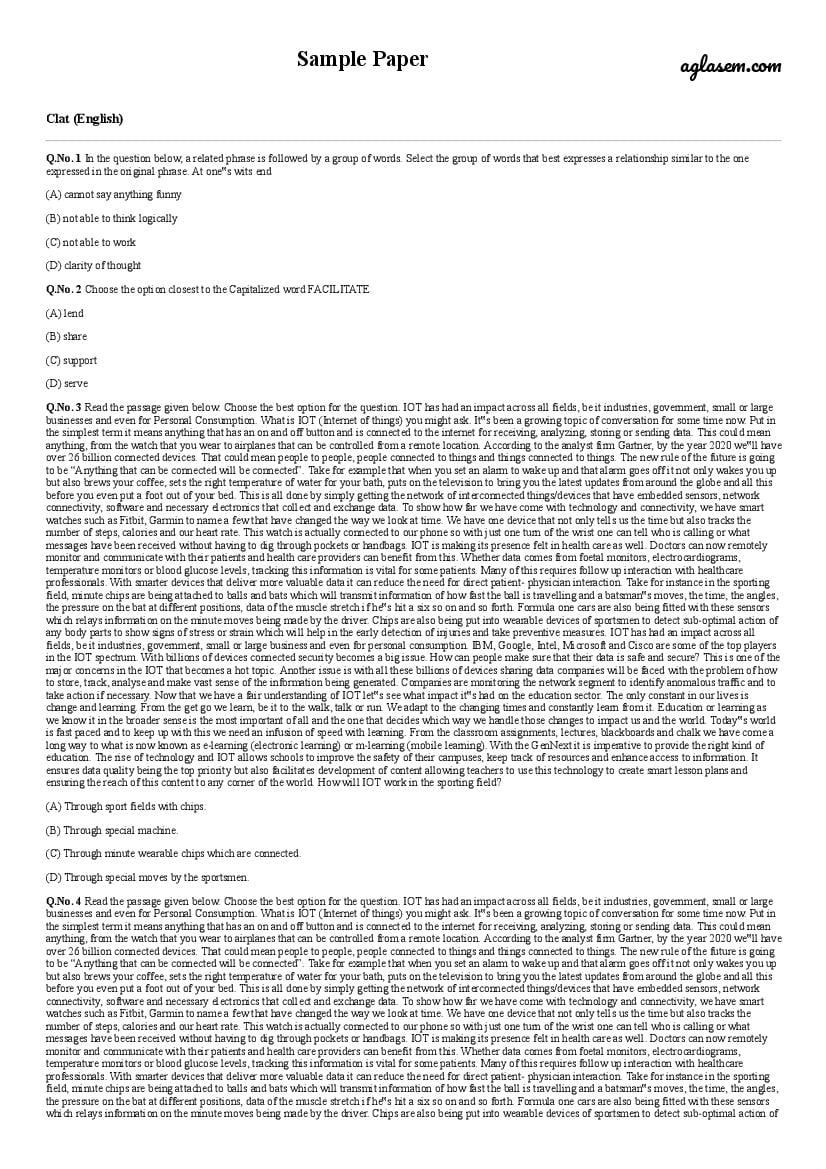
Page 1
Clat (English)
Q.No. 1 In the question below, a related phrase is followed by a group of words. Select the group of words that best expresses a relationship similar to the one
expressed in the original phrase. At one‟s wits end
(A) cannot say anything funny
(B) not able to think logically
(C) not able to work
(D) clarity of thought
Q.No. 2 Choose the option closest to the Capitalized word FACILITATE
(A) lend
(B) share
(C) support
(D) serve
Q.No. 3 Read the passage given below. Choose the best option for the question. IOT has had an impact across all fields, be it industries, government, small or large
businesses and even for Personal Consumption. What is IOT (Internet of things) you might ask. It‟s been a growing topic of conversation for some time now. Put in
the simplest term it means anything that has an on and off button and is connected to the internet for receiving, analyzing, storing or sending data. This could mean
anything, from the watch that you wear to airplanes that can be controlled from a remote location. According to the analyst firm Gartner, by the year 2020 we‟ll have
over 26 billion connected devices. That could mean people to people, people connected to things and things connected to things. The new rule of the future is going
to be “Anything that can be connected will be connected”. Take for example that when you set an alarm to wake up and that alarm goes off it not only wakes you up
but also brews your coffee, sets the right temperature of water for your bath, puts on the television to bring you the latest updates from around the globe and all this
before you even put a foot out of your bed. This is all done by simply getting the network of interconnected things/devices that have embedded sensors, network
connectivity, software and necessary electronics that collect and exchange data. To show how far we have come with technology and connectivity, we have smart
watches such as Fitbit, Garmin to name a few that have changed the way we look at time. We have one device that not only tells us the time but also tracks the
number of steps, calories and our heart rate. This watch is actually connected to our phone so with just one turn of the wrist one can tell who is calling or what
messages have been received without having to dig through pockets or handbags. IOT is making its presence felt in health care as well. Doctors can now remotely
monitor and communicate with their patients and health care providers can benefit from this. Whether data comes from foetal monitors, electrocardiograms,
temperature monitors or blood glucose levels, tracking this information is vital for some patients. Many of this requires follow up interaction with healthcare
professionals. With smarter devices that deliver more valuable data it can reduce the need for direct patient- physician interaction. Take for instance in the sporting
field, minute chips are being attached to balls and bats which will transmit information of how fast the ball is travelling and a batsman‟s moves, the time, the angles,
the pressure on the bat at different positions, data of the muscle stretch if he‟s hit a six so on and so forth. Formula one cars are also being fitted with these sensors
which relays information on the minute moves being made by the driver. Chips are also being put into wearable devices of sportsmen to detect sub-optimal action of
any body parts to show signs of stress or strain which will help in the early detection of injuries and take preventive measures. IOT has had an impact across all
fields, be it industries, government, small or large business and even for personal consumption. IBM, Google, Intel, Microsoft and Cisco are some of the top players
in the IOT spectrum. With billions of devices connected security becomes a big issue. How can people make sure that their data is safe and secure? This is one of the
major concerns in the IOT that becomes a hot topic. Another issue is with all these billions of devices sharing data companies will be faced with the problem of how
to store, track, analyse and make vast sense of the information being generated. Companies are monitoring the network segment to identify anomalous traffic and to
take action if necessary. Now that we have a fair understanding of IOT let‟s see what impact it‟s had on the education sector. The only constant in our lives is
change and learning. From the get go we learn, be it to the walk, talk or run. We adapt to the changing times and constantly learn from it. Education or learning as
we know it in the broader sense is the most important of all and the one that decides which way we handle those changes to impact us and the world. Today‟s world
is fast paced and to keep up with this we need an infusion of speed with learning. From the classroom assignments, lectures, blackboards and chalk we have come a
long way to what is now known as e-learning (electronic learning) or m-learning (mobile learning). With the GenNext it is imperative to provide the right kind of
education. The rise of technology and IOT allows schools to improve the safety of their campuses, keep track of resources and enhance access to information. It
ensures data quality being the top priority but also facilitates development of content allowing teachers to use this technology to create smart lesson plans and
ensuring the reach of this content to any corner of the world. How will IOT work in the sporting field?
(A) Through sport fields with chips.
(B) Through special machine.
(C) Through minute wearable chips which are connected.
(D) Through special moves by the sportsmen.
Q.No. 4 Read the passage given below. Choose the best option for the question. IOT has had an impact across all fields, be it industries, government, small or large
businesses and even for Personal Consumption. What is IOT (Internet of things) you might ask. It‟s been a growing topic of conversation for some time now. Put in
the simplest term it means anything that has an on and off button and is connected to the internet for receiving, analyzing, storing or sending data. This could mean
anything, from the watch that you wear to airplanes that can be controlled from a remote location. According to the analyst firm Gartner, by the year 2020 we‟ll have
over 26 billion connected devices. That could mean people to people, people connected to things and things connected to things. The new rule of the future is going
to be “Anything that can be connected will be connected”. Take for example that when you set an alarm to wake up and that alarm goes off it not only wakes you up
but also brews your coffee, sets the right temperature of water for your bath, puts on the television to bring you the latest updates from around the globe and all this
before you even put a foot out of your bed. This is all done by simply getting the network of interconnected things/devices that have embedded sensors, network
connectivity, software and necessary electronics that collect and exchange data. To show how far we have come with technology and connectivity, we have smart
watches such as Fitbit, Garmin to name a few that have changed the way we look at time. We have one device that not only tells us the time but also tracks the
number of steps, calories and our heart rate. This watch is actually connected to our phone so with just one turn of the wrist one can tell who is calling or what
messages have been received without having to dig through pockets or handbags. IOT is making its presence felt in health care as well. Doctors can now remotely
monitor and communicate with their patients and health care providers can benefit from this. Whether data comes from foetal monitors, electrocardiograms,
temperature monitors or blood glucose levels, tracking this information is vital for some patients. Many of this requires follow up interaction with healthcare
professionals. With smarter devices that deliver more valuable data it can reduce the need for direct patient- physician interaction. Take for instance in the sporting
field, minute chips are being attached to balls and bats which will transmit information of how fast the ball is travelling and a batsman‟s moves, the time, the angles,
the pressure on the bat at different positions, data of the muscle stretch if he‟s hit a six so on and so forth. Formula one cars are also being fitted with these sensors
which relays information on the minute moves being made by the driver. Chips are also being put into wearable devices of sportsmen to detect sub-optimal action of
Page 2
fields, be it industries, government, small or large business and even for personal consumption. IBM, Google, Intel, Microsoft and Cisco are some of the top players
in the IOT spectrum. With billions of devices connected security becomes a big issue. How can people make sure that their data is safe and secure? This is one of the
major concerns in the IOT that becomes a hot topic. Another issue is with all these billions of devices sharing data companies will be faced with the problem of how
to store, track, analyse and make vast sense of the information being generated. Companies are monitoring the network segment to identify anomalous traffic and to
take action if necessary. Now that we have a fair understanding of IOT let‟s see what impact it‟s had on the education sector. The only constant in our lives is
change and learning. From the get go we learn, be it to the walk, talk or run. We adapt to the changing times and constantly learn from it. Education or learning as
we know it in the broader sense is the most important of all and the one that decides which way we handle those changes to impact us and the world. Today‟s world
is fast paced and to keep up with this we need an infusion of speed with learning. From the classroom assignments, lectures, blackboards and chalk we have come a
long way to what is now known as e-learning (electronic learning) or m-learning (mobile learning). With the GenNext it is imperative to provide the right kind of
education. The rise of technology and IOT allows schools to improve the safety of their campuses, keep track of resources and enhance access to information. It
ensures data quality being the top priority but also facilitates development of content allowing teachers to use this technology to create smart lesson plans and
ensuring the reach of this content to any corner of the world. Teachers can use this data:
(A) Only to teach with more resources
(B) Only to create a smart classroom
(C) Only to reach out to the world
(D) To teach with more resources, create a smart classroom and reach out to the world.
Q.No. 5 In Mann Joseph's debut novel Serious Men, the protagonist, Ayyan Mani, is a U1, scheming Dalit-Buddhist who almost gets away with passing off his
partially deaf son, Adi, as a prodigy, a genius who can recite the first 1,000 prime numbers. The garb of satire-where almost every character cuts a sorry figure-gives
the author the licence to offer one' of the most bleak and pessimistic portrayals of urban Dalits. Despite his savage portrayal of Dalit (and female) characters--or
perhaps because of it?-Serious Men has won critical appreciation front a cross-section of readers and critics. At a time when a formidable body of Dalit literature-
writing by Dalits about Dalit lives-has created a distinct space for itself, how and why is it that a novel such as Serious Men, with its gleefully skewed portrayal of an
angry Dalit man, manages to win such accolades? In American literature-and particularly in the case of African- American authors and characters-these issues of
representation have been debated for decades. But in India, the sustained refusal to address issues related to caste in everyday life-and the continued and
unquestioned predominance of a Brahminical stranglehold over cultural production-have led us to a place where non-Dalit portrayal of Dalits in literature, cinema
and art remains the norm. The journey of modem Dalit literature has been a difficult one. But even though it has not necessarily enjoyed the support of numbers, we
must engage with what Dalits are writing-not simply for reasons of authenticity, or as a concession to identity politics, but simply because of the aesthetic value of
this body of writing, and for the insights it offers into the human condition. In a society that is still largely unwilling to recognise Dalits as equal, rights-bearing
human beings, in a society that is inherently indifferent to the everyday violence against Dalits, in a society unwilling to share social and cultural resources equitably
with Dalits unless mandated by law (as seen in the anti-reservation discourse), Dalit literature has the potential to humanise non- Dalits and sensitise them to a world
into which they have no insight. But before we can understand what Dalit literature is seeking to accomplish, we need first to come to terms with the stranglehold of
non-Dalit representations of Dalits. Rohinton Miary's (A Fine Balance), published 15 years ago, chronicles the travails of two Dalit characters-uncle Ishvar and
nephew Omprakash-who migrate to Bombay and yet cannot escape brutality. While the present of the novel is set at the time of the Emergency, Ishvar's father
Dukhy belongs to the era of the anti-colonial nationalist movement. During one of Dukhi's visits to the town, he chances upon a meeting of the Indian National
Congress, where speakers spread the "Mahatma's message regarding the freedom struggle, the struggle for justice," and wiping out "the disease of untouchability;
ravaging us for centuries, denying dignity to our fellow human beings." Neither in the 1940s, where the novel's past is set, nor in the Emergency period of
the 1970swhen the minds and bodies Ishvar and Omprakash, are savaged by the state-do we find any mention of a figure like BR Ambedkar or of Dalit movements.
In his `nationalist' understanding of modem Indian history, Mistry seems to have not veered too far from the road charted by predecessors like Mulk Raj Anand and
Premchand. Sixty years after Premchand, Mistry's literary imagination seems stuck in the empathy-realism mode, trapping Dalits in abjection. Mistry happily
continues the broad stereotype of the Dalit as a passive sufferer, without consciousness of caste politics. Which of the following statements is least likely to be
inferred from this passage:
(A) The author of Serious Men has used the literary device of satire to present an unflattering picture of women characters.
(B) Issues of representation of minorities have been debated extensively in American literature.
(C) The writer of this passage believes that engagement with Dalits is necessary only because such engagement affirms the importance of identity politics.
(D) The writer believes that Rohinton Mistry presented a stereotypical representation of Dal its character in his book.
Q.No. 6 Fill up the blanks numbered [a] [b] [c] [d] [e] [f] in the passage given below with the most appropriate word from the options given for each blank The main
objective of art and [a] living is to develop [b] sensibilities and skills of healthful living besides providing a [c] ground for love of labour, [d] social attitudes and
moral values so as to enable the child to be [e] to the ideas of others with humility and sincerity in thought, word and deed. Love for mankind and helping the needy
would [f] at this stage and its culmination would be in terms of attainment of selfless service. 'c' is
(A) nurturing
(B) fruitful
(C) attractive
(D) interesting
Q.No. 7 In recent weeks, the writers William Dalrymple and Patrick French, among others, have come before a fusillade of criticism in India, much of it questioning
not their facts, not their interpretations, but their foreignness. "Who gets to write about India?" The Wall Street Journal asked on Wednesday in its own report on this
Indian literary feuding. It is a complicated question, not least because to decide who gets to write about India, you would need to decide who gets to decide who gets
to write about India. Rather than conjecturing some Committee for the Deciding of the Deciding of Who Gets to Write about India, it might be easier to let writers
write what they please and readers read what they wish. The accusations pouring forth from a section of the Indian commentariat are varied. Some criticism is of a
genuine literary nature, fair game, customary, expected. But lately a good amount of the reproaching has been about identity. In the case of Mr. Dalrymple, a Briton
who lives in New Delhi, it is - in the critics' view - that his writing is an act of re-colonization. In the case of Mr. French, it is that he belongs to a group of foreign
writers who use business-class lounges and see some merit in capitalism and therefore do not know the real India, which only the commentariat member in question
does. What is most interesting about these appraisals is that their essential nature makes reading the book superfluous, as one of my Indian reviewers openly
admitted. (His review was not about the book but about his refusal to read the book.) The book is not necessary in these cases, for the argument is about who can
write about India, not what has been written. For critics of this persuasion, India surely seems a lonely land. A country with a millennial historv of Hindus,
Christians, Jews, Muslims and Buddhists living peaceably together; a country of hundreds.of dialects in which so many Indians are linguistic foreigners to each
other, and happily, tolerantly so; a country that welcomes foreign seekers (of yoga poses, of spiritual wisdom, of ancestral roots) with open arms; a country where,
outside the elite world of South Delhi and South Bombay, I have not heard an Indian ask whether outsiders have a right to write, think or exist on their soil. But it is
not just this deep-in-the-bones pluralism that challenges the who-gets-towrite- aboutIndia contingent. It is also that at the very heart of India's multifarious changes
today is this glimmering idea: that Indians must be rewarded for what they do, not who they are. Identities you never chose - caste, gender, birth order - are
becoming less important determinants of fate. Your deeds - how hard you work, what risks you take - are becoming more important. It is this idea, which I have
found pulsating throughout the Indian layers, that leaves a certain portion of the intelligentsia out of sync with the surrounding country. As Mr. French has observed,
there is a tendency in some of these writers to value social mobility only for themselves. When the new economy lifts up the huddled masses, then it becomes tawdry
capitalism and rapacious imperialism and soulless globalization. Fortunately for those without Indian passports, the nativists' vision of India is under demographic
Page 3
their own level in the society and to find their voice; and they tend to be delighted at the thought that some foreigners do the same in India and love their country as
much as they do. Which of the following would be the best substitute for the word, `fusillade' in the passage?
(A) Barrage
(B) Breach
(C) Temper
(D) Row
Q.No. 8 If religion and community are associated with global violence in the rtvnds of many people, then so are global poverty and inequality. There has, in fact,
been an increasing tendency in recent years to justify policies of poverty removal on the ground that this is the surest way to prevent political strife and turmoil.
Basing public policy - international as well as domestic- on such an understanding has some evident attractions. Given the public anxiety about wars and disorders in
the rich countries in the world, the indirect justification of poverty removal -not for its own sake but for the sake of peace and quiet in the world - provides an
argument that appeals to self interest for helping the needy. It presents an argument for allocating more resources on poverty removal because of its presumed
political, rather than moral, relevance. While the temptation to go in that direction is easy to understand, it is a perilous route to take even for a worthy cause. Part of
the difficulty lies in the possibility that if wrong, economic reductionism would not only impair our understanding of the world, but would also tend to undermine
the declared rationale of the public commitment to remove poverty. This is a particularly serious concern, since poverty and massive inequality are terrible enough in
themselves, and deserve priority even if there were no connection whatsoever with violence. Just as virtue is its own reward, poverty is at least its own penalty. This
is not to deny that poverty and inequality can - and do - have far reaching consequences with conflict and strife, but these connections have to be examined and
investigated with appropriate care and empirical scrutiny, rather than being casually invoked with unreasoned rapidity in support of a `good cause." Destitution can,
of course, produce provocation for defying established laws and rules. But it need not give people the initiative, courage, and actual ability to do anything very
violent. Destitution can be accompanied not only by economic debility, but also by political helplessness. A starving wretch can be too frail and too dejected to fight
and battle, and even te protest and holler. It is thus not surprising that often enough intense and widespread suffering and misery have been accompanied by unusual
peace and silence. Indeed, many famines have occurred without there being much political rebellion or civil strife or intergroup warfare. For example, the famine
years in the 1840s in Ireland were among the most peaceful, and there was little attempt by the hungry masses to intervene even as ship after ship sailed down the
river Shannon with rich food. Looking elsewhere, my own childhood memories in Calcutta during the Bengal famine of 1943 include the sight of starving people
dying in front of sweetshops with various layers of luscious food displayed behind the glass windows, without a single glass being broken, or law or order being
disrupted. The author believes that it may not be advisable to emphasise on the connection between poverty and violence as:
(A) Emphasis on such connection appeals only to self-interest of persons.
(B) Linking poverty and violence undermines the moral character of anti-poverty measures.
(C) The absence of any essential connection between poverty and violence may then weaken the very rationale of anti-poverty policies.
(D) There is no necessary link between poverty and inequality.
Q.No. 9 Answer the Question, based on the following information. Indicate which of the statements given with that particular question, is consistent with the
information given in the passage below. A Holistic Viewpoint It is now recognised by modern science that the universe at the subatomic level does not have solid
material objects, but consists of only wavelike patterns which represent probabilities of interconnections between other interconnections, all of which together
constitute an inseparable web of inter-relationships constituting the entire universe. Fritj of Capra therefore, views the universe not as “an assemblage of independent
parts” but as “a dynamic web of inter-related events” in which each part of the web determines the structure of the whole. Geoffrey Chew views such inter-
penetrating and interdependent relationships in the universe in terms of a “bootstrap” theory which implies that all forces in the universe are inseparably linked
together, every part affects every other part, and the whole world is held together so to say, by bootstraps. David Bohm refers to a holographic concept which implies
not only that every part is connected with every other part within the whole but also that, in a sense, each part contains the whole. This, according to David Bohm,
recognises the “Undivided wholeness” of the entire universe instead of the classical idea of analysability of the world into separately and independently existent
parts. Choose the appropriate option:
(A) there are many solid material objects in the universe
(B) the entire universe has a web of inter-relationships
(C) the universe comprises of a number of independent parts
(D) these independent parts determine the structure of the web
Q.No. 10 In the question below, a related phrase is followed by a group of words. Select the group of words that best expresses a relationship similar to the one
expressed in the original phrase. Die in harness
(A) Die while riding
(B) die at the height of one’s success
(C) die with help
(D) die when the work has been completed
Q.No. 11 In the paragraph below there are five sentences. In each sentence there are pairs of highlighted words [A, B]. Select the most appropriate words to form
correct sentences. Then from the options given select the correct option. Internationally high rise walls serve as street [A] paintings [B] canvasses. In Delhi and
Gurgaon artists have [A] earmarked [B] earmark a district and after civic authority [A] compliance, [B] grant transformed it into a throbbing art district. A walk
through the [A] instalment [B] installations for public interaction is [A] instituted [B] envisaged. It is hoped that this will discourage defiling city‟s public places.
The correct sequence should be:
(A) ABABB
(B) BABAB
(C) BAABB
(D) ABABA
Q.No. 12 If religion and community are associated with global violence in the rtvnds of many people, then so are global poverty and inequality. There has, in fact,
been an increasing tendency in recent years to justify policies of poverty removal on the ground that this is the surest way to prevent political strife and turmoil.
Basing public policy - international as well as domestic- on such an understanding has some evident attractions. Given the public anxiety about wars and disorders in
the rich countries in the world, the indirect justification of poverty removal -not for its own sake but for the sake of peace and quiet in the world - provides an
argument that appeals to self interest for helping the needy. It presents an argument for allocating more resources on poverty removal because of its presumed
Page 4
the difficulty lies in the possibility that if wrong, economic reductionism would not only impair our understanding of the world, but would also tend to undermine
the declared rationale of the public commitment to remove poverty. This is a particularly serious concern, since poverty and massive inequality are terrible enough in
themselves, and deserve priority even if there were no connection whatsoever with violence. Just as virtue is its own reward, poverty is at least its own penalty. This
is not to deny that poverty and inequality can - and do - have far reaching consequences with conflict and strife, but these connections have to be examined and
investigated with appropriate care and empirical scrutiny, rather than being casually invoked with unreasoned rapidity in support of a `good cause." Destitution can,
of course, produce provocation for defying established laws and rules. But it need not give people the initiative, courage, and actual ability to do anything very
violent. Destitution can be accompanied not only by economic debility, but also by political helplessness. A starving wretch can be too frail and too dejected to fight
and battle, and even te protest and holler. It is thus not surprising that often enough intense and widespread suffering and misery have been accompanied by unusual
peace and silence. Indeed, many famines have occurred without there being much political rebellion or civil strife or intergroup warfare. For example, the famine
years in the 1840s in Ireland were among the most peaceful, and there was little attempt by the hungry masses to intervene even as ship after ship sailed down the
river Shannon with rich food. Looking elsewhere, my own childhood memories in Calcutta during the Bengal famine of 1943 include the sight of starving people
dying in front of sweetshops with various layers of luscious food displayed behind the glass windows, without a single glass being broken, or law or order being
disrupted. Economic reductionism' in this passage means;
(A) Neglecting the economic connection between poverty & violence
(B) Excessive accent on poverty and inequality
(C) Emphasizing on the linkage between violence, poverty and economic equality.
(D) The view that every conflict is caused by underlying economic tensions.
Q.No. 13 In recent weeks, the writers William Dalrymple and Patrick French, among others, have come before a fusillade of criticism in India, much of it
questioning not their facts, not their interpretations, but their foreignness. "Who gets to write about India?" The Wall Street Journal asked on Wednesday in its own
report on this Indian literary feuding. It is a complicated question, not least because to decide who gets to write about India, you would need to decide who gets
to decide who gets to write about India. Rather than conjecturing some Committee for the Deciding of the Deciding of Who Gets to Write about India, it might be
easier to let writers write what they please and readers read what they wish. The accusations pouring forth from a section of the Indian commentariat are
varied. Some criticism is of a genuine literary nature, fair game, customary, expected. But lately a good amount of the reproaching has been about identity. In the
case of Mr. Dalrymple, a Briton who lives in New Delhi, it is - in the critics' view - that his writing is an act of re-colonization. In the case of Mr. French, it is that
he belongs to a group of foreign writers who use business-class lounges and see some merit in capitalism and therefore do not know the real India, which only
the commentariat member in question does. What is most interesting about these appraisals is that their essential nature makes reading the book superfluous, as one
of my Indian reviewers openly admitted. (His review was not about the book but about his refusal to read the book.) The book is not necessary in these cases, for the
argument is about who can write about India, not what has been written. For critics of this persuasion, India surely seems a lonely land. A country with a millennial
historv of Hindus, Christians, Jews, Muslims and Buddhists living peaceably together; a country of hundreds.of dialects in which so many Indians are linguistic
foreigners to each other, and happily, tolerantly so; a country that welcomes foreign seekers (of yoga poses, of spiritual wisdom, of ancestral roots) with open arms; a
country where, outside the elite world of South Delhi and South Bombay, I have not heard an Indian ask whether outsiders have a right to write, think or exist on
their soil. But it is not just this deep-in-the-bones pluralism that challenges the who-gets-towrite- aboutIndia contingent. It is also that at the very heart of India's
multifarious changes today is this glimmering idea: that Indians must be rewarded for what they do, not who they are. Identities you never chose - caste, gender,
birth order - are becoming less important determinants of fate. Your deeds - how hard you work, what risks you take - are becoming more important. It is this idea,
which I have found pulsating throughout the Indian layers, that leaves a certain portion of the intelligentsia out of sync with the surrounding country. As Mr. French
has observed, there is a tendency in some of these writers to value social mobility only for themselves. When the new economy lifts up the huddled masses, then it
becomes tawdry capitalism and rapacious imperialism and soulless globalization. Fortunately for those without Indian passports, the nativists' vision of India is
under demographic siege. The young and the relentless are India's future. They could not think more differently from these literatis. They savour the freedom they
are gaining to seek their own level in the society and to find their voice; and they tend to be delighted at the thought that some foreigners do the same in India and
love their country as much as they do. Which of the following statements is least likely to be inferred from the passage:
(A) Younger generations of Indians are more tolerant of foreign scribes who write about their country.
(B) The writer believes that a section of Indian intelligentsia is very hostile to upward economic mobility.
(C) Mr. William Dalrymple has been accused of recolonising India through his writings.
(D) Most of the criticism that has been recently directed at Patrick French has emphasized mainly on the writer's undenvhelming literary style.
Q.No. 14 In Mann Joseph's debut novel Serious Men, the protagonist, Ayyan Mani, is a U1, scheming Dalit-Buddhist who almost gets away with passing off his
partially deaf son, Adi, as a prodigy, a genius who can recite the first 1,000 prime numbers. The garb of satire-where almost every character cuts a sorry figure-gives
the author the licence to offer one' of the most bleak and pessimistic portrayals of urban Dalits. Despite his savage portrayal of Dalit (and female) characters--or
perhaps because of it?-Serious Men has won critical appreciation front a cross-section of readers and critics. At a time when a formidable body of Dalit literature-
writing by Dalits about Dalit lives-has created a distinct space for itself, how and why is it that a novel such as Serious Men, with its gleefully skewed portrayal of an
angry Dalit man, manages to win such accolades? In American literature-and particularly in the case of African- American authors and characters-these issues of
representation have been debated for decades. But in India, the sustained refusal to address issues related to caste in everyday life-and the continued and
unquestioned predominance of a Brahminical stranglehold over cultural production-have led us to a place where non-Dalit portrayal of Dalits in literature, cinema
and art remains the norm. The journey of modem Dalit literature has been a difficult one. But even though it has not necessarily enjoyed the support of numbers, we
must engage with what Dalits are writing-not simply for reasons of authenticity, or as a concession to identity politics, but simply because of the aesthetic value of
this body of writing, and for the insights it offers into the human condition. In a society that is still largely unwilling to recognise Dalits as equal, rights-bearing
human beings, in a society that is inherently indifferent to the everyday violence against Dalits, in a society unwilling to share social and cultural resources equitably
with Dalits unless mandated by law (as seen in the anti-reservation discourse), Dalit literature has the potential to humanise non- Dalits and sensitise them to a world
into which they have no insight. But before we can understand what Dalit literature is seeking to accomplish, we need first to come to terms with the stranglehold of
non-Dalit representations of Dalits. Rohinton Miary's (A Fine Balance), published 15 years ago, chronicles the travails of two Dalit characters-uncle Ishvar and
nephew Omprakash-who migrate to Bombay and yet cannot escape brutality. While the present of the novel is set at the time of the Emergency, Ishvar's father
Dukhy belongs to the era of the anti-colonial nationalist movement. During one of Dukhi's visits to the town, he chances upon a meeting of the Indian National
Congress, where speakers spread the "Mahatma's message regarding the freedom struggle, the struggle for justice," and wiping out "the disease of untouchability;
ravaging us for centuries, denying dignity to our fellow human beings." Neither in the 1940s, where the novel's past is set, nor in the Emergency period of
the 1970swhen the minds and bodies Ishvar and Omprakash, are savaged by the state-do we find any mention of a figure like BR Ambedkar or of Dalit movements.
In his `nationalist' understanding of modem Indian history, Mistry seems to have not veered too far from the road charted by predecessors like Mulk Raj Anand and
Premchand. Sixty years after Premchand, Mistry's literary imagination seems stuck in the empathy-realism mode, trapping Dalits in abjection. Mistry happily
continues the broad stereotype of the Dalit as a passive sufferer, without consciousness of caste politics. Which of the following is not among the reasons suggested
by the writer for engaging with Dalit writing:
(A) Dalit literature has the potential to sensitize non-Dalits about the experiences of the former.
(B) Dalit writing is more authentic than representation of Dalits by non-Dalits.
(C) Dalit literature does not have the support of numbers.
(D) The aesthetic value of Dalit writing.
Page 5
We can read intensively and extensively. [D] Basic literacy among the prison population is insignificant.
(A) C
(B) D
(C) B
(D) A
Q.No. 16 In the following sentence a part of the sentence is underlined. Beneath each sentence four different ways of paraphrasing the underlined part are indicated.
Choose the best alternative among the four options. The police searched everywhere but they drew a blank.
(A) upset
(B) did not find any information
(C) came to a dead end (changed as: came to an end)
(D) drew a line
Q.No. 17 In recent weeks, the writers William Dalrymple and Patrick French, among others, have come before a fusillade of criticism in India, much of it
questioning not their facts, not their interpretations, but their foreignness. "Who gets to write about India?" The Wall Street Journal asked on Wednesday in its own
report on this Indian literary feuding. It is a complicated question, not least because to decide who gets to write about India, you would need to decide who gets
to decide who gets to write about India. Rather than conjecturing some Committee for the Deciding of the Deciding of Who Gets to Write about India, it might be
easier to let writers write what they please and readers read what they wish. The accusations pouring forth from a section of the Indian commentariat are
varied. Some criticism is of a genuine literary nature, fair game, customary, expected. But lately a good amount of the reproaching has been about identity. In the
case of Mr. Dalrymple, a Briton who lives in New Delhi, it is - in the critics' view - that his writing is an act of re-colonization. In the case of Mr. French, it is that
he belongs to a group of foreign writers who use business-class lounges and see some merit in capitalism and therefore do not know the real India, which only
the commentariat member in question does. What is most interesting about these appraisals is that their essential nature makes reading the book superfluous, as one
of my Indian reviewers openly admitted. (His review was not about the book but about his refusal to read the book.) The book is not necessary in these cases, for the
argument is about who can write about India, not what has been written. For critics of this persuasion, India surely seems a lonely land. A country with a millennial
historv of Hindus, Christians, Jews, Muslims and Buddhists living peaceably together; a country of hundreds.of dialects in which so many Indians are linguistic
foreigners to each other, and happily, tolerantly so; a country that welcomes foreign seekers (of yoga poses, of spiritual wisdom, of ancestral roots) with open arms; a
country where, outside the elite world of South Delhi and South Bombay, I have not heard an Indian ask whether outsiders have a right to write, think or exist on
their soil. But it is not just this deep-in-the-bones pluralism that challenges the who-gets-towrite- aboutIndia contingent. It is also that at the very heart of India's
multifarious changes today is this glimmering idea: that Indians must be rewarded for what they do, not who they are. Identities you never chose - caste, gender,
birth order - are becoming less important determinants of fate. Your deeds - how hard you work, what risks you take - are becoming more important. It is this idea,
which I have found pulsating throughout the Indian layers, that leaves a certain portion of the intelligentsia out of sync with the surrounding country. As Mr. French
has observed, there is a tendency in some of these writers to value social mobility only for themselves. When the new economy lifts up the huddled masses, then it
becomes tawdry capitalism and rapacious imperialism and soulless globalization. Fortunately for those without Indian passports, the nativists' vision of India is
under demographic siege. The young and the relentless are India's future. They could not think more differently from these literatis. They savour the freedom they
are gaining to seek their own level in the society and to find their voice; and they tend to be delighted at the thought that some foreigners do the same in India and
love their country as much as they do. Which of the following statements can be inferred from the passage?
(A) Ascriptive identities like caste, tribe, etc. are becoming more and more important with the passage of time.
(B) Patrick French believes that the new market friendly economic policies followed for the last decades have resulted in the rise of tawdry capitalism and rapacious
imperialism.
(C) The writer is of the opinion that a section of the intelligentsia is divorced from the views of their compatriots.
(D) While India has historically been very hospitable to a variety of religions, it has not been equally open to linguistic foreigners.
Q.No. 18 In 1954, a Bombay economist named A.D. Shroff began a Forum of Free Enterprise, whose ideas on economic development were somewhat at odds with
those then influentially articulated by the Planning Commission of the Government of India. Shroff complained against the ‘indifference, if not discouragement’
with which the state treated entrepreneurs. At the same time as Shroff, but independently of him, a journalist named Philip Spratt was writing a series of essays in
favour of free enterprise. Spratt was a Cambridge communist who was sent by the party in 1920s to foment revolution in the subcontinent. Detected in the act, he
spent many years in an Indian jail. The books he read in the prison, and his marriage to an Indian woman afterwards, inspired a steady move rightwards. By the
1950s, he was editing a proAmerican weekly from Bangalore, called Myslndia. There he inveighed against the economic policies of the government of India. These,
he said, treated the entrepreneur as a criminal who has dared to use his brains independently of the state to create wealth and give employment. The state’s chief
planner P.C. Mahalanobis, had surrounded himself with Western leftists and Soviet academicians, who reinforced his belief in rigid control by the government over
all activities. The result, said Spratt, would be 'the smothering of free enterprise, a famine of consumer goods, and the tying down of millions of workers to soul-
deadening techniques.’ The voices of men like Spratt and Shroff were drowned in the chorus of popular support for a model of heavy industrialization funded and
directed by the governments. The 1950s were certainly not propitious times for free marketers in India. But from time to time their ideas were revived. After the
rupee was devalued in 1966, there were some moves towards freeing the trade regime, and hopes that the licensing system would also be liberalized. However, after
Indira Gandhi split the Congress Party in 1969, her government took its `left turn’, nationalizing a fresh range of industries and returning to economic autarky. The
author avers that A.D Shroffs ideas were somewhat at odds with the views of Planning Commission because:
(A) A.D. Shroff was in favour of rigid governmental control over all economic activities.
(B) Shroff had opposed government’s decision to devalue Indian rupee.
(C) The hostility of the government to private entrepreneurs was complained against by A.D. Shroff.
(D) Shroff had been critical of the influence of Soviet academicians over India's economic policy.
Q.No. 19 In 1954, a Bombay economist named A.D. Shroff began a Forum of Free Enterprise, whose ideas on economic development were somewhat at odds with
those then influentially articulated by the Planning Commission of the Government of India. Shroff complained against the ‘indifference, if not discouragement’
with which the state treated entrepreneurs. At the same time as Shroff, but independently of him, a journalist named Philip Spratt was writing a series of essays in
favour of free enterprise. Spratt was a Cambridge communist who was sent by the party in 1920s to foment revolution in the subcontinent. Detected in the act, he
spent many years in an Indian jail. The books he read in the prison, and his marriage to an Indian woman afterwards, inspired a steady move rightwards. By the
1950s, he was editing a proAmerican weekly from Bangalore, called Myslndia. There he inveighed against the economic policies of the government of India. These,
he said, treated the entrepreneur
asa cri min alwhohasdared → usehisbra ∈ s ∈ dependentlyof thestate → createwea < h and giveemployment’. T hestate’sχef pla ∩ e
rigid control by the government over all activities’. The result, said Spratt, would be
Page 6
––
––
left turn’, nationalizing a fresh range of industries and returning to economic autarky. Philip Spratt came to India because he:
(A) Fell in love with an Indian women
(B) Wanted [o protest against the economic policies of the Indian government.
(C) Was offered the editorship of Mysindia.
(D) Had been instructed to work towards the goal of inciting a revolution in India.
Q.No. 20 Read the passage given below. Choose the best option for the question. IOT has had an impact across all fields, be it industries, government, small or large
businesses and even for Personal Consumption. What is IOT (Internet of things) you might ask. It‟s been a growing topic of conversation for some time now. Put in
the simplest term it means anything that has an on and off button and is connected to the internet for receiving, analyzing, storing or sending data. This could mean
anything, from the watch that you wear to airplanes that can be controlled from a remote location. According to the analyst firm Gartner, by the year 2020 we‟ll have
over 26 billion connected devices. That could mean people to people, people connected to things and things connected to things. The new rule of the future is going
to be “Anything that can be connected will be connected”. Take for example that when you set an alarm to wake up and that alarm goes off it not only wakes you up
but also brews your coffee, sets the right temperature of water for your bath, puts on the television to bring you the latest updates from around the globe and all this
before you even put a foot out of your bed. This is all done by simply getting the network of interconnected things/devices that have embedded sensors, network
connectivity, software and necessary electronics that collect and exchange data. To show how far we have come with technology and connectivity, we have smart
watches such as Fitbit, Garmin to name a few that have changed the way we look at time. We have one device that not only tells us the time but also tracks the
number of steps, calories and our heart rate. This watch is actually connected to our phone so with just one turn of the wrist one can tell who is calling or what
messages have been received without having to dig through pockets or handbags. IOT is making its presence felt in health care as well. Doctors can now remotely
monitor and communicate with their patients and health care providers can benefit from this. Whether data comes from foetal monitors, electrocardiograms,
temperature monitors or blood glucose levels, tracking this information is vital for some patients. Many of this requires follow up interaction with healthcare
professionals. With smarter devices that deliver more valuable data it can reduce the need for direct patient- physician interaction. Take for instance in the sporting
field, minute chips are being attached to balls and bats which will transmit information of how fast the ball is travelling and a batsman‟s moves, the time, the angles,
the pressure on the bat at different positions, data of the muscle stretch if he‟s hit a six so on and so forth. Formula one cars are also being fitted with these sensors
which relays information on the minute moves being made by the driver. Chips are also being put into wearable devices of sportsmen to detect sub-optimal action of
any body parts to show signs of stress or strain which will help in the early detection of injuries and take preventive measures. IOT has had an impact across all
fields, be it industries, government, small or large business and even for personal consumption. IBM, Google, Intel, Microsoft and Cisco are some of the top players
in the IOT spectrum. With billions of devices connected security becomes a big issue. How can people make sure that their data is safe and secure? This is one of the
major concerns in the IOT that becomes a hot topic. Another issue is with all these billions of devices sharing data companies will be faced with the problem of how
to store, track, analyse and make vast sense of the information being generated. Companies are monitoring the network segment to identify anomalous traffic and to
take action if necessary. Now that we have a fair understanding of IOT let‟s see what impact it‟s had on the education sector. The only constant in our lives is
change and learning. From the get go we learn, be it to the walk, talk or run. We adapt to the changing times and constantly learn from it. Education or learning as
we know it in the broader sense is the most important of all and the one that decides which way we handle those changes to impact us and the world. Today‟s world
is fast paced and to keep up with this we need an infusion of speed with learning. From the classroom assignments, lectures, blackboards and chalk we have come a
long way to what is now known as e-learning (electronic learning) or m-learning (mobile learning). With the GenNext it is imperative to provide the right kind of
education. The rise of technology and IOT allows schools to improve the safety of their campuses, keep track of resources and enhance access to information. It
ensures data quality being the top priority but also facilitates development of content allowing teachers to use this technology to create smart lesson plans and
ensuring the reach of this content to any corner of the world. How is IOT a concept of connecting?
(A) It is the internet in a different form.
(B) It is internet but connected to anything.
(C) It is an analysing machine.
(D) It is a data collection term.
Q.No. 21 In Mann Joseph's debut novel Serious Men, the protagonist, Ayyan Mani, is a U1, scheming Dalit-Buddhist who almost gets away with passing off his
partially deaf son, Adi, as a prodigy, a genius who can recite the first 1,000 prime numbers. The garb of satire-where almost every character cuts a sorry figure-gives
the author the licence to offer one' of the most bleak and pessimistic portrayals of urban Dalits. Despite his savage portrayal of Dalit (and female) characters--or
perhaps because of it?-Serious Men has won critical appreciation front a cross-section of readers and critics. At a time when a formidable body of Dalit literature-
writing by Dalits about Dalit lives-has created a distinct space for itself, how and why is it that a novel such as Serious Men, with its gleefully skewed portrayal of an
angry Dalit man, manages to win such accolades? In American literature-and particularly in the case of African- American authors and characters-these issues of
representation have been debated for decades. But in India, the sustained refusal to address issues related to caste in everyday life-and the continued and
unquestioned predominance of a Brahminical stranglehold over cultural production-have led us to a place where non-Dalit portrayal of Dalits in literature, cinema
and art remains the norm. The journey of modem Dalit literature has been a difficult one. But even though it has not necessarily enjoyed the support of numbers, we
must engage with what Dalits are writing-not simply for reasons of authenticity, or as a concession to identity politics, but simply because of the aesthetic value of
this body of writing, and for the insights it offers into the human condition. In a society that is still largely unwilling to recognise Dalits as equal, rights-bearing
human beings, in a society that is inherently indifferent to the everyday violence against Dalits, in a society unwilling to share social and cultural resources equitably
with Dalits unless mandated by law (as seen in the anti-reservation discourse), Dalit literature has the potential to humanise non- Dalits and sensitise them to a world
into which they have no insight. But before we can understand what Dalit literature is seeking to accomplish, we need first to come to terms with the stranglehold of
non-Dalit representations of Dalits. Rohinton Miary's (A Fine Balance), published 15 years ago, chronicles the travails of two Dalit characters-uncle Ishvar and
nephew Omprakash-who migrate to Bombay and yet cannot escape brutality. While the present of the novel is set at the time of the Emergency, Ishvar's father
Dukhy belongs to the era of the anti-colonial nationalist movement. During one of Dukhi's visits to the town, he chances upon a meeting of the Indian National
Congress, where speakers spread the "Mahatma's message regarding the freedom struggle, the struggle for justice," and wiping out "the disease of untouchability;
ravaging us for centuries, denying dignity to our fellow human beings." Neither in the 1940s, where the novel's past is set, nor in the Emergency period of
the 1970swhen the minds and bodies Ishvar and Omprakash, are savaged by the state-do we find any mention of a figure like BR Ambedkar or of Dalit movements.
In his `nationalist' understanding of modem Indian history, Mistry seems to have not veered too far from the road charted by predecessors like Mulk Raj Anand and
Premchand. Sixty years after Premchand, Mistry's literary imagination seems stuck in the empathy-realism mode, trapping Dalits in abjection. Mistry happily
continues the broad stereotype of the Dalit as a passive sufferer, without consciousness of caste politics. Which of the following statement cannot be inferred from
the passage:
(A) Upper-castes have dominated the instruments of cultural production in Indian society.
(B) Indian society is unwilling to recognise Dalits as equal, rights-bearing human beings.
(C) Dalit writers have carved out a space for writings on Dalit experience and world view.
(D) The judiciary in India, in its opposition to reservation, has betrayed its unwillingness to acknowledge Dalits as equal bearer of rights.
Q.No. 22 Choose the option closest to the Capitalized word ANNIHILATE
(A) devastate
Page 7
(C) investigate
(D) retaliate
Q.No. 23 Choose the option closest to the Capitalized word CAMPAIGN
(A) lobby
(B) run
(C) agree
(D) work
Q.No. 24 In Mann Joseph's debut novel Serious Men, the protagonist, Ayyan Mani, is a U1, scheming Dalit-Buddhist who almost gets away with passing off his
partially deaf son, Adi, as a prodigy, a genius who can recite the first 1,000 prime numbers. The garb of satire-where almost every character cuts a sorry figure-gives
the author the licence to offer one' of the most bleak and pessimistic portrayals of urban Dalits. Despite his savage portrayal of Dalit (and female) characters--or
perhaps because of it?-Serious Men has won critical appreciation front a cross-section of readers and critics. At a time when a formidable body of Dalit literature-
writing by Dalits about Dalit lives-has created a distinct space for itself, how and why is it that a novel such as Serious Men, with its gleefully skewed portrayal of an
angry Dalit man, manages to win such accolades? In American literature-and particularly in the case of African- American authors and characters-these issues of
representation have been debated for decades. But in India, the sustained refusal to address issues related to caste in everyday life-and the continued and
unquestioned predominance of a Brahminical stranglehold over cultural production-have led us to a place where non-Dalit portrayal of Dalits in literature, cinema
and art remains the norm. The journey of modem Dalit literature has been a difficult one. But even though it has not necessarily enjoyed the support of numbers, we
must engage with what Dalits are writing-not simply for reasons of authenticity, or as a concession to identity politics, but simply because of the aesthetic value of
this body of writing, and for the insights it offers into the human condition. In a society that is still largely unwilling to recognise Dalits as equal, rights-bearing
human beings, in a society that is inherently indifferent to the everyday violence against Dalits, in a society unwilling to share social and cultural resources equitably
with Dalits unless mandated by law (as seen in the anti-reservation discourse), Dalit literature has the potential to humanise non- Dalits and sensitise them to a world
into which they have no insight. But before we can understand what Dalit literature is seeking to accomplish, we need first to come to terms with the stranglehold of
non-Dalit representations of Dalits. Rohinton Miary's (A Fine Balance), published 15 years ago, chronicles the travails of two Dalit characters-uncle Ishvar and
nephew Omprakash-who migrate to Bombay and yet cannot escape brutality. While the present of the novel is set at the time of the Emergency, Ishvar's father
Dukhy belongs to the era of the anti-colonial nationalist movement. During one of Dukhi's visits to the town, he chances upon a meeting of the Indian National
Congress, where speakers spread the "Mahatma's message regarding the freedom struggle, the struggle for justice," and wiping out "the disease of untouchability;
ravaging us for centuries, denying dignity to our fellow human beings." Neither in the 1940s, where the novel's past is set, nor in the Emergency period of
the 1970swhen the minds and bodies Ishvar and Omprakash, are savaged by the state-do we find any mention of a figure like BR Ambedkar or of Dalit movements.
In his `nationalist' understanding of modem Indian history, Mistry seems to have not veered too far from the road charted by predecessors like Mulk Raj Anand and
Premchand. Sixty years after Premchand, Mistry's literary imagination seems stuck in the empathy-realism mode, trapping Dalits in abjection. Mistry happily
continues the broad stereotype of the Dalit as a passive sufferer, without consciousness of caste politics. "It is not as if Dalit movements ______not active during the
periods that form A Fine Balance's backdrop." Select the most appropriate choice to fill in the blank in the above sentence:
(A) is
(B) was
(C) were
(D) are
Q.No. 25 Read the passage given below. Choose the best option for the question. IOT has had an impact across all fields, be it industries, government, small or large
businesses and even for Personal Consumption. What is IOT (Internet of things) you might ask. It‟s been a growing topic of conversation for some time now. Put in
the simplest term it means anything that has an on and off button and is connected to the internet for receiving, analyzing, storing or sending data. This could mean
anything, from the watch that you wear to airplanes that can be controlled from a remote location. According to the analyst firm Gartner, by the year 2020 we‟ll have
over 26 billion connected devices. That could mean people to people, people connected to things and things connected to things. The new rule of the future is going
to be “Anything that can be connected will be connected”. Take for example that when you set an alarm to wake up and that alarm goes off it not only wakes you up
but also brews your coffee, sets the right temperature of water for your bath, puts on the television to bring you the latest updates from around the globe and all this
before you even put a foot out of your bed. This is all done by simply getting the network of interconnected things/devices that have embedded sensors, network
connectivity, software and necessary electronics that collect and exchange data. To show how far we have come with technology and connectivity, we have smart
watches such as Fitbit, Garmin to name a few that have changed the way we look at time. We have one device that not only tells us the time but also tracks the
number of steps, calories and our heart rate. This watch is actually connected to our phone so with just one turn of the wrist one can tell who is calling or what
messages have been received without having to dig through pockets or handbags. IOT is making its presence felt in health care as well. Doctors can now remotely
monitor and communicate with their patients and health care providers can benefit from this. Whether data comes from foetal monitors, electrocardiograms,
temperature monitors or blood glucose levels, tracking this information is vital for some patients. Many of this requires follow up interaction with healthcare
professionals. With smarter devices that deliver more valuable data it can reduce the need for direct patient- physician interaction. Take for instance in the sporting
field, minute chips are being attached to balls and bats which will transmit information of how fast the ball is travelling and a batsman‟s moves, the time, the angles,
the pressure on the bat at different positions, data of the muscle stretch if he‟s hit a six so on and so forth. Formula one cars are also being fitted with these sensors
which relays information on the minute moves being made by the driver. Chips are also being put into wearable devices of sportsmen to detect sub-optimal action of
any body parts to show signs of stress or strain which will help in the early detection of injuries and take preventive measures. IOT has had an impact across all
fields, be it industries, government, small or large business and even for personal consumption. IBM, Google, Intel, Microsoft and Cisco are some of the top players
in the IOT spectrum. With billions of devices connected security becomes a big issue. How can people make sure that their data is safe and secure? This is one of the
major concerns in the IOT that becomes a hot topic. Another issue is with all these billions of devices sharing data companies will be faced with the problem of how
to store, track, analyse and make vast sense of the information being generated. Companies are monitoring the network segment to identify anomalous traffic and to
take action if necessary. Now that we have a fair understanding of IOT let‟s see what impact it‟s had on the education sector. The only constant in our lives is
change and learning. From the get go we learn, be it to the walk, talk or run. We adapt to the changing times and constantly learn from it. Education or learning as
we know it in the broader sense is the most important of all and the one that decides which way we handle those changes to impact us and the world. Today‟s world
is fast paced and to keep up with this we need an infusion of speed with learning. From the classroom assignments, lectures, blackboards and chalk we have come a
long way to what is now known as e-learning (electronic learning) or m-learning (mobile learning). With the GenNext it is imperative to provide the right kind of
education. The rise of technology and IOT allows schools to improve the safety of their campuses, keep track of resources and enhance access to information. It
ensures data quality being the top priority but also facilitates development of content allowing teachers to use this technology to create smart lesson plans and
ensuring the reach of this content to any corner of the world. Technology and IOT has benefited education considerably because it has
(A) Helped in improving the lesson.
(B) Helped keep track of all resources.
(C) Helped teachers to track.
(D) Helped with keeping up with the change in learning.
Page 8
businesses and even for Personal Consumption. What is IOT (Internet of things) you might ask. It‟s been a growing topic of conversation for some time now. Put in
the simplest term it means anything that has an on and off button and is connected to the internet for receiving, analyzing, storing or sending data. This could mean
anything, from the watch that you wear to airplanes that can be controlled from a remote location. According to the analyst firm Gartner, by the year 2020 we‟ll have
over 26 billion connected devices. That could mean people to people, people connected to things and things connected to things. The new rule of the future is going
to be “Anything that can be connected will be connected”. Take for example that when you set an alarm to wake up and that alarm goes off it not only wakes you up
but also brews your coffee, sets the right temperature of water for your bath, puts on the television to bring you the latest updates from around the globe and all this
before you even put a foot out of your bed. This is all done by simply getting the network of interconnected things/devices that have embedded sensors, network
connectivity, software and necessary electronics that collect and exchange data. To show how far we have come with technology and connectivity, we have smart
watches such as Fitbit, Garmin to name a few that have changed the way we look at time. We have one device that not only tells us the time but also tracks the
number of steps, calories and our heart rate. This watch is actually connected to our phone so with just one turn of the wrist one can tell who is calling or what
messages have been received without having to dig through pockets or handbags. IOT is making its presence felt in health care as well. Doctors can now remotely
monitor and communicate with their patients and health care providers can benefit from this. Whether data comes from foetal monitors, electrocardiograms,
temperature monitors or blood glucose levels, tracking this information is vital for some patients. Many of this requires follow up interaction with healthcare
professionals. With smarter devices that deliver more valuable data it can reduce the need for direct patient- physician interaction. Take for instance in the sporting
field, minute chips are being attached to balls and bats which will transmit information of how fast the ball is travelling and a batsman‟s moves, the time, the angles,
the pressure on the bat at different positions, data of the muscle stretch if he‟s hit a six so on and so forth. Formula one cars are also being fitted with these sensors
which relays information on the minute moves being made by the driver. Chips are also being put into wearable devices of sportsmen to detect sub-optimal action of
any body parts to show signs of stress or strain which will help in the early detection of injuries and take preventive measures. IOT has had an impact across all
fields, be it industries, government, small or large business and even for personal consumption. IBM, Google, Intel, Microsoft and Cisco are some of the top players
in the IOT spectrum. With billions of devices connected security becomes a big issue. How can people make sure that their data is safe and secure? This is one of the
major concerns in the IOT that becomes a hot topic. Another issue is with all these billions of devices sharing data companies will be faced with the problem of how
to store, track, analyse and make vast sense of the information being generated. Companies are monitoring the network segment to identify anomalous traffic and to
take action if necessary. Now that we have a fair understanding of IOT let‟s see what impact it‟s had on the education sector. The only constant in our lives is
change and learning. From the get go we learn, be it to the walk, talk or run. We adapt to the changing times and constantly learn from it. Education or learning as
we know it in the broader sense is the most important of all and the one that decides which way we handle those changes to impact us and the world. Today‟s world
is fast paced and to keep up with this we need an infusion of speed with learning. From the classroom assignments, lectures, blackboards and chalk we have come a
long way to what is now known as e-learning (electronic learning) or m-learning (mobile learning). With the GenNext it is imperative to provide the right kind of
education. The rise of technology and IOT allows schools to improve the safety of their campuses, keep track of resources and enhance access to information. It
ensures data quality being the top priority but also facilitates development of content allowing teachers to use this technology to create smart lesson plans and
ensuring the reach of this content to any corner of the world. Select a title that is most suitable for the passage
(A) IOT curse or boon
(B) IOT and our life tomorrow
(C) IOT is changing the way we learn
(D) IOT is all pervading
Q.No. 27 In 1954, a Bombay economist named A.D. Shroff began a Forum of Free Enterprise, whose ideas on economic development were somewhat at odds with
those then influentially articulated by the Planning Commission of the Government of India. Shroff complained against the ‘indifference, if not discouragement’
with which the state treated entrepreneurs. At the same time as Shroff, but independently of him, a journalist named Philip Spratt was writing a series of essays in
favour of free enterprise. Spratt was a Cambridge communist who was sent by the party in 1920s to foment revolution in the subcontinent. Detected in the act, he
spent many years in an Indian jail. The books he read in the prison, and his marriage to an Indian woman afterwards, inspired a steady move rightwards. By the
1950s, he was editing a proAmerican weekly from Bangalore, called Myslndia. There he inveighed against the economic policies of the government of India. These,
he said, treated the entrepreneur
asa cri min alwhohasdared → usehisbra ∈ s ∈ dependentlyof thestate → createwea < h and giveemployment’. T hestate’sχef pla ∩ e
rigid control by the government over all activities’. The result, said Spratt, would be
thesmother ∈ gof eeenterprise, af a min eof con ∑ erg∞ds, and thety ∈ gdown of millionsof w or kers → so − deaden ∈ gtechnique
––
––
left turn’, nationalizing a fresh range of industries and returning to economic autarky. Which of the following statements is least likely to be inferred from the
passage:
(A) Acceptance of A.D. Shroff's plans in the official circles smothered free enterprise in India.
(B) The views of the Forum of Free Enterprise ran against the conception of development then prevalent among the policy makers.
(C) A.D. Shroff believed that state should actively support the private sector.
(D) Philip Sprxtt had been educated in Cambridge.
Q.No. 28 The word given in each of the sentences is used contextually. Pick the word from the alternatives given that is most inappropriate in the given context.
BENEVOLENCE : Every religion believes in the concept of benevolence.
(A) generosity
(B) malignity
(C) liberality
(D) benignity
Q.No. 29 In Mann Joseph's debut novel Serious Men, the protagonist, Ayyan Mani, is a U1, scheming Dalit-Buddhist who almost gets away with passing off his
partially deaf son, Adi, as a prodigy, a genius who can recite the first 1,000 prime numbers. The garb of satire-where almost every character cuts a sorry figure-gives
the author the licence to offer one' of the most bleak and pessimistic portrayals of urban Dalits. Despite his savage portrayal of Dalit (and female) characters--or
perhaps because of it?-Serious Men has won critical appreciation front a cross-section of readers and critics. At a time when a formidable body of Dalit literature-
writing by Dalits about Dalit lives-has created a distinct space for itself, how and why is it that a novel such as Serious Men, with its gleefully skewed portrayal of an
angry Dalit man, manages to win such accolades? In American literature-and particularly in the case of African- American authors and characters-these issues of
representation have been debated for decades. But in India, the sustained refusal to address issues related to caste in everyday life-and the continued and
unquestioned predominance of a Brahminical stranglehold over cultural production-have led us to a place where non-Dalit portrayal of Dalits in literature, cinema
and art remains the norm. The journey of modem Dalit literature has been a difficult one. But even though it has not necessarily enjoyed the support of numbers, we
must engage with what Dalits are writing-not simply for reasons of authenticity, or as a concession to identity politics, but simply because of the aesthetic value of
this body of writing, and for the insights it offers into the human condition. In a society that is still largely unwilling to recognise Dalits as equal, rights-bearing
human beings, in a society that is inherently indifferent to the everyday violence against Dalits, in a society unwilling to share social and cultural resources equitably
with Dalits unless mandated by law (as seen in the anti-reservation discourse), Dalit literature has the potential to humanise non- Dalits and sensitise them to a world
into which they have no insight. But before we can understand what Dalit literature is seeking to accomplish, we need first to come to terms with the stranglehold of
non-Dalit representations of Dalits. Rohinton Miary's (A Fine Balance), published 15 years ago, chronicles the travails of two Dalit characters-uncle Ishvar and
nephew Omprakash-who migrate to Bombay and yet cannot escape brutality. While the present of the novel is set at the time of the Emergency, Ishvar's father
Page 9
Congress, where speakers spread the "Mahatma's message regarding the freedom struggle, the struggle for justice," and wiping out "the disease of untouchability;
ravaging us for centuries, denying dignity to our fellow human beings." Neither in the 1940s, where the novel's past is set, nor in the Emergency period of
the 1970swhen the minds and bodies Ishvar and Omprakash, are savaged by the state-do we find any mention of a figure like BR Ambedkar or of Dalit movements.
In his `nationalist' understanding of modem Indian history, Mistry seems to have not veered too far from the road charted by predecessors like Mulk Raj Anand and
Premchand. Sixty years after Premchand, Mistry's literary imagination seems stuck in the empathy-realism mode, trapping Dalits in abjection. Mistry happily
continues the broad stereotype of the Dalit as a passive sufferer, without consciousness of caste politics. Which of the following is the closest description of the
central argument of this passage :
(A) Manu Joseph's novel presents a scathing portrayal of Dalits.
(B) Contemporary American literature is very cautious on politically correct representation of minorities.
(C) The last two decades have witnessed the rise of a very vibrant Dalit literature.
(D) Portrayal of Dalits by non-Dalits merely as passive victims has been the dominant norm in Indian literature, cinema
Q.No. 30 If religion and community are associated with global violence in the rtvnds of many people, then so are global poverty and inequality. There has, in fact,
been an increasing tendency in recent years to justify policies of poverty removal on the ground that this is the surest way to prevent political strife and turmoil.
Basing public policy - international as well as domestic- on such an understanding has some evident attractions. Given the public anxiety about wars and disorders in
the rich countries in the world, the indirect justification of poverty removal -not for its own sake but for the sake of peace and quiet in the world - provides an
argument that appeals to self interest for helping the needy. It presents an argument for allocating more resources on poverty removal because of its presumed
political, rather than moral, relevance. While the temptation to go in that direction is easy to understand, it is a perilous route to take even for a worthy cause. Part of
the difficulty lies in the possibility that if wrong, economic reductionism would not only impair our understanding of the world, but would also tend to undermine
the declared rationale of the public commitment to remove poverty. This is a particularly serious concern, since poverty and massive inequality are terrible enough in
themselves, and deserve priority even if there were no connection whatsoever with violence. Just as virtue is its own reward, poverty is at least its own penalty. This
is not to deny that poverty and inequality can - and do - have far reaching consequences with conflict and strife, but these connections have to be examined and
investigated with appropriate care and empirical scrutiny, rather than being casually invoked with unreasoned rapidity in support of a `good cause." Destitution can,
of course, produce provocation for defying established laws and rules. But it need not give people the initiative, courage, and actual ability to do anything very
violent. Destitution can be accompanied not only by economic debility, but also by political helplessness. A starving wretch can be too frail and too dejected to fight
and battle, and even te protest and holler. It is thus not surprising that often enough intense and widespread suffering and misery have been accompanied by unusual
peace and silence. Indeed, many famines have occurred without there being much political rebellion or civil strife or intergroup warfare. For example, the famine
years in the 1840s in Ireland were among the most peaceful, and there was little attempt by the hungry masses to intervene even as ship after ship sailed down the
river Shannon with rich food. Looking elsewhere, my own childhood memories in Calcutta during the Bengal famine of 1943 include the sight of starving people
dying in front of sweetshops with various layers of luscious food displayed behind the glass windows, without a single glass being broken, or law or order being
disrupted. The author asserts that basing anti-poverty measures on the avowed connections between poverty and violence has certain apparent benefits because:
(A) Poverty is similar to religious exploitation in terms of the potential violent consequences.
(B) It leads to allocation of more resources on anti-poverty policies.
(C) The widespread concern about war and violence provides a rationale for poverty removal that appeals to the `self-interest' of persons
(D) Otherwise, there would not have been the tendency to justify anti-poverty policies on the ground that they prevent political turmoil.
Answer Sheet
Q.No Answer
Q.No. 1 (B)
Q.No. 2 (C)
Q.No. 3 (C)
Q.No. 4 (D)
Q.No. 5 (C)
Q.No. 6 (A)
Q.No. 7 (A)
Q.No. 8 (D)
Q.No. 9 (B)
Q.No. 10 (B)
Q.No. 11 (C)
Q.No. 12 (C)
Q.No. 13 (A)
Q.No. 14 (A)
Q.No. 15 (D)
Q.No. 16 (B)
Q.No. 17 (B)
Q.No. 18 (C)
Q.No. 19 (D)
Q.No. 20 (B)
Q.No. 21 (D)
Q.No. 22 (A)
Q.No. 23 (C)
Q.No. 24 (C)
Q.No. 25 (D)
Page 10
Q.No. 27 (D)
Q.No. 28 (B)
Q.No. 29 (D)
Q.No. 30 (C)
Document Details
| Board / Org | NLUs |
| Exam | Common Law Admission Test |
| Type | Sample Paper |
| Pages | 10 |
| Language | english |
| Updated | 22 Jul 2026 |