CLAT 2022 Sample Paper Legal Aptitude
Finished viewing? Save it for later —
Download CLAT 2022 Sample Paper Legal Aptitude (PDF · 11 pages)About CLAT 2022 Sample Paper Legal Aptitude
CLAT 2022 Sample Paper Legal Aptitude is available here for free download. Published by NLUs for Common Law Admission Test, this sample paper can be viewed online or downloaded as a PDF (11 pages). Candidates preparing for Common Law Admission Test can use CLAT 2022 Sample Paper Legal Aptitude to understand the exam pattern, the type of questions asked, and the overall difficulty level.
Frequently Asked Questions
How can I download CLAT 2022 Sample Paper Legal Aptitude?
Open this page and click the Download button to save CLAT 2022 Sample Paper Legal Aptitude as a PDF. It is completely free on AglaSem Docs.
Is CLAT 2022 Sample Paper Legal Aptitude free to download?
Yes. CLAT 2022 Sample Paper Legal Aptitude can be viewed online and downloaded as a PDF free of cost on AglaSem Docs.
How many pages does CLAT 2022 Sample Paper Legal Aptitude have?
CLAT 2022 Sample Paper Legal Aptitude contains 11 pages, which you can read online or download together as a single PDF.
Where can I find more Common Law Admission Test study material?
You can find more Common Law Admission Test question papers, sample papers, syllabus, and answer keys on AglaSem Docs.
CLAT 2022 Sample Paper Legal Aptitude – Text
Read the full text of this sample paper below — useful to quickly search, copy and reference the content online without downloading the PDF.
📄 View text version (11 pages)
Page 1
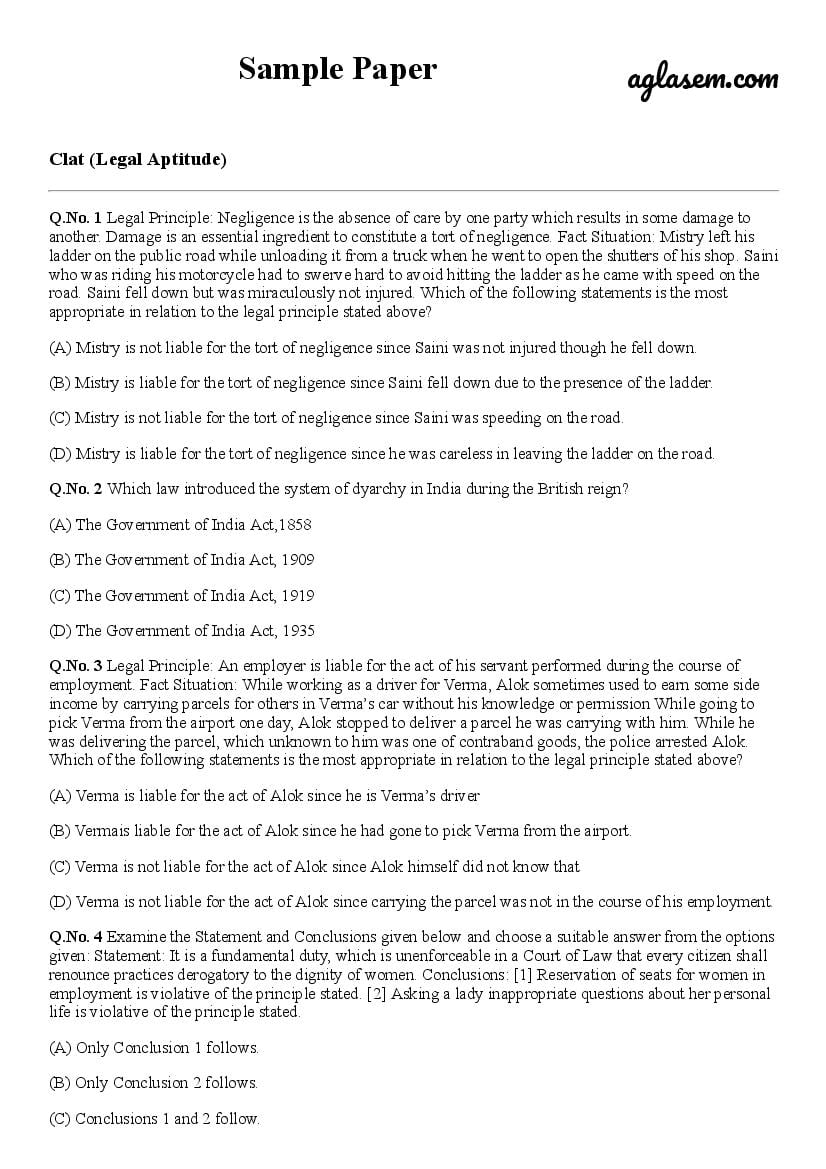
Clat (Legal Aptitude)
Q.No. 1 Legal Principle: Negligence is the absence of care by one party which results in some damage to
another. Damage is an essential ingredient to constitute a tort of negligence. Fact Situation: Mistry left his
ladder on the public road while unloading it from a truck when he went to open the shutters of his shop. Saini
who was riding his motorcycle had to swerve hard to avoid hitting the ladder as he came with speed on the
road. Saini fell down but was miraculously not injured. Which of the following statements is the most
appropriate in relation to the legal principle stated above?
(A) Mistry is not liable for the tort of negligence since Saini was not injured though he fell down.
(B) Mistry is liable for the tort of negligence since Saini fell down due to the presence of the ladder.
(C) Mistry is not liable for the tort of negligence since Saini was speeding on the road.
(D) Mistry is liable for the tort of negligence since he was careless in leaving the ladder on the road.
Q.No. 2 Which law introduced the system of dyarchy in India during the British reign?
(A) The Government of India Act,1858
(B) The Government of India Act, 1909
(C) The Government of India Act, 1919
(D) The Government of India Act, 1935
Q.No. 3 Legal Principle: An employer is liable for the act of his servant performed during the course of
employment. Fact Situation: While working as a driver for Verma, Alok sometimes used to earn some side
income by carrying parcels for others in Verma’s car without his knowledge or permission While going to
pick Verma from the airport one day, Alok stopped to deliver a parcel he was carrying with him. While he
was delivering the parcel, which unknown to him was one of contraband goods, the police arrested Alok.
Which of the following statements is the most appropriate in relation to the legal principle stated above?
(A) Verma is liable for the act of Alok since he is Verma’s driver
(B) Vermais liable for the act of Alok since he had gone to pick Verma from the airport.
(C) Verma is not liable for the act of Alok since Alok himself did not know that
(D) Verma is not liable for the act of Alok since carrying the parcel was not in the course of his employment.
Q.No. 4 Examine the Statement and Conclusions given below and choose a suitable answer from the options
given: Statement: It is a fundamental duty, which is unenforceable in a Court of Law that every citizen shall
renounce practices derogatory to the dignity of women. Conclusions: [1] Reservation of seats for women in
employment is violative of the principle stated. [2] Asking a lady inappropriate questions about her personal
life is violative of the principle stated.
(A) Only Conclusion 1 follows.
(B) Only Conclusion 2 follows.
(C) Conclusions 1 and 2 follow.
Page 2
Q.No. 5 In this Question problem consists of a set of rules and facts. Apply the specified rules to the set of
already possess. Rule: Whoever finds an unattended object can keep it unless the true owner claims that
object. This does not affect the property owner's right to the ownership of the property on whicit the object is
found. The right to ownership of a property does not include the right to ownership of unattended objects on
that property. Facts: Elizabeth is the CEO of a global management services company in Chcnnai and is on
her way to Ranchi to deliver the convocation address at India's leading business school on the outskirts of
Ranchi. Flying business class on Dolphin Airlines, she is entitled to use the lounge owned by the airline in
Chennai Airport while waiting for her flight. She finds a diamond ear-ring on the floor of the lounge and
gives it to the staff of Dolphin Airlines expressly stating that in the event of nobody claiming the ear-ring
within six months, she would claim it back. The airline sells the ear-ring after eight months and Elizabeth
files a case to recover the value of the ear-ring from the airline when she is informed about its sale. As a
judge you would order that:
(A) Elizabeth is not entitled to compensation because the ear-ring was found on the property of the airline
and therefore, the airline is entitled to sell it.
(B) The airline must compensate Elizabeth because owning the lounge does not give the airline the right over
all things that might be found on it.
(C) The airline must compensate Elizabeth because while accepting the ear-ring from Elizabeth they had
agreed to return it if nobody claimed it within six months.
(D) Elizabeth is not entitled to compensation because she did not claim the earring after the expiry of six
months and the airline waited for a couple more months before selling it.
Q.No. 6 Legal Principle: Parents are not liable for wrongs committed by their children unless they provide
the opportunity for such wrongful acts to be committed by their children. Fact Situation: Sunil, a minor, takes
the keys to his father’s car from the table top where his father keeps it, drives the car on the public road and
hits a pedestrian who gets injured. Which of the following statements is the most appropriate in relation to
the legal principle stated above?
(A) Since Sunil took the car without his father’s permission, his father is not liable for Sunil’s act resulting in
the accident
(B) Sunil’s father is liable for the conduct of Sunil resulting in the accident since he left the car keys where
his son could easily take it without permission.
(C) Accidents happen despite utmost care and hence neither Sunil nor his father is liable in the instant case.
(D) Sunil’s father is not liable since he had kept his car locked and securely deposited its keys without
negligence on his table top.
Q.No. 7 The primary legislation relating to organ donation and transplantation, aimed at regulation of
removal, storage and transplantation of human organs for therapeutic purposes and for prevention of
commercial dealings in human organs in India, namely, the Transplantation of Human Organs Act, was
passed in the year
(A) 1994
(B) 1998
(C) 2004
Page 3
Q.No. 8 In this Question problem consists of a set of rules and facts. Apply the specified rules to the set of
already possess. Rule A: When a State undertakes any measure, the effects of the measure must be the same
for all those who are affected by it. Rule B: When a State undertakes any measure, everyone affected must
have an equal chance to benefit from it. Facts 100 mountaineers embarked on an extremely risky climbing
expedition in Leh. Weather conditions worsened five days into the expedition and the mountaineers are
trapped under heavy snow. The government received information of this tragedy only two weeks after the
unfortunate incident and has only 24 hours in which to send rescue helicopters. Weather stations across the
world confirm that this particular region of Leh will experience blizzards of unprecedented intensity for
almost two weeks after this 24 hour window rendering any helicopter activity in the region impossible and
certain death for anyone left behind. The government has only five rescue helicopters with a maximum
capacity of 50 people (excluding pilots and requisite soldiers) and these helicopters can fly only once in 24
hours to such altitudes. As the Air Force gets ready to send the helicopters, an emergency hearing is
convened in the Supreme Court to challenge this measure as this would leave 50 people to die. Choosing 50
survivors exclusively by a lottery would be:
(A) Permissible under Rules A and B
(B) Impermissible under Rule A and B
(C) Permissible only under Rule B
(D) Permissible only under Rule A
Q.No. 9 Who is an Ombudsman?
(A) A judicial officer designated to receive complaints against the violation of rights of citizens.
(B) An official who is charged with representing the interests of the public by investigating and addressing
complaints of maladministration or a violation of rights.
(C) An elected representative of the people toinvestigate and address the complaints of maladministration or
a violation of rights.
(D) A specially designated police officer assigned with the power toinvestigate and address the complaints of
maladministration or a violation of rights.
Q.No. 10 Legal Principle: In the law of evidence, a person missing for long and not heard of, for over seven
years is presumed to have died. Facts: A, B and C are children of F and M. At the age of 20, A went out in
search of a job and was not contacting the family. All attempts to trace A by the family failed. Eight years
after the death of the parents, B and C entered into a partition and took equal share in the property of F and
M. One year after this, A returned home with his wife and two children and claimed his share in the property
Whether A’s claim is legally sustainable?
(A) Since A was not heard of, for more than eight years, the legal presumption of death will apply and hence,
he cannot claim a share in the property.
(B) It was A’s duty to be in touch with the family at least once in a year The failure of this duty will disentitle
him from claiming property.
(C) A will succeed because he is a legitimate son of F and M.
(D) B and C are legally bound to give 1/3rd share of the property to A.
Page 4
already possess. Rules A: The State shall not discriminate, either directly or indirectly, on the grounds of
sex, race, religion, caste, creed, sexual orientation, marital status, disability, pregnancy, place of birth, gender
orientation or any other status. Rule B: Direct discrimination occurs when for a reason related to one or more
prohibited grounds a person or group of persons is treated less favourably than another person or another
group of persons in a comparable situation. Rule C: Indirect discrimination occurs when a provision,
criterion or practice which is neutral on the face of it would have the effect of putting persons having a status
or a characteristic associated with one or more prohibited grounds at a particular disadvantage compared
with other persons. Rule D: Discrimination shall be justified when such discrimination is absolutely
necessary in order to promote the well-being of disadvantaged groups, such as women, dalits, religious
minorities, sexual minorities or disabled persons. Facts: On 2"° October 2010, the Governor of the state of
Bihar ordered the release of all women prisoners who were serving sentence of less than one year
imprisonment to mark the occasion of Mahatma Gandhi's birthday. Assume that the Governor also made a
second order requiring the release of all persons under the age of 25 and over the age of 65 who were serving
a sentence of less than one year's imprisonment. Under the Rules, this order is:
(A) Directly discriminatory.
(B) Indirectly discriminatory.
(C) Not discriminatory.
(D) Discriminatory, butjustifiable.
Q.No. 12 In this Question problem consists of a set of rules and facts. Apply the specified rules to the set of
already possess. Rule A: When a State undertakes any measure, the effects of the measure must be the same
for all those who are affected by it. Rule B: When a State undertakes any measure, everyone affected must
have an equal chance to benefit from it. Facts 100 mountaineers embarked on an extremely risky climbing
expedition in Leh. Weather conditions worsened five days into the expedition and the mountaineers are
trapped under heavy snow. The government received information of this tragedy only two weeks after the
unfortunate incident and has only 24 hours in which to send rescue helicopters. Weather stations across the
world confirm that this particular region of Leh will experience blizzards of unprecedented intensity for
almost two weeks after this 24 hour window rendering any helicopter activity in the region impossible and
certain death for anyone left behind. The government has only five rescue helicopters with a maximum
capacity of 50 people (excluding pilots and requisite soldiers) and these helicopters can fly only once in 24
hours to such altitudes. As the Air Force gets ready to send the helicopters, an emergency hearing is
convened in the Supreme Court to challenge this measure as this would leave 50 people to die. If you were
the judge required to apply Rule A, you would decide that:
(A) As many lives must be saved as possible
(B) If everyone cannot be rescued, then everyone must be left behind
(C) A measure cannot be upheld at the cost of 50 lives
(D) It must be left to those who are trapped to decide if they want half amongst them to be saved and leave
the rest to die
Q.No. 13 Article 51-A on Fundamental Duties was inserted into the Constitution of India through the
(A) 41st Constitution (Amendment) Act, 1976
Page 5
(C) 40th Constitution (Amendment) Act, 1976
(D) 42nd Constitution (Amendment) Act, 1976
Q.No. 14 In this Question problem consists of a set of rules and facts. Apply the specified rules to the set of
already possess. Rule A: An owner of land has the right to use the land in any manner he or she desires. The
owner of land also owns the space above and the depths below it. Rule B: Rights above the laud extend only
to the point they are essential to any use or enjoyment of land. Rule C: An owner cannot claim infringement
of her property right if the space above his or her land is put to reasonable use by someone else at a height at
which the owner would have to reasonable use of it and it does not affect the reasonable enjoyment of his or
her land. Shazia's case: Shazia owns a single storeyed house in Ahmedabad which has been in her family for
more than 75 years. The foundation of the house cannot support another floor and Shazia has no intention of
demolishing her family home to construct a bigger building. Javed and Sandeep are business partners and
own three storey houses on either side of Shazia's house. Javed and Sandeep are also Ahmedabad's main
distributors for a major soft drinke company. They have erected a huge hoarding advertising their products,
with the ends supported on their roofs but the hoarding also passes over Shazia's house at 70 feet and casts a
permanent shadow on her terrace. Shazia decides to hoist a huge Indian flag, going up to 75 feet, on her roof.
She files a case, asking the court to order Javed and Sandeep to remove the hoarding for all these reasons.
Applying Rule C to Shazia's case, you would decide:
(A) In her favour because hoisting a 75 feet high flag is reasonable.
(B) Against her because hoisting a 75 feet high flag is not reasonable.
(C) Against her because the hoarding is a reasonable use of the space above her land.
(D) In her favour because the permanent shadow cast by the hoarding affects the reasonable enjoyment of
her land.
Q.No. 15 Legal Principle: A product cannot be sold in shops to consumers after its date of expiry. Fact
Situation: Lata, while shopping, notices that the milk packets on the shelves are due for expiry on that day.
She objects to this to the shopkeeper, saying that since she was there to buy milk for the next day, keeping
the milk on its date of expiry was against the law. Which of the following statements is the most appropriate
in relation to the legal principle stated above?
(A) Lata is right and the shopkeeper should take the milk packets off his shelves.
(B) The shopkeeper should not sell the milk packets after the date of expiry is over.
(C) The shopkeeper must remove the milk packets from the shelves and keep it refrigerated.
(D) Milk is not a product and hence the principle is not applicable in this case.
Q.No. 16 Legal Principle: An essential condition in a contract for sale of goods is that the seller has title over
the goods sold. Fact Situation: Ranjan pays rupees two thousand and buys a watch from Mohit who runs a
watch showroom and a repair shop.Jatin sees the watch with Ranjanand tells him that it is his watch and was
only given to Mohit for repairs. If what Jatin says is true, Which of the following statements is the most
appropriate in relation to the legal principle stated above?
(A) Ranjan is now the owner of the watch since he paid rupees two thousand for it.
(B) Ranjan is not the owner of the watch since Mohit did not have a title to it.
Page 6
(D) Mohit is the owner of the watch since he sold it to Ranjan.
Q.No. 17 In this Question problem consists of a set of rules and facts. Apply the specified rules to the set of
already possess. Rules: A. A minor is a person who is below the age of eighteen. However, where a guardian
administers the minor's property the age of majority is twenty-one. B. A minor is not permitted by law to
enter into a contract. Hence, where a minor enters into a contract with a major person, the contract is not
enforceable. This effectively means that neither the minor nor the other party can make any claim on the
basis of the contract. C. In a contract with a minor, if the other party hands over any money or confers any
other benefit on the minor, the same shall not be recoverable from the minor unless the otherparty was
deceived by the minor lo hand over money or any other benefit. The other party will have to show that (he
minor misrepresented her age, he was ignorant about the age of the minor and that he handed over the benefit
on the basis of such representation. Facts Ajay convinces Bandita, a girl aged IR that she should sell her land
to him. Bandita's mother Chaaru is her guardian. Nonetheless Bandita, without the permission of Chaaru,
sells the land to Ajay for a total sum of rupees fifty lakh, paid in full and final settlement of the price. Chaaru
challenges this transaction claiming that Bandita is a minor and hence the possession of the land shall not be
given to Ajay. Thus Ajay is in a difficult situation and has no idea how to recover his money from Bandita.
Chaaru is justified in challenging the sale transaction because:
(A) Bandita is of unsound mind and is not in a position to make rational decisions.
(B) Though Bandita is eighteen year old, she will be treated as a minor, as Chaaru is her guardian.
(C) Though Bandita is eighteen year old, she cannot sell the land without the permission of her mother.
(D) Though Bandita is eighteen year old she should not be treated like a person who has attained the age of
majority.
Q.No. 18 Legal Principle: No remedy lies in law where an injury is caused to a person without any
infringement of his legal right. Fact Situation: Ashutosh started a tuition Centre right next to the one being
run for the past twenty years by Gulshan. After Ashutosh started his Centre, a large number of students
shifted from Gulshan’s tuition Centre to Ashutosh’s Centre forcing Gulshan to close down his establishment
suffering huge losses. Can Gulshan initiate legal action against Ashutosh? Which of the following statements
is the most appropriate in relation to the legal principle stated above?
(A) Ashutosh must compensate Gulshan for his loss consequent to the start of the new tuition centre.
(B) Gulshan cannot blame Ashutosh if he cannot retain his students.
(C) Ashutosh has not violated any legal right of Gulshan, though students shifted to Ashutosh’s Centre and
though Gulshan suffered loss, after he shut down his tuition Centre.
(D) Gulshan should have improved his quality with lower fees to retain his students in the light of
competition brought in by Ashutosh.
Q.No. 19 The Right to Education Act, 2009 (RTE) provides for free and compulsory education to:
(A) All illiterate children of India
(B) All citizens of India
(C) Children aged between 6 and 14 years
(D) All children up to the age of 10 years
Page 7
already possess. Rules A. A person is an employee of another if the mode and the manner in which he or she
carries out his work is subject to control and supervision of the latter. B. An employer is required to provide
compensation to his or her employees for any injury caused by an accident arising in the course of
employment. The words 'in the course of the employment' means in the course of the work which the
employee is contracted to do and which is incidental to it. Facts Messrs. ZafarAbidi and Co. (Company)
manufactures bidis with the help of persons known as `pattadars'. The pattadars are supplied tobacco and
leaves by the Company and are required to roll them into bidis and bring the bidis back to the Company. The
pattadars are free to roll the bidis either in the factory or anywhere else they prefer. They are not bound to
attend the factory for any fixed hours of work or for any fixed number of days. Neither are they required to
roll up any fixed number of bidis. The Company verifies whether the bidis adhere to the specified
instructions or not and pays the pattadars on the basis of the number of bidis that are found to be of right
quality. Aashish Mathew is one of the pattadars of the Company. He was hit by a car just outside the precinct
of the factory while he was heading to have lunch in a nearby foodstall. Aashish Mathew has applied for
compensation from the Company. According to the facts and the rules specified, which of the following
propositions is correct?
(A) The Company is not liable to pay compensation as the injury to Aashish Mathew was not caused by an
accident arising in the course of employment.
(B) The Company is liable to pay the compensation.
(C) Since the injury did not arise in the course of employment, the Company would not be liable to pay the
compensation even though Aashish Mathew is an employee of the company.
(D) The Company is liable to pay the compensation as Aashish Mathew is a contracted pattadar with the
company.
Q.No. 21 In this Question problem consists of a set of rules and facts. Apply the specified rules to the set of
already possess. Rules A. The act of using threats to force another person to enter into a contract is called
coercion. B. The act of using influence on another and taking undue advantage of that person is called undue
influence. C. In order to prove coercion, the existence of the use of threat, in any form and manner, is
necessary. If coercion is proved, the person who has been so threatened can refuse to abide by the contract.
D. In order to prove undue-influence, there has to be a pre-existing relationship between the parties to a
contract. The relationship has to be of such a nature that one is in a position to influence the other. If it is
proven that there has been undue influence, the party who has been so influenced need not enforce the
contract or perform his obligations under the contract. Facts Aadil and Baalu are best friends. Aadil is the
son of multi millionaire business person, Chulbal who owns Maakhan Pharmaceuticals. Baalu is the son of a
bank employee, Dhanraj. One day, Aadil is abducted from his office by Baalu. Chulbul receives a phone call
from Dhamaj telling him that if he does not make Baalu the CEO of NIaakhan Pharmaceuticals, Aadil will
be killed. Chulbul reluctantly agrees to make the Baalu the CEO. Subsequently Chulbul and Baalu sign an
employment contract. However as soon as Aadil is released and safely returns home, Chulbul tells Baala that
he shall not enforce the employment contract. Baalu and Dhanraj are not sure as to what is to be done next.
As per the rules and the given facts, who coerces whom:
(A) Aadil coerces Baalu
(B) Baalu coerces Chulbul
(C) Dhanraj coerces Chulbul
Page 8
Q.No. 22 Which of the following is NOT a fundamental duty as per the provisions of the Constitution of
India?
(A) To uphold and protect the sovereignty, unity and integrity of India
(B) To join the Defence Forces of India
(C) To defend the country and render national service when called upon to do so
(D) To value and preserve the rich heritage of our composite culture
Q.No. 23 In this Question problem consists of a set of rules and facts. Apply the specified rules to the set of
already possess. Rules A. The fundamental right to freedom of association includes the right to form an
association as well as not join an association. B. The fundamental right to freedom of association also
includes the freedom to decide with whom to associate. C. The fundamental right to freedom of association
does not extend to the right to realise the objectives of forming the association. D. Fundamental rights are
applicable only to laws made by or administrative actions of the State and do not apply to actions of private
persons. E. Any law in contravention of fundamental rights is unconstitutional and therefore cannot bind any
person. Facts Gajodhar Pharmaceuticals, a private company, offered an employment contract of two years to
Syed Monitul Alam. One of the clauses in the employment contract provided that Syed Monirul Alam must
join Gajodhar Mazdoor Sangh (GMS), one of the trade unions active in Gajodhar Pharmaceuticals. If
Parliament enacts a law that requires a trade union to open its membership to all the employees, then
(A) Such a law would not infringe any fundamental right to freedom of association
(B) The law of the parliament would curtail an individual's right not to join any association
(C) Such a law would curtail the union members' right to decide with whom they would like to associate
(D) Such a law would render the employment contract offered by Gajodhar Pharmaceuticals to Syed Monirul
Alam unenforceable
Q.No. 24 In this Question problem consists of a set of rules and facts. Apply the specified rules to the set of
already possess. Rules A. The fundamental right to freedom of association includes the right to form an
association as well as not join an association. B. The fundamental right to freedom of association also
includes the freedom to decide with whom to associate. C. The fundamental right to freedom of association
does not extend to the right to realise the objectives of forming the association. D. Fundamental rights are
applicable only to laws made by or administrative actions of the State and do not apply to actions of private
persons. E. Any law in contravention of fundamental rights is unconstitutional and therefore cannot bind any
person. Facts Gajodhar Pharmaceuticals, a private company, offered an employment contract of two years to
Syed Monitul Alam. One of the clauses in the employment contract provided that Syed Monirul Alam must
join Gajodhar Mazdoor Sangh (GMS), one of the trade unions active in Gajodhar Pharmaceuticals. If
Gajodhar Pharmaceuticals enter into an agreement with GMS wherein the former agrees to hire only the
existing members of GMS as employees, then:
(A) The agreement would be illegal as it would curtail the union members' right to decide with whom they
would like to associate
Page 9
legally not enforceable
(C) The agreement would not be enforceable as it would infringe upon the employer's right not to join an
association
(D) The constitutionality of this agreement cannot be contested on grounds of contravention of fundamental
rights as such rights are not applicable to private persons
Q.No. 25 In this Question problem consists of a set of rules and facts. Apply the specified rules to the set of
already possess. Rules: A. Whoever intending to take any moveable property out of the possession of any
person without that person's consent, moves that property out of his or her possession, is said to commit
theft. B. A person who, without lawful excuse, damages any property belonging to another intending to
damage any such property shall be guilty of causing criminal damage. C. Damage means any impairment of
the value of a property. Facts: Veena, an old lady of 78 years, used to live with her granddaughter Indira.
Veena was ill and therefore bed-ridden for several months. In those months, she could not tolerate any noise
and it 'became quite difficult to clean her room. After she died, Indira hired a cleaner, Lucky, to clean the
room and throw away any rubbish that may be there. There was a pile of old newspapers which Veena had
stacked in a corner of her room. Lucky asked Indira if he should clear away the pile of old newspapers, to
which she said yes. Lucky took the pile to a municipality rubbish dump. While Lucky was sorting and
throwing away the newspapers, he was very surprised to find a beautiful painting in between two sheets of
paper. He thought that Indira probably wouldn't want this old painting back, especially because it was I’m in
several places and the colour was fading. He took the painting home, mounted it on a wooden frame and
hung it on the wall of his bedroom. Unknown to him, the painting was an old, masterpiece, and worth twenty
thousand rupees. Before mounting the painting, Lucky pasted it on a plain sheet of paper so that it does not
tear any more. By doing so, he made its professional restoration very difficult and thereby reduced its value
by half Lucky's neighbour Kamala discovered that the painting belonged to Indira. With the motive of
returning the painting to Indira, Kamala climbed through an open window into Lucky's room when he was
away one afternoon and removed the painting from his house. Is Lucky guilty of criminal damage?
(A) No, Lucky is not guilty of criminal damage as he did not intentionally impair the value of the painting.
(B) Yes, Lucky is guilty of criminal damage as he intentionally stuck the paper on to the painting
(C) No, Lucky is not guilty of criminal damage as he does not have the painting in his possession anymore.
(D) No, Lucky is not guilty of Criminal damage as he has not destroyed the painting.
Q.No. 26 Article 1 of a legal instrument reads: “All human beings are born free and equal in dignity and
rights. They are endowed with reason and conscience and should act towards one another in a spirit of
brotherhood” Which is the legal instrument being referred to above?
(A) National Human Rights Act, 1995
(B) Constitution of India, 1951
(C) Universal Declaration of Human Rights, 1948
(D) Philadelphia Declaration, 1944
Q.No. 27 Examine the Statement and Conclusions given below and choose a suitable answer from the
options given: Statement: A punishment is the imposition of an undesirable or unpleasant outcome upon a
group or individual, meted out by an authority. Conclusions: [1] Eye for an eye and tooth for a tooth is an
example of punishment. [2] Imposition of fine on someone who inflicted bodily injury on another is justified
by the statement.
Page 10
(B) Only Conclusion 2 follows.
(C) Conclusions 1 and 2 follow.
(D) Neither Conclusion 1 nor 2 follows.
Q.No. 28 A Panchayat Samiti at the block level in India is only a/an:
(A) Administrative authority
(B) Co-ordinating and Supervisory authority
(C) Consultative Committee
(D) Advisory body
Q.No. 29 In this Question problem consists of a set of rules and facts. Apply the specified rules to the set of
already possess. Rules: A. Whoever intending to take any moveable property out of the possession of any
person without that person's consent, moves that property out of his or her possession, is said to commit
theft. B. A person who, without lawful excuse, damages any property belonging to another intending to
damage any such property shall be guilty of causing criminal damage. C. Damage means any impairment of
the value of a property. Facts: Veena, an old lady of 78 years, used to live with her granddaughter Indira.
Veena was ill and therefore bed-ridden for several months. In those months, she could not tolerate any noise
and it 'became quite difficult to clean her room. After she died, Indira hired a cleaner, Lucky, to clean the
room and throw away any rubbish that may be there. There was a pile of old newspapers which Veena had
stacked in a corner of her room. Lucky asked Indira if he should clear away the pile of old newspapers, to
which she said yes. Lucky took the pile to a municipality rubbish dump. While Lucky was sorting and
throwing away the newspapers, he was very surprised to find a beautiful painting in between two sheets of
paper. He thought that Indira probably wouldn't want this old painting back, especially because it was I’m in
several places and the colour was fading. He took the painting home, mounted it on a wooden frame and
hung it on the wall of his bedroom. Unknown to him, the painting was an old, masterpiece, and worth twenty
thousand rupees. Before mounting the painting, Lucky pasted it on a plain sheet of paper so that it does not
tear any more. By doing so, he made its professional restoration very difficult and thereby reduced its value
by half Lucky's neighbour Kamala discovered that the painting belonged to Indira. With the motive of
returning the painting to Indira, Kamala climbed through an open window into Lucky's room when he was
away one afternoon and removed the painting from his house. Is Kamala guilty of theft'?
(A) No, Kamala is not guilty of theft since the person she took the painting from (Lucky) was not its lawful
owner.
(B) No, Kamala is not guilty of theft since she took the painting only with the motive of returning it to Indira.
(C) Yes, Kamala is guilty of theft as she took the painting out of Lucky's possession without his consent.
(D) None of the above
Q.No. 30 Which of the following is the oldest law code in India?
(A) Hammurabi’s code
(B) Prasarsmriti
(C) Manusmriti
Page 11
Answer Sheet
Q.No Answer
Q.No. 1 (B)
Q.No. 2 (C)
Q.No. 3 (D)
Q.No. 4 (B)
Q.No. 5 (B)
Q.No. 6 (B)
Q.No. 7 (A)
Q.No. 8 (C)
Q.No. 9 (B)
Q.No. 10 (A)
Q.No. 11 (A)
Q.No. 12 (D)
Q.No. 13 (D)
Q.No. 14 (D)
Q.No. 15 (B)
Q.No. 16 (B)
Q.No. 17 (B)
Q.No. 18 (C)
Q.No. 19 (C)
Q.No. 20 (D)
Q.No. 21 (C)
Q.No. 22 (B)
Q.No. 23 (C)
Q.No. 24 (D)
Q.No. 25 (A)
Q.No. 26 (C)
Q.No. 27 (C)
Q.No. 28 (B)
Q.No. 29 (C)
Q.No. 30 (C)
Document Details
| Board / Org | NLUs |
| Exam | Common Law Admission Test |
| Type | Sample Paper |
| Pages | 11 |
| Language | english |
| Updated | 22 Jul 2026 |