WBCHSE Class 11 Syllabus for Biological Science
Finished viewing? Save it for later —
Download WBCHSE Class 11 Syllabus for Biological Science (PDF · 10 pages)About WBCHSE Class 11 Syllabus for Biological Science
WBCHSE Class 11 Syllabus for Biological Science is available here for free download. Published by West Bengal Board for Class 11, this syllabus can be viewed online or downloaded as a PDF (10 pages). Candidates preparing for Class 11 can use WBCHSE Class 11 Syllabus for Biological Science to understand the exam pattern, the type of questions asked, and the overall difficulty level.
Frequently Asked Questions
How can I download WBCHSE Class 11 Syllabus for Biological Science?
Open this page and click the Download button to save WBCHSE Class 11 Syllabus for Biological Science as a PDF. It is completely free on AglaSem Docs.
Is WBCHSE Class 11 Syllabus for Biological Science free to download?
Yes. WBCHSE Class 11 Syllabus for Biological Science can be viewed online and downloaded as a PDF free of cost on AglaSem Docs.
How many pages does WBCHSE Class 11 Syllabus for Biological Science have?
WBCHSE Class 11 Syllabus for Biological Science contains 10 pages, which you can read online or download together as a single PDF.
Where can I find more Class 11 study material?
You can find more Class 11 question papers, sample papers, syllabus, and answer keys on AglaSem Docs.
WBCHSE Class 11 Syllabus for Biological Science – Text
Read the full text of this syllabus below — useful to quickly search, copy and reference the content online without downloading the PDF.
📄 View text version (10 pages)
Page 1
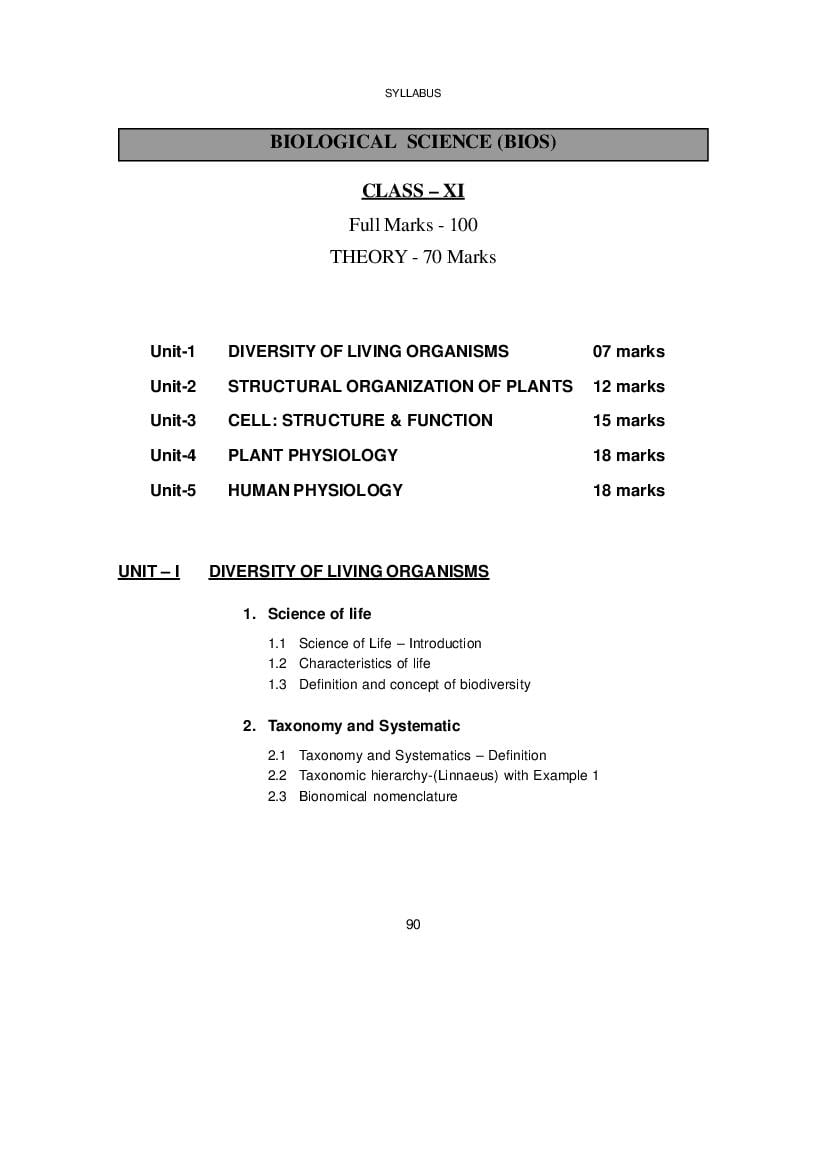
CLASS – XI
Full Marks - 100
THEORY - 70 Marks
Unit-1 DIVERSITY OF LIVING ORGANISMS 07 marks
Unit-2 STRUCTURAL ORGANIZATION OF PLANTS 12 marks
Unit-3 CELL: STRUCTURE & FUNCTION 15 marks
Unit-4 PLANT PHYSIOLOGY 18 marks
Unit-5 HUMAN PHYSIOLOGY 18 marks
UNIT – I DIVERSITY OF LIVING ORGANISMS
1. Science of life
1.1 Science of Life – Introduction
1.2 Characteristics of life
1.3 Definition and concept of biodiversity
2. Taxonomy and Systematic
2.1 Taxonomy and Systematics – Definition
2.2 Taxonomic hierarchy-(Linnaeus) with Example 1
2.3 Bionomical nomenclature
90
Page 2
3.1 What is classification (Definition)
3.2 Need for classification
3.3 Five kingdoms of life and the basis of classification
of five kingdoms.
3.4 Salient features and classification of
Monera, Protoctista (Protista),
Fungi and Lichens into major groups.
3.5 Virus and viriods – a brief
General account.
3.6 Salient features and classification
of plant into major group – Algae,
Bryophytes Pteridophytes, Gymnosperms
and Angiosperms (three to five salient
and distinguishing features of each
category and at least two examples
of each category
3.7 Angiosperm – classification upto class,
characteristic features (three to five) and
examples.
3.8 Salient features and classification of
Animals – major non chordata upto phyla
And chordatas upto class level (three to five
Salient features and at least two examples)
3.9 Tools for study of biodiversity – Museums, Zoos,
Botanical Garden & Herberia.
Unit – II STRUCTURAL ORGANISATION IN PLANTS AND ANIMALS
4. Structural Organisation in Plants
4.1 Tissues (Definition)
4.2 Tissues in plants – Meristematic and
Permanent (Structure and function)
4.3 Morphology of Root, Stem and leaf
(including modifications, microscopic
91
Page 3
with relevant practicals)
4.4 Inflorescenes (Major types – Racemose
And Cymose)
4.5 Morphology of flower (including aestivation
And placentation), fruit and seed (one
Monocot-Maize and one Dicot-Gram)
5. Structural Organisation in Animals
5.1 Tissues in animals (structure, occurrence
and function in brief).
5.2 Morphology, anatomy and functions
of different systems (digestive, circulatory
respiratory, nervous and reproductive)
of an insect-cockroach.(brief account)
Unit-III CELL STRUCTURE AND FUNCTION
6. Cell
6.1 Cell theory and cell as the basic unit of life
6.2 Cell and its major parts - cell membranes
and protoplasm (cytoplasm and nucleus)
6.3 Structure of a prokaryotic and eukaryotic
cell (in brief).
6.4 Structure of plant cell and animal cell
(in brief).
6.5 Cell envelop - cell membrane and cell wall
(ultrastructure and function)
6.6 Cell organelles-Ultrastructure and function;
Mitochondria, golgi bodies, endoplasmic
reticulum, ribosomes, lysomes,vacuoles,
plastids, micro bodies (peroxisomes,
spherosomes and glyoxysomes).
6.7 Ultra structure and function of cytoskeleton,
Cilia, flagella and centrioles.
92
Page 4
Chromatin,nucleolus(ultrastructure and
function)
7. Chemical constituents of living cell
7.1 Chemical constituents of living cell
7.2 Biomolecules-structure and function
of protein, carbohydrate, lipid and
nucleic acid.
7.3 Enzyme-types,properties and enzyme
action (lock and key, induced fit model
and allosterism)
8. Cell Division
8.1 Introduction
8.2 Definition and types
8.3 Cell cycle
8.4 Mitosis- Definition and significance
(process not required)
8.5 Meiosis- Definition,types,process and
Significance
8.6 Difference between mitosis and meiosis
Unit- IV PLANT PHYSIOLOGY
9. Movement of Water, Food, Nutrition And Gases
9.1 Introduction
Absorption of water,gases and nutrients.
9.2 Cell to cell transport- diffusion,facilitated
diffusion,active transport
9.3 Plant-water relation- imbibitions,water
potential,osmosis and plasmolysis.
9.4 Long distance transport-apoplast,symplast,
root pressure transpiration pull, Uptake of
mineral ions
93
Page 5
closing of stomata
9.6 Translocation- transport through
xylem and phloem,
Mass flow hypothesis
10. Plant Nutrition And Minerals
10.1 Introduction
10.2 Essential minerals-macro and micro
nutrients, their roles and deficiency
symptoms (in tabular form)
10.3 Mineral toxicity
10.4 Elementary idea of the Hydroponics
10.5 Nitrogen metabolism-nitrogen cycle,
biological nitrogen fixation.
11. Respiration
11.1 Introduction
11.2 Exchange of gases
11.3 Cellulare respiration-glycolysis,
fermentation (anaerobic), T.C.A cycle
and E.T.S (aerobic) Definition, process
and significance
11.4 Energy relations-number of A.T.P
molecules generated in respiration.
11.5 Amphibolic pathways
11.6 Respiratory quotient of nutrients
12. Photosynthesis
12.1 Introduction-Autotrophic nutrition:
photo and chemo-autotrophic, nutritions.
12.2 Definition and the site of Photosynthesis.
12.3 Photosynthetic pigments
(elementary idea-structure not required)
94
Page 6
of photosynthesis.
12.5 Cyclic and non cyclic
photophosphorylation.
12.6 Chemo osmotic hypothesis
12.7 Photo respiration
12.8 C3 and C4 pathways
12.9 Factors Controlling photosynthesis
13. Plant Growth And Development
13.1 Introduction
13.2 Phases of plant growth and plant growth rate
13.3 Condition of growth.....(light, temperature,
water,hormone,nutrients only)
13.4 Differentiation, De-differentiation,
and Re-differentiation-definition
and example only.
13.5 Sequence of developmental process
in a plant cell through chart.
13.6 Growth regulations-auxin, gibberellins
cytokinin, ethylene, A.B.A
13.7 Seed germination
13.8 Seed dormancy
13.9 Vernalisation
13.10Photoperiodism-definition,
types of plants on the basis of the
length of the photoperiod.
Unit- V HUMAN PHYSIOLOGY
14. Digestion and Absorption
14.1 Introduction
14.2 Structure (in brief) of human
Alimentary canal including
dental arrangement and digestive glands.
95
Page 7
G -1 Hormone in digestion.
14.4 Peristalsis
14.5 Digestion, absorption and assimilation
of protein, carbohydrate and fat
14.6 [Caloric value of proteins, carbohydrates
and fats.] Box item-not to be evaluated.
14.7 Egestion
14.8 Nutritional and digestive disorders-
PEM (protein energy malnutrition,)
indigestion, constipation
vomiting, jaundice, diarrhoea.
15. Breathing and Respiration
15.1 Introduction
15.2 Respiratory organs in animals
(through chart, recall only)
15.3 Respiratory system in human (outline)
15.4 Mechanism of breathing and its
regulation in human.
15.5 Exchange of gases, transport of
gases and regulation of respiration.
15.6 Repertory volumes
15.7 Disorders related to respiration Asthma,
emphysema, occupational respiratory
disorders- (e.g. Silicosis, Asbestosis)
16. Body Fluids And Circulation
16.1 Introduction
16.2 Composition of Blood (Tabular form)
16.3 Blood groups, ABO Blood groups
16.4 Coagulation of blood
16.5 Composition of lymph and its function
16.6 Human circulatory system-(outline idea)
16.7 Structure of Human heart and
blood vessels.
96
Page 8
16.9 Cardiac output (stroke volume and
minute volume, determination of
cardiac output- Fick’s Principle)
16.10 E.C.G (brief idea, no analysis required)
16.11 Double circulation
16.12 Regulation of cardiac activity
(neutral and hormonal) including
factors regulating Blood Pressure
16.13 Disorders of the circulatory system
hypertension, corornary artery disese,
angina pectoris, heart failure.
17. Excretory Products And their Elimination
17.1 Introduction
17.2 Modes of excretion- Ammonotelism
Ureotelism, Uricotelism
(Definition and Examples)
17.3 Human excretory system- structure
and function (Histology of nephron)
17.4 Urine formation and Osmo- regulation
17.5 Regulation of Kidney function, Renin,
angiotensin, Antidiuretic factor A.D.H
and diabetes insipidus
17.6 Role of other organs in excretion-
Liver, skin , lung and salivary gland.
17.7 Disorders- Uraemia, renal failure,
Renal calculi, Nephritis.
17.8 Dialysis and artificial kidney
18. Locomotion and Movement
18.1 Introduction- What is locomotion
and movement?
18.2 Types of movement ciliary
Flagellar and muscular.
97
Page 9
proteins and muscle contraction.
18.4 Skeletal system and its function.
(To be dealt with relevant portion
of practical syllabus)
18.5 Joints
18.6 Disorders of muscular and skeletal
system- Myasthenia gravis, tetany,
Muscular dystrophy, arthritis
osteoporosis and gout.
19. Neural control and coordination
19.1 Introduction- what is neural
control and co-ordination
19.2 Neurones and nerves (Revisionary)
19.3 Nervous system in human
19.4 Central Nervous System, Peripheral
Nervous System (P.N.S), and visceral Nervous
System. Brain and its major parts-
cerebral cortex, thalamus, hypothalamus
and lymbic system, mid brain, pons,
medulla, cerebellum and Spinal
cord ( function only), Mode of
distribution and function of
P.N.S and autonomic nervous system.
19.5 Generation and Conduction of nerve impulse.
19.6 Reflex action and Reflex Arc
19.7 Sense Organs- sensory perception
outline structure and function of eye and ear.
20. Chemical Coordination And Regulation
20.1 Introduction- endocrine
glands and hormones.
20.2 Human endocrine system-
Hypothalamus, Pituitary, Pineal,
98
Page 10
Pancreas,Gonads
(location and function only)
20.3 Mechanism of hormone action
(elementary idea)
20.4 Role of hormones as messengers
and regulators.
20.5 Hypo and Hyper activity of
endocrine glands and related Disorders
(common disorders e.g., Dwarfism
Acromegaly Cretinism,Goiter,
Exopthalmic goiter, Diabetes,
Addisons disease.
(Important diseases related to physiology
of all Systems of human are to be
taught briefly.)
99
Document Details
| Board / Org | West Bengal Board |
| Exam | Class 11 |
| Type | Syllabus |
| Pages | 10 |
| Updated | 22 Jul 2026 |