WBCHSE Class 11 Syllabus for Computer Science
Finished viewing? Save it for later —
Download WBCHSE Class 11 Syllabus for Computer Science (PDF · 5 pages)About WBCHSE Class 11 Syllabus for Computer Science
WBCHSE Class 11 Syllabus for Computer Science is available here for free download. Published by West Bengal Board for Class 11, this syllabus can be viewed online or downloaded as a PDF (5 pages). Candidates preparing for Class 11 can use WBCHSE Class 11 Syllabus for Computer Science to understand the exam pattern, the type of questions asked, and the overall difficulty level.
Frequently Asked Questions
How can I download WBCHSE Class 11 Syllabus for Computer Science?
Open this page and click the Download button to save WBCHSE Class 11 Syllabus for Computer Science as a PDF. It is completely free on AglaSem Docs.
Is WBCHSE Class 11 Syllabus for Computer Science free to download?
Yes. WBCHSE Class 11 Syllabus for Computer Science can be viewed online and downloaded as a PDF free of cost on AglaSem Docs.
How many pages does WBCHSE Class 11 Syllabus for Computer Science have?
WBCHSE Class 11 Syllabus for Computer Science contains 5 pages, which you can read online or download together as a single PDF.
Where can I find more Class 11 study material?
You can find more Class 11 question papers, sample papers, syllabus, and answer keys on AglaSem Docs.
WBCHSE Class 11 Syllabus for Computer Science – Text
Read the full text of this syllabus below — useful to quickly search, copy and reference the content online without downloading the PDF.
📄 View text version (5 pages)
Page 1
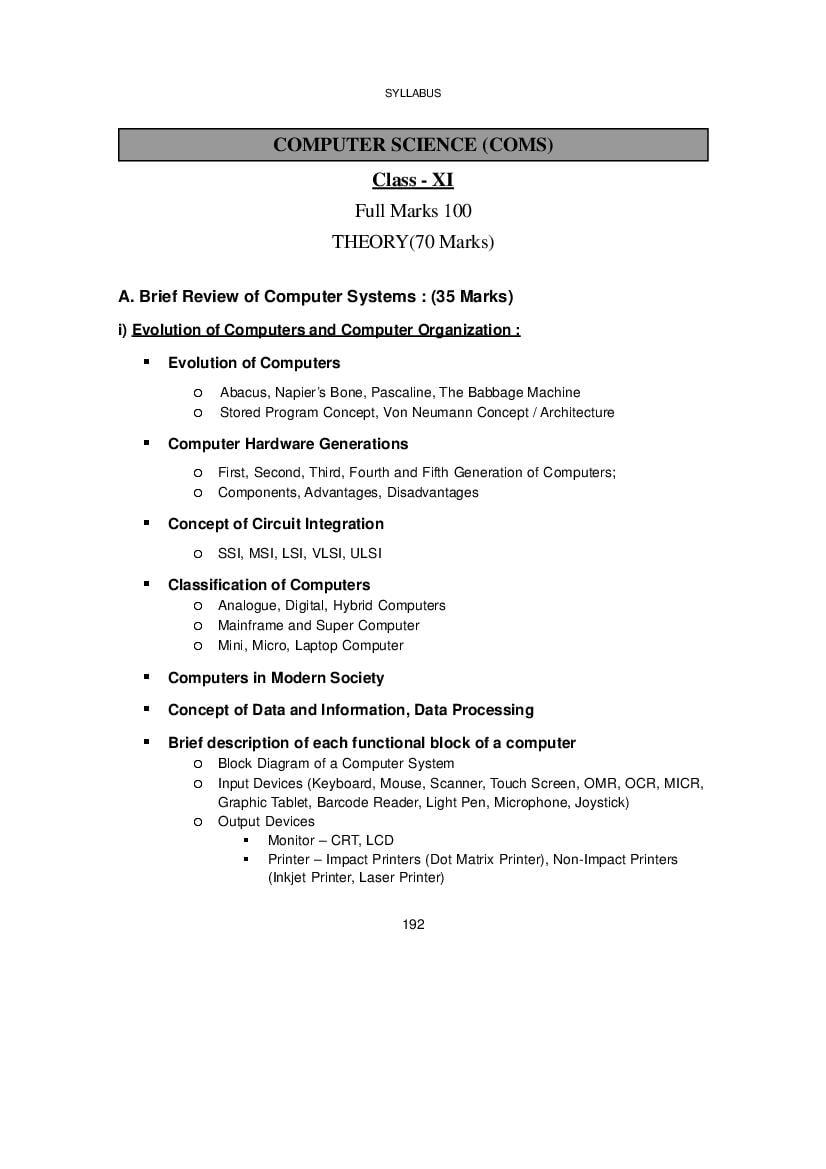
Class - XI
Full Marks 100
THEORY(70 Marks)
A. Brief Review of Computer Systems : (35 Marks)
i) Evolution of Computers and Computer Organization :
Evolution of Computers
o Abacus, Napier’s Bone, Pascaline, The Babbage Machine
o Stored Program Concept, Von Neumann Concept / Architecture
Computer Hardware Generations
o First, Second, Third, Fourth and Fifth Generation of Computers;
o Components, Advantages, Disadvantages
Concept of Circuit Integration
o SSI, MSI, LSI, VLSI, ULSI
Classification of Computers
o Analogue, Digital, Hybrid Computers
o Mainframe and Super Computer
o Mini, Micro, Laptop Computer
Computers in Modern Society
Concept of Data and Information, Data Processing
Brief description of each functional block of a computer
o Block Diagram of a Computer System
o Input Devices (Keyboard, Mouse, Scanner, Touch Screen, OMR, OCR, MICR,
Graphic Tablet, Barcode Reader, Light Pen, Microphone, Joystick)
o Output Devices
Monitor – CRT, LCD
Printer – Impact Printers (Dot Matrix Printer), Non-Impact Printers
(Inkjet Printer, Laser Printer)
192
Page 2
o Central Processing Unit : CU, ALU
o Storage Devices
Primary Memory : RAM (DRAM, SRAM), ROM (PROM, EPROM,
EEPROM, UVPROM)
Secondary Memory : Magnetic Media (HDD, FDD), Optical Media
(CD, DVD, Blue-Ray Disk)
Cache Memory
Flash Memory
o Communication Bus
System Bus – Address Bus, Data Bus, Control Bus, Power Bus
ii) Data Representation :
Number Systems
o Concept of Non-Positional Number System
Roman Number System
Concept of Positional Number System
Decimal, Binary, Octal and Hexadecimal Number System
o Conversion
Inter-conversion between Decimal, Binary, Octal and Hexadecimal
Numbers (Whole numbers and Fractions, using Double Add and Half
Add Methods)
o Arithmetic
Addition, Subtraction – Decimal, Binary, Octal and Hexadecimal
Numbers
Multiplication, Division – Binary Number System only
o Different methods of Negative Number Representation
Signed Magnitude
One’s Complement
Two’s Complement
Subtraction using Complements (1’s, 2’s, 7’s, 8’s, 9’s, 10’s, 15’s, 16’s
complement)
Various Binary Coding Schemes
o BCD
o EBCDIC
o ASCII
o ISCII
193
Page 3
o Excess-3 Code
Concept of Fixed and Floating Point Numbers
o Difference between fixed and floating point numbers
o Concept of normalised numbers
o Floating point arithmetic (addition, subtraction, multiplication, division)
Bit map representation of images
iii) Boolean Algebra
Definition and postulates.
Boolean operations – OR, AND, NOT
Proof using identities and truth tables
De’ Morgan’s Theorems and Basic Principle of Duality
Deriving truth table from Boolean expression and vice versa
o Sum of Product (SOP) Expressions (using min-terms)
o Product of Sum (POS) Expressions (using max-term)
Canonical form of Boolean expressions and their complements
Simplifications (Algebraic method, K-map method up to 4 variables)
Use of Don’t Care terms
Logic Gates – OR, AND, NOT, XOR, X-NOR Gates
Universal Gates – NAND and NOR Gate
Basic gates using Universal Gates
Two Level Circuits
Combinational Circuits :
o Half Adder & Full Adder (definition and representation)
o Full Adder using Half Adders only
o Half Subtractor & Full Subtractor (definition and representation)
o 4 bit Adder and Subtractor Circuit
o Multiplexer (4x1) and De-multiplexer (1x4)
o Decoder (Maximum 3 bits), and Encoder (Decimal to Binary, Octal to
Binary)
B. Software and Languages: (10 Marks)
Definition of Software
194
Page 4
language
Types of Software
o System Software
Translator – compiler, interpreter, assembler
Operating systems:
Definition and Function
Types of OS – Single User, Multi-user, Multiprogramming,
Multiprocessing, Time Sharing
Booting (cold and warm), Spooling, Buffering, Concept of Virtual
Memory
Directory and file Structure, Path and Pathname
Concept of GUI, CUI with examples
Using MS DOS (Commands and their use – DIR, MD, RD, CD, COPY,
CON, MOVE, REN, DEL, TYPE, MORE, ATTRIB, EDIT, DATE, TIME,
CLS), Concept of Batch File
Using MS Windows OS
UNIX OS (Commands and their use – chmod, cd, pr, cp, cat, rn, rmdir,
ls, vi, mkdir, more, mv, mail, who), Use of Wild Card, File Permission,
Concept of Piping, UNIX shell
o Application Software (definition and example)
o Utility Software (definition and example)
C. Programming in C: (25 Marks)
Concept of Algorithm and Flowchart
Introduction to C
Character Sets, Keywords, Constants, Variables, Operators in C
Data types in C
Header files
Input / Output operations
Control structures
Loop structures
Functions (user-defined and common library functions) including recursive function
Array (one and two dimension numeric array)
Basic concept of Pointer and String
195
Page 5
Problem solving
D. Practical - (30 Marks)
MS-Windows / UNIX / LINUX Operating System Commands - (5 Marks)
Programming in C (Algorithm / Flow Chart, Coding, Execution (15 Marks)
o One program using branching and loop (5 marks)
o One program using Function, Array, String, Structure (10 marks)
Laboratory Copy (must have minimum 20 programs from topics in class 11)
(5 Marks)
o 6 programs on control structures
o 4 programs on array manipulations
o 4 programs on string manipulation
o 2 programs on structure manipulation
o 4 programs on functions
Viva Voce (5 Marks)
196
Document Details
| Board / Org | West Bengal Board |
| Exam | Class 11 |
| Type | Syllabus |
| Pages | 5 |
| Updated | 22 Jul 2026 |