WBCHSE Class 11 Syllabus for Economics
Finished viewing? Save it for later —
Download WBCHSE Class 11 Syllabus for Economics (PDF · 9 pages)About WBCHSE Class 11 Syllabus for Economics
WBCHSE Class 11 Syllabus for Economics is available here for free download. Published by West Bengal Board for Class 11, this syllabus can be viewed online or downloaded as a PDF (9 pages). Candidates preparing for Class 11 can use WBCHSE Class 11 Syllabus for Economics to understand the exam pattern, the type of questions asked, and the overall difficulty level.
Frequently Asked Questions
How can I download WBCHSE Class 11 Syllabus for Economics?
Open this page and click the Download button to save WBCHSE Class 11 Syllabus for Economics as a PDF. It is completely free on AglaSem Docs.
Is WBCHSE Class 11 Syllabus for Economics free to download?
Yes. WBCHSE Class 11 Syllabus for Economics can be viewed online and downloaded as a PDF free of cost on AglaSem Docs.
How many pages does WBCHSE Class 11 Syllabus for Economics have?
WBCHSE Class 11 Syllabus for Economics contains 9 pages, which you can read online or download together as a single PDF.
Where can I find more Class 11 study material?
You can find more Class 11 question papers, sample papers, syllabus, and answer keys on AglaSem Docs.
WBCHSE Class 11 Syllabus for Economics – Text
Read the full text of this syllabus below — useful to quickly search, copy and reference the content online without downloading the PDF.
📄 View text version (9 pages)
Page 1
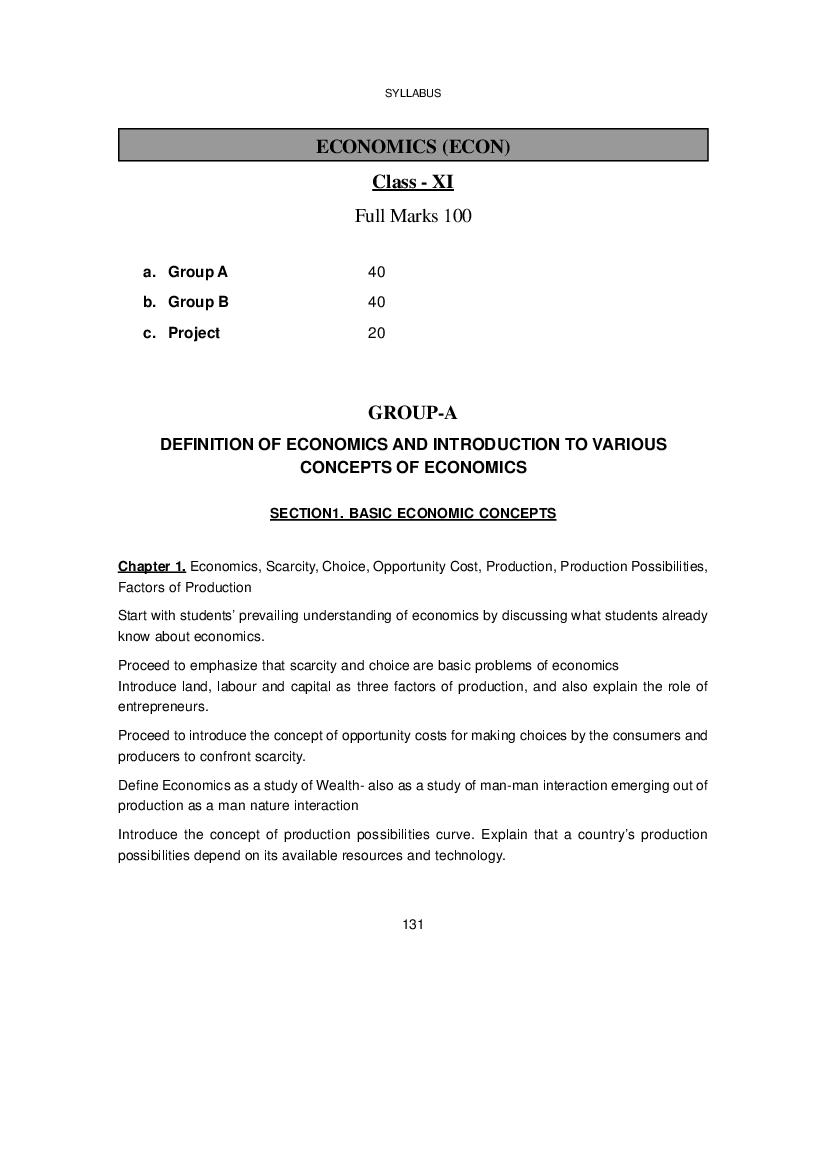
Class - XI
Full Marks 100
a. Group A 40
b. Group B 40
c. Project 20
GROUP-A
DEFINITION OF ECONOMICS AND INTRODUCTION TO VARIOUS
CONCEPTS OF ECONOMICS
SECTION1. BASIC ECONOMIC CONCEPTS
Chapter 1. Economics, Scarcity, Choice, Opportunity Cost, Production, Production Possibilities,
Factors of Production
Start with students’ prevailing understanding of economics by discussing what students already
know about economics.
Proceed to emphasize that scarcity and choice are basic problems of economics
Introduce land, labour and capital as three factors of production, and also explain the role of
entrepreneurs.
Proceed to introduce the concept of opportunity costs for making choices by the consumers and
producers to confront scarcity.
Define Economics as a study of Wealth- also as a study of man-man interaction emerging out of
production as a man nature interaction
Introduce the concept of production possibilities curve. Explain that a country’s production
possibilities depend on its available resources and technology.
131
Page 2
Underdevelopment
a. Relative scarcity and the economic problem
b. The three fundamental economic questions every society must address
c. The six broad social goals of efficiency, equity, freedom, growth, security, and stability
d. Private property and market economy-features, merits and demerits
e. Discuss Adam Smith as one of the early free market philosopher
f. State Property and planned economy-features, merits and demerits
g. Discuss socialism and communism
h. Discuss Karl Marx as a philosopher in favour of communism and socialism
i. Mixed economy (with the Indian economy as an illustrative example)- features, merits and
demerits
j. Discuss how different economic systems solve the most important economic questions
k. Common property resources and their uses/abuses (with the Indian economy as an illustrative
example)
l. Developed economy- Industrialized economy
m. Developing economy- less developed economy-underdeveloped economy
Chapter 3. Demand, Supply, Production, Cost of Production, Markets
a. Utility
b. Diminishing marginal utility
c. Price
d. Demand
e. Law of Demand
f. Demand Schedule
132
Page 3
h. Supply
i. Law of Supply
j. Supply Schedule
k. Supply Curve
l. Equilibrium price
m. Equilibrium quantity
n. Market
o. Competitive market
p. Cost
q. Fixed Cost
r. Variable Cost
s. Marginal cost
t. Average cost
Chapter 4. The Role of Government in the Economy
Introduce the followings:
a. Market Failures
b. Regulation of markets
c. Social Cost
d. Private Cost
e. Public Goods
f. Social Investment
g. Private Investment
h. Public Private Partnership
i. Pollution Tax
j. Income Redistribution
133
Page 4
l. Natural Monopoly
SECTION 2. MACROECONOMIC CONCEPTS
Chapter 5. The Major Macroeconomic Variables: National Income, Consumption, Savings and
Investments, Unemployment, and Inflation
a. Index Number- Price Index Number- Simple average method-Weighted average method
b. Consumption Goods
c. Capital Goods
d. Final Goods
e. Intermediate Goods
f. Stocks and Flows
g. Savings and Investment
h. Depreciation
i. National income
j. Gross Domestic Product
k. Gross National Product
l. Net Domestic Product
m. Net National Product
n. Per capita National Income
o. Nominal Gross Domestic Product (NGDP)
p. Real Gross Domestic Product (RGDP)
q. Gross Domestic Product Per Capita (PCGDP)
r. Nominal Gross National Product (NGNP)
s. Real Gross National Product (RGNP)
134
Page 5
u. Inflation Rate
v. CPI used to compute changes in Inflation
w. Unemployment Rate- Seasonal Unemployment- Frictional Unemployment- Voluntary
Unemployment- Involuntary Unemployment
x. Aggregate Expenditure
y. Net Exports
Chapter 6. Growth and Development
a. Economic growth rates- National income based growth indicators
b. Per capita growth rates- Per capita real GNP growth rate-Per capita real GDP growth
rate
c. Economic development and underdevelopment- distinction between growth and
development
d. Developed economies- differences among developed economies
e. Underdeveloped economies- differences among the underdeveloped economies
Chapter 7. Explaining Business Cycles
a. Aggregate Demand d. Demand side shocks
b. Aggregate Supply e. The 4 parts of a business cycle
c. Supply side shocks f. Recessions
Chapter 8. Fiscal Policy
a. Taxes- Direct Tax- Indirect Tax- Central Government Taxes and State Government Taxes
(In Indian Context)
b. Transfer Payments- Subsidies
135
Page 6
d. Fiscal deficit-Revenue Deficit
e. Government Expenditure- Expansionary Fiscal Policy- Contractionary Fiscal Policy
f. Public Debt
Chapter 9. Money and Banking
a. Money Supply- Components of Money Supply in an economy
b. Bank- Commercial Bank- Central Bank
c. Non Bank Financial Intermediaries
d. Type of Deposits- Current Deposits- Term Deposits- Savings Deposits- Fixed Deposits-
Recurring Deposits
e. Interest Rates- Prime Lending Rates- REPO rate-Reverse Repo Rate
f. Variable Reserve ratio.
SECTION3. MICROECONOMIC CONCEPTS
Chapter 10. Business Organizations
a. Sole proprietor
b. Partnership
c. Corporation
d. Shares and stocks
e. Cooperative
136
Page 7
Chapter 11. International Trade, Exchange Rates, Tariff, Quotas
a. International Trade
b. Absolute Advantage
c. Comparative Advantage
d. Gains from trade
e. Specialization
f. Exchange Rates
g. Tariffs
h. Quotas
i. Export Subsidies
j. Trade liberalization
k. Bilateral trade agreements
l. Regional trade agreements
SECTION5. FACTOR MARKETS
Chapter 12. The Basics of Factor Market
a. Total Product
b. Average Product of a Factor
c. Marginal Product of a Factor
d. Total Revenue Product
e. Average Revenue Product
f. Marginal Revenue Product
g. Total Factor Cost
h. Average Factor Cost
i. Marginal Factor Cost
137
Page 8
INDIAN ECONOMY INCLUDING STATISTICAL TOOLS
SECTION.1 STATISTICAL TOOLS
Chapter
1. Statistical Tools for Understanding Indian Economy
Data- Collection of Data- Presentation of Data- Graphical- Tabular-Frequency
Distribution-Measures of Central Tendency- Mean, Median, Mode.
SECTION2. INDIAN ECONOMY WITH SPECIAL REFERENCE TO WEST BENGAL
(FEATURES, AGRICULTURE AND INDUSTRIES)
Chapter
2. Changing Features of Indian Economy- Sectoral Composition of National Income-
Changes over Time during Plan Period- Changes in Demographic Features-
Changes in Occupational Patterns- Human Development- Sectoral Composition
of State Domestic Products of West Bengal Economy- Changes in Demographic
Features of West Bengal- Human Development in West Bengal.
3. Analysis of the Agricultural Economy of India and West Bengal- Role of
Agriculture in India and West Bengal- Cash Crops, Food Crops, Marketable
Surplus- Green Revolution in India and West Bengal- Productivity in
Agriculture in India and West Bengal- Land Reforms in India and West
Bengal-Agricultural Growth in India and West Bengal-Policy of Food
procurement in India and West Bengal- Public Distribution System- Mahatma
Gandhi National Rural Employment Guarantee Act- Economic Reforms in
Agriculture.
4. Analysis of the Industrial economy of India and West Bengal- Role of
Industry in India and West Bengal- Industrial Growth and Stagnation in India
and West Bengal- Public Sector, Private Sector, Joint Sector- Role of Public
Sector in India and West Bengal- Role of Small Scale Industries in India and
West Bengal- Changes in Industrial Policy during Plan Period- Economic
Reforms, New Industrial Policy, Liberalisation, Privatisation, Globalisation-
Impact of Economic Reforms on Industries in India and West Bengal.
138
Page 9
National Income, Per Capita Income- Literacy and Education- Population- Health
Indicators- Sectoral Compositions.
India and Pakistan- India and China- India and Japan.
PROJECT
There may be 2 types of Project, one based on Field Works and other based on
Secondary Data.
Some suggested Field Works are:
1. Visit to village panchayat for agriculture based project
2. Visit to Village panchayat For data on land holdings, crop patterns, occupational
patterns, Food procurement.
Suggested Projects on the Basis of Secondary data are:
1. Growth of Industries on the Basis of Annual Survey of Industries
2. Changes in Sectoral Composition of State/ National Income on the basis of
National Accounts Data, State Domestic Product data.
139
Document Details
| Board / Org | West Bengal Board |
| Exam | Class 11 |
| Type | Syllabus |
| Pages | 9 |
| Updated | 22 Jul 2026 |