NIOS Class 12 Question Paper Apr 2019 - Mass Communication
Finished viewing? Save it for later —
Download NIOS Class 12 Question Paper Apr 2019 - Mass Communication (PDF · 4 pages)About NIOS Class 12 Question Paper Apr 2019 - Mass Communication
NIOS Class 12 Question Paper Apr 2019 - Mass Communication is available here for free download. Published by NIOS for National Institute of Open Schooling Class 12, this question paper can be viewed online or downloaded as a PDF (4 pages). Candidates preparing for National Institute of Open Schooling Class 12 can use NIOS Class 12 Question Paper Apr 2019 - Mass Communication to understand the exam pattern, the type of questions asked, and the overall difficulty level.
Frequently Asked Questions
How can I download NIOS Class 12 Question Paper Apr 2019 - Mass Communication?
Open this page and click the Download button to save NIOS Class 12 Question Paper Apr 2019 - Mass Communication as a PDF. It is completely free on AglaSem Docs.
Is NIOS Class 12 Question Paper Apr 2019 - Mass Communication free to download?
Yes. NIOS Class 12 Question Paper Apr 2019 - Mass Communication can be viewed online and downloaded as a PDF free of cost on AglaSem Docs.
How many pages does NIOS Class 12 Question Paper Apr 2019 - Mass Communication have?
NIOS Class 12 Question Paper Apr 2019 - Mass Communication contains 4 pages, which you can read online or download together as a single PDF.
Where can I find more National Institute of Open Schooling Class 12 study material?
You can find more National Institute of Open Schooling Class 12 question papers, sample papers, syllabus, and answer keys on AglaSem Docs.
NIOS Class 12 Question Paper Apr 2019 - Mass Communication – Text
Read the full text of this question paper below — useful to quickly search, copy and reference the content online without downloading the PDF.
📄 View text version (4 pages)
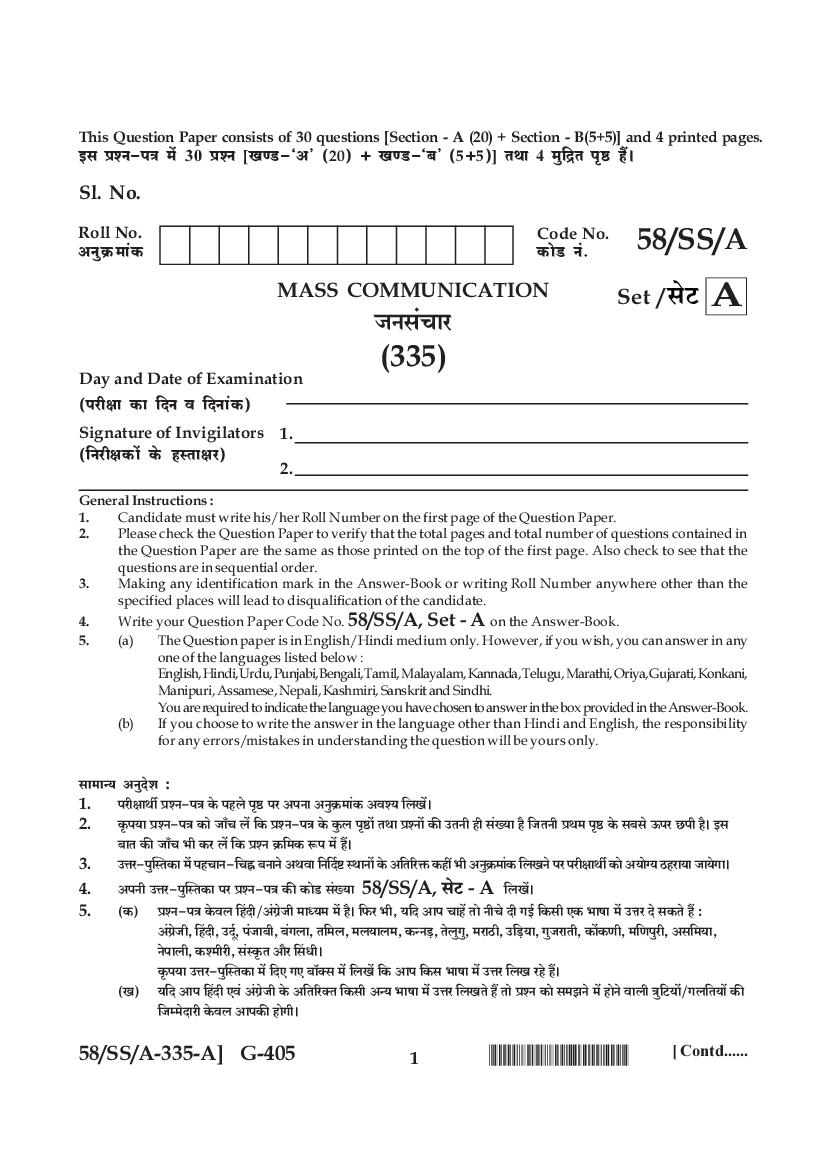
Page 1
Bg àíZ-nÌ _| 30 àíZ [IÊS>-"A' ( 20) + IÊS>-"~' ( 5+5) ] VWm 4 w{ÐV n¥ð> h¢&
Sl. No.
Roll No.
AZw H « $ _m§ H $
Code No.
H$moS> Z§. 58/SS/A
MASS COMMUNICATION Set / go Q > A
Day and Date of Examination
(narjm H$m {XZ d {XZm§ H $)
Signature of Invigilators 1.
({ZarjH$m| Ho $ hñVmja)
2.
General Instructions :
1. Candidate must write his/her Roll Number on the first page of the Question Paper.
2. Please check the Question Paper to verify that the total pages and total number of questions contained in
the Question Paper are the same as those printed on the top of the first page. Also check to see that the
questions are in sequential order.
3. Making any identification mark in the Answer-Book or writing Roll Number anywhere other than the
specified places will lead to disqualification of the candidate.
4. Write your Question Paper Code No. 58/SS/A, Set - A on the Answer-Book.
5. (a) The Question paper is in English/Hindi medium only. However, if you wish, you can answer in any
one of the languages listed below :
English, Hindi, Urdu, Punjabi, Bengali, Tamil, Malayalam, Kannada, Telugu, Marathi, Oriya, Gujarati, Konkani,
Manipuri, Assamese, Nepali, Kashmiri, Sanskrit and Sindhi.
You are required to indicate the language you have chosen to answer in the box provided in the Answer-Book.
(b) If you choose to write the answer in the language other than Hindi and English, the responsibility
for any errors/mistakes in understanding the question will be yours only.
gm_mÝ` AZwXoe :
1. narjmWu àíZ-nÌ Ho$ nhbo n¥ð> na AnZm AZwH«$m§H$ Adí¶ {bI|&
2. H¥$n¶m àíZ-nÌ H$mo Om±M b| {H$ àíZ-nÌ Ho$ Hw$b n¥ð>m| VWm àíZm| H$s CVZr hr g§»¶m h¡ {OVZr àW n¥ð> Ho$ g~go D$na N>nr h¡& Bg
~mV H$s Om±M ^r H$a b| {H$ àíZ H«${H$ ê$n | h¢&
3. CÎma-nwpñVH$m | nhMmZ-{M ~ZmZo AWdm {Z{X©ï> ñWmZm| Ho$ A{V[aº$ H$ht ^r AZwH$« m§H$ {bIZo na narjmWu H$mo A¶mo½¶ R>ham¶m Om¶oJm&
4. AnZr CÎma-nwpñVH$m na àíZ-nÌ H$s H$moS> g§»¶m 58/SS/A, goQ> - A {bI|&
5. (H$) àíZ-nÌ Ho$db qhXr/A§J«oOr mܶ | h¡& {$a ^r, ¶{X Amn Mmh| Vmo ZrMo Xr JB© {H$gr EH$ ^mfm | CÎma Xo gH$Vo h¢ :
A§J«oOr, qhXr, CX©ÿ, n§Om~r, ~§Jbm, V{b, b¶mb, H$ÝZS>, VobwJw, amR>r, C{S>¶m, JwOamVr, H$m|H$Ur, {Unwar, Ag{¶m,
Zonmbr, H$írar, g§ñH¥$V Am¡a qgYr&
H¥$n¶m CÎma-nwpñVH$m | {XE JE ~m°³g | {bI| {H$ Amn {H$g ^mfm | CÎma {bI aho h¢&
(I) ¶{X Amn qhXr Ed§ A§J«oOr Ho$ A{V[a³V {H$gr Aݶ ^mfm | CÎma {bIVo h¢ Vmo àíZ H$mo gPZo | hmoZo dmbr Ìw{Q>¶m|/Jb{V¶m| H$s
{OåoXmar Ho$db AmnH$s hmoJr&
58/SS/A-335-A] G-405 1 *58/SS/A-335-A* [ Contd......
Page 2
Time : 3 Hours] [Maximum Marks : 80
g_` : 3 KÊQ>o] [nyUmªH$ : 80
Note : (i) All questions in Section 'A' are compulsory.
(ii) From Section 'B' attempt questions of only one option of your choice.
(iii) Marks for each question is indicated against it.
{ZX}e : (i) IÊS> "A' | {XE JE g^r àíZ A{Zdm¶© h¡§ &
(ii) IÊS> "~' | {XE JE AnZr ng§X Ho$ {g©$ EH$ {dH$ën | go àíZm| Ho$ CÎma X| &
(iii) à˶oH$ àíZ Ho$ A§H$ CgHo$ gmZo {XE JE h¢ &
SECTION - A
IÊS> - A
1. What is reporting? [1]
[anmo[Q>ªJ ³¶m hmoVr h¡?
2. Define advertising. [1]
{dkmnZ H$s n[a^mfm Xr{OE &
3. What is Mass Communication? [1]
OZ g§Mma ³¶m h¡?
4. Give any two reasons for the importance of regional language newspapers in India.[2]
^maV | joÌr¶ ^mfm Ho$ gmMmanÌmo Ho$ hËd Ho$ {H$Ýhr§ Xmo H$maUm| H$m CoI H$s{OE &
5. Write any two formats of television programmes. [2]
Q>obr{dOZ H$m¶©H«$m| Ho$ {H$Ýht Xmo $m°o©Q> Ho$ ~mao §o {b{IE &
6. Mention any two advantages of a radio. [2]
ao{S>¶mo Ho$ {H$Ýhr§ Xmo loîR>VmAmo H$m CoI H$s{OE&
58/SS/A-335-A] G-405 2 *58/SS/A-335-A* [ Contd......
Page 3
AmCQ>S>moa mܶ Ho$ {H$Ýhr§ Xmo CXmhaUm| H$m CoI H$s{OE &
8. Write any two PR tools used in communication for the public. [2]
npãbH$ H$mo g§ào{fV H$aZo Ho$ {bE à¶wº$ {H$Ýht Xmo OZg§nH©$ CnH$aUm| Ho$ ~mao | {b{IE &
9. Give any two limitations of radio broadcast. [2]
ao{S>¶mo àgmaU H$s {H$Ýhr§ Xmo grmAmo H$m CoI H$s{OE &
10. Write about development communicator and its role in society. [4]
gmO | {dH$mg g§àofH$ VWm Bg H$s ^y{H$m Ho$ ~mao §o {b{IE &
11. What are news stories and their sources? [4]
gmMma ñQ>moar ³¶m hmoVr h¡ VWm BZHo$ ómoV ³¶m h¡?
12. Discuss the employment opportunities that a journalist can find with new media.[4]
EH$ nÌH$ma ݶy r{S>¶m §o H$m¡Z go ì¶dgm¶ Ho$ Adga Ty>§T> gH$Vm h¡ MMm© H$s{OE &
13. Why development communication is required? Explain. [4]
{dH$mg gånoo«fU H$s ³¶m Amdí¶H$Vm h¡? ì¶m»¶m H$s{OE &
14. Explain three-tier system of broadcasting in India. [4]
^maV | àgmaU godm H$s {ÌñVar¶ àUmbr H$s ì¶m»¶m H$s{OE &
15. Write any four elements of a radio production. [4]
ao{S>¶mo H$m¶©H«$ {Zm©U Ho$ {H$Ýhr§ Mma VËdm| H$m CoI H$s{OE &
16. Explain any four equipments required for television production process. [4]
Q>obr{dOZ H$m¶©H«$ {Zm©U à{H«$¶m Ho$ {H$Ýht Mma CnH$aUm| H$s ì¶m»¶m H$s{OE &
17. Explain any four qualities of a good news story. [4]
{H$gr AÀN>r gmMma ñQ>moar Ho$ {H$Ýhr§ Mma JwUm§o H$s ì¶m»¶m H$s{OE &
18. Write the history of television in India. [6]
^maV §o Q>obr{dOZ Ho$ B{Vhmg Ho$ ~mao | {b{IE &
19. Explain various types of public relations. [6]
{d{^Þ àH$ma Ho$ OZ-g§nH$m} H$s ì¶m»¶m H$s{OE &
20. Discuss and explain the skills required for new media. [6]
ݶy r{S>¶m Ho$ {bE A{Zdm¶© ¶mo½¶VmAmo na MMm© VWm ì¶m»¶m H$s{OE &
58/SS/A-335-A] G-405 3 *58/SS/A-335-A* [ Contd......
Page 4
IÊS> - ~
Optional Module VII A
(Traditional Media)
d¡H$pënH$ m°S²>¶yb VII A
(nmaån[aH$ mܶ)
21. What is Khayal? [1]
»¶mb ³¶m h¢?
22. Mention the traditional paintings of Madhya Pradesh. [2]
ܶ àXoe H$s nmaån[aH$ {MÌH$bm H$m CoI H$s{OE &
23. Write two application of traditional media? [2]
nmaån[aH$ mܶ Ho$ Xmo à¶moJm§o Ho$ ~mao | {b{IE &
24. Write short notes on four different forms of traditional media. [4]
nmaån[aH$ mܶ Ho$ Mma {d{^Þ àH$mamo na g§jon | ZmoQ> {b{IE &
25. Discuss the advantages and disadvantages of traditional media. [6]
nmaån[aH$ mܶ H$s bm^ VWm hm{Z¶m| na MMm© H$s{OE &
Optional Module VII B
(Photo Journalism)
d¡H$pënH$ m°S²>¶yb VII B
($moQ>mo - nÌH$m[aVm)
21. What is the basic rule of framing? [1]
o«$qJ H$m ~w{Z¶mXr {Z¶ ³¶m h¡?
22. What is composition? [2]
g§¶moOZ ³¶m h¡?
23. Write brief notes on wildlife photo journalism. [2]
dݶ OrdZ $moQ>mo nÌH$m[aVm na g§jon o§ ZmoQ> {b{IE &
24. Describe the working of a camera. [4]
H¡$ao H$s H$m¶©àUmbr H$m dU©Z H$s{OE &
25. List out two famous photojournalists of India and write the role of a photo journalist.[6]
^maV Ho$ Xmo à{gÕ $moQ>mo nÌH$mam| H$mo gyMr~Õ H$s{OE VWm $moQ>mo nÌH$ma H$s ^y{H$m Ho$ ~mao | {b{IE &
yyy
58/SS/A-335-A] G-405 4 *58/SS/A-335-A*
Document Details
| Board / Org | NIOS |
| Exam | National Institute of Open Schooling Class 12 |
| Type | Question Paper |
| Pages | 4 |
| Updated | 22 Jul 2026 |