NIOS Class 12 Question Paper Apr 2019 - Chemistry
Finished viewing? Save it for later —
Download NIOS Class 12 Question Paper Apr 2019 - Chemistry (PDF · 12 pages)About NIOS Class 12 Question Paper Apr 2019 - Chemistry
NIOS Class 12 Question Paper Apr 2019 - Chemistry is available here for free download. Published by NIOS for National Institute of Open Schooling Class 12, this question paper can be viewed online or downloaded as a PDF (12 pages). Candidates preparing for National Institute of Open Schooling Class 12 can use NIOS Class 12 Question Paper Apr 2019 - Chemistry to understand the exam pattern, the type of questions asked, and the overall difficulty level.
Frequently Asked Questions
How can I download NIOS Class 12 Question Paper Apr 2019 - Chemistry?
Open this page and click the Download button to save NIOS Class 12 Question Paper Apr 2019 - Chemistry as a PDF. It is completely free on AglaSem Docs.
Is NIOS Class 12 Question Paper Apr 2019 - Chemistry free to download?
Yes. NIOS Class 12 Question Paper Apr 2019 - Chemistry can be viewed online and downloaded as a PDF free of cost on AglaSem Docs.
How many pages does NIOS Class 12 Question Paper Apr 2019 - Chemistry have?
NIOS Class 12 Question Paper Apr 2019 - Chemistry contains 12 pages, which you can read online or download together as a single PDF.
Where can I find more National Institute of Open Schooling Class 12 study material?
You can find more National Institute of Open Schooling Class 12 question papers, sample papers, syllabus, and answer keys on AglaSem Docs.
NIOS Class 12 Question Paper Apr 2019 - Chemistry – Text
Read the full text of this question paper below — useful to quickly search, copy and reference the content online without downloading the PDF.
📄 View text version (12 pages)
Page 1
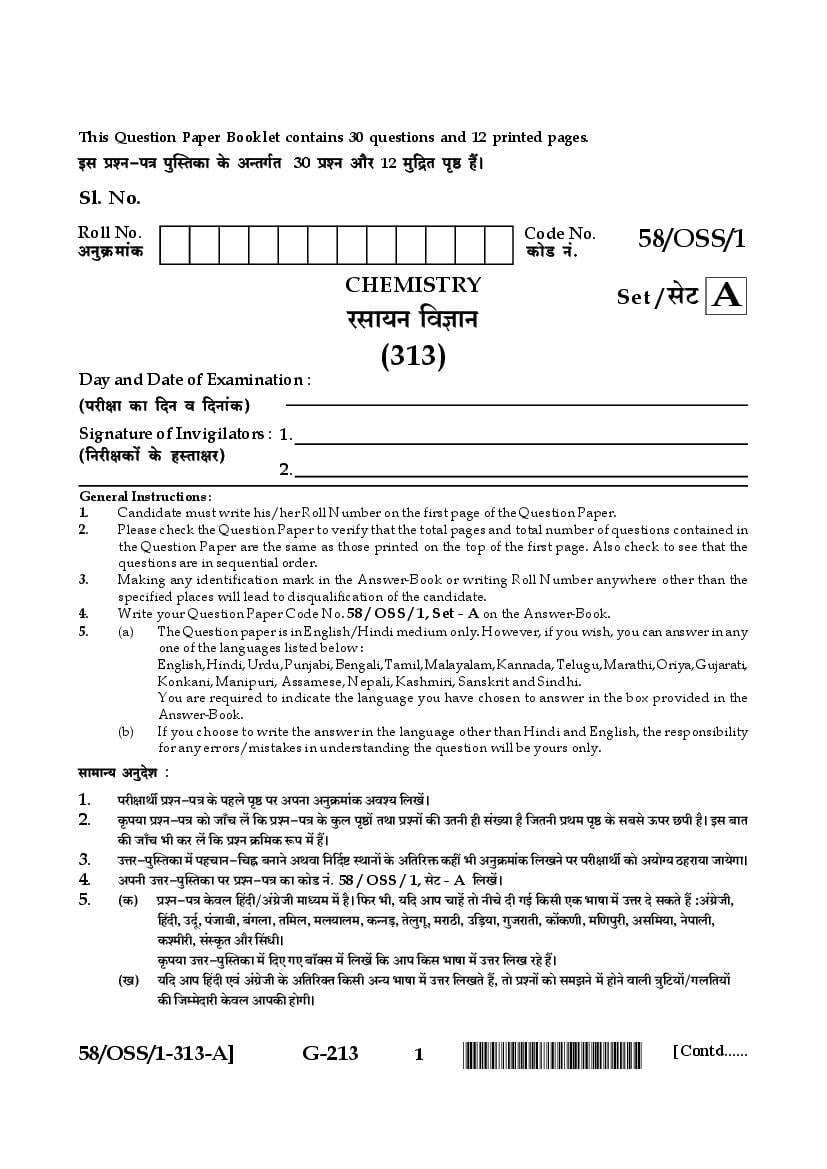
Bg àíZ-nÌ nwpñVH$m Ho $ AÝVJ© V 30 àíZ Am¡ a 12 ‘w{ÐV n¥ð> h¢ &
Sl. No.
Roll No.
AZw H « $ _m§ H $
Code No.
H$mo S > Z§ .
58/OSS/1
CHEMISTRY
Set / go Q > A
agm¶Z {dkmZ
(313)
Day and Date of Examination :
(narjm H$m {XZ d {XZm§ H $)
Signature of Invigilators : 1.
({ZarjH$m| Ho $ hñVmja)
2.
General Instructions :
1. Candidate must write his/her Roll Number on the first page of the Question Paper.
2. Please check the Question Paper to verify that the total pages and total number of questions contained in
the Question Paper are the same as those printed on the top of the first page. Also check to see that the
questions are in sequential order.
3. Making any identification mark in the Answer-Book or writing Roll Number anywhere other than the
specified places will lead to disqualification of the candidate.
4. Write your Question Paper Code No. 58 / OSS / 1, Set - A on the Answer-Book.
5. (a) The Question paper is in English/Hindi medium only. However, if you wish, you can answer in any
one of the languages listed below :
English, Hindi, Urdu, Punjabi, Bengali, Tamil, Malayalam, Kannada, Telugu, Marathi, Oriya, Gujarati,
Konkani, Manipuri, Assamese, Nepali, Kashmiri, Sanskrit and Sindhi.
You are required to indicate the language you have chosen to answer in the box provided in the
Answer-Book.
(b) If you choose to write the answer in the language other than Hindi and English, the responsibility
for any errors/mistakes in understanding the question will be yours only.
gm_mÝ` AZw Xo e :
1. narjmWu àíZ-nÌ Ho$ nhbo n¥ð> na AnZm AZwH«$‘m§H$ Adí¶ {bI|&
2. H¥$n¶m àíZ-nÌ H$mo Om±M b| {H$ àíZ-nÌ Ho$ Hw$b n¥ð>m| VWm àíZm| H$s CVZr hr g§»¶m h¡ {OVZr àW‘ n¥ð> Ho$ g~go D$na N>nr h¡& Bg ~mV
H$s Om±M ^r H$a b| {H$ àíZ H«${‘H$ ê$n ‘| h¢&
3. CÎma-nwpñVH$m ‘| nhMmZ-{M• ~ZmZo AWdm {Z{X©ï> ñWmZm| Ho$ A{V[aº$ H$ht ^r AZwH«$‘m§H$ {bIZo na narjmWu H$mo A¶mo½¶ R>ham¶m Om¶oJm&
4. AnZr CÎma-nwpñVH$m na àíZ-nÌ H$m H$moS> Z§. 58 / OSS / 1, goQ> - A {bI|&
5. (H$) àíZ-nÌ Ho$db qhXr/A§J«oOr ‘mܶ‘ ‘| h¡& {’$a ^r, ¶{X Amn Mmh| Vmo ZrMo Xr JB© {H$gr EH$ ^mfm ‘| CÎma Xo gH$Vo h¢ :A§J«oOr,
qhXr, CXÿ©, n§Om~r, ~§Jbm, V{‘b, ‘b¶mb‘, H$ÝZ‹S>, VobwJy, ‘amR>r, C{‹S>¶m, JwOamVr, H$m|H$Ur, ‘{Unwar, Ag{‘¶m, Zonmbr,
H$í‘rar, g§ñH¥$V Am¡a qgYr&
H¥$n¶m CÎma-nwpñVH$m ‘| {XE JE ~m°³g ‘| {bI| {H$ Amn {H$g ^mfm ‘| CÎma {bI aho h¢&
(I) ¶{X Amn qhXr Ed§ A§J«oOr Ho$ A{V[a³V {H$gr Aݶ ^mfm ‘| CÎma {bIVo h¢, Vmo àíZm| H$mo g‘PZo ‘| hmoZo dmbr Ìw{Q>¶m|/Jb{V¶m|
H$s {Oå‘oXmar Ho$db AmnH$s hmoJr&
58/OSS/1-313-A] G-213 1 [ Contd......
Page 2
agm¶Z {dkmZ
(313)
Time : 3 Hours] [Maximum Marks : 80
g_` : 3 KÊQ>o] [nyUmªH$ : 80
Note : (i) All questions are compulsory.
(ii) Marks allotted are indicated against each question.
(iii) Each question from Question Nos. 1 to 10 has four alternatives - (A), (B), (C) and (D), out of which one
is the most appropriate. Choose the correct answer among the four alternatives and write it in your
Answer-Book against the Number of the question. No extra time is allotted for attempting multiple
choice questions.
(iv) Use log tables, if necessary.
{ZX}e :(i) g^r àíZm| Ho$ CÎma Xr{OE&
(ii) à˶oH$ àíZ Ho$ gm‘Zo CgHo$ A§H$ Xem©¶o JE h¢&
(iii) àíZ g§»¶m 1 go 10 ‘| à˶oH$ àíZ ‘| Mma {dH$ën - (A), (B), (C) VWm (D) h¢, {OZ‘| go EH$ g~go Cn¶w³V h¢& Mmam| {dH$ënm| ‘|
go ghr CÎma MwZ| VWm AnZr CÎma-nwpñVH$m ‘| àíZ g§»¶m Ho$ gm‘Zo CÎma {bI|& ~hþ{dH$ënr àíZm| Ho$ {b¶o A{V[a³V g‘¶ Zht Xr¶m
Om¶oJm&
(iv) ¶{X Amdí¶H$ hmo, Vmo bm°J Q>o~b H$m à¶moJ H$a|&
1. Prefix pico means [1]
(A) 10–12 (B) 10–9
(C) 10–6 (D) 1012
CngJ© nrH$mo H$m AW© h¡…
(A) 10–12 (B) 10–9
(C) 10–6 (D) 1012
2. One mole of P4 molecules contains [1]
(A) 1 molecule (B) 4 molecules
(C) 1.5055×10²² atoms (D) 2.4092×1024 atoms
1 ‘mob P4 AUyAm| ‘| hmoVo h¢-
(A) 1 AUy (B) 4 AUy
(C) 1.5055×10²² na‘mUy (D) 2.4092×1024 na‘mUy
58/OSS/1-313-A] G-213 2 [ Contd......
Page 3
(A) HCl is water soluble due to H-bonding
(B) Glycerol is more soluble in water than in ethanol.
(C) Boiling point of C2H5OH is higher than CH3–O–CH3
(D) p-nitrophenol has higher boiling point than o–nitrophenol
{ZåZ{b{IV ‘| go H$m¡Z hmBS´>moOZ-Am~§YZ H$m n[aUm‘ Zht h¡?
(A) H- Am~§YZ Ho$ H$maU HCl Ob ‘| {dbo¶ h¡&
(B) EWoZm°b H$s Anojm p½bgam°b Ob ‘| A{YH$ {dbo¶ h¡&
(C) C2H5OH H$m ³dWZm§H$ CH3–O–CH3 H$s VwbZm ‘| CƒVa h¡&
(D) o-ZmBQ´>mo’$sZm°b H$s Anojm p-ZmBQ´>mo’$sZm°b H$m ³dWZm§H$ CƒVa hmoVm h¡&
4. Which set of quantum numbers is possible for the last electron of Mg+ ion? [1]
(A) n=1, l=0, ml=0, s=+½ (B) n=2, l=1, ml=0, s=+½
(C) n=3, l=0, ml=0, s=+½ (D) n=3, l=2, ml=0, s=+½
Mg+ Am¶Z ‘| ApÝV‘ Bbo³Q´>m°Z Ho$ {bE ³dm§Q>‘ g§»¶mAm| H$m H$m¡Z-gm goQ> g§^d h¡?
(A) n=1, l=0, ml=0, s=+½ (B) n=2, l=1, ml=0, s=+½
(C) n=3, l=0, ml=0, s=+½ (D) n=3, l=2, ml=0, s=+½
5. Which pair of molecules has the strongest dipole-dipole interactions? [1]
(A) NH3 and CH4 (B) NH3 and NH3
(C) CO2 and CO2 (D) CH4 and CH4
{ZåZ[b{IV AUyAm| Ho$ ¶w½‘ ‘§o go {H$g ‘| à~bV‘ {ÛY«wd-{ÛY«wd Aݶmoݶ {H«$¶mE± hmoVr h¢?
(A) NH3 Am¡a CH4 (B) NH3 Am¡a NH3
(C) CO2 Am¡a CO2 (D) CH4 Am¡a CH4
58/OSS/1-313-A] G-213 3 [ Contd......
Page 4
(A) Cl ions coagulate positively charged blood solution.
–
(B) Cl– ions coagulate negatively charged blood solution.
(C) Fe3+ ions coagulate negatively charged blood solution.
(D) Fe3+ ions coagulate positively charged blood solution.
ê${Ya ~hZm ~ÝX H$aZo Ho$ {bE FeCl3{db¶Z bJm¶m OmVm h¡ ³¶m§o{H$
(A) Cl– Am¶Z YZ Amdo{eV ê${Ya H$m AmV§MZ H$a XoVo h¢&
(B) Cl– Am¶Z F$U Amdo{eV ê${Ya H$m AmV§MZ H$a XoVo h¢&
(C) Fe3+ Am¶Z F$U Amdo{eV ê${Ya H$m AmV§MZ H$a XoVo h¢&
(D) Fe3+ Am¶Z YZ Amdo{eV ê${Ya H$m AmV§MZ H$a XoVo h¢&
7. Solubility of Ag2CrO4 is decreased in presence of [1]
(A) AgNO3 (B) AgCl
(C) BaCrO4 (D) PbCrO4
{ZåZ{b{IV ‘| go {H$gH$s CnpñW{V ‘§o Ag2CrO4 H$s {dbo¶Vm KQ> OmVr h¡?
(A) AgNO3 (B) AgCl
(C) BaCrO4 (D) PbCrO4
8. Basic buffer solution can be obtained by mixing aqueous solutions of [1]
(A) CH3COONa and CH3COOH (B) NaOH and NaCl
(C) NH4OH and NH4Cl (D) CH3COONa and excess HCl
jmar¶ ~’$a {db¶Z {H$gHo$ Obr¶ {db¶Zm| H$mo {‘{lV H$aHo$ ~Vm¶m Om gH$Vm h¡?
(A) CH3COONa Am¡a CH3COOH (B) NaOH Am¡a NaCl
(C) NH4OH Am¡a NH4Cl (D) CH3COONa Am¡a A{YH$ HCl
9. A colourless solid 'X' on heating evolved CO2 and also gave a white residue 'Y',
Which is soluble in water. 'Y' also gave CO2 when treated with dil. H2SO4. 'X' is
[1]
(A) Na2CO3 (B) NaHCO3
(C) CaCO3 (D) Ca (HCO3)2
EH$ a§JhrZ R>mog 'X' J‘© {H$E OmZo na CO2 Am¡a EH$ g’o$X nXmW© 'Y' Omo nmZr ‘§o {dbo¶ h¡, XoVm h¡& 'Y' H$mo
O~ VZw H2SO4 go CnMm[aV {H$¶m J¶m V~ ^r CgZo CO2 {X¶m& 'X' h¡ -
(A) Na2CO3 (B) NaHCO3
(C) CaCO3 (D) Ca (HCO3)2
58/OSS/1-313-A] G-213 4 [ Contd......
Page 5
(A) Na2CO3 (B) CaCO3
(C) Li2CO3 (D) BaCO3
J‘© H$aZo na g~go AmgmZr go {dK{Q>V hmoZo dmbm H$m~m}ZoQ> h¡-
(A) Na2CO3 (B) CaCO3
(C) Li2CO3 (D) BaCO3
11. The following data were obtained when nitrogen and oxygen react together to form
different compounds:
Mass of nitrogen Mass of oxygen
(I) 14g 16g
(II) 14g 32g
Which law of chemical combination is obeyed by the above experimental data?
Define this law. [2]
O~ ZmBQ´>moOZ Am¡a Am°³grOZ nañna A{^{H«$¶m H$aHo$ Xmo {^Þ ¶m¡{JH$ ~ZmVo h¢ Vmo {ZåZ{b{IV Am±H$µS>o àmá
hþE…
ZmBQ´>moOZ H$m Ð춑mZ Am°³grOZ H$m Ð춑mZ
(I) 14g 16g
(II) 14g 32g
Cn¶w©º$ àm¶mo{JH$ Am±H$µS>o amgm¶{ZH$ g§¶moOZ Ho$ {H$g {Z¶‘ H$m nmbZ H$aVo h¢? Bg {Z¶‘ H$mo n[a^m{fV
H$s{OE&
12. An infrared radiation has a frequency of 5×10¹⁴ Hz. Calculate energy of one mole
of photons corresponding to this radiation.
[h = 6.626×10⁻³⁴ Js ; NA = 6.022×10²³ mol–1] [2]
{H$gr Adaº$ {d{H$aU H$s Amd¥{Îm 5×10¹⁴ Hz h¡& Bg {d{H$aU go g§JV EH$ ‘mob ’$moQ>moZm| H$s D$Om©
n[aH${bV H$s{OE&
[h = 6.626×10⁻³⁴ Js ; NA = 6.022×10²³ mol–1]
13. Define the following : [2]
i) Graham's law of diffusion
ii) Critical temperature of a gas
{ZåZ{b{IV H$mo n[a^m{fV H$s{OE …
i) J«mh‘ H$m {dgaU {Z¶‘
ii) J¡g H$m H«$m§{VH$ Vmn
58/OSS/1-313-A] G-213 5 [ Contd......
Page 6
i) Enthalphy of neutralisation
ii) Enthalpy of atomisation
{ZåZ{b{IV H$s n[a^mfm {b{IE …
i) CXmgrZrH$aU EÝW¡ënr
ii) AUy {d¶mo{OV (EQ>mo‘mB©OoeZ) EÝW¡ënr
15. Write the reactions which occur when ozone reacts with (i) acidified ferrous sulphate
and (ii) Stannous chloride in presence of hydrochloric acid. [2]
O~ AmoOmoZ i) AåbrH¥$V ’o$ag gë’o$Q> Am¡a ii) HCl H$s CnpñW{V ‘| ñQ>oZg ³bmoamBS> go A{^{H«$¶m H$aVr h¡
Vmo hmoZo dmbr A{^{H«$¶mAm| H$mo {b{IE&
16. (i) Write IUPAC name of the following compound: [2]
CH3–N–CH2–CH3
CH3
(ii) Write the product formed when 1, 3– dinitrobenzene is treated with tin and
hydrochloric acid.
(i) {ZåZ{b{IV ¶m¡{JH$ H$m AmB©.¶y.nr.E.gr. Zm‘ {b{IE …
CH3–N–CH2–CH3
CH3
(ii) O~ 1, 3 - S>mBZmBQ´>mo~oÝOrZ H$mo {Q>Z Am¡a hmBS´>mo³bmo[aH$ Aåb Ho$ gmW A{^{H«$¶m H$s OmVr h¡ Vmo àmá
CËnmX H$mo {b{IE&
17. Give simple chemical test to distinguish between : [2]
i) ethene and ethyne
ii) Chloroethane and chlorobenzene
{ZåZ{b{IV ‘| {d^oX H$aZo Ho$ {bE gab amgm¶{ZH$ n[ajU {b{IE …
i) EWrZ Am¡a EWmBZ
ii) ³bmoamoEWoZ Am¡a ³bmoamo~oÝOrZ
58/OSS/1-313-A] G-213 6 [ Contd......
Page 7
gm~wZrH$aU ³¶m h¡? ¶h {H$g àH$ma [H$¶m OmVm h¡? g§~Õ amgm¶{ZH$ g‘rH$aU {b{IE&
19. Identify the monomers in the following polymeric structure : [2]
{ZåZ{b{IV ~hþbH$ g§aMZm ‘| EH$bH$m| H$s nhMmZ H$s{OE …
20. a) Why is the vapour pressure of a solution containing a non-volatile solute
always less than that of the pure solvent?
b) Calculate the boiling point of a solution containing 0.456 g of camphor (molar
mass = 152 g mol–1) dissolved in 31.4 g of acetone. [Given : Boiling point of
pure acetone = 392.3K, Kb of acetone = 1.72 K kg mol–1] [4]
a) Admînerb {dbo¶ dmbo {db¶Z H$m dmîn Xm~, ewÕ {dbm¶H$ Ho$ dmîn Xm~ go gX¡d H$‘ ³¶m| hmoVm h¡?
b) 31.4 g EgrQ>moZ ‘| 0.456 g H$nya (‘mobma Ð춑mZ = 152 g mol–1) ImobZo na àmá {db¶Z H$m
³dWZm§H$ n[aH${bV H$s{OE& ({X¶m h¡ … ewÕ EgrQ>moZ H$m ³dWZm§H$ = 392.3K, EgrQ>moZ Ho$ {bE
Kb = 1.72 K kg mol–1)
21. a) Under what condition enthalpy change is equal to the internal energy change?
b) Calculate the enthalpy of formation of benzene at 25ºC, if the enthalpy of
combustion of benzene, carbon and hydrogen at 25ºC is -3276.0, –394.8 and
–286.86 kJ respectively at 25ºC. [4]
a) {H$g AdñWm ‘| EÝW¡ënr n[adV©Z, Am§V[aH$ D$Om© n[adV©Z Ho$ ~am~a hmoVm h¡? ì¶m»¶m H$s{OE&
b) ¶{X 25ºC na ~§oOrZ, H$m~©Z Am¡a hmBS´>moOZ H$s XhZ EÝW¡ënr H«$‘e… –3276.0, –394.8 Am¡a
–286.86 kJ h¡ Vmo 25ºC na ~oݵOrZ H$s g§^dZ EÝW¡ënr n[aH${bV H$s{OE&
58/OSS/1-313-A] G-213 7 [ Contd......
Page 8
t/s 0 300 600
[N2O5]/mol L–1 1.6×10⁻² 0.8×10⁻² 0.4×10⁻²
a) Show that it follows first order reaction.
b) Calculate half-life of the reaction.
[Given : log 2 = 0.3010, log 3 = 0.4771, log 4 = 0.6021]
{ZåZ A[^{H«$¶m Ho$ {bE {XE JE Am±H$µS>o àmá hþE … N2O52NO2 + ½O2
t/s 0 300 600
[N2O5]/mol L–1 1.6×10⁻² 0.8×10⁻² 0.4×10⁻²
a) Xem©BE {H$ ¶h A{^{H«$¶m àW‘ H$mo{Q> H$s h¡&
b) A{^{H«$¶m H$s AY©-Am¶w n[aH${bV H$s{OE&
[{X¶m h¡ : log 2 = 0.3010, log 3 = 0.4771, log 4 = 0.6021]
23. a) Mention two reasons for the fact that the top element in each group of
p-block exhibits unique behaviour.
b) Draw structures of the following :
i) HOClO3 ii) XeOF4 [4]
a) Bg H$WZ Ho$ Xmo H$maUm| H$m C„oI H$s{OE {H$ p-ãbm°H$ Ho$ à˶oH$ dJ© Ho$ àW‘ (D$na Ho$) VËd
A{ÛVr¶ ì¶dhma àX{e©V H$aVo h¢&
b) {ZåZ{b{IV H$r g§aMZmE± Amao{IV H$s{OE …
i) HOClO3 ii) XeOF4
58/OSS/1-313-A] G-213 8 [ Contd......
Page 9
a) Fe2+ ion is bound with six cyanide ions
b) Ni2+ ion is bound with four cyanide ions.
Write the IUPAC name, type of hybridisation and magnetic behaviour of the above
coordination entities.
[Atomic No. : Fe = 26, Ni = 28] [4]
{ZåZ{b{IV Cnghg§¶moOH$ gÎmmAm| Ho$ gwÌ {b{IE…
a) Fe2+ Am¶Z N>… gm¶ZmBS> Am¶Zm| go g§b¾ h¡&
b) Ni2+ Am¶Z Mma gm¶ZmBS> Am¶Zm| go g§b¾ h¡&
Cn¶©wº$ Cnghg§¶moOH$ gÎmmAm| Ho$ AmB©.¶w.nr.E.gr. Zm‘, g§H$aU H$m àH$ma Am¡a Mwå~H$s¶ ì¶dhma {b{IE&
[na‘mUw g§»¶m … Fe = 26, Ni = 28]
25. a) What are free radicals? How are they formed?
b) Explain the following with example :
i) Nucleophilic substitution reaction
ii) Functional isomerism
[4]
a) ‘w³V ‘ybH$ ³¶m h¡? ¶o {H$g àH$ma ~ZVo h¢?
b) {ZåZ{b{IV H$mo CXmhaU XoVo hþE g‘PmBE …
i) Zm{‘H$ñZohr à{VñWmnZ A{^{H«$¶mE±
ii) A{^bjH$s¶ g‘yh g‘md¶dVm
58/OSS/1-313-A] G-213 9 [ Contd......
Page 10
reactions : [4]
{ZåZ{b{IV A{^{H«$¶m loUrH«$‘ ‘|A, B, C Am¡a D Ho$ Zm‘ VWm g§aMZmE± {b{IE …
27. a) How are bonding and antibonding molecular orbitals formed from a given
pair of atomic orbitals? Compare these molecular orbitals with each other in
terms of their energy.
b) Explain the following on the basis of valence bond theory
i) BCl3 is planar but NH3 is pyramidal.
ii) Both CCl4 and SiCl4 are tetrahedral. [6]
a) na‘mUw H$jH$mo| Ho$ EH$ ¶w½‘ go Am~§YZ H$jH$ Am¡a à{VAm~§YZ H$jH$m| H$m {Z‘m©U H¡$go hmoVm h¡? BZ
AmpÊdH$ H$jH$m| H$mo CZH$s D$Om© Ho$ AmYma na VwbZm H$s{OE&
b) g§¶moOH$Vm Am~§Y [gÕmÝV Ho$ AmYma na {ZåZ{b{IV H$s ì¶m»¶m H$s{OE …
i) BCl3 g‘Vbr¶ hmoVm h¡ O~ H$s NH3 {na¡{‘S>r&
ii) CCl4 Am¡a SiCl4 XmoZm| hr MVwî’$bH$s¶ hmoVo h¢&
58/OSS/1-313-A] G-213 10 [ Contd......
Page 11
cell : Fe (s) /Fe 2+ (0.001M) H + (1M)/H 2(g) (1bar)/Pt (s)
[Given : Eº Fe2+/Fe = –0.44 V]
b) Which cell was used as a power source in Apollo space program? Write the
chemical reactions taking place during anodic and cathodic processes. Mention
two advantages of such cells. [6]
a) {ZåZ{b{IV gob Ho$ {bE gob A{^{H«$¶m, ZñQ>© g‘rH$aU Am¡a emf n[aH${bV H$s{OE …
Fe (s) /Fe 2+ (0.001M) H + (1M)/H 2(g) (1bar)/Pt (s)
[[X¶m h¡ … Eº Fe2+/Fe = –0.44 V]
b) Anmobmo AmH$mg H$m¶©H«$‘ ‘| H$m¡Z-gm gob à¶y³V hþAm Wm? Bg‘| EZmo{S>H$ Am¡a H¡$Wmo{S>H$ àH«$‘m| ‘| hmoZo
dmbr amgm¶{ZH$ A{^{H«$¶mE± {b{IE& Bg àH$ma Ho$ gobm| Ho$ Xmo bm^m| H$m C„oI H$s{OE&
29. a) State the reasons of the following.
i) MnO is basic while Mn2O7 is acidic.
ii) Transition metals show high melting and boiling points.
iii) Zn, Cd and Hg are not regarded as transition metals.
iv) Transition elements show variable oxidation states.
b) An orange coloured compound 'A' of chromium when heated with NaCl in
presence of conc. H2SO4 gives red vapours of compound 'B'. Identify the
compounds 'A' and 'B' and write chemical equations involved. [6]
a) {ZåZ{b{IV Ho$ {bE H$maU Xr{OE …
i) MnO jmar¶ h¡ O~ {H$ Mn2O7 Aåbr¶&
ii) g§H«$‘U YmVwE± Cƒ JbZm§H$ Ed§ ³dWZm§H$ Xem©Vo h¢&
iii) Zn, Cd Am¡a Hg g§H«$‘U VËd Zht ‘mZo OmVo h¢&
iv) g§H«$‘U VËd n[adV©Zr¶ Am³grH$aU AdñWmE± Xem©Vo h¢&
b) H«$mo{‘¶‘ Ho$ EH$ Zma§Jr a§J Ho$ ¶m¡{JH$ "A' H$mo O~ gmÝÐ H2SO4 H$s CnpñWVr ‘| NaCl Ho$ gmW J‘©
{H$¶m OmVm h¡ Vmo bmb dmîn dmbm ¶m¡{JH$ "B' ~ZVm h¡& ¶m¡{JH$ "A' Am¡a "B' H$s nhMmZ H$s{OE Am¡a
g§~Õ amgm¶{ZH$ g‘rH$aU| {b{IE&
58/OSS/1-313-A] G-213 11 [ Contd......
Page 12
i) Phenol gives 2, 4, 6 - tribromophenol on bromination with bromine water.
ii) Ethers are polar in nature.
iii) Methanal does not undergo aldol condensation.
iv) Chloroethanoic acid is stronger acid than ethanoic acid.
b) With the help of suitable example explain Hell–Volhard Zelinsky reaction.
a) {ZåZ{b{IV Ho$ {bE H$maU Xr{OE …
i) ~«mo‘rZ Ho$ Obr¶ {db¶Z Ho$ gmW ’$sZm°b A{^{H«$¶m H$aHo$ 2, 4, 6 - Q´>mB~«mo‘mo’$sZm°b XoVm h¡&
ii) B©Wa H$s àH¥${V Y«wdr¶ hmoVr h¡&
iii) ‘oWoZ¡b EëS>m°b g§KZZ Zhr§ XoVm&
iv) EWoZm°Bb Aåb H$s VwbZm ‘| ³bmoamoEWoZm°BH$ Aåb à~bVa hmoVm h¡&
b) C{MV CXmhaU H$s ghm¶Vm go hob-’$mobmS>© OoqbñH$s A{^{H«$¶m H$s ì¶m»¶m H$s{OE&
58/OSS/1-313-A] G-213 12 [ Contd......
Document Details
| Board / Org | NIOS |
| Exam | National Institute of Open Schooling Class 12 |
| Type | Question Paper |
| Pages | 12 |
| Updated | 30 Apr 2026 |