NIOS Class 12 Question Paper Apr 2019 - Economics
Finished viewing? Save it for later —
Download NIOS Class 12 Question Paper Apr 2019 - Economics (PDF · 8 pages)About NIOS Class 12 Question Paper Apr 2019 - Economics
NIOS Class 12 Question Paper Apr 2019 - Economics is available here for free download. Published by NIOS for National Institute of Open Schooling Class 12, this question paper can be viewed online or downloaded as a PDF (8 pages). Candidates preparing for National Institute of Open Schooling Class 12 can use NIOS Class 12 Question Paper Apr 2019 - Economics to understand the exam pattern, the type of questions asked, and the overall difficulty level.
Frequently Asked Questions
How can I download NIOS Class 12 Question Paper Apr 2019 - Economics?
Open this page and click the Download button to save NIOS Class 12 Question Paper Apr 2019 - Economics as a PDF. It is completely free on AglaSem Docs.
Is NIOS Class 12 Question Paper Apr 2019 - Economics free to download?
Yes. NIOS Class 12 Question Paper Apr 2019 - Economics can be viewed online and downloaded as a PDF free of cost on AglaSem Docs.
How many pages does NIOS Class 12 Question Paper Apr 2019 - Economics have?
NIOS Class 12 Question Paper Apr 2019 - Economics contains 8 pages, which you can read online or download together as a single PDF.
Where can I find more National Institute of Open Schooling Class 12 study material?
You can find more National Institute of Open Schooling Class 12 question papers, sample papers, syllabus, and answer keys on AglaSem Docs.
NIOS Class 12 Question Paper Apr 2019 - Economics – Text
Read the full text of this question paper below — useful to quickly search, copy and reference the content online without downloading the PDF.
📄 View text version (8 pages)
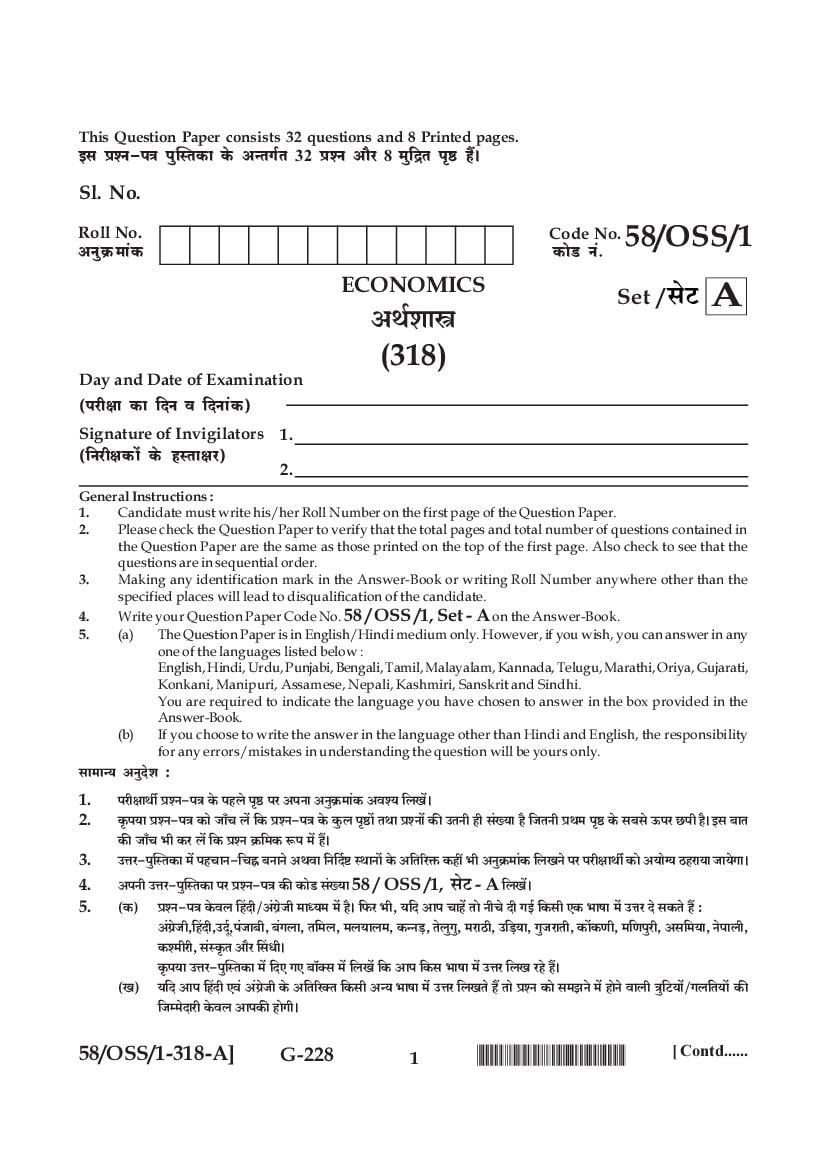
Page 1
Bg àíZ-nÌ nwpñVH$m Ho$ AÝVJ©V 32 àíZ Am¡a 8 w{ÐV n¥ð> h¢&
Sl. No.
Roll No.
AZw H « $ _m§ H $
Code No.
H$moS> Z§.
58/OSS/1
ECONOMICS
Set / go Q > A
AW©emó
(318)
Day and Date of Examination
(narjm H$m {XZ d {XZm§ H $)
Signature of Invigilators 1.
({ZarjH$m| Ho $ hñVmja)
2.
General Instructions :
1. Candidate must write his/her Roll Number on the first page of the Question Paper.
2. Please check the Question Paper to verify that the total pages and total number of questions contained in
the Question Paper are the same as those printed on the top of the first page. Also check to see that the
questions are in sequential order.
3. Making any identification mark in the Answer-Book or writing Roll Number anywhere other than the
specified places will lead to disqualification of the candidate.
4. Write your Question Paper Code No. 58 / OSS /1, Set - A on the Answer-Book.
5. (a) The Question Paper is in English/Hindi medium only. However, if you wish, you can answer in any
one of the languages listed below :
English, Hindi, Urdu, Punjabi, Bengali, Tamil, Malayalam, Kannada, Telugu, Marathi, Oriya, Gujarati,
Konkani, Manipuri, Assamese, Nepali, Kashmiri, Sanskrit and Sindhi.
You are required to indicate the language you have chosen to answer in the box provided in the
Answer-Book.
(b) If you choose to write the answer in the language other than Hindi and English, the responsibility
for any errors/mistakes in understanding the question will be yours only.
gm_mÝ` AZwXoe :
1. narjmWu àíZ-nÌ Ho$ nhbo n¥ð> na AnZm AZwH«$m§H$ Adí¶ {bI|&
2. H¥$n¶m àíZ-nÌ H$mo Om±M b| {H$ àíZ-nÌ Ho$ Hw$b n¥ð>m| VWm àíZm| H$s CVZr hr g§»¶m h¡ {OVZr àW n¥ð> Ho$ g~go D$na N>nr h¡& Bg ~mV
H$s Om±M ^r H$a b| {H$ àíZ H«${H$ ê$n | h¢&
3. CÎma-nwpñVH$m | nhMmZ-{M ~ZmZo AWdm {Z{X©ï> ñWmZm| Ho$ A{V[aº$ H$ht ^r AZwH«$m§H$ {bIZo na narjmWu H$mo A¶mo½¶ R>ham¶m Om¶oJm&
4. AnZr CÎma-nwpñVH$m na àíZ-nÌ H$s H$moS> g§»¶m 58 / OSS /1, goQ> - A {bI|&
5. (H$) àíZ-nÌ Ho$db qhXr/A§J«oOr mܶ | h¡& {$a ^r, ¶{X Amn Mmh| Vmo ZrMo Xr JB© {H$gr EH$ ^mfm | CÎma Xo gH$Vo h¢ :
A§J«oOr,qhXr,CX©ÿ,n§Om~r, ~§Jbm, V{b, b¶mb, H$ÝZS>, VobwJw, amR>r, C{S>¶m, JwOamVr, H$m|H$Ur, {Unwar, Ag{¶m, Zonmbr,
H$írar, g§ñH¥$V Am¡a qgYr&
H¥$n¶m CÎma-nwpñVH$m | {XE JE ~m°³g | {bI| {H$ Amn {H$g ^mfm | CÎma {bI aho h¢&
(I) ¶{X Amn qhXr Ed§ A§J«oOr Ho$ A{V[a³V {H$gr Aݶ ^mfm | CÎma {bIVo h¢ Vmo àíZ H$mo gPZo | hmoZo dmbr Ìw{Q>¶m|/Jb{V¶m| H$s
{OåoXmar Ho$db AmnH$s hmoJr&
58/OSS/1-318-A] G-228 1 *58/OSS/1-318-A* [ Contd......
Page 2
AW©emó
(318)
Time : 3 Hours] [Maximum Marks : 100
g_` : 3 KÊQ>o] [nyUmªH$ : 100
Note : i) All questions are compulsory.
ii) Marks allotted to each question are indicated against it.
iii) Each question from Question Nos. 1 to 10 has four alternatives - (A), (B), (C) and
(D), out of which one is most appropriate. Choose the correct answer among the
four alternatives and write it in your answer-book against the number of the ques-
tion. No extra time is allotted for attempting multiple choice questions.
{ZX}e: i) g^r àíZm| Ho$ CÎma Xr{OE &
ii) à˶oH$ àíZ Ho$ gmZo CgHo$ A§H$ {bIo JE h¢ &
iii) àíZ g§»¶m 1 go 10 VH$ Ho$ à˶oH$ àíZ | Mma {dH$ën-(A), (B), (C) VWm (D) h¢, {OZ| go EH$ g~go Cn¶wº$ h¡ & Mmam|
{dH$ënm| | go ghr CÎma MwZ| VWm AnZr CÎma-nwpñVH$m | àíZ g§»¶m Ho$ gmZo CÎma {bI| & ~hþ-{dH$ënr àíZm| Ho$ {bE A{V[aº$
g¶ Zht {X¶m OmEJm &
1. The measure of Central tendency around which maximum concentration of items
occurs is: [1]
(A) Mean (B) Median
(C) Mode (D) Quartile
Ho$ÝÐr¶ àd¥{V H$m dh mn {OgH$s g~go A{YH$ Amd¥{V hmoVr h¡, ¶h h¡ :
(A) mܶ (B) mpܶH$m
(C) ~hþbH$ (D) MVwW©H$
2. The general relationship between price and demand is referred to as the following
type of correlation : [1]
(A) Positive (B) Negative
(C) Linear (D) Perfect
H$sV Am¡a m±J Ho$ ~rM gh g§~§Y {ZåZ{b{IV àH$ma H$m ghg§~§Y H$hbmVm h¡ :
(A) YZmËH$ (B) F$UmËH$
(C) a¡{IH$ (D) nyU©
58/OSS/1-318-A] G-228 2 *58/OSS/1-318-A* [ Contd......
Page 3
(A) What is?
(B) What should be?
(C) What has happened in the past?
(D) What is likely to happen in future
AmXe© AW©emó BgH$m Aܶ¶Z H$aVm h¡?
(A) ³¶m h¡?
(B) ³¶m hmoZm Mm{hE?
(C) AVrV §o ³¶m hþAm Wm?
(D) ^{dî¶ | ³¶m hmoZo H$s g§^mdZm h¡?
4. Total utility of one unit a good is 5 utils and that of 3 units is 10 utils. What is
marginal utility of 3 units? [1]
(A) 2.5 (B) 5
(C) 7.5 (D) 10
EH$ dñVw H$s EH$ BH$mB© H$s Hw$b Cn¶mo{JVm 5 ¶w{Q>b h¡ Am¡a 3 BH$mB© H$s 10 ¶w{Q>b h¡ & 3 BH$mB© H$s grm±V
Cn¶mo{JVm ³¶m h¡?
(A) 2.5 (B) 5
(C) 7.5 (D) 10
5. Shortrun production function shows the changes in total output when: [1]
(A) Only one input is increased (B) Only two inputs are increased
(C) Only few inputs are increased (D) All inputs are increased
AënH$mbrZ CËnmXZ $bZ Hw$b CËnmXZ | n[adV©Z {XImVr h¡ O~ :
(A) Ho$db EH$ AmJV | d¥[Õ H$s OmE (B) Ho$db Xmo AmJVm| | d¥[Õ H$s OmE &
(C) Ho$db Hw$N> AmJVm| | d¥[Õ H$s OmE & (D) g^r AmJVm| | d¥[Õ H$s Om¶ &
58/OSS/1-318-A] G-228 3 *58/OSS/1-318-A* [ Contd......
Page 4
(A) Number of firms
(B) Differences in products produced by different firms
(C) Freedom of entry and exit to firms
(D) All the above
ì¶pîQ> AW©emó §o ~mOmam| H$mo Bg AmYma na d¥JrH¥$V {H$¶m OmVm h¡ :
(A) $m|© H$s g§»¶m
(B) {d{^Þ $m] Ûmam CËnm{XV CËnmXm| §o {d{^ÞVm
(C) $m] H$mo àdoe VWm ~{hJ©Z H$s ñdV§ÌVm
(D) Cnamoº$ g^r
7. The basic economic activity is: [1]
(A) Production (B) Consumption
(C) Capital formation (D) All the above
AmYma^yV Am{W©H$ à{H«$¶m ¶h h¡ :
(A) CËnmXZ (B) Cn^moJ
(C) ny±Or {Zm©U (D) Cnamoº$ g^r
8. GNPMP equals: [1]
(A) National income
(B) NNPFc + depreciation
(C) National income + depreciation + net Indirect Tax
(D) NNPFc + net indirect Tax
~mOma yë¶ na gH$b amîQ´>r¶ CËnmX BgHo$ gmZ h¡ :
(A) amîQ´>r¶ Am¶
(B) gmYZ bmJV na {Zdb amîQ´>r¶ CËnmX + yë¶õmg
(C) amîQ´>r¶ Am¶ + yë¶õmg + {Zdb Aà˶j H$a
(D) gmYZ yë¶ na {Zdb amîQ´>r¶ CËnmX + {Zdb Aà˶j H$a
58/OSS/1-318-A] G-228 4 *58/OSS/1-318-A* [ Contd......
Page 5
(A) Saving (B) Investment
(C) Income (D) None of the above
Cn^moJ Bg na {Z^©a H$aVm h¡ :
(A) ~MV (B) {Zdoe
(C) Am¶ (D) Cnamoº$ | go H$moB© Zht
10. Which of the following is primary function of money. [1]
(A) Store of value (B) Measure of value
(C) Transfer of value (D) Standard of deferred payment
{ZåZ{b{IV | go H$m¡Z gm wÐm H$m àmW{H$ H$m¶© h¡?
(A) yë¶ H$m g§J«h (B) yë¶ H$m mnH$
(C) yë¶ H$m ñWmZm§VaU (D) ñW{JV ^wJVmZ H$m mZH$
11. Index numbers are economic barometers. Explain how? [3]
gyMH$m±H$ Am[W©H$ dm¶wmnH$¶§Ì hmoVo h¡? gPmBE H¡$go?
12. Explain the meaning of correlation. [3]
ghg§~§Y H$m AW© gPmBE &
13. Giving an example explain how economic problem arises in an economy due to
'unlimited wants'. [3]
CXmhaU XoH$a gPmBE {H$ "Agr{V m±Jmo' Ho$ H$maU Am{W©H$ gñ¶m H¡$go n¡Xm hmoVr h¡ &
14. Define production possibilities curve. State its two properties. [3]
CËnmXZ g§^mdZm dH«$ H$s n[a^mfm Xr{OE & BgH$s Xmo {deofVmE± ~VmBE &
15. Explain how demand for a given good is affected by change in prices of substitute
goods. [3]
gPmBE {H$ {H$gr dñVw H$s m±J CgH$s ñWmZmnÞ dñVwAm| H$s H$sVm| | n[adV©Z go H¡$go à^m{dV hmoVr h¡ &
58/OSS/1-318-A] G-228 5 *58/OSS/1-318-A* [ Contd......
Page 6
{XImBE H¡$go {H$gr CËnmX H$m Am¡gV AmJ CgH$s H$sV ^r hmoVm h¡ &
17. An individual firm under perfect competition is price taker. Explain how [3]
nyU© à{V¶mo{JVm | EH$ AHo$br $© H$sV ñdrH$maH$ hmoVr h¡ & gPmBE H¡$go &
18. Distinguish between closed economy and open economy. [3]
~§X AW©ì¶dñWm Am¡a Iwbr AW©ì¶dñWm | ^oX H$s{OE &
19. Name three instruments of fiscal policy. [3]
amOH$mofr¶ Zr{V Ho$ VrZ CnH$aU ~VmBE &
20. Explain store of value function of money [3]
wÐm H$m yë¶ g§J«h H$m¶© gPmBE &
21. A consumer buys 20 units of a good at a price of Rs.5 per unit. The price elasticity
is () 2. When price changes he buys 28 units. Calculate the new price. [4]
5 ê$. à{V BH$mB© na EH$ Cn^moº$m EH$ dñVw H$s 20 BH$mB¶m± IarXVm h¡ & H$sV bmoM () 2 h¡ & O~ H$sV
~XbVr h¡ Vmo dh 28 BH$mB© IarXVm h¡ & Z¶r H$sV H$m n[aH$bZ H$s{OE &
22. A producer supplies 100 units of a good at a price of Rs.10 per unit. The price
elasticity of supply is 1. How many units will he be willing to sell when price falls by
one rupee per unit. Calculate. [4]
EH$ CËnmXH$ 10 ê$. à{V BH$mB© na EH$ dñVw H$s 100 BH$mB© ~oMVm h¡ & ny{V© H$s {H$V bmoM 1 h¡ & ¶{X H$sV
1 é. {Ja Om¶ dh {H$VZr BH$mB© ~oMZo H$mo V¡¶ma hmoJm & n[aH$bZ H$s{OE &
23. Distinguish between explicit cost and implicit cost. Give an example of each. [4]
ñnîQ> bmJV Am¡a A§V{Z©{hV bmJV | A§Va ~VmBE & à˶oH$ H$m EH$ EH$ CXmhaU Xr{OE &
58/OSS/1-318-A] G-228 6 *58/OSS/1-318-A* [ Contd......
Page 7
(Rs. crore)
i) National Income 550
ii) Depreciation 30
iii) Indirect Tax 60
iv) Subsidy 10
v) Net current transfers to abroad () 5
gH$b amîQ´>r¶ à¶moÁ¶ Am¶ H$m n[aH$bZ H$s{OE :
(H$amoS> ê$.)
i) amîQ´>r¶ Am¶ 550
ii) yë¶õmg 30
iii) Aà˶j H$a 60
iv) Am[W©H$ ghm¶Vm 10
v) {dXoem| H$mo {Zdb Mmby hñVm§VaU () 5
25. Explain 'banker to the government' function of central bank. [4]
Ho$ÝÐr¶ ~¢H$ H$m "gaH$ma H$m ~¢H$a' H$m¶© gPmBE &
26. Distinguish between revenue expenditure and capital expenditure of government.
Give an example of each. [4]
gaH$ma Ho$ amOñd 춶 Am¡a ny±OrJV 춶 | A§Va H$s{OE & à˶oH$ H$m EH$ EH$ CXmhaU Xr{OE &
27. Calculate first quartile of daily wages of 11 workers. [6]
Wages (Rs)
300, 270, 210, 250, 225, 230, 245, 255, 275, 280, 290
11 l{H$m| H$s X¡{ZH$ OXÿar H$m àW MVwW©H$ H$m n[aH$bZ H$s{OE &
OXÿar (ê$.)
300, 270, 210, 250, 225, 230, 245, 255, 275, 280, 290
28. State 3 positional averages. Also state any three properties of arithmetic average.[6]
3 pñW{V g§~§Yr Am¡gV ~VmBE & A§H$J{UVr¶ mܶ H$s VrZ {deofVmE± ^r ~VmBE &
58/OSS/1-318-A] G-228 7 *58/OSS/1-318-A* [ Contd......
Page 8
{XImBE {H$ Xmo AZ{YmZ dH«$ EH$ Xÿgao H$mo Zht H$mQ> gH$Vo & aoIm{MÌ H$m à¶moJ H$s{OE &
For blind candidates only in lieu of Q No. 29
Ho$db ÑpîQ>hrZ narjm{W©¶mo Ho$ {bE àíZ g§»¶m 29 Ho$ ñWmZ na
Explain why an indifference curve is (a) downward slopping and (b) convex.
gPmBE {H$ EH$ AZ{YmZ dH«$ (a) ZrMo H$s Amoa T>bdm° Am¡a (b) CÞVmoXa ³¶m§o hmoVm h¡ &
30. Define supply. Explain how 'prices of other goods' is a determinant of supply of
a good. Give example. [6]
ny{V© H$s n[a^mfm Xr{OE & gPmBE {H$ Aݶ dñVwAm| H$s H$sVo {H$gr dñVw H$s ny{V© H$m {ZYm©aH$ H¡$go h¢ &
31. Calculate GNPmp: (Rs. crore) [6]
i) Net factor income from abroad 5
ii) Compensation of employees 350
iii) Employers contribution to social security 30
iv) Rent 200
v) Net indirect Tax 60
vi) Interest 150
vii) Dividends 20
viii) Corporate Tax 100
ix) Depreciation 35
x) Undistributed profits 5
xi) Subsidy 10
GNPmp H$m n[aH$bZ H$s{OE : (H$amoS> ê$.)
i) {dXoemo go {Zdb H$maH$ Am¶ 5
ii) H$©Mm[a¶m| H$m nm[al{H$ 350
iii) {Z¶moOH$m| H$m gmm{OH$ gwajm §o ¶moJXmZ 30
iv) {H$am¶m 200
v) {Zdb Aà˶j H$a 60
vi) ã¶mO 150
vii) bm^m§e 20
viii) {ZJ H$a 100
ix) yë¶õmg 35
x) A{dV[aV bm^ 5
xi) Am[W©H$ ghm¶Vm 10
32. Given that MPC = 0.80 and investment increases by Rs. 200 crore,
calculate (a) value of multiplier and (b) increase in income. [6]
¶{X MPC = 0.80 h¡ Am¡a {Zdoe 200 H$amoS> ê$. ~T> OmVm h¡ Vmo, (H$) JwUH$ H$m yë¶ Am¡a (I) Am¶ |
d¥[Õ H$m n[aH$bZ H$s{OE &
yyy
58/OSS/1-318-A] G-228 8 *58/OSS/1-318-A*
Document Details
| Board / Org | NIOS |
| Exam | National Institute of Open Schooling Class 12 |
| Type | Question Paper |
| Pages | 8 |
| Updated | 30 Apr 2026 |