NIOS Class 12 Question Paper Apr 2019 - Geography
Finished viewing? Save it for later —
Download NIOS Class 12 Question Paper Apr 2019 - Geography (PDF · 12 pages)About NIOS Class 12 Question Paper Apr 2019 - Geography
NIOS Class 12 Question Paper Apr 2019 - Geography is available here for free download. Published by NIOS for National Institute of Open Schooling Class 12, this question paper can be viewed online or downloaded as a PDF (12 pages). Candidates preparing for National Institute of Open Schooling Class 12 can use NIOS Class 12 Question Paper Apr 2019 - Geography to understand the exam pattern, the type of questions asked, and the overall difficulty level.
Frequently Asked Questions
How can I download NIOS Class 12 Question Paper Apr 2019 - Geography?
Open this page and click the Download button to save NIOS Class 12 Question Paper Apr 2019 - Geography as a PDF. It is completely free on AglaSem Docs.
Is NIOS Class 12 Question Paper Apr 2019 - Geography free to download?
Yes. NIOS Class 12 Question Paper Apr 2019 - Geography can be viewed online and downloaded as a PDF free of cost on AglaSem Docs.
How many pages does NIOS Class 12 Question Paper Apr 2019 - Geography have?
NIOS Class 12 Question Paper Apr 2019 - Geography contains 12 pages, which you can read online or download together as a single PDF.
Where can I find more National Institute of Open Schooling Class 12 study material?
You can find more National Institute of Open Schooling Class 12 question papers, sample papers, syllabus, and answer keys on AglaSem Docs.
NIOS Class 12 Question Paper Apr 2019 - Geography – Text
Read the full text of this question paper below — useful to quickly search, copy and reference the content online without downloading the PDF.
📄 View text version (12 pages)
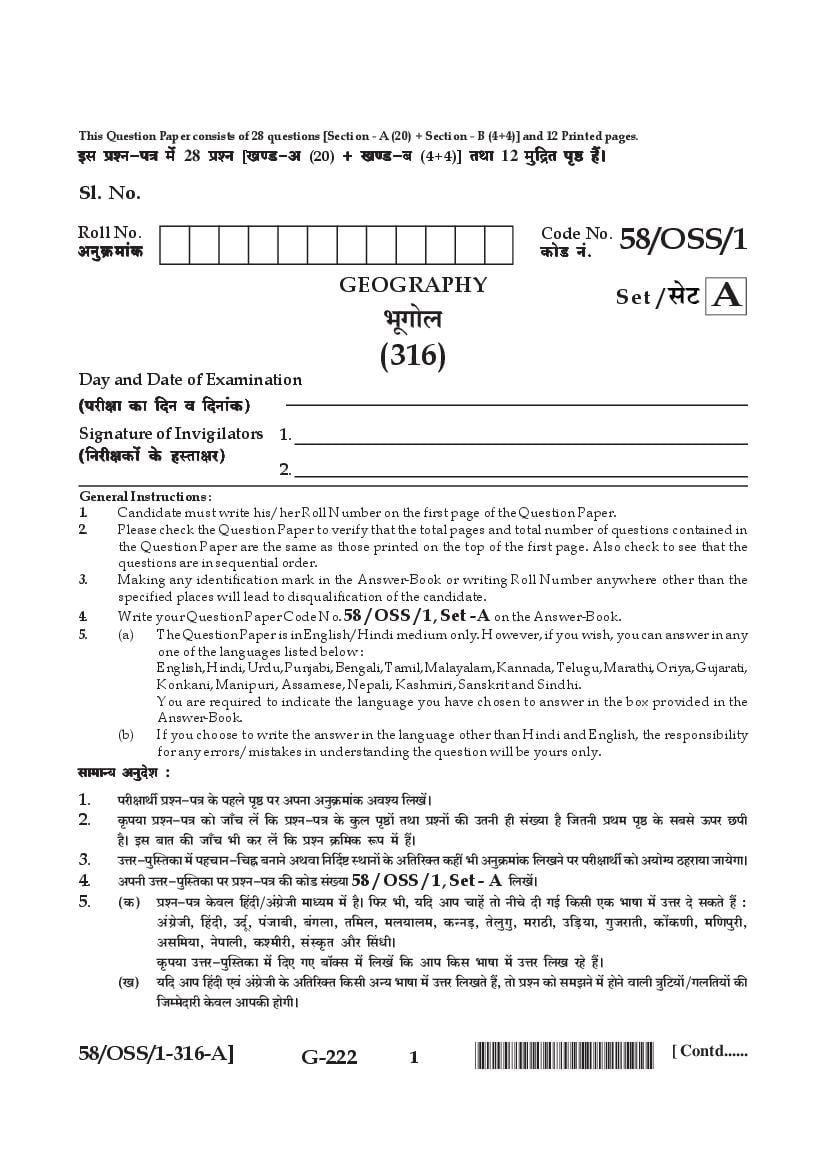
Page 1
Bg àíZ-nÌ _| 28 àíZ [IÊS>-A (20) + IÊS>-~ (4+4)] VWm 12 ‘w{ÐV n¥ð> h¢&
Sl. No.
Roll No.
AZw H « $ _m§ H $
Code No.
H$mo S > Z§ . 58/OSS/1
GEOGRAPHY
Set / go Q > A
^yJmob
(316)
Day and Date of Examination
(narjm H$m {XZ d {XZm§ H $)
Signature of Invigilators 1.
({ZarjH$m| Ho $ hñVmja)
2.
General Instructions :
1. Candidate must write his/her Roll Number on the first page of the Question Paper.
2. Please check the Question Paper to verify that the total pages and total number of questions contained in
the Question Paper are the same as those printed on the top of the first page. Also check to see that the
questions are in sequential order.
3. Making any identification mark in the Answer-Book or writing Roll Number anywhere other than the
specified places will lead to disqualification of the candidate.
4. Write your Question Paper Code No. 58 / OSS / 1, Set -A on the Answer-Book.
5. (a) The Question Paper is in English/Hindi medium only. However, if you wish, you can answer in any
one of the languages listed below :
English, Hindi, Urdu, Punjabi, Bengali, Tamil, Malayalam, Kannada, Telugu, Marathi, Oriya, Gujarati,
Konkani, Manipuri, Assamese, Nepali, Kashmiri, Sanskrit and Sindhi.
You are required to indicate the language you have chosen to answer in the box provided in the
Answer-Book.
(b) If you choose to write the answer in the language other than Hindi and English, the responsibility
for any errors/mistakes in understanding the question will be yours only.
gm_mÝ` AZwXoe :
1. narjmWu àíZ-nÌ Ho$ nhbo n¥ð> na AnZm AZwH«$‘m§H$ Adí¶ {bI|&
2. H¥$n¶m àíZ-nÌ H$mo Om±M b| {H$ àíZ-nÌ Ho$ Hw$b n¥ð>m| VWm àíZm| H$s CVZr hr g§»¶m h¡ {OVZr àW‘ n¥ð> Ho$ g~go D$na N>nr
h¡& Bg ~mV H$s Om±M ^r H$a b| {H$ àíZ H«${‘H$ ê$n ‘| h¢&
3. CÎma-nwpñVH$m ‘| nhMmZ-{M• ~ZmZo AWdm {Z{X©ï> ñWmZm| Ho$ A{V[aŠV H$ht ^r AZwH«$‘m§H$ {bIZo na narjmWu H$mo A¶mo½¶ R>ham¶m Om¶oJm&
4. AnZr CÎma-nwpñVH$m na àíZ-nÌ H$s H$moS> g§»¶m 58 / OSS / 1, Set - A {bI|&
5. (H$) àíZ-nÌ Ho$db qhXr/A§J«oOr ‘mܶ‘ ‘| h¡& {’$a ^r, ¶{X Amn Mmh| Vmo ZrMo Xr JB© {H$gr EH$ ^mfm ‘| CÎma Xo gH$Vo h¢ :
A§J«oOr, qhXr, CXÿ©, n§Om~r, ~§Jbm, V{‘b, ‘b¶mb‘, H$ÝZ‹S>, VobwJw, ‘amR>r, C{‹S>¶m, JwOamVr, H$m|H$Ur, ‘{Unwar,
Ag{‘¶m, Zonmbr, H$í‘rar, g§ñH¥$V Am¡a qgYr&
H¥$n¶m CÎma-nwpñVH$m ‘| {XE JE ~m°³g ‘| {bI| {H$ Amn {H$g ^mfm ‘| CÎma {bI aho h¢&
(I) ¶{X Amn qhXr Ed§ A§J«oOr Ho$ A{V[a³V {H$gr Aݶ ^mfm ‘| CÎma {bIVo h¢, Vmo àíZ H$mo g‘PZo ‘| hmoZo dmbr Ìw{Q>¶m|/Jb{V¶m| H$s
{Oå‘oXmar Ho$db AmnH$s hmoJr&
58/OSS/1-316-A] G-222 1 [ Contd......
Page 2
^yJmob
(316)
Time : 3 Hours] [Maximum Marks : 80
g_` : 3 KÊQ>o] [nyUmªH$ : 80
Note : (i) There are 24 questions in all.
(ii) All questions are compulsory.
(iii) Marks for each question are indicated against it.
(iv) Question Nos. 1 to 4 are very short answer questions carrying 1 mark each.
Answer to these questions should not exceed 30 words each.
(v) Question Nos. 5 to 9 and 21 and 22 are also very short answer questions carrying
2 marks each. Answers to these questions should not exceed 60 words each.
(vi) Question Nos. 10 to 13 and 23 and 24 are short answer questions carrying 4
marks each. Answers to these questions should not exceed 100 words each.
(vii) Question Nos. 14 to 18 are long answer questions carrying 6 marks each.
Answer of each of these questions should not exceed 140 words each.
(viii) Question Nos. 19 and 20 are on filling Outline Maps of the World and India
respectively. Each question contains 4 test-items of very short answers of 1 mark
each.
(ix) Use of templates or stencils for drawing outline maps in illustrating your answer
is allowed.
(x) Answer to Question Nos. 21 to 24 of Section - B should be given from any one of
the options.
{ZX}e : (i) àíZm| H$s Hw$b g§»¶m 24 h¡&
(ii) g^r àíZ A{Zdm¶© h¢&
(iii) à˶oH$ àíZ Ho$ gm‘Zo CgHo$ {ZYm©[aV A§H$ {XE JE h¢&
(iv) àíZ g§»¶m 1 go 4 VH$ A{VbKw-CÎmar¶ àíZ h¢ Am¡a à˶oH$ àíZ H$m 1 A§H$ h¡& Eogo à˶oH$ àíZ H$m CÎma 30
eãXm| go A{YH$ H$m Zht hmoZm Mm{hE&
(v) àíZ g§»¶m 5 go 9 VH$ Am¡a 21 VWm 22 ^r A{VbKw-CÎmar¶ àíZ h¢ Am¡a à˶oH$ àíZ Ho$ 2 A§H$ h¢& BZ‘| go
à˶oH$ àíZ H$m CÎma 60 eãXm| go A{YH$ H$m Zht hmoZm Mm{hE&
(vi) àíZ g§»¶m 10 go 13 VH$ Am¡a 23 VWm 24 bKw-CÎmar¶ àíZ h¢, {OZ‘| go à˶oH$ Ho$ 4 A§H$ h¢& BZ‘| go
à˶oH$ àíZ H$m CÎma 100 eãXm| go A{YH$ H$m Zht hmoZm Mm{hE&
(vii) àíZ g§»¶m 14 go 18 VH$ XrK© - CÎmar¶ àíZ h¢ Am¡a à˶oH$ àíZ Ho$ 6 A§H$ h¢& Eogo à˶oH$ àíZ H$m CÎma
140 eãXm| go A{YH$ H$m Zht hmoZm Mm{hE&
(viii) àíZ g§»¶m 19 Am¡a 20 H«$‘e: g§gma Am¡a ^maV Ho$ aoIm ‘mZ{MÌm| Ho$ ^aZo na h¢& à˶oH$ àíZ ‘| A{VbKw-
CÎmam| H$s 4 narjU ‘X| 1-1 A§H$ H$s h¢&
(ix) AnZo CÎma H$mo ñnï> H$aZo Ho$ {bE aoIm-‘mZ{MÌ ~ZmZo Ho$ {bE gm±Mm| ¶m ñQ>|{gbm| Ho$ à¶moJ H$s AZw‘{V Xr OmVr h¡&
(x) IÊS>-"~' ‘| àíZ g§»¶m 21 go 24 VH$ Ho$ CÎma {H$gr EH$ {dH$ën ‘| go Xr{OE&
58/OSS/1-316-A] G-222 2 [ Contd......
Page 3
IÊS> - A
1. Name the layer lying between the core and lithosphere. [1]
H«$mo‹S> Am¡a ñWb_§S>b Ho$ ~rM pñWV naV H$m Zm_ {b{IE &
2. Define the term 'Epicentre'. [1]
"A{YHo$ÝÐ' eãX H$mo n[a^m{fV H$s{OE &
3. Mention any two most cyclone prone states of India. [1]
g~go A{YH$ MH«$dmV à^m{dV {H$Ýht Xmo amÁ`m| H$m C„oI H$s{OE &
4. What is meant by 'diurnal migration'? [1]
"X¡{ZH$ àdmg' H$m Š`m AW© h¡?
5. State four main sub branches of 'Regional Geography'. [½ × 4 = 2 ]
"àmXo{eH$ ^yJmob' H$s Mma _w»` CnemImAm| H$m CëboI H$s{OE &
6. Name the Northern most range of Himalayas. Write its average height from the
sea level. [1 + 1 = 2]
{h_mb` H$s g~go CÎmar loUr H$m Zm_ {b{IE & Bg loUr H$s g_wÐVb go Am¡gV D±$MmB© {b{IE &
7. Give two examples each of biotic and abiotic resources. [1 + 1 = 2]
O¡{dH$ Am¡a AO¡{dH$ g§gmYZm| Ho$ Xmo-Xmo CXmhaU {b{IE &
8. How do geographical thinking and concepts affect our daily decisions? Explain
any two ways. [1 × 2 = 2]
^m¡Jmo{bH$ qMVZ Am¡a g§H$ënZmE± h_mao {XZ-à{V{XZ Ho$ {ZU©`m| H$mo {H$g àH$ma à^m{dV H$aVo h¢? {H$Ýht Xmo
VarH$m| H$s ì`m»`m H$s{OE &
9. Suggest any four measures to increase fish production in India. [½ × 4 = 2 ]
^maV _| _Ëñ` CËnmXZ H$mo ~‹T>mZo Ho$ {bE H$moB© Mma Cnm` gwPmBE &
58/OSS/1-316-A] G-222 3 [ Contd......
Page 4
_mZd Ho$ {bE _hmÛrnr` {Z_¾ VQ> Ho$ _hËd Ho$ {H$Ýht Mma {~ÝXþAm| H$s ì`m»`m H$s{OE &
11. 'Many changes have taken place in the lives of nomadic people of Arctic Tundra
Biome'. Justify the statement with examples. [4]
"AmH©${Q>H$ Qw>ÊS´>m Ordmo_ Ho$ Mbdmgr bmoJm| Ho$ OrdZ _| ~hþV go n[adV©Z hþE h¢ &' CXmhaUm| g{hV Bg H$WZ H$mo
Ý`m`g§JV R>hamBE &
12. Study the diagram showing the structure of the atmosphere carefully and answer
the questions that follow : EXOSPHERE
[1 × 4 = 4]
IONOSPHERE
MESOSPHERE
STATOSPHERE
TROPOSPHERE
i) In which layer of the atmosphere all kinds of weather changes take place?
ii) Which layer of the atmosphere is considered ideal for flying aircrafts?
iii) Due to which layer of the atmosphere radio broadcasting has become
possible?
iv) Name the upper most layer of the atmosphere.
dm`w_§S>b H$s g§aMZm {XImZo dmbo AmaoI H$m gmdYmZrnyd©H$ AÜ``Z H$s{OE Am¡a CgHo$ ZrMo {XE JE àíZm| Ho$
CÎma {b{IE … ~{h_©ÊS>b
Am`Z _ÊS>b
_Ü` _ÊS>b
g_Vmn _ÊS>b
jmo^ _ÊS>b
CÎmar Y«dw
i) dm`w_§S>b H$s {H$g naV _| g^r àH$ma Ho$ _m¡g_r n[adV©Z hmoVo h¢?
ii) dm`w_§S>b H$s H$m¡Z gr naV, dm`w`mZm| H$mo C‹S>mZo Ho$ {bE AmXe© g_Pr OmVr h¡?
iii) dm`w_§S>b H$s {H$g naV Ho$ H$maU, ao{S>`mo àgmaU g§^d hmoVm h¡?
iv) dm`w_§S>b H$s A§{V_ naV H$m Zm_ {b{IE &
58/OSS/1-316-A] G-222 4 [ Contd......
Page 5
[1 × 4 = 4]
i) In which parts of the country does the South West monsoon arrive first of
all?
ii) In which areas of India does South West monsoon arrive last of all?
iii) Name any two stations which experience South West monsoon between
10th and 15th June.
iv) What are the probable dates of arrival of South West monsoon in Delhi?
58/OSS/1-316-A] G-222 5 [ Contd......
Page 6
i) ^maV Ho$ {H$g ^mJ _| X{jU npíM_ _mZgyZ g~go nhbo nh±þMVm h¡?
ii) ^maV Ho$ {H$g ^mJ _| X{jU npíM_ _mZgyZ g~go ~mX _| nh±þMVm h¡?
iii) {H$Ýht Xmo ñWmZm| Ho$ Zm_ {b{IE, {OZ_| X{jU npíM_ _mZgyZ Ho$ nh±þMZo H$s Ad{Y 10 Am¡a 15 OyZ
Ho$ ~rM h¡?
iv) {Xëbr _| X{jU npíM_ _mZgyZ Ho$ nh±þMZo Ho$ gå^m{dV {XZm§H$ Š`m h¢?
58/OSS/1-316-A] G-222 6 [ Contd......
Page 7
the surface of the earth. [1 × 6 = 6]
n¥Ïdr Ho$ YamVb na Vmn_mZ Ho$ Ag_mZ {dVaU Ho$ {bE CÎmaXm`r {H$Ýht N>… H$maH$m| H$m dU©Z H$s{OE &
15. Describe any six issues which are important for the development of agriculture
in India. [1 × 6 = 6]
^maV _| H¥${f Ho$ {dH$mg Ho$ {bE _hËdnyU© {H$Ýht N>… _wÔm| H$m dU©Z H$s{OE &
16. Examine any four factors of soil formation. [4 × 1½ = 6]
_¥Xm {Z_m©U Ho$ {H$Ýht Mma H$maH$m| H$s naI H$s{OE &
17. Suggest any six methods for water conservation in India. [1 × 6 = 6]
^maV _| Ob g§ajU Ho$ {bE H$moB© N>… Cnm` gwPmBE &
18. Examine economic and demographic consequences of migration in India.
[3 + 3 = 6]
^maV _| àdmg Ho$ Am{W©H$ Am¡a OZm§{H$H$s` n[aUm_m| H$s naI H$s{OE &
58/OSS/1-316-A] G-222 7 [ Contd......
Page 8
given outline map of the World. Identify these features with the help of the following
information and write their correct names in your answer-book. [1 × 4 = 4]
(A) A volcano
(B) A plateau
(C) A grassland
(D) A desert
58/OSS/1-316-A] G-222 8 [ Contd......
Page 9
nhMm{ZE Am¡a CZHo$ ghr Zm‘ AnZr CÎma nwpñVH$m ‘| {b{IE &
(A) Ádmbm_wIr
(B) nR>ma
(C) Kmg^y{‘
(D) ‘ê$ñWb
58/OSS/1-316-A] G-222 9 [ Contd......
Page 10
the given Political outline map of India. Identify these features with the help of
the following information and write their correct names in your answer-book :
[1 × 4 = 4]
(A) River
(B) Iron and Steel Plant
(C) Coal Field
(D) Hydel Power Station
58/OSS/1-316-A] G-222 10 [ Contd......
Page 11
{XIm¶m J¶m h¡ & BZ bjUm| H$mo {ZåZ{b{IV OmZH$mar H$s _XX go nhMm{ZE Am¡a CZHo$ ghr Zm‘ AnZr CÎma-
nwpñVH$m ‘| {b{IE …
(A) ZXr
(B) bmohm-BñnmV g§`§Ì
(C) H$mo¶bm joÌ
(D) Obe{º$ Ho$ÝÐ
58/OSS/1-316-A] G-222 11 [ Contd......
Page 12
IÊS> - ~
OPTION - I
{dH$ën - I
(Local Area Planning)
(ñWmZr¶ jo Ì {Z¶mo O Z)
21. State any two uses of maps in local area planning. [1 × 2 = 2]
ñWmZr` joÌ {Z`moOZ _| _mZ{MÌm| Ho$ {H$Ýht Xmo Cn`moJm| H$m CëboI H$s{OE &
22. Explain any two merits of 'mode'. [1 × 2 = 2]
"~hþbH$' Ho$ {H$Ýht Xmo JwUm| H$s ì`m»`m H$s{OE &
23. Explain any four steps involved in the collection of primary data. [1 × 4 = 4]
àmW{_H$ Am§H$S>m| Ho$ EH$ÌrH$aU Ho$ {bE Ano{jV {H$Ýht Mma gmonmZm| H$s ì`m»`m H$s{OE &
24. Suggest any four priorities of planning for the improvement of slum areas in
India. [1 × 4 = 4]
^maV _| _{bZ ~pñV`m| Ho$ gwYma Ho$ {bE {Z`moOZ H$s H$moB© Mma àmW{_H$VmE± gwPmBE &
OPTION - II
{dH$ën - II
(Geography of Tourism in India)
(^maV ‘| n¶©Q>Z ^yJmob)
21. Mention any two factors for the popularity of Kovalam beach. [1 × 2 = 2]
H$modmb_ nw{bZ H$s bmoH${à`Vm Ho$ {H$Ýht Xmo H$maH$m| H$m CëboI H$sOrE &
22. Explain any two characteristics of 'health tourism'. [1 × 2 = 2]
"ñdmñÏ` n`©Q>Z' H$s {H$Ýht Xmo {deofVmAm| H$s ì`m»`m H$s{OE &
23. Describe any four negative impact of 'mass tourism' on the local youths. [1 × 4 = 4]
"OZ n`©Q>Z' Ho$ ñWmZr` `wdmAm| na n‹S>Zo dmbo {H$Ýht Mma ZH$mamË_H$ à^mdm| H$m dU©Z H$s{OE &
24. How does tourism help in the development of underdeveloped areas? Explain
with examples. [1 × 4 = 4]
n`©Q>Z, Aën {dH${gV joÌm| Ho$ {dH$mg _| H¡$go _XX H$aVm h¡? CXmhaUm| g{hV ì`m»`m H$s{OE &
58/OSS/1-316-A] G-222 12
Document Details
| Board / Org | NIOS |
| Exam | National Institute of Open Schooling Class 12 |
| Type | Question Paper |
| Pages | 12 |
| Updated | 30 Apr 2026 |