WBCHSE Class 11 Syllabus for Education
Finished viewing? Save it for later —
Download WBCHSE Class 11 Syllabus for Education (PDF · 3 pages)About WBCHSE Class 11 Syllabus for Education
WBCHSE Class 11 Syllabus for Education is available here for free download. Published by West Bengal Board for Class 11, this syllabus can be viewed online or downloaded as a PDF (3 pages). Candidates preparing for Class 11 can use WBCHSE Class 11 Syllabus for Education to understand the exam pattern, the type of questions asked, and the overall difficulty level.
Frequently Asked Questions
How can I download WBCHSE Class 11 Syllabus for Education?
Open this page and click the Download button to save WBCHSE Class 11 Syllabus for Education as a PDF. It is completely free on AglaSem Docs.
Is WBCHSE Class 11 Syllabus for Education free to download?
Yes. WBCHSE Class 11 Syllabus for Education can be viewed online and downloaded as a PDF free of cost on AglaSem Docs.
How many pages does WBCHSE Class 11 Syllabus for Education have?
WBCHSE Class 11 Syllabus for Education contains 3 pages, which you can read online or download together as a single PDF.
Where can I find more Class 11 study material?
You can find more Class 11 question papers, sample papers, syllabus, and answer keys on AglaSem Docs.
WBCHSE Class 11 Syllabus for Education – Text
Read the full text of this syllabus below — useful to quickly search, copy and reference the content online without downloading the PDF.
📄 View text version (3 pages)
Page 1
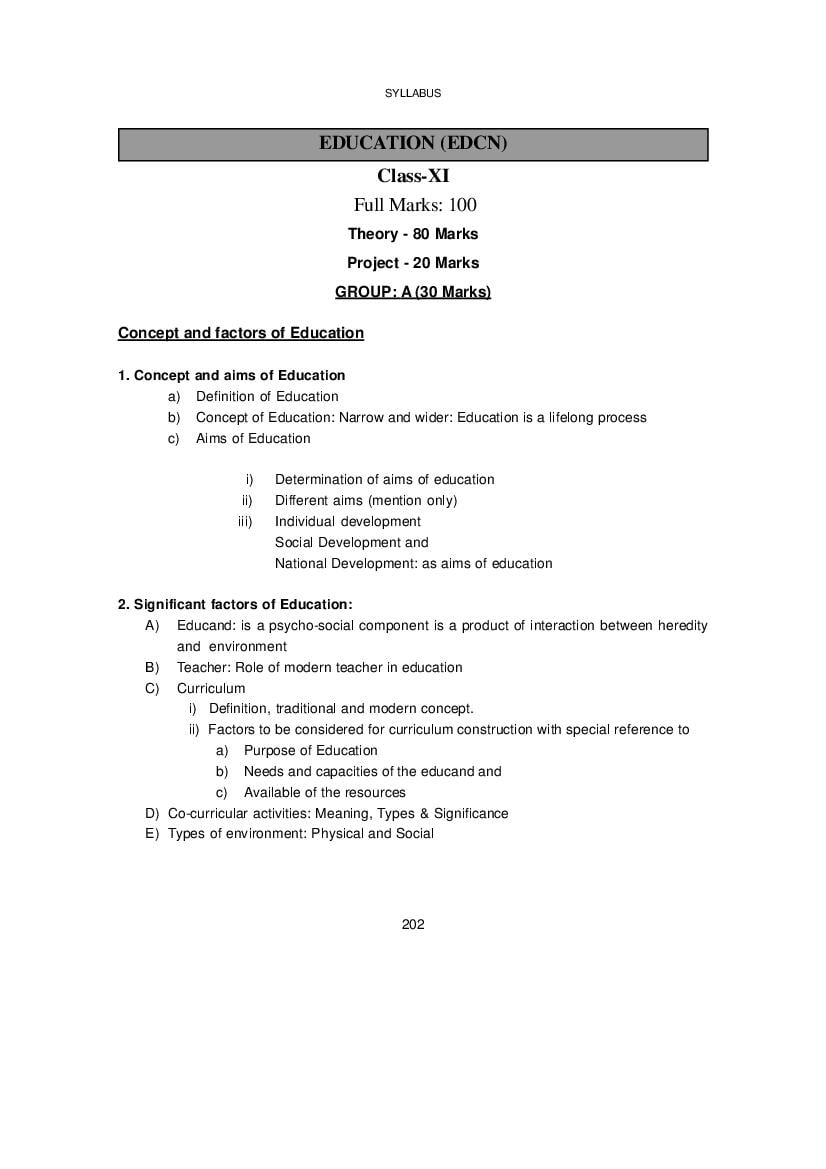
Class-XI
Full Marks: 100
Theory - 80 Marks
Project - 20 Marks
GROUP: A (30 Marks)
Concept and factors of Education
1. Concept and aims of Education
a) Definition of Education
b) Concept of Education: Narrow and wider: Education is a lifelong process
c) Aims of Education
i) Determination of aims of education
ii) Different aims (mention only)
iii) Individual development
Social Development and
National Development: as aims of education
2. Significant factors of Education:
A) Educand: is a psycho-social component is a product of interaction between heredity
and environment
B) Teacher: Role of modern teacher in education
C) Curriculum
i) Definition, traditional and modern concept.
ii) Factors to be considered for curriculum construction with special reference to
a) Purpose of Education
b) Needs and capacities of the educand and
c) Available of the resources
D) Co-curricular activities: Meaning, Types & Significance
E) Types of environment: Physical and Social
202
Page 2
a) Informal Education: Characteristics, Limitations:
i) Role of family and
ii) Mass media.
b) Formal Education: Characteristics, Limitations, Role of School.
c) Non formal Education: Need and meaning, concept, types, methods
GROUP-B (30 Marks)
Psychological perspectives
4. Psychology: Definition, Relation between Education and Psychology and its importance,
Educational psychology: Definition
5. Growth and development of a child
i) Definition of Growth and development and differences
ii) Developmental characteristics and needs at different stages of development: (Physical,
Psychological and Social)
a) Infancy
b) Childhood
c) Adolescence
d) Adult hood
iii) Levels of Education related to stages of development (mention stages of formal
education only)
6. Maturation and learning as process of development
Definition, Characteristics and Inter-relationship
7. Process involved in the acquisition of knowledge
a) Sensation-Definition, types, importance of sensation in education (with reference to
Froebel and Montessori)
b) Perception: Definition, Difference between perception and sensation, importance of
perception in education
c) Concept: definition, stages of concept development, importance of concept formation
in education and acquisition of knowledge
203
Page 3
Historical development of Indian education
8. Ancient period (Brahmanic and Buddhistic) characteristics only based on (Aims of education,
curriculum rituals, institutions, teacher pupil relationship, method of teaching, discipline,
evaluation)
9. Medieval period: Characteristics only related to the points as referred above
10. Important events leading to the modern system of education: pre independent period:
Charter Act-1813,Woods Despatch-1854, Hunter Commission-1882, Curzon Policy: an
overview on primary, secondary and higher education, Sadler Commission-1917, Sargent
Plan-1944: Brief Study
11. Contribution of eminent Indian educators towards the development of modern education
in India
a) Raja Ram Mohan Roy- A social reformer and pre-cursor of education in India.
b) Ishwar Chandra Vidyasagar : Social and educational contribution towards mass
education, establishment or schools, curriculum reforms, contribution to Bengali
Language and literature and women’s education.
c) Rabindranath Tagore: Educational thought and practice of education (with special
reference to Santiniketan and Sriniketan)
d) Swami Vivekananda: Views on education-man making and character building, mass
education, women’s education and technical education.
e) Mahatma Gandhi: Educational views with special emphasis on Basic education.
Project work(20 Marks)
To study needs of the students of class VI to X (at least 10 students of any two classes
belonging to two stages of development: childhood and adolescence
To organize any activity within school (cultural function, debate, any game, sports, morning
assembly etc.) or to study on going co-curricular activities in another secondary/primary
school in comparison to your own
Project or comprehensive study on the view point of Indian educators on women’s education,
mass education etc
Apart from the suggested project or field studies any relevant project based on the syllabus
can be undertaken
204
Document Details
| Board / Org | West Bengal Board |
| Exam | Class 11 |
| Type | Syllabus |
| Pages | 3 |
| Updated | 22 Jul 2026 |