ICSE Class 10 Question Paper 2020 for Science - Physics
Finished viewing? Save it for later —
Download ICSE Class 10 Question Paper 2020 for Science - Physics (PDF · 8 pages)About ICSE Class 10 Question Paper 2020 for Science - Physics
ICSE Class 10 Question Paper 2020 for Science - Physics is available here for free download. Published by CISCE for Class 10, this question paper can be viewed online or downloaded as a PDF (8 pages). Candidates preparing for Class 10 can use ICSE Class 10 Question Paper 2020 for Science - Physics to understand the exam pattern, the type of questions asked, and the overall difficulty level.
Frequently Asked Questions
How can I download ICSE Class 10 Question Paper 2020 for Science - Physics?
Open this page and click the Download button to save ICSE Class 10 Question Paper 2020 for Science - Physics as a PDF. It is completely free on AglaSem Docs.
Is ICSE Class 10 Question Paper 2020 for Science - Physics free to download?
Yes. ICSE Class 10 Question Paper 2020 for Science - Physics can be viewed online and downloaded as a PDF free of cost on AglaSem Docs.
How many pages does ICSE Class 10 Question Paper 2020 for Science - Physics have?
ICSE Class 10 Question Paper 2020 for Science - Physics contains 8 pages, which you can read online or download together as a single PDF.
Where can I find more Class 10 study material?
You can find more Class 10 question papers, sample papers, syllabus, and answer keys on AglaSem Docs.
ICSE Class 10 Question Paper 2020 for Science - Physics – Text
Read the full text of this question paper below — useful to quickly search, copy and reference the content online without downloading the PDF.
📄 View text version (8 pages)
Page 1
SCIENCE Paper – 1
(Two hours)
Answers to this Paper must be written on the paper provided separately.
You will not be allowed to write during the first 15 minutes.
This time is to be spent in reading the Question Paper.
The time given at the head of this Paper is the time allowed for writing the answers.
Section I is compulsory. Attempt any four questions from Section II.
The intended marks for questions or parts of questions are given in brackets [ ].
SECTION I (40 Marks)
Attempt all questions from this Section.
Question 1
(a) (i) Define moment of force. [2]
(ii) Write the relationship between the SI and CGS unit of moment of force.
(b) Define a kilowatt hour. How is it related to joule? [2]
(c) A satellite revolves around a planet in a circular orbit. What is the work done [2]
by the satellite at any instant? Give a reason.
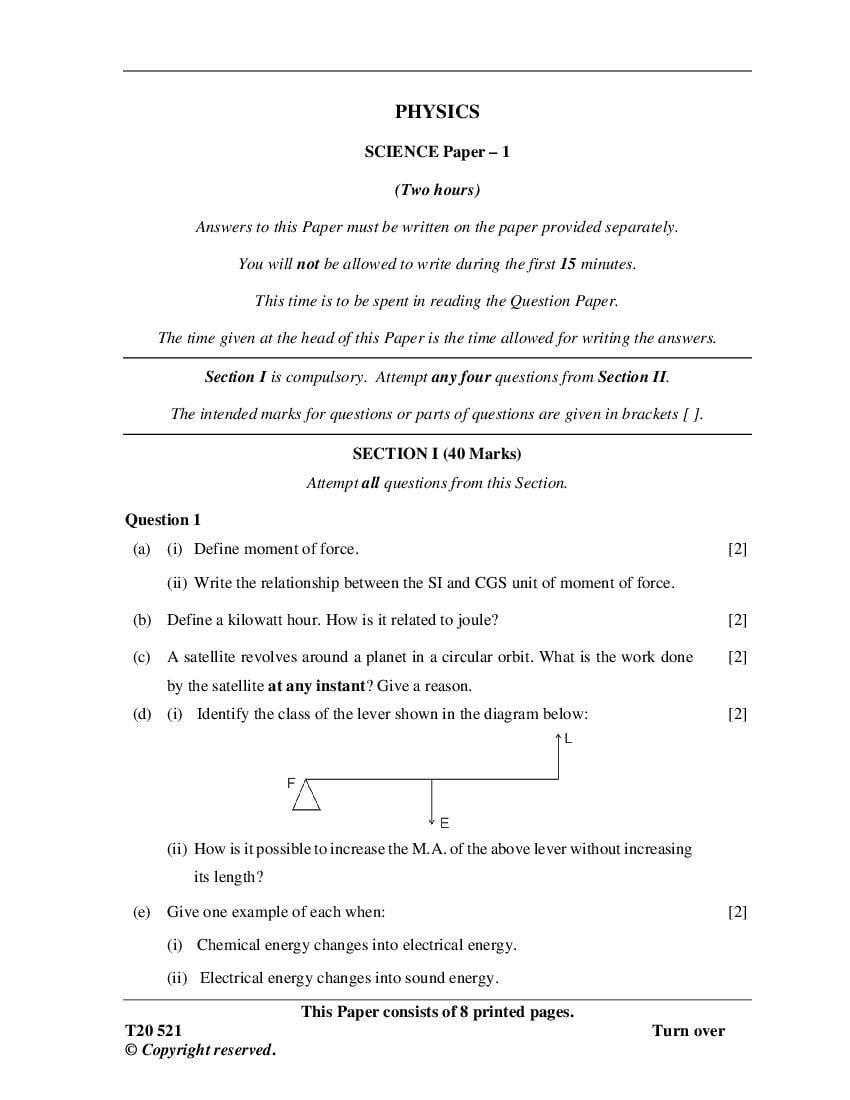
(d) (i) Identify the class of the lever shown in the diagram below: [2]
(ii) How is it possible to increase the M.A. of the above lever without increasing
its length?
(e) Give one example of each when: [2]
(i) Chemical energy changes into electrical energy.
(ii) Electrical energy changes into sound energy.
This Paper consists of 8 printed pages.
T20 521 Turn over
© Copyright reserved.
Page 2
(a) A crane ‘A’ lifts a heavy load in 5 seconds, whereas another crane ‘B’ does the [2]
same work in 2 seconds. Compare the power of crane ‘A’ to that of crane ‘B’.
(b) A ray of light falls normally on a rectangular glass slab. [2]
Draw a ray diagram showing the path of the ray till it emerges out of the slab.
(c) Complete the path of the monochromatic light ray AB incident on the surface [2]
PQ of the equilateral glass prism PQR till it emerges out of the prism due to
refraction.
(d) Where should an object be placed in front of a convex lens in order to get: [2]
(i) an enlarged real image
(ii) enlarged virtual image?
(e) 4 [2]
A pond appears to be 2.7 m deep. If the refractive index of water is , find the
3
actual depth of the pond.
Question 3
(a) The wave lengths for the light of red and blue colours are nearly 7.8 x 10⁻⁷ m [2]
and 4.8 x 10⁻⁷ m respectively.
(i) Which colour has the greater speed in a vacuum?
(ii) Which colour has a greater speed in glass?
T20 521 2
Page 3
executing free vibration in a vacuum.
(c) A sound wave travelling in water has wavelength 0.4 m. [2]
Is this wave audible in air? (The speed of sound in water = 1400 ms-1)
(d) Why does stone lying in the sun get heated up much more than water lying for [2]
the same duration of time?
(e) Why is it not advisable to use a piece of copper wire as fuse wire in an electric [2]
circuit?
Question 4
(a) Calculate the total resistance across AB: [2]
(b) Two metallic blocks P and Q having masses in ratio 2:1 are supplied with the [2]
same amount of heat. If their temperatures rise by same degree, compare their
specific heat capacities.
(c) When a current carrying conductor is placed in a magnetic field, it experiences [2]
a mechanical force. What should be the angle between the magnetic field and
the length of the conductor so that the force experienced is:
(i) Zero
(ii) Maximum?
(d) A nucleus 84 X202 of an element emits an alpha particle followed by a beta [2]
particle. The final nucleus is a Yb. Find a and b.
T20 521 3 Turn Over
Page 4
(i) What is the magnetic polarity of the loop that faces us?
(ii) With respect to the diagram how can we increase the strength of the
magnetic field produced by this loop?
SECTION II (40 Marks)
Attempt any four questions from this Section
Question 5
(a) The figure below shows a simple pendulum of mass 200 g. It is displaced from [3]
the mean position A to the extreme position B. The potential energy at the
position A is zero. At the position B the pendulum bob is raised by 5 m.
(i) What is the potential energy of the pendulum at the position B?
(ii) What is the total mechanical energy at point C?
(iii) What is the speed of the bob at the position A when released from B?
(Take g = 10 ms-2 and there is no loss of energy.)
T20 521 4
Page 5
from a centrifugal force during uniform circular motion?
(ii) Is centrifugal force the force of reaction of centripetal force?
(iii) Compare the magnitudes of centripetal and centrifugal force.
(c) A block and tackle system of pulleys has velocity ratio 4. [4]
(i) Draw a neat labelled diagram of the system indicating clearly the points of
application and direction of load and effort.
(ii) What will be its V.R. if the weight of the movable block is doubled?
Question 6
(a) A diver in water looks obliquely at an object AB in air. [3]
air A
B C D
water
Eye of the Diver
(i) Does the object appear taller, shorter or of the same size to the diver?
(ii) Show the path of two rays AC & AD starting from the tip of the object as it
travels towards the diver in water and hence obtain the image of the object.
(b) Complete the path of the ray AB through the glass prism in PQR till it emerges [3]
out of the prism. Given the critical angle of the glass as 42o.
T20 521 5 Turn Over
Page 6
the lens.
(i) Identify the lens.
(ii) How far is the lens present in front of the object?
(iii) Calculate the magnification of the image.
Question 7
(a) Give reasons for the following: [3]
During the day:
(i) Clouds appear white.
(ii) Sky appears blue.
(b) (i) Name the system which enables us to locate underwater objects by [3]
transmitting ultrasonic waves and detecting the reflecting impulse.
(ii) What are acoustically measurable quantities related to pitch and loudness?
(c) (i) When a tuning fork [vibrating] is held close to ear, one hears a faint hum. [4]
The same [vibrating tuning fork] is held such that its stem is in contact with
the table surface, then one hears a loud sound. Explain.
(ii) A man standing in front of a vertical cliff fires a gun. He hears the echo
after 3.5 seconds. On moving closer to the cliff by 84 m, he hears the echo
after 3 seconds. Calculate the distance of the cliff from the initial position
of the man.
T20 521 6
Page 7
(a) The diagram below shows the core of a transformer and its input and output [3]
connections
(i) State the material used for the core.
(ii) Copy and complete the diagram of the transformer by drawing input and
output coils.
(b) (i) What are superconductors? [3]
(ii) Calculate the current drawn by an appliance rated 110 W, 220 V when
connected across 220 V supply.
(iii) Name a substance whose resistance decreases with the increase in
temperature.
(c) [4]
The diagram above shows three resistors connected across a cell of e.m.f.
1.8 V and internal resistance r. Calculate:
(i) Current through 3 Ω resistor.
(ii) The internal resistance r.
Question 9
(a) (i) Define heat capacity of a substance. [3]
(ii) Write the SI unit of heat capacity.
(iii) What is the relationship between heat capacity and specific heat capacity
of a substance?
T20 521 7 Turn Over
Page 8
vs time graph on heating the substance at a constant rate.
(i) Why is the slope of CD less than slope of AB?
(ii) What is the boiling and melting point of the substance?
(c) A piece of ice of mass 60 g is dropped into 140 g of water at 50oC. [4]
Calculate the final temperature of water when all the ice has melted.
(Assume no heat is lost to the surrounding)
Specific heat capacity of water = 4.2 Jg-1k-1
Specific latent heat of fusion of ice = 336 Jg-1
Question 10
(a) (i) Draw a neat labeled diagram of a d.c. motor. [3]
(ii) Write any one use of a d.c. motor.
(b) (i) Differentiate between nuclear fusion and nuclear fission. [3]
(ii) State one safety precaution in the disposal of nuclear waste.
(c) An atomic nucleus A is composed of 84 protons and 128 neutrons. The nucleus [4]
A emits an alpha particle and is transformed into a nucleus B.
(i) What is the composition of B?
(ii) The nucleus B emits a beta particle and is transformed into a nucleus C.
What is the composition of C?
(iii) What is mass number of the nucleus A?
(iv) Does the composition of C change if it emits gamma radiations?
T20 521 8
Document Details
| Board / Org | CISCE |
| Exam | Class 10 |
| Type | Question Paper |
| Pages | 8 |
| Language | english |
| Updated | 30 Apr 2026 |