NIOS Class 12 Question Paper Apr 2019 - Physics
Finished viewing? Save it for later —
Download NIOS Class 12 Question Paper Apr 2019 - Physics (PDF · 12 pages)About NIOS Class 12 Question Paper Apr 2019 - Physics
NIOS Class 12 Question Paper Apr 2019 - Physics is available here for free download. Published by NIOS for National Institute of Open Schooling Class 12, this question paper can be viewed online or downloaded as a PDF (12 pages). Candidates preparing for National Institute of Open Schooling Class 12 can use NIOS Class 12 Question Paper Apr 2019 - Physics to understand the exam pattern, the type of questions asked, and the overall difficulty level.
Frequently Asked Questions
How can I download NIOS Class 12 Question Paper Apr 2019 - Physics?
Open this page and click the Download button to save NIOS Class 12 Question Paper Apr 2019 - Physics as a PDF. It is completely free on AglaSem Docs.
Is NIOS Class 12 Question Paper Apr 2019 - Physics free to download?
Yes. NIOS Class 12 Question Paper Apr 2019 - Physics can be viewed online and downloaded as a PDF free of cost on AglaSem Docs.
How many pages does NIOS Class 12 Question Paper Apr 2019 - Physics have?
NIOS Class 12 Question Paper Apr 2019 - Physics contains 12 pages, which you can read online or download together as a single PDF.
Where can I find more National Institute of Open Schooling Class 12 study material?
You can find more National Institute of Open Schooling Class 12 question papers, sample papers, syllabus, and answer keys on AglaSem Docs.
NIOS Class 12 Question Paper Apr 2019 - Physics – Text
Read the full text of this question paper below — useful to quickly search, copy and reference the content online without downloading the PDF.
📄 View text version (12 pages)
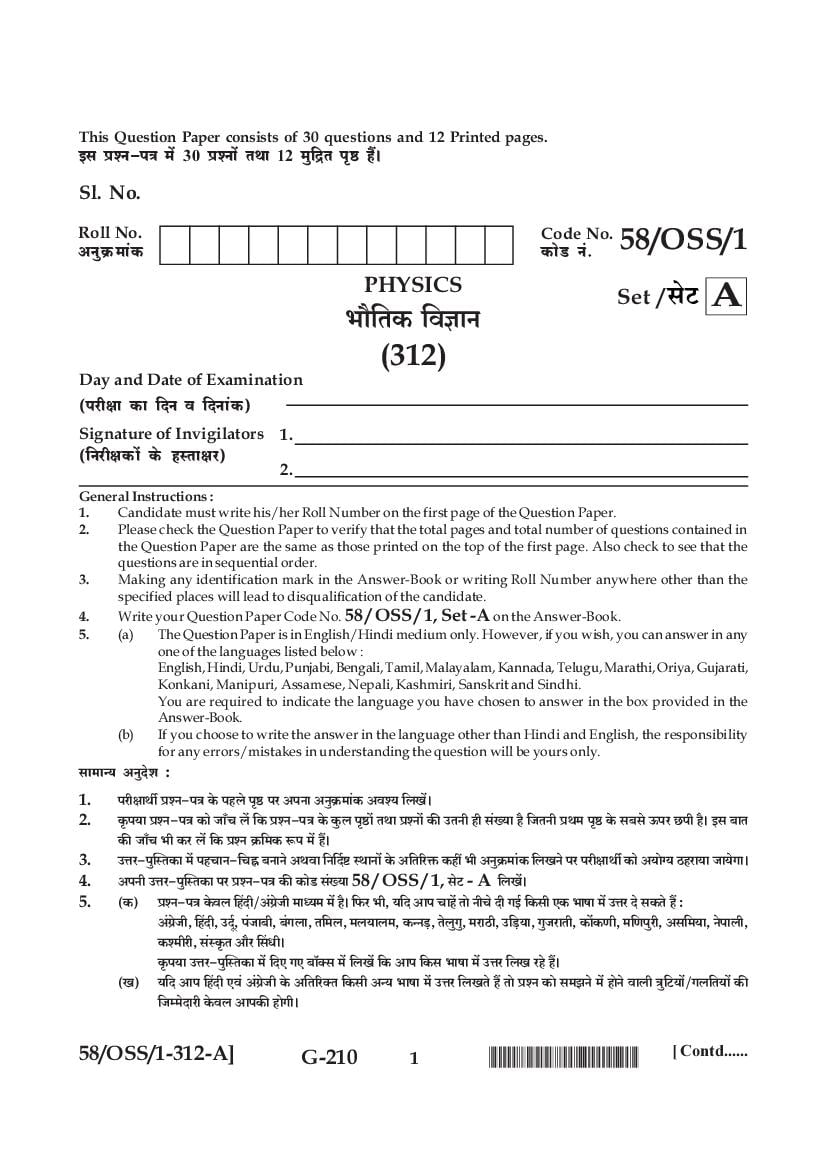
Page 1
Bg àíZ-nÌ _| 30 àíZm| VWm 12 w{ÐV n¥ð> h¢&
Sl. No.
Roll No.
AZw H « $ _m§ H $
Code No.
H$moS> Z§. 58/OSS/1
PHYSICS
Set / go Q > A
^m¡{VH$ {dkmZ
(312)
Day and Date of Examination
(narjm H$m {XZ d {XZm§ H $)
Signature of Invigilators 1.
({ZarjH$m| Ho $ hñVmja)
2.
General Instructions :
1. Candidate must write his/her Roll Number on the first page of the Question Paper.
2. Please check the Question Paper to verify that the total pages and total number of questions contained in
the Question Paper are the same as those printed on the top of the first page. Also check to see that the
questions are in sequential order.
3. Making any identification mark in the Answer-Book or writing Roll Number anywhere other than the
specified places will lead to disqualification of the candidate.
4. Write your Question Paper Code No. 58 / OSS / 1, Set -A on the Answer-Book.
5. (a) The Question Paper is in English/Hindi medium only. However, if you wish, you can answer in any
one of the languages listed below :
English, Hindi, Urdu, Punjabi, Bengali, Tamil, Malayalam, Kannada, Telugu, Marathi, Oriya, Gujarati,
Konkani, Manipuri, Assamese, Nepali, Kashmiri, Sanskrit and Sindhi.
You are required to indicate the language you have chosen to answer in the box provided in the
Answer-Book.
(b) If you choose to write the answer in the language other than Hindi and English, the responsibility
for any errors/mistakes in understanding the question will be yours only.
gm_mÝ` AZwXoe :
1. narjmWu àíZ-nÌ Ho$ nhbo n¥ð> na AnZm AZwH«$m§H$ Adí¶ {bI|&
2. H¥$n¶m àíZ-nÌ H$mo Om±M b| {H$ àíZ-nÌ Ho$ Hw$b n¥ð>m| VWm àíZm| H$s CVZr hr g§»¶m h¡ {OVZr àW n¥ð> Ho$ g~go D$na N>nr h¡& Bg ~mV
H$s Om±M ^r H$a b| {H$ àíZ H«${H$ ê$n | h¢&
3. CÎma-nwpñVH$m | nhMmZ-{M ~ZmZo AWdm {Z{X©ï> ñWmZm| Ho$ A{V[aº$ H$ht ^r AZwH«$m§H$ {bIZo na narjmWu H$mo A¶mo½¶ R>ham¶m Om¶oJm&
4. AnZr CÎma-nwpñVH$m na àíZ-nÌ H$s H$moS> g§»¶m 58 / OSS / 1, goQ> - A {bI|&
5. (H$) àíZ-nÌ Ho$db qhXr/A§JO o« r mܶ | h¡& {$a ^r, ¶{X Amn Mmh| Vmo ZrMo Xr JB© {H$gr EH$ ^mfm | CÎma Xo gH$Vo h¢ :
A§JOo« r, qhXr, CXÿ,© n§Om~r, ~§Jbm, V{b, b¶mb, H$ÝZS>, VobJw ,w amR>r, C{S>¶m, JwOamVr, H$m|H$Ur, {Unwar, Ag{¶m, Zonmbr,
H$írar, g§ñH¥$V Am¡a qgYr&
H¥$n¶m CÎma-nwpñVH$m | {XE JE ~m°³g | {bI| {H$ Amn {H$g ^mfm | CÎma {bI aho h¢&
(I) ¶{X Amn qhXr Ed§ A§J«oOr Ho$ A{V[a³V {H$gr Aݶ ^mfm | CÎma {bIVo h¢ Vmo àíZ H$mo gPZo | hmoZo dmbr Ìw{Q>¶m|/Jb{V¶m| H$s
{OåoXmar Ho$db AmnH$s hmoJr&
58/OSS/1-312-A] G-210 1 *58/OSS/1-312-A* [ Contd......
Page 2
^m¡{VH$ {dkmZ
(312)
Time : 3 Hours] [Maximum Marks : 80
g_` : 3 KÊQ>o] [nyUmªH$ : 80
Note : (i) All questions are compulsory.
(ii) Marks allotted are indicated against each question.
(iii) Each question from Question Nos. 1 to 10 has four alternative - (A), (B), (C)
and (D) out of which one is most appropriate. Choose the correct answer
among the four alternative and write it in your answer-book against the num-
ber of the question. No separate time is allotted for attempting multiple choice
questions.
{ZX}e : (i) g^r àíZ A{Zdm¶© h¢&
(ii) à˶oH$ àíZ Ho$ gmZo A§H$ Xem©¶o J¶o h¢&
(iii) àíZ H«$m§H$ 1 go 10 | à˶oH$ | Mma {dH$ën - (A), (B), (C) Am¡a (D) {X¶o J¶o h¢, {OZ| EH$ ghr h¡& Mmam|
{dH$ënm| | go ghr CÎma Mw{Z¶o Am¡a AnZr CÎma-nwpñVH$m | àíZ H«$m§H$ Ho$ gmZo {b{I¶o& ~hþd¡H$pënH$ àíZm| Ho$ {b¶o
A{V[aº$ g¶ Zht Xr¶m Om¶oJm&
1. The force of action and reaction are equal and opposite. Despite this, object
moves on application of force because: [1]
(A) Both action and reaction act on the same object in same direction
(B) Both action and reaction act on the same object in opposite direction.
(C) Both action and reaction act on two different objects.
(D) None of these
{H«$¶m Am¡a à{V{H«$¶m ~b ~am~a hmoVo h¢ Am¡a {dnarV {Xem | bJVo h¢ & {$a ^r ~b bJmZo na qnS> | J{V hmoVr
h¡, ³¶m|{H$-
(A) {H«$¶m Am¡a à{V{H«$¶m ~b XmoZm| EH$ hr qnS> na EH$ hr {Xem o§ bJVo h¢ &
(B) {H«$¶m Am¡a à{V{H«$¶m ~b EH$ hr qnS> na {dnarV {Xem | bJVo h¢ &
(C) {H«$¶m Am¡a à{V{H«$¶m Ho$ ~b Xmo {^Þ qnS>mo na bJVo h¢ &
(D) Cn¶w©³V | H$moB© Zht &
58/OSS/1-312-A] G-210 2 *58/OSS/1-312-A* [ Contd......
Page 3
10kg mass sliding over a rough horizontal surface. The work done by this force
in one minute is : [1]
(A) 600J (B) 60J
(C) 6J (D) 6000J
{H$gr IwaXao j¡{VO n¥îR> na {$gbVo hþE 10kg Ðì¶mZ Ho$ JwQ>Ho$ H$m doJ 2m/s ~ZmE aIZo Ho$ {bE 5N
H$m j¡{VO ~b bJmVma bJmE aIZm nS>Vm h¡ & Bg ~b Ûmam EH$ {ZQ> | {H$¶m J¶m H$m¶© h¡ -
(A) 600J (B) 60J
(C) 6J (D) 6000J
3. Variation of viscous force (F) on a small sphere falling through a medium with
the radius of the sphere, is represented as : [1]
(A) (B)
F F
r r
F
F
(C) (D)
r r
{H$gr mܶ | {JaVo hþE EH$ N>moQ>o JmobmH$ma qnS> na bJZo dmbo í¶mZ-~b Ho$ qnS> H$s {ÌÁ¶m Ho$ gmW
n[adV©Z H$mo {Zé{nV H$aZo dmbm J«m$ h¡ :
(A) (B)
F F
r r
F F
(C) (D)
r r
58/OSS/1-312-A] G-210 3 *58/OSS/1-312-A* [ Contd......
Page 4
air, fundamental frequency of standing wave in pipe is: [1]
(A) 640Hz (B) 320Hz
(C) 160Hz (D) 80Hz
XmoZm| {gam| na Iwbo EH$ nmBn H$s bå~mB© 1m h¡ & ¶{X dm¶w | Üd{Z H$s Mmb 320m/s hmo Vmo nmBn |
AàJmr Va§J H$s yb Amd¥{Îm h¡ :
(A) 640Hz (B) 320Hz
(C) 160Hz (D) 80Hz
5. A parallel plate capacitor with air between the plates has a capacitance of 8pF. If
the distance between the plates is reduced to half and the space between them is
filled with a substance of dielectric constant 2, its capacitance will be: [1]
(A) 32pF (B) 16pF
(C) 8pF (D) 4pF
EH$ gm§Va ßboQ> g§Ym[aÌ H$s Ym[aVm O~ BgH$s ßboQ>m| Ho$ ~rM dm¶w 8pF h¡ & ¶{X ßboQ>m| Ho$ ~rM H$s Xÿar H$mo
AmYm H$a {X¶m OmE Am¡a CZHo$ ~rM nam{dÚwVm§H$ 2 H$m nXmW© ^a {X¶m OmE Vmo BgH$s Ym[aVm hmoJr -
(A) 32pF (B) 16pF
(C) 8pF (D) 4pF
6. S.I. unit of self-inductance of a solenoid is : [1]
(A) Volt/second (B) Ohm-second
(C) Volt-second (D) Ohm/second
{H$gr n[aZm{bH$m Ho$ ñdàoaU H$m S.I. mÌH$ h¡ :
(A) dmoëQ>/goH§$S> (B) Amo²-goH§$S>
(C) dmoëQ>-goH§$S> (D) Amo²/goH§$S>
58/OSS/1-312-A] G-210 4 *58/OSS/1-312-A* [ Contd......
Page 5
colour. Deviation of yellow light passing through it is: [1]
(A) 2° (B) 1°
(C) 1 2 n (D) 1 4 n
{H$gr {àµÁ H$m AndV©H$ H$moU ½° h¡ Am¡a nrbo a§J Ho$ àH$me Ho$ {bE BgH$m AndV©Zm§H$ 1.5 h¡ & Bggo
hmoH$a JwOaZo dmbo nrbo àH$me H$m {dMbZ H$moU h¡ -
(A) 2° (B) 1°
(C) 1 2 n (D) 1 4 n
8. Balmer series of spectral lines is obtained when an electron in hydrogen atom
jumps from higher orbits to the: [1]
(A) first orbit (B) second orbit
(C) third orbit (D) fourth orbit
ñno³Q´>r aoImAm| H$s ~ma loUr V~ àmá hmoVr h¡ O~ hmBS´>moOZ namUw | H$moB© Bbo³Q´>m°Z CÀMVa H$jm go
g§H«$U H$aVm h¡ -
(A) àW H$jm | (B) {ÛVr¶ H$jm |
(C) V¥Vr¶ H$jm | (D) MVwW© H$jm |
9. An electron is accelerated through a potential V, its de-Broglie wavelength is l. If
accelerating voltage is increased to 4V, its de-Broglie wavelength will become:[1]
(A) 4l (B) 2l
(C) l (D) l/2
H$moB© Bbo³Q´>mZ {d^dm§Va V Ho$ A§VJ©V Ëd[aV hmoVm h¡ & BgH$m S>r-~«m°½br Va§JX¡Ü¶© l h¡& ¶{X ËdaUH$mar dmoëQ>Vm
H$mo ~T>mH$a 4V H$a {X¶m OmE Vmo BgH$s S>r-~«m°½br Va§JX¡Ü¶© hmo OmEJr -
(A) 4l (B) 2l
(C) l (D) l/2
58/OSS/1-312-A] G-210 5 *58/OSS/1-312-A* [ Contd......
Page 6
(A) emitter
(B) base
(C) collector
(D) none of these
Q´>m§{OñQ>a H$m dh ^mJ {Og| g~go H$ S>moqnJ H$s OmVr h¡, hmoVm h¡ -
(A) CËgO©H$
>(B) AmYma
(C) g§J«mhH$>
(D) Cn¶w©º$ §o H$moB© Zht
11. Draw a graph showing variation of spring force (F) with extension (X) of an
ideal spring. Write S.I. unit of spring constant. [2]
AmXe© pñà¨J Ho$ {bE pñà¨J-~b (F) | bå~mB© d¥[Õ (X) Ho$ gmW hmoZo dmbo n[adV©Z H$m J«m$ ~ZmB©E & pñà¨J
{Z¶Vm§H$ H$m S.I. mÌH$ {b{IE &
12. Using dimensional analysis, derive Stokes law for the viscous force acting on a
spherical body of radius (r), falling freely with a velocity (n) through a fluid of
viscosity h. [2]
{dr¶ {díbofU H$m Cn¶moJ H$aHo$, h í¶mZVm Ho$ Vab §o, n doJ go ñdV§ÌVmnyd©H$ {JaVo hþE, r {ÌÁ¶m Ho$
JmobmH$ma qnS> na bJZo dmbo í¶mZ ~b Ho$ {bE ñQ>moH$ H$m {Z¶ ì¶wËnÝZ H$s{OE &
58/OSS/1-312-A] G-210 6 *58/OSS/1-312-A* [ Contd......
Page 7
not necessarily settle to mean temperature (T1+T2)/2 always. Why is it so? [2]
Xmo qnS> {OZHo$ àma§{^H$ Vmn T1 Ed§ T2 h¢ O~ Vmnr¶ g§nH©$ | aIo OmVo h¡ Vmo Oê$ar Zhr h¡§ {H$ Vmnr¶ g§VwbZ
| AmZo na BZH$m Vmn mܶ Vmn (T1+T2)/2 hmo & Eogm {H$g{bE hmoVm h¡?
14. A battery of e.m.f. 10V and internal resistance 3W is connected to a external
resistor. If the current in the circuit is 0.5A, Calculate the [2]
i) external resistor and
ii) terminal voltage of the battery.
e.m.f. 10V Am¡a Am§V[aH$ à{VamoY 3W H$s EH$ ~¡Q>ar H$mo {H$gr ~mh²¶ à{VamoY Ho$ gmW OmoS>m J¶m h¡ & ¶{X
n[anW | Ymam 0.5A hmo Vmo n[aH${bV H$s{OE :
i) ~mh²¶ à{VamoY Am¡a
ii) ~¡Q>ar Ho$ {gam| Ho$ ~rM dmoëQ>Vm
15. An electron is projected at right angle to a uniform magnetic field (B) with
velocity v. Derive the expression for the radius of circular path described by the
electron. Take m as mass of electron and e its electric charge. [2]
{H$gr Bbo³Q´>m°Z H$mo EH$ gmZ Mwå~H$s¶ joÌ (B) | BgHo$ gmW gH$moU ~ZmVo hþE v doJ go àjo{nV {H$¶m
OmVm h¡ & Bbo³Q´>m°Z Ûmam AZwg[aV d¥ÎmmH$ma nW H$s {ÌÁ¶m Ho$ {bE ì¶ÄOH$ ì¶wËnÝZ H$s{OE & Bbo³Q´>m°Z H$m
Ðì¶mZ m Am¡a BgH$m {dÚwV Amdoe e br{OE &
16. Draw a graph showing variation of angle of deviation (D) with angle of incidence
(i) of rays passing through a prism. Name the two factors on which angle of
minimum deviation (d) depends. [2]
{àÁ go hmoH$a JwOaZo dmbr {H$aUm| Ho$ AmnVZ H$moU (i) | n[adV©Z go {dMbZ H$moU (D) | hmoZo dmbo
n[adV©Z H$mo Xem©Vm hþAm J«m$ ~ZmB©E & CZ Xmo H$maH$m| Ho$ Zm ~VmB©E {OZna ݶyZV {dMbZ H$moU (d) {Z^©a
H$aVm h¡&
58/OSS/1-312-A] G-210 7 *58/OSS/1-312-A* [ Contd......
Page 8
h = 6.62 × 1034 J-s) [2]
1012 hQ²>©O Amd¥{Îm H$s {d{H$aU D$Om© Ho$ 6.62J | $moQ>moZm| H$s g§»¶m H$m n[aH$bZ H$s{OE &
(h = 6.62 × 1034 J-s br{OE)
18. Why is depletion region named so in a semiconductor diode? What is total
charge of depletion region in a diode in forward biasing? [2]
AY©MmbH$ S>m¶moS> | "Adj¶ joÌ' H$mo CgH$m ¶h Zm ³¶m| {X¶m J¶m h¡? AJ« ~m¶{gV S>m¶moS> Ho$ Adj¶ joÌ
| gH$b Amdoe {H$VZm hmoVm h¡?
19. i) Make truth table of following combination of logic gates. [2]
A
Y
B
ii) Name the basic gate equivalent to this combination.
i) ZrMo {XE JE bm°{OH$ JoQ>m| Ho$ g§¶moOZ Ho$ {bE g˶mnZ gmaUr ~ZmBE :
A
Y
B
ii) Bg g§¶moOZ Ho$ gVwë¶ AmYma^yV JoQ> H$m Zm {b{IE &
58/OSS/1-312-A] G-210 8 *58/OSS/1-312-A* [ Contd......
Page 9
the help of mass less inextensible string passing over a [4]
O
Q B
A
53° 37°
P R
Light friction less pulley fixed as shown in figure. Find the acceleration of the
system of trolleys A & B.
(Assume no friction, g = 10ms2, sin 53° = 4 5 , sin 37° = 3/5)
2kg Ðì¶mZ H$s EH$ Q´>m°br "A' H$mo EH$ Ðì¶mZhrZ, A{dVmݶ S>moar H$s ghm¶Vm go 10kg Ðì¶mZ H$s
EH$ Xÿgar Q´>m°br "B' Ho$ gmW OmoS>m J¶m h¡ & S>moar H$mo EH$ pñWa, hëH$s Kf©U{dhrZ {Kau Ho$ D$na JwOma H$a A
Am¡a B H$mo Xmo ZV Vbm| na {MÌ | Xem©E AZwgma aIm J¶m h¡ & Q´>m°br A Ed§ B Ho$ Bg V§Ì Ho$ ËdaU H$m
n[aH$bZ H$s{OE &
O
Q B
A
53° 37°
P R
({X¶m h¡ : nyam V§Ì Kf©U a{hV h¡; g = 10ms2, sin 53° = 4 5 , sin 37° = 3/5)
21. Briefly explain the term critical velocity of flow of a fluid? How is Reynolds
number related to critical velocity of fluid passing through cylindrical pipe? [4]
{H$gr Vab Ho$ àdmh Ho$ H«$m§{VH$ doJ H$s ì¶m»¶m g§jon | H$s{OE & {H$gr ~obZmH$ma nmBn | àdmhmZ Vab
H$m H«$m§{VH$ doJ aoZm°ëS> g§»¶m go {H$g àH$ma g§~§{YV hmoVm h¡?
58/OSS/1-312-A] G-210 9 *58/OSS/1-312-A* [ Contd......
Page 10
temperature of source and sink are 227°C and 27°C respectively, calculate
efficiency of Carnot engine. [4]
gyMH$ AmaoI H$s ghm¶Vm go H$mZm} BÝOZ H$s H$m¶©{d{Y gPmB©E & ¶{X D$îm Ho$ òmoV Am¡a qgH$ Ho$ Vmn
H«$e: 227°C Am¡a 27°C hm| Vmo H$mZm} BÝOZ H$s XjVm H$m n[aH$bZ H$s{OE &
23. What are beats? Use graphic method to show formation of beats. A tuning fork(A)
of unknown frequency gives 4 beats per second with another tuning fork(B) of
280Hz frequency. What is maximum possible frequency of the tuning
fork(A)? [4]
{dñnÝX ³¶m hmoVo h¡?§ J«m$ {d{Y H$m Cn¶moJ H$aHo$ {dñnÝXm| H$m ~ZZm gPmB©E & AkmV Amd¥{Îm H$m EH$ ñd[aÌ
{Û^wO 'A' 280Hz Amd¥Îmr Ho$ Xÿgao ñd[aÌ {Û^wO 'B' Ho$ gmW à{VgoH$§ S> 4 {dñnÝX àXmZ H$aVm h¡ & ñd[aÌ
{Û^wO 'A' H$s A{YH$V Amd¥{Îm {H$VZr hmo gH$Vr h¡?
24. Find the magnitude and direction of the electric field intensity due to an electric
dipole of moment 1010 C-m at a point 20cm from each charge. Dipole length is
10cm. [4]
AmKyU© 1010 C-m Ho$ {dÚwVr¶ {ÛYw«d Ho$ XmoZm| Y«wdm| | à˶oH$ go 20cm H$s Xÿar na pñWV {H$gr {~ÝXþ na
Bg {ÛY«w«d Ho$ {dÚwV joÌ Ho$ n[amU Am¡a {Xem kmV H$s{OE & {ÛYw«d H$s bå~mB© 10 cm h¡ &
25. In a Youngs double slit experiment, b is the fringe width, I0 is the intensity
at the central bright fringe and l is wavelength of monochromatic light. Show
that intensity at distance y from the central bright fringe on screen is
Qy
I = I0 cos2 C [4]
¶§J Ho$ {Û{Pau à¶moJ §o b q«$O Mm¡S>mmB© h¡, I0 Ho$ÝÐr¶ Xrá q«$O H$s Vrd«Vm h¡ VWm l EH$ dUu
àH$me H$m Va§J X¡Ü¶© h¡ & Xem©B©E {H$ nX} na Ho$ÝÐr¶ Xrá q«$O go y Xÿar na pñWV {H$gr {~ÝXþ na q«$O H$s
Qy
Vrd«Vm I = I0 cos2 C hmoJr &
OR/AWdm
In a Youngs double slit experiment, the fringe width is found to be 4.2 mm. If
complete apparatus is immersed in a transparent oil of refractive index 1.4, calculate
new fringe width.
¶§J Ho$ {Û{Pau à¶moJ | q«$O Mm¡S>mB© 4.2 mm nmB© JB© ¶{X nyao CnH$aU H$mo 1.4 AndV©Zm§H$ Ho$ nmaXeu Vob
| Sw>~mo H$a aI| Vmo àmá hmoZo dmbr ZB© q«$O Mm¡S>mB© H$m n[aH$bZ H$s{OE &
58/OSS/1-312-A] G-210 10 *58/OSS/1-312-A* [ Contd......
Page 11
of radioactive atoms(N) at time t i.e. N = N0 explt. [4]
l = decay constant and N0 is number of radioactive atoms at time t = 0.
ao{S>¶moEp³Q>d jVm H$m {Z¶ {b{IE & Bg {Z¶ H$m Cn¶moJ H$aHo$ {H$gr jU t na ao{S>¶moEp³Q>d namUwAm|
H$s g§»¶m (N) Ho$ {bE ì¶ÄOH$ AWm©V N = N0 explt ì¶wËnÞ H$s{OE &
¶hm± l = jVm JwUm§H$ VWm N0 g¶ t=0 na ao{S>¶moEp³Q>d namUwAm| H$s g§»¶m h¡ &
27. a) Define impulse. Give its S.I. unit.
b) A foot ball of mass 200g moving towards a player with a velocity 20ms1 is
kicked by him. If the ball after being kicked, moves with velocity 20m/s at
an angle of 90° with initial direction in same horizontal plane, find the
impulse of the force applied by player.
[6]
a) AmdoJ H$s n[a^mfm {b{IE & BgH$m S.I. mÌH$ ~VmB©E &
b) 200g Ðì¶mZ H$m H$moB© w$Q>~mb 20ms1 Ho$ doJ go EH$ {IbmS>r H$s Amoa AmVm h¡ Omo Cgo {H$H$
maVm h¡ & ¶{X {H$H$ bJZo Ho$ ~mX J|X 20ms1 Ho$ doJ go ewê$ AmVr doJ {Xem go 90° H$m H$moU ~ZmVr
hþB© Cgr j¡{VO gVb | OmE Vmo {IbmS>r Ûmam Amamo{nV AmdoJ H$m n[aH$bZ H$s{OE &
OR/AWdm
a) Define kinetic and potential energy of a body. Give their S.I. units.
b) A block of mass 10kg is released from a height 10m from rest state. It falls
freely. Taking floor as reference position for potential energy, calculate its
kinetic and potential energy when it is at height 4m from the floor.
(Take g = 9.8ms2)
a) {H$gr qnS> H$s J{VO Ed§ pñW{VO D$Om© H$s n[a^mfm H$s{OE & BZHo$ S.I. mÌH$ ~VmB©E &
b) 10kg Ðì¶mZ H$m EH$ JwQ>H$m, {dammdñWm go, 10m H$s D±$MmB© na {dww³V {H$¶m OmVm h¡ & ¶h
w³Vê$n go {JaVm h¡ & pñW{VO D$Om© Ho$ {bE $e© H$mo g§X^© pñW{V mZVo hþE JwQ>Ho$ H$s J{VO Am¡a
pñW{VO D$Om©Am| H$m n[aH$bZ $e© go 4m H$s D$MmB© na H$s{OE & (g = 9.8ms2 br{OE)
58/OSS/1-312-A] G-210 11 *58/OSS/1-312-A* [ Contd......
Page 12
b) What are Eddy currents? Give two important properties of these currents.
c) How are energy losses due to Eddy current minimised?
[6]
a) ¡$amS>o Ho$ {dÚwV Mwå~H$s¶ àoaU Ho$ {Z¶ {b{IE &
b) ^§da YmamE± ³¶m hmoVr h¡? BZ YmamAm| Ho$ Xmo hÎdnyU© JwU ~VmB©E &
c) ^§da YmamAm| Ho$ H$maU hmoZo dmbr D$Om©-hm{Z H$mo H$ H¡$go {H$¶m Om gH$Vm h¡?
29. a) Distinguish between the polarised and unpolarised light. Explain, how can
polarised light be experimentally detected?
b) State Brewsters law. The polarising angle of a medium is 60°. Calculate its
refractive index.
[6]
a) Y«w{dV Ed§ AY«w{dV àH$me §o ^oX H$s{OE & gPmB©E {H$ à¶moJ Ûmam Y«w{dV àH$me H$s nhMmZ H¡$go H$s
Om gH$Vr h¡?
b) ~«odoñQ>a H$m {Z¶ {b{IE & {H$gr mܶ H$m Y«wdUH$mar H$moU 60° h¡ & BgHo$ AndV©Zm§H$ H$m
n[aH$bZ H$s{OE &
30. a) With the help of circuit diagram, explain how a combination of two diodes
can be used as rectifier.
b) What is a Zener diode? With the help of circuit diagram explain how can it
be used as voltage regulator.
[6]
a) n[anW AmaoI H$s ghm¶Vm go ì¶m»¶m H$s{OE {H$ Xmo S>m¶moS>m| Ho$ g§¶moOZ H$m Cn¶moJ {XîQ>H$mar Ho$ ê$n
| H¡$go {H$¶m Om gH$Vm h¡?
b) OoZa S>m¶moS> ³¶m hmoVm h¡? EH$ n[anW AmaoI H$s ghm¶Vm go gPmB©E {H$ BgH$m Cn¶moJ dmoëQ>Vm
{Z¶mH$ Ho$ ê$n | H¡$go {H$¶m Om gH$Vm h¡ &
yyy
58/OSS/1-312-A] G-210 12 *58/OSS/1-312-A*
Document Details
| Board / Org | NIOS |
| Exam | National Institute of Open Schooling Class 12 |
| Type | Question Paper |
| Pages | 12 |
| Updated | 30 Apr 2026 |