NIOS Class 12 Question Paper Apr 2019 - Tourism
Finished viewing? Save it for later —
Download NIOS Class 12 Question Paper Apr 2019 - Tourism (PDF · 4 pages)About NIOS Class 12 Question Paper Apr 2019 - Tourism
NIOS Class 12 Question Paper Apr 2019 - Tourism is available here for free download. Published by NIOS for NIOS Class 12, this question paper can be viewed online or downloaded as a PDF (4 pages). Candidates preparing for NIOS Class 12 can use NIOS Class 12 Question Paper Apr 2019 - Tourism to understand the exam pattern, the type of questions asked, and the overall difficulty level.
Frequently Asked Questions
How can I download NIOS Class 12 Question Paper Apr 2019 - Tourism?
Open this page and click the Download button to save NIOS Class 12 Question Paper Apr 2019 - Tourism as a PDF. It is completely free on AglaSem Docs.
Is NIOS Class 12 Question Paper Apr 2019 - Tourism free to download?
Yes. NIOS Class 12 Question Paper Apr 2019 - Tourism can be viewed online and downloaded as a PDF free of cost on AglaSem Docs.
How many pages does NIOS Class 12 Question Paper Apr 2019 - Tourism have?
NIOS Class 12 Question Paper Apr 2019 - Tourism contains 4 pages, which you can read online or download together as a single PDF.
Where can I find more NIOS Class 12 study material?
You can find more NIOS Class 12 question papers, sample papers, syllabus, and answer keys on AglaSem Docs.
NIOS Class 12 Question Paper Apr 2019 - Tourism – Text
Read the full text of this question paper below — useful to quickly search, copy and reference the content online without downloading the PDF.
📄 View text version (4 pages)
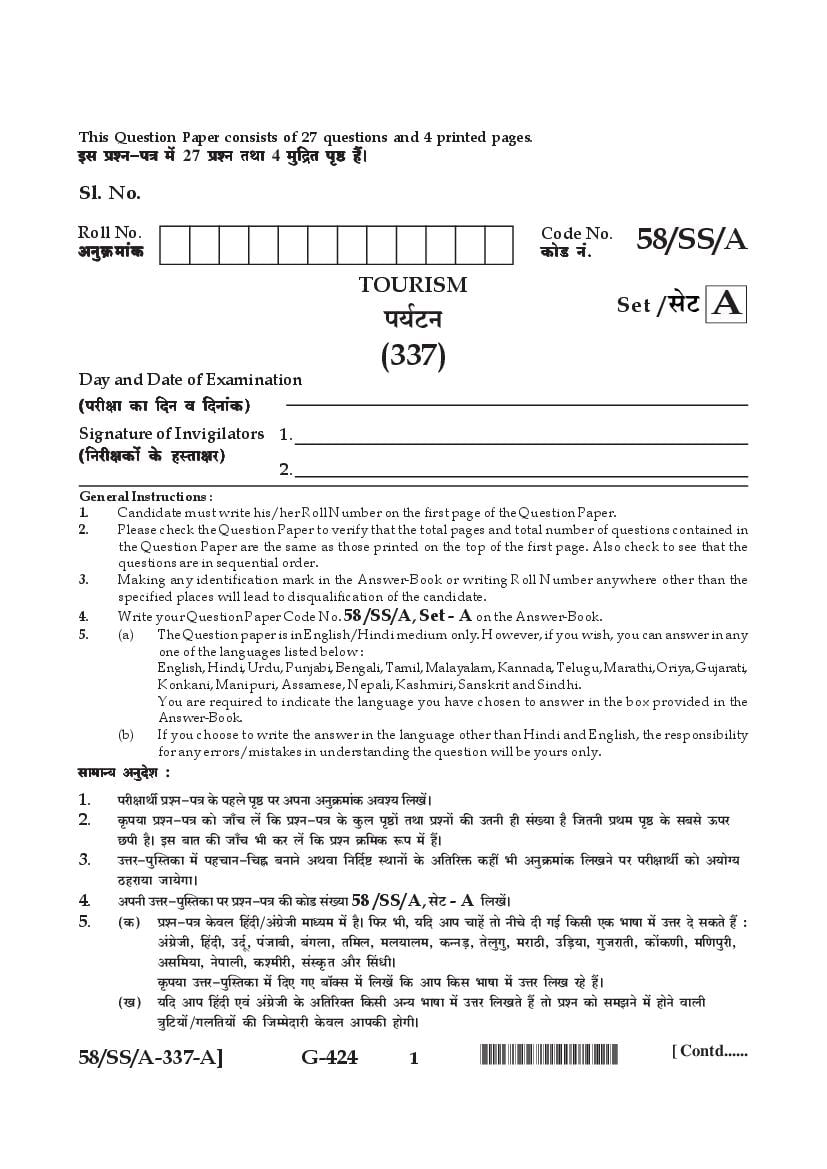
Page 1
Bg àíZ-nÌ _| 27 àíZ VWm 4 ‘w{ÐV n¥ð> h¢&
Sl. No.
Roll No.
AZw H « $ _m§ H $
Code No.
H$mo S > Z§ . 58/SS/A
Set / go Q > A
Day and Date of Examination
(narjm H$m {XZ d {XZm§ H $)
Signature of Invigilators 1.
({ZarjH$m| Ho $ hñVmja)
2.
General Instructions :
1. Candidate must write his/her Roll Number on the first page of the Question Paper.
2. Please check the Question Paper to verify that the total pages and total number of questions contained in
the Question Paper are the same as those printed on the top of the first page. Also check to see that the
questions are in sequential order.
3. Making any identification mark in the Answer-Book or writing Roll Number anywhere other than the
specified places will lead to disqualification of the candidate.
4. Write your Question Paper Code No. 58 /SS/A, Set - A on the Answer-Book.
5. (a) The Question paper is in English/Hindi medium only. However, if you wish, you can answer in any
one of the languages listed below :
English, Hindi, Urdu, Punjabi, Bengali, Tamil, Malayalam, Kannada, Telugu, Marathi, Oriya, Gujarati,
Konkani, Manipuri, Assamese, Nepali, Kashmiri, Sanskrit and Sindhi.
You are required to indicate the language you have chosen to answer in the box provided in the
Answer-Book.
(b) If you choose to write the answer in the language other than Hindi and English, the responsibility
for any errors/mistakes in understanding the question will be yours only.
gm_mÝ` AZwXoe :
1. narjmWu àíZ-nÌ Ho$ nhbo n¥ð> na AnZm AZwH«$‘m§H$ Adí¶ {bI|&
2. H¥$n¶m àíZ-nÌ H$mo Om±M b| {H$ àíZ-nÌ Ho$ Hw$b n¥ð>m| VWm àíZm| H$s CVZr hr g§»¶m h¡ {OVZr àW‘ n¥ð> Ho$ g~go D$na
N>nr h¡& Bg ~mV H$s Om±M ^r H$a b| {H$ àíZ H«${‘H$ ê$n ‘| h¢&
3. CÎma-nwpñVH$m ‘| nhMmZ-{M• ~ZmZo AWdm {Z{X©ï> ñWmZm| Ho$ A{V[aº$ H$ht ^r AZwH«$‘m§H$ {bIZo na narjmWu H$mo A¶mo½¶
R>ham¶m Om¶oJm&
4. AnZr CÎma-nwpñVH$m na àíZ-nÌ H$s H$moS> g§»¶m 58 /SS/A, goQ> - A {bI|&
5. (H$) àíZ-nÌ Ho$db qhXr/A§J«oOr ‘mܶ‘ ‘| h¡& {’$a ^r, ¶{X Amn Mmh| Vmo ZrMo Xr JB© {H$gr EH$ ^mfm ‘| CÎma Xo gH$Vo h¢ :
A§J«oOr, qhXr, CXÿ©, n§Om~r, ~§Jbm, V{‘b, ‘b¶mb‘, H$ÝZ‹S>, VobwJw, ‘amR>r, C{‹S>¶m, JwOamVr, H$m|H$Ur, ‘{Unwar,
Ag{‘¶m, Zonmbr, H$í‘rar, g§ñH¥$V Am¡a qgYr&
H¥$n¶m CÎma-nwpñVH$m ‘| {XE JE ~m°³g ‘| {bI| {H$ Amn {H$g ^mfm ‘| CÎma {bI aho h¢&
(I) ¶{X Amn qhXr Ed§ A§J«oOr Ho$ A{V[a³V {H$gr Aݶ ^mfm ‘| CÎma {bIVo h¢ Vmo àíZ H$mo g‘PZo ‘| hmoZo dmbr
Ìw{Q>¶m|/Jb{V¶m| H$s {Oå‘oXmar Ho$db AmnH$s hmoJr&
58/SS/A-337-A] G-424 1 [ Contd......
Page 2
g_` : 3 KÊQ>o] [nyUmªH$ : 100
Note : (i) This Question Paper consists of two sections, Viz., 'A' and 'B'
(ii) All questions froms Section 'A' are to be attempted.
(iii) Section 'B' has two options. Candidates are required to attempt questions from one
option only.
{ZX}e : (i) Bg àíZ - nÌ ‘| Xmo I§S> h¢ - IÊS> - "A' VWm IÊS> - "~'&
(ii) IÊS> - " A' ‘| {XE JE g^r àíZ A{Zdm¶© h¢&
(iii) IÊS> - "~' ‘| Xmo {dH$ën h¢& narjm{W©¶m| H$mo Ho$db EH$ {dH$ën Ho$ hr àíZm| Ho$ CÎma XoZo h¢&
Section - A / IÊS>-A
1. Write the four noble truths of Buddhist Philosophy. [4×½=2]
~m¡ÜX Xe©Z Ho$ Mma ‘hmZ g˶m| H$mo {b{IE&
2. Mention any two types of managerial skills. [2×1=2]
à~§YH$ Ho$ {H$Ýht Xmo àH$ma H$m¡ebm| H$m CëboI H$s{OE&
3. Explain the role played by the water transport in the development of tourism.[2]
n¶©Q>Z Ho$ {dH$mg ‘| Ob n[adhZ Ûmam {Z^mB© JB© ^y{‘H$m H$mo ñnï> H$s{OE&
4. Explain the importance of Trekking route map for tourists. [2]
n¶©Q>Zmo Ho$ {bE Q´>oqH$J ‘mJ© ‘mZ{MÌ H$m ‘hËd ñnï> H$s{OE&
5. Explain the concept of 'culture'. [2]
"g§ñH¥${V' H$s AdYmaUm H$mo ñnï> H$s{OE&
6. Name the most important religious monument for the religious as well as for
secular tourist in Kashmir. Explain its significance. [1+1=2]
H$í‘ra ‘| pñWV g~go A{YH$ ‘hËdnyU© Ym{‘©H$ B‘maV H$m Zm‘ {b{IE Omo Ym{‘©H$ bmoJm| Ho$ gmW Y‘© {Zn}j
n¶©Q>H$m| Ho$ {bE ‘hËdnyU© h¡& CgH$s gmW©H$Vm ñnï> H$s{OE&
7. Why has 'adventure tourism' been gaining popularity in the recent times in India?
Explain. [2]
^maV ‘| dV©‘mZ g‘¶ ‘| "gmh{gH$ n¶©Q>Z' ³¶m| bmoH${à¶Vm àmá H$a ahm h¡? ñnï> H$s{OE&
8. Explain the meaning of tapping external manpower sources. [2]
~mhar ‘mZd e{³V gmYZm| Ho$ XmohZ H$m AW© ñnï> H$s{OE&
58/SS/A-337-A] G-424 2 [ Contd......
Page 3
the manager his or her fullest potential". Support the statement. [2]
à~§YH$s¶ {dH$mg H$m¶©H«$‘ {H$gr à~§YH$ H$s nyar j‘Vm H$mo à{e{jV Am¡a {dH${gV H$aZo H$m XrK© H$mbrZ
à¶mg h¡& Bg H$WZ H$mo nw{ï> H$s{OE&
10. Write any four characteristics of 'folk music'. [4×1=4]
"bmoH$ g§JrV' H$s H$moB© Mma& {deofVmE§ {b{IE&
11. Describe the importance of Darghas as the tourist attraction irrespective of religion
and cultural differences. [4]
Y‘© Am¡a g§ñH¥${V H$s {^ÝZVmAm| Ho$ ~mdOyX XaJmAmo| H$m n¶©Q>H$m| Ho$ AmH$f©U H$s ‘hÎmm H$m dU©Z H$s{OE&
12. Describe the main features each of Bharatpur and Kumarakom Bird Sanctuaries.
^aVnwa Am¡a Hw$‘maH$‘ njr {dhmam| H$s ‘w»¶ - ‘w»¶ {deofVmAm| H$m dU©Z H$s{OE& [2+2=4]
13. Explain any two features each of "Lai Haraoba' and 'Garba' folk dances.[2+2=4]
"bmB© hamAmo~m' Am¡a "Ja~m' bmoH$ Z¥Ë¶m| {H$ {H$Ýht Xmo-Xmo {deofVmAm| H$s ì¶m»¶m H$s{OE&
14. How are festivals related to sikhs and christians serve as tourist attractions? Explain.[2+2=4]
{gI Am¡a B©gmB¶m| go g§~§{YV CËgd {H$g àH$ma n¶©Q>Z AmH$f©Um| Ho$ ê$n ‘| H$m‘ H$aVo h¢? ñnï> H$s{OE&
15. Distinguish between oral and written communication stating four points of
distinctions. [4×1=4]
Mma {~ÝXþ XoVo hþE, ‘m¡{IH$ g§àofU Am¡a {b{IV g§àofU ‘| A§Îma ñnï> H$s{OE&
16. Explain with examples any four negative socio-cultural impact of tourism
particularly at the destination places. [4×1=4]
{deofH$a J§Vì¶ ñWmZm| na {H$Ýht Mma ZH$mamË‘H$ gm‘m{OH$ - gm§ñH¥${VH$ à^mdm| H$mo CXmhaUm| g{hV ñnï> H$s{OE&
17. Describe with examples the significant role of 'Geography' in enhancing travel
and tourism at Global Level. [6×1=6]
{díd ñVa na ¶mÌm Am¡a n¶©Q>Z H$s A{^d¥pÜX ‘| ^yJmob H$s ‘hËdnyU© ^y{‘H$m H$m CXmhaUm| g{hV dU©Z H$s{OE&
18. Explain any six important positive political impacts on tourism particularly at
the destination places. [6×1=6]
n¶©Q>Z na {H$Ýht N> ‘hËdnyU© gH$mamË‘H$ amOZr{VH$ à^mdm| H$mo {deofH$a J§Vì¶ ñWmZm| na ñnï> H$s{OE&
19. Highlight the contribution of different rulers of the Mauryan period in the field
of architecture. [6]
‘m¡¶© H$mb Ho$ {d{^Þ emgH$m| Ho$ dmñVwH$bm Ho$ joÌ ‘| ¶moJXmZ H$mo COmJa H$s{OE&
20. How does physiography of India promote the tourism activities? Explain. [6]
^maV H$m ^m¡{VH$ ñdê$n n¶©Q>Z H$s J{V{d{Y¶m| H$mo {H$g àH$ma àmoÝZV H$aVm h¡? ì¶m»¶m H$s{OE&
21. How to face an interview? Explain any six valid points. [6×1=6]
gmjmËH$ma H$m H¡$go gm‘Zm {H$¶m OmE? {H$Ýht N>: VH©$g§JV {~ÝXþAm| H$s ì¶m»¶m H$s{OE&
58/SS/A-337-A] G-424 3 [ Contd......
Page 4
suitable examples. [6×1=6]
^maV ‘| àmá AëH$mohb a{hV nXmW© {H$g àH$ma n¶©Q>H$m| H$mo à^m{dV H$aVo h¢? Cn¶w³V CXmhaUm| g{hV ñnï> H$s{OE&
23. "The tourism is directly linked with a number of factors that are associated with tourists
throughout the world". Support the statement with suitable examples. [6×1=6]
""n¶©Q>Z H$m AZoH$ KQ>H$m| Ho$ gmW grYm g§~§Y h¡ Omo Xþ{Z¶m§ ^a ‘| n¶©Q>H$m| go Ow‹S>| h¢&'' Bg H$WZ H$s nw{ï>
Cn¶w³V CXmhaUm| g{hV H$s{OE&
Section - B/IÊS>-~
Option - I/{dH$ën-I
(Travel and Tour Operation Business)
(¶mÌm Ed§ n¶© Q > Z g§ M mbZ ì¶mnma)
24. Mention any four features of Online Travel Agency. [4×½=2]
Am°ZbmB©Z ¶mÌm - EOo§gr H$s {H$Ýht Mma {deofVmAm| H$m CëboI H$s{OE&
25. Describe the need for travel insurance. [2]
¶mÌm - ~r‘m H$s Amdí¶H$Vm H$m dU©Z H$s{OE&
26. Explain any four types of package tours based on operation and types of services.[4×1=4]
g§MmbZ Am¡a godmAm| Ho$ àH$mam| na AmYm[aV {H$Ýht Mma àH$ma Ho$ n¶©Q>Z n¡H$o Om| H$s CXmhaUm| g{hV ì¶m»¶m H$s{OE&
27. Explain with examples any four types of a package tour itinerary. [4×1=4]
n¶©Q>Z n¡Ho$O Ho$ ¶mÌm {dH$aUm| Ho$ {H$Ýht Mma àH$mam| H$s CXmhaUm| g{hV ì¶m»¶m H$s{OE&
Option - II/{dH$ën-II
(Hospitality Management)
(A{V{W gËH$ma à~§ Y Z)
24. Mention any two features each of I star and 5 star hotels. [1+1=2]
EH$ {gVmam Am¡a nm±M {gVmam hmoQ>bm| H$s {H$Ýht Xmo-Xmo {deofVmAm| H$m CëboI H$s{OE&
25. Mention any four expectations during arrival of guests. [4×½=2]
A{V{W¶m| Ho$ AmJ‘Z Ho$ g‘¶ A{V{W¶m| H$s {H$Ýht Mma AnojmAm| H$m CëboI H$s{OE&
26. Analyse the role of 'Front Office Department' of hotels in providing accommodation.[4]
ahZo H$s ì¶dñWm àXmZ H$aZo ‘| hmoQ>bm| Ho$ "‘w»¶ H$m¶m©b¶ {d^mJ' H$s ^y{‘H$m H$m {díbofU H$s{OE&
27. ''Basically if there is no engineering department, there is no hotel". Support the
statement with suitable examples. [4]
""gmYmaUV: ¶{X B§Or{Z¶[a¨J {d^mJ Zht Vmo dhm± hmoQ>b ^r Zht&'' Cn¶w³V CXmhaUm| g{hV Bg H$WZ H$s nw{ï>
H$s{OE&
58/SS/A-337-A] G-424 4
Document Details
| Board / Org | NIOS |
| Exam | NIOS Class 12 |
| Type | Question Paper |
| Pages | 4 |
| Updated | 30 Apr 2026 |