ICSE Class 10 Question Paper 2025 Biology
Finished viewing? Save it for later —
Download ICSE Class 10 Question Paper 2025 Biology (PDF · 16 pages)About ICSE Class 10 Question Paper 2025 Biology
ICSE Class 10 Question Paper 2025 Biology is available here for free download. Published by CISCE for Class 10, this question paper can be viewed online or downloaded as a PDF (16 pages). Candidates preparing for Class 10 can use ICSE Class 10 Question Paper 2025 Biology to understand the exam pattern, the type of questions asked, and the overall difficulty level.
Frequently Asked Questions
How can I download ICSE Class 10 Question Paper 2025 Biology?
Open this page and click the Download button to save ICSE Class 10 Question Paper 2025 Biology as a PDF. It is completely free on AglaSem Docs.
Is ICSE Class 10 Question Paper 2025 Biology free to download?
Yes. ICSE Class 10 Question Paper 2025 Biology can be viewed online and downloaded as a PDF free of cost on AglaSem Docs.
How many pages does ICSE Class 10 Question Paper 2025 Biology have?
ICSE Class 10 Question Paper 2025 Biology contains 16 pages, which you can read online or download together as a single PDF.
Where can I find more Class 10 study material?
You can find more Class 10 question papers, sample papers, syllabus, and answer keys on AglaSem Docs.
ICSE Class 10 Question Paper 2025 Biology – Text
Read the full text of this question paper below — useful to quickly search, copy and reference the content online without downloading the PDF.
📄 View text version (16 pages)
Page 1
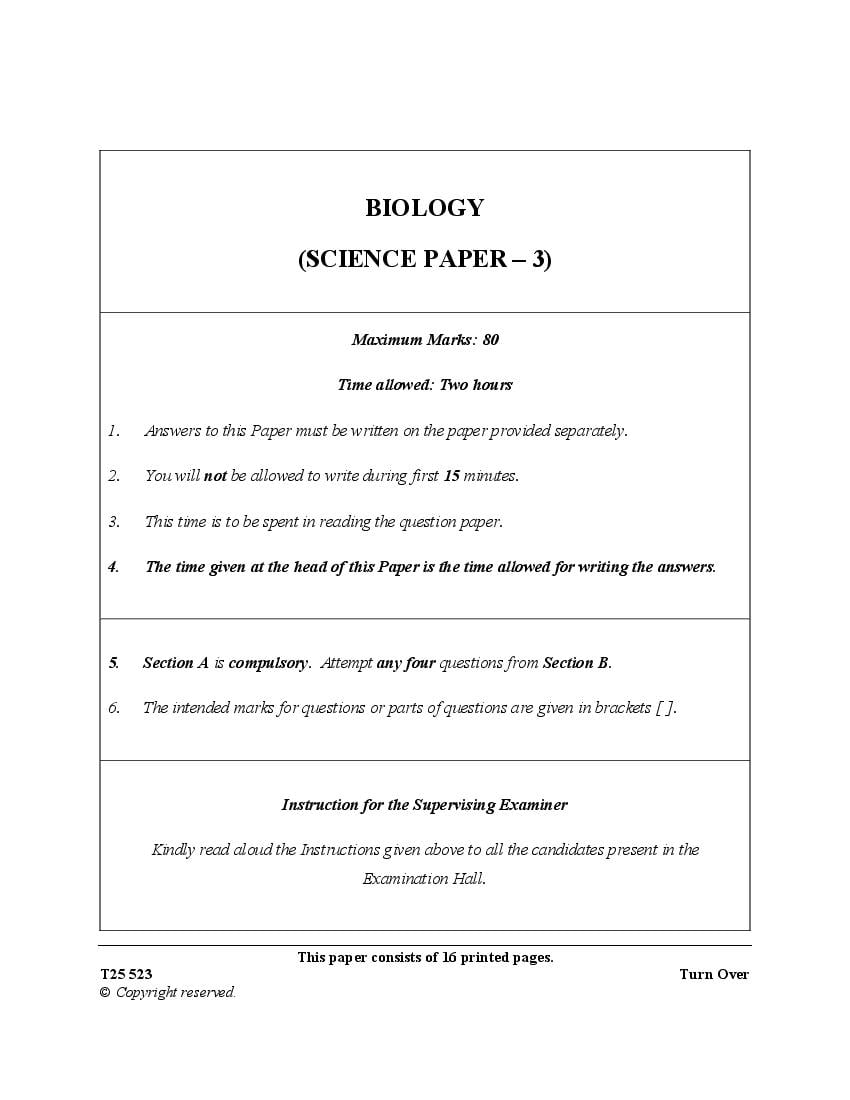
(SCIENCE PAPER – 3)
Maximum Marks: 80
Time allowed: Two hours
1. Answers to this Paper must be written on the paper provided separately.
2. You will not be allowed to write during first 15 minutes.
3. This time is to be spent in reading the question paper.
4. The time given at the head of this Paper is the time allowed for writing the answers.
5. Section A is compulsory. Attempt any four questions from Section B.
6. The intended marks for questions or parts of questions are given in brackets [ ].
Instruction for the Supervising Examiner
Kindly read aloud the Instructions given above to all the candidates present in the
Examination Hall.
This paper consists of 16 printed pages.
T25 523 Turn Over
© Copyright reserved.
Page 2
(Attempt all questions from this Section.)
Question 1
Select the correct answers to the questions from the given options. [15]
(Do not copy the questions, write the correct answer only).
(i) The number of live births per thousand people per year is called:
(a) Mortality
(b) Population density
(c) Population growth rate
(d) Natality
(ii) The structure that lies at the junction of the choroid and the iris and is itself a
part of the choroid is called:
(a) Ciliary body
(b) Suspensory ligament
(c) Pupil
(d) Lens
(iii) Assertion (A): Seminal vesicles pour an alkaline secretion into the semen as
it passes through the ureter.
Reason (R): The female vagina is acidic and needs to be neutralized for
sperm survival.
(a) (A) is true and (R) is false.
(b) (A) is false and (R) is true.
(c) Both (A) and (R) are true.
(d) Both (A) and (R) are false.
T25 523 2
Page 3
mother is:
(a) Oestrogen
(b) Prolactin
(c) Oxytocin
(d) Progesterone
(v) A scientist wanted to conduct a genetic experiment on mice. He cut the tails of
all the mice and made them reproduce. What will be the phenotype of the
offsprings?
(a) All the offsprings will be tailless.
(b) There will be a mix of tailed and tailless offsprings.
(c) All the offsprings will have tails.
(d) Tail of the offsprings cannot be predicted.
(vi) Assertion (A): A turgid plant cell is in a balanced state.
Reason (R): In a turgid cell, turgor pressure and wall pressure are equal
and in the same direction.
(a) (A) is true and (R) is false.
(b) (A) is false and (R) is true.
(c) Both (A) and (R) are true.
(d) Both (A) and (R) are false.
T25 523 3 Turn Over
Page 4
(a) 10 – 15oC
(b) 60 – 65oC
(c) 40 – 45oC
(d) 25 – 35oC
(viii) Ajay and Vijay are siblings. Ajay can roll his tongue while Vijay cannot.
What is the genotype of their parents?
(a) Both the parents are homozygous dominant.
(b) Both the parents are homozygous recessive.
(c) One parent is homozygous dominant, and the other is homozygous
recessive.
(d) Both the parents are heterozygous dominant.
(ix) Assertion (A): Deficiency of Antidiuretic hormone causes an increase in
urination.
Reason (R): Antidiuretic hormone acts on the kidney to reabsorb water
from the kidney tubules.
(a) (A) is true and (R) is false.
(b) (A) is false and (R) is true.
(c) Both (A) and (R) are true.
(d) Both (A) and (R) are false.
T25 523 4
Page 5
(a) Telophase
(b) Prophase
(c) Metaphase
(d) Anaphase
(xi) Assertion(A): Arachnoid layer helps in speeding up the transmission of
nerve impulses along the axons.
Reason(R): Axon endings at the synapse secrete acetylene.
(a) (A) is true and (R) is false.
(b) (A) is false and (R) is true.
(c) Both (A) and (R) are true.
(d) Both (A) and (R) are false.
(xii) Many nuclear power plants are constructed near water sources. They use water
for cooling their machinery and release it back into the water stream. Identify
the kind of pollution caused.
(a) Radiation pollution
(b) Water pollution
(c) Industrial pollution
(d) Thermal pollution
T25 523 5 Turn Over
Page 6
Owls are nocturnal animals. They are active at night and hunt small animals for
food. Owls have large eyes and can see well at night. This is due to:
(a) Cones and Rhodopsin
(b) Rods and Iodopsin
(c) Rods and Rhodopsin
(d) Cones and Iodopsin
(xiv) Sunil tried to match the tropic movements in plants with the stimulus they
respond to. The tabulation is given below:
Tropism Stimulus
P Thigmotropism Touch
Q Geotropism Water
R Chemotropism Chemicals
S Phototropism Gravity
Identify the correct pair:
(a) P and R
(b) Q and S
(c) R and S
(d) P and S
T25 523 6
Page 7
(a) Simple goitre, under secretion of thyroxine.
(b) Ex-ophthalmic goitre, over secretion of thyroxine.
(c) Simple goitre, over secretion of thyroxine.
(d) Ex-ophthalmic goitre, under secretion of thyroxine.
Question 2
(i) Name the following: [5]
(a) The fully developed part of the ovary containing a mature ovum.
(b) A waxy layer on the upper epidermis of leaves meant to reduce
Transpiration.
(c) The ear ossicle which opens into the oval window of Cochlea.
(d) The physiological process which is the starting point of all food chains.
(e) An insect which is a classic example of natural selection due to industrial
melanism.
T25 523 7 Turn Over
Page 8
diagram and fill in the blanks:
The human heart pumps blood throughout the body. It is the size of a large fist.
The heart is located between the lungs in the thoracic cavity. It has four
chambers. The heart functions all through the lifespan of a person and is
responsible for the survival of the person.
The heart is enclosed by a membrane called (a) ____________. The ventricles
give rise to two large blood vessels called (b) ____________ and
(c) ____________. The flaps of the cuspid valves are kept in position by
(d) ____________. (e) ____________ arteries supply oxygenated blood to the
walls of the heart.
(iii) Arrange the terms in each group in the correct order. Write them in a logical [5]
sequence beginning with the term that is underlined.
(a) Palisade cells, Cuticle, Upper epidermis, Spongy cells.
(b) Hepatic portal vein, Stomach, Hepatic vein, Liver.
(c) Cyton, Dendrites, Synaptic cleft, Axon endings.
(d) Insulin release, High blood sugar, Lowers blood sugar, Stimulates
glucose uptake from blood.
(e) Sperm duct, Seminiferous tubule, Epididymis, Efferent ducts.
T25 523 8
Page 9
Example: The tubules which produce sperms.
Answer: Seminiferous tubules
(a) The canal through which the testes descend down into the scrotum just
before the birth of a male baby.
(b) The part of the brain that regulates the peristaltic movement of the
alimentary canal.
(c) A structure that collects the soundwaves and conducts them through the
external auditory canal.
(d) The point of attachment of two chromatids of a chromosome.
(e) Regulation of the opening and closing of stomata.
(v) Given below is an outline of the human body showing the important endocrine [5]
glands. Match the glands marked (a) to (e) with their correct functions:
Example: (f) – 6. Secretes Testosterone.
Endocrine glands Functions
1. Prepares the body to face stress.
(a)
2. Secretes tropic hormones
(b) 3. Secretes Oestrogens
4. Maintains blood sugar level
5. Regulates basal metabolism
(c)
(d) 6. Secretes Testosterone.
(e)
(f)
T25 523 9 Turn Over
Page 10
(Attempt any four questions from this Section.)
Question 3
(i) Write the overall chemical equation for photosynthesis. [1]
(ii) Ramesh is a farmer who has a vineyard and cultivates grapes. To improve the [2]
shape of the grapes and make them elongated he sprays a particular
phytohormone at the time of fruiting.
(a) Name the phytohormone that Ramesh sprays on the plant at the time of
fruiting.
(b) These grapes are said to be seedless. What is the technical term for the
formation of such fruits?
(iii) Mention the two pairs of nitrogenous bases that are present in a DNA strand [2]
and pair with each other by hydrogen bonds.
(iv) State any two disadvantages of living close to an airport. [2]
(v) Draw a neat, labelled diagram of an animal cell showing Metaphase with four [3]
chromosomes.
T25 523 10
Page 11
(i) What is the structure of DNA as proposed by Watson and Crick? [1]
(ii) Name the white blood cells that: [2]
(a) show phagocytosis
(b) produce antibodies
(iii) Complete the food chain by mentioning the names of the organisms in (c) and (d): [2]
(d) ____________
(a) (b) (c) ____________
(iv) State any two harmful effects of acid rain. [2]
(v) Given below is a picture of a tree. Mention the scientific phenomena occurring [3]
in the parts labelled (a), (b) and (c).
(c)
(b)
(a)
T25 523 11 Turn Over
Page 12
(i) What is Micturition? Explain. [1]
(ii) What are biomedical wastes? Give an example. [2]
(iii) Differentiate between the functions of Urethra and Uterus. [2]
(iv) Rachna is an expert gymnast on the balance beam. She has been vigorously [2]
practising for the Olympic Games. Lately, she has been experiencing dizziness
and losing her balance during the practise sessions.
(a) Which part of the membranous labyrinth is responsible for maintaining
the body balance on the beam?
(b) Which type of balance is maintained by the structure mentioned in (a)?
(v) Draw a neat, labelled diagram to show that oxygen is released during [3]
photosynthesis.
Question 6
(i) Where are Hydathodes located? [1]
(ii) What are Vestigial organs? Give one example of a vestigial structure in the [2]
human mouth.
T25 523 12
Page 13
too. What could be the reason for the pain in his ears? Explain.
(iv) Mr. Sharma is a 76 year old man. His vision was gradually becoming blurred. [2]
He consulted an eye doctor and it was diagnosed as cataract.
(a) Which part of the eye does cataract affect?
(b) Why does the vision become blurred?
(v) Given below is the diagram of a plasmolysed cortical cell of a root. [3]
Copy the diagram and label the following parts in the diagram:
(a) Cytoplasm
(b) Hypertonic solution
(c) Plasma membrane
T25 523 13 Turn Over
Page 14
(i) Define the term Allele. [1]
(ii) In the last century, the human population has increased tremendously. Death [2]
rate has reduced and life expectancy has increased. This rapid growth has
placed significant pressure on resources. Global cooperation is needed for
environmental preservation.
(a) Mention any one reason for reduction in the death rate.
(b) Name any one resource that is under pressure due to population
explosion.
(iii) Mention any two functions of amniotic fluid. [2]
(iv) Expand the following abbreviations: [2]
(a) CFC
(b) CNG
T25 523 14
Page 15
present in coffee which increases the circulation of Adrenaline in the body.
Vineet feels refreshed, alert and focussed.
(a) Name the organ that is stimulated by caffeine which makes Vineet alert
and focussed.
(b) Give the collective term for the protective membranes of the organ
mentioned in (a).
(c) Which part of the autonomic nervous system increases the secretion of
Adrenaline?
Question 8
(i) Explain the term Excretion. [1]
(ii) State the difference between Nephron and Neuron. [2]
(iii) Mention any two objectives of Swachh Bharat Abhiyan. [2]
(iv) Give any two characteristic features of a Cro-Magnon man. [2]
T25 523 15 Turn Over
Page 16
for breeding were: Colour of the fruits and height of the plants. The farmer
initially crosses a homozygous tall plant bearing red fruits (TTRR) with a
dwarf plant bearing yellow fruits (ttrr) and the genotype of all the offsprings
of the F1 generation was TtRr. Next, he crosses two F1 generation plants
(TtRr).
Tall plant with Dwarf plant with
red fruits yellow fruits
(a) Explain the phenotype of the offsprings of the F1 generation obtained
from the initial cross.
(b) Mention the phenotypic ratio of the F2 generation offsprings.
(c) State Mendel’s Law of Independent Assortment.
T25 523 16
Document Details
| Board / Org | CISCE |
| Exam | Class 10 |
| Type | Question Paper |
| Pages | 16 |
| Updated | 24 Sep 2026 |